OBJECTIVE
The aim ofthis defensive driving course is to
enhance your driving skills.
Your theoretical driving knowledge.
Inform you of all project driving rules
3.
Defensive Driving -Agenda
License Talks!!
Statistics
Vehicle Inspection
Occupant Protection
Road Signs
Drugs and Alcohol - Influences
Site Driving Rules and Regulations
Petrol Kiosk Safety
VEHICLE SAFETY
The vehicleand the driver are the only
conditions that we can control. Before
getting into a vehicle, Have a valid
Driving License.
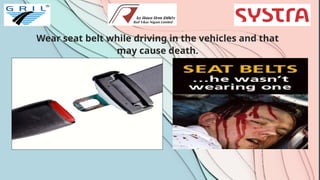
Wear Your Seat Belts before moving off.
Follow the Road Signs and Speed Limits.
Ensure vehicle is inspected before
entering at Work Sites. (Inspection
Sticker)
30 KM/hr
Defensive Driving
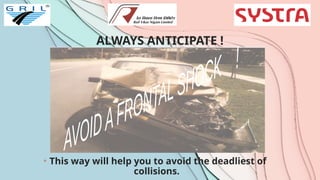
Head-on Collisions
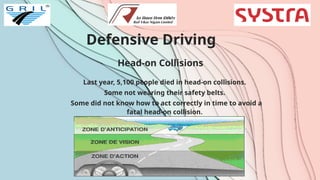
Lastyear, 5,100 people died in head-on collisions.
Some not wearing their safety belts.
Some did not know how to act correctly in time to avoid a
fatal head-on collision.
Defensive Driving
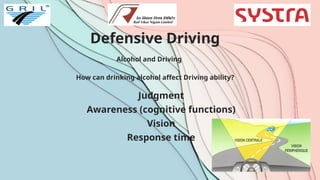
Alcohol andDriving
How can drinking alcohol affect Driving ability?
Judgment
Awareness (cognitive functions)
Vision
Response time
18.
Defensive Driving
The effectof these drugs on driving are:
unpredictable reactions.
high-risk behavior.
aggressive, violent behavior.
visual distortion.
time and distance distortion.
impaired short-term memory.
delayed reaction time.
19.
Defensive Driving
It isYOUR
responsibility to refrain
from driving under the
influence of any drugs
that impair driving skills.
20.
Defensive Driving
Reaction distance
Thisis the number of feet the vehicle will travel between the
time you perceive a hazard until you get your foot on the
brake.
Take the first digit(s) of your speedometer reading and add
it to your total speed.
At 20 mph, your vehicle will travel 22 feet
At 55 mph, 60 feet
At 65 mph, 71 feet
21.
Defensive Driving
Following Distance
Thefaster you drive, the longer it takes you to stop.
The two second Rule
Enough time to stop in case the driver
ahead stops suddenly.
22.
Defensive Driving
Following Distance(Continued)
Two second plus rule
If you are being tailgated by another car add two seconds
from the vehicle ahead of you.
If you are being tailgated by a tractor-trailer or bus, you'll
need six seconds from the vehicle ahead.
If you are following a motorcycle add one second.
Only under perfect conditions should you use the two second
rule. Any other time use two seconds plus.
23.
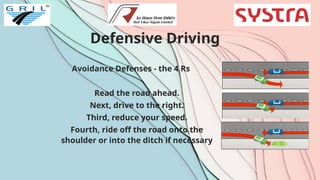
Defensive Driving
Avoidance Defenses- the 4 Rs
Read the road ahead.
Next, drive to the right.
Third, reduce your speed.
Fourth, ride off the road onto the
shoulder or into the ditch if necessary
24.
Defensive Driving
Split seconddecisions
If you can't get off the road and a head-on is
inevitable, use these split-second decisions.
Drive! don't skid off the road
Second, hit something soft, not hard.
Third, hit the fixed object with a glancing blow.
Fourth, hit a movable object at a glancing blow.
Defensive Driving
Intersection safetyformula
To reduce your chances of involvement in an
intersection collision, follow these four steps:
Know
Slow
Show
Go
Defensive Driving
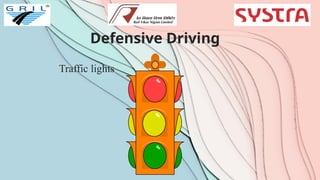
Green light
Drivethrough the intersection or turn if it is
clear and safe to do so
First seconds following a light change to
green are most dangerous. Scan carefully.
Traffic may attempt to continue through
despite the red light.
30.
Defensive Driving
Yellow light
Ifyou are in the intersection or that stopping
would cause a collision, proceed through.
When you are approaching a yellow light:
slow down.
cover your brake.
be prepared to stop.
if traffic is blocking the intersection, do not
enter. May invite a collision.
31.
Defensive Driving
Backing andparking lots
To make backing as easy as possible:
before you get into it, walk around it.
roll down the window & turn off the radio to
hear. .
put your foot on the brake before you shift.
back slowly.
look in the direction you are driving.
ALWAYS REVERSE PARK!
32.
Defensive Driving
When drivingin a parking lot:
drive in the proper direction, in designated
lanes, and within the speed limit.
look for pedestrians.
look out for loose shopping carts.
look for vehicles backing/pulling into
driving lanes.
maneuver slowly
33.
Defensive Driving
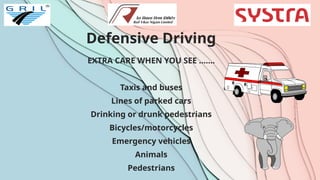
EXTRA CAREWHEN YOU SEE …….
Taxis and buses
Lines of parked cars
Drinking or drunk pedestrians
Bicycles/motorcycles
Emergency vehicles
Animals
Pedestrians
34.
Defensive Driving
INCIDENTS –PETROL REFULING
The phone was placed on the car’s trunk
lid during fueling; it rang, and the
ensuing fire destroyed the car and the
gasoline pump.
Defensive Driving
Four Rulesfor Safe Re-fuelling
1) Turn OFF Engine
2) Don’t SMOKE
3) Don’t use you cell phone – leave it inside the
vehicle or turn it off
4) Don’t re-enter your vehicle during fuelling
Safe drive advice
Aplaned journey and relaxed drive will
give you more time to analyze the road
ahead, (mirrors, junctions, pedestrians,
other road users,).
You will have more time to react correctly,
and you will arrive less tired and your
vehicle will last longer.
40.
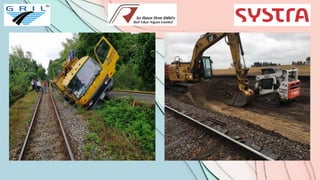
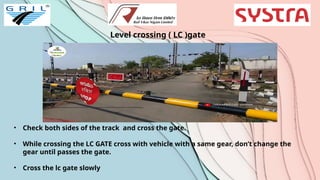
Level crossing (LC )gate
• Check both sides of the track and cross the gate.
• While crossing the LC GATE cross with vehicle with a same gear, don’t change the
gear until passes the gate.
• Cross the lc gate slowly
41.
• When thetrain approach, Stop the movement of the vehicle in rail bed
until train passes
• Don't unload when train is passing .
• While reversing the vehicle always keep vehicle engine towards track side
only.
• Don't move vehicle on edges of the rail bed.
• Always park the vehicle on rail bed parallel to track on other side of rail
bed.
• Night-time stop the vehicle movement and head light when train
approach.
• Don't overtaken on rail bed.
• Earphones and MP3 player are not allowed near running track.
• Always keep vehicle records ,licence and competence certificate in hand.
• After unloading the material completely down the jack in site itself.
•
42.
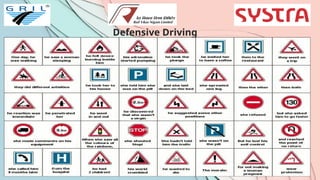
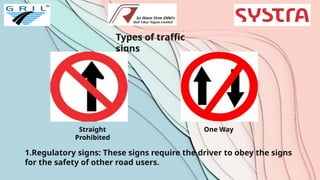
1.Regulatory signs: Thesesigns require the driver to obey the signs
for the safety of other road users.
Types of traffic
signs
Straight
Prohibited
One Way
43.
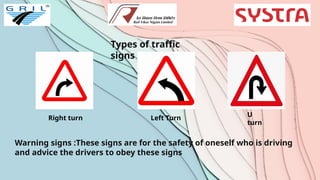
Types of traffic
signs
Rightturn Left Turn
U
turn
Warning signs :These signs are for the safety of oneself who is driving
and advice the drivers to obey these signs
44.
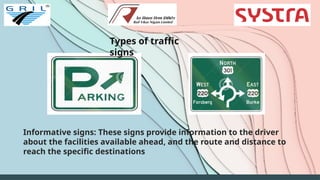
Types of traffic
signs
Informativesigns: These signs provide information to the driver
about the facilities available ahead, and the route and distance to
reach the specific destinations
45.
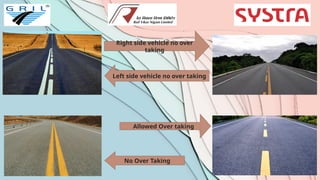
Right side vehicleno over
taking
Allowed Over taking
Left side vehicle no over taking
No Over Taking