1
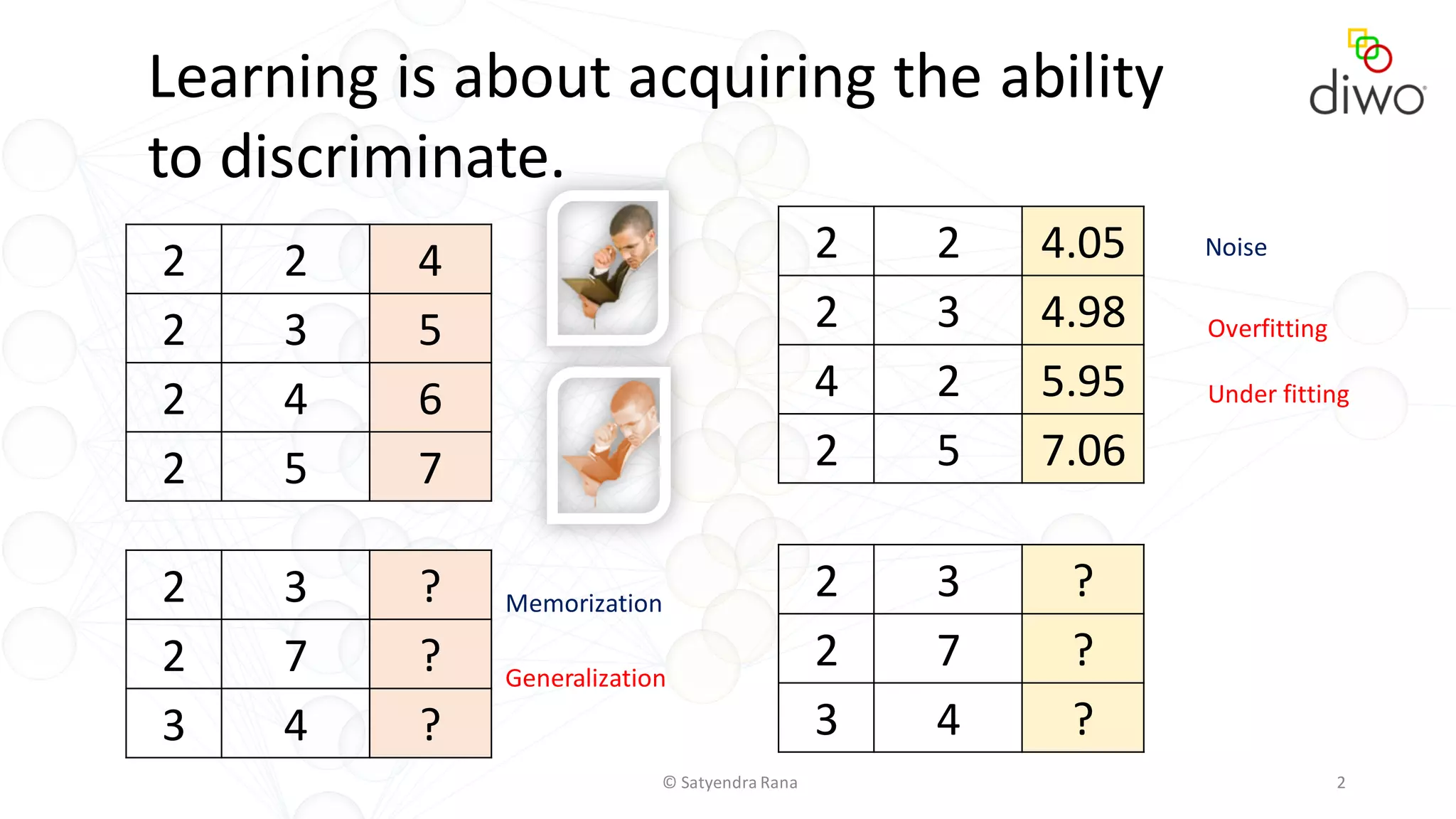
Learning is about acquiring the ability
to discriminate.
Memorization
Overfitting
Under fitting
Generalization
© Satyendra Rana 2
2 2 4
2 3 5
2 4 6
2 5 7
2 3 ?
2 7 ?
3 4 ?
2 2 4.05
2 3 4.98
4 2 5.95
2 5 7.06
2 3 ?
2 7 ?
3 4 ?
Noise
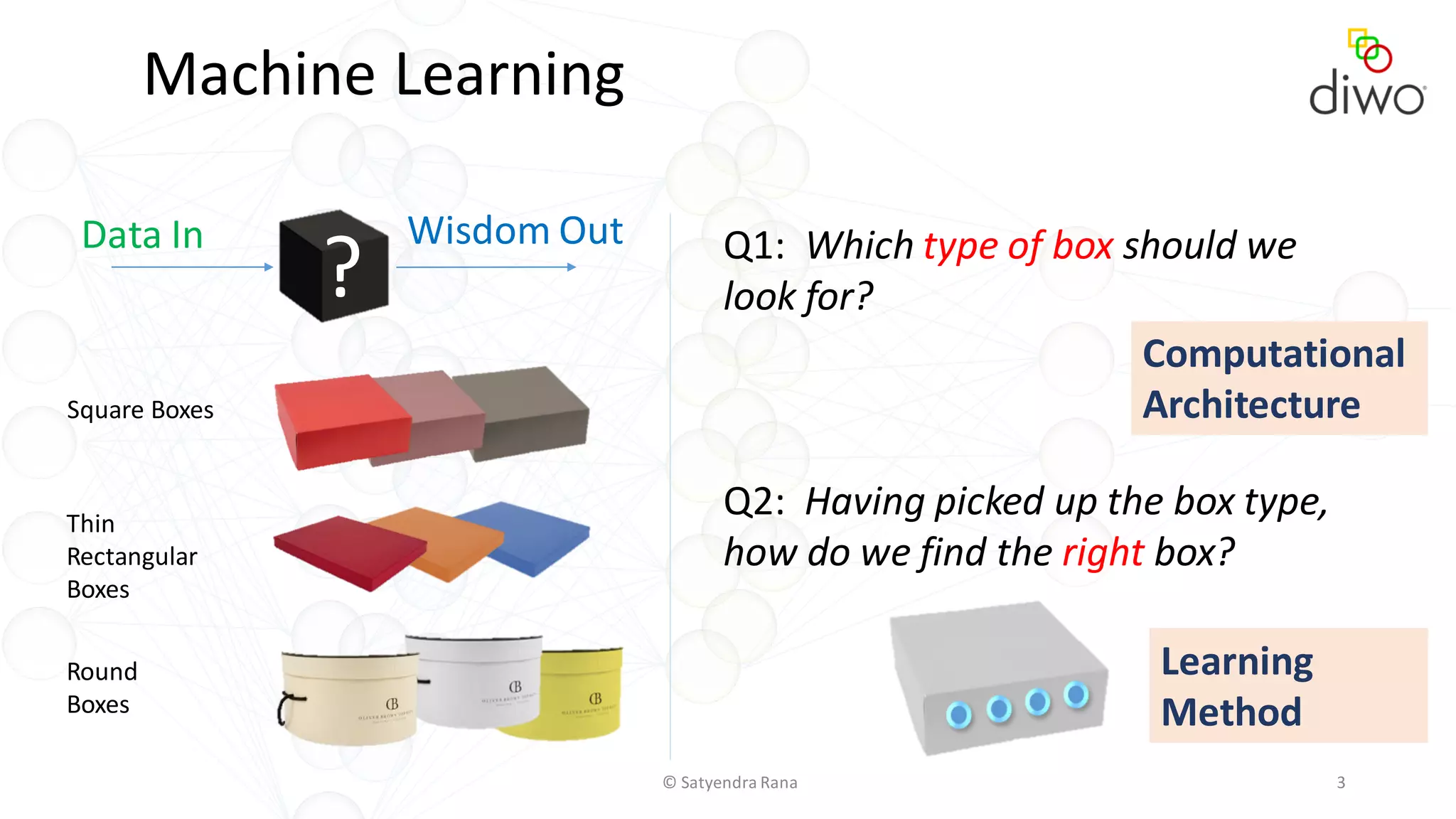
Machine Learning
Data In Wisdom Out
© Satyendra Rana 3
?
Square Boxes
Thin
Rectangular
Boxes
Round
Boxes
Q1: Which type of box should we
look for?
Q2: Having picked up the box type,
how do we find the right box?
Computational
Architecture
Learning
Method
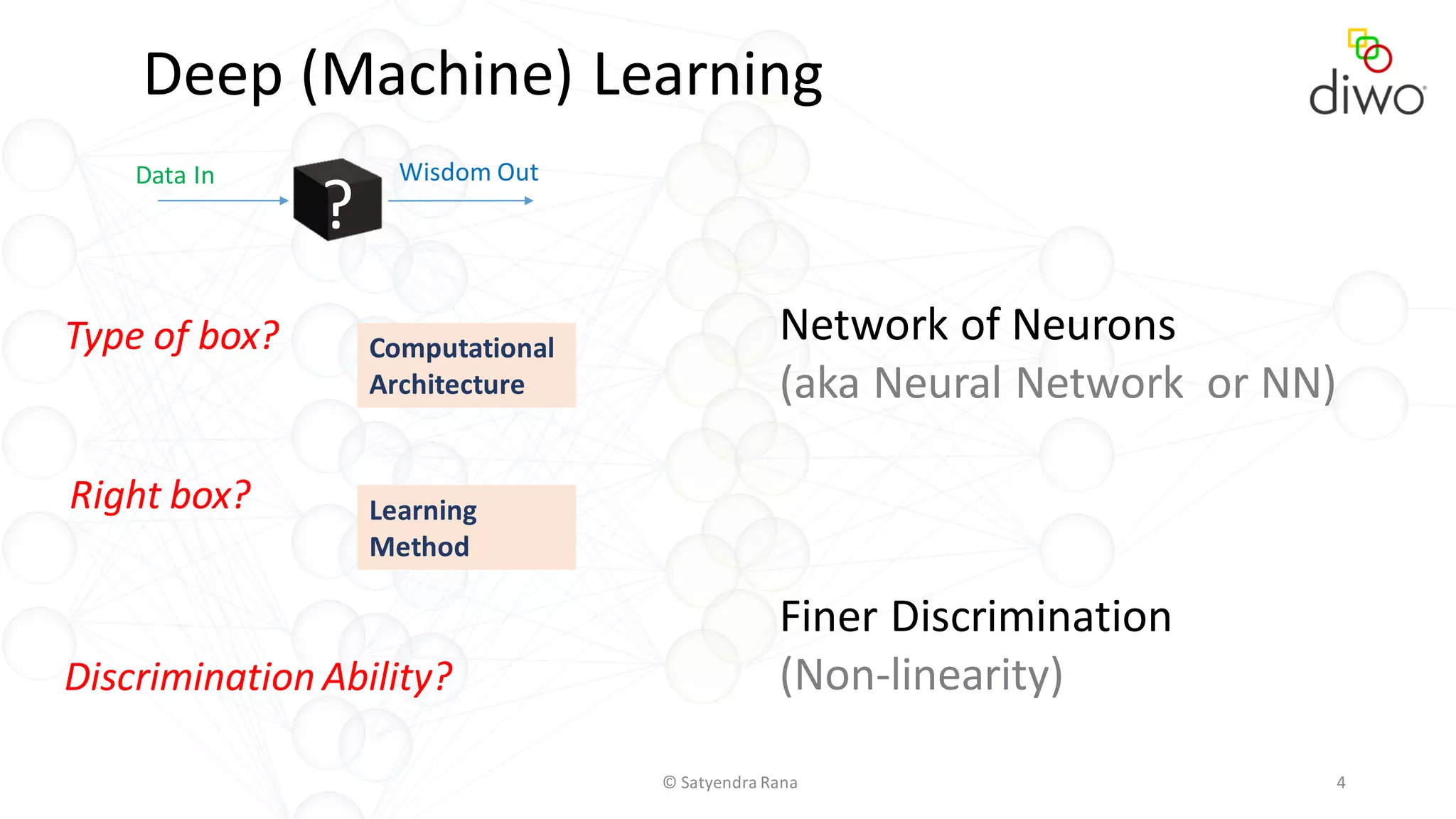
Deep (Machine) Learning
Data In Wisdom Out
© Satyendra Rana 4
?
Type of box?
Right box?
Computational
Architecture
Learning
Method
Discrimination Ability?
Finer Discrimination
(Non-linearity)
Network of Neurons
(aka Neural Network or NN)
© Satyendra Rana 5
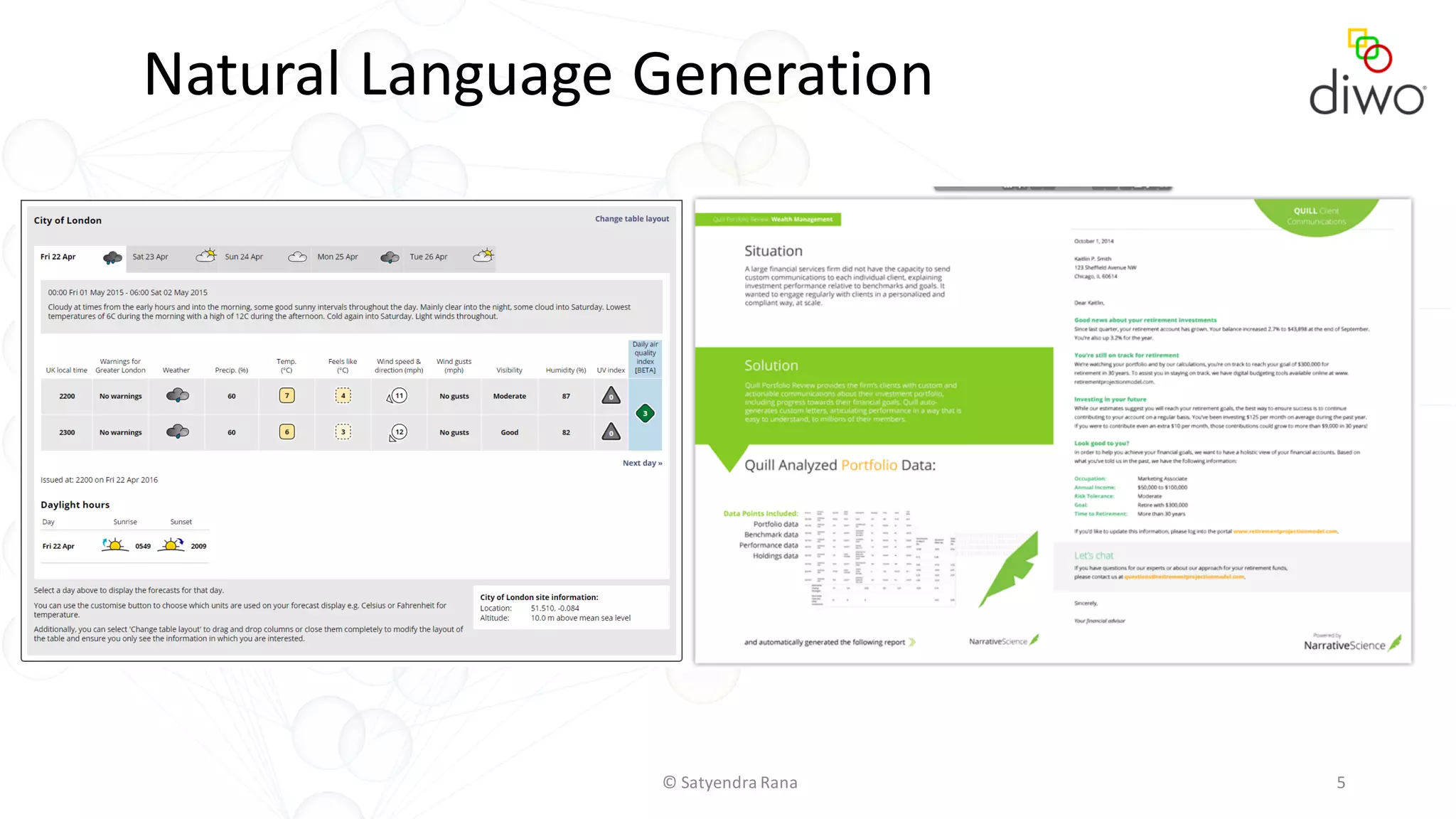
Natural Language Generation
© Satyendra Rana 6
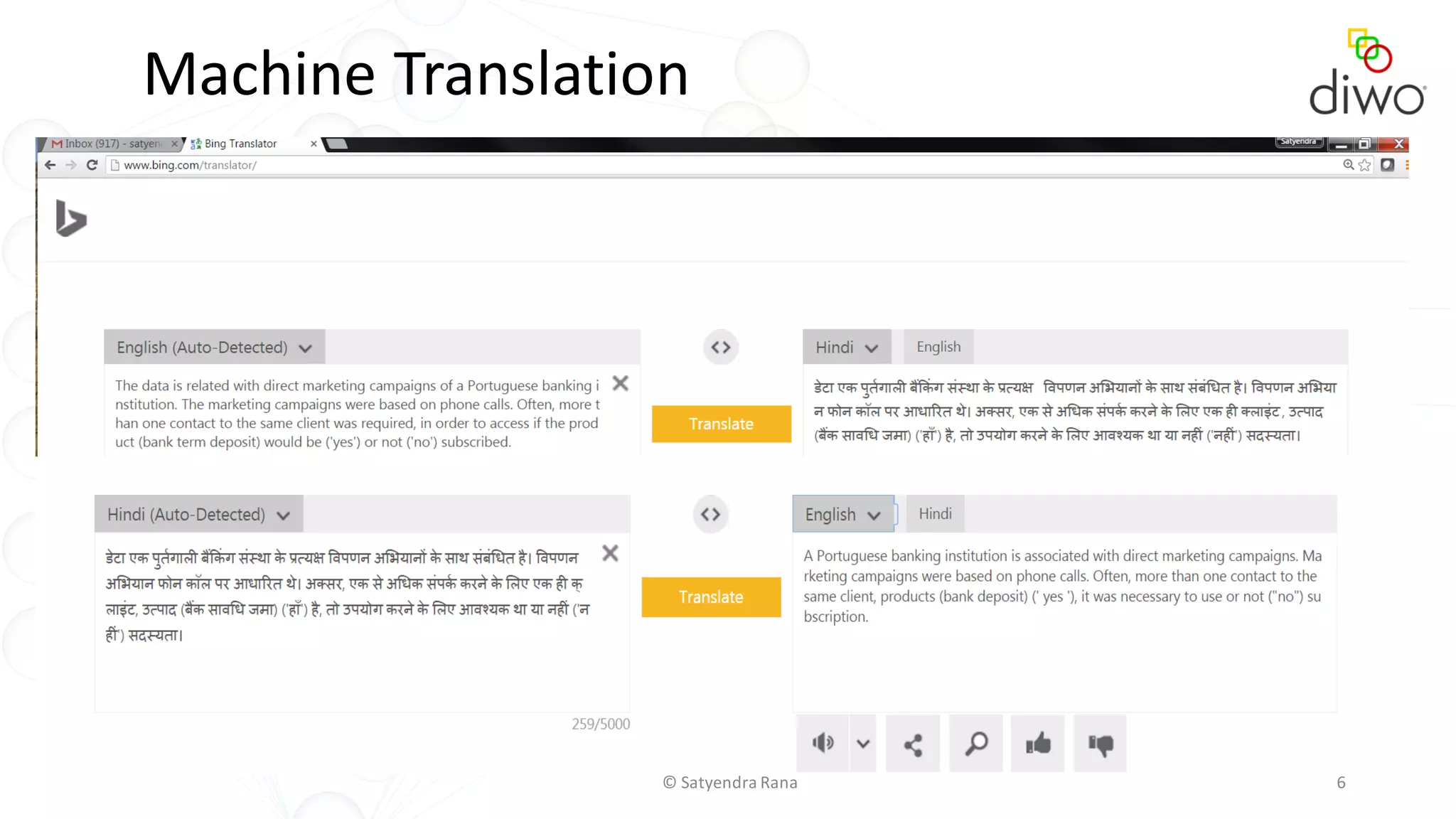
Machine Translation
© Satyendra Rana 7
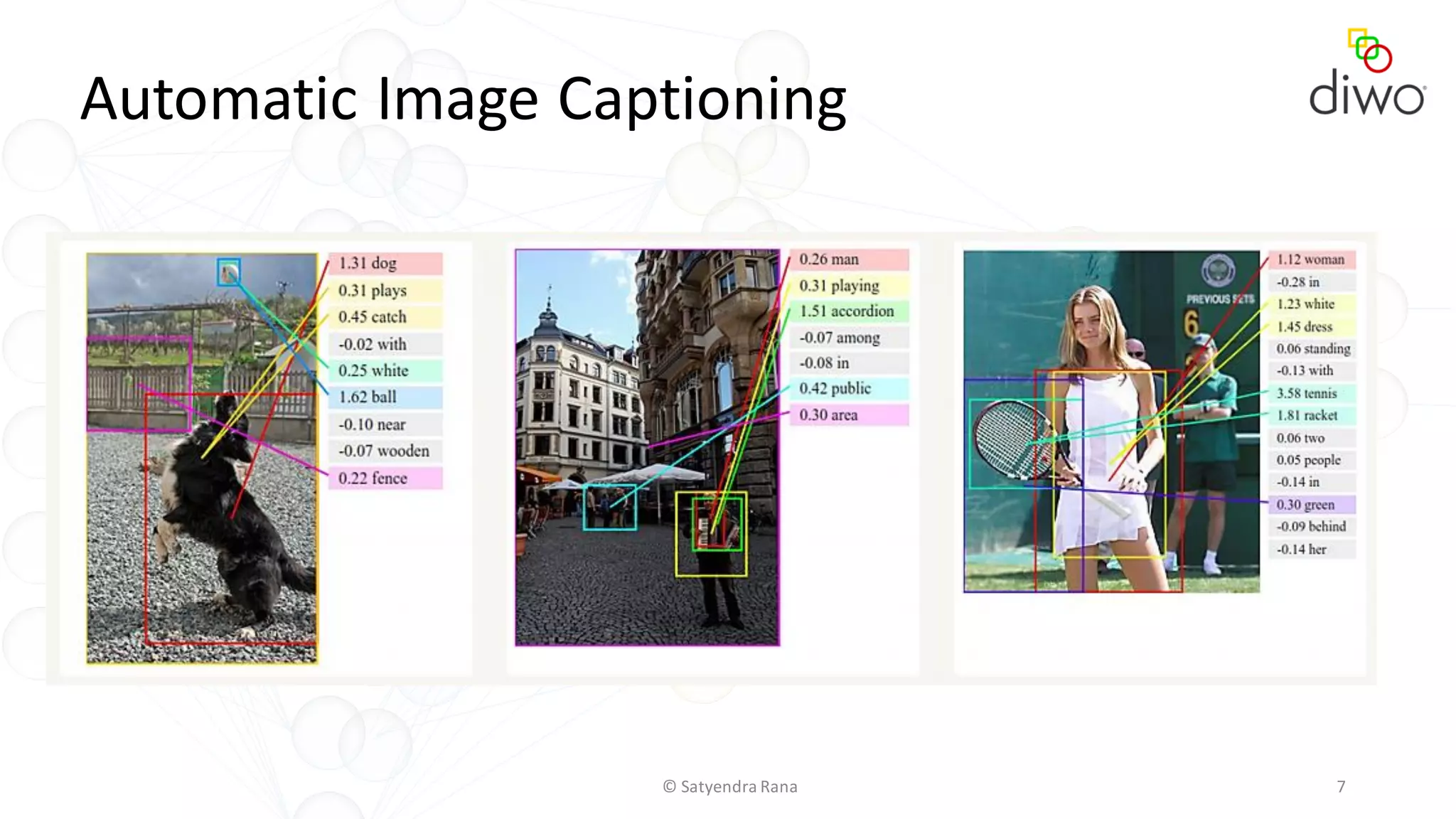
Automatic Image Captioning
© Satyendra Rana 8
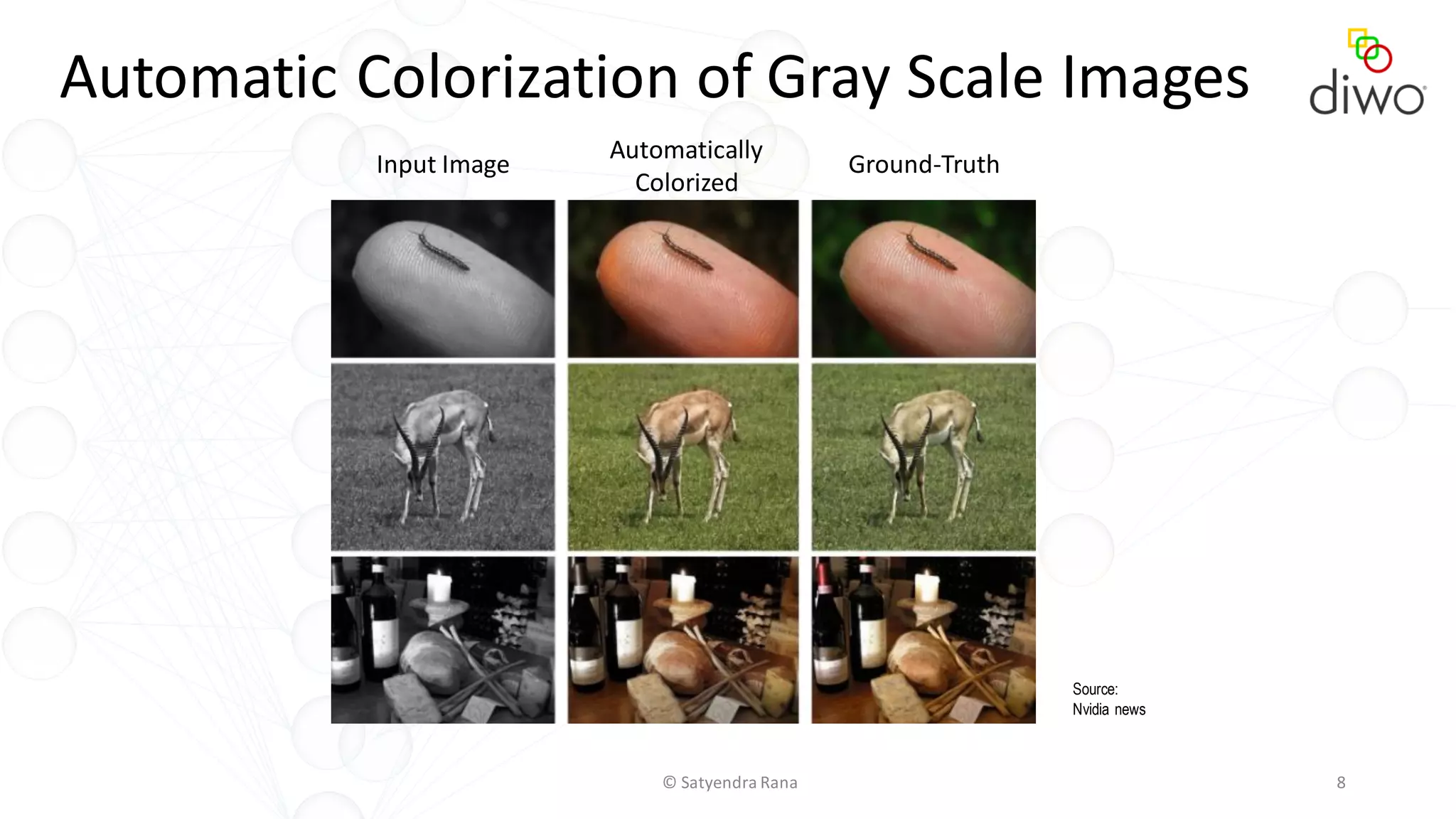
Automatic Colorization of Gray Scale Images
Input Image
Automatically
Colorized
Ground-Truth
Source:
Nvidia news
© Satyendra Rana 9
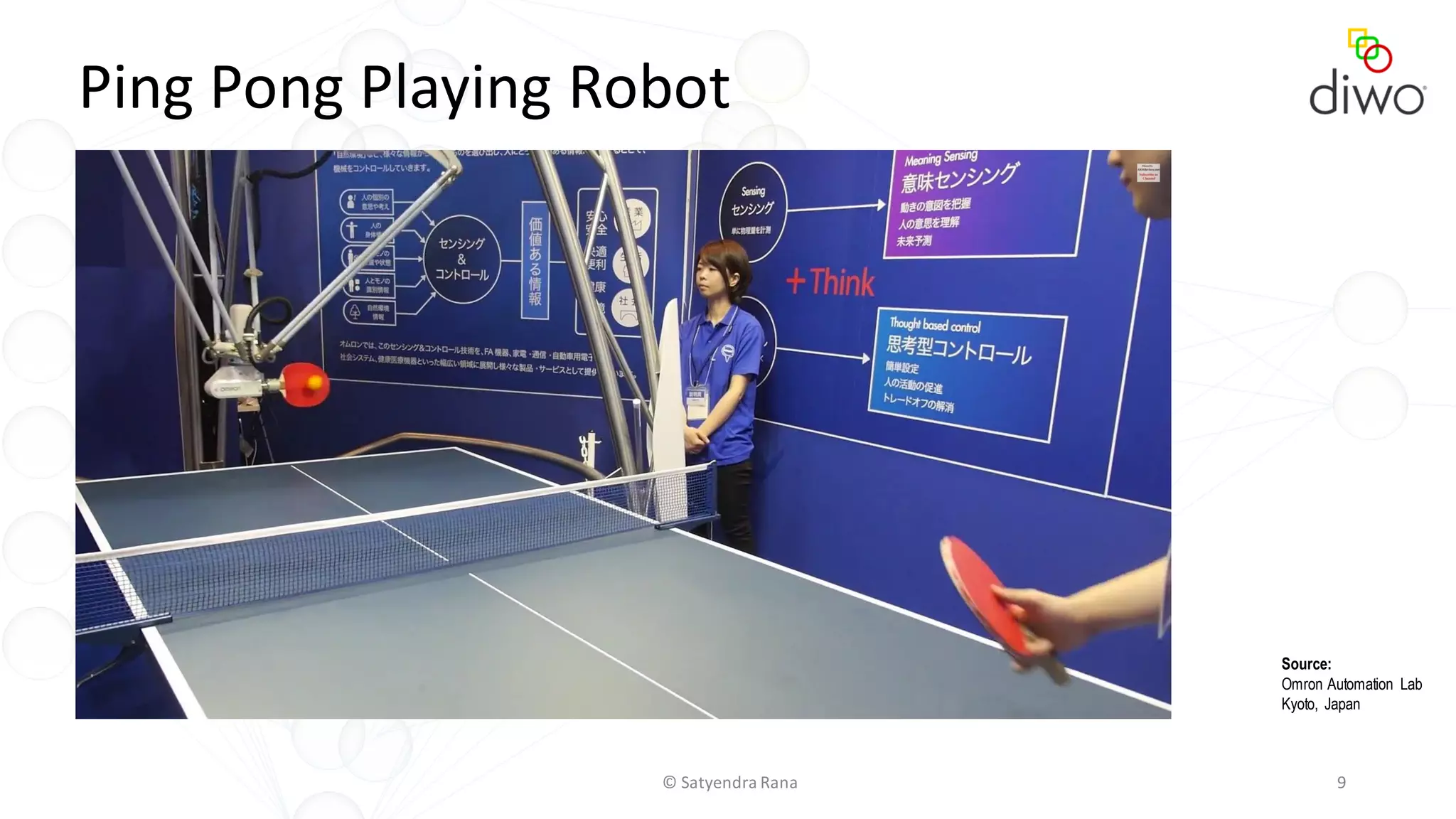
Ping Pong Playing Robot
Source:
Omron Automation Lab
Kyoto, Japan
© Satyendra Rana 10
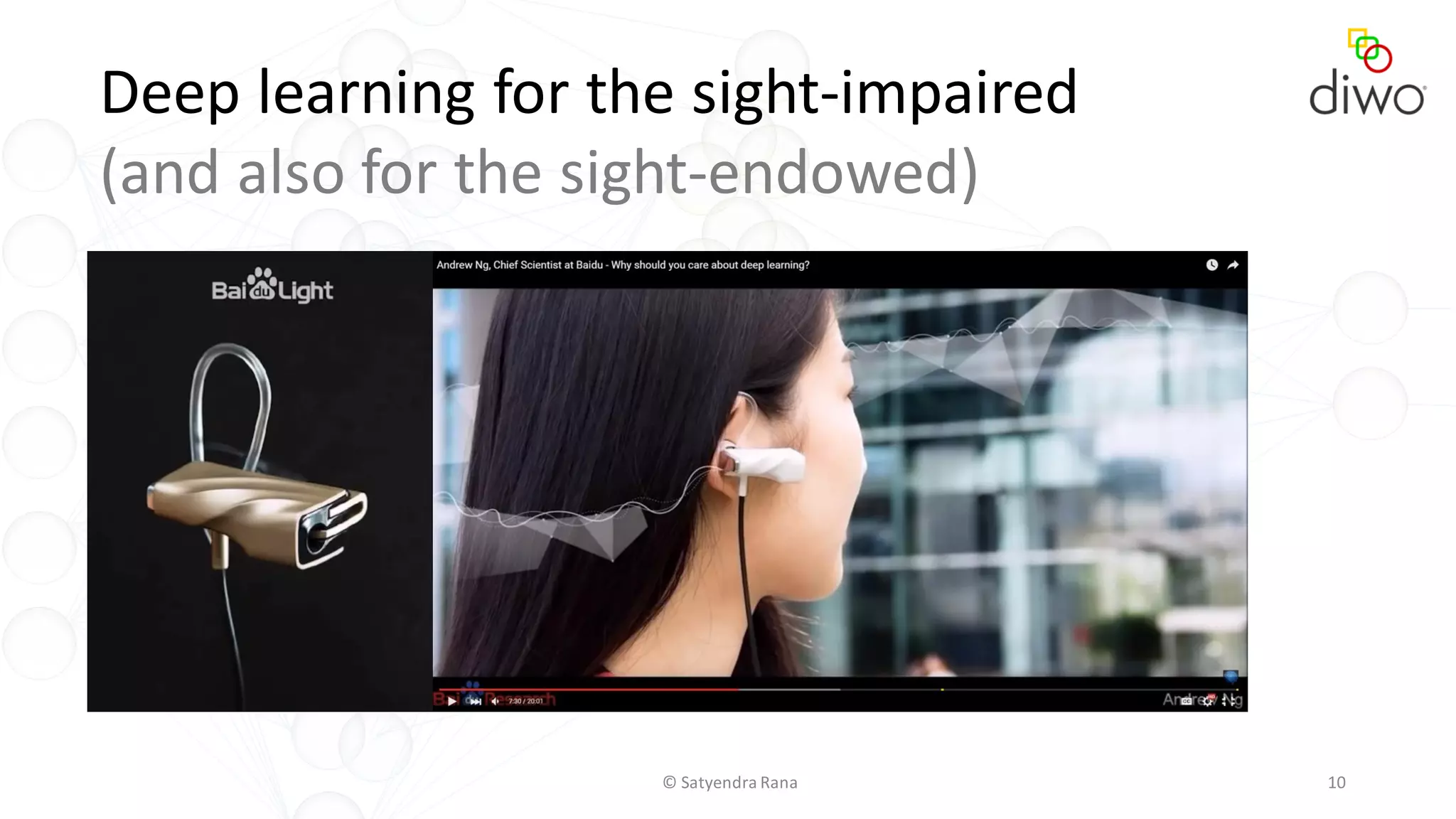
Deep learning for the sight-impaired
(and also for the sight-endowed)
© Satyendra Rana 11
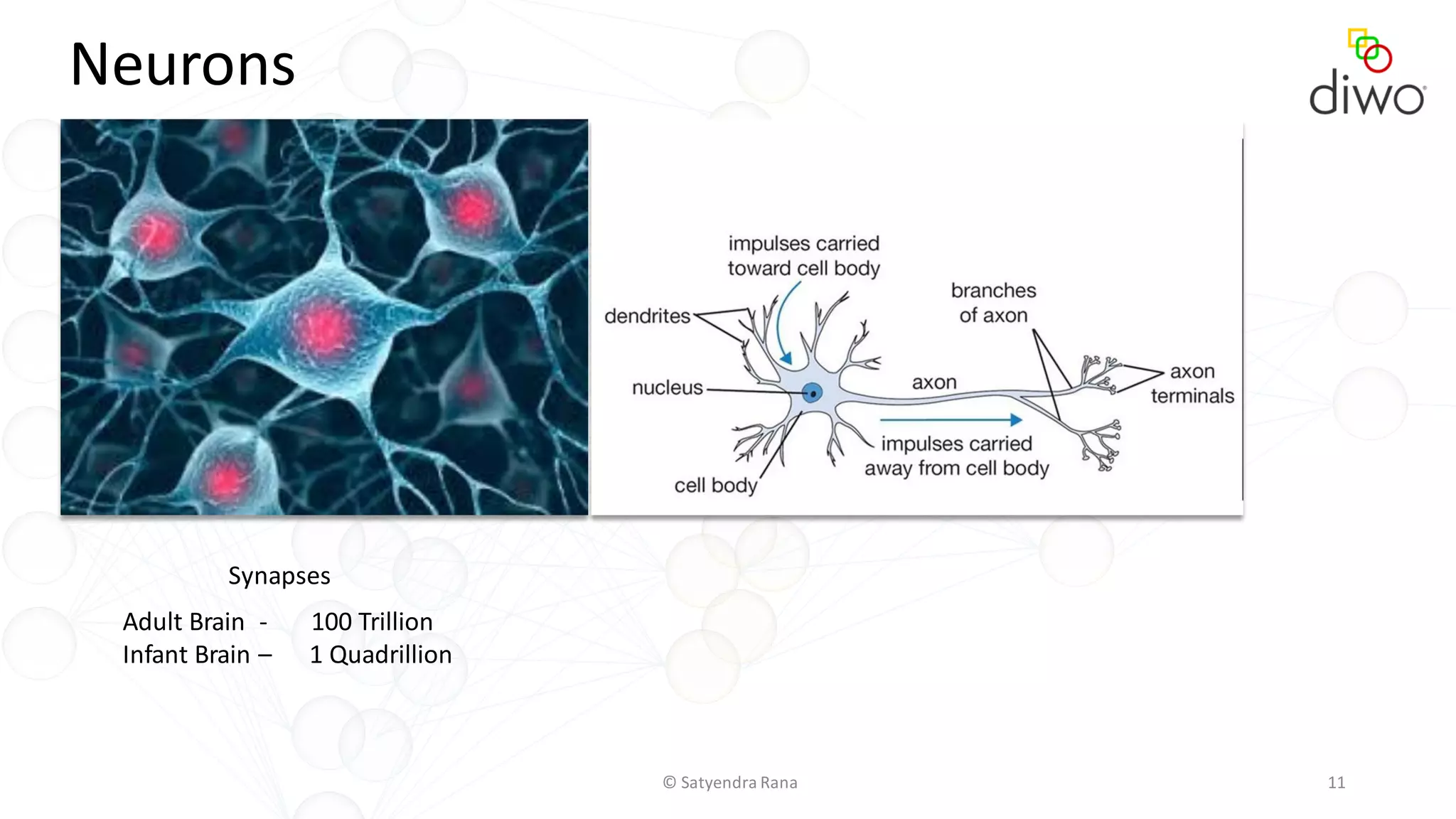
Neurons
Adult Brain - 100 Trillion
Infant Brain – 1 Quadrillion
Synapses
© Satyendra Rana 12
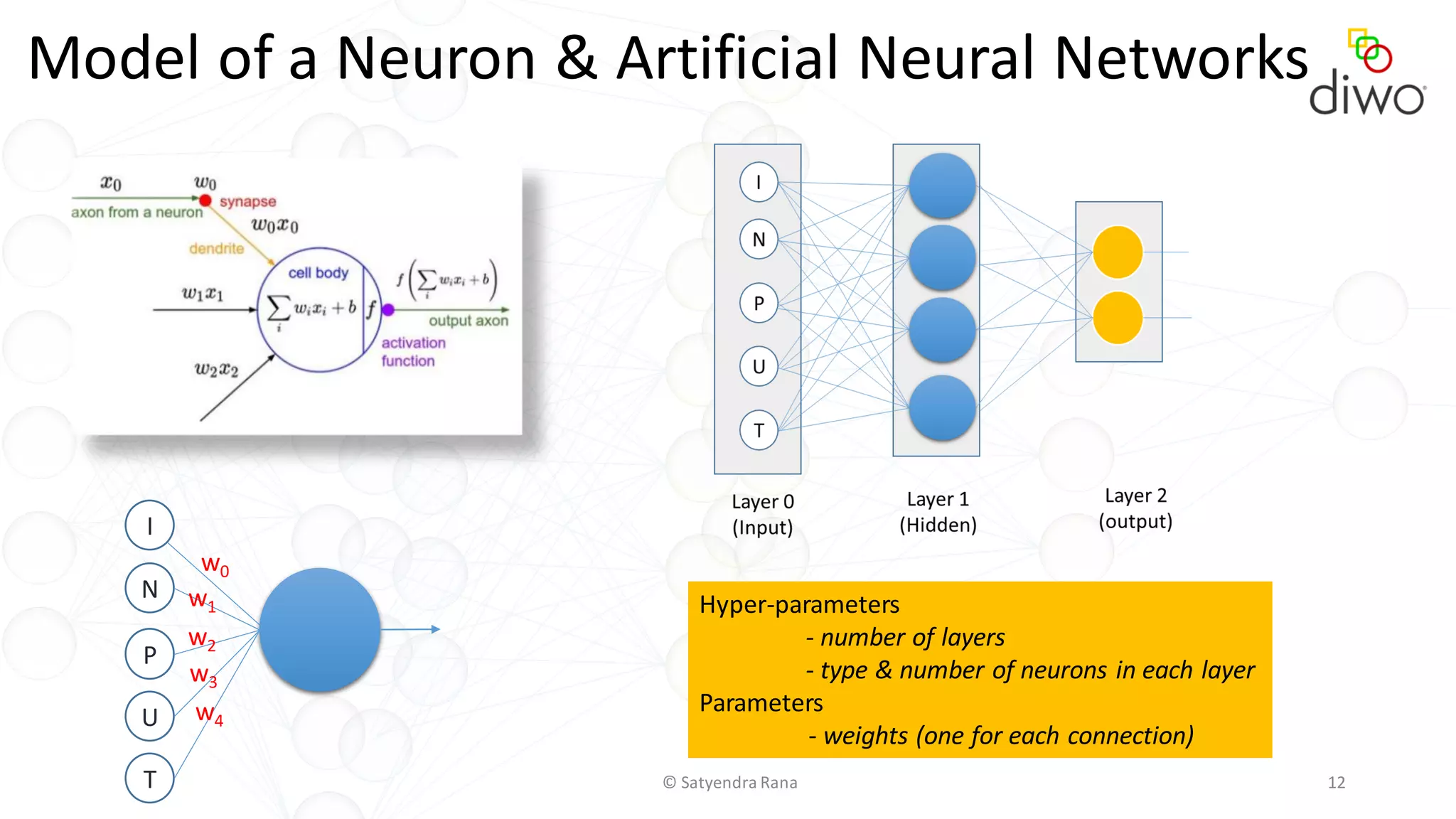
Model of a Neuron & Artificial Neural Networks
I
N
P
U
T
w0
w1
w2
w3
w4
Hyper-parameters
- number of layers
- type & number of neurons in each layer
Parameters
- weights (one for each connection)
© Satyendra Rana 13
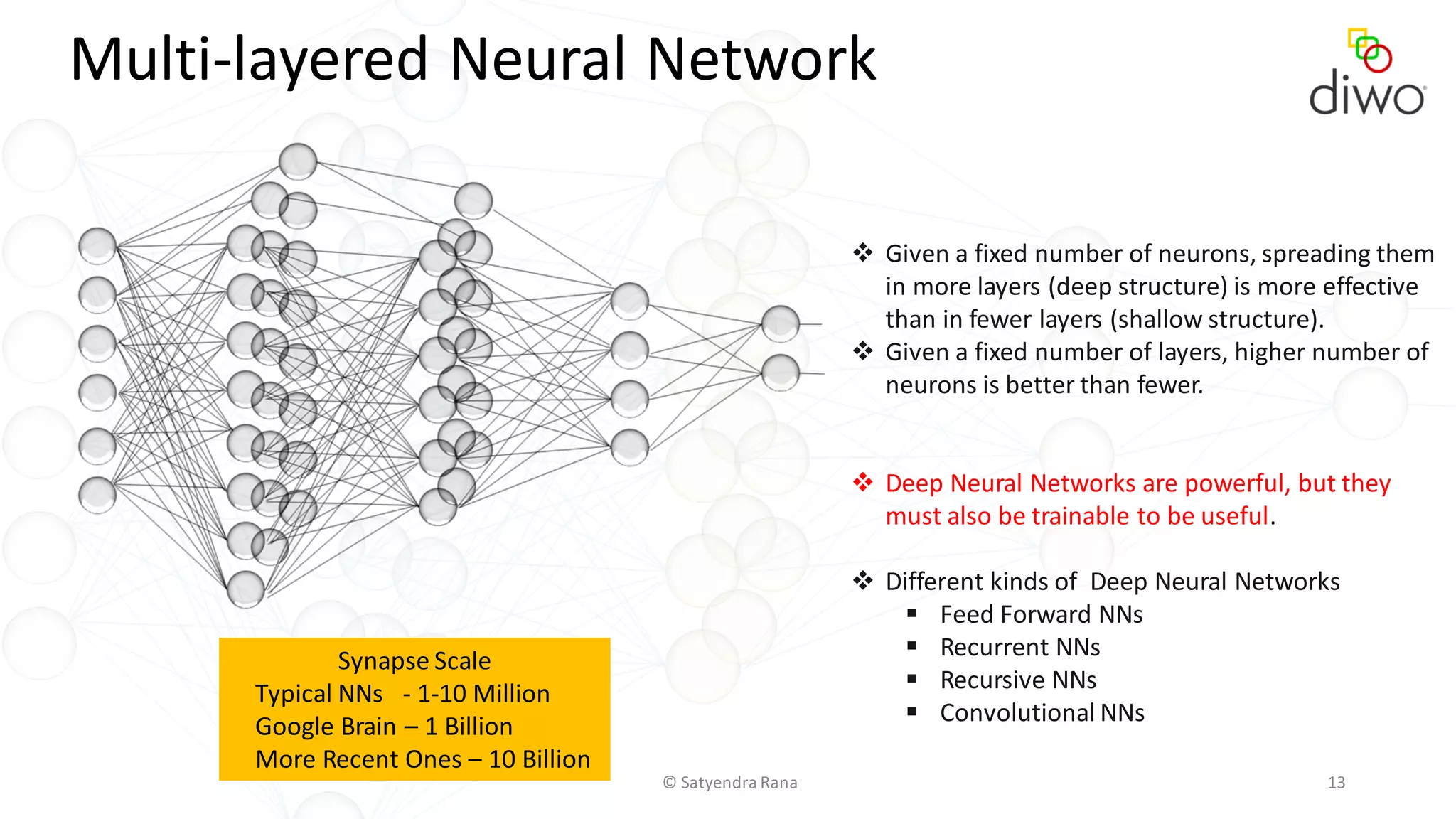
Multi-layered Neural Network
Synapse Scale
Typical NNs - 1-10 Million
Google Brain – 1 Billion
More Recent Ones – 10 Billion
 Given a fixed number of neurons, spreading them
in more layers (deep structure) is more effective
than in fewer layers (shallow structure).
 Given a fixed number of layers, higher number of
neurons is better than fewer.
 Deep Neural Networks are powerful, but they
must also be trainable to be useful.
 Different kinds of Deep Neural Networks
 Feed Forward NNs
 Recurrent NNs
 Recursive NNs
 Convolutional NNs
© Satyendra Rana 14
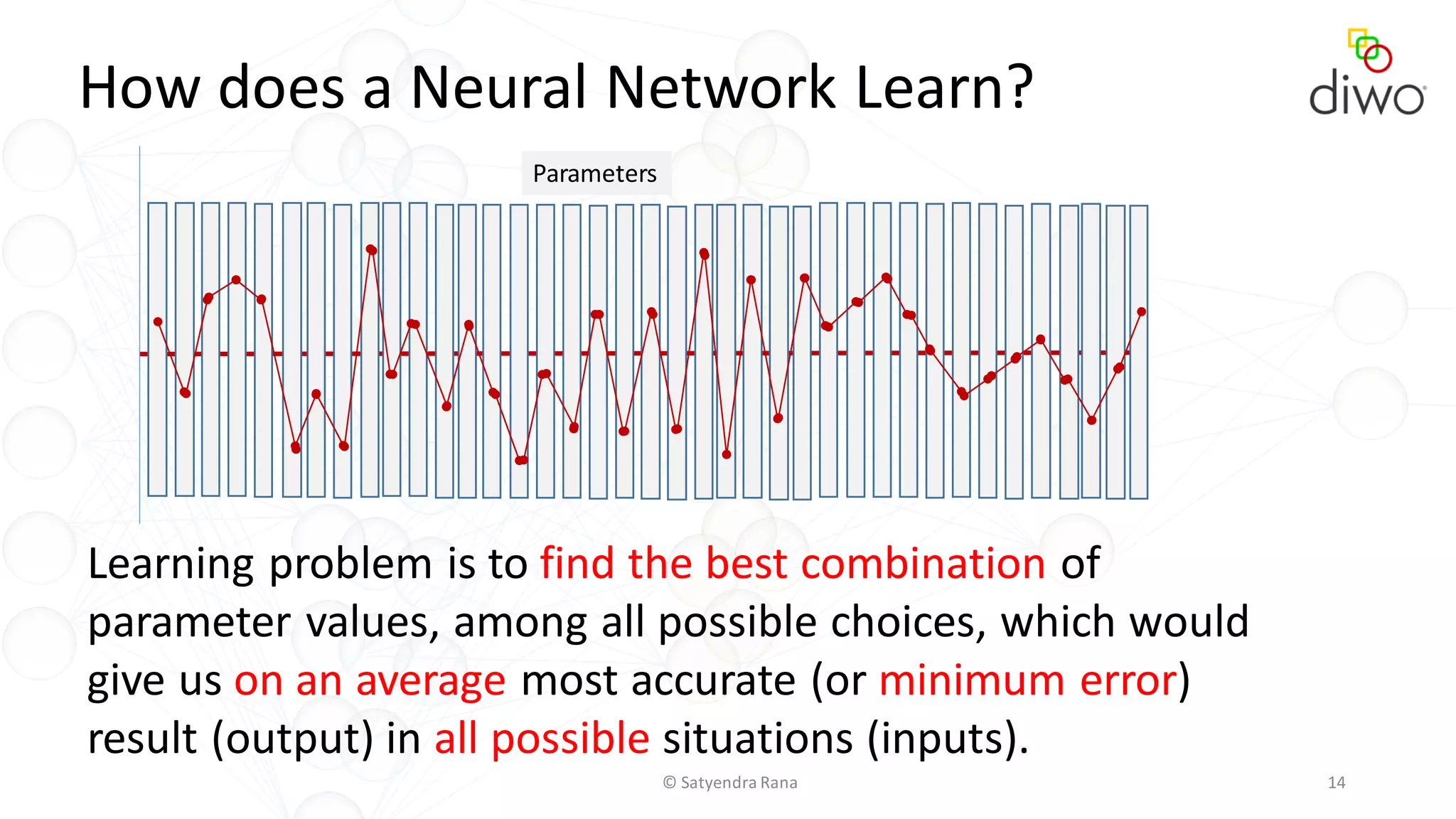
How does a Neural Network Learn?
Parameters
Learning problem is to find the best combination of
parameter values, among all possible choices, which would
give us on an average most accurate (or minimum error)
result (output) in all possible situations (inputs).
© Satyendra Rana 15
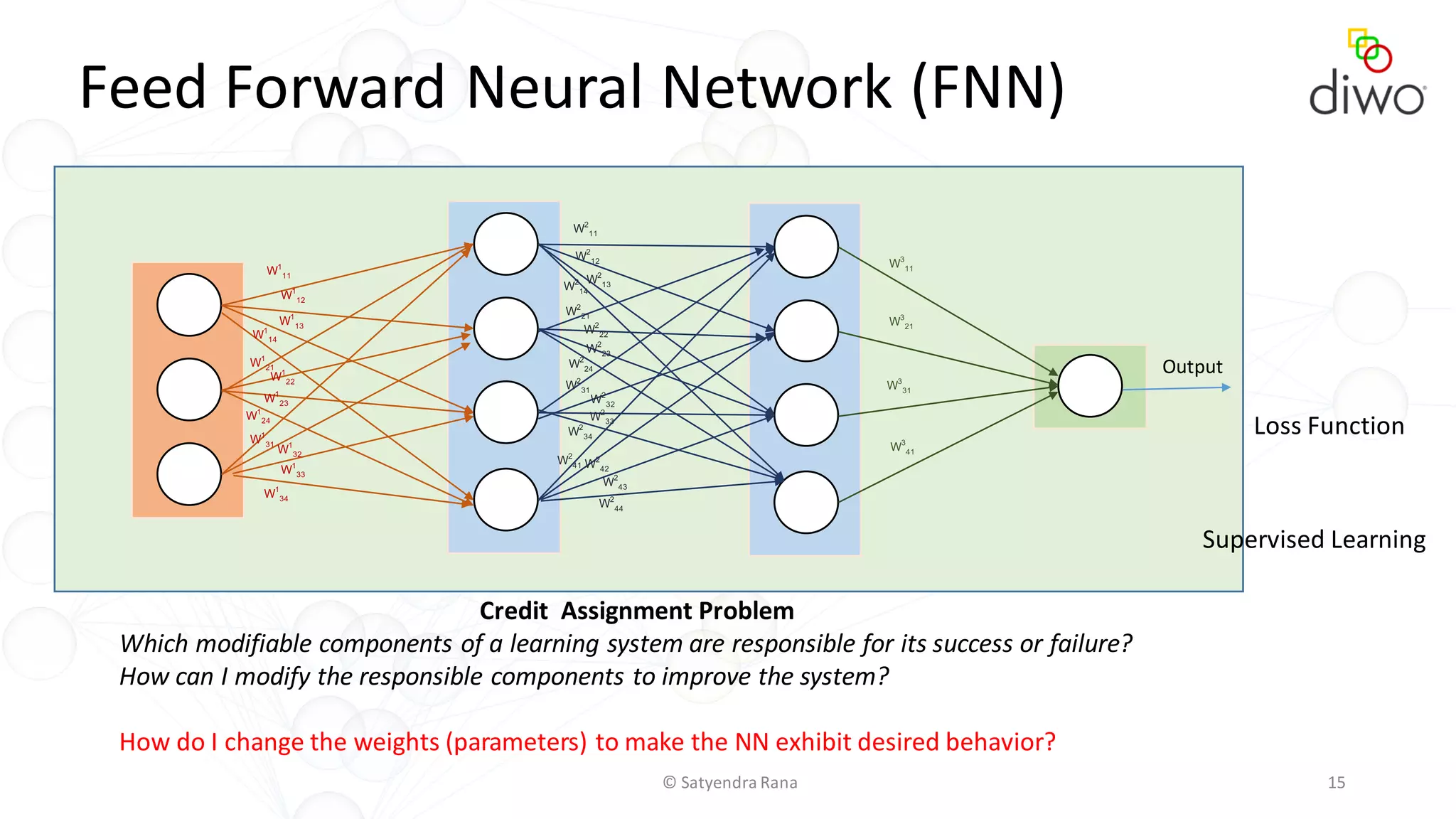
Feed Forward Neural Network (FNN)
W1
11
W1
12
W1
13
W1
14
W1
21
W1
22
W1
23
W1
24
W1
31
W1
32
W1
33
W1
34
W2
11
W2
12
W2
13W2
14
W2
21
W2
22
W2
23
W2
24
W2
31
W2
32
W2
33
W2
34
W2
41 W2
42
W2
43
W2
44
W3
21
W3
11
W3
31
W3
41
Loss Function
Output
Credit Assignment Problem
Which modifiable components of a learning system are responsible for its success or failure?
How can I modify the responsible components to improve the system?
How do I change the weights (parameters) to make the NN exhibit desired behavior?
Supervised Learning
© Satyendra Rana 16
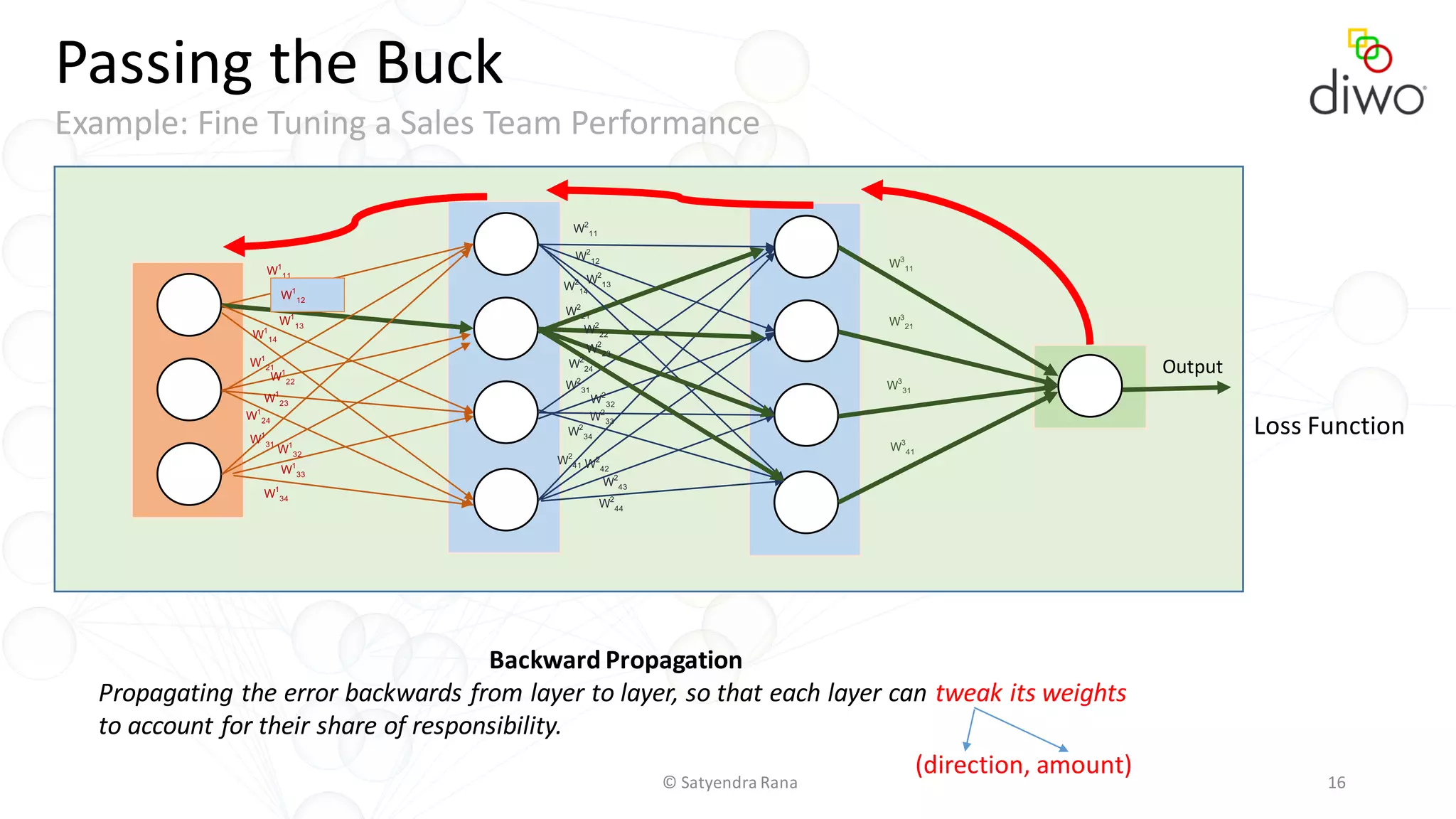
Passing the Buck
Example: Fine Tuning a Sales Team Performance
W1
11
W1
12
W1
13
W1
14
W1
21
W1
22
W1
23
W1
24
W1
31
W1
32
W1
33
W1
34
W2
11
W2
12
W2
13W2
14
W2
21
W2
22
W2
23
W2
24
W2
31
W2
32
W2
33
W2
34
W2
41 W2
42
W2
43
W2
44
W3
21
W3
11
W3
31
W3
41
Loss Function
Output
Backward Propagation
Propagating the error backwards from layer to layer, so that each layer can tweak its weights
to account for their share of responsibility.
(direction, amount)
© Satyendra Rana 17
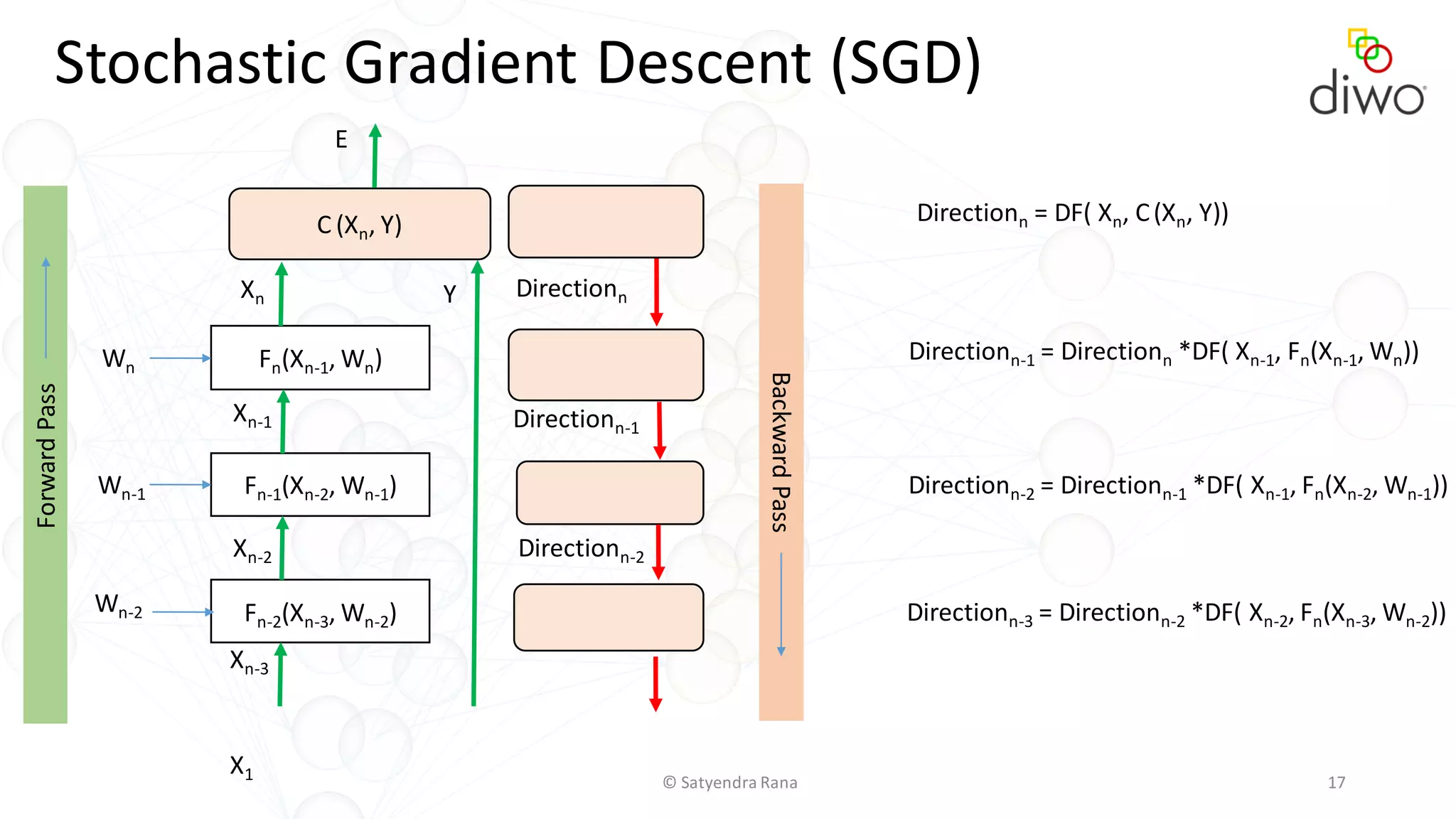
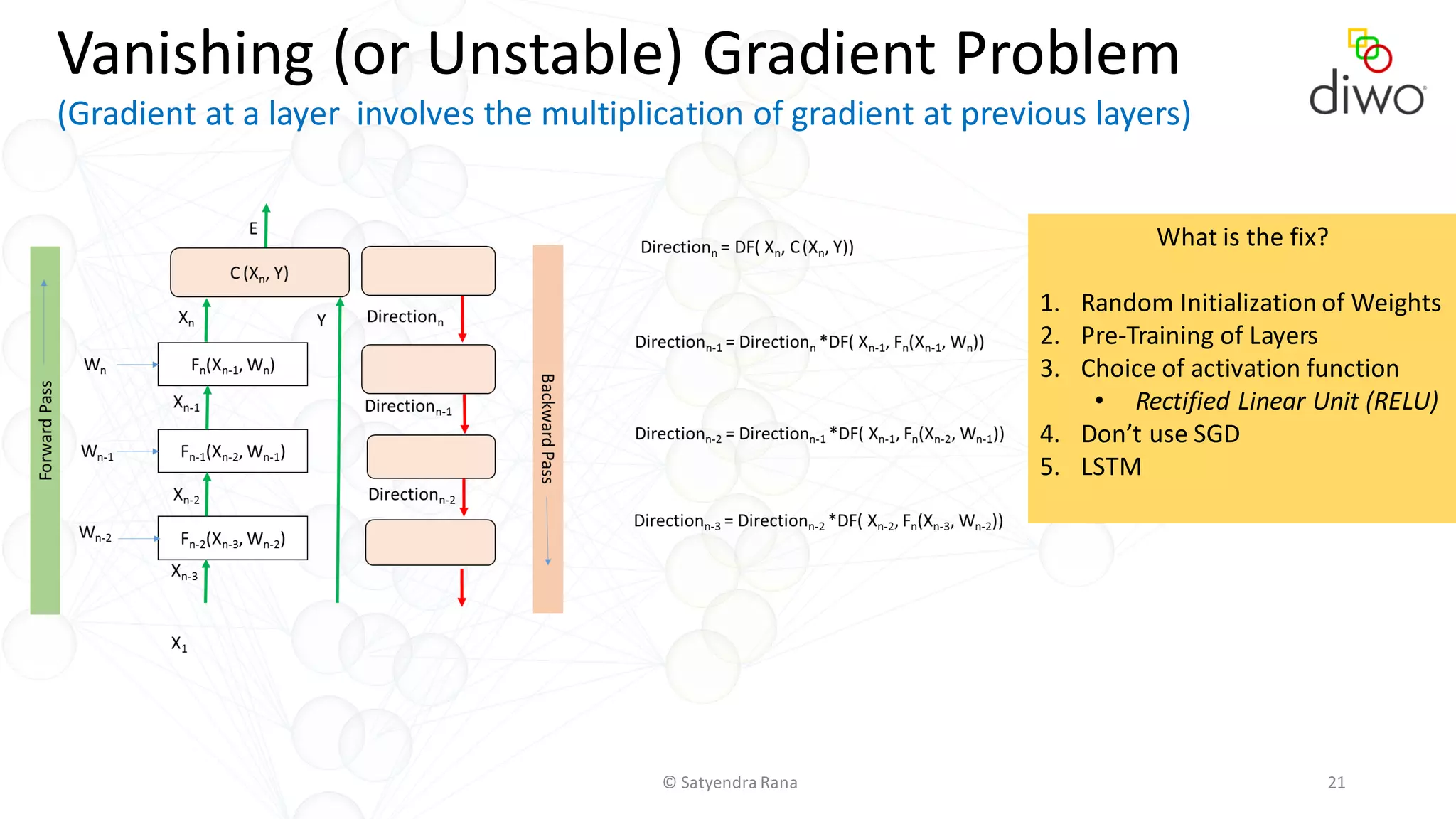
Fn-2(Xn-3, Wn-2)
Fn-1(Xn-2, Wn-1)
Fn(Xn-1, Wn)Wn
Wn-2
Wn-1
Xn-1
Xn-2
Xn-3
X1
Xn
C (Xn, Y)
Y
E
Directionn
Directionn-1
Directionn-2
ForwardPass
BackwardPass
Directionn = DF( Xn, C(Xn, Y))
Directionn-1 = Directionn *DF( Xn-1, Fn(Xn-1, Wn))
Directionn-2 = Directionn-1 *DF( Xn-1, Fn(Xn-2, Wn-1))
Directionn-3 = Directionn-2 *DF( Xn-2, Fn(Xn-3, Wn-2))
Stochastic Gradient Descent (SGD)
© Satyendra Rana 18
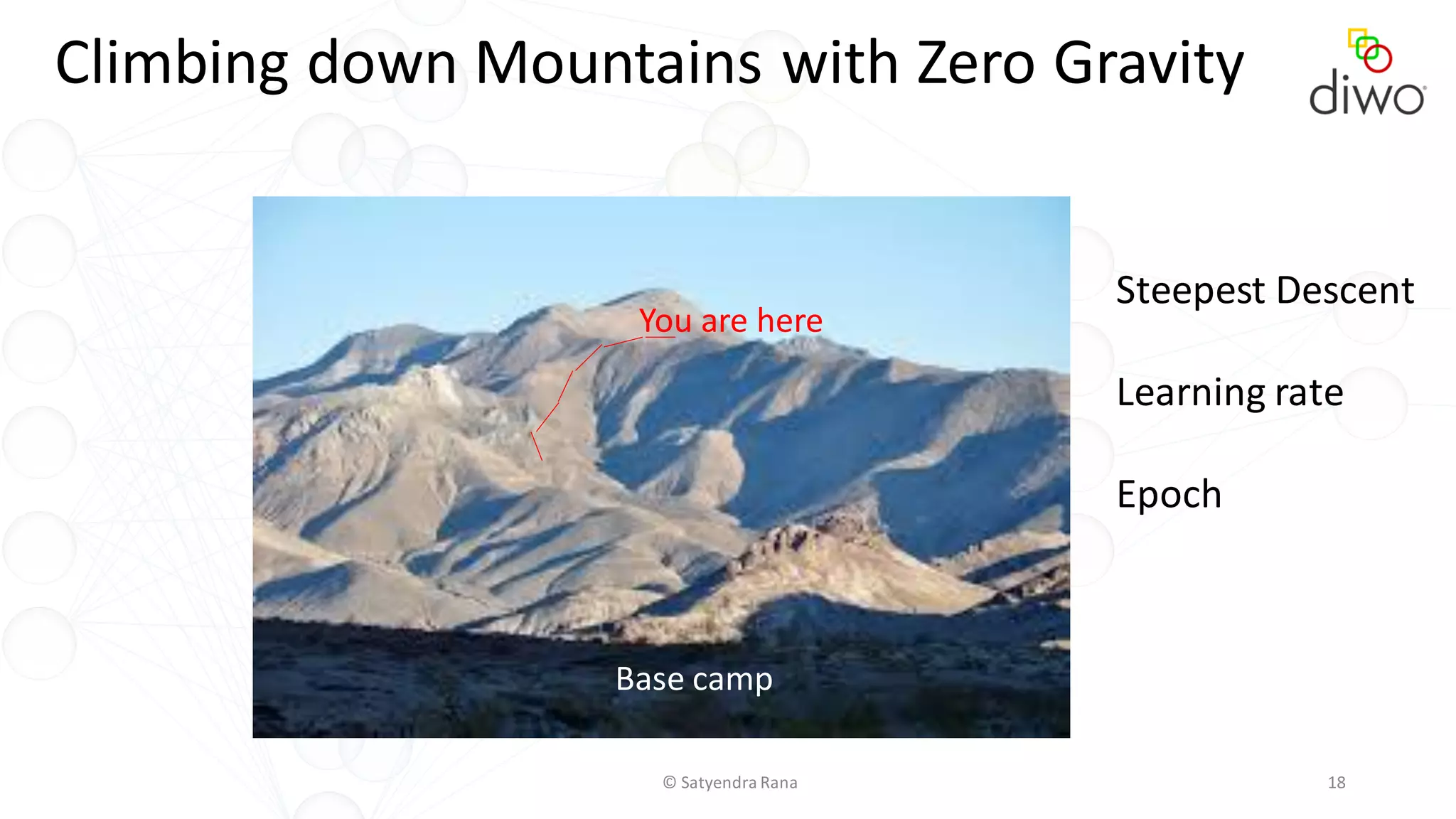
Base camp
You are here
Climbing down Mountains with Zero Gravity
Steepest Descent
Learning rate
Epoch
© Satyendra Rana 19
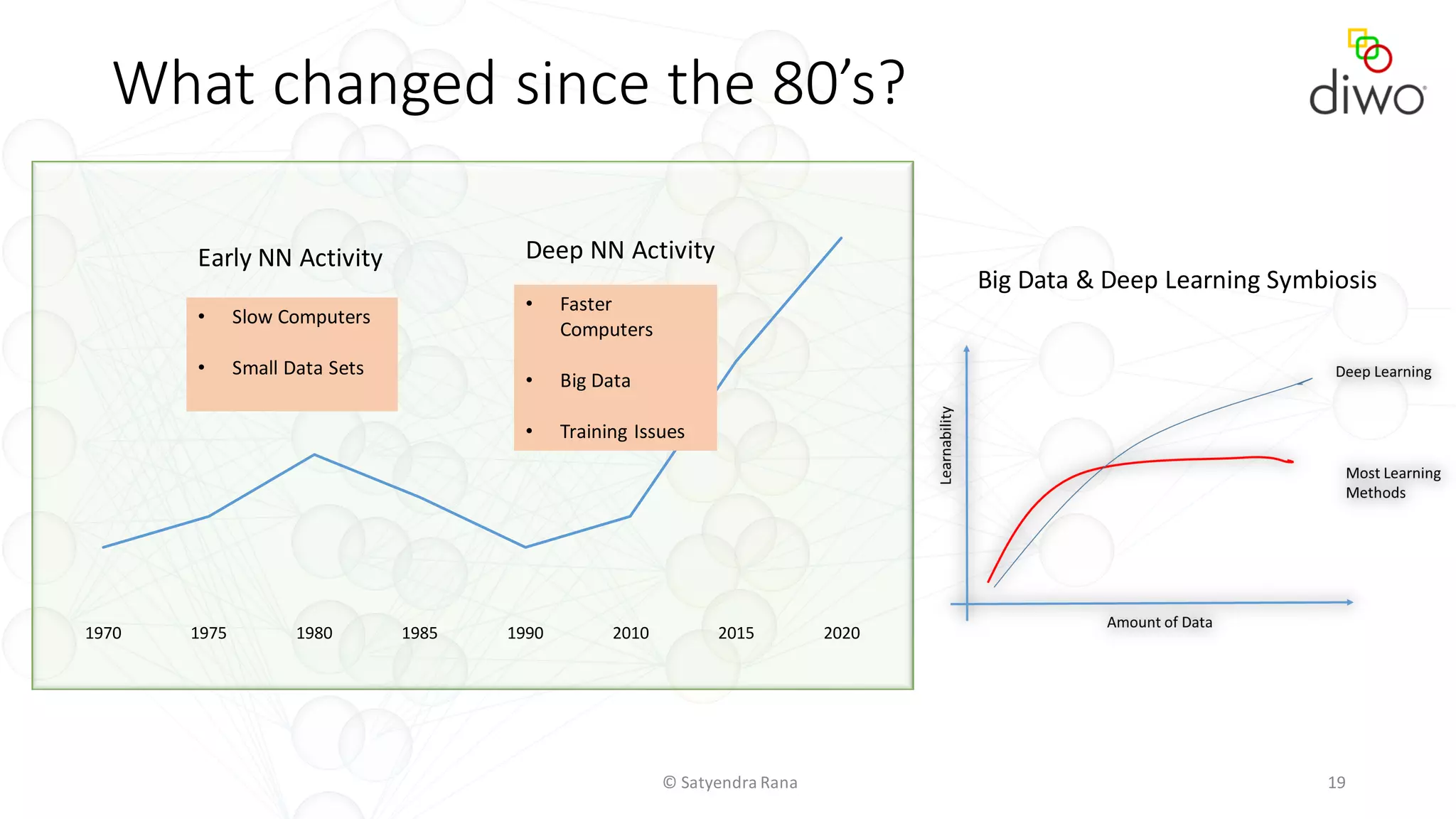
What changed since the 80’s?
1970 1975 1980 1985 1990 2010 2015 2020
Early NN Activity Deep NN Activity
• Slow Computers
• Small Data Sets
• Faster
Computers
• Big Data
• Training Issues
Big Data & Deep Learning Symbiosis
© Satyendra Rana 20
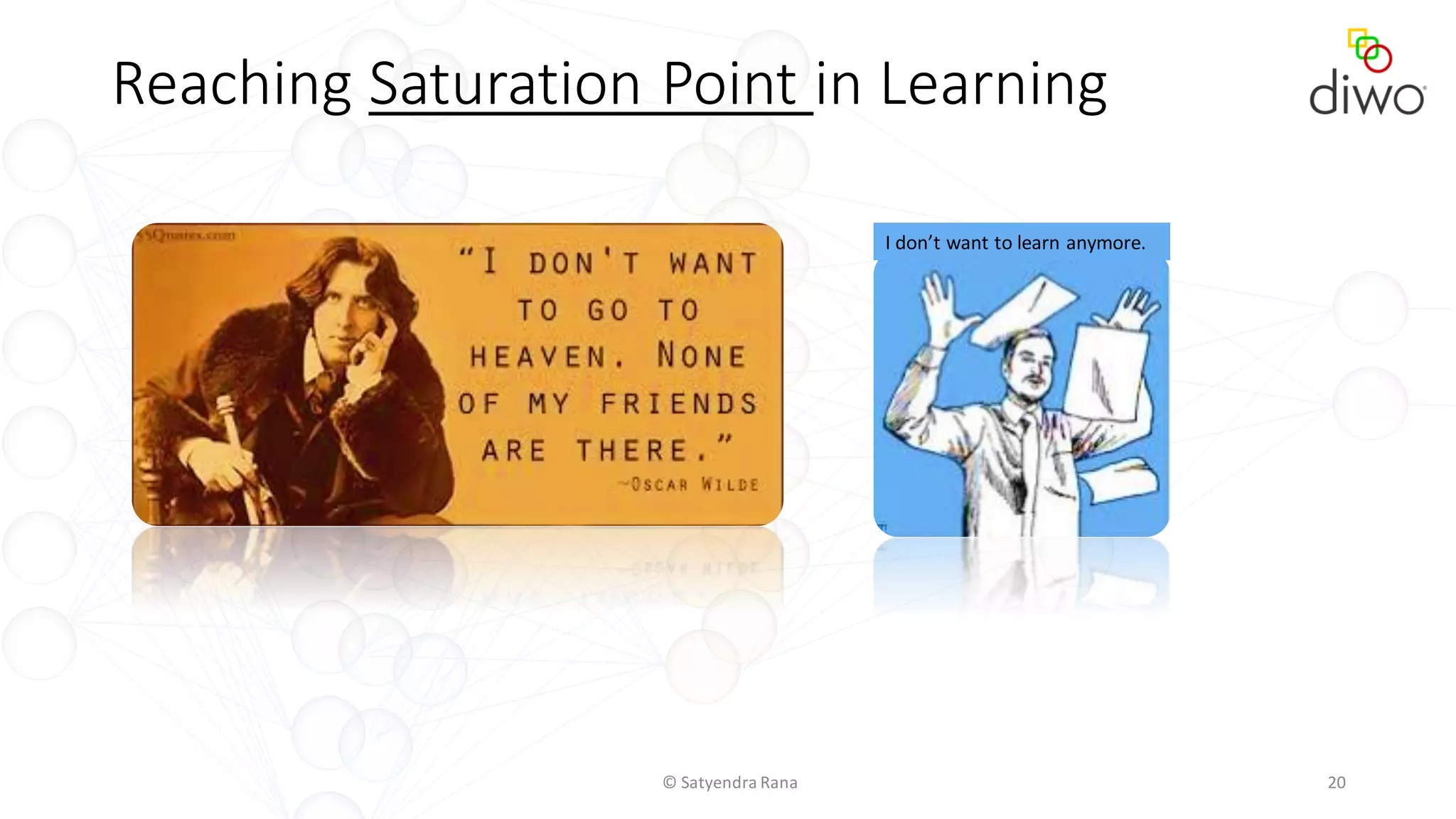
Reaching Saturation Point in Learning
I don’t want to learn anymore.
© Satyendra Rana 21
Vanishing (or Unstable) Gradient Problem
(Gradient at a layer involves the multiplication of gradient at previous layers)
What is the fix?
1. Random Initialization of Weights
2. Pre-Training of Layers
3. Choice of activation function
• Rectified Linear Unit (RELU)
4. Don’t use SGD
5. LSTM
© Satyendra Rana 22
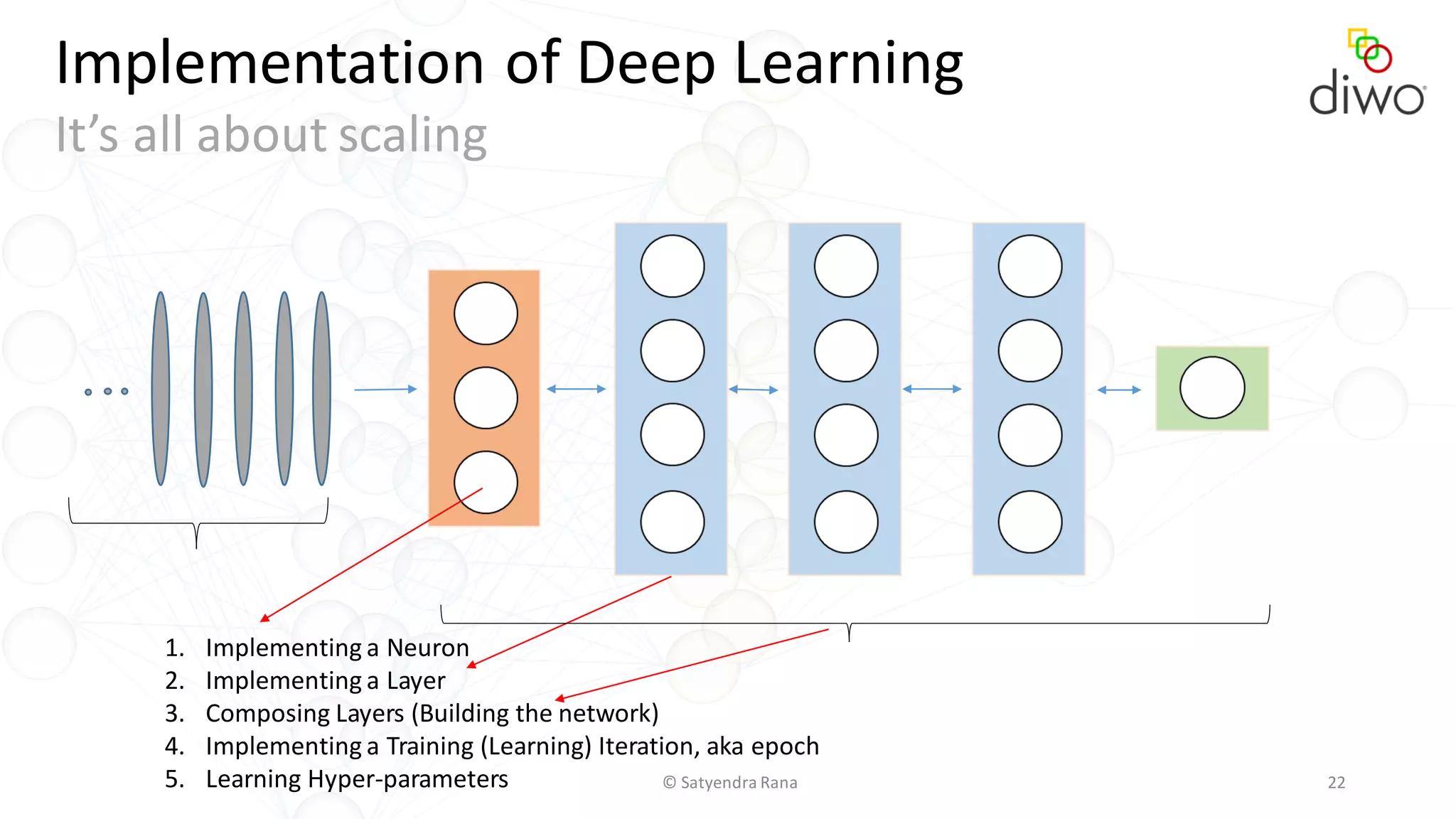
Implementation of Deep Learning
It’s all about scaling
1. Implementing a Neuron
2. Implementing a Layer
3. Composing Layers (Building the network)
4. Implementing a Training (Learning) Iteration, aka epoch
5. Learning Hyper-parameters
© Satyendra Rana 23
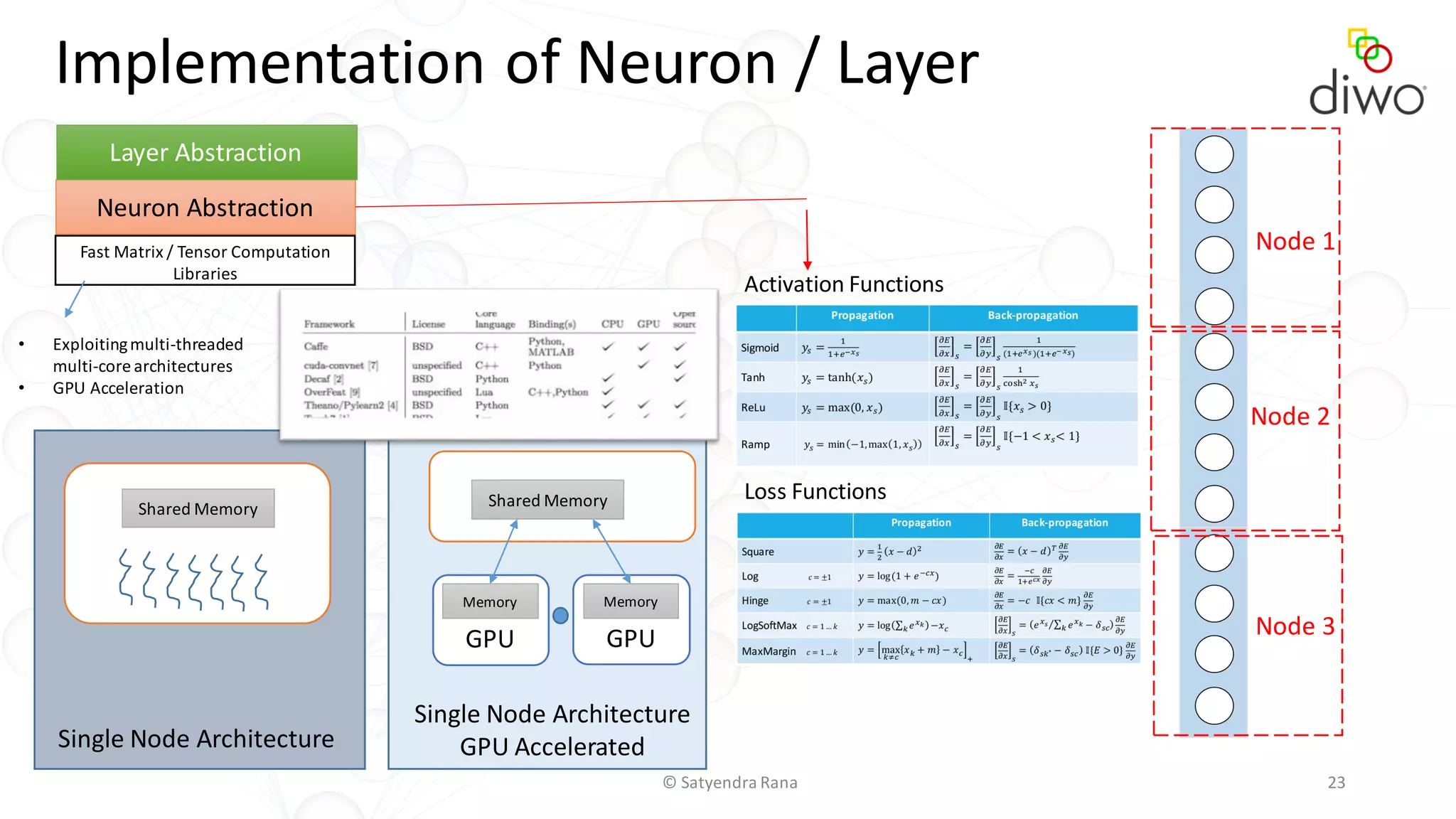
Implementation of Neuron / Layer
Neuron Abstraction
Layer Abstraction
Fast Matrix / Tensor Computation
Libraries
• Exploitingmulti-threaded
multi-core architectures
• GPU Acceleration
Single Node Architecture
Shared Memory Shared Memory
Memory
GPU
Memory
GPU
Single Node Architecture
GPU Accelerated
Activation Functions
Loss Functions
Node 1
Node 2
Node 3
© Satyendra Rana 24
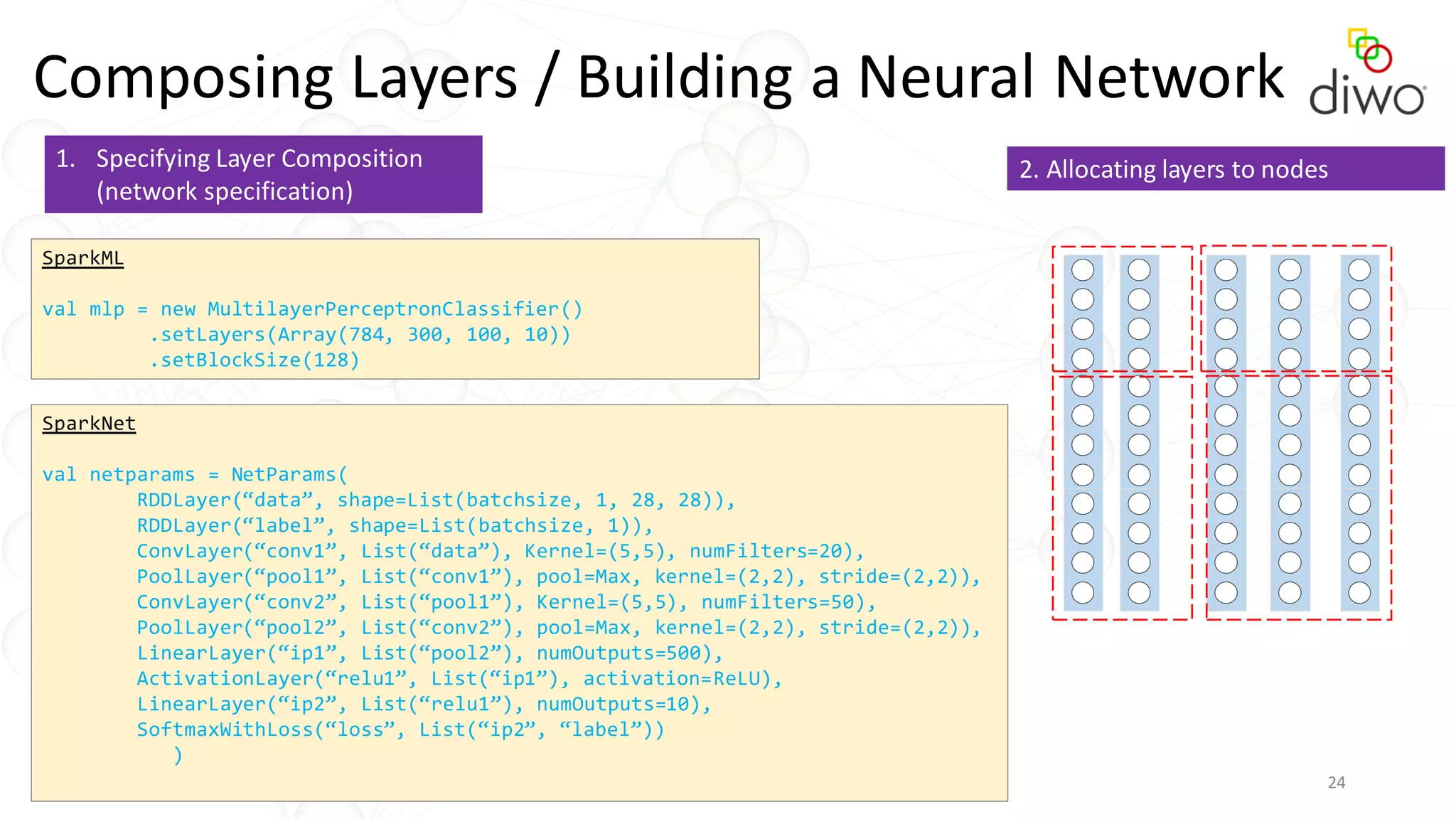
Composing Layers / Building a Neural Network
1. Specifying Layer Composition
(network specification)
SparkML
val mlp = new MultilayerPerceptronClassifier()
.setLayers(Array(784, 300, 100, 10))
.setBlockSize(128)
SparkNet
val netparams = NetParams(
RDDLayer(“data”, shape=List(batchsize, 1, 28, 28)),
RDDLayer(“label”, shape=List(batchsize, 1)),
ConvLayer(“conv1”, List(“data”), Kernel=(5,5), numFilters=20),
PoolLayer(“pool1”, List(“conv1”), pool=Max, kernel=(2,2), stride=(2,2)),
ConvLayer(“conv2”, List(“pool1”), Kernel=(5,5), numFilters=50),
PoolLayer(“pool2”, List(“conv2”), pool=Max, kernel=(2,2), stride=(2,2)),
LinearLayer(“ip1”, List(“pool2”), numOutputs=500),
ActivationLayer(“relu1”, List(“ip1”), activation=ReLU),
LinearLayer(“ip2”, List(“relu1”), numOutputs=10),
SoftmaxWithLoss(“loss”, List(“ip2”, “label”))
)
2. Allocating layers to nodes
© Satyendra Rana 25
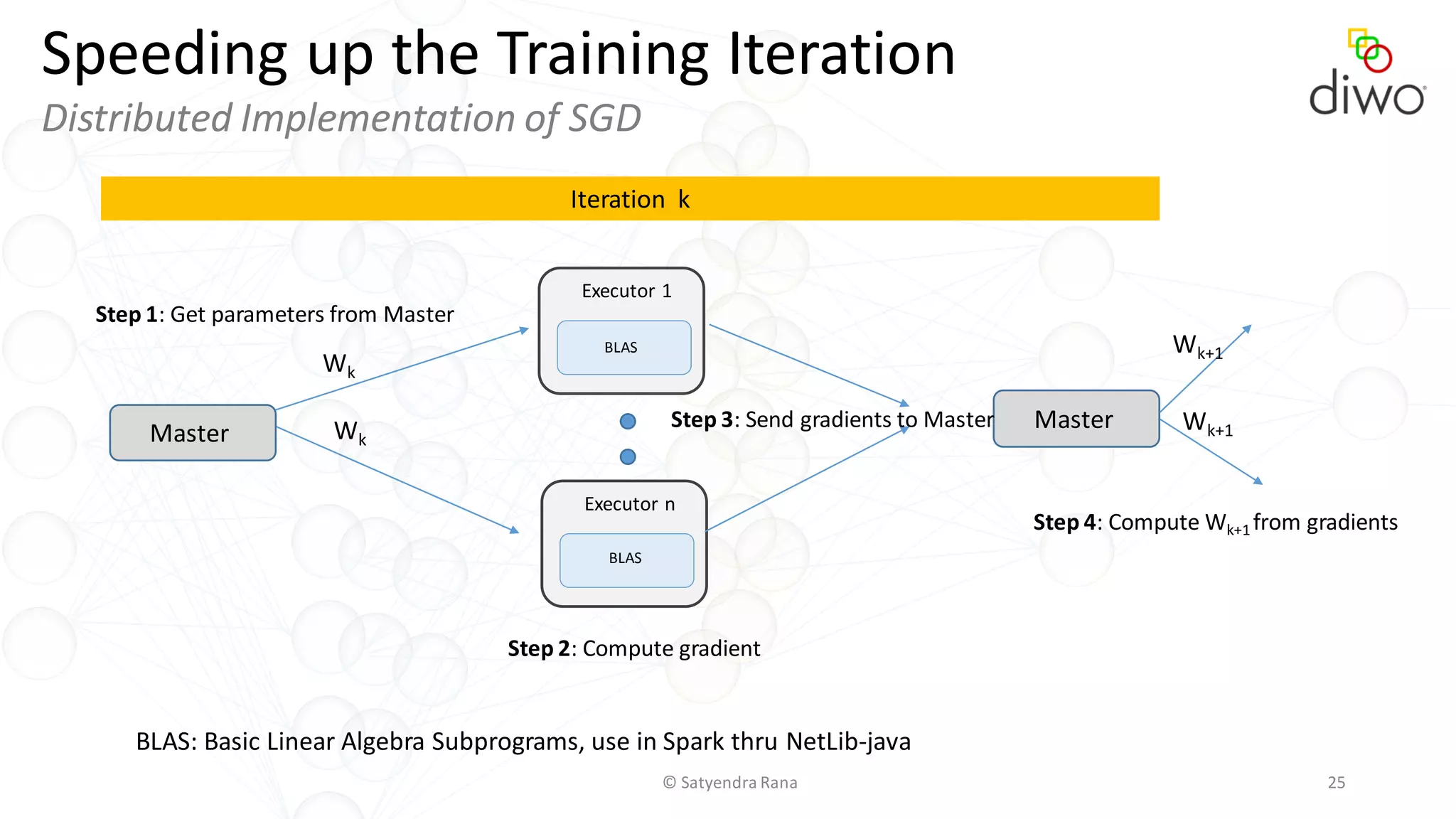
Speeding up the Training Iteration
Distributed Implementation of SGD
Executor 1
BLAS
Master
Executor n
BLAS
Wk
Wk
Step 1: Get parameters from Master
Step 2: Compute gradient
Step 3: Send gradients to Master
Master
Step 4: Compute Wk+1 from gradients
Wk+1
Wk+1
Iteration k
BLAS: Basic Linear Algebra Subprograms, use in Spark thru NetLib-java
© Satyendra Rana 26
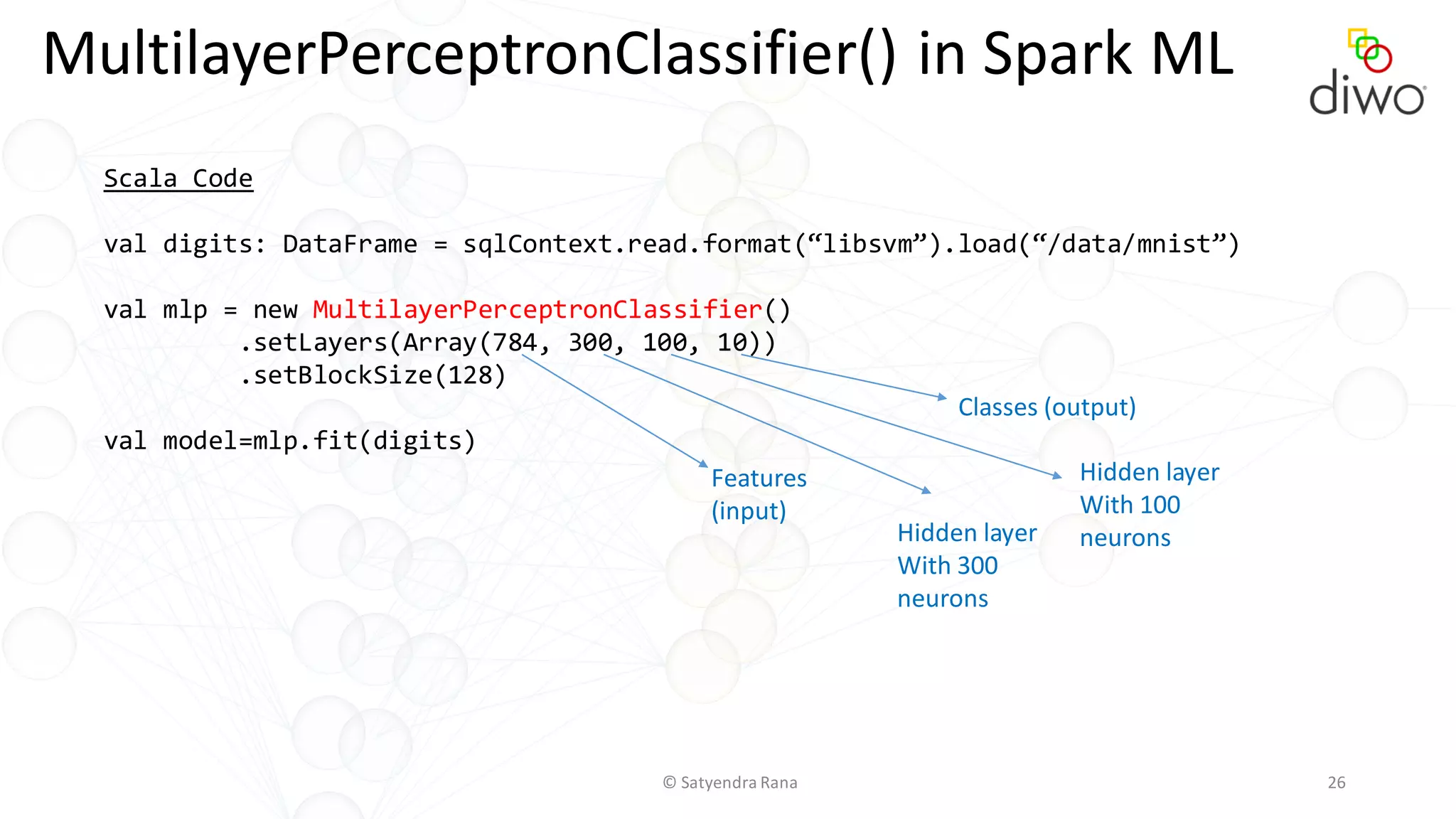
MultilayerPerceptronClassifier() in Spark ML
Scala Code
val digits: DataFrame = sqlContext.read.format(“libsvm”).load(“/data/mnist”)
val mlp = new MultilayerPerceptronClassifier()
.setLayers(Array(784, 300, 100, 10))
.setBlockSize(128)
val model=mlp.fit(digits)
Features
(input)
Classes (output)
Hidden layer
With 300
neurons
Hidden layer
With 100
neurons
© Satyendra Rana 27
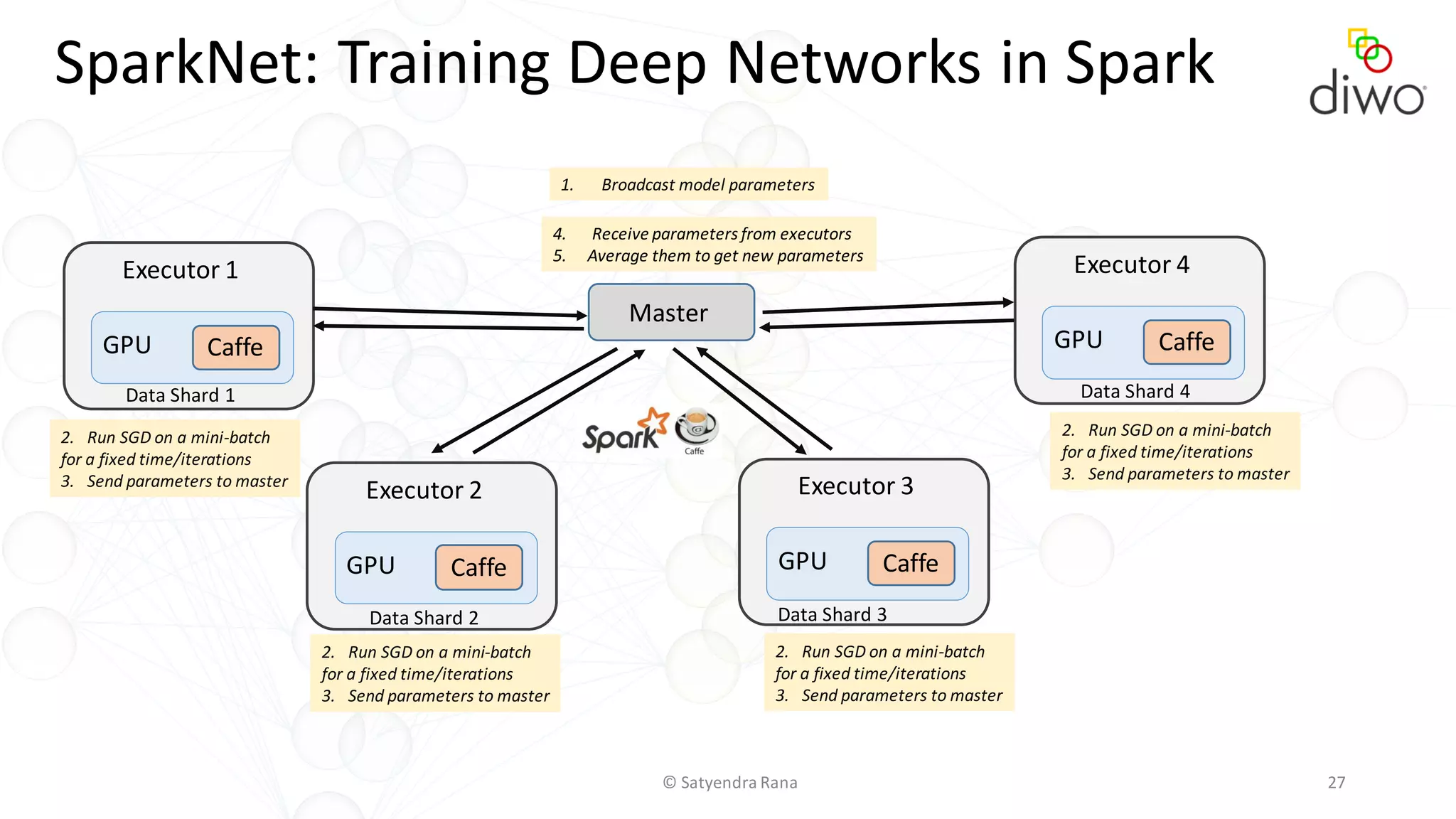
SparkNet: Training Deep Networks in Spark
Executor 3
GPU Caffe
Executor 2
GPU Caffe
Executor 1
GPU Caffe
Executor 4
GPU Caffe
Master
Data Shard 1
Data Shard 2 Data Shard 3
Data Shard 4
2. Run SGD on a mini-batch
for a fixed time/iterations
3. Send parameters to master
1. Broadcast model parameters
4. Receive parameters from executors
5. Average them to get new parameters
2. Run SGD on a mini-batch
for a fixed time/iterations
3. Send parameters to master
2. Run SGD on a mini-batch
for a fixed time/iterations
3. Send parameters to master
2. Run SGD on a mini-batch
for a fixed time/iterations
3. Send parameters to master
© Satyendra Rana 28
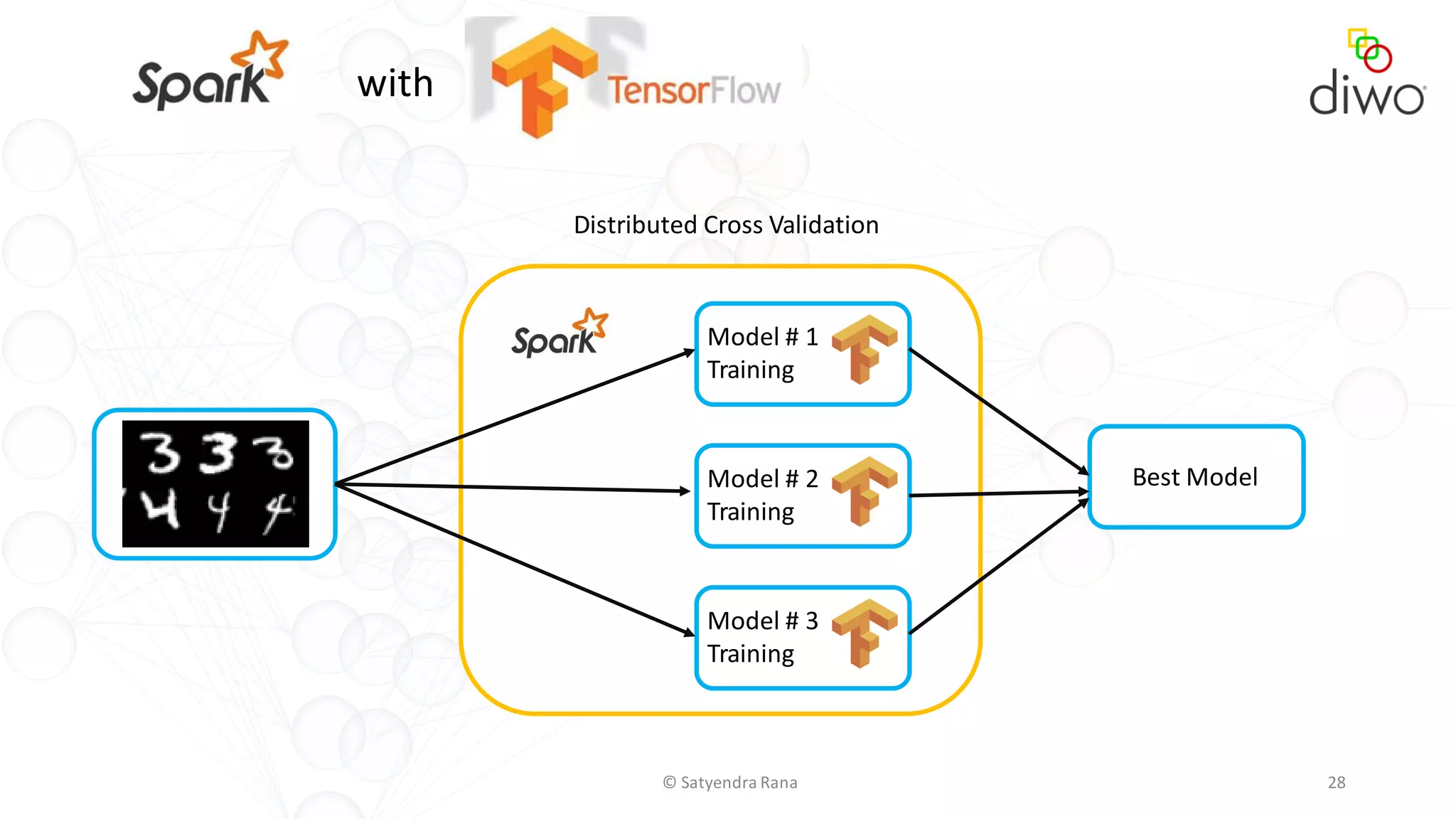
with
Best Model
Model # 1
Training
Model # 2
Training
Model # 3
Training
Distributed Cross Validation
© Satyendra Rana 29
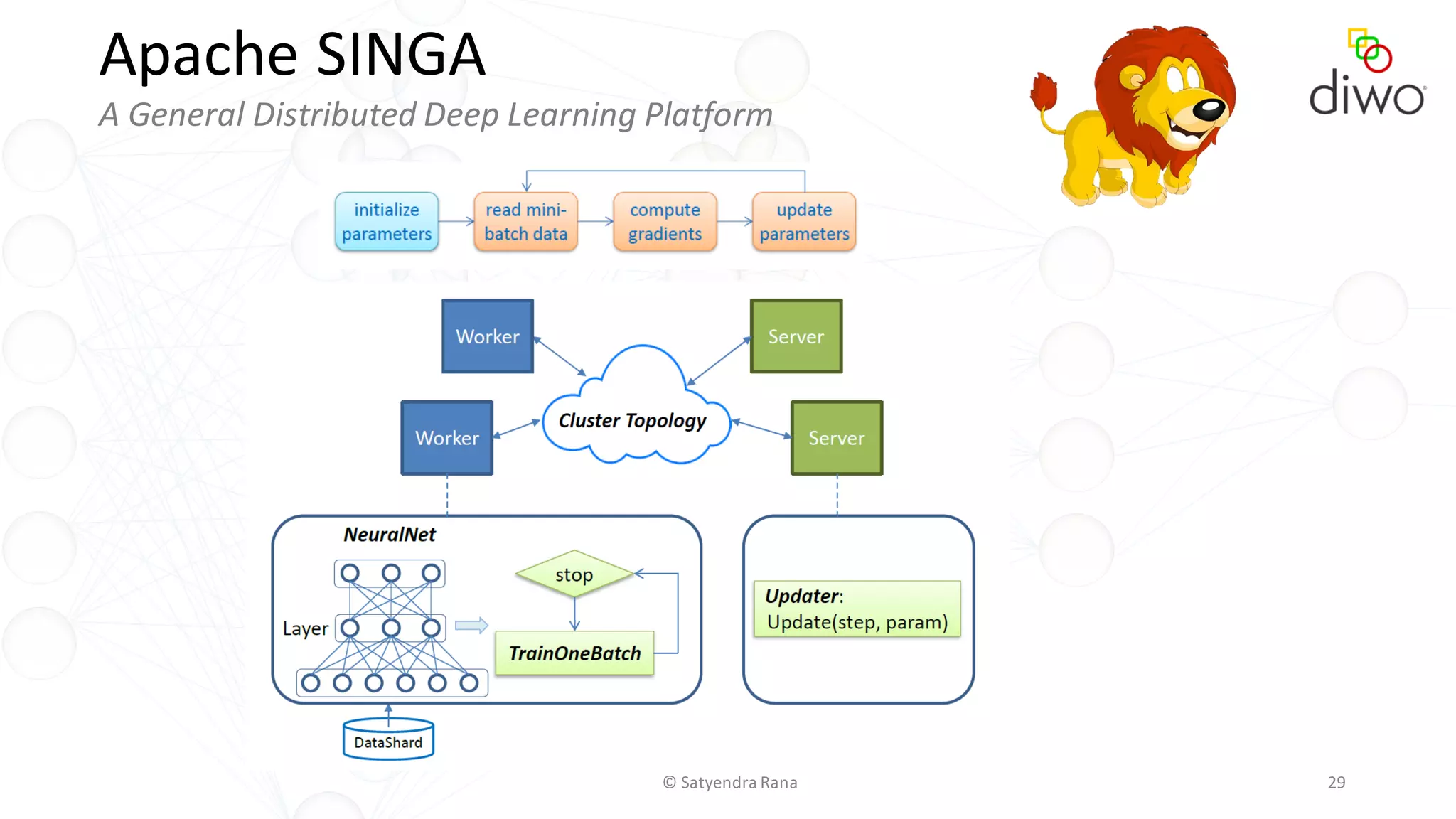
Apache SINGA
A General Distributed Deep Learning Platform
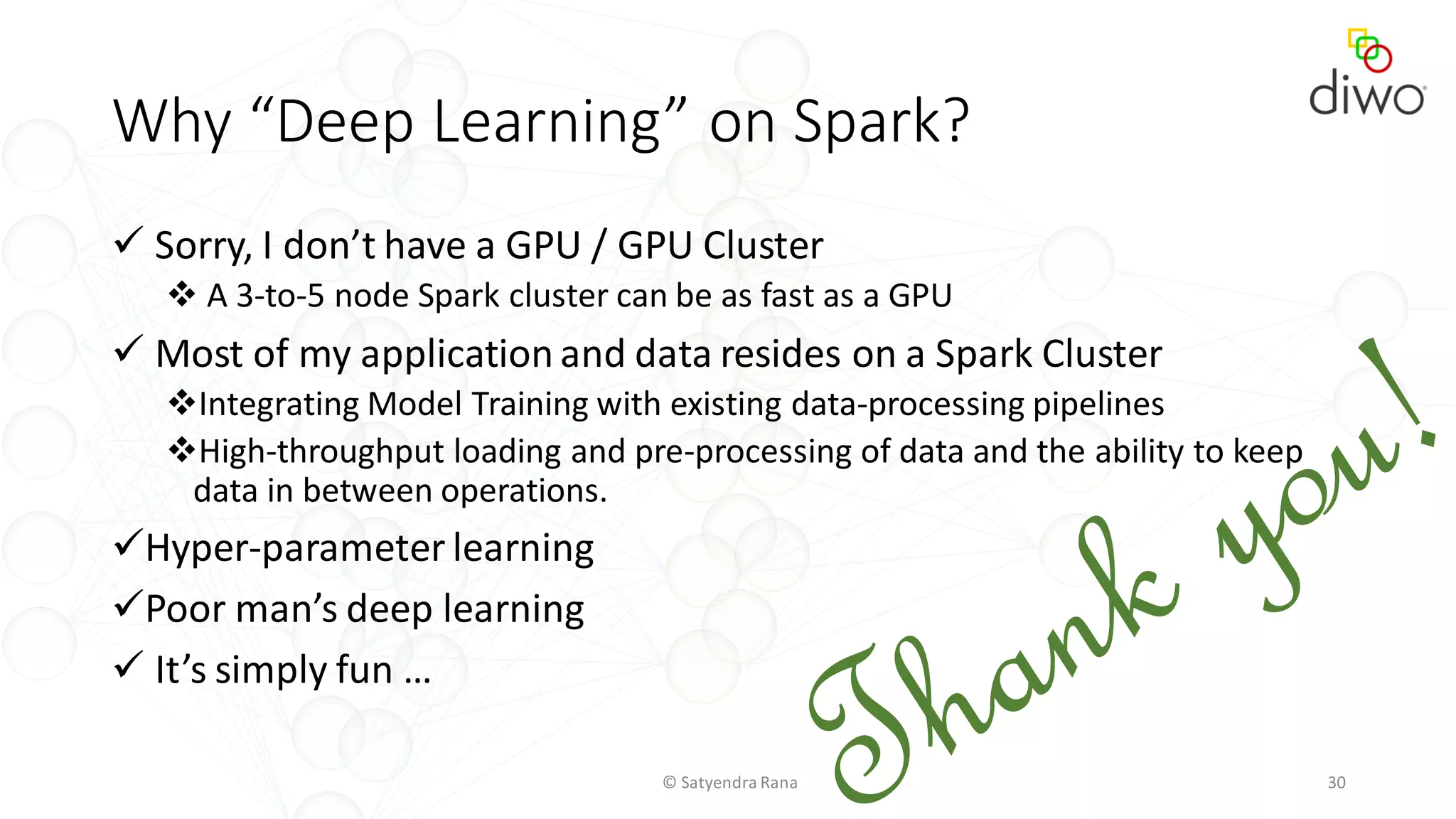
Why “Deep Learning” on Spark?
 Sorry, I don’t have a GPU / GPU Cluster
 A 3-to-5 node Spark cluster can be as fast as a GPU
 Most of my application and data resides on a Spark Cluster
Integrating Model Training with existing data-processing pipelines
High-throughput loading and pre-processing of data and the ability to keep
data in between operations.
Hyper-parameter learning
Poor man’s deep learning
 It’s simply fun …
© Satyendra Rana 30

Deep learning on spark

  • 1.
  • 2.
    Learning is aboutacquiring the ability to discriminate. Memorization Overfitting Under fitting Generalization © Satyendra Rana 2 2 2 4 2 3 5 2 4 6 2 5 7 2 3 ? 2 7 ? 3 4 ? 2 2 4.05 2 3 4.98 4 2 5.95 2 5 7.06 2 3 ? 2 7 ? 3 4 ? Noise
  • 3.
    Machine Learning Data InWisdom Out © Satyendra Rana 3 ? Square Boxes Thin Rectangular Boxes Round Boxes Q1: Which type of box should we look for? Q2: Having picked up the box type, how do we find the right box? Computational Architecture Learning Method
  • 4.
    Deep (Machine) Learning DataIn Wisdom Out © Satyendra Rana 4 ? Type of box? Right box? Computational Architecture Learning Method Discrimination Ability? Finer Discrimination (Non-linearity) Network of Neurons (aka Neural Network or NN)
  • 5.
    © Satyendra Rana5 Natural Language Generation
  • 6.
    © Satyendra Rana6 Machine Translation
  • 7.
    © Satyendra Rana7 Automatic Image Captioning
  • 8.
    © Satyendra Rana8 Automatic Colorization of Gray Scale Images Input Image Automatically Colorized Ground-Truth Source: Nvidia news
  • 9.
    © Satyendra Rana9 Ping Pong Playing Robot Source: Omron Automation Lab Kyoto, Japan
  • 10.
    © Satyendra Rana10 Deep learning for the sight-impaired (and also for the sight-endowed)
  • 11.
    © Satyendra Rana11 Neurons Adult Brain - 100 Trillion Infant Brain – 1 Quadrillion Synapses
  • 12.
    © Satyendra Rana12 Model of a Neuron & Artificial Neural Networks I N P U T w0 w1 w2 w3 w4 Hyper-parameters - number of layers - type & number of neurons in each layer Parameters - weights (one for each connection)
  • 13.
    © Satyendra Rana13 Multi-layered Neural Network Synapse Scale Typical NNs - 1-10 Million Google Brain – 1 Billion More Recent Ones – 10 Billion  Given a fixed number of neurons, spreading them in more layers (deep structure) is more effective than in fewer layers (shallow structure).  Given a fixed number of layers, higher number of neurons is better than fewer.  Deep Neural Networks are powerful, but they must also be trainable to be useful.  Different kinds of Deep Neural Networks  Feed Forward NNs  Recurrent NNs  Recursive NNs  Convolutional NNs
  • 14.
    © Satyendra Rana14 How does a Neural Network Learn? Parameters Learning problem is to find the best combination of parameter values, among all possible choices, which would give us on an average most accurate (or minimum error) result (output) in all possible situations (inputs).
  • 15.
    © Satyendra Rana15 Feed Forward Neural Network (FNN) W1 11 W1 12 W1 13 W1 14 W1 21 W1 22 W1 23 W1 24 W1 31 W1 32 W1 33 W1 34 W2 11 W2 12 W2 13W2 14 W2 21 W2 22 W2 23 W2 24 W2 31 W2 32 W2 33 W2 34 W2 41 W2 42 W2 43 W2 44 W3 21 W3 11 W3 31 W3 41 Loss Function Output Credit Assignment Problem Which modifiable components of a learning system are responsible for its success or failure? How can I modify the responsible components to improve the system? How do I change the weights (parameters) to make the NN exhibit desired behavior? Supervised Learning
  • 16.
    © Satyendra Rana16 Passing the Buck Example: Fine Tuning a Sales Team Performance W1 11 W1 12 W1 13 W1 14 W1 21 W1 22 W1 23 W1 24 W1 31 W1 32 W1 33 W1 34 W2 11 W2 12 W2 13W2 14 W2 21 W2 22 W2 23 W2 24 W2 31 W2 32 W2 33 W2 34 W2 41 W2 42 W2 43 W2 44 W3 21 W3 11 W3 31 W3 41 Loss Function Output Backward Propagation Propagating the error backwards from layer to layer, so that each layer can tweak its weights to account for their share of responsibility. (direction, amount)
  • 17.
    © Satyendra Rana17 Fn-2(Xn-3, Wn-2) Fn-1(Xn-2, Wn-1) Fn(Xn-1, Wn)Wn Wn-2 Wn-1 Xn-1 Xn-2 Xn-3 X1 Xn C (Xn, Y) Y E Directionn Directionn-1 Directionn-2 ForwardPass BackwardPass Directionn = DF( Xn, C(Xn, Y)) Directionn-1 = Directionn *DF( Xn-1, Fn(Xn-1, Wn)) Directionn-2 = Directionn-1 *DF( Xn-1, Fn(Xn-2, Wn-1)) Directionn-3 = Directionn-2 *DF( Xn-2, Fn(Xn-3, Wn-2)) Stochastic Gradient Descent (SGD)
  • 18.
    © Satyendra Rana18 Base camp You are here Climbing down Mountains with Zero Gravity Steepest Descent Learning rate Epoch
  • 19.
    © Satyendra Rana19 What changed since the 80’s? 1970 1975 1980 1985 1990 2010 2015 2020 Early NN Activity Deep NN Activity • Slow Computers • Small Data Sets • Faster Computers • Big Data • Training Issues Big Data & Deep Learning Symbiosis
  • 20.
    © Satyendra Rana20 Reaching Saturation Point in Learning I don’t want to learn anymore.
  • 21.
    © Satyendra Rana21 Vanishing (or Unstable) Gradient Problem (Gradient at a layer involves the multiplication of gradient at previous layers) What is the fix? 1. Random Initialization of Weights 2. Pre-Training of Layers 3. Choice of activation function • Rectified Linear Unit (RELU) 4. Don’t use SGD 5. LSTM
  • 22.
    © Satyendra Rana22 Implementation of Deep Learning It’s all about scaling 1. Implementing a Neuron 2. Implementing a Layer 3. Composing Layers (Building the network) 4. Implementing a Training (Learning) Iteration, aka epoch 5. Learning Hyper-parameters
  • 23.
    © Satyendra Rana23 Implementation of Neuron / Layer Neuron Abstraction Layer Abstraction Fast Matrix / Tensor Computation Libraries • Exploitingmulti-threaded multi-core architectures • GPU Acceleration Single Node Architecture Shared Memory Shared Memory Memory GPU Memory GPU Single Node Architecture GPU Accelerated Activation Functions Loss Functions Node 1 Node 2 Node 3
  • 24.
    © Satyendra Rana24 Composing Layers / Building a Neural Network 1. Specifying Layer Composition (network specification) SparkML val mlp = new MultilayerPerceptronClassifier() .setLayers(Array(784, 300, 100, 10)) .setBlockSize(128) SparkNet val netparams = NetParams( RDDLayer(“data”, shape=List(batchsize, 1, 28, 28)), RDDLayer(“label”, shape=List(batchsize, 1)), ConvLayer(“conv1”, List(“data”), Kernel=(5,5), numFilters=20), PoolLayer(“pool1”, List(“conv1”), pool=Max, kernel=(2,2), stride=(2,2)), ConvLayer(“conv2”, List(“pool1”), Kernel=(5,5), numFilters=50), PoolLayer(“pool2”, List(“conv2”), pool=Max, kernel=(2,2), stride=(2,2)), LinearLayer(“ip1”, List(“pool2”), numOutputs=500), ActivationLayer(“relu1”, List(“ip1”), activation=ReLU), LinearLayer(“ip2”, List(“relu1”), numOutputs=10), SoftmaxWithLoss(“loss”, List(“ip2”, “label”)) ) 2. Allocating layers to nodes
  • 25.
    © Satyendra Rana25 Speeding up the Training Iteration Distributed Implementation of SGD Executor 1 BLAS Master Executor n BLAS Wk Wk Step 1: Get parameters from Master Step 2: Compute gradient Step 3: Send gradients to Master Master Step 4: Compute Wk+1 from gradients Wk+1 Wk+1 Iteration k BLAS: Basic Linear Algebra Subprograms, use in Spark thru NetLib-java
  • 26.
    © Satyendra Rana26 MultilayerPerceptronClassifier() in Spark ML Scala Code val digits: DataFrame = sqlContext.read.format(“libsvm”).load(“/data/mnist”) val mlp = new MultilayerPerceptronClassifier() .setLayers(Array(784, 300, 100, 10)) .setBlockSize(128) val model=mlp.fit(digits) Features (input) Classes (output) Hidden layer With 300 neurons Hidden layer With 100 neurons
  • 27.
    © Satyendra Rana27 SparkNet: Training Deep Networks in Spark Executor 3 GPU Caffe Executor 2 GPU Caffe Executor 1 GPU Caffe Executor 4 GPU Caffe Master Data Shard 1 Data Shard 2 Data Shard 3 Data Shard 4 2. Run SGD on a mini-batch for a fixed time/iterations 3. Send parameters to master 1. Broadcast model parameters 4. Receive parameters from executors 5. Average them to get new parameters 2. Run SGD on a mini-batch for a fixed time/iterations 3. Send parameters to master 2. Run SGD on a mini-batch for a fixed time/iterations 3. Send parameters to master 2. Run SGD on a mini-batch for a fixed time/iterations 3. Send parameters to master
  • 28.
    © Satyendra Rana28 with Best Model Model # 1 Training Model # 2 Training Model # 3 Training Distributed Cross Validation
  • 29.
    © Satyendra Rana29 Apache SINGA A General Distributed Deep Learning Platform
  • 30.
    Why “Deep Learning”on Spark?  Sorry, I don’t have a GPU / GPU Cluster  A 3-to-5 node Spark cluster can be as fast as a GPU  Most of my application and data resides on a Spark Cluster Integrating Model Training with existing data-processing pipelines High-throughput loading and pre-processing of data and the ability to keep data in between operations. Hyper-parameter learning Poor man’s deep learning  It’s simply fun … © Satyendra Rana 30