Name Matching at Scale:
CPU, GPU or SPARK?
Wendell Kuling and Chris Broeren
ING Wholesale Banking Advanced Analytics Team
Chris Broeren,
Data Scientist
Wendell Kuling,
Data Scientist
Overview
• Introduction to problem
• Methods to solve problem
• Brute Force approach
• Metric tree approach
• Tokenised approach
• Current status
Introduction
Wholesale bank = dealing with companies
Interested in different data sets about companies
To join multiple data sets together, we need a common key: company name
However one company may be called by different name:
: McDonalds Corporation, McDonalds, McDonald’s Corp, etc…
Therefore we need to match approximately similar names of companies
together
Introduction
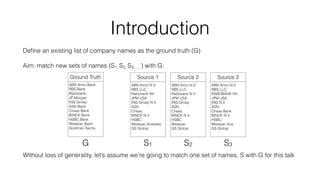
Define an existing list of company names as the ground truth (G)
Aim: match new sets of names (S1, S2, S3, … ) with G:
Without loss of generality, let’s assume we’re going to match one set of names, S with G for this talk
ABN Amro Bank
RBS Bank
Rabobank
JP Morgan
ING Groep
ASN Bank
Chase Bank
BINCK Bank
HSBC Bank
Westpac Bank
Goldman Sachs
ABN Amro N.V
RBS LLC
Rabobank NV
JPM USA
ING Groep N.V.
ASN
Chase
BINCK N.V
HSBC
Westpac Australia
GS Global
Source 1Ground Truth
ABN Amro N.V
RBS LLC
Rabobank N.V
JPM USA
ING Groep
ASN
Chase
BINCK N.V
HSBC
Westpac
GS Global
Source 2
ABN Amro N.V
RBS LLC
RABOBANK NV
JPM USA
ING N.V.
ASN
Chase Bank
BINCK N.V
HSBC
Westpac Aus
GS Global
Source 3
G S1 S2 S3
Introduction
Many ways to look at problem:
• Approximate string match problem
• Nearest Neighbour Search problem
• Pattern matching
• etc…
We need to find the “closest” name in G to match to every name in S
Reality
In our first case:
• G has 12 million names
• S ranges in length between 3000 and 5 mln names
To make matters worse:
• On average, a name is 31 characters long, containing ~4 words
• The world isn’t UTF8 compliant, we have over 160 characters
• Although there are limited duplicates in G, some companies have similar
names and have hierarchical structures which must be observed
Overview
• Introduction to problem
• Methods to solve problem
• Brute Force approach
• Metric tree approach
• Tokenised approach
• Current status
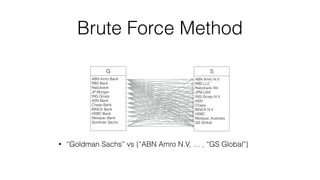
Brute Force Method
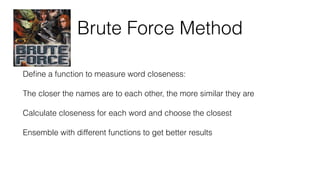
Define a function to measure word closeness:
The closer the names are to each other, the more similar they are
Calculate closeness for each word and choose the closest
Ensemble with different functions to get better results
Brute Force Method
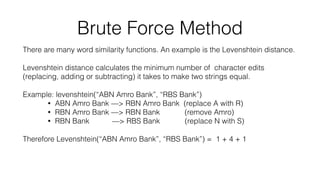
There are many word similarity functions. An example is the Levenshtein distance.
Levenshtein distance calculates the minimum number of character edits
(replacing, adding or subtracting) it takes to make two strings equal.
Example: levenshtein(“ABN Amro Bank”, “RBS Bank”)
• ABN Amro Bank —> RBN Amro Bank (replace A with R)
• RBN Amro Bank —> RBN Bank (remove Amro)
• RBN Bank —> RBS Bank (replace N with S)
Therefore Levenshtein(“ABN Amro Bank”, “RBS Bank”) = 1 + 4 + 1
Brute Force Method
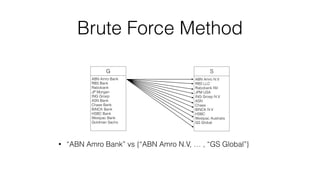
• “ABN Amro Bank” vs {“ABN Amro N.V, … , “GS Global”}
ABN Amro Bank
RBS Bank
Rabobank
JP Morgan
ING Groep
ASN Bank
Chase Bank
BINCK Bank
HSBC Bank
Westpac Bank
Goldman Sachs
ABN Amro N.V
RBS LLC
Rabobank NV
JPM USA
ING Groep N.V.
ASN
Chase
BINCK N.V
HSBC
Westpac Australia
GS Global
SG
Brute Force Method
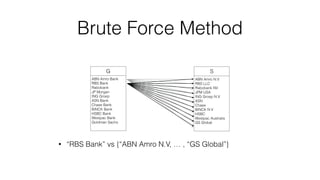
• “RBS Bank” vs {“ABN Amro N.V, … , “GS Global”}
ABN Amro Bank
RBS Bank
Rabobank
JP Morgan
ING Groep
ASN Bank
Chase Bank
BINCK Bank
HSBC Bank
Westpac Bank
Goldman Sachs
ABN Amro N.V
RBS LLC
Rabobank NV
JPM USA
ING Groep N.V.
ASN
Chase
BINCK N.V
HSBC
Westpac Australia
GS Global
SG
Brute Force Method
• “Goldman Sachs” vs {“ABN Amro N.V, … , “GS Global”}
ABN Amro Bank
RBS Bank
Rabobank
JP Morgan
ING Groep
ASN Bank
Chase Bank
BINCK Bank
HSBC Bank
Westpac Bank
Goldman Sachs
ABN Amro N.V
RBS LLC
Rabobank NV
JPM USA
ING Groep N.V.
ASN
Chase
BINCK N.V
HSBC
Westpac Australia
GS Global
SG
Brute force method
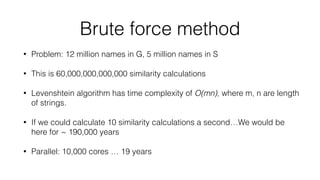
• Problem: 12 million names in G, 5 million names in S
• This is 60,000,000,000,000 similarity calculations
• Levenshtein algorithm has time complexity of O(mn), where m, n are length
of strings.
• If we could calculate 10 similarity calculations a second…We would be
here for ~ 190,000 years
• Parallel: 10,000 cores … 19 years
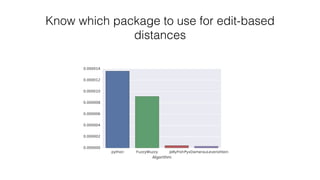
Know which package to use for edit-based
distances
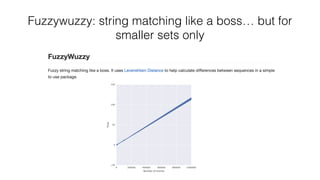
Fuzzywuzzy: string matching like a boss… but for
smaller sets only
Overview
• Introduction to problem
• Methods to solve problem
• Brute Force approach
• Metric tree approach
• Tokenised approach
• Current status
Metric Tree Method
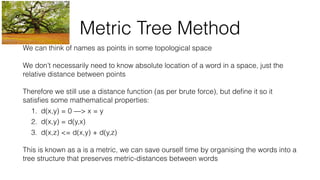
We can think of names as points in some topological space
We don’t necessarily need to know absolute location of a word in a space, just the
relative distance between points
Therefore we still use a distance function (as per brute force), but define it so it
satisfies some mathematical properties:
1. d(x,y) = 0 —> x = y
2. d(x,y) = d(y,x)
3. d(x,z) <= d(x,y) + d(y,z)
This is known as a is a metric, we can save ourself time by organising the words into a
tree structure that preserves metric-distances between words
Metric Tree Method
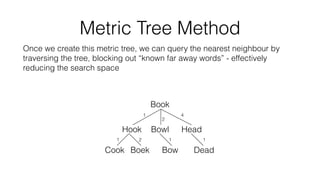
Once we create this metric tree, we can query the nearest neighbour by
traversing the tree, blocking out “known far away words” - effectively
reducing the search space
Book
BowlHook Head
Cook Boek Bow Dead
1
2
4
1 2 1 1
Metric Tree Method
Building the tree, is well feasible with ~2.7 mln different words - O(n log(n))
Typically, all words with distance of 1 determined in ~1 sec
Build + query time still years worth of calculation
• Added problem of making a tree in parallel
• Lots of space required
• Worst case performance is actually bad
Overview
• Introduction to problem
• Methods to solve problem
• Brute Force approach
• Metric tree approach
• Tokenised approach
• Current status
Tokenised Method
Break name up into components (tokenising)
Many different types of tokens available: words, grams
Do this for all names in both G and S (this creates two matrices [names x tokens])
Example: Indicator function word tokeniser:
ABN RBS BANK Rabobank NV
ABN Amro
Bank
1 0 1 0 0
RBS Bank 0 1 1 0 0
Rabobank NV 0 0 0 1 1
Tokenised Method
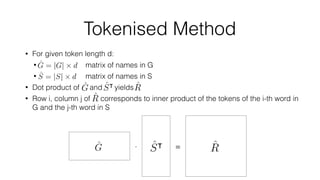
• For given token length d:
• matrix of names in G
• matrix of names in S
• Dot product of and yields
• Row i, column j of corresponds to inner product of the tokens of the i-th word in
G and the j-th word in S
=.
Tokenised Method
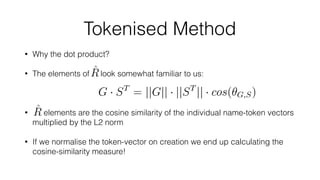
• Why the dot product?
• The elements of look somewhat familiar to us:
• elements are the cosine similarity of the individual name-token vectors
multiplied by the L2 norm
• If we normalise the token-vector on creation we end up calculating the
cosine-similarity measure!
Tokenised Method
• Same number of total comparisons as brute-force
• But inner-products are cheap to calculate
• Tokenised matrices can be computed offline cheaply
• Tokenised methods allow for vectorisation and allow for increased memory
and CPU efficiency
• We can even compute this on a GPU cluster
Overview
• Introduction to problem
• Methods to solve problem
• Brute Force approach
• Metric tree approach
• Tokenised approach
• Current status
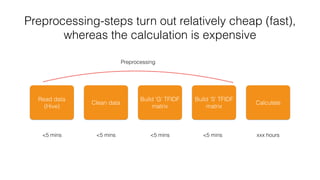
Preprocessing-steps turn out relatively cheap (fast),
whereas the calculation is expensive
Read data
(Hive)
Clean data
Build ‘G’ TFIDF
matrix
Build ‘S’ TFIDF
matrix
<5 mins <5 mins <5 mins xxx hours
Preprocessing
Calculate
<5 mins
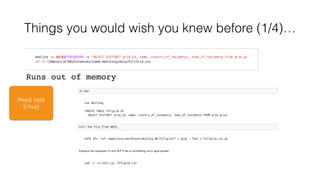
Things you would wish you knew before (1/4)…
Read data
(Hive)
Runs out of memory
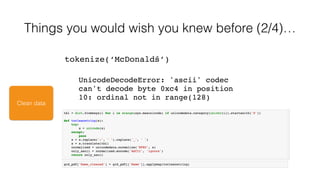
(or use Python 3.x ;))
Clean data
Things you would wish you knew before (2/4)…
tokenize(‘McDonaldś’)
Build ‘G’ TFIDF
matrix
Things you would wish you knew before (3/4)…
Standard token_pattern (‘(?u)bww+b’) ignores single letters
Use token_pattern (‘(?u)bw+b’) for ‘full’ tokenization
(token_pattern = u’(?u)S', ngram_range=(3, 3)) gives 3-gram matching
‘Taxibedrijf M. van Seben’ —> [‘Taxibedrijf’, ‘van’, ‘ Seben’ ]
Build ‘S’ TFIDF
matrix
Things you would wish you knew before (4/4)
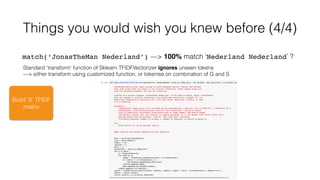
Standard ‘transform’ function of Sklearn TFIDFVectorizer ignores unseen tokens
—> either transform using customized function, or tokenise on combination of G and S
match(‘JonasTheMan Nederland’) —> 100% match ‘Nederland Nederland’ ?
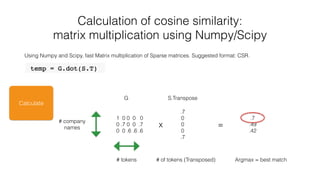
Calculation of cosine similarity:
matrix multiplication using Numpy/Scipy
Using Numpy and Scipy, fast Matrix multiplication of Sparse matrices. Suggested format: CSR.
.7
0
0
0
.7
1 0 0 0 0
0 .7 0 0 .7
0 0 .6 .6 .6
x
# tokens
# company
names
# of tokens (Transposed)
G S.Transpose
=
.7
.49
.42
Argmax = best match
Calculate
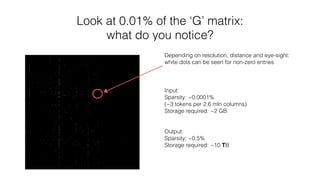
Look at 0.01% of the ‘G’ matrix:
what do you notice?
Input:
Sparsity: ~0.0001%
(~3 tokens per 2.6 mln columns)
Storage required: ~2 GB
Output:
Sparsity: ~0.5%
Storage required: ~10 TB
Depending on resolution, distance and eye-sight:
white dots can be seen for non-zero entries
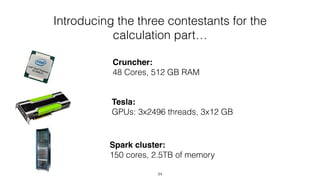
Cruncher:
48 Cores, 512 GB RAM
Tesla:
GPUs: 3x2496 threads, 3x12 GB
Spark cluster:
150 cores, 2.5TB of memory
34
Introducing the three contestants for the
calculation part…
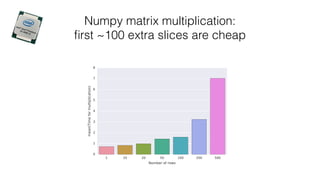
Numpy matrix multiplication:
first ~100 extra slices are cheap
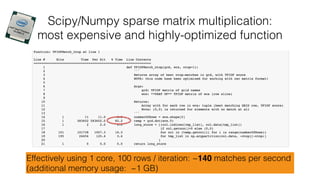
Scipy/Numpy sparse matrix multiplication:
most expensive and highly-optimized function
Effectively using 1 core, 100 rows / iteration: ~140 matches per second
(additional memory usage: ~1 GB)
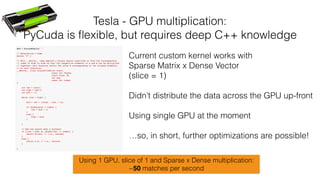
Tesla - GPU multiplication:
PyCuda is flexible, but requires deep C++ knowledge
Current custom kernel works with
Sparse Matrix x Dense Vector
(slice = 1)
Didn’t distribute the data across the GPU up-front
Using single GPU at the moment
…so, in short, further optimizations are possible!
Using 1 GPU, slice of 1 and Sparse x Dense multiplication:
~50 matches per second
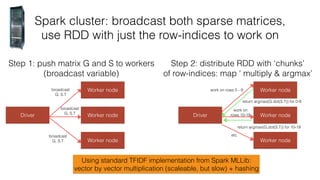
Spark cluster: broadcast both sparse matrices,
use RDD with just the row-indices to work on
Driver
Step 1: push matrix G and S to workers
(broadcast variable)
Worker node
Worker node
Worker node
Step 2: distribute RDD with ‘chunks’
of row-indices: map ‘ multiply & argmax’
broadcast
G, S.T
broadcast
G, S.T
broadcast
G, S.T
Driver
Worker node
Worker node
Worker node
work on rows 0 - 9
return argmax(G.dot(S.T)) for 0-9
work on
rows 10-19
return argmax(G.dot(S.T)) for 10-19
etc.
Using standard TFIDF implementation from Spark MLLib:
vector by vector multiplication (scaleable, but slow) + hashing
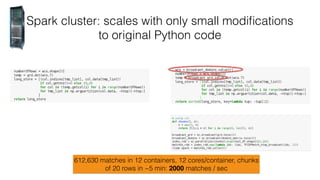
Spark cluster: scales with only small modifications
to original Python code
612,630 matches in 12 containers, 12 cores/container, chunks
of 20 rows in ~5 min: 2000 matches / sec
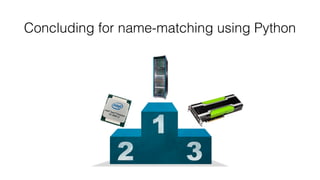
Concluding for name-matching using Python

PyData Amsterdam - Name Matching at Scale

  • 1.
    Name Matching atScale: CPU, GPU or SPARK? Wendell Kuling and Chris Broeren ING Wholesale Banking Advanced Analytics Team
  • 2.
  • 3.
    Overview • Introduction toproblem • Methods to solve problem • Brute Force approach • Metric tree approach • Tokenised approach • Current status
  • 4.
    Introduction Wholesale bank =dealing with companies Interested in different data sets about companies To join multiple data sets together, we need a common key: company name However one company may be called by different name: : McDonalds Corporation, McDonalds, McDonald’s Corp, etc… Therefore we need to match approximately similar names of companies together
  • 5.
    Introduction Define an existinglist of company names as the ground truth (G) Aim: match new sets of names (S1, S2, S3, … ) with G: Without loss of generality, let’s assume we’re going to match one set of names, S with G for this talk ABN Amro Bank RBS Bank Rabobank JP Morgan ING Groep ASN Bank Chase Bank BINCK Bank HSBC Bank Westpac Bank Goldman Sachs ABN Amro N.V RBS LLC Rabobank NV JPM USA ING Groep N.V. ASN Chase BINCK N.V HSBC Westpac Australia GS Global Source 1Ground Truth ABN Amro N.V RBS LLC Rabobank N.V JPM USA ING Groep ASN Chase BINCK N.V HSBC Westpac GS Global Source 2 ABN Amro N.V RBS LLC RABOBANK NV JPM USA ING N.V. ASN Chase Bank BINCK N.V HSBC Westpac Aus GS Global Source 3 G S1 S2 S3
  • 6.
    Introduction Many ways tolook at problem: • Approximate string match problem • Nearest Neighbour Search problem • Pattern matching • etc… We need to find the “closest” name in G to match to every name in S
  • 7.
    Reality In our firstcase: • G has 12 million names • S ranges in length between 3000 and 5 mln names To make matters worse: • On average, a name is 31 characters long, containing ~4 words • The world isn’t UTF8 compliant, we have over 160 characters • Although there are limited duplicates in G, some companies have similar names and have hierarchical structures which must be observed
  • 8.
    Overview • Introduction toproblem • Methods to solve problem • Brute Force approach • Metric tree approach • Tokenised approach • Current status
  • 9.
    Brute Force Method Definea function to measure word closeness: The closer the names are to each other, the more similar they are Calculate closeness for each word and choose the closest Ensemble with different functions to get better results
  • 10.
    Brute Force Method Thereare many word similarity functions. An example is the Levenshtein distance. Levenshtein distance calculates the minimum number of character edits (replacing, adding or subtracting) it takes to make two strings equal. Example: levenshtein(“ABN Amro Bank”, “RBS Bank”) • ABN Amro Bank —> RBN Amro Bank (replace A with R) • RBN Amro Bank —> RBN Bank (remove Amro) • RBN Bank —> RBS Bank (replace N with S) Therefore Levenshtein(“ABN Amro Bank”, “RBS Bank”) = 1 + 4 + 1
  • 11.
    Brute Force Method •“ABN Amro Bank” vs {“ABN Amro N.V, … , “GS Global”} ABN Amro Bank RBS Bank Rabobank JP Morgan ING Groep ASN Bank Chase Bank BINCK Bank HSBC Bank Westpac Bank Goldman Sachs ABN Amro N.V RBS LLC Rabobank NV JPM USA ING Groep N.V. ASN Chase BINCK N.V HSBC Westpac Australia GS Global SG
  • 12.
    Brute Force Method •“RBS Bank” vs {“ABN Amro N.V, … , “GS Global”} ABN Amro Bank RBS Bank Rabobank JP Morgan ING Groep ASN Bank Chase Bank BINCK Bank HSBC Bank Westpac Bank Goldman Sachs ABN Amro N.V RBS LLC Rabobank NV JPM USA ING Groep N.V. ASN Chase BINCK N.V HSBC Westpac Australia GS Global SG
  • 13.
    Brute Force Method •“Goldman Sachs” vs {“ABN Amro N.V, … , “GS Global”} ABN Amro Bank RBS Bank Rabobank JP Morgan ING Groep ASN Bank Chase Bank BINCK Bank HSBC Bank Westpac Bank Goldman Sachs ABN Amro N.V RBS LLC Rabobank NV JPM USA ING Groep N.V. ASN Chase BINCK N.V HSBC Westpac Australia GS Global SG
  • 14.
    Brute force method •Problem: 12 million names in G, 5 million names in S • This is 60,000,000,000,000 similarity calculations • Levenshtein algorithm has time complexity of O(mn), where m, n are length of strings. • If we could calculate 10 similarity calculations a second…We would be here for ~ 190,000 years • Parallel: 10,000 cores … 19 years
  • 15.
    Know which packageto use for edit-based distances
  • 16.
    Fuzzywuzzy: string matchinglike a boss… but for smaller sets only
  • 17.
    Overview • Introduction toproblem • Methods to solve problem • Brute Force approach • Metric tree approach • Tokenised approach • Current status
  • 18.
    Metric Tree Method Wecan think of names as points in some topological space We don’t necessarily need to know absolute location of a word in a space, just the relative distance between points Therefore we still use a distance function (as per brute force), but define it so it satisfies some mathematical properties: 1. d(x,y) = 0 —> x = y 2. d(x,y) = d(y,x) 3. d(x,z) <= d(x,y) + d(y,z) This is known as a is a metric, we can save ourself time by organising the words into a tree structure that preserves metric-distances between words
  • 19.
    Metric Tree Method Oncewe create this metric tree, we can query the nearest neighbour by traversing the tree, blocking out “known far away words” - effectively reducing the search space Book BowlHook Head Cook Boek Bow Dead 1 2 4 1 2 1 1
  • 20.
    Metric Tree Method Buildingthe tree, is well feasible with ~2.7 mln different words - O(n log(n)) Typically, all words with distance of 1 determined in ~1 sec Build + query time still years worth of calculation • Added problem of making a tree in parallel • Lots of space required • Worst case performance is actually bad
  • 21.
    Overview • Introduction toproblem • Methods to solve problem • Brute Force approach • Metric tree approach • Tokenised approach • Current status
  • 22.
    Tokenised Method Break nameup into components (tokenising) Many different types of tokens available: words, grams Do this for all names in both G and S (this creates two matrices [names x tokens]) Example: Indicator function word tokeniser: ABN RBS BANK Rabobank NV ABN Amro Bank 1 0 1 0 0 RBS Bank 0 1 1 0 0 Rabobank NV 0 0 0 1 1
  • 23.
    Tokenised Method • Forgiven token length d: • matrix of names in G • matrix of names in S • Dot product of and yields • Row i, column j of corresponds to inner product of the tokens of the i-th word in G and the j-th word in S =.
  • 24.
    Tokenised Method • Whythe dot product? • The elements of look somewhat familiar to us: • elements are the cosine similarity of the individual name-token vectors multiplied by the L2 norm • If we normalise the token-vector on creation we end up calculating the cosine-similarity measure!
  • 25.
    Tokenised Method • Samenumber of total comparisons as brute-force • But inner-products are cheap to calculate • Tokenised matrices can be computed offline cheaply • Tokenised methods allow for vectorisation and allow for increased memory and CPU efficiency • We can even compute this on a GPU cluster
  • 26.
    Overview • Introduction toproblem • Methods to solve problem • Brute Force approach • Metric tree approach • Tokenised approach • Current status
  • 27.
    Preprocessing-steps turn outrelatively cheap (fast), whereas the calculation is expensive Read data (Hive) Clean data Build ‘G’ TFIDF matrix Build ‘S’ TFIDF matrix <5 mins <5 mins <5 mins xxx hours Preprocessing Calculate <5 mins
  • 28.
    Things you wouldwish you knew before (1/4)… Read data (Hive) Runs out of memory
  • 29.
    (or use Python3.x ;)) Clean data Things you would wish you knew before (2/4)… tokenize(‘McDonaldś’)
  • 30.
    Build ‘G’ TFIDF matrix Thingsyou would wish you knew before (3/4)… Standard token_pattern (‘(?u)bww+b’) ignores single letters Use token_pattern (‘(?u)bw+b’) for ‘full’ tokenization (token_pattern = u’(?u)S', ngram_range=(3, 3)) gives 3-gram matching ‘Taxibedrijf M. van Seben’ —> [‘Taxibedrijf’, ‘van’, ‘ Seben’ ]
  • 31.
    Build ‘S’ TFIDF matrix Thingsyou would wish you knew before (4/4) Standard ‘transform’ function of Sklearn TFIDFVectorizer ignores unseen tokens —> either transform using customized function, or tokenise on combination of G and S match(‘JonasTheMan Nederland’) —> 100% match ‘Nederland Nederland’ ?
  • 32.
    Calculation of cosinesimilarity: matrix multiplication using Numpy/Scipy Using Numpy and Scipy, fast Matrix multiplication of Sparse matrices. Suggested format: CSR. .7 0 0 0 .7 1 0 0 0 0 0 .7 0 0 .7 0 0 .6 .6 .6 x # tokens # company names # of tokens (Transposed) G S.Transpose = .7 .49 .42 Argmax = best match Calculate
  • 33.
    Look at 0.01%of the ‘G’ matrix: what do you notice? Input: Sparsity: ~0.0001% (~3 tokens per 2.6 mln columns) Storage required: ~2 GB Output: Sparsity: ~0.5% Storage required: ~10 TB Depending on resolution, distance and eye-sight: white dots can be seen for non-zero entries
  • 34.
    Cruncher: 48 Cores, 512GB RAM Tesla: GPUs: 3x2496 threads, 3x12 GB Spark cluster: 150 cores, 2.5TB of memory 34 Introducing the three contestants for the calculation part…
  • 35.
    Numpy matrix multiplication: first~100 extra slices are cheap
  • 36.
    Scipy/Numpy sparse matrixmultiplication: most expensive and highly-optimized function Effectively using 1 core, 100 rows / iteration: ~140 matches per second (additional memory usage: ~1 GB)
  • 37.
    Tesla - GPUmultiplication: PyCuda is flexible, but requires deep C++ knowledge Current custom kernel works with Sparse Matrix x Dense Vector (slice = 1) Didn’t distribute the data across the GPU up-front Using single GPU at the moment …so, in short, further optimizations are possible! Using 1 GPU, slice of 1 and Sparse x Dense multiplication: ~50 matches per second
  • 38.
    Spark cluster: broadcastboth sparse matrices, use RDD with just the row-indices to work on Driver Step 1: push matrix G and S to workers (broadcast variable) Worker node Worker node Worker node Step 2: distribute RDD with ‘chunks’ of row-indices: map ‘ multiply & argmax’ broadcast G, S.T broadcast G, S.T broadcast G, S.T Driver Worker node Worker node Worker node work on rows 0 - 9 return argmax(G.dot(S.T)) for 0-9 work on rows 10-19 return argmax(G.dot(S.T)) for 10-19 etc. Using standard TFIDF implementation from Spark MLLib: vector by vector multiplication (scaleable, but slow) + hashing
  • 39.
    Spark cluster: scaleswith only small modifications to original Python code 612,630 matches in 12 containers, 12 cores/container, chunks of 20 rows in ~5 min: 2000 matches / sec
  • 40.