International Research Journal of Engineering and Technology (IRJET) e-ISSN: 2395-0056
Volume: 10 Issue: 12 | Dec 2023 www.irjet.net p-ISSN: 2395-0072
© 2023, IRJET | Impact Factor value: 8.226 | ISO 9001:2008 Certified Journal | Page 910
DEEP LEARNING APPROACH FOR SUSPICIOUS ACTIVITY DETECTION
FROM SURVEILLANCE VIDEO
Vedant Saikhede1, Kiran Shende2, Yuvraj Darekar3 , Hemant Thorat4
Prof. Snehal. S. Shinde5
1,2,3,4Student, Department of Information Technology, Smt. Kashibai Navale College Engineering, Pune 411041
5 Assistant Professor, Dept. of Information Technology, Smt. Kashibai Navale College Engineering, Pune 411041
---------------------------------------------------------------------***---------------------------------------------------------------------
Abstract - Suspicious Activity is predicting the body part
or joint locations of a person from an image or a video. This
project will entail detecting suspicious human activity from
real-time CCTV footage using neural networks. Human
suspicious activity is one of the key problems in computer
vision that has been studied for more than 15 years. It is
important because of the sheer number of applications that
can benefit from Activity detection. For example, human
pose estimation is used in applications including video
surveillance, animal tracking, behavior understanding, sign
language detection, advanced human-computer interaction,
and marker less motion cap turning. Low-cost depth sensors
have limitations limited to indoor use, and their low
resolution and noisy depth information make it difficult to
estimate human poses from depth images. Hence, we plan to
use neural networks to overcome these problems. Suspicious
human activity recognition from surveillance video is an
active research area of image processing and computer
vision. Through visual surveillance, human activities can be
monitored in sensitive and public areas such as bus stations,
railway stations, airports, banks, shopping malls, schools
and colleges, parking lots, roads, etc. to prevent terrorism,
theft, accidents, and illegal parking, vandalism, fighting,
chain snatching, crime, and other suspicious activities. It is
very difficult to watch public places continuously, therefore
intelligent video surveillance is required that can monitor
human activities in real time and categorize them as usual
and unusual activities and can generate an alert. Mostly, the
research being carried out is on images and not videos. Also,
none of the papers published tries to use CNNs to detect
suspicious activities.
Key Words: Suspicious Activity, Neural networks, Image
processing, surveillance video.
1. INTRODUCTION
In today's digital age, ensuring public safety has emerged
as a paramount concern, with intelligent video
surveillance systems playing a pivotal role. Detecting and
predicting suspicious human activity from real-time CCTV
footage has become a focal point of research in the domain
of computer vision and artificial intelligence. This research
paper delves into the multifaceted realm of neural
network-based technology and its application in
addressing the critical issue of suspicious human activity
detection, focusing primarily on video surveillance.
Overcoming the Limitations of Depth Sensors: While low-
cost depth sensors have paved the way for advanced
human pose estimation, their limitations are apparent,
particularly in terms of being confined to indoor usage and
offering low-resolution and noisy depth information. This
paper presents a novel approach that leverages neural
networks to surmount these constraints, resulting in more
accurate and robust human pose estimation. Real-World
Applications: The research primarily addresses the
domain of suspicious human activity recognition in video
surveillance, an actively evolving field within image
processing and computer vision. Through the lens of
visual surveillance, human behavior in sensitive and
public areas, including transportation hubs, commercial
establishments, and educational institutions, is closely
monitored. This proactive approach serves as a deterrent
to a wide spectrum of potential threats, ranging from
terrorism and theft to accidents and illegal activities. The
Need for Intelligent Video Surveillance: Continuous,
manual surveillance of public spaces is a formidable
challenge. This research advocates for the integration of
intelligent video surveillance systems equipped with
neural networks, capable of real-time monitoring and
categorization of human activities as either usual or
unusual. Furthermore, these systems are poised to
generate alerts, ensuring a swift response to suspicious
behavior Addressing the Gap in Research: It's noteworthy
that while extensive research has focused on image-based
activity detection, the application of Convolutional Neural
Networks.
2. PROBLEM STATEMENT
Recognition of the criminal and preventing suspicious
activities during Examination using CCTV footage.
3. MOTIVATION
The motivation behind developing a Suspicious Activity
Detection System (SADS) utilizing Convolutional Neural
Networks (CNNs) as input for video analysis is rooted in
the urgent need for advanced security measures in today's
International Research Journal of Engineering and Technology (IRJET) e-ISSN: 2395-0056
Volume: 10 Issue: 12 | Dec 2023 www.irjet.net p-ISSN: 2395-0072
© 2023, IRJET | Impact Factor value: 8.226 | ISO 9001:2008 Certified Journal | Page 911
complex and rapidly evolving world. Traditional security
systems often struggle to keep pace with emerging threats,
making it essential to harness the capabilities of AI and
deep learning technologies. SADS aims to provide a
proactive and intelligent solution that goes beyond
conventional surveillance methods. By employing CNNs,
which excel at recognizing patterns and anomalies in
visual data, this system can automatically identify
suspicious activities that might otherwise go unnoticed.
The motivation behind SADS is to enhance public safety,
protect critical infrastructure, and improve overall
security by enabling rapid response to potential threats.
Whether in crowded public spaces or high-security
facilities, this innovative system offers the promise of a
more secure and vigilant environment, ultimately
contributing to the well-being and peace of mind of
individuals and organizations alike. In an era were
security.
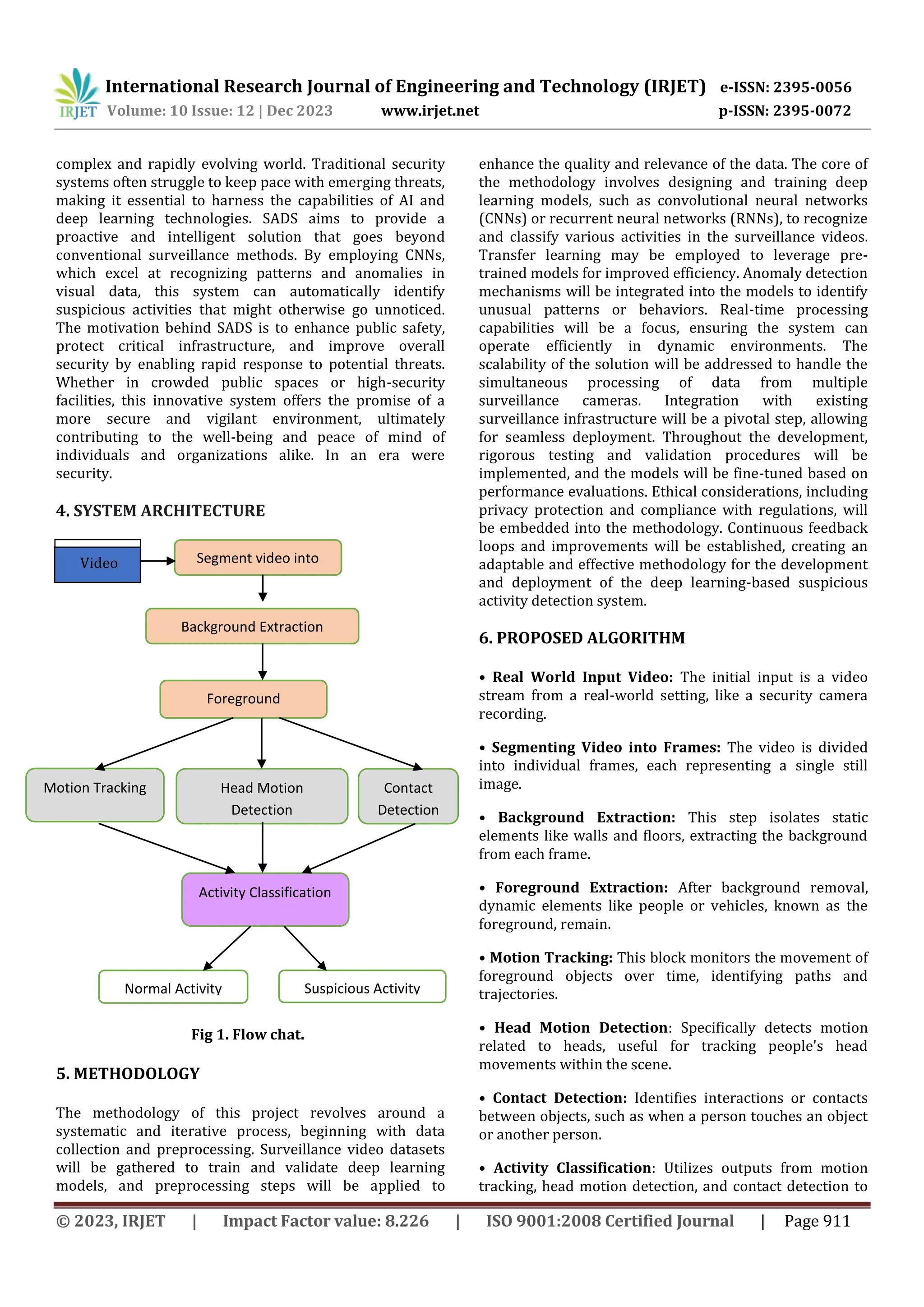
4. SYSTEM ARCHITECTURE
Fig 1. Flow chat.
5. METHODOLOGY
The methodology of this project revolves around a
systematic and iterative process, beginning with data
collection and preprocessing. Surveillance video datasets
will be gathered to train and validate deep learning
models, and preprocessing steps will be applied to
enhance the quality and relevance of the data. The core of
the methodology involves designing and training deep
learning models, such as convolutional neural networks
(CNNs) or recurrent neural networks (RNNs), to recognize
and classify various activities in the surveillance videos.
Transfer learning may be employed to leverage pre-
trained models for improved efficiency. Anomaly detection
mechanisms will be integrated into the models to identify
unusual patterns or behaviors. Real-time processing
capabilities will be a focus, ensuring the system can
operate efficiently in dynamic environments. The
scalability of the solution will be addressed to handle the
simultaneous processing of data from multiple
surveillance cameras. Integration with existing
surveillance infrastructure will be a pivotal step, allowing
for seamless deployment. Throughout the development,
rigorous testing and validation procedures will be
implemented, and the models will be fine-tuned based on
performance evaluations. Ethical considerations, including
privacy protection and compliance with regulations, will
be embedded into the methodology. Continuous feedback
loops and improvements will be established, creating an
adaptable and effective methodology for the development
and deployment of the deep learning-based suspicious
activity detection system.
6. PROPOSED ALGORITHM
• Real World Input Video: The initial input is a video
stream from a real-world setting, like a security camera
recording.
• Segmenting Video into Frames: The video is divided
into individual frames, each representing a single still
image.
• Background Extraction: This step isolates static
elements like walls and floors, extracting the background
from each frame.
• Foreground Extraction: After background removal,
dynamic elements like people or vehicles, known as the
foreground, remain.
• Motion Tracking: This block monitors the movement of
foreground objects over time, identifying paths and
trajectories.
• Head Motion Detection: Specifically detects motion
related to heads, useful for tracking people's head
movements within the scene.
• Contact Detection: Identifies interactions or contacts
between objects, such as when a person touches an object
or another person.
• Activity Classification: Utilizes outputs from motion
tracking, head motion detection, and contact detection to
Suspicious Activity
Contact
Detection
Normal Activity
Segment video into
frames
Background Extraction
Head Motion
Detection
Motion Tracking
Foreground
Extraction
Activity Classification
Video
International Research Journal of Engineering and Technology (IRJET) e-ISSN: 2395-0056
Volume: 10 Issue: 12 | Dec 2023 www.irjet.net p-ISSN: 2395-0072
© 2023, IRJET | Impact Factor value: 8.226 | ISO 9001:2008 Certified Journal | Page 912
classify overall scene activity, potentially using machine
learning algorithms.
• Normal Activity: If classified as "normal," observed
behavior aligns with expected, routine patterns, like
walking or standing.
• Suspicious Activity: If classified as "suspicious,"
observed behavior deviates from normal, including actions
like running, fighting, or other potentially dangerous or
unusual activities.
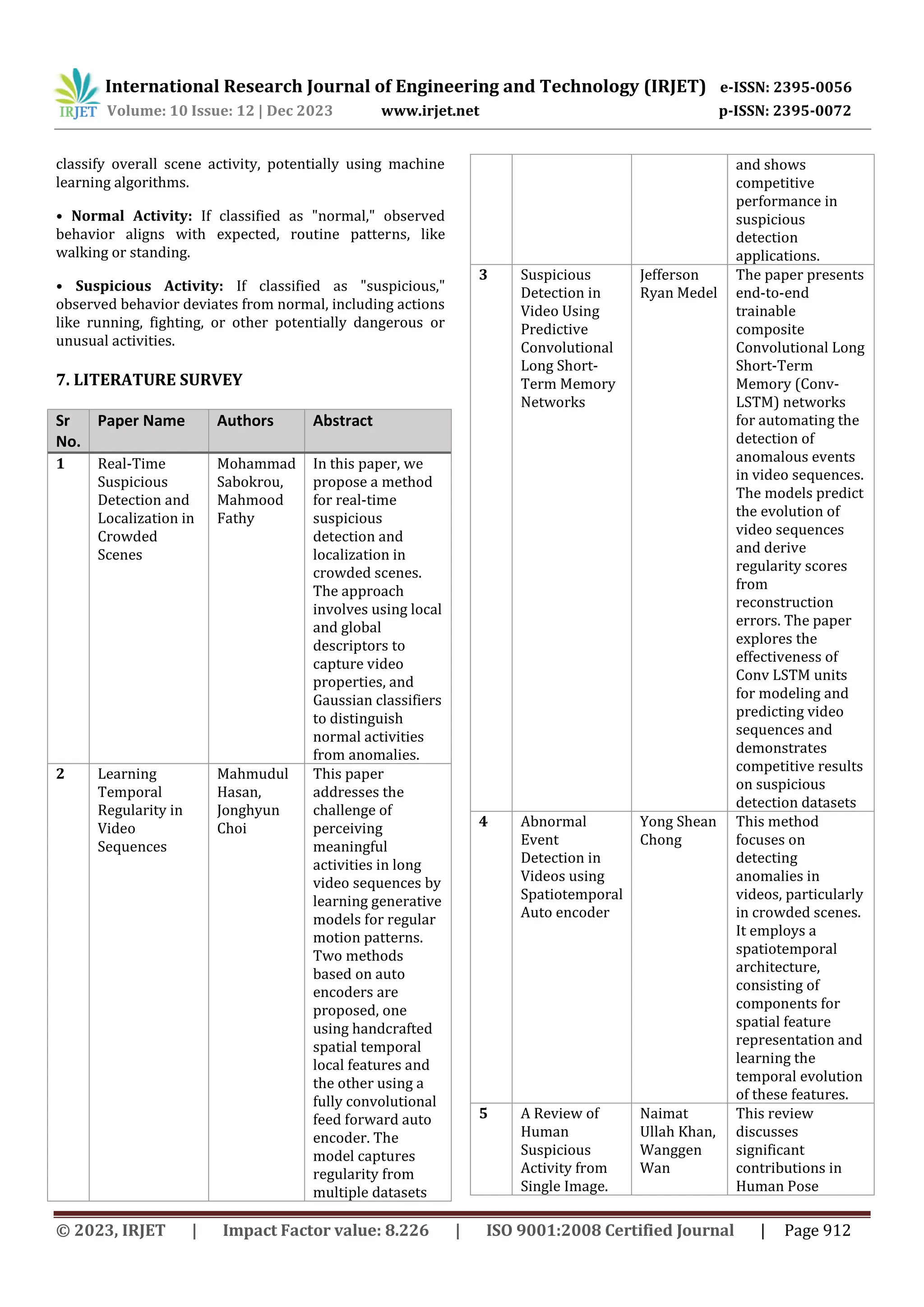
7. LITERATURE SURVEY
Sr
No.
Paper Name Authors Abstract
1 Real-Time
Suspicious
Detection and
Localization in
Crowded
Scenes
Mohammad
Sabokrou,
Mahmood
Fathy
In this paper, we
propose a method
for real-time
suspicious
detection and
localization in
crowded scenes.
The approach
involves using local
and global
descriptors to
capture video
properties, and
Gaussian classifiers
to distinguish
normal activities
from anomalies.
2 Learning
Temporal
Regularity in
Video
Sequences
Mahmudul
Hasan,
Jonghyun
Choi
This paper
addresses the
challenge of
perceiving
meaningful
activities in long
video sequences by
learning generative
models for regular
motion patterns.
Two methods
based on auto
encoders are
proposed, one
using handcrafted
spatial temporal
local features and
the other using a
fully convolutional
feed forward auto
encoder. The
model captures
regularity from
multiple datasets
and shows
competitive
performance in
suspicious
detection
applications.
3 Suspicious
Detection in
Video Using
Predictive
Convolutional
Long Short-
Term Memory
Networks
Jefferson
Ryan Medel
The paper presents
end-to-end
trainable
composite
Convolutional Long
Short-Term
Memory (Conv-
LSTM) networks
for automating the
detection of
anomalous events
in video sequences.
The models predict
the evolution of
video sequences
and derive
regularity scores
from
reconstruction
errors. The paper
explores the
effectiveness of
Conv LSTM units
for modeling and
predicting video
sequences and
demonstrates
competitive results
on suspicious
detection datasets
4 Abnormal
Event
Detection in
Videos using
Spatiotemporal
Auto encoder
Yong Shean
Chong
This method
focuses on
detecting
anomalies in
videos, particularly
in crowded scenes.
It employs a
spatiotemporal
architecture,
consisting of
components for
spatial feature
representation and
learning the
temporal evolution
of these features.
5 A Review of
Human
Suspicious
Activity from
Single Image.
Naimat
Ullah Khan,
Wanggen
Wan
This review
discusses
significant
contributions in
Human Pose
International Research Journal of Engineering and Technology (IRJET) e-ISSN: 2395-0056
Volume: 10 Issue: 12 | Dec 2023 www.irjet.net p-ISSN: 2395-0072
© 2023, IRJET | Impact Factor value: 8.226 | ISO 9001:2008 Certified Journal | Page 913
Estimation
methods from
single two-
dimensional
images. It covers
traditional pictorial
structures, Deep
Neural Networks,
and the Stacked
Hourglass
approach. The
paper provides a
comprehensive
study of influential
deep learning
methods for
human pose
estimation, starting
from the earliest
practical models
and progressing to
the most recent
advancements.
8. CONCLUSION
A system to process real-time CCTV footage to detect any
suspicious activity will help to create better security and
less human intervention. Great strides have been made in
the field of human Suspicious Activity, which enables us to
better serve the myriad applications that are possible with
it. Moreover, research in related fields such as Activity
Tracking can greatly enhance its productive utilization in
several fields.
ACKNOWLEDGEMENT
I wish to express my sincere thanks and deep Sense of
gratitude to my respected mentor and guide.
Prof.S.S.Shinde Assistant Professor in Department of
Information Technology of Smt. Kashibai Navale College
Engineering, Pune-41 for the technical advice,
encouragement and constructive criticism, which
motivated to strive harder for excellence
REFERENCES
[1] Naimat Ullah Khan, Wangen Wan: “A Review of
Human Pose Estimation from Single Image”- 978-1-
5386-5195-7/18/ 2018 IEEE
[2] Qiuhui Chen, Chongyang Zhang, Weiwei Liu, and Dan
Wang,” Surveillance Human Pose Dataset and
Performance Evaluation for Coarse-Grained Pose
Estimation”, Athens 2018.
[3] E. Eksioglu. Decoupled algorithm for MRI
reconstruction using nonlocal block matching model:
BM3DMRI. Journal of Mathematical Imaging and
Vision, 56(3):430–440, 2016.
[4] Y. Yang, J. Sun, H. Li, and Z. Xu. Deep ADMM-Net for
compressive sensing
[5] MRI. In Advances in Neural Information Processing
Systems, pages 10–18, 2016.
[6] P.Bhagya Divya, S.Shalini, R.Deepa, Baddeli Sravya
Reddy,“Inspection of suspicious human activity in the
crowdsourced areas captured in surveillance
cameras”, International Research Journal of
Engineering and Technology (IRJET), December 2017.
[7] Jitendra Musale,Akshata Gavhane, Liyakat Shaikh,
Pournima Hagwane, Snehalata Tadge, “Suspicious
Movement Detection and Tracking of Human Behavior
and Object with Fire Detection using A Closed Circuit
TV (CCTV) cameras ”, International Journal for
Research in Applied Science & Engineering
Technology (IJRASET) Volume 5 Issue XII December
2017.
[8] U.M.Kamthe,C.G.Patil “Suspicious Activity Recognition
in Video Surveillance System”, Fourth International
Conference on Computing Communication Control
and Automation (ICCUBEA), 2018.
[9] Zahraa Kain, Abir Youness, Ismail El Sayad, Samih
Abdul-Nabi, Hussein Kassem, “Detecting Abnormal
Events in University Areas”, International conference
on Computer and Application,2018.
[10] Tian Wanga, Meina Qia, Yingjun Deng, Yi Zhouc, Huan
Wangd, Qi Lyua, Hichem Snoussie, “Abnormal event
detection based on analysis of movement information
of video sequence”, Article-Optik, vol-152, January-
2018.
BIOGRAPHIES
Mr. Vedant. U. Saikhede
B.E Information Technology
Smt. Kashibai Navale College
Engineering, Pune 41
Maharashtra, India
Mr. Kiran Shende
B.E Information Technology
Smt. Kashibai Navale College
Engineering, Pune 41
Maharashtra, India
International Research Journal of Engineering and Technology (IRJET) e-ISSN: 2395-0056
Volume: 10 Issue: 12 | Dec 2023 www.irjet.net p-ISSN: 2395-0072
© 2023, IRJET | Impact Factor value: 8.226 | ISO 9001:2008 Certified Journal | Page 914
Mr. Yuvraj Darekar
B.E Information Technology
Smt. Kashibai Navale College
Engineering, Pune 41
Maharashtra, India
Mr. Hemant Thorat
B.E Information Technology
Smt. Kashibai Navale College
Engineering, Pune 41
Maharashtra, India
Prof. S.S.Shinde
Assistant Professor
Dept. of Information Technology
Smt. Kashibai Navale College
Engineering, Pune 41
Maharashtra, India

DEEP LEARNING APPROACH FOR SUSPICIOUS ACTIVITY DETECTION FROM SURVEILLANCE VIDEO

  • 1.
    International Research Journalof Engineering and Technology (IRJET) e-ISSN: 2395-0056 Volume: 10 Issue: 12 | Dec 2023 www.irjet.net p-ISSN: 2395-0072 © 2023, IRJET | Impact Factor value: 8.226 | ISO 9001:2008 Certified Journal | Page 910 DEEP LEARNING APPROACH FOR SUSPICIOUS ACTIVITY DETECTION FROM SURVEILLANCE VIDEO Vedant Saikhede1, Kiran Shende2, Yuvraj Darekar3 , Hemant Thorat4 Prof. Snehal. S. Shinde5 1,2,3,4Student, Department of Information Technology, Smt. Kashibai Navale College Engineering, Pune 411041 5 Assistant Professor, Dept. of Information Technology, Smt. Kashibai Navale College Engineering, Pune 411041 ---------------------------------------------------------------------***--------------------------------------------------------------------- Abstract - Suspicious Activity is predicting the body part or joint locations of a person from an image or a video. This project will entail detecting suspicious human activity from real-time CCTV footage using neural networks. Human suspicious activity is one of the key problems in computer vision that has been studied for more than 15 years. It is important because of the sheer number of applications that can benefit from Activity detection. For example, human pose estimation is used in applications including video surveillance, animal tracking, behavior understanding, sign language detection, advanced human-computer interaction, and marker less motion cap turning. Low-cost depth sensors have limitations limited to indoor use, and their low resolution and noisy depth information make it difficult to estimate human poses from depth images. Hence, we plan to use neural networks to overcome these problems. Suspicious human activity recognition from surveillance video is an active research area of image processing and computer vision. Through visual surveillance, human activities can be monitored in sensitive and public areas such as bus stations, railway stations, airports, banks, shopping malls, schools and colleges, parking lots, roads, etc. to prevent terrorism, theft, accidents, and illegal parking, vandalism, fighting, chain snatching, crime, and other suspicious activities. It is very difficult to watch public places continuously, therefore intelligent video surveillance is required that can monitor human activities in real time and categorize them as usual and unusual activities and can generate an alert. Mostly, the research being carried out is on images and not videos. Also, none of the papers published tries to use CNNs to detect suspicious activities. Key Words: Suspicious Activity, Neural networks, Image processing, surveillance video. 1. INTRODUCTION In today's digital age, ensuring public safety has emerged as a paramount concern, with intelligent video surveillance systems playing a pivotal role. Detecting and predicting suspicious human activity from real-time CCTV footage has become a focal point of research in the domain of computer vision and artificial intelligence. This research paper delves into the multifaceted realm of neural network-based technology and its application in addressing the critical issue of suspicious human activity detection, focusing primarily on video surveillance. Overcoming the Limitations of Depth Sensors: While low- cost depth sensors have paved the way for advanced human pose estimation, their limitations are apparent, particularly in terms of being confined to indoor usage and offering low-resolution and noisy depth information. This paper presents a novel approach that leverages neural networks to surmount these constraints, resulting in more accurate and robust human pose estimation. Real-World Applications: The research primarily addresses the domain of suspicious human activity recognition in video surveillance, an actively evolving field within image processing and computer vision. Through the lens of visual surveillance, human behavior in sensitive and public areas, including transportation hubs, commercial establishments, and educational institutions, is closely monitored. This proactive approach serves as a deterrent to a wide spectrum of potential threats, ranging from terrorism and theft to accidents and illegal activities. The Need for Intelligent Video Surveillance: Continuous, manual surveillance of public spaces is a formidable challenge. This research advocates for the integration of intelligent video surveillance systems equipped with neural networks, capable of real-time monitoring and categorization of human activities as either usual or unusual. Furthermore, these systems are poised to generate alerts, ensuring a swift response to suspicious behavior Addressing the Gap in Research: It's noteworthy that while extensive research has focused on image-based activity detection, the application of Convolutional Neural Networks. 2. PROBLEM STATEMENT Recognition of the criminal and preventing suspicious activities during Examination using CCTV footage. 3. MOTIVATION The motivation behind developing a Suspicious Activity Detection System (SADS) utilizing Convolutional Neural Networks (CNNs) as input for video analysis is rooted in the urgent need for advanced security measures in today's
  • 2.
    International Research Journalof Engineering and Technology (IRJET) e-ISSN: 2395-0056 Volume: 10 Issue: 12 | Dec 2023 www.irjet.net p-ISSN: 2395-0072 © 2023, IRJET | Impact Factor value: 8.226 | ISO 9001:2008 Certified Journal | Page 911 complex and rapidly evolving world. Traditional security systems often struggle to keep pace with emerging threats, making it essential to harness the capabilities of AI and deep learning technologies. SADS aims to provide a proactive and intelligent solution that goes beyond conventional surveillance methods. By employing CNNs, which excel at recognizing patterns and anomalies in visual data, this system can automatically identify suspicious activities that might otherwise go unnoticed. The motivation behind SADS is to enhance public safety, protect critical infrastructure, and improve overall security by enabling rapid response to potential threats. Whether in crowded public spaces or high-security facilities, this innovative system offers the promise of a more secure and vigilant environment, ultimately contributing to the well-being and peace of mind of individuals and organizations alike. In an era were security. 4. SYSTEM ARCHITECTURE Fig 1. Flow chat. 5. METHODOLOGY The methodology of this project revolves around a systematic and iterative process, beginning with data collection and preprocessing. Surveillance video datasets will be gathered to train and validate deep learning models, and preprocessing steps will be applied to enhance the quality and relevance of the data. The core of the methodology involves designing and training deep learning models, such as convolutional neural networks (CNNs) or recurrent neural networks (RNNs), to recognize and classify various activities in the surveillance videos. Transfer learning may be employed to leverage pre- trained models for improved efficiency. Anomaly detection mechanisms will be integrated into the models to identify unusual patterns or behaviors. Real-time processing capabilities will be a focus, ensuring the system can operate efficiently in dynamic environments. The scalability of the solution will be addressed to handle the simultaneous processing of data from multiple surveillance cameras. Integration with existing surveillance infrastructure will be a pivotal step, allowing for seamless deployment. Throughout the development, rigorous testing and validation procedures will be implemented, and the models will be fine-tuned based on performance evaluations. Ethical considerations, including privacy protection and compliance with regulations, will be embedded into the methodology. Continuous feedback loops and improvements will be established, creating an adaptable and effective methodology for the development and deployment of the deep learning-based suspicious activity detection system. 6. PROPOSED ALGORITHM • Real World Input Video: The initial input is a video stream from a real-world setting, like a security camera recording. • Segmenting Video into Frames: The video is divided into individual frames, each representing a single still image. • Background Extraction: This step isolates static elements like walls and floors, extracting the background from each frame. • Foreground Extraction: After background removal, dynamic elements like people or vehicles, known as the foreground, remain. • Motion Tracking: This block monitors the movement of foreground objects over time, identifying paths and trajectories. • Head Motion Detection: Specifically detects motion related to heads, useful for tracking people's head movements within the scene. • Contact Detection: Identifies interactions or contacts between objects, such as when a person touches an object or another person. • Activity Classification: Utilizes outputs from motion tracking, head motion detection, and contact detection to Suspicious Activity Contact Detection Normal Activity Segment video into frames Background Extraction Head Motion Detection Motion Tracking Foreground Extraction Activity Classification Video
  • 3.
    International Research Journalof Engineering and Technology (IRJET) e-ISSN: 2395-0056 Volume: 10 Issue: 12 | Dec 2023 www.irjet.net p-ISSN: 2395-0072 © 2023, IRJET | Impact Factor value: 8.226 | ISO 9001:2008 Certified Journal | Page 912 classify overall scene activity, potentially using machine learning algorithms. • Normal Activity: If classified as "normal," observed behavior aligns with expected, routine patterns, like walking or standing. • Suspicious Activity: If classified as "suspicious," observed behavior deviates from normal, including actions like running, fighting, or other potentially dangerous or unusual activities. 7. LITERATURE SURVEY Sr No. Paper Name Authors Abstract 1 Real-Time Suspicious Detection and Localization in Crowded Scenes Mohammad Sabokrou, Mahmood Fathy In this paper, we propose a method for real-time suspicious detection and localization in crowded scenes. The approach involves using local and global descriptors to capture video properties, and Gaussian classifiers to distinguish normal activities from anomalies. 2 Learning Temporal Regularity in Video Sequences Mahmudul Hasan, Jonghyun Choi This paper addresses the challenge of perceiving meaningful activities in long video sequences by learning generative models for regular motion patterns. Two methods based on auto encoders are proposed, one using handcrafted spatial temporal local features and the other using a fully convolutional feed forward auto encoder. The model captures regularity from multiple datasets and shows competitive performance in suspicious detection applications. 3 Suspicious Detection in Video Using Predictive Convolutional Long Short- Term Memory Networks Jefferson Ryan Medel The paper presents end-to-end trainable composite Convolutional Long Short-Term Memory (Conv- LSTM) networks for automating the detection of anomalous events in video sequences. The models predict the evolution of video sequences and derive regularity scores from reconstruction errors. The paper explores the effectiveness of Conv LSTM units for modeling and predicting video sequences and demonstrates competitive results on suspicious detection datasets 4 Abnormal Event Detection in Videos using Spatiotemporal Auto encoder Yong Shean Chong This method focuses on detecting anomalies in videos, particularly in crowded scenes. It employs a spatiotemporal architecture, consisting of components for spatial feature representation and learning the temporal evolution of these features. 5 A Review of Human Suspicious Activity from Single Image. Naimat Ullah Khan, Wanggen Wan This review discusses significant contributions in Human Pose
  • 4.
    International Research Journalof Engineering and Technology (IRJET) e-ISSN: 2395-0056 Volume: 10 Issue: 12 | Dec 2023 www.irjet.net p-ISSN: 2395-0072 © 2023, IRJET | Impact Factor value: 8.226 | ISO 9001:2008 Certified Journal | Page 913 Estimation methods from single two- dimensional images. It covers traditional pictorial structures, Deep Neural Networks, and the Stacked Hourglass approach. The paper provides a comprehensive study of influential deep learning methods for human pose estimation, starting from the earliest practical models and progressing to the most recent advancements. 8. CONCLUSION A system to process real-time CCTV footage to detect any suspicious activity will help to create better security and less human intervention. Great strides have been made in the field of human Suspicious Activity, which enables us to better serve the myriad applications that are possible with it. Moreover, research in related fields such as Activity Tracking can greatly enhance its productive utilization in several fields. ACKNOWLEDGEMENT I wish to express my sincere thanks and deep Sense of gratitude to my respected mentor and guide. Prof.S.S.Shinde Assistant Professor in Department of Information Technology of Smt. Kashibai Navale College Engineering, Pune-41 for the technical advice, encouragement and constructive criticism, which motivated to strive harder for excellence REFERENCES [1] Naimat Ullah Khan, Wangen Wan: “A Review of Human Pose Estimation from Single Image”- 978-1- 5386-5195-7/18/ 2018 IEEE [2] Qiuhui Chen, Chongyang Zhang, Weiwei Liu, and Dan Wang,” Surveillance Human Pose Dataset and Performance Evaluation for Coarse-Grained Pose Estimation”, Athens 2018. [3] E. Eksioglu. Decoupled algorithm for MRI reconstruction using nonlocal block matching model: BM3DMRI. Journal of Mathematical Imaging and Vision, 56(3):430–440, 2016. [4] Y. Yang, J. Sun, H. Li, and Z. Xu. Deep ADMM-Net for compressive sensing [5] MRI. In Advances in Neural Information Processing Systems, pages 10–18, 2016. [6] P.Bhagya Divya, S.Shalini, R.Deepa, Baddeli Sravya Reddy,“Inspection of suspicious human activity in the crowdsourced areas captured in surveillance cameras”, International Research Journal of Engineering and Technology (IRJET), December 2017. [7] Jitendra Musale,Akshata Gavhane, Liyakat Shaikh, Pournima Hagwane, Snehalata Tadge, “Suspicious Movement Detection and Tracking of Human Behavior and Object with Fire Detection using A Closed Circuit TV (CCTV) cameras ”, International Journal for Research in Applied Science & Engineering Technology (IJRASET) Volume 5 Issue XII December 2017. [8] U.M.Kamthe,C.G.Patil “Suspicious Activity Recognition in Video Surveillance System”, Fourth International Conference on Computing Communication Control and Automation (ICCUBEA), 2018. [9] Zahraa Kain, Abir Youness, Ismail El Sayad, Samih Abdul-Nabi, Hussein Kassem, “Detecting Abnormal Events in University Areas”, International conference on Computer and Application,2018. [10] Tian Wanga, Meina Qia, Yingjun Deng, Yi Zhouc, Huan Wangd, Qi Lyua, Hichem Snoussie, “Abnormal event detection based on analysis of movement information of video sequence”, Article-Optik, vol-152, January- 2018. BIOGRAPHIES Mr. Vedant. U. Saikhede B.E Information Technology Smt. Kashibai Navale College Engineering, Pune 41 Maharashtra, India Mr. Kiran Shende B.E Information Technology Smt. Kashibai Navale College Engineering, Pune 41 Maharashtra, India
  • 5.
    International Research Journalof Engineering and Technology (IRJET) e-ISSN: 2395-0056 Volume: 10 Issue: 12 | Dec 2023 www.irjet.net p-ISSN: 2395-0072 © 2023, IRJET | Impact Factor value: 8.226 | ISO 9001:2008 Certified Journal | Page 914 Mr. Yuvraj Darekar B.E Information Technology Smt. Kashibai Navale College Engineering, Pune 41 Maharashtra, India Mr. Hemant Thorat B.E Information Technology Smt. Kashibai Navale College Engineering, Pune 41 Maharashtra, India Prof. S.S.Shinde Assistant Professor Dept. of Information Technology Smt. Kashibai Navale College Engineering, Pune 41 Maharashtra, India