Carried out by:
Likhitha S (1GG20CS015)
Navyashree P (1GG20CS023)
Pragathi G S (1GG21CS414)
Sindhu K L (1GG21CS419)
DEPARTMENT OF CSE
VII SEM
PROJECT PHASE – I SEMINAR
ON
Suspicious Activity Detection Using-AI &ML
Under the Guidence of:
Dr. Vasanth G
Professor and HOD
Department of CSE
1
GOVERNMENT ENGINEERING COLLEGE
CONTENTS
 Abstract
 Introduction
 System Requirements
 Literature review
 Problem Identification
 Objectives
 System Design
 Conclusion
 References
14 January 2021 Dept.of CSE,GECR 2
ABSTRACT
14 DECEMBER 2023 Dept.of CSE,GECR 3
•Suspicious human activity recognition from surveillance video is an active research area of
image processing and computer vision.
•Through the visual surveillance, human activities can be monitored in sensitive and public
areas such as stations, airports, school and colleges, roads, etc. to prevent terrorism, theft,
accidents and illegal parking, vandalism, fighting, chain snatching, crime and other suspicious
activities.
•It is very difficult to watch public places continuously, therefore an intelligent video
surveillance is required that can monitor the human activities in real-time and categorize them
as usual and unusual activities; and can generate an alert.
INTRODUCTION
 Suspicious activity detection involves the use of algorithms and technologies to identify
behavior or events that deviate from normal patterns, indicating potential threats or illgal
actions.
 This can apply to various domains, such as cybersecurity, finance, or surveillance.
Techniques include anomaly detection, machine learning, and pattern recognition to flag
activities that might be indicative of fraud, security breaches, or other unauthorized actions.
 The goal is to enhance proactive monitoring and security measures by quickly identifying
and responding to potentially harmful activities.
14 DECEMBER 2023 Dept.Of CSE,GECR 4
INTRODUCTION OF PROJECT
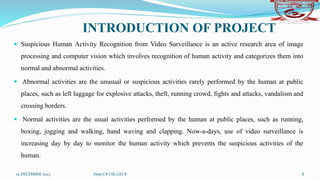
 Suspicious Human Activity Recognition from Video Surveillance is an active research area of image
processing and computer vision which involves recognition of human activity and categorizes them into
normal and abnormal activities.
 Abnormal activities are the unusual or suspicious activities rarely performed by the human at public
places, such as left luggage for explosive attacks, theft, running crowd, fights and attacks, vandalism and
crossing borders.
 Normal activities are the usual activities performed by the human at public places, such as running,
boxing, jogging and walking, hand waving and clapping. Now-a-days, use of video surveillance is
increasing day by day to monitor the human activity which prevents the suspicious activities of the
human.
14 DECEMBER 2023 Dept.Of CSE,GECR 5
SYSTEM REQUIREMENTS
 O/S : Windows 7.
 Language : Python
 Front End : Anaconda Navigator –
Spyder
14 DECEMBER 2023 Dept.Of CSE,GECR 6
 System : Pentium IV 2.4 GHz
 Hard Disk : 200 GB
 Ram : 4GB
HARDWARE REQUIREMENTS SOFTWARE REQUIREMENTS
14 DECEMBER 2023 Dept.Of CSE,GECR 7
LITERATURE REVIEW
YEAR TITLE AUTHOR ABSTRACT LIMITATIONS
2022 Suspicious
activity detection
from video
surveillance
K. Kranthi Kumar , B.
Hema Kumari , T.
Saikumar , U. Sridhar
, G. Srinivas , G. Sai
Karan Reddy
With the rise in criminal activity in
urban and suburban areas, it is more
important than ever to prevent them
and detect them.
The system's storage capacity
was restricted, and it could be
used in surveillance regions
with a high-tech form of video
capture.
2021 Alert Generation
on Detection of
Suspicious
Activity Using
Transfer
Learning
Om M. Rajpurkar,
Siddesh S. Kamble,
Jayram P. Nandagiri
and Anant V. Nimkar
The goal of this paper is to identify
suspicious activity for Surveillance and
alert the shop owners when suspicious
activity is detected.
The behavior is not sufficient
criteria for alerting the owner
of shoplifters, robbers and
break-in in the store.
2021 Suspicious Action
Detection in
Intelligent
Surveillance
System
Manisha Mudgal,
Deepika Punj and
Anuradha Pillai
For a human it is very difficult
to monitor surveillance videos
continually, therefore a smart and
intelligent system is required that can
do real time monitoring of all activities
Sometimes video with
complex background takes
more time in processing and
tracking of object may take
time.
14 DECEMBER 2023 Dept.Of CSE,GECR 8
YEAR TITLE AUTHOR ABSTRACT LIMITATIONS
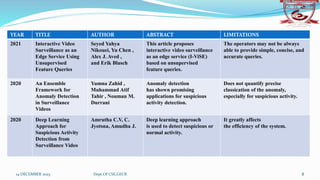
2021 Interactive Video
Surveillance as an
Edge Service Using
Unsupervised
Feature Queries
Seyed Yahya
Nikouei, Yu Chen ,
Alex J. Aved ,
and Erik Blasch
This article proposes
interactive video surveillance
as an edge service (I-ViSE)
based on unsupervised
feature queries.
The operators may not be always
able to provide simple, concise, and
accurate queries.
2020 An Ensemble
Framework for
Anomaly Detection
in Surveillance
Videos
Yumna Zahid ,
Muhammad Atif
Tahir , Nouman M.
Durrani
Anomaly detection
has shown promising
applications for suspicious
activity detection.
Does not quantify precise
classication of the anomaly,
especially for suspicious activity.
2020 Deep Learning
Approach for
Suspicious Activity
Detection from
Surveillance Video
Amrutha C.V, C.
Jyotsna, Amudha J.
Deep learning approach
is used to detect suspicious or
normal activity.
It greatly affects
the efficiency of the system.
14 DECEMBER 2023 Dept.Of CSE,GECR 9
YEAR TITLE AUTHOR ABSTRACT LIMITATIONS
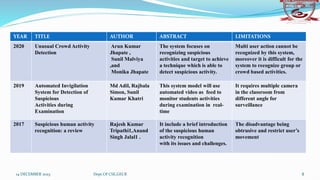
2020 Unusual Crowd Activity
Detection
Arun Kumar
Jhapate ,
Sunil Malviya
,and
Monika Jhapate
The system focuses on
recognizing suspicious
activities and target to achieve
a technique which is able to
detect suspicious activity.
Multi user action cannot be
recognized by this system,
moreover it is difficult for the
system to recognize group or
crowd based activities.
2019 Automated Invigilation
System for Detection of
Suspicious
Activities during
Examination
Md Adil, Rajbala
Simon, Sunil
Kumar Khatri
This system model will use
automated video as feed to
monitor students activities
during examination in real-
time
It requires multiple camera
in the classroom from
different angle for
surveillance
2017 Suspicious human activity
recognition: a review
Rajesh Kumar
Tripathi1,Anand
Singh Jalal1 .
It include a brief introduction
of the suspicious human
activity recognition
with its issues and challenges.
The disadvantage being
obtrusive and restrict user’s
movement
14 DECEMBER 2023 Dept.Of CSE,GECR 10
PROBLEM STATEMENT
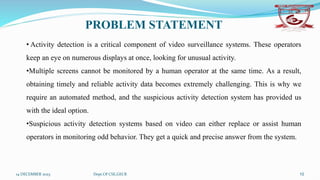
• Activity detection is a critical component of video surveillance systems. These operators
keep an eye on numerous displays at once, looking for unusual activity.
•Multiple screens cannot be monitored by a human operator at the same time. As a result,
obtaining timely and reliable activity data becomes extremely challenging. This is why we
require an automated method, and the suspicious activity detection system has provided us
with the ideal option.
•Suspicious activity detection systems based on video can either replace or assist human
operators in monitoring odd behavior. They get a quick and precise answer from the system.
EXISTING SYSTEM
14 DECEMBER 2023 Dept.Of CSE,GECR 11
•In existing system, Suspicious Human Activity Recognition for Video Surveillance System, we
detected cheating activities in examination hall. We used SURF (Speed Up Robust Features) to
extract interest points, and use SURF method to match and find the corresponding features.
• We used some algorithms to classify the suspicious activities.
•We also use Viola Jones object detectors for finding the faces and labelling the activities. We also
use tracking algorithms to track detectors in the input video. The proposed techniques use fast
detectors and they are robust.
•In addition to the detectors and tracking algorithms, we used text labelling to avoid false
classification, if detectors and tracking algorithms fail to track the faces.
PROPOSED SYSTEM
 In proposed system, the suspicious activity video image dataset was taken as input. Then, we have to
implement the pre-processing step. In this step, we have to resize the original image as well as grey scale
conversion. After that, we have to extract the features from the pre-processed image by local binary pattern
(LBP).
 Then, we have to implement the image splitting such as test and train. Test is used for predicting and train is
used for evaluating the model.
 After that, we have to implement the deep and machine learning algorithm such as Convolutional Neural
Network and RF. The experimental results shows that some performance metrics such as accuracy, loss value
and detect or classify the different types of activities.
14 DECEMBER 2023 Dept.Of CSE,GECR 12
OBJECTIVES
14 DECEMBER 2023 Dept.Of CSE,GECR 13
The main objective of our process is,
•To recognize or to classify the suspicious activity effectively.
•To implement the different classification algorithms.
•To enhance the overall performance for classification algorithms.
•To visualize the graph.
SYSTEM ARCHITECTURE &
DESIGN
14 DECEMBER 2023 Dept.Of CSE,GECR 14
Suspicious
Dataset
Input Video
Resize
Gray scale
Preprocessing
Feature Extraction LBP
Image Splitting
Train
Test
Classification CNN
RF
Performance
Accuracy
Error rate
Recognition Suspicious Activity
ADVANTAGES
 It is efficient for large number of datasets.
 Time consumption is low.
 The prediction is efficient when compared with existing.
 Easy to detect illigal activities.
14 DECEMBER 2023 Dept.Of CSE,GECR 15
14 DECEMBER 2023 Dept.Of CSE,GECR 16
EXPECTED OUTCOMES
•In existing system, Suspicious Human Activity Recognition for Video Surveillance System, we detected
cheating activities in examination hall. We used SURF (Speed Up Robust Features) to extract interest
points, and use SURF method to match and find the corresponding features.
• We used some algorithms to classify the suspicious activities.
•We also use Viola Jones object detectors for finding the faces and labelling the activities. We also use
tracking algorithms to track detectors in the input video. The proposed techniques use fast detectors and
they are robust.
•In addition to the detectors and tracking algorithms, we used text labelling to avoid false classification, if
detectors and tracking algorithms fail to track the faces.
CONCLUSION
14 DECEMBER 2023 Dept.Of CSE,GECR 17
•We conclude that, the video dataset was taken from dataset repository as input. We
are developed the two different classification algorithms such as CNN and RF.
•Finally, the result shows that some performance metrics such as accuracy and error
rate. Then, we are recognized the suspicious activities and compare the algorithms
based on results.
REFERENCES
 [1] A. O Oredein, “Checking Examination Malpractice in Nigerian Schools, Nigerian Journal of Educational Research
and Evaluation”, Vol: 5, No: 1, pg: 82-90, 2004.
 [2] Alexander Alahi, Raphael Ortiz, Pierre, Vandergheynst, “Fast Retina Keypoint (FREAK)”, IEEE, Computer Vision
and Pattern Recognition, pages: 510- 517, 2012.
 [3] Faisal Bashir, David Usher, Pablo Casaverde, Marc Friedman, “Video Surveillance for Biometrics: Long-Range
Multi-Biometric System, Advanced Video and Signal Based Surveillance”, AVSS ’08 IEEE Fifth International
Conference, 175-182, 2008.
 [4] Gang Yu, Junsong Yuan, Zicheng Liu, “Predicting human activities using Spatio-temporal Structure of interest
points”, ACM multimedia conference, pages: 1049-1052, 2012.
14 DECEMBER 2023 Dept.Of CSE,GECR 18
Thank You

SUSPICIOUS activity detection using surveillance camara.pptx

  • 1.
    Carried out by: LikhithaS (1GG20CS015) Navyashree P (1GG20CS023) Pragathi G S (1GG21CS414) Sindhu K L (1GG21CS419) DEPARTMENT OF CSE VII SEM PROJECT PHASE – I SEMINAR ON Suspicious Activity Detection Using-AI &ML Under the Guidence of: Dr. Vasanth G Professor and HOD Department of CSE 1 GOVERNMENT ENGINEERING COLLEGE
  • 2.
    CONTENTS  Abstract  Introduction System Requirements  Literature review  Problem Identification  Objectives  System Design  Conclusion  References 14 January 2021 Dept.of CSE,GECR 2
  • 3.
    ABSTRACT 14 DECEMBER 2023Dept.of CSE,GECR 3 •Suspicious human activity recognition from surveillance video is an active research area of image processing and computer vision. •Through the visual surveillance, human activities can be monitored in sensitive and public areas such as stations, airports, school and colleges, roads, etc. to prevent terrorism, theft, accidents and illegal parking, vandalism, fighting, chain snatching, crime and other suspicious activities. •It is very difficult to watch public places continuously, therefore an intelligent video surveillance is required that can monitor the human activities in real-time and categorize them as usual and unusual activities; and can generate an alert.
  • 4.
    INTRODUCTION  Suspicious activitydetection involves the use of algorithms and technologies to identify behavior or events that deviate from normal patterns, indicating potential threats or illgal actions.  This can apply to various domains, such as cybersecurity, finance, or surveillance. Techniques include anomaly detection, machine learning, and pattern recognition to flag activities that might be indicative of fraud, security breaches, or other unauthorized actions.  The goal is to enhance proactive monitoring and security measures by quickly identifying and responding to potentially harmful activities. 14 DECEMBER 2023 Dept.Of CSE,GECR 4
  • 5.
    INTRODUCTION OF PROJECT Suspicious Human Activity Recognition from Video Surveillance is an active research area of image processing and computer vision which involves recognition of human activity and categorizes them into normal and abnormal activities.  Abnormal activities are the unusual or suspicious activities rarely performed by the human at public places, such as left luggage for explosive attacks, theft, running crowd, fights and attacks, vandalism and crossing borders.  Normal activities are the usual activities performed by the human at public places, such as running, boxing, jogging and walking, hand waving and clapping. Now-a-days, use of video surveillance is increasing day by day to monitor the human activity which prevents the suspicious activities of the human. 14 DECEMBER 2023 Dept.Of CSE,GECR 5
  • 6.
    SYSTEM REQUIREMENTS  O/S: Windows 7.  Language : Python  Front End : Anaconda Navigator – Spyder 14 DECEMBER 2023 Dept.Of CSE,GECR 6  System : Pentium IV 2.4 GHz  Hard Disk : 200 GB  Ram : 4GB HARDWARE REQUIREMENTS SOFTWARE REQUIREMENTS
  • 7.
    14 DECEMBER 2023Dept.Of CSE,GECR 7 LITERATURE REVIEW YEAR TITLE AUTHOR ABSTRACT LIMITATIONS 2022 Suspicious activity detection from video surveillance K. Kranthi Kumar , B. Hema Kumari , T. Saikumar , U. Sridhar , G. Srinivas , G. Sai Karan Reddy With the rise in criminal activity in urban and suburban areas, it is more important than ever to prevent them and detect them. The system's storage capacity was restricted, and it could be used in surveillance regions with a high-tech form of video capture. 2021 Alert Generation on Detection of Suspicious Activity Using Transfer Learning Om M. Rajpurkar, Siddesh S. Kamble, Jayram P. Nandagiri and Anant V. Nimkar The goal of this paper is to identify suspicious activity for Surveillance and alert the shop owners when suspicious activity is detected. The behavior is not sufficient criteria for alerting the owner of shoplifters, robbers and break-in in the store. 2021 Suspicious Action Detection in Intelligent Surveillance System Manisha Mudgal, Deepika Punj and Anuradha Pillai For a human it is very difficult to monitor surveillance videos continually, therefore a smart and intelligent system is required that can do real time monitoring of all activities Sometimes video with complex background takes more time in processing and tracking of object may take time.
  • 8.
    14 DECEMBER 2023Dept.Of CSE,GECR 8 YEAR TITLE AUTHOR ABSTRACT LIMITATIONS 2021 Interactive Video Surveillance as an Edge Service Using Unsupervised Feature Queries Seyed Yahya Nikouei, Yu Chen , Alex J. Aved , and Erik Blasch This article proposes interactive video surveillance as an edge service (I-ViSE) based on unsupervised feature queries. The operators may not be always able to provide simple, concise, and accurate queries. 2020 An Ensemble Framework for Anomaly Detection in Surveillance Videos Yumna Zahid , Muhammad Atif Tahir , Nouman M. Durrani Anomaly detection has shown promising applications for suspicious activity detection. Does not quantify precise classication of the anomaly, especially for suspicious activity. 2020 Deep Learning Approach for Suspicious Activity Detection from Surveillance Video Amrutha C.V, C. Jyotsna, Amudha J. Deep learning approach is used to detect suspicious or normal activity. It greatly affects the efficiency of the system.
  • 9.
    14 DECEMBER 2023Dept.Of CSE,GECR 9 YEAR TITLE AUTHOR ABSTRACT LIMITATIONS 2020 Unusual Crowd Activity Detection Arun Kumar Jhapate , Sunil Malviya ,and Monika Jhapate The system focuses on recognizing suspicious activities and target to achieve a technique which is able to detect suspicious activity. Multi user action cannot be recognized by this system, moreover it is difficult for the system to recognize group or crowd based activities. 2019 Automated Invigilation System for Detection of Suspicious Activities during Examination Md Adil, Rajbala Simon, Sunil Kumar Khatri This system model will use automated video as feed to monitor students activities during examination in real- time It requires multiple camera in the classroom from different angle for surveillance 2017 Suspicious human activity recognition: a review Rajesh Kumar Tripathi1,Anand Singh Jalal1 . It include a brief introduction of the suspicious human activity recognition with its issues and challenges. The disadvantage being obtrusive and restrict user’s movement
  • 10.
    14 DECEMBER 2023Dept.Of CSE,GECR 10 PROBLEM STATEMENT • Activity detection is a critical component of video surveillance systems. These operators keep an eye on numerous displays at once, looking for unusual activity. •Multiple screens cannot be monitored by a human operator at the same time. As a result, obtaining timely and reliable activity data becomes extremely challenging. This is why we require an automated method, and the suspicious activity detection system has provided us with the ideal option. •Suspicious activity detection systems based on video can either replace or assist human operators in monitoring odd behavior. They get a quick and precise answer from the system.
  • 11.
    EXISTING SYSTEM 14 DECEMBER2023 Dept.Of CSE,GECR 11 •In existing system, Suspicious Human Activity Recognition for Video Surveillance System, we detected cheating activities in examination hall. We used SURF (Speed Up Robust Features) to extract interest points, and use SURF method to match and find the corresponding features. • We used some algorithms to classify the suspicious activities. •We also use Viola Jones object detectors for finding the faces and labelling the activities. We also use tracking algorithms to track detectors in the input video. The proposed techniques use fast detectors and they are robust. •In addition to the detectors and tracking algorithms, we used text labelling to avoid false classification, if detectors and tracking algorithms fail to track the faces.
  • 12.
    PROPOSED SYSTEM  Inproposed system, the suspicious activity video image dataset was taken as input. Then, we have to implement the pre-processing step. In this step, we have to resize the original image as well as grey scale conversion. After that, we have to extract the features from the pre-processed image by local binary pattern (LBP).  Then, we have to implement the image splitting such as test and train. Test is used for predicting and train is used for evaluating the model.  After that, we have to implement the deep and machine learning algorithm such as Convolutional Neural Network and RF. The experimental results shows that some performance metrics such as accuracy, loss value and detect or classify the different types of activities. 14 DECEMBER 2023 Dept.Of CSE,GECR 12
  • 13.
    OBJECTIVES 14 DECEMBER 2023Dept.Of CSE,GECR 13 The main objective of our process is, •To recognize or to classify the suspicious activity effectively. •To implement the different classification algorithms. •To enhance the overall performance for classification algorithms. •To visualize the graph.
  • 14.
    SYSTEM ARCHITECTURE & DESIGN 14DECEMBER 2023 Dept.Of CSE,GECR 14 Suspicious Dataset Input Video Resize Gray scale Preprocessing Feature Extraction LBP Image Splitting Train Test Classification CNN RF Performance Accuracy Error rate Recognition Suspicious Activity
  • 15.
    ADVANTAGES  It isefficient for large number of datasets.  Time consumption is low.  The prediction is efficient when compared with existing.  Easy to detect illigal activities. 14 DECEMBER 2023 Dept.Of CSE,GECR 15
  • 16.
    14 DECEMBER 2023Dept.Of CSE,GECR 16 EXPECTED OUTCOMES •In existing system, Suspicious Human Activity Recognition for Video Surveillance System, we detected cheating activities in examination hall. We used SURF (Speed Up Robust Features) to extract interest points, and use SURF method to match and find the corresponding features. • We used some algorithms to classify the suspicious activities. •We also use Viola Jones object detectors for finding the faces and labelling the activities. We also use tracking algorithms to track detectors in the input video. The proposed techniques use fast detectors and they are robust. •In addition to the detectors and tracking algorithms, we used text labelling to avoid false classification, if detectors and tracking algorithms fail to track the faces.
  • 17.
    CONCLUSION 14 DECEMBER 2023Dept.Of CSE,GECR 17 •We conclude that, the video dataset was taken from dataset repository as input. We are developed the two different classification algorithms such as CNN and RF. •Finally, the result shows that some performance metrics such as accuracy and error rate. Then, we are recognized the suspicious activities and compare the algorithms based on results.
  • 18.
    REFERENCES  [1] A.O Oredein, “Checking Examination Malpractice in Nigerian Schools, Nigerian Journal of Educational Research and Evaluation”, Vol: 5, No: 1, pg: 82-90, 2004.  [2] Alexander Alahi, Raphael Ortiz, Pierre, Vandergheynst, “Fast Retina Keypoint (FREAK)”, IEEE, Computer Vision and Pattern Recognition, pages: 510- 517, 2012.  [3] Faisal Bashir, David Usher, Pablo Casaverde, Marc Friedman, “Video Surveillance for Biometrics: Long-Range Multi-Biometric System, Advanced Video and Signal Based Surveillance”, AVSS ’08 IEEE Fifth International Conference, 175-182, 2008.  [4] Gang Yu, Junsong Yuan, Zicheng Liu, “Predicting human activities using Spatio-temporal Structure of interest points”, ACM multimedia conference, pages: 1049-1052, 2012. 14 DECEMBER 2023 Dept.Of CSE,GECR 18
  • 19.

Editor's Notes

  • #8 Prof. Savitha T, Archana M, Bhuvana A, Dharithri ISE Department,