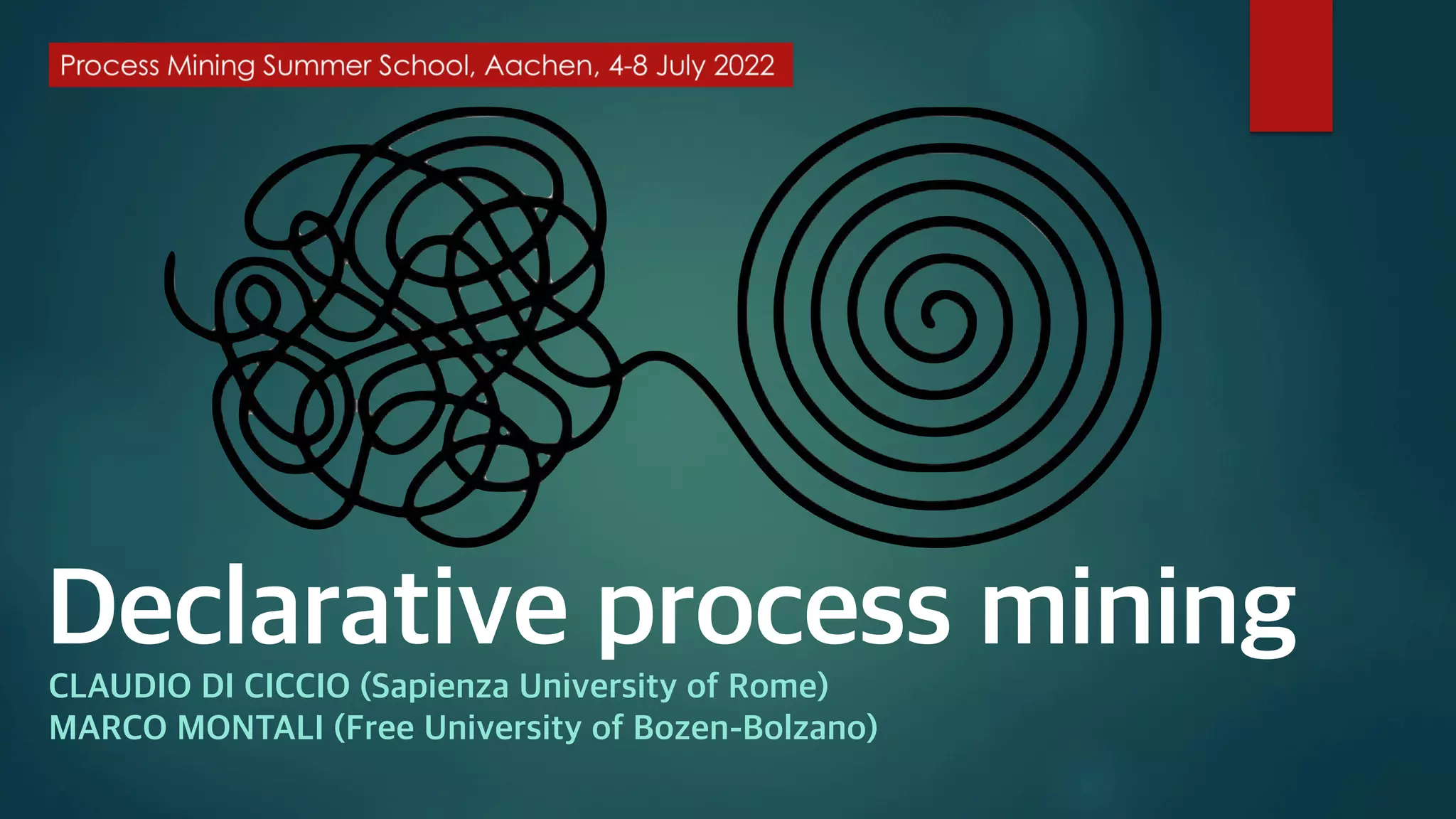
Declarative process mining
CLAUDIO DI CICCIO (Sapienza University of Rome)
MARCO MONTALI (Free University of Bozen-Bolzano)
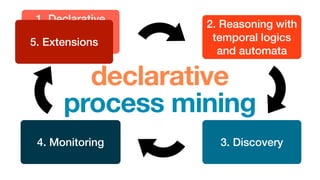
declarative
process mining
declarative
process mining
1. Declarative
process
speci
fi
cations
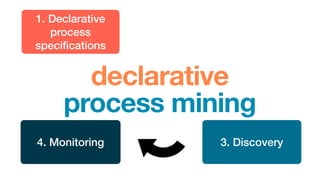
declarative
process mining
1. Declarative
process
speci
fi
cations
3. Discovery
4. Monitoring
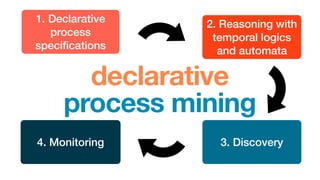
declarative
process mining
1. Declarative
process
speci
fi
cations
2. Reasoning with
temporal logics
and automata
3. Discovery
4. Monitoring
declarative
process mining
1. Declarative
process
speci
fi
cations
2. Reasoning with
temporal logics
and automata
3. Discovery
4. Monitoring
5. Extensions
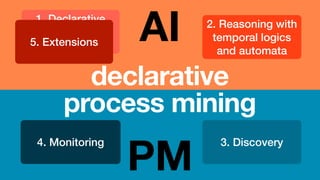
AI
PM
declarative
process mining
1. Declarative
process
speci
fi
cations
2. Reasoning with
temporal logics
and automata
3. Discovery
4. Monitoring
5. Extensions
Declarative process mining
1. DECLARATIVE PROCESS SPECIFICATIONS
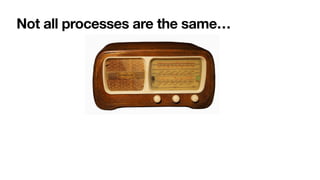
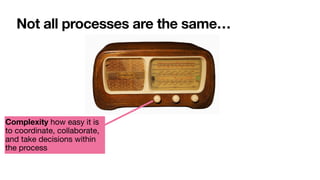
Not all processes are the same…
Complexity how easy it is
to coordinate, collaborate,
and take decisions within
the process
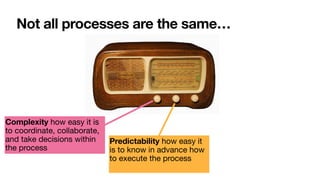
Not all processes are the same…
Complexity how easy it is
to coordinate, collaborate,
and take decisions within
the process
Predictability how easy it
is to know in advance how
to execute the process
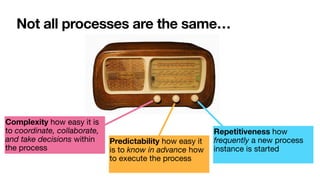
Not all processes are the same…
Complexity how easy it is
to coordinate, collaborate,
and take decisions within
the process
Predictability how easy it
is to know in advance how
to execute the process
Repetitiveness how
frequently a new process
instance is started
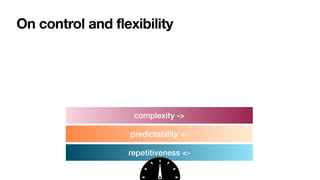
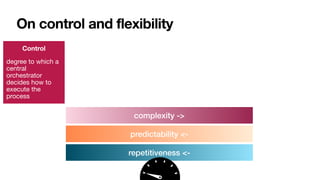
On control and flexibility
complexity ->
predictability <-
repetitiveness <-
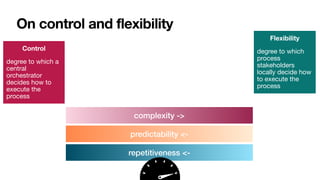
On control and flexibility
complexity ->
predictability <-
repetitiveness <-
Control 

degree to which a
central
orchestrator
decides how to
execute the
process
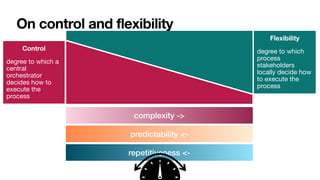
On control and flexibility
complexity ->
predictability <-
repetitiveness <-
Control 

degree to which a
central
orchestrator
decides how to
execute the
process
Flexibility

degree to which
process
stakeholders
locally decide how
to execute the
process
On control and flexibility
complexity ->
predictability <-
repetitiveness <-
Control 

degree to which a
central
orchestrator
decides how to
execute the
process
Flexibility

degree to which
process
stakeholders
locally decide how
to execute the
process
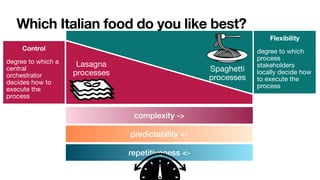
Which Italian food do you like best?
complexity ->
predictability <-
repetitiveness <-
Control 

degree to which a
central
orchestrator
decides how to
execute the
process
Flexibility

degree to which
process
stakeholders
locally decide how
to execute the
process
Lasagna
processes Spaghetti
processes
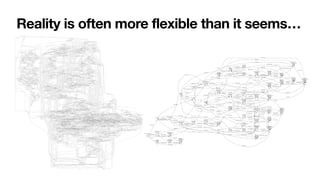
Reality is often more flexible than it seems…
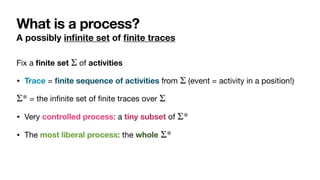
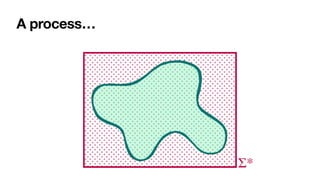
What is a process?
A possibly in
fi
nite set of
fi
nite traces
Fix a
fi
nite set of activities

• Trace =
fi
nite sequence of activities from (event = activity in a position!) 

Σ
Σ
What is a process?
A possibly in
fi
nite set of
fi
nite traces
Fix a
fi
nite set of activities

• Trace =
fi
nite sequence of activities from (event = activity in a position!) 

= the in
fi
nite set of
fi
nite traces over 

• Very controlled process: a tiny subset of 

• The most liberal process: the whole
Σ
Σ
Σ* Σ
Σ*
Σ*
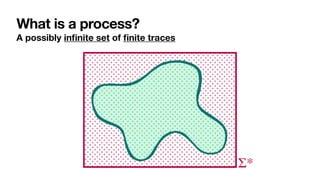
What is a process?
A possibly in
fi
nite set of
fi
nite traces
Σ*
What is a process?
A possibly in
fi
nite set of
fi
nite traces
Σ*
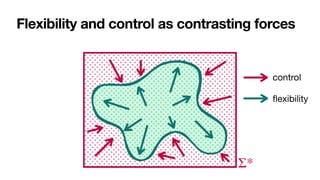
Flexibility and control as contrasting forces
Σ*
control
fl
exibility
BPM!
BPM?
BPM?
Knowledge-
intensive
processes
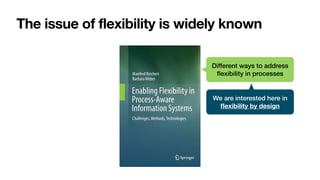
The issue of flexibility is widely known
Different ways to address
fl
exibility in processes
We are interested here in


fl
exibility by design
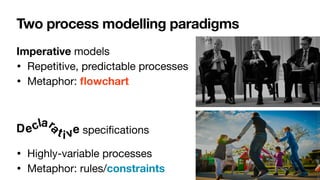
Two process modelling paradigms
Imperative models

• Repetitive, predictable processes

• Metaphor:
fl
owchart
speci
fi
cations

• Highly-variable processes

• Metaphor: rules/constraints
Dec t i
lar
a
e
v
31
Imperative process
models
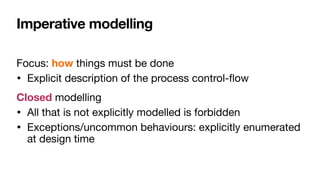
Imperative modelling
Focus: how things must be done

• Explicit description of the process control-
fl
ow

Closed modelling

• All that is not explicitly modelled is forbidden

• Exceptions/uncommon behaviours: explicitly enumerated
at design time
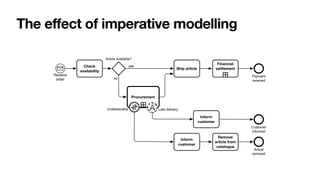
The effect of imperative modelling
Receive
order
Check
availability
Article available?
Ship article
Financial
settlement
yes
Procurement
no
Payment
received
Inform
customer
Late delivery
Undeliverable
Customer
informed
Inform
customer
Article
removed
Remove
article from
catalogue
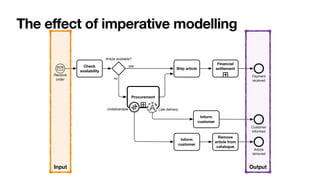
The effect of imperative modelling
Receive
order
Check
availability
Article available?
Ship article
Financial
settlement
yes
Procurement
no
Payment
received
Inform
customer
Late delivery
Undeliverable
Customer
informed
Inform
customer
Article
removed
Remove
article from
catalogue
Input Output
The effect of imperative modelling
Receive
order
Check
availability
Article available?
Ship article
Financial
settlement
yes
Procurement
no
Payment
received
Inform
customer
Late delivery
Undeliverable
Customer
informed
Inform
customer
Article
removed
Remove
article from
catalogue
Input Output
Receive
order
Check
availability
Article available?
Ship article
Financial
settlement
yes
Procurement
no
Payment
received
Inform
customer
Late delivery
Undeliverable
Customer
informed
Inform
customer
Article
removed
Remove
article from
catalogue
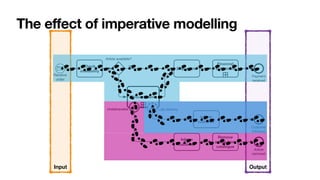
A process…
Σ*
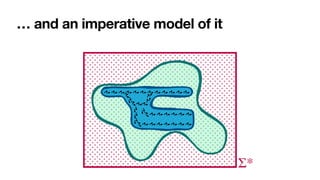
… and an imperative model of it
Σ*
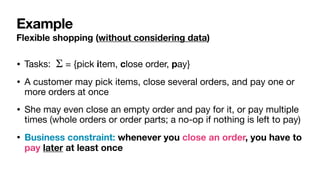
Example
Flexible shopping (without considering data)
• Tasks: = {pick item, close order, pay}

• A customer may pick items, close several orders, and pay one or
more orders at once

• She may even close an empty order and pay for it, or pay multiple
times (whole orders or order parts; a no-op if nothing is left to pay)

• Business constraint: whenever you close an order, you have to
pay later at least once
Σ
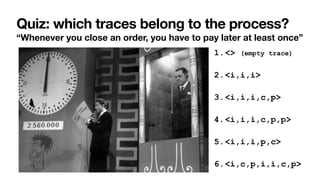
Quiz: which traces belong to the process?
“Whenever you close an order, you have to pay later at least once”
1.<> (empty trace)


2.<i,i,i>


3.<i,i,i,c,p>


4.<i,i,i,c,p,p>


5.<i,i,i,p,c>


6.<i,c,p,i,i,c,p>
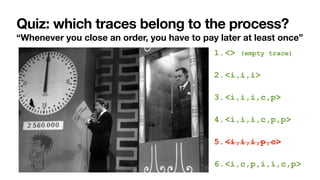
Quiz: which traces belong to the process?
“Whenever you close an order, you have to pay later at least once”
1.<> (empty trace)


2.<i,i,i>


3.<i,i,i,c,p>


4.<i,i,i,c,p,p>


5.<i,i,i,p,c>


6.<i,c,p,i,i,c,p>
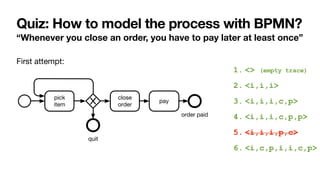
Quiz: How to model the process with BPMN?
“Whenever you close an order, you have to pay later at least once”
First attempt:
1. <> (empty trace)


2. <i,i,i>


3. <i,i,i,c,p>


4. <i,i,i,c,p,p>


5. <i,i,i,p,c>


6. <i,c,p,i,i,c,p>
pick
item
close
order
pay
quit
order paid
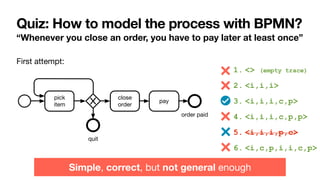
Quiz: How to model the process with BPMN?
“Whenever you close an order, you have to pay later at least once”
First attempt:
1. <> (empty trace)


2. <i,i,i>


3. <i,i,i,c,p>


4. <i,i,i,c,p,p>


5. <i,i,i,p,c>


6. <i,c,p,i,i,c,p>
pick
item
close
order
pay
quit
order paid
Simple, correct, but not general enough
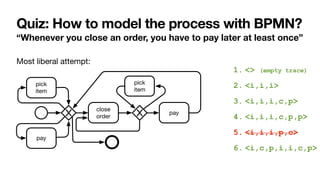
Quiz: How to model the process with BPMN?
“Whenever you close an order, you have to pay later at least once”
Most liberal attempt:
1. <> (empty trace)


2. <i,i,i>


3. <i,i,i,c,p>


4. <i,i,i,c,p,p>


5. <i,i,i,p,c>


6. <i,c,p,i,i,c,p>
pick
item
close
order
pay
pick
item
pay
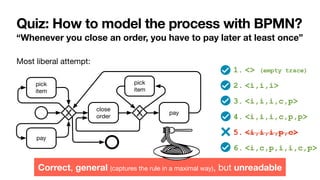
Quiz: How to model the process with BPMN?
“Whenever you close an order, you have to pay later at least once”
Most liberal attempt:
1. <> (empty trace)


2. <i,i,i>


3. <i,i,i,c,p>


4. <i,i,i,c,p,p>


5. <i,i,i,p,c>


6. <i,c,p,i,i,c,p>
Correct, general (captures the rule in a maximal way), but unreadable
pick
item
close
order
pay
pick
item
pay
45
Declarative process
specifications
!
Simplicity
cannot be
obtained by
sweeping
complexity
under the
carpet
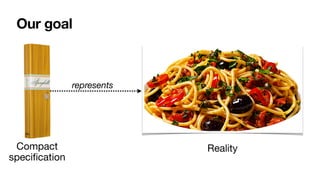
Our goal
Compact
speci
fi
cation
Reality
represents
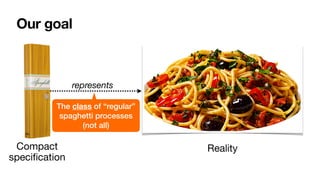
Our goal
Compact
speci
fi
cation
Reality
represents
The class of “regular”
spaghetti processes
(not all)
Idea
Focus: what has to be accomplished

• Explicit description of the relevant process constraints

• Control-
fl
ow left implicit

Open modelling

• All behaviors are possible as long as all constraints are
satis
fi
ed
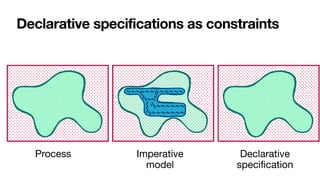
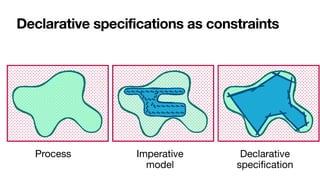
Declarative specifications as constraints
Process Imperative
model
Declarative
speci
fi
cation
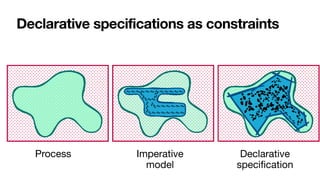
Declarative specifications as constraints
Process Imperative
model
Declarative
speci
fi
cation
Declarative specifications as constraints
Process Imperative
model
Declarative
speci
fi
cation
Constraint-based specifications of behaviour
• Multiagent systems: declarative agent programs [Fisher,JSC1996]
and interaction protocols [Singh,AAMAS2003]

• Data management: cascaded transactional updates
[DavulcuEtAl,PODS1998]

• BPM (1st wave): loosely-coupled subprocesses [SadiqEtAl,ER2001]

• BPM (2nd wave): process constraints 

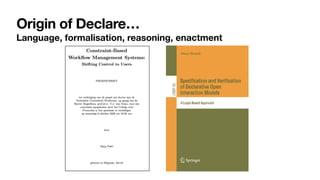
• DECLARE [PesicEtAl,EDOC2007]

• Dynamic Condition-Response (DCR) Graphs
[HildebrandtEtAl,PLACES2010]
Origin of Declare…
Language, formalisation, reasoning, enactment
Which constraints are useful?
Constraint templates
Constraint types de
fi
ned on activity placeholders, each with a speci
fi
c
meaning

• … then instantiated on actual activities (by grounding)

Dimensions
• Activities: how many are involved

• Time: temporal orientation (past, future, either) and strength (when)

• Expectation: negative vs positive

Much richer than the precedence
fl
ow relation of imperative languages
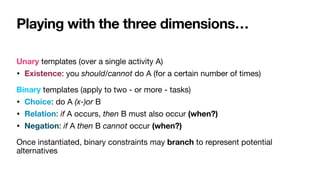
Playing with the three dimensions…
Unary templates (over a single activity A)

• Existence: you should/cannot do A (for a certain number of times)

Binary templates (apply to two - or more - tasks)

• Choice: do A (x-)or B

• Relation: if A occurs, then B must also occur (when?)

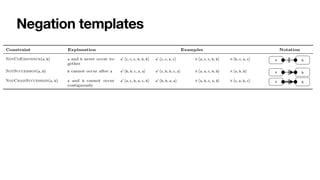
• Negation: if A then B cannot occur (when?)

Once instantiated, binary constraints may branch to represent potential
alternatives
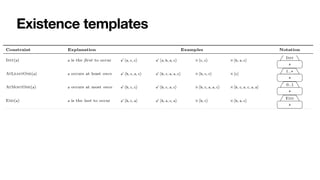
Existence templates
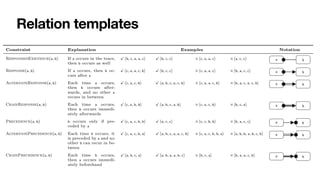
Relation templates
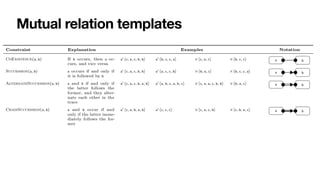
Mutual relation templates
Negation templates
Declare specification
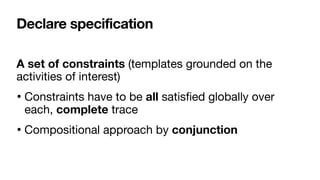
A set of constraints (templates grounded on the
activities of interest)

• Constraints have to be all satis
fi
ed globally over
each, complete trace

• Compositional approach by conjunction
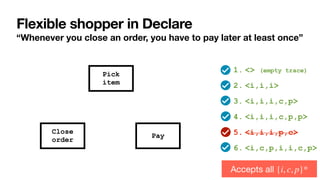
Flexible shopper in Declare
“Whenever you close an order, you have to pay later at least once”
1. <> (empty trace)


2. <i,i,i>


3. <i,i,i,c,p>


4. <i,i,i,c,p,p>


5. <i,i,i,p,c>


6. <i,c,p,i,i,c,p>
Pick


item
Close
order
Pay
Accepts all {i, c, p}*
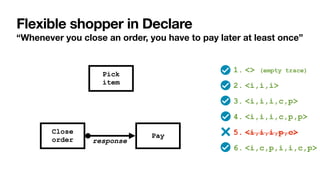
Flexible shopper in Declare
“Whenever you close an order, you have to pay later at least once”
1. <> (empty trace)


2. <i,i,i>


3. <i,i,i,c,p>


4. <i,i,i,c,p,p>


5. <i,i,i,p,c>


6. <i,c,p,i,i,c,p>
Pick


item
Close
order
Pay
response
Interaction among constraints
Aka hidden dependencies [MontaliEtAl,TWEB2010]
Cancel
order
Confirm
order
Pay
If you cancel the order, you
cannot pay for it
If you con
fi
rm the order,
you must pay for it
Interaction among constraints
Aka hidden dependencies [MontaliEtAl,TWEB2010]
Cancel
order
Confirm
order
Pay
If you cancel the order, you
cannot pay for it
If you con
fi
rm the order,
you must pay for it
Hence:
forbidden to
cancel and
con
fi
rm!
Key questions
1. How to
characterise the
language of a
Declare
speci
fi
cation?

2. How to
understand
whether a
speci
fi
cation is
correct?
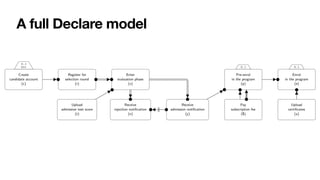
A full Declare model
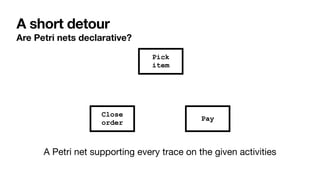
A short detour
Are Petri nets declarative?
A Petri net supporting every trace on the given activities
Pick


item
Close
order
Pay
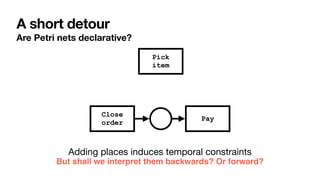
A short detour
Are Petri nets declarative?
Adding places induces temporal constraints 

But shall we interpret them backwards? Or forward?
Pick


item
Close
order
Pay
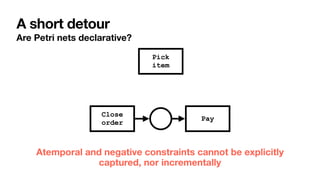
A short detour
Are Petri nets declarative?
Atemporal and negative constraints cannot be explicitly
captured, nor incrementally
Pick


item
Close
order
Pay
Declarative process mining
2. REASONING WITH TEMPORAL LOGICS AND AUTOMATA
Back to the roots
Back to the roots
Patterns in Linear
Temporal Logic
(LTL)
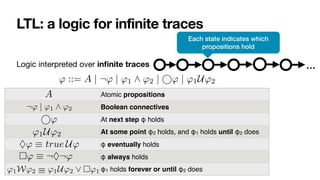
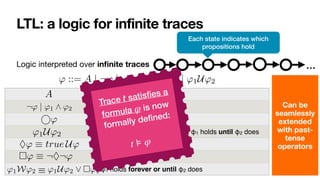
LTL: a logic for infinite traces
Logic interpreted over in
fi
nite traces
' ::= A | ¬' | '1 ^ '2 | ' | '1U'2
Atomic propositions
Boolean connectives
At next step φ holds
At some point φ2 holds, and φ1 holds until φ2 does
φ eventually holds
φ always holds
φ1 holds forever or until φ2 does
' ::= A | ¬' | '1 ^ '2 | ' | '1U'2
::= A | ¬' | '1 ^ '2 | ' | '1U'2
'1 ^ '2 | ' | '1U'2
| ' | '1U'2
⌃' ⌘ true U'
⇤' ⌘ ¬⌃¬'
'1W'2 = '1U'2 _ ⇤'1
⇤' ⌘ ¬⌃¬'
…
Each state indicates which
propositions hold
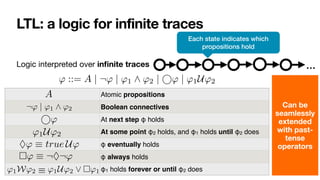
LTL: a logic for infinite traces
Logic interpreted over in
fi
nite traces
' ::= A | ¬' | '1 ^ '2 | ' | '1U'2
Atomic propositions
Boolean connectives
At next step φ holds
At some point φ2 holds, and φ1 holds until φ2 does
φ eventually holds
φ always holds
φ1 holds forever or until φ2 does
' ::= A | ¬' | '1 ^ '2 | ' | '1U'2
::= A | ¬' | '1 ^ '2 | ' | '1U'2
'1 ^ '2 | ' | '1U'2
| ' | '1U'2
⌃' ⌘ true U'
⇤' ⌘ ¬⌃¬'
'1W'2 = '1U'2 _ ⇤'1
⇤' ⌘ ¬⌃¬'
…
Each state indicates which
propositions hold
Can be
seamlessly
extended
with past-
tense
operators
LTL: a logic for infinite traces
Logic interpreted over in
fi
nite traces
' ::= A | ¬' | '1 ^ '2 | ' | '1U'2
Atomic propositions
Boolean connectives
At next step φ holds
At some point φ2 holds, and φ1 holds until φ2 does
φ eventually holds
φ always holds
φ1 holds forever or until φ2 does
' ::= A | ¬' | '1 ^ '2 | ' | '1U'2
::= A | ¬' | '1 ^ '2 | ' | '1U'2
'1 ^ '2 | ' | '1U'2
| ' | '1U'2
⌃' ⌘ true U'
⇤' ⌘ ¬⌃¬'
'1W'2 = '1U'2 _ ⇤'1
⇤' ⌘ ¬⌃¬'
…
Each state indicates which
propositions hold
Can be
seamlessly
extended
with past-
tense
operators
Trace t satis
fi
es a
formula is now
formally de
fi
ned:


φ
t ⊧ φ
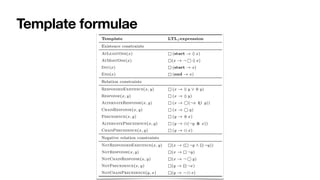
Template formulae
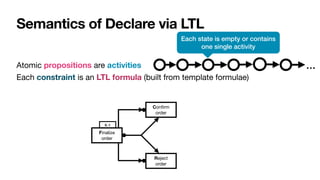
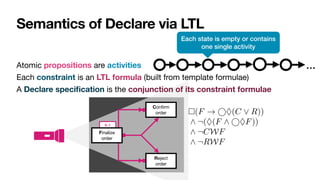
Semantics of Declare via LTL
Atomic propositions are activities

Each constraint is an LTL formula (built from template formulae)

…
Each state is empty or contains
one single activity
0..1
Con
fi
rm

order
Reject

order
Finalize
order
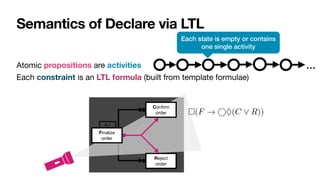
Semantics of Declare via LTL
Atomic propositions are activities

Each constraint is an LTL formula (built from template formulae)

…
Each state is empty or contains
one single activity
0..1
Con
fi
rm

order
Reject

order
Finalize
order
⇤(F ! ⌃(C _ R))
Semantics of Declare via LTL
…
Each state is empty or contains
one single activity
⇤(F ! ⌃(C _ R))
^ ¬(⌃(F ^ ⌃F))
^ ¬CWF
^ ¬RWF
0..1
Con
fi
rm

order
Reject

order
Finalize
order
Atomic propositions are activities

Each constraint is an LTL formula (built from template formulae)

A Declare speci
fi
cation is the conjunction of its constraint formulae
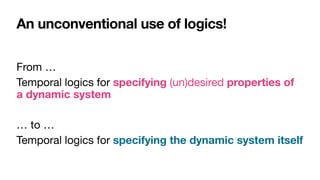
An unconventional use of logics!
From …

Temporal logics for specifying (un)desired properties of
a dynamic system

… to …

Temporal logics for specifying the dynamic system itself
⇤(F ! ⌃(C _ R))
^ ¬(⌃(F ^ ⌃F))
^ ¬CWF
^ ¬RWF
0..1
Con
fi
rm

order
Reject

order
Finalize
order
Wait a moment…
⇤(F ! ⌃(C _ R))
^ ¬(⌃(F ^ ⌃F))
^ ¬CWF
^ ¬RWF
0..1
Con
fi
rm

order
Reject

order
Finalize
order
Wait a moment…
Just what we needed!
However…


Each process instance should
end in a
fi
nite number of steps!
LTLf: LTL over finite traces
[DeGiacomoVardi,IJCAI2013]
LTL interpreted over
fi
nite traces
' ::= A | ¬' | '1 ^ '2 | ' | '1U'2
No successor!
Same syntax of LTL
In LTL, there is always a next moment… in LTLf, the contrary!
φ always holds from current to the last instant
The next step exists and at next step φ holds
(weak next) If the next step exists, then at next step φ holds
last instant in the trace
' | '1 ^ '2 | ' | '1U'2
⇤'
Last ⌘ ¬ true
' ⌘ ¬ ¬'
Look the same, but they are not the same
Many researchers: misled by moving from in
fi
nite to
fi
nite traces

In [DeGiacomoEtAl,AAAI14], we studied why!

• People typically focus on “patterns”, not on the entire logic

• Many of such patterns in BPM, reasoning about actions, planning, etc. are
“insensitive to in
fi
nity”
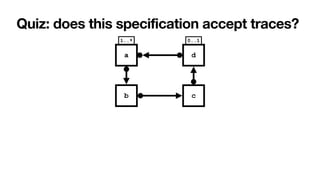
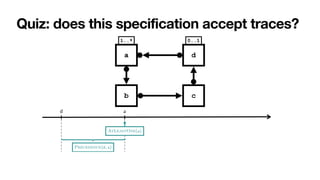
Quiz: does this specification accept traces?
b c
0..1
1..*
a d
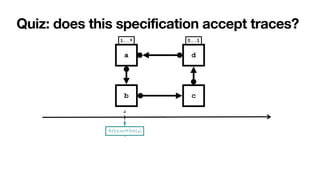
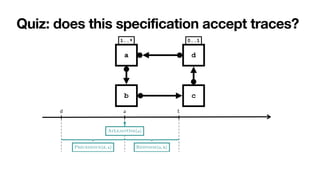
Quiz: does this specification accept traces?
b c
0..1
1..*
a d
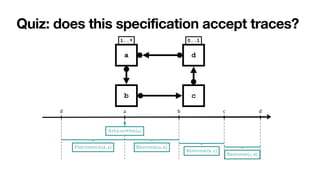
Quiz: does this specification accept traces?
b c
0..1
1..*
a d
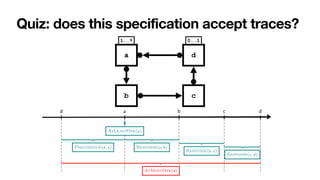
Quiz: does this specification accept traces?
b c
0..1
1..*
a d
Quiz: does this specification accept traces?
b c
0..1
1..*
a d
Quiz: does this specification accept traces?
b c
0..1
1..*
a d
Quiz: does this specification accept traces?
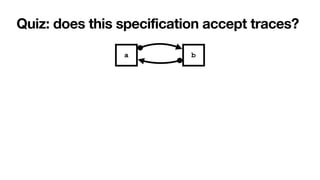
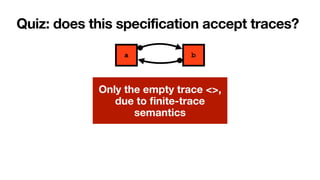
a b
Quiz: does this specification accept traces?
a b
Only the empty trace <>,
due to
fi
nite-trace
semantics
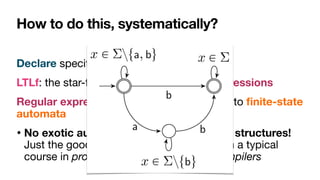
How to do this, systematically?
Declare speci
fi
cation: encoded in LTLf

LTLf: the star-free fragment of regular expressions

Regular expressions: intimately connected to
fi
nite-state
automata

• No exotic automata models over in
fi
nite structures!
Just the good old automata you know from a typical
course in programming languages and compilers
How to do this, systematically?
Declare speci
fi
cation: encoded in LTLf

LTLf: the star-free fragment of regular expressions

Regular expressions: intimately connected to
fi
nite-state
automata

• No exotic automata models over in
fi
nite structures!
Just the good old automata you know from a typical
course in programming languages and compilers
From Declare to automata
LTLf NFA

nondeterministic
DFA

deterministic
LTLf2aut determin.
'
nt
lf formulas can be translated into equivalent nfa:
t |= Ï iff t œ L(AÏ)
/ldlf to nfa (exponential)
to dfa (exponential)
often nfa/dfa corresponding to ltlf /ldlf are in fact small!
ompile reasoning into automata based procedures!
Process engine!
[DeGiacomoVardi,IJCAI2013]
[DeGiacomoEtAl,TOSEM2022]
Vision realised!
LTLf NFA

nondeterministic
DFA

deterministic
LTLf2aut determin.
'
nt
lf formulas can be translated into equivalent nfa:
t |= Ï iff t œ L(AÏ)
/ldlf to nfa (exponential)
to dfa (exponential)
often nfa/dfa corresponding to ltlf /ldlf are in fact small!
ompile reasoning into automata based procedures!
Process engine!
[DeGiacomoVardi,IJCAI2013]
[DeGiacomoEtAl,TOSEM2022]
Few lines of code
[DeGiacomoEtAl,TOSEM2022]
0:8 G. De Giacomo et al.
(tt, ⇧) = true
(↵ , ⇧) = false
( , ⇧) = (h itt, ⇧) ( prop.)
('1 ^ '2, ⇧) = ('1, ⇧) ^ ('2, ⇧)
('1 _ '2, ⇧) = ('1, ⇧) _ ('2, ⇧)
(h i', ⇧) =
⇢
E (') if ⇧ |= ( prop.)
false if ⇧ 6|=
(h ?i', ⇧) = ( , ⇧) ^ (', ⇧)
(h⇢1 + ⇢2i', ⇧) = (h⇢1i', ⇧) _ (h⇢2i', ⇧)
(h⇢1; ⇢2i', ⇧) = (h⇢1ih⇢2i', ⇧)
(h⇢⇤
i', ⇧) = (', ⇧) _ (h⇢iF h⇢⇤i', ⇧)
([ ]', ⇧) =
⇢
E (') if ⇧ |= ( prop.)
true if ⇧ 6|=
([ ?]', ⇧) = (nnf (¬ ), ⇧) _ (', ⇧)
([⇢1 + ⇢2]', ⇧) = ([⇢1]', ⇧) ^ ([⇢2]', ⇧)
([⇢1; ⇢2]', ⇧) = ([⇢1][⇢2]', ⇧)
([⇢⇤
]', ⇧) = (', ⇧) ^ ([⇢]T [⇢⇤]', ⇧)
(F , ⇧) = false
(T , ⇧) = true
Fig. 1: Definition of , where E (') recursively replaces in ' all occurrences of atoms of
the form T and F by .
1: algorithm LDLf 2NFA
2: input LDLf formula '
3: output NFA A(') = (2P
, S, s0, %, Sf )
4: s0 {'} . set the initial state
5: Sf {;} . set final states
6: if ( (', ✏) = true) then . check if initial state is also final
7: Sf Sf [ {s0}
8: S {s0, ;}, % ;
9: while (S or % change) do
10: for (s 2 S) do
11: if (s0
|=
V
( 2s) ( , ⇧) then . add new state and transition
12: S S [ {s0
}
13: % % [ {(s, ⇧, s0
)}
14: if (
V
( 2s0) ( , ✏) = true) then . check if new state is also final
15: Sf Sf [ {s0
}
Fig. 2: NFA construction.
' NFA
Few lines of code
[DeGiacomoEtAl,TOSEM2022]
0:8 G. De Giacomo et al.
(tt, ⇧) = true
(↵ , ⇧) = false
( , ⇧) = (h itt, ⇧) ( prop.)
('1 ^ '2, ⇧) = ('1, ⇧) ^ ('2, ⇧)
('1 _ '2, ⇧) = ('1, ⇧) _ ('2, ⇧)
(h i', ⇧) =
⇢
E (') if ⇧ |= ( prop.)
false if ⇧ 6|=
(h ?i', ⇧) = ( , ⇧) ^ (', ⇧)
(h⇢1 + ⇢2i', ⇧) = (h⇢1i', ⇧) _ (h⇢2i', ⇧)
(h⇢1; ⇢2i', ⇧) = (h⇢1ih⇢2i', ⇧)
(h⇢⇤
i', ⇧) = (', ⇧) _ (h⇢iF h⇢⇤i', ⇧)
([ ]', ⇧) =
⇢
E (') if ⇧ |= ( prop.)
true if ⇧ 6|=
([ ?]', ⇧) = (nnf (¬ ), ⇧) _ (', ⇧)
([⇢1 + ⇢2]', ⇧) = ([⇢1]', ⇧) ^ ([⇢2]', ⇧)
([⇢1; ⇢2]', ⇧) = ([⇢1][⇢2]', ⇧)
([⇢⇤
]', ⇧) = (', ⇧) ^ ([⇢]T [⇢⇤]', ⇧)
(F , ⇧) = false
(T , ⇧) = true
Fig. 1: Definition of , where E (') recursively replaces in ' all occurrences of atoms of
the form T and F by .
1: algorithm LDLf 2NFA
2: input LDLf formula '
3: output NFA A(') = (2P
, S, s0, %, Sf )
4: s0 {'} . set the initial state
5: Sf {;} . set final states
6: if ( (', ✏) = true) then . check if initial state is also final
7: Sf Sf [ {s0}
8: S {s0, ;}, % ;
9: while (S or % change) do
10: for (s 2 S) do
11: if (s0
|=
V
( 2s) ( , ⇧) then . add new state and transition
12: S S [ {s0
}
13: % % [ {(s, ⇧, s0
)}
14: if (
V
( 2s0) ( , ✏) = true) then . check if new state is also final
15: Sf Sf [ {s0
}
Fig. 2: NFA construction.
' NFA
Automata manipulations
much easier to handle
than in the in
fi
nite case,
with huge performance
improvements


[ZhuEtAl,
IJ
CAI17]
[Westergaard,BPM11]
Constraint automata
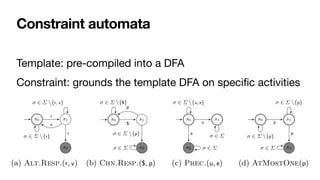
Template: pre-compiled into a DFA

Constraint: grounds the template DFA on speci
fi
c activities
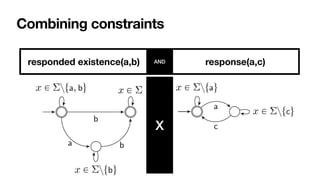
Combining constraints
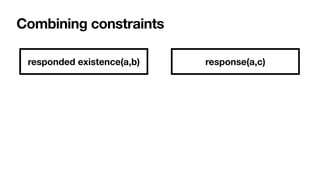
responded existence(a,b) response(a,c)
Combining constraints
responded existence(a,b) response(a,c)
Combining constraints
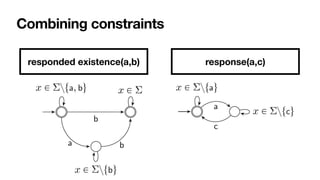
responded existence(a,b) response(a,c)
AND
Combining constraints
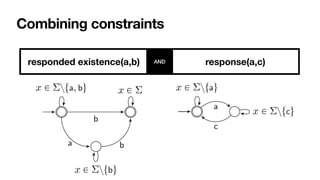
responded existence(a,b) response(a,c)
AND
X
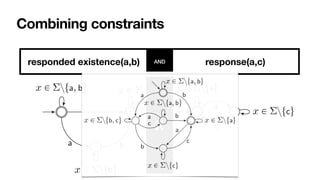
Combining constraints
responded existence(a,b) response(a,c)
AND
X
From local automata to global automaton
Entire speci
fi
cation: product automaton of all local
automata

• Corresponds to the automaton of the conjunction of
all formulae

• Many optimisations available
Declare speci
fi
cation consistent if and only if its
global automaton is non-empty
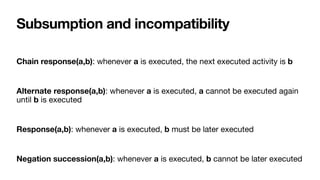
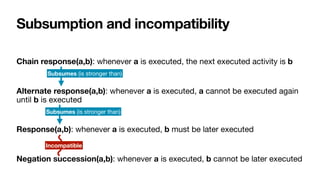
Subsumption and incompatibility
Chain response(a,b): whenever a is executed, the next executed activity is b
Alternate response(a,b): whenever a is executed, a cannot be executed again
until b is executed

Response(a,b): whenever a is executed, b must be later executed

Negation succession(a,b): whenever a is executed, b cannot be later executed
Subsumption and incompatibility
Chain response(a,b): whenever a is executed, the next executed activity is b
Alternate response(a,b): whenever a is executed, a cannot be executed again
until b is executed

Response(a,b): whenever a is executed, b must be later executed

Negation succession(a,b): whenever a is executed, b cannot be later executed
Subsumes (is stronger than)
Incompatible
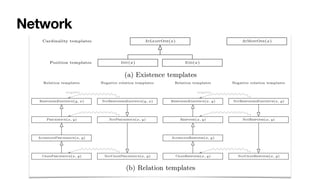
Network
Ready?
Declarative process mining
3. DISCOVERY
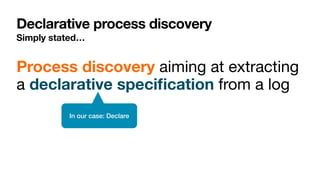
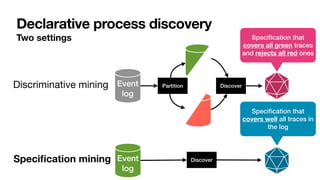
Declarative process discovery
Simply stated…
Process discovery aiming at extracting
a declarative speci
fi
cation from a log
In our case: Declare
Declarative process discovery
Two settings
Discriminative mining
Speci
fi
cation mining
Event


log
Event


log
Partition
Discover
Discover
Speci
fi
cation that
covers all green traces
and rejects all red ones
Speci
fi
cation that
covers well all traces in
the log
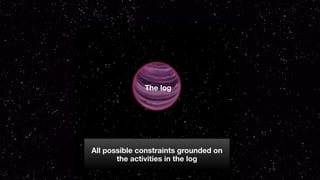
All possible constraints grounded on
the activities in the log
The log
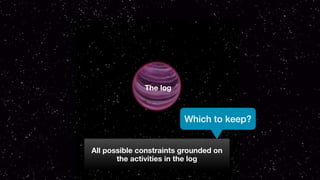
All possible constraints grounded on
the activities in the log
The log
Which to keep?
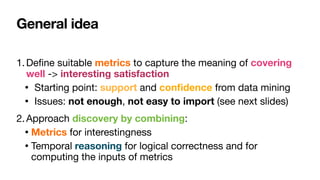
General idea
1.De
fi
ne suitable metrics to capture the meaning of covering
well -> interesting satisfaction

• Starting point: support and con
fi
dence from data mining

• Issues: not enough, not easy to import (see next slides)

2.Approach discovery by combining:

• Metrics for interestingness

• Temporal reasoning for logical correctness and for
computing the inputs of metrics
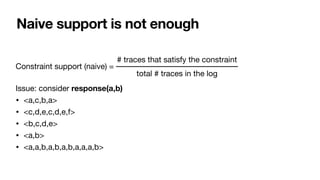
Naive support is not enough
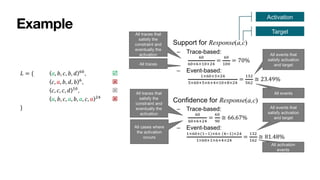
Constraint support (naive) = 

Issue: consider response(a,b)
• <a,c,b,a>
• <c,d,e,c,d,e,f>

• <b,c,d,e>

• <a,b>

• <a,a,b,a,b,a,b,a,a,a,b>

# traces that satisfy the constraint
total # traces in the log
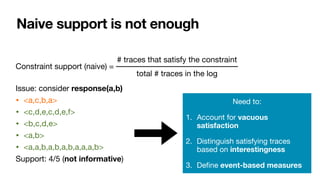
Naive support is not enough
Constraint support (naive) = 

Issue: consider response(a,b)
• <a,c,b,a>
• <c,d,e,c,d,e,f>

• <b,c,d,e>

• <a,b>

• <a,a,b,a,b,a,b,a,a,a,b>

Support: 4/5 (not informative)
# traces that satisfy the constraint
total # traces in the log
Need to:

1. Account for vacuous
satisfaction

2. Distinguish satisfying traces
based on interestingness

3. De
fi
ne event-based measures
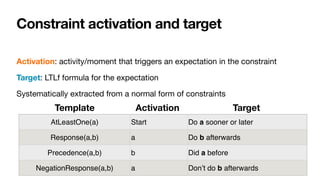
Constraint activation and target
Activation: activity/moment that triggers an expectation in the constraint

Target: LTLf formula for the expectation

Systematically extracted from a normal form of constraints
AtLeastOne(a) Start Do a sooner or later
Response(a,b) a Do b afterwards
Precedence(a,b) b Did a before
NegationResponse(a,b) a Don’t do b afterwards
Template Activation Target
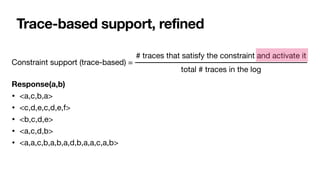
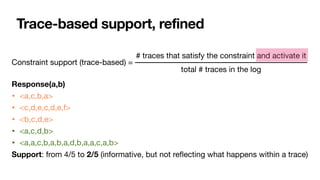
Trace-based support, refined
Constraint support (trace-based) = 

Response(a,b)
• <a,c,b,a>
• <c,d,e,c,d,e,f>

• <b,c,d,e>

• <a,c,d,b>

• <a,a,c,b,a,b,a,d,b,a,a,c,a,b>

Support: from 4/5 to 2/5 (informative, but not re
fl
ecting what happens within a trace)
# traces that satisfy the constraint and activate it
total # traces in the log
Trace-based support, refined
Constraint support (trace-based) = 

Response(a,b)
• <a,c,b,a>
• <c,d,e,c,d,e,f>

• <b,c,d,e>

• <a,c,d,b>

• <a,a,c,b,a,b,a,d,b,a,a,c,a,b>

Support: from 4/5 to 2/5 (informative, but not re
fl
ecting what happens within a trace)
# traces that satisfy the constraint and activate it
total # traces in the log
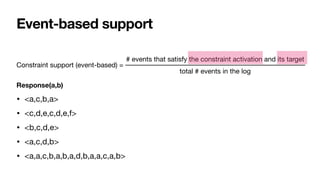
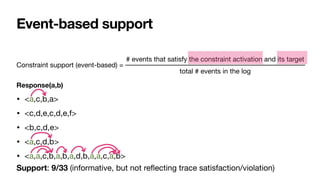
Event-based support
Constraint support (event-based) = 

Response(a,b)
• <a,c,b,a>
• <c,d,e,c,d,e,f>

• <b,c,d,e>

• <a,c,d,b>

• <a,a,c,b,a,b,a,d,b,a,a,c,a,b>

Support: 9/33 (informative, but not re
fl
ecting trace satisfaction/violation)
# events that satisfy the constraint activation and its target
total # events in the log
Event-based support
Constraint support (event-based) = 

Response(a,b)
• <a,c,b,a>
• <c,d,e,c,d,e,f>

• <b,c,d,e>

• <a,c,d,b>

• <a,a,c,b,a,b,a,d,b,a,a,c,a,b>

Support: 9/33 (informative, but not re
fl
ecting trace satisfaction/violation)
# events that satisfy the constraint activation and its target
total # events in the log
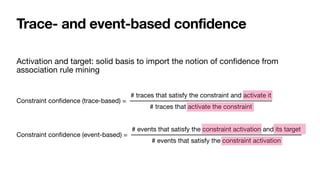
Trace- and event-based confidence
Activation and target: solid basis to import the notion of con
fi
dence from
association rule mining

Constraint con
fi
dence (trace-based) = 

Constraint con
fi
dence (event-based) = 

# traces that satisfy the constraint and activate it
# traces that activate the constraint
# events that satisfy the constraint activation and its target
# events that satisfy the constraint activation
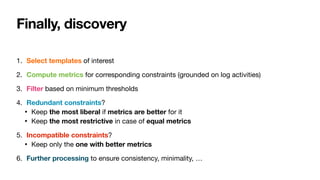
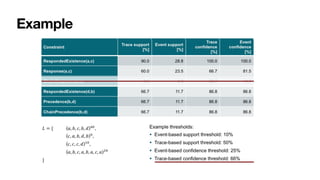
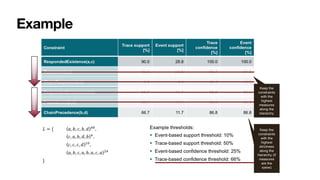
Finally, discovery
1. Select templates of interest

2. Compute metrics for corresponding constraints (grounded on log activities)

3. Filter based on minimum thresholds

4. Redundant constraints?

• Keep the most liberal if metrics are better for it

• Keep the most restrictive in case of equal metrics

5. Incompatible constraints?

• Keep only the one with better metrics

6. Further processing to ensure consistency, minimality, …
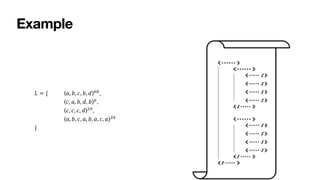
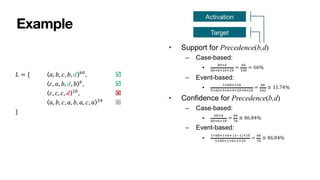
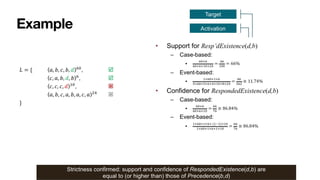
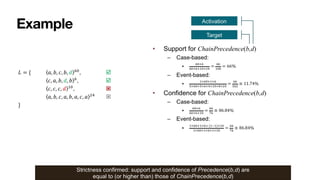
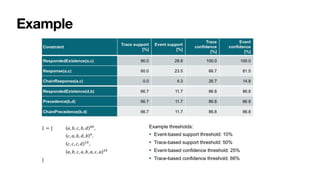
Example
Example
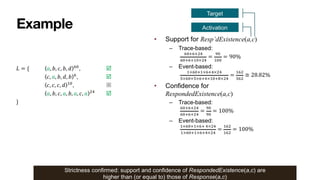
Example
Example
Example
Example
Example
Example
Example
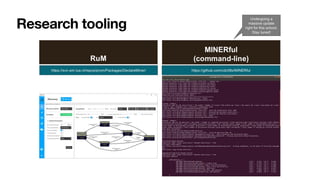
Research tooling
Declarative process mining
4. MONITORING
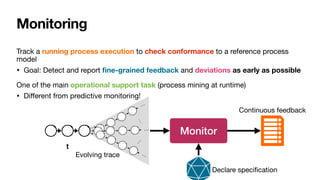
Monitoring
Track a running process execution to check conformance to a reference process
model

• Goal: Detect and report
fi
ne-grained feedback and deviations as early as possible

One of the main operational support task (process mining at runtime)

• Di
ff
erent from predictive monitoring!
…
…
t
…
…
…
Evolving trace
Declare speci
fi
cation
Monitor
Continuous feedback
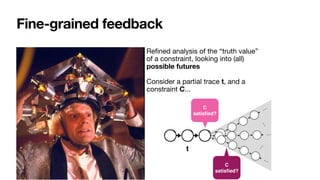
Fine-grained feedback
Re
fi
ned analysis of the “truth value”
of a constraint, looking into (all)
possible futures
Consider a partial trace t, and a
constraint C...
…
…
…
t
C
satis
fi
ed?
…
…
C
satis
fi
ed?
RV-LTL truth values
[BauerEtAl,TOSEM2011]
C is permanently satis
fi
ed if t
satis
fi
es C and no matter how t is
extended, C will stay satis
fi
ed

C is currently satis
fi
ed if t satis
fi
es C
but there is a continuation of t that
violates C
…
…
t
…
…
…
t
RV-LTL truth values
C is currently violated if t violates C
but there is a continuation that leads
to satisfy C

C is permanently violated if t violates
C and no matter how t is extended, C
will stay violated
t
…
…
…
…
…
[BauerEtAl,TOSEM2011]
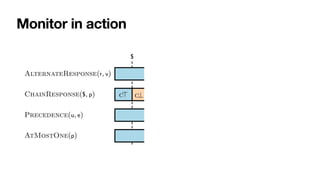
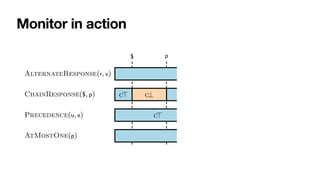
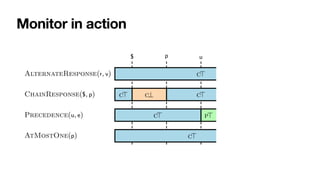
Monitoring by coloring automata
[MaggiEtAl,BPM2011] [DeGiacomoEtAl,TOSEM2022]
Each automaton state: colored with an RV-LTL value 

• Via simple
fi
nal-state reachability checks
Monitoring by coloring automata
[MaggiEtAl,BPM2011] [DeGiacomoEtAl,TOSEM2022]
Each automaton state: colored with an RV-LTL value 

• Via simple
fi
nal-state reachability checks
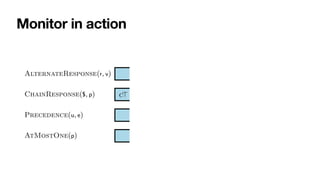
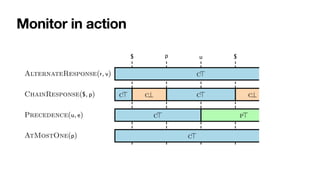
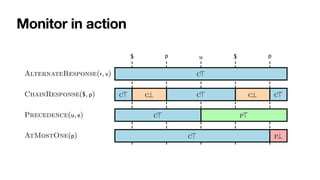
Monitor in action
Monitor in action
Monitor in action
Monitor in action
Monitor in action
Monitor in action
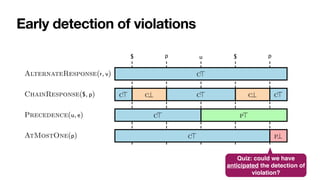
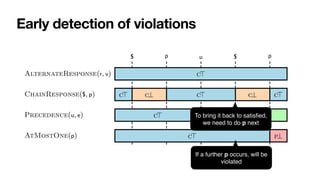
Early detection of violations
Quiz: could we have
anticipated the detection of
violation?
Early detection of violations
If a further p occurs, will be
violated
To bring it back to satis
fi
ed,
we need to do p next
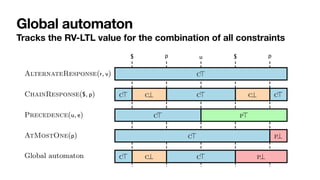
Global automaton
Tracks the RV-LTL value for the combination of all constraints
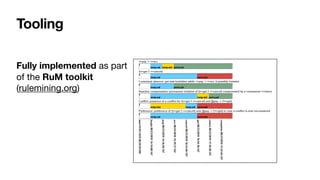
Tooling
0:28 G. De Giacomo et al.
Fig. 10: Screenshot of one of the LDL MONITOR clients.
adopted by the IEEE task force on process mining. The response produced by the LDL
MONITOR provider is composed of two parts. The first part contains the temporal infor-
Fully implemented as part
of the RuM toolkit

(rulemining.org)
Declarative process mining
5. CONCLUSIONS AND EXTENSIONS
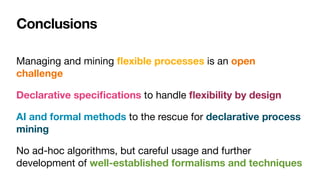
Conclusions
Managing and mining
fl
exible processes is an open
challenge
Declarative speci
fi
cations to handle
fl
exibility by design
AI and formal methods to the rescue for declarative process
mining 

No ad-hoc algorithms, but careful usage and further
development of well-established formalisms and techniques
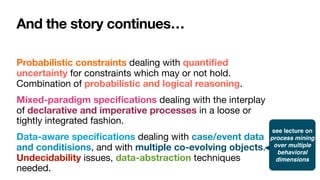
And the story continues…
Probabilistic constraints dealing with quanti
fi
ed
uncertainty for constraints which may or not hold.
Combination of probabilistic and logical reasoning.
Mixed-paradigm speci
fi
cations dealing with the interplay
of declarative and imperative processes in a loose or
tightly integrated fashion.
Data-aware speci
fi
cations dealing with case/event data
and conditisions, and with multiple co-evolving objects.
Undecidability issues, data-abstraction techniques
needed.
see lecture on
process mining
over multiple
behavioral
dimensions
Thank you!
claudio.diciccio@uniroma1.it
montali@inf.unibz.it

Declarative process mining

  • 1.
    Declarative process mining CLAUDIODI CICCIO (Sapienza University of Rome) MARCO MONTALI (Free University of Bozen-Bolzano)
  • 2.
  • 3.
  • 4.
  • 5.
    declarative process mining 1. Declarative process speci fi cations 2.Reasoning with temporal logics and automata 3. Discovery 4. Monitoring
  • 6.
    declarative process mining 1. Declarative process speci fi cations 2.Reasoning with temporal logics and automata 3. Discovery 4. Monitoring 5. Extensions
  • 7.
    AI PM declarative process mining 1. Declarative process speci fi cations 2.Reasoning with temporal logics and automata 3. Discovery 4. Monitoring 5. Extensions
  • 8.
    Declarative process mining 1.DECLARATIVE PROCESS SPECIFICATIONS
  • 9.
    Not all processesare the same…
  • 10.
    Not all processesare the same… Complexity how easy it is to coordinate, collaborate, and take decisions within the process
  • 11.
    Not all processesare the same… Complexity how easy it is to coordinate, collaborate, and take decisions within the process Predictability how easy it is to know in advance how to execute the process
  • 12.
    Not all processesare the same… Complexity how easy it is to coordinate, collaborate, and take decisions within the process Predictability how easy it is to know in advance how to execute the process Repetitiveness how frequently a new process instance is started
  • 13.
    On control andflexibility complexity -> predictability <- repetitiveness <-
  • 14.
    On control andflexibility complexity -> predictability <- repetitiveness <- Control degree to which a central orchestrator decides how to execute the process
  • 15.
    On control andflexibility complexity -> predictability <- repetitiveness <- Control degree to which a central orchestrator decides how to execute the process Flexibility degree to which process stakeholders locally decide how to execute the process
  • 16.
    On control andflexibility complexity -> predictability <- repetitiveness <- Control degree to which a central orchestrator decides how to execute the process Flexibility degree to which process stakeholders locally decide how to execute the process
  • 17.
    Which Italian fooddo you like best? complexity -> predictability <- repetitiveness <- Control degree to which a central orchestrator decides how to execute the process Flexibility degree to which process stakeholders locally decide how to execute the process Lasagna processes Spaghetti processes
  • 18.
    Reality is oftenmore flexible than it seems…
  • 19.
    Reality is oftenmore flexible than it seems…
  • 20.
    What is aprocess? A possibly in fi nite set of fi nite traces Fix a fi nite set of activities • Trace = fi nite sequence of activities from (event = activity in a position!) Σ Σ
  • 21.
    What is aprocess? A possibly in fi nite set of fi nite traces Fix a fi nite set of activities • Trace = fi nite sequence of activities from (event = activity in a position!) = the in fi nite set of fi nite traces over • Very controlled process: a tiny subset of • The most liberal process: the whole Σ Σ Σ* Σ Σ* Σ*
  • 22.
    What is aprocess? A possibly in fi nite set of fi nite traces Σ*
  • 23.
    What is aprocess? A possibly in fi nite set of fi nite traces Σ*
  • 24.
    Flexibility and controlas contrasting forces Σ* control fl exibility
  • 25.
  • 26.
  • 27.
  • 28.
    The issue offlexibility is widely known
  • 29.
    The issue offlexibility is widely known Different ways to address fl exibility in processes We are interested here in fl exibility by design
  • 30.
    Two process modellingparadigms Imperative models • Repetitive, predictable processes • Metaphor: fl owchart speci fi cations • Highly-variable processes • Metaphor: rules/constraints Dec t i lar a e v
  • 31.
  • 32.
    Imperative modelling Focus: howthings must be done • Explicit description of the process control- fl ow Closed modelling • All that is not explicitly modelled is forbidden • Exceptions/uncommon behaviours: explicitly enumerated at design time
  • 33.
    The effect ofimperative modelling Receive order Check availability Article available? Ship article Financial settlement yes Procurement no Payment received Inform customer Late delivery Undeliverable Customer informed Inform customer Article removed Remove article from catalogue
  • 34.
    The effect ofimperative modelling Receive order Check availability Article available? Ship article Financial settlement yes Procurement no Payment received Inform customer Late delivery Undeliverable Customer informed Inform customer Article removed Remove article from catalogue Input Output
  • 35.
    The effect ofimperative modelling Receive order Check availability Article available? Ship article Financial settlement yes Procurement no Payment received Inform customer Late delivery Undeliverable Customer informed Inform customer Article removed Remove article from catalogue Input Output Receive order Check availability Article available? Ship article Financial settlement yes Procurement no Payment received Inform customer Late delivery Undeliverable Customer informed Inform customer Article removed Remove article from catalogue
  • 36.
  • 37.
    … and animperative model of it Σ*
  • 38.
    Example Flexible shopping (withoutconsidering data) • Tasks: = {pick item, close order, pay} • A customer may pick items, close several orders, and pay one or more orders at once • She may even close an empty order and pay for it, or pay multiple times (whole orders or order parts; a no-op if nothing is left to pay) • Business constraint: whenever you close an order, you have to pay later at least once Σ
  • 39.
    Quiz: which tracesbelong to the process? “Whenever you close an order, you have to pay later at least once” 1.<> (empty trace) 2.<i,i,i> 3.<i,i,i,c,p> 4.<i,i,i,c,p,p> 5.<i,i,i,p,c> 6.<i,c,p,i,i,c,p>
  • 40.
    Quiz: which tracesbelong to the process? “Whenever you close an order, you have to pay later at least once” 1.<> (empty trace) 2.<i,i,i> 3.<i,i,i,c,p> 4.<i,i,i,c,p,p> 5.<i,i,i,p,c> 6.<i,c,p,i,i,c,p>
  • 41.
    Quiz: How tomodel the process with BPMN? “Whenever you close an order, you have to pay later at least once” First attempt: 1. <> (empty trace) 2. <i,i,i> 3. <i,i,i,c,p> 4. <i,i,i,c,p,p> 5. <i,i,i,p,c> 6. <i,c,p,i,i,c,p> pick item close order pay quit order paid
  • 42.
    Quiz: How tomodel the process with BPMN? “Whenever you close an order, you have to pay later at least once” First attempt: 1. <> (empty trace) 2. <i,i,i> 3. <i,i,i,c,p> 4. <i,i,i,c,p,p> 5. <i,i,i,p,c> 6. <i,c,p,i,i,c,p> pick item close order pay quit order paid Simple, correct, but not general enough
  • 43.
    Quiz: How tomodel the process with BPMN? “Whenever you close an order, you have to pay later at least once” Most liberal attempt: 1. <> (empty trace) 2. <i,i,i> 3. <i,i,i,c,p> 4. <i,i,i,c,p,p> 5. <i,i,i,p,c> 6. <i,c,p,i,i,c,p> pick item close order pay pick item pay
  • 44.
    Quiz: How tomodel the process with BPMN? “Whenever you close an order, you have to pay later at least once” Most liberal attempt: 1. <> (empty trace) 2. <i,i,i> 3. <i,i,i,c,p> 4. <i,i,i,c,p,p> 5. <i,i,i,p,c> 6. <i,c,p,i,i,c,p> Correct, general (captures the rule in a maximal way), but unreadable pick item close order pay pick item pay
  • 45.
  • 46.
  • 47.
  • 48.
    Our goal Compact speci fi cation Reality represents The classof “regular” spaghetti processes (not all)
  • 49.
    Idea Focus: what hasto be accomplished • Explicit description of the relevant process constraints • Control- fl ow left implicit Open modelling • All behaviors are possible as long as all constraints are satis fi ed
  • 50.
    Declarative specifications asconstraints Process Imperative model Declarative speci fi cation
  • 51.
    Declarative specifications asconstraints Process Imperative model Declarative speci fi cation
  • 52.
    Declarative specifications asconstraints Process Imperative model Declarative speci fi cation
  • 53.
    Constraint-based specifications ofbehaviour • Multiagent systems: declarative agent programs [Fisher,JSC1996] and interaction protocols [Singh,AAMAS2003] • Data management: cascaded transactional updates [DavulcuEtAl,PODS1998] • BPM (1st wave): loosely-coupled subprocesses [SadiqEtAl,ER2001] • BPM (2nd wave): process constraints • DECLARE [PesicEtAl,EDOC2007] • Dynamic Condition-Response (DCR) Graphs [HildebrandtEtAl,PLACES2010]
  • 54.
    Origin of Declare… Language,formalisation, reasoning, enactment
  • 55.
  • 56.
    Constraint templates Constraint typesde fi ned on activity placeholders, each with a speci fi c meaning • … then instantiated on actual activities (by grounding) Dimensions • Activities: how many are involved • Time: temporal orientation (past, future, either) and strength (when) • Expectation: negative vs positive Much richer than the precedence fl ow relation of imperative languages
  • 57.
    Playing with thethree dimensions… Unary templates (over a single activity A) • Existence: you should/cannot do A (for a certain number of times) Binary templates (apply to two - or more - tasks) • Choice: do A (x-)or B • Relation: if A occurs, then B must also occur (when?) • Negation: if A then B cannot occur (when?) Once instantiated, binary constraints may branch to represent potential alternatives
  • 58.
  • 59.
  • 60.
  • 61.
  • 62.
    Declare specification A setof constraints (templates grounded on the activities of interest) • Constraints have to be all satis fi ed globally over each, complete trace • Compositional approach by conjunction
  • 63.
    Flexible shopper inDeclare “Whenever you close an order, you have to pay later at least once” 1. <> (empty trace) 2. <i,i,i> 3. <i,i,i,c,p> 4. <i,i,i,c,p,p> 5. <i,i,i,p,c> 6. <i,c,p,i,i,c,p> Pick item Close order Pay Accepts all {i, c, p}*
  • 64.
    Flexible shopper inDeclare “Whenever you close an order, you have to pay later at least once” 1. <> (empty trace) 2. <i,i,i> 3. <i,i,i,c,p> 4. <i,i,i,c,p,p> 5. <i,i,i,p,c> 6. <i,c,p,i,i,c,p> Pick item Close order Pay response
  • 65.
    Interaction among constraints Akahidden dependencies [MontaliEtAl,TWEB2010] Cancel order Confirm order Pay If you cancel the order, you cannot pay for it If you con fi rm the order, you must pay for it
  • 66.
    Interaction among constraints Akahidden dependencies [MontaliEtAl,TWEB2010] Cancel order Confirm order Pay If you cancel the order, you cannot pay for it If you con fi rm the order, you must pay for it Hence: forbidden to cancel and con fi rm! Key questions 1. How to characterise the language of a Declare speci fi cation? 2. How to understand whether a speci fi cation is correct?
  • 67.
  • 68.
    A short detour ArePetri nets declarative? A Petri net supporting every trace on the given activities Pick item Close order Pay
  • 69.
    A short detour ArePetri nets declarative? Adding places induces temporal constraints But shall we interpret them backwards? Or forward? Pick item Close order Pay
  • 70.
    A short detour ArePetri nets declarative? Atemporal and negative constraints cannot be explicitly captured, nor incrementally Pick item Close order Pay
  • 71.
    Declarative process mining 2.REASONING WITH TEMPORAL LOGICS AND AUTOMATA
  • 72.
  • 73.
    Back to theroots Patterns in Linear Temporal Logic (LTL)
  • 74.
    LTL: a logicfor infinite traces Logic interpreted over in fi nite traces ' ::= A | ¬' | '1 ^ '2 | ' | '1U'2 Atomic propositions Boolean connectives At next step φ holds At some point φ2 holds, and φ1 holds until φ2 does φ eventually holds φ always holds φ1 holds forever or until φ2 does ' ::= A | ¬' | '1 ^ '2 | ' | '1U'2 ::= A | ¬' | '1 ^ '2 | ' | '1U'2 '1 ^ '2 | ' | '1U'2 | ' | '1U'2 ⌃' ⌘ true U' ⇤' ⌘ ¬⌃¬' '1W'2 = '1U'2 _ ⇤'1 ⇤' ⌘ ¬⌃¬' … Each state indicates which propositions hold
  • 75.
    LTL: a logicfor infinite traces Logic interpreted over in fi nite traces ' ::= A | ¬' | '1 ^ '2 | ' | '1U'2 Atomic propositions Boolean connectives At next step φ holds At some point φ2 holds, and φ1 holds until φ2 does φ eventually holds φ always holds φ1 holds forever or until φ2 does ' ::= A | ¬' | '1 ^ '2 | ' | '1U'2 ::= A | ¬' | '1 ^ '2 | ' | '1U'2 '1 ^ '2 | ' | '1U'2 | ' | '1U'2 ⌃' ⌘ true U' ⇤' ⌘ ¬⌃¬' '1W'2 = '1U'2 _ ⇤'1 ⇤' ⌘ ¬⌃¬' … Each state indicates which propositions hold Can be seamlessly extended with past- tense operators
  • 76.
    LTL: a logicfor infinite traces Logic interpreted over in fi nite traces ' ::= A | ¬' | '1 ^ '2 | ' | '1U'2 Atomic propositions Boolean connectives At next step φ holds At some point φ2 holds, and φ1 holds until φ2 does φ eventually holds φ always holds φ1 holds forever or until φ2 does ' ::= A | ¬' | '1 ^ '2 | ' | '1U'2 ::= A | ¬' | '1 ^ '2 | ' | '1U'2 '1 ^ '2 | ' | '1U'2 | ' | '1U'2 ⌃' ⌘ true U' ⇤' ⌘ ¬⌃¬' '1W'2 = '1U'2 _ ⇤'1 ⇤' ⌘ ¬⌃¬' … Each state indicates which propositions hold Can be seamlessly extended with past- tense operators Trace t satis fi es a formula is now formally de fi ned: φ t ⊧ φ
  • 77.
  • 78.
    Semantics of Declarevia LTL Atomic propositions are activities Each constraint is an LTL formula (built from template formulae) … Each state is empty or contains one single activity 0..1 Con fi rm order Reject order Finalize order
  • 79.
    Semantics of Declarevia LTL Atomic propositions are activities Each constraint is an LTL formula (built from template formulae) … Each state is empty or contains one single activity 0..1 Con fi rm order Reject order Finalize order ⇤(F ! ⌃(C _ R))
  • 80.
    Semantics of Declarevia LTL … Each state is empty or contains one single activity ⇤(F ! ⌃(C _ R)) ^ ¬(⌃(F ^ ⌃F)) ^ ¬CWF ^ ¬RWF 0..1 Con fi rm order Reject order Finalize order Atomic propositions are activities Each constraint is an LTL formula (built from template formulae) A Declare speci fi cation is the conjunction of its constraint formulae
  • 81.
    An unconventional useof logics! From … Temporal logics for specifying (un)desired properties of a dynamic system … to … Temporal logics for specifying the dynamic system itself
  • 82.
    ⇤(F ! ⌃(C_ R)) ^ ¬(⌃(F ^ ⌃F)) ^ ¬CWF ^ ¬RWF 0..1 Con fi rm order Reject order Finalize order Wait a moment…
  • 83.
    ⇤(F ! ⌃(C_ R)) ^ ¬(⌃(F ^ ⌃F)) ^ ¬CWF ^ ¬RWF 0..1 Con fi rm order Reject order Finalize order Wait a moment… Just what we needed! However… Each process instance should end in a fi nite number of steps!
  • 84.
    LTLf: LTL overfinite traces [DeGiacomoVardi,IJCAI2013] LTL interpreted over fi nite traces ' ::= A | ¬' | '1 ^ '2 | ' | '1U'2 No successor! Same syntax of LTL In LTL, there is always a next moment… in LTLf, the contrary! φ always holds from current to the last instant The next step exists and at next step φ holds (weak next) If the next step exists, then at next step φ holds last instant in the trace ' | '1 ^ '2 | ' | '1U'2 ⇤' Last ⌘ ¬ true ' ⌘ ¬ ¬'
  • 85.
    Look the same,but they are not the same Many researchers: misled by moving from in fi nite to fi nite traces In [DeGiacomoEtAl,AAAI14], we studied why! • People typically focus on “patterns”, not on the entire logic • Many of such patterns in BPM, reasoning about actions, planning, etc. are “insensitive to in fi nity”
  • 86.
    Quiz: does thisspecification accept traces? b c 0..1 1..* a d
  • 87.
    Quiz: does thisspecification accept traces? b c 0..1 1..* a d
  • 88.
    Quiz: does thisspecification accept traces? b c 0..1 1..* a d
  • 89.
    Quiz: does thisspecification accept traces? b c 0..1 1..* a d
  • 90.
    Quiz: does thisspecification accept traces? b c 0..1 1..* a d
  • 91.
    Quiz: does thisspecification accept traces? b c 0..1 1..* a d
  • 92.
    Quiz: does thisspecification accept traces? a b
  • 93.
    Quiz: does thisspecification accept traces? a b Only the empty trace <>, due to fi nite-trace semantics
  • 94.
    How to dothis, systematically? Declare speci fi cation: encoded in LTLf LTLf: the star-free fragment of regular expressions Regular expressions: intimately connected to fi nite-state automata • No exotic automata models over in fi nite structures! Just the good old automata you know from a typical course in programming languages and compilers
  • 95.
    How to dothis, systematically? Declare speci fi cation: encoded in LTLf LTLf: the star-free fragment of regular expressions Regular expressions: intimately connected to fi nite-state automata • No exotic automata models over in fi nite structures! Just the good old automata you know from a typical course in programming languages and compilers
  • 96.
    From Declare toautomata LTLf NFA
 nondeterministic DFA
 deterministic LTLf2aut determin. ' nt lf formulas can be translated into equivalent nfa: t |= Ï iff t œ L(AÏ) /ldlf to nfa (exponential) to dfa (exponential) often nfa/dfa corresponding to ltlf /ldlf are in fact small! ompile reasoning into automata based procedures! Process engine! [DeGiacomoVardi,IJCAI2013] [DeGiacomoEtAl,TOSEM2022]
  • 97.
    Vision realised! LTLf NFA
 nondeterministic DFA
 deterministic LTLf2autdetermin. ' nt lf formulas can be translated into equivalent nfa: t |= Ï iff t œ L(AÏ) /ldlf to nfa (exponential) to dfa (exponential) often nfa/dfa corresponding to ltlf /ldlf are in fact small! ompile reasoning into automata based procedures! Process engine! [DeGiacomoVardi,IJCAI2013] [DeGiacomoEtAl,TOSEM2022]
  • 98.
    Few lines ofcode [DeGiacomoEtAl,TOSEM2022] 0:8 G. De Giacomo et al. (tt, ⇧) = true (↵ , ⇧) = false ( , ⇧) = (h itt, ⇧) ( prop.) ('1 ^ '2, ⇧) = ('1, ⇧) ^ ('2, ⇧) ('1 _ '2, ⇧) = ('1, ⇧) _ ('2, ⇧) (h i', ⇧) = ⇢ E (') if ⇧ |= ( prop.) false if ⇧ 6|= (h ?i', ⇧) = ( , ⇧) ^ (', ⇧) (h⇢1 + ⇢2i', ⇧) = (h⇢1i', ⇧) _ (h⇢2i', ⇧) (h⇢1; ⇢2i', ⇧) = (h⇢1ih⇢2i', ⇧) (h⇢⇤ i', ⇧) = (', ⇧) _ (h⇢iF h⇢⇤i', ⇧) ([ ]', ⇧) = ⇢ E (') if ⇧ |= ( prop.) true if ⇧ 6|= ([ ?]', ⇧) = (nnf (¬ ), ⇧) _ (', ⇧) ([⇢1 + ⇢2]', ⇧) = ([⇢1]', ⇧) ^ ([⇢2]', ⇧) ([⇢1; ⇢2]', ⇧) = ([⇢1][⇢2]', ⇧) ([⇢⇤ ]', ⇧) = (', ⇧) ^ ([⇢]T [⇢⇤]', ⇧) (F , ⇧) = false (T , ⇧) = true Fig. 1: Definition of , where E (') recursively replaces in ' all occurrences of atoms of the form T and F by . 1: algorithm LDLf 2NFA 2: input LDLf formula ' 3: output NFA A(') = (2P , S, s0, %, Sf ) 4: s0 {'} . set the initial state 5: Sf {;} . set final states 6: if ( (', ✏) = true) then . check if initial state is also final 7: Sf Sf [ {s0} 8: S {s0, ;}, % ; 9: while (S or % change) do 10: for (s 2 S) do 11: if (s0 |= V ( 2s) ( , ⇧) then . add new state and transition 12: S S [ {s0 } 13: % % [ {(s, ⇧, s0 )} 14: if ( V ( 2s0) ( , ✏) = true) then . check if new state is also final 15: Sf Sf [ {s0 } Fig. 2: NFA construction. ' NFA
  • 99.
    Few lines ofcode [DeGiacomoEtAl,TOSEM2022] 0:8 G. De Giacomo et al. (tt, ⇧) = true (↵ , ⇧) = false ( , ⇧) = (h itt, ⇧) ( prop.) ('1 ^ '2, ⇧) = ('1, ⇧) ^ ('2, ⇧) ('1 _ '2, ⇧) = ('1, ⇧) _ ('2, ⇧) (h i', ⇧) = ⇢ E (') if ⇧ |= ( prop.) false if ⇧ 6|= (h ?i', ⇧) = ( , ⇧) ^ (', ⇧) (h⇢1 + ⇢2i', ⇧) = (h⇢1i', ⇧) _ (h⇢2i', ⇧) (h⇢1; ⇢2i', ⇧) = (h⇢1ih⇢2i', ⇧) (h⇢⇤ i', ⇧) = (', ⇧) _ (h⇢iF h⇢⇤i', ⇧) ([ ]', ⇧) = ⇢ E (') if ⇧ |= ( prop.) true if ⇧ 6|= ([ ?]', ⇧) = (nnf (¬ ), ⇧) _ (', ⇧) ([⇢1 + ⇢2]', ⇧) = ([⇢1]', ⇧) ^ ([⇢2]', ⇧) ([⇢1; ⇢2]', ⇧) = ([⇢1][⇢2]', ⇧) ([⇢⇤ ]', ⇧) = (', ⇧) ^ ([⇢]T [⇢⇤]', ⇧) (F , ⇧) = false (T , ⇧) = true Fig. 1: Definition of , where E (') recursively replaces in ' all occurrences of atoms of the form T and F by . 1: algorithm LDLf 2NFA 2: input LDLf formula ' 3: output NFA A(') = (2P , S, s0, %, Sf ) 4: s0 {'} . set the initial state 5: Sf {;} . set final states 6: if ( (', ✏) = true) then . check if initial state is also final 7: Sf Sf [ {s0} 8: S {s0, ;}, % ; 9: while (S or % change) do 10: for (s 2 S) do 11: if (s0 |= V ( 2s) ( , ⇧) then . add new state and transition 12: S S [ {s0 } 13: % % [ {(s, ⇧, s0 )} 14: if ( V ( 2s0) ( , ✏) = true) then . check if new state is also final 15: Sf Sf [ {s0 } Fig. 2: NFA construction. ' NFA Automata manipulations much easier to handle than in the in fi nite case, with huge performance improvements [ZhuEtAl, IJ CAI17] [Westergaard,BPM11]
  • 100.
    Constraint automata Template: pre-compiledinto a DFA Constraint: grounds the template DFA on speci fi c activities
  • 101.
  • 102.
  • 103.
  • 104.
  • 105.
  • 106.
    From local automatato global automaton Entire speci fi cation: product automaton of all local automata • Corresponds to the automaton of the conjunction of all formulae • Many optimisations available Declare speci fi cation consistent if and only if its global automaton is non-empty
  • 107.
    Subsumption and incompatibility Chainresponse(a,b): whenever a is executed, the next executed activity is b Alternate response(a,b): whenever a is executed, a cannot be executed again until b is executed Response(a,b): whenever a is executed, b must be later executed Negation succession(a,b): whenever a is executed, b cannot be later executed
  • 108.
    Subsumption and incompatibility Chainresponse(a,b): whenever a is executed, the next executed activity is b Alternate response(a,b): whenever a is executed, a cannot be executed again until b is executed Response(a,b): whenever a is executed, b must be later executed Negation succession(a,b): whenever a is executed, b cannot be later executed Subsumes (is stronger than) Subsumes (is stronger than) Incompatible
  • 109.
  • 110.
  • 111.
  • 112.
    Declarative process discovery Simplystated… Process discovery aiming at extracting a declarative speci fi cation from a log In our case: Declare
  • 113.
    Declarative process discovery Twosettings Discriminative mining Speci fi cation mining Event log Event log Partition Discover Discover Speci fi cation that covers all green traces and rejects all red ones Speci fi cation that covers well all traces in the log
  • 114.
    All possible constraintsgrounded on the activities in the log The log
  • 115.
    All possible constraintsgrounded on the activities in the log The log Which to keep?
  • 116.
    General idea 1.De fi ne suitablemetrics to capture the meaning of covering well -> interesting satisfaction • Starting point: support and con fi dence from data mining • Issues: not enough, not easy to import (see next slides) 2.Approach discovery by combining: • Metrics for interestingness • Temporal reasoning for logical correctness and for computing the inputs of metrics
  • 117.
    Naive support isnot enough Constraint support (naive) = Issue: consider response(a,b) • <a,c,b,a> • <c,d,e,c,d,e,f> • <b,c,d,e> • <a,b> • <a,a,b,a,b,a,b,a,a,a,b> # traces that satisfy the constraint total # traces in the log
  • 118.
    Naive support isnot enough Constraint support (naive) = Issue: consider response(a,b) • <a,c,b,a> • <c,d,e,c,d,e,f> • <b,c,d,e> • <a,b> • <a,a,b,a,b,a,b,a,a,a,b> Support: 4/5 (not informative) # traces that satisfy the constraint total # traces in the log Need to: 1. Account for vacuous satisfaction 2. Distinguish satisfying traces based on interestingness 3. De fi ne event-based measures
  • 119.
    Constraint activation andtarget Activation: activity/moment that triggers an expectation in the constraint Target: LTLf formula for the expectation Systematically extracted from a normal form of constraints AtLeastOne(a) Start Do a sooner or later Response(a,b) a Do b afterwards Precedence(a,b) b Did a before NegationResponse(a,b) a Don’t do b afterwards Template Activation Target
  • 120.
    Trace-based support, refined Constraintsupport (trace-based) = Response(a,b) • <a,c,b,a> • <c,d,e,c,d,e,f> • <b,c,d,e> • <a,c,d,b> • <a,a,c,b,a,b,a,d,b,a,a,c,a,b> Support: from 4/5 to 2/5 (informative, but not re fl ecting what happens within a trace) # traces that satisfy the constraint and activate it total # traces in the log
  • 121.
    Trace-based support, refined Constraintsupport (trace-based) = Response(a,b) • <a,c,b,a> • <c,d,e,c,d,e,f> • <b,c,d,e> • <a,c,d,b> • <a,a,c,b,a,b,a,d,b,a,a,c,a,b> Support: from 4/5 to 2/5 (informative, but not re fl ecting what happens within a trace) # traces that satisfy the constraint and activate it total # traces in the log
  • 122.
    Event-based support Constraint support(event-based) = Response(a,b) • <a,c,b,a> • <c,d,e,c,d,e,f> • <b,c,d,e> • <a,c,d,b> • <a,a,c,b,a,b,a,d,b,a,a,c,a,b> Support: 9/33 (informative, but not re fl ecting trace satisfaction/violation) # events that satisfy the constraint activation and its target total # events in the log
  • 123.
    Event-based support Constraint support(event-based) = Response(a,b) • <a,c,b,a> • <c,d,e,c,d,e,f> • <b,c,d,e> • <a,c,d,b> • <a,a,c,b,a,b,a,d,b,a,a,c,a,b> Support: 9/33 (informative, but not re fl ecting trace satisfaction/violation) # events that satisfy the constraint activation and its target total # events in the log
  • 124.
    Trace- and event-basedconfidence Activation and target: solid basis to import the notion of con fi dence from association rule mining Constraint con fi dence (trace-based) = Constraint con fi dence (event-based) = # traces that satisfy the constraint and activate it # traces that activate the constraint # events that satisfy the constraint activation and its target # events that satisfy the constraint activation
  • 125.
    Finally, discovery 1. Selecttemplates of interest 2. Compute metrics for corresponding constraints (grounded on log activities) 3. Filter based on minimum thresholds 4. Redundant constraints? • Keep the most liberal if metrics are better for it • Keep the most restrictive in case of equal metrics 5. Incompatible constraints? • Keep only the one with better metrics 6. Further processing to ensure consistency, minimality, …
  • 126.
  • 127.
  • 128.
  • 129.
  • 130.
  • 131.
  • 132.
  • 133.
  • 134.
  • 135.
  • 136.
  • 137.
    Monitoring Track a runningprocess execution to check conformance to a reference process model • Goal: Detect and report fi ne-grained feedback and deviations as early as possible One of the main operational support task (process mining at runtime) • Di ff erent from predictive monitoring! … … t … … … Evolving trace Declare speci fi cation Monitor Continuous feedback
  • 138.
    Fine-grained feedback Re fi ned analysisof the “truth value” of a constraint, looking into (all) possible futures Consider a partial trace t, and a constraint C... … … … t C satis fi ed? … … C satis fi ed?
  • 139.
    RV-LTL truth values [BauerEtAl,TOSEM2011] Cis permanently satis fi ed if t satis fi es C and no matter how t is extended, C will stay satis fi ed C is currently satis fi ed if t satis fi es C but there is a continuation of t that violates C … … t … … … t
  • 140.
    RV-LTL truth values Cis currently violated if t violates C but there is a continuation that leads to satisfy C C is permanently violated if t violates C and no matter how t is extended, C will stay violated t … … … … … [BauerEtAl,TOSEM2011]
  • 141.
    Monitoring by coloringautomata [MaggiEtAl,BPM2011] [DeGiacomoEtAl,TOSEM2022] Each automaton state: colored with an RV-LTL value • Via simple fi nal-state reachability checks
  • 142.
    Monitoring by coloringautomata [MaggiEtAl,BPM2011] [DeGiacomoEtAl,TOSEM2022] Each automaton state: colored with an RV-LTL value • Via simple fi nal-state reachability checks
  • 143.
  • 144.
  • 145.
  • 146.
  • 147.
  • 148.
  • 149.
    Early detection ofviolations Quiz: could we have anticipated the detection of violation?
  • 150.
    Early detection ofviolations If a further p occurs, will be violated To bring it back to satis fi ed, we need to do p next
  • 151.
    Global automaton Tracks theRV-LTL value for the combination of all constraints
  • 152.
    Tooling 0:28 G. DeGiacomo et al. Fig. 10: Screenshot of one of the LDL MONITOR clients. adopted by the IEEE task force on process mining. The response produced by the LDL MONITOR provider is composed of two parts. The first part contains the temporal infor- Fully implemented as part of the RuM toolkit (rulemining.org)
  • 153.
    Declarative process mining 5.CONCLUSIONS AND EXTENSIONS
  • 154.
    Conclusions Managing and mining fl exibleprocesses is an open challenge Declarative speci fi cations to handle fl exibility by design AI and formal methods to the rescue for declarative process mining No ad-hoc algorithms, but careful usage and further development of well-established formalisms and techniques
  • 155.
    And the storycontinues… Probabilistic constraints dealing with quanti fi ed uncertainty for constraints which may or not hold. Combination of probabilistic and logical reasoning. Mixed-paradigm speci fi cations dealing with the interplay of declarative and imperative processes in a loose or tightly integrated fashion. Data-aware speci fi cations dealing with case/event data and conditisions, and with multiple co-evolving objects. Undecidability issues, data-abstraction techniques needed. see lecture on process mining over multiple behavioral dimensions
  • 156.