Marco Montali

Free University of Bozen-Bolzano
montali@inf.unibz.it
cess Story
TEMPORAL
DECLARATIVE
OVER
FOR
BPM
FINITE
TRACES
LOGICS
A SUCCESS STORY
marco montali
free university
of bozen-bolzano
FMAI17
Assets of an Organization
• Data: the main information source about the history
of the domain of interest and the relevant aspects
of the current state of affairs
• Resources: humans and devices responsible for
the execution of work
• Business processes: how work is carried out in
the domain of interest, towards the achievement of
organizational objectives
2
Business Process Management
A collection of

concepts, methodologies, techniques,

to support humans in 

modeling, governance, deployment,
enactment, and analysis of

business processes
3
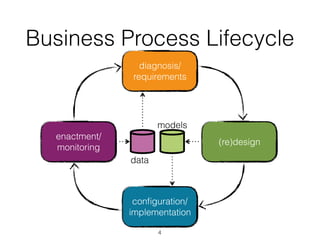
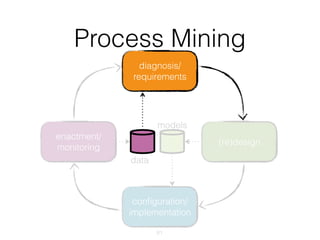
Business Process Lifecycle
diagnosis/
requirements
configuration/
implementation
(re)design
enactment/
monitoring
4
models
data
BPM!
5
BPM?
6
Environment
7
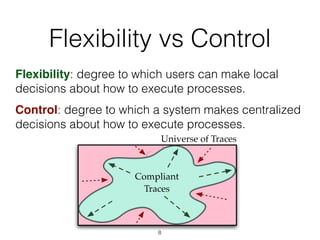
Flexibility vs Control
Flexibility: degree to which users can make local
decisions about how to execute processes.
Control: degree to which a system makes centralized
decisions about how to execute processes.
Universe of Traces
Compliant
Traces
Flexibility8
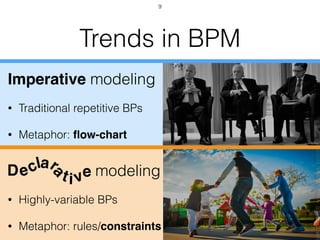
Trends in BPM
modeling
• Highly-variable BPs
• Metaphor: rules/constraints
Dec t i
lar
a
ev
Imperative modeling
• Traditional repetitive BPs
• Metaphor: flow-chart
9
The Issue of Flexibility
10
Imperative Modeling
11
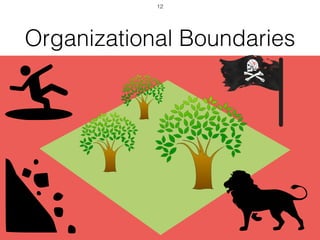
Organizational Boundaries
12
Imperative Modeling
Focus: howthings must be done
• Explicit description of the process control-flow
Closedmodeling
• All that is not explicitly modeled is forbidden
• Exceptions/uncommon behaviors have to be
explicitly enumerated at design time
13
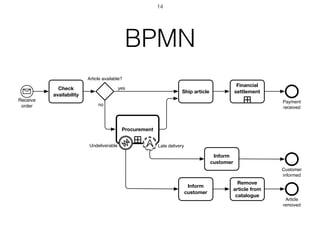
BPMN
Receive
order
Check
availability
Article available?
Ship article
Financial
settlement
yes
Procurement
no
Payment
received
Inform
customer
Late deliveryUndeliverable
Customer
informed
Inform
customer
Article
removed
Remove
article from
catalogue
14
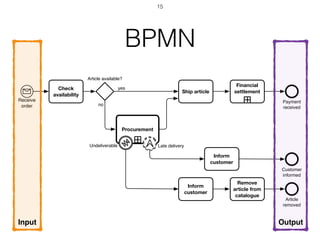
BPMN
Receive
order
Check
availability
Article available?
Ship article
Financial
settlement
yes
Procurement
no
Payment
received
Inform
customer
Late deliveryUndeliverable
Customer
informed
Inform
customer
Article
removed
Remove
article from
catalogue
Input Output
15
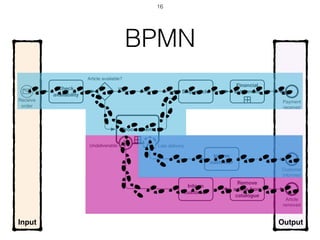
BPMN
Receive
order
Check
availability
Article available?
Ship article
Financial
settlement
yes
Procurement
no
Payment
received
Inform
customer
Late deliveryUndeliverable
Customer
informed
Inform
customer
Article
removed
Remove
article from
catalogue
Input Output
16
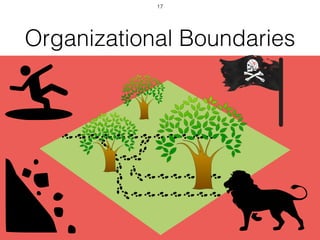
Organizational Boundaries
17
Choreography Example
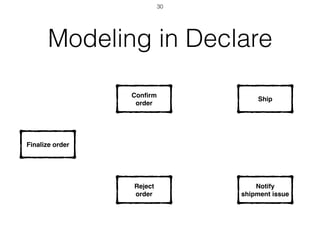
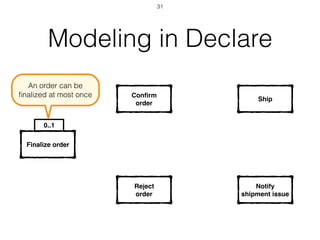
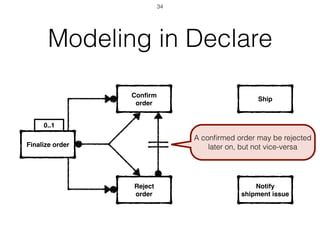
• An order can be finalized at most once
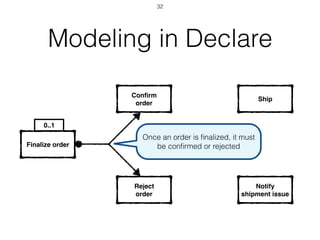
• Once an order is finalized, it must be confirmed or rejected
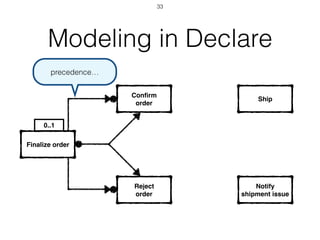
• A confirmed order may be rejected later on (due to “late”
problems), but not vice-versa: a rejection cannot be reverted.
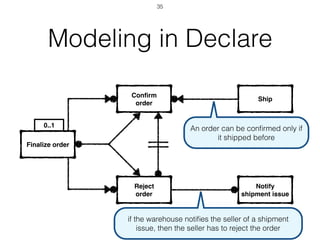
• An order can be confirmed only if it shipped before.
• An order may be rejected autonomously by the seller.
However, if the warehouse notifies the seller of a shipment
issue, then the seller has to reject the order.
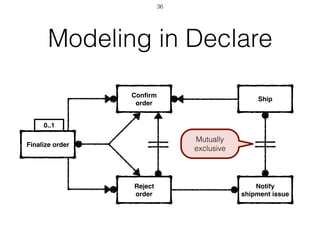
• The warehouse decision is firm: “Ship” and “Notify shipment
issue” are mutually exclusive.
18
What is your
Favourite Italian Food?
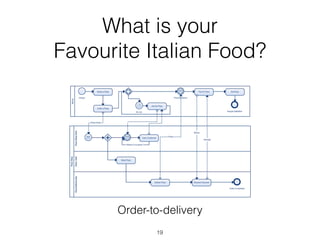
Order-to-delivery
19
What is your
Favourite Italian Food?
Order-to-delivery
20
What is your
Favourite Italian Food?
UnderstandingSpaghettiModelswithSequenceClusteringforProM9
thoseexceptions.Figure4depictstheresultofafirstattempttoanalyzethe
applicationserverlogsusingtheheuristicsminer[4].
Exception
(complete)
187
EstabelecimentoNotFoundException
(complete)
187
0,991
152
GREJBPersistencyException
(complete)
179
0,909
159
PGWSException
(complete)
168
0,889
12
ITPTExternalServiceException
(complete)
183
0,944
162
SIPSCNoRecordsFoundException
(complete)
160
0,8
5
PessoaSingularNotFoundException
(complete)
138
0,667
3
BusinessLogicException
(complete)
183
0,75
4
SICCLException
(complete)
175
0,857
19
NaoExistemRegistosException
(complete)
143
0,833
6
RPCBusinessException
(complete)
38
0,75
3
SAFBusinessException
(complete)
115
0,8
68
GREJBBusinessException
(complete)
45
0,75
23
DESWSException
(complete)
14
0,667
14
NullPointerException
(complete)
104
0,8
91
ValidationException
(complete)
31
0,8
12
GILBusinessException
(complete)
14
0,5
6
GRServicesException
(complete)
7
0,667
3
CSIBusinessException
(complete)
14
0,5
6
ConcorrenciaException
(complete)
5
0,5
2
CSIPersistencyException
(complete)
3
0,5
2
0,857
34
ITPTServerException
(complete)
21
0,667
15
COOPException
(complete)
4
0,5
2
RSIValidationException
(complete)
25
0,667
18
BasicSystemException
(complete)
16
0,667
11
PesquisaAmbiguaException
(complete)
6
0,5
6
CPFBusinessException
(complete)
3
0,5
2
0,8
95
ADOPException
(complete)
6
0,5
5
AFBusinessException
(complete)
64
SIPSCRemoteBusinessException
(complete)
51
0,833
13
ConcurrentModificationException
(complete)
5
0,5
1
CDFBusinessException
(complete)
6
0,667
2
AssinaturaNaoIncluidaException
(complete)
1
0,5
1
SICCSException
(complete)
32
0,8
11
CartaoCidadaoException
(complete)
64
0,833
38
SOAPException
(complete)
22
0,667
14
TooManyRowsException
(complete)
112
0,667
18
SIPSCFatalException
(complete)
20
0,667
9
LimiteTemporalException
(complete)
4
0,5
2
0,8
28
SVIBusinessUserException
(complete)
18
0,75
12
GRConcurrencyException
(complete)
8
0,5
2
ContribuinteRegionalNotFoundException
(complete)
63
0,75
30
JDOFatalUserException
(complete)
124
0,947
49
0,667
5
SQLException
(complete)
9
0,667
7
IOException
(complete)
27
0,75
22
PessoaColectivaNotFoundException
(complete)
23
0,75
20
ServiceDelegateRemoteException
(complete)
3
0,5
2
0,5
5
PASException
(complete)
2
0,5
1
FileNotFoundException
(complete)
31
0,75
13
QgenMIParametrizedBusinessException
(complete)
1
0,5
1
ADOPMessageException
(complete)
3
0,5
2
LayoffException
(complete)
1
0,5
1
0,75
8
CMPException
(complete)
1
0,5
1
GREJBRemoteServiceException
(complete)
34
0,75
4
RSIPersistenceException
(complete)
24
0,75
4
CSIRemoteException
(complete)
3
0,5
1
SIPSCFatalRemoteCallException
(complete)
3
0,5
1
SIPSCDatabaseException
(complete)
1
0,5
1
BusinessException
(complete)
159
0,667
9
SVIBusinessException
(complete)
1
0,5
1
ParametrizedBusinessException
(complete)
2
0,5
2
GDServicesException
(complete)
4
0,5
3
ServerException
(complete)
132
0,75
16
PGException
(complete)
6
0,667
5
0,75
4
DESException
(complete)
135
0,667
13
0,667
2
0,75
9
SIPSCException
(complete)
27
0,75
9
ReportException
(complete)
5
0,667
2
SSNServiceException
(complete)
1
0,5
1
AFException
(complete)
1
0,5
1
InvalidNISSException
(complete)
14
0,75
4
0,75
14
GILConcurrencyException
(complete)
1
0,5
1
RSISystemException
(complete)
28
0,75
7
0,667
5
0,667
1
0,75
2
0,667
5
0,833
5
0,667
5
0,667
4
0,75
12
0,981
53
ADOPUserChoiceException
(complete)
1
0,5
1
0,667
5
RPCException
(complete)
1
0,5
1
GREJBConcurrencyException
(complete)
15
0,875
8
0,5
1
0,5
1
0,667
1
MoradaPortuguesaNotFoundException
(complete)
1
0,5
1
0,75
4
0,5
1
0,667
6
0,5
1
0,5
2
0,889
8
0,75
3
0,8
3
RSIException
(complete)
1
0,5
1
0,5
1
0,5
1
0,667
4
0,667
3
0,5
1
0,5
2
0,75
5
0,5
1
0,5
1
0,5
2
0,5
1
0,5
1
0,5
1
0,5
1
0,5
1
0,5
1
0,5
1
0,5
1
0,5
1
0,5
1
0,5
1
0,5
1
0,8
1
0,5
1
0,5
1
0,5
1
Fig.4.Spaghettimodelobtainedfromtheapplicationserverlogsusingtheheuristics
miner.
Usingthesequenceclusteringplug-inanditspreprocessingcapabilities,as
wellasthepossibilityofvisuallyadjustingtheclustermodelsaccordingtocertain
Healthcare
21
What is your
Favourite Italian Food?
UnderstandingSpaghettiModelswithSequenceClusteringforProM9
thoseexceptions.Figure4depictstheresultofafirstattempttoanalyzethe
applicationserverlogsusingtheheuristicsminer[4].
Exception
(complete)
187
EstabelecimentoNotFoundException
(complete)
187
0,991
152
GREJBPersistencyException
(complete)
179
0,909
159
PGWSException
(complete)
168
0,889
12
ITPTExternalServiceException
(complete)
183
0,944
162
SIPSCNoRecordsFoundException
(complete)
160
0,8
5
PessoaSingularNotFoundException
(complete)
138
0,667
3
BusinessLogicException
(complete)
183
0,75
4
SICCLException
(complete)
175
0,857
19
NaoExistemRegistosException
(complete)
143
0,833
6
RPCBusinessException
(complete)
38
0,75
3
SAFBusinessException
(complete)
115
0,8
68
GREJBBusinessException
(complete)
45
0,75
23
DESWSException
(complete)
14
0,667
14
NullPointerException
(complete)
104
0,8
91
ValidationException
(complete)
31
0,8
12
GILBusinessException
(complete)
14
0,5
6
GRServicesException
(complete)
7
0,667
3
CSIBusinessException
(complete)
14
0,5
6
ConcorrenciaException
(complete)
5
0,5
2
CSIPersistencyException
(complete)
3
0,5
2
0,857
34
ITPTServerException
(complete)
21
0,667
15
COOPException
(complete)
4
0,5
2
RSIValidationException
(complete)
25
0,667
18
BasicSystemException
(complete)
16
0,667
11
PesquisaAmbiguaException
(complete)
6
0,5
6
CPFBusinessException
(complete)
3
0,5
2
0,8
95
ADOPException
(complete)
6
0,5
5
AFBusinessException
(complete)
64
SIPSCRemoteBusinessException
(complete)
51
0,833
13
ConcurrentModificationException
(complete)
5
0,5
1
CDFBusinessException
(complete)
6
0,667
2
AssinaturaNaoIncluidaException
(complete)
1
0,5
1
SICCSException
(complete)
32
0,8
11
CartaoCidadaoException
(complete)
64
0,833
38
SOAPException
(complete)
22
0,667
14
TooManyRowsException
(complete)
112
0,667
18
SIPSCFatalException
(complete)
20
0,667
9
LimiteTemporalException
(complete)
4
0,5
2
0,8
28
SVIBusinessUserException
(complete)
18
0,75
12
GRConcurrencyException
(complete)
8
0,5
2
ContribuinteRegionalNotFoundException
(complete)
63
0,75
30
JDOFatalUserException
(complete)
124
0,947
49
0,667
5
SQLException
(complete)
9
0,667
7
IOException
(complete)
27
0,75
22
PessoaColectivaNotFoundException
(complete)
23
0,75
20
ServiceDelegateRemoteException
(complete)
3
0,5
2
0,5
5
PASException
(complete)
2
0,5
1
FileNotFoundException
(complete)
31
0,75
13
QgenMIParametrizedBusinessException
(complete)
1
0,5
1
ADOPMessageException
(complete)
3
0,5
2
LayoffException
(complete)
1
0,5
1
0,75
8
CMPException
(complete)
1
0,5
1
GREJBRemoteServiceException
(complete)
34
0,75
4
RSIPersistenceException
(complete)
24
0,75
4
CSIRemoteException
(complete)
3
0,5
1
SIPSCFatalRemoteCallException
(complete)
3
0,5
1
SIPSCDatabaseException
(complete)
1
0,5
1
BusinessException
(complete)
159
0,667
9
SVIBusinessException
(complete)
1
0,5
1
ParametrizedBusinessException
(complete)
2
0,5
2
GDServicesException
(complete)
4
0,5
3
ServerException
(complete)
132
0,75
16
PGException
(complete)
6
0,667
5
0,75
4
DESException
(complete)
135
0,667
13
0,667
2
0,75
9
SIPSCException
(complete)
27
0,75
9
ReportException
(complete)
5
0,667
2
SSNServiceException
(complete)
1
0,5
1
AFException
(complete)
1
0,5
1
InvalidNISSException
(complete)
14
0,75
4
0,75
14
GILConcurrencyException
(complete)
1
0,5
1
RSISystemException
(complete)
28
0,75
7
0,667
5
0,667
1
0,75
2
0,667
5
0,833
5
0,667
5
0,667
4
0,75
12
0,981
53
ADOPUserChoiceException
(complete)
1
0,5
1
0,667
5
RPCException
(complete)
1
0,5
1
GREJBConcurrencyException
(complete)
15
0,875
8
0,5
1
0,5
1
0,667
1
MoradaPortuguesaNotFoundException
(complete)
1
0,5
1
0,75
4
0,5
1
0,667
6
0,5
1
0,5
2
0,889
8
0,75
3
0,8
3
RSIException
(complete)
1
0,5
1
0,5
1
0,5
1
0,667
4
0,667
3
0,5
1
0,5
2
0,75
5
0,5
1
0,5
1
0,5
2
0,5
1
0,5
1
0,5
1
0,5
1
0,5
1
0,5
1
0,5
1
0,5
1
0,5
1
0,5
1
0,5
1
0,5
1
0,8
1
0,5
1
0,5
1
0,5
1
Fig.4.Spaghettimodelobtainedfromtheapplicationserverlogsusingtheheuristics
miner.
Usingthesequenceclusteringplug-inanditspreprocessingcapabilities,as
wellasthepossibilityofvisuallyadjustingtheclustermodelsaccordingtocertain
Healthcare
22
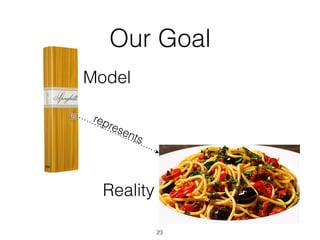
Our Goal
represents
Reality
Model
23
Constraint-Based Modeling
24
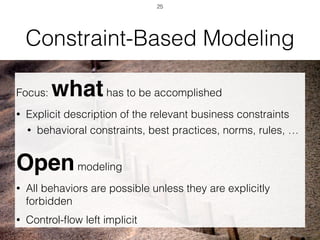
Constraint-Based Modeling
Focus: whathas to be accomplished
• Explicit description of the relevant business constraints
• behavioral constraints, best practices, norms, rules, …
Openmodeling
• All behaviors are possible unless they are explicitly
forbidden
• Control-flow left implicit
25
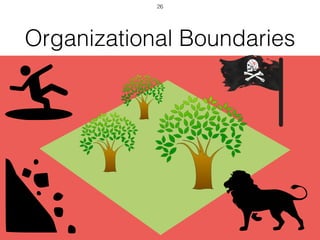
Organizational Boundaries
26
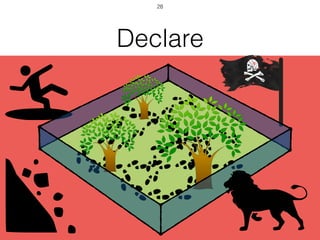
Declare
27
Declare
28
Declare
• A constraint-based extensible language 

for flexible process modeling
• An execution engine for constraint-based
processes

http://www.win.tue.nl/declare/
• Originally proposed by Pesic and van der 

Aalst
• Formalized by Pesic and van der Aaalst, 

and by _
29
Modeling in Declare
Finalize order
Confirm
order
Reject
order
Ship
Notify
shipment issue
30
0..1
Modeling in Declare
Finalize order
Confirm
order
Reject
order
Ship
Notify
shipment issue
An order can be
finalized at most once
31
0..1
Modeling in Declare
Finalize order
Confirm
order
Reject
order
Ship
Notify
shipment issue
Once an order is finalized, it must
be confirmed or rejected
32
0..1
Modeling in Declare
Finalize order
Confirm
order
Reject
order
Ship
Notify
shipment issue
precedence…
33
0..1
Modeling in Declare
Finalize order
Confirm
order
Reject
order
Ship
Notify
shipment issue
A confirmed order may be rejected
later on, but not vice-versa
34
0..1
Modeling in Declare
Finalize order
Confirm
order
Reject
order
Ship
Notify
shipment issue
if the warehouse notifies the seller of a shipment
issue, then the seller has to reject the order
An order can be confirmed only if
it shipped before
35
0..1
Modeling in Declare
Finalize order
Confirm
order
Reject
order
Ship
Notify
shipment issue
Mutually
exclusive
36
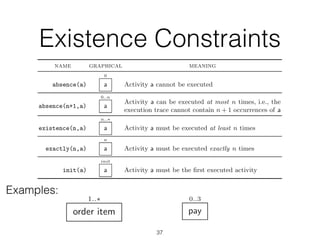
Existence Constraints
50 3 The ConDec Language
Table 3.1. ConDec existence constraints
name graphical meaning
absence(a)
0
a Activity a cannot be executed
absence(n+1,a)
0..n
a
Activity a can be executed at most n times, i.e., the
execution trace cannot contain n + 1 occurrences of a
existence(n,a)
n..∗
a Activity a must be executed at least n times
exactly(n,a)
n
a Activity a must be executed exactly n times
init(a)
init
a Activity a must be the first executed activity
1..∗
order item
On the contrary, an absenceN constraint could be used to state that at most
three payment attempts can be made by the customer:
Examples:
ec existence constraints
graphical meaning
0
a Activity a cannot be executed
0..n
a
Activity a can be executed at most n times, i.e., the
execution trace cannot contain n + 1 occurrences of a
n..∗
a Activity a must be executed at least n times
n
a Activity a must be executed exactly n times
init
a Activity a must be the first executed activity
1..∗
order item
, an absenceN constraint could be used to state that at most
absence(n+1,a)
0..n
a
Activity a can be executed at most n times, i
execution trace cannot contain n + 1 occurrenc
existence(n,a)
n..∗
a Activity a must be executed at least n times
exactly(n,a)
n
a Activity a must be executed exactly n times
init(a)
init
a Activity a must be the first executed activity
1..∗
order item
On the contrary, an absenceN constraint could be used to state that a
three payment attempts can be made by the customer:
0..3
pay
37
Choice Constraints
3.3 Constraints 51
Table 3.2. ConDec choice constraints
name graphical meaning
choice(n of m,[a1,...,am])
a1
am
a2
n of m
...
At least n distinct activities
among a1,. . . ,am must be exe-
cuted
ex choice(n of m,[a1,...,am])
a1
am
a2
n of m
...
Exactly n distinct activities
among a1,. . . ,am must be exe-
cuted
Note that the constraint supports an execution trace containing three submis-
sions of the paper (via e-mail and/or by using the web site), while it evaluates
a trace without submissions as noncompliant.
A 1 of 2-exclusive choice can be instead adopted to model the existence
between two alternatives that exclude each other. For example, it could be
used to state that, within an instance of the system, the customer commits
herself to cancel or successfully close the order, but not both:
Examples:
choice(n of m,[a1,...,am])
a1
am
a2
n of m
...
At least n distinct activitie
among a1,. . . ,am must be exe
cuted
x choice(n of m,[a1,...,am])
a1
am
a2
n of m
...
Exactly n distinct activitie
among a1,. . . ,am must be exe
cuted
ote that the constraint supports an execution trace containing three submis
ons of the paper (via e-mail and/or by using the web site), while it evaluate
trace without submissions as noncompliant.
A 1 of 2-exclusive choice can be instead adopted to model the existenc
etween two alternatives that exclude each other. For example, it could b
sed to state that, within an instance of the system, the customer commit
erself to cancel or successfully close the order, but not both:
cancel order −− −− close order
It is worth noting that choice constraints, together with the existence38
name graphical meaning
resp existence([a], [b]) a •−−−− b
If a is executed, then b must be exe-
cuted before or after a
coexistence([a],[b]) a •−−−• b
Neither a nor b is executed, or they
are both executed
response([a],[b]) a •−−− b
If a is executed, then b must be exe-
cuted thereafter
precedence([a],[b]) a −−− • b
b can be executed only if a has been
previously executed
succession([a],[b]) a •−− • b
a and b must be executed in succes-
sion, i.e. b must follow a and a must
precede b
alt response([a],[b]) a •=== b
b is response of a and between every
two executions of a, b must be exe-
cuted at least once
alt precedence([a],[b]) a === • b
a is precedence of b and between ev-
ery two executions of b, a must be
executed at least once
alt succession([a],[b]) a •== • b
b is alternate response of a, and a is
alternate precedence of b
chain response([a],[b]) a •=−=−=− b
If a is executed, then b must be exe-
cuted next (immediately after a)
chain precedence([a],[b]) a =−=−=− • b
If b is executed, then a must have
been executed immediately before b
chain succession([a],[b]) a •=−=− • b
a and b must be executed in sequence
(next to each other)
RelationConstraints
39
NegationConstraints
Table 3.4. ConDec negation constraints
name graphical meaning
resp absence([a],[b]) a •−−−−∥ b
If a is executed, then b can never
be executed
not coexistence([a],[b]) a •−−−•∥ b a and b exclude each other
neg response([a],[b]) a •−−−∥ b b cannot be executed after a
neg precedence([a],[b]) a −−− •∥ b a cannot be executed before b
neg succession([a],[b]) a •−− •∥ b
a and b cannot be executed in
succession
neg alt response([a],[b]) a •===∥ b
b cannot be executed between
any two occurrences of a
neg alt precedence([a],[b]) a === •∥ b
a cannot be executed between
any two bs
neg alt succession([a],[b]) a •== •∥ b
b cannot be executed between
any two as and viceversa
neg chain response([a],[b]) a •=−=−=−∥ b b cannot be executed next to a
neg chain precedence([a],[b]) a =−=−=− •∥ b
a cannot be executed immedi-
ately before b
neg chain succession([a],[b]) a •=−=− •∥ b
a and b cannot be executed in
sequence
40
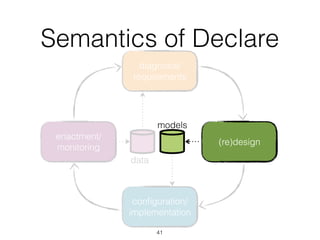
Semantics of Declare
diagnosis/
requirements
configuration/
implementation
enactment/
monitoring
41
data
(re)design
models
The Origin of Declare…
42
The Origin of Declare…
43
LTL
A Slide of Fairness
The disruptive novelty of this idea has to be
put in the BPM context!
• In AI, these ideas have been around for a
long time
• E.g., work on declarative interaction protocols
and temporal declarative specification of
agents
44
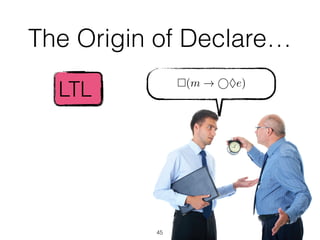
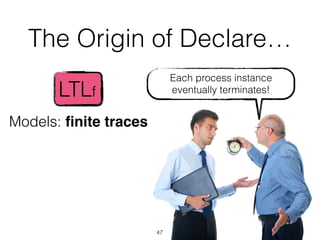
The Origin of Declare…
45
LTL ⇤(m ! ⌃e)
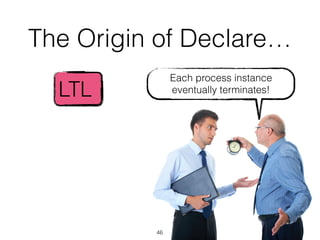
The Origin of Declare…
46
LTL
Each process instance
eventually terminates!
The Origin of Declare…
47
LTLf
Each process instance
eventually terminates!
Models: finite traces
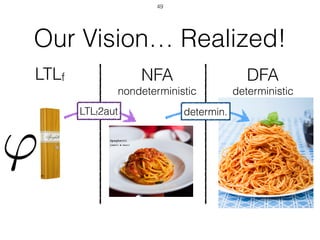
Declare 2 Finite State Automata
LTLf NFA

nondeterministic
DFA

deterministic
LTLf2aut determin.
'
48
For a single constraint:
local automaton
For the whole model:
global automaton
Our Vision… Realized!
'
LTLf NFA

nondeterministic
DFA

deterministic
LTLf2aut determin.
49
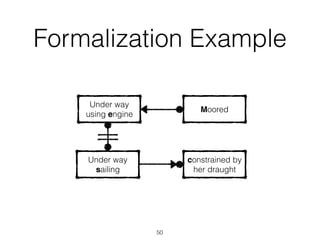
Formalization Example
Moored
Under way
using engine
Under way
sailing
constrained by
her draught
50
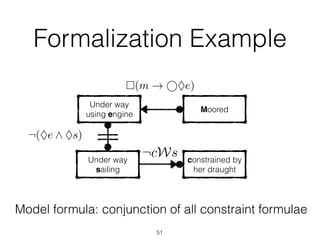
Formalization Example
Moored
Under way
using engine
Under way
sailing
constrained by
her draught
¬(⌃e ^ ⌃s)
Model formula: conjunction of all constraint formulae
⇤(m ! ⌃e)
51
¬cWs
Correctness Verification
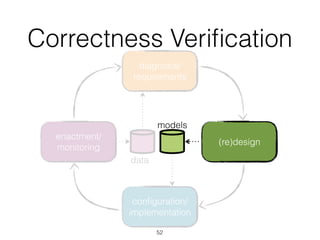
diagnosis/
requirements
configuration/
implementation
enactment/
monitoring
52
data
(re)design
models
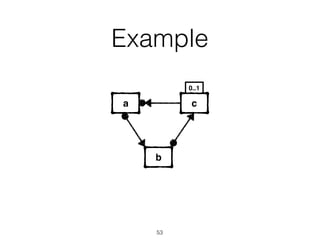
0..1
Example
a c
b
53
0..1
Example
a c
b
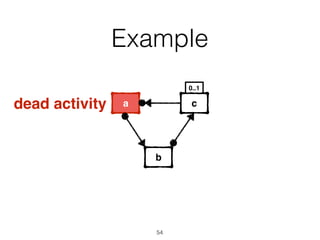
dead activity
54
0..1
Example
a c
b
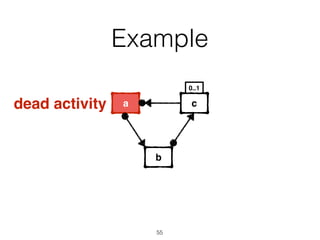
dead activity
55
Correctness
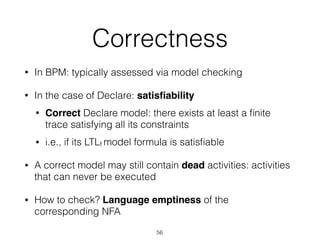
• In BPM: typically assessed via model checking
• In the case of Declare: satisfiability
• Correct Declare model: there exists at least a finite
trace satisfying all its constraints
• i.e., if its LTLf model formula is satisfiable
• A correct model may still contain dead activities: activities
that can never be executed
• How to check? Language emptiness of the
corresponding NFA
56
(re)design
models
diagnosis/
requirements
configuration/
implementation
57
data
enactment/
monitoring
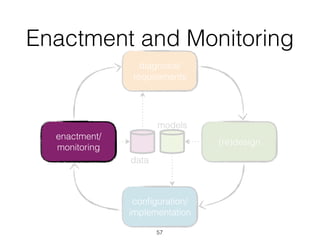
Enactment and Monitoring
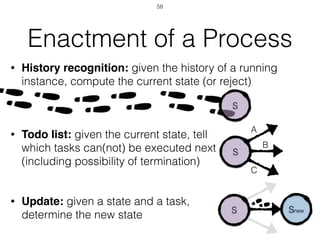
Enactment of a Process
• History recognition: given the history of a running
instance, compute the current state (or reject)
• Todo list: given the current state, tell 

which tasks can(not) be executed next

(including possibility of termination)

• Update: given a state and a task,

determine the new state
S
A
B
C
S
SnewS
58
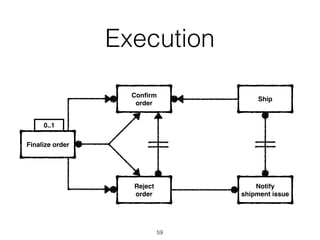
Execution
0..1
Finalize order
Confirm
order
Reject
order
Ship
Notify
shipment issue
59
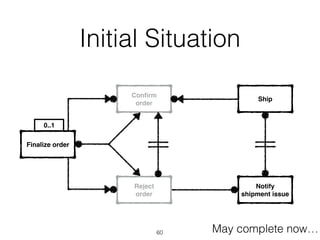
Initial Situation
0..1
Finalize order
Confirm
order
Reject
order
Ship
Notify
shipment issue
May complete now…60
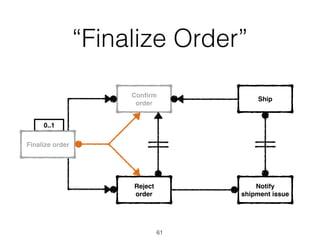
“Finalize Order”
0..1
Finalize order
Confirm
order
Reject
order
Ship
Notify
shipment issue
61
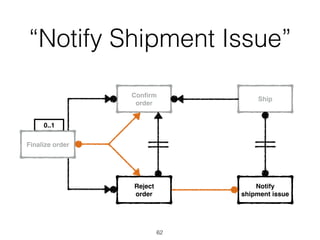
“Notify Shipment Issue”
0..1
Finalize order
Confirm
order
Reject
order
Ship
Notify
shipment issue
62
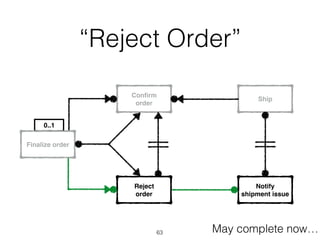
“Reject Order”
0..1
Finalize order
Confirm
order
Reject
order
Ship
Notify
shipment issue
May complete now…63
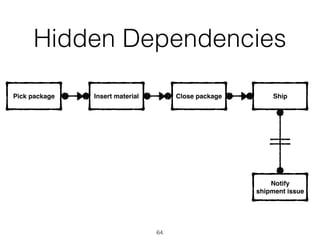
Hidden Dependencies
Ship
Notify
shipment issue
Pick package Insert material Close package
64
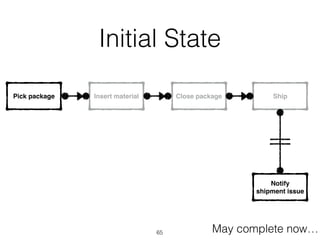
Initial State
Ship
Notify
shipment issue
Pick package Insert material Close package
May complete now…65
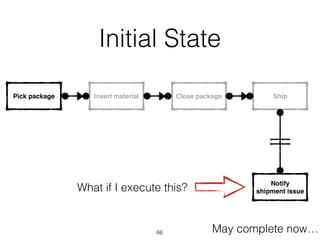
Initial State
Ship
Notify
shipment issue
Pick package Insert material Close package
May complete now…
What if I execute this?
66
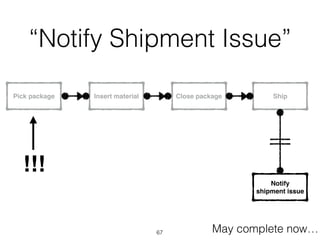
“Notify Shipment Issue”
Ship
Notify
shipment issue
Pick package Insert material Close package
May complete now…
!!!
67
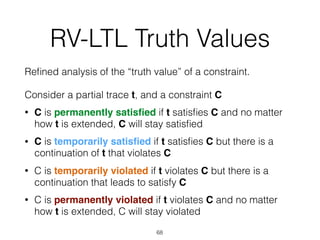
RV-LTL Truth Values
Refined analysis of the “truth value” of a constraint.
Consider a partial trace t, and a constraint C
• C is permanently satisfied if t satisfies C and no matter
how t is extended, C will stay satisfied
• C is temporarily satisfied if t satisfies C but there is a
continuation of t that violates C
• C is temporarily violated if t violates C but there is a
continuation that leads to satisfy C
• C is permanently violated if t violates C and no matter
how t is extended, C will stay violated
68
Linear Dynamic Logic
over Finite Traces
69
The Logic ldlf [De Giacomo&Vardi,IJCAI13]
Merges ltlf with regular expressions, through the syntax of Propositional
Dynamic Logic (PDL):
Ï ::= „ | tt | | ¬Ï | Ï1 · Ï2 | ÈflÍÏ | [fl]Ï
fl ::= „ | Ï? | fl1 + fl2 | fl1; fl2 | flú
Ï: ltlf part; fl: regular expression part.
They mutually refer to each other:
• ÈflÍÏ states that, from the current step in the trace, there is an
execution satisfying fl such that its last step satisfies Ï.
• [fl]Ï states that, from the current step in the trace, all execution
satisfying fl are such that their last step satisfies Ï.
• Ï? checks whether Ï is true in the current step and, if so, continues
to evaluate the remaining execution.
Of special interest is end = [true?] , to check whether the trace has been
Automata for LDLf
70
From ldlf to nfa
Direct calculation of nfa corresponding to ldlf formula Ï
Algorithm
1: algorithm ldlf 2nfa()
2: input ltlf formula Ï
3: output nfa AÏ = (2P
, S, {s0}, Í, {sf })
4: s0 Ω {"Ï"} Û single initial state
5: sf Ω ÿ Û single final state
6: S Ω {s0, sf }, Í Ω ÿ
7: while (S or Í change) do
8: if (q œ S and qÕ
|=
w
("Â"œq) ”("Â", ))
9: S Ω S fi {qÕ
} Û update set of states
10: Í Ω Í fi {(q, , qÕ
)} Û update transition relation
Note
• Standard nfa.
• No detour to Büchi automata.
• Easy to code.
• Implemented!
Auxiliary rules
”("tt", ) = true
”(" ", ) = false
”("„", ) =
I
true if |= „
false if ”|= „
(„ propositional)
”("Ï1 · Ï2", ) = ”("Ï1", ) · ”("Ï2", )
”("Ï1 ‚ Ï2", ) = ”("Ï1", ) ‚ ”("Ï2", )
”("È„ÍÏ", ) =
Y
_]
_[
"Ï" if last ”œ and |= „ („ propositional)
”("Ï", ‘) if last œ and |= „
false if ”|= „
”("ÈÂ?ÍÏ", ) = ”("Â", ) · ”("Ï", )
”("Èfl1 + fl2ÍÏ", ) = ”("Èfl1ÍÏ", ) ‚ ”("Èfl2ÍÏ", )
”("Èfl1; fl2ÍÏ", ) = ”("Èfl1ÍÈfl2ÍÏ", )
”("Èflú
ÍÏ", ) =
I
”("Ï", ) if fl is test-only
”("Ï", ) ‚ ”("ÈflÍÈflúÍÏ", ) o/w
”("[„]Ï", ) =
Y
_]
_[
"Ï" if last ”œ and |= „ („ propositional)
”("Ï", ‘) if last œ and |= „ („ propositional)
true if ”|= „
”("[Â?]Ï", ) = ”("nnf (¬Â)", ) ‚ ”("Ï", )
”("[fl1 + fl2]Ï", ) = ”("[fl1]Ï", ) · ”("[fl2]Ï", )
”("[fl1; fl2]Ï", ) = ”("[fl1][fl2]Ï", )
”("[flú
]Ï", ) =
I
”("Ï", ) if fl is test-only
”("Ï", ) · ”("[fl][flú]Ï", ) o/w
Marco Montali (unibz) Monitoring Business Metaconstraints BPM 2014 22 / 26
Black Magic with LDLf
71
Runtime ldlf Monitors
Check partial trace fi = e1, . . . , en against formula Ï.
From ad-hoc techniques . . .
e1 . . . en |=
C
Ï
D
RV =
Y
___]
___[
temp_true
temp_false
true
false
. . . To standard techniques
e1 . . . en |=
Y
______]
______[
Ïtemp_true
Ïtemp_false
Ïtrue
Ïfalse
Marco Montali (unibz) Monitoring Business Metaconstraints BPM 2014 14 / 26
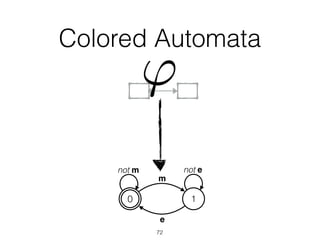
Colored Automata
72
'
00 1
m
e
not m not e
'temp true
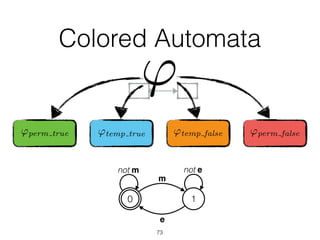
Colored Automata
73
'
'temp false 'perm false'perm true
00 1
m
e
not m not e
'temp true
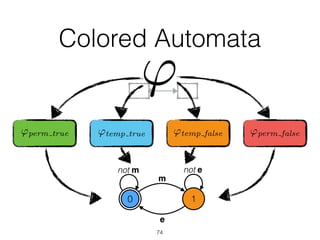
Colored Automata
74
'
'temp false 'perm false'perm true
00 1
m
e
not m not e
00 1
m
e
not m not e
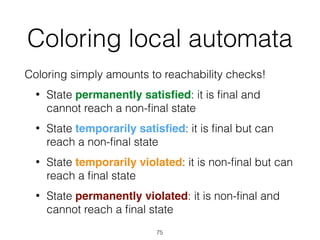
Coloring local automata
Coloring simply amounts to reachability checks!
• State permanently satisfied: it is final and
cannot reach a non-final state
• State temporarily satisfied: it is final but can
reach a non-final state
• State temporarily violated: it is non-final but can
reach a final state
• State permanently violated: it is non-final and
cannot reach a final state
75
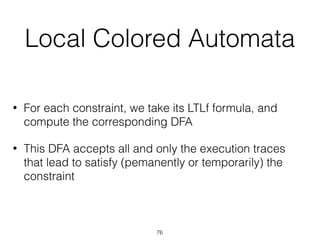
Local Colored Automata
• For each constraint, we take its LTLf formula, and
compute the corresponding DFA
• This DFA accepts all and only the execution traces
that lead to satisfy (pemanently or temporarily) the
constraint
76
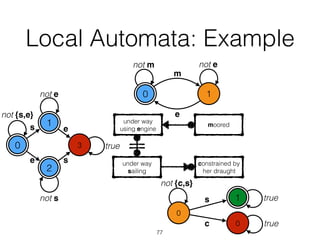
Local Automata: Example
moored
under way
using engine
under way
sailing
constrained by
her draught
0
s
c
not {c,s}
true1
0 true
00 1
m
e
not m not e
s
e
not s
true00
not {s,e}
1
2
3
e
s
not e
1
2
77
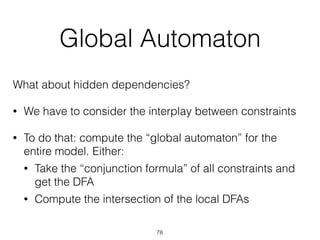
Global Automaton
What about hidden dependencies?
• We have to consider the interplay between constraints
• To do that: compute the “global automaton” for the
entire model. Either:
• Take the “conjunction formula” of all constraints and
get the DFA
• Compute the intersection of the local DFAs
78
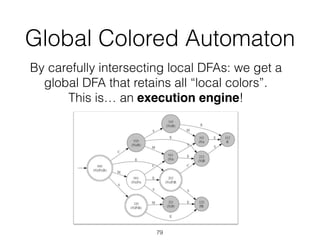
Global Colored Automaton
By carefully intersecting local DFAs: we get a
global DFA that retains all “local colors”.

This is… an execution engine!
79
Implemented in ProM!
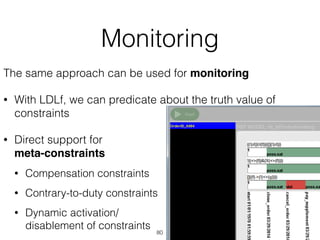
Monitoring
The same approach can be used for monitoring
• With LDLf, we can predicate about the truth value of
constraints
• Direct support for

meta-constraints
• Compensation constraints
• Contrary-to-duty constraints
• Dynamic activation/

disablement of constraints
80
enactment/
monitoring
Process Mining
81
(re)design
models
configuration/
implementation
data
diagnosis/
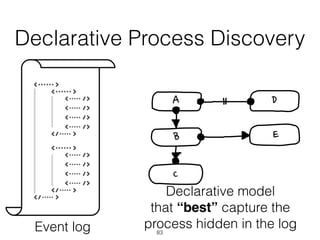
requirements
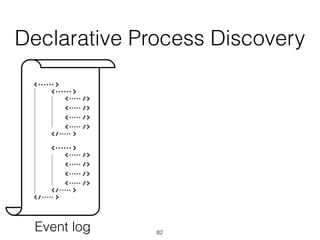
Declarative Process Discovery
82
Event log
Declarative Process Discovery
83
Event log
Declarative model 

that “best” capture the
process hidden in the log
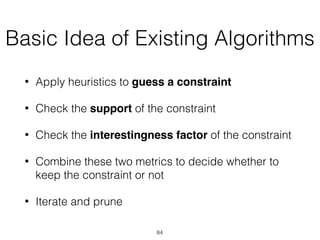
Basic Idea of Existing Algorithms
• Apply heuristics to guess a constraint
• Check the support of the constraint
• Check the interestingness factor of the constraint
• Combine these two metrics to decide whether to
keep the constraint or not
• Iterate and prune
84
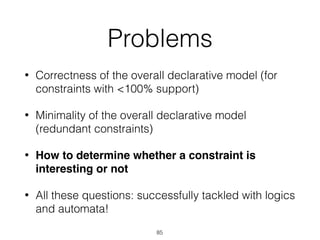
Problems
• Correctness of the overall declarative model (for
constraints with <100% support)
• Minimality of the overall declarative model
(redundant constraints)
• How to determine whether a constraint is
interesting or not
• All these questions: successfully tackled with logics
and automata!
85
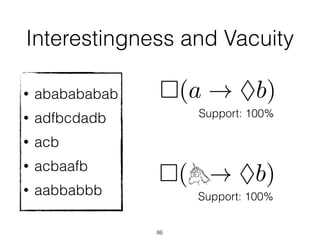
Interestingness and Vacuity
• ababababab
• adfbcdadb
• acb
• acbaafb
• aabbabbb
86
⇤(a ! ⌃b)
Support: 100%
⇤(a ! ⌃b)
Support: 100%
Why is a trace interesting for
a constraint?
• Because it “activates” the constraint, “changing”
something
• Semantically:
• It flips the RV-LTL state of the constraint
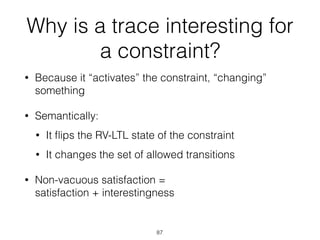
• It changes the set of allowed transitions
• Non-vacuous satisfaction =

satisfaction + interestingness

87
Example
88
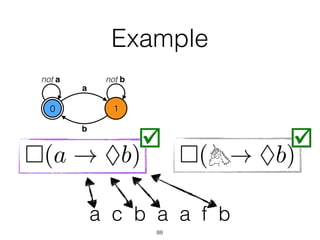
00 1
a
b
not a not b
⇤(a ! ⌃b) ⇤(a ! ⌃b)
a c b a a f b
Another Example
89
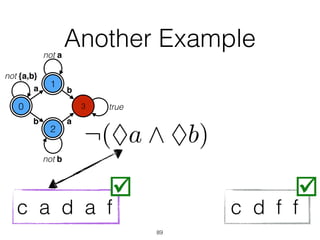
c a d a f
¬(⌃a ^ ⌃b)
a
b
not b
true00
not {a,b}
1
2
3
b
a
not a
1
2
c d f f
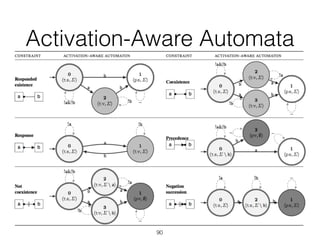
Activation-Aware Automata
90
Conclusion
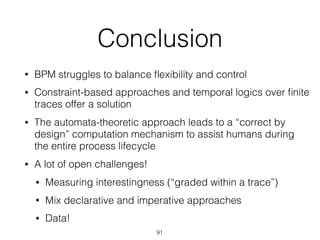
• BPM struggles to balance flexibility and control
• Constraint-based approaches and temporal logics over finite
traces offer a solution
• The automata-theoretic approach leads to a “correct by
design” computation mechanism to assist humans during
the entire process lifecycle
• A lot of open challenges!
• Measuring interestingness (“graded within a trace”)
• Mix declarative and imperative approaches
• Data!
91
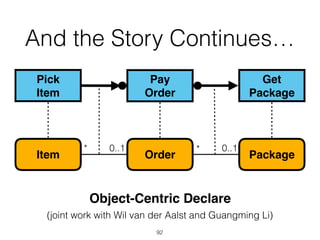
And the Story Continues…
Object-Centric Declare 

(joint work with Wil van der Aalst and Guangming Li)
92
OrderItem Package
Pick 

Item
Pay

Order
Get 

Package
0..1 ** 0..1
Acknowledgments
• Wil van der Aalst
• Maja Pesic
• Federico Chesani
• Paola Mello
• Fabrizio Maggi
93
• Michael Westergaard
• Giuseppe De Giacomo
• Riccardo De Masellis
• Claudio di Ciccio
• Jan Mendling
Some References
Declare and its formalizations
• M. Pesic and W. van der Aalst, A Declarative Approach for Flexible Business
Processes Management, in BPM Workshops. Vol. 4103 of LNCS, pp. 169-180.
Springer, 2007.
• M. Montali, M. Pesic, W. M. P. van der Aalst, F. Chesani, P. Mello, and S. Storari,
Declarative specification and verification of service choreographies, ACM
Trans. Web, vol. 4, pp. 3:1–3:62, 2010.
• M. Montali. Specification and Verification of Declarative Open Interaction
Models: a Logic- Based Approach, vol. 56 of LNBIP. Springer, 2010.
• M. Westergaard, Better Algorithms for Analyzing and Enacting Declarative
Workflow Languages Using LTL, in BPM, vol. 6896 of LNCS, pp. 83-98. Springer,
2010.
• Giuseppe De Giacomo, Riccardo De Masellis, Marco Montali,

Reasoning on LTL on Finite Traces: Insensitivity to Infiniteness, in AAAI, pp.
1027-1033. AAAI Press, 2014.
94
Some References
Declare Execution Environment
• M. Pesic, H. Schonenberg, and W. M. P. van der Aalst, DECLARE:
Full Support for Loosely-Structured Processes, in EDOC, pp.
287–300. IEEE Computer Society, 2007.
• M. Pesic, M. Schonenberg, N. Sidorova, and W. van der Aalst,
Constraint-Based Workflow Models: Change Made Easy, in
CoopIS, vol. 4803 of LNCS, pp. 77-94. Springer, 2007.
• M. Pesic, H. Schonenberg, and W. Aalst, The Declare Service, in
Modern Business Process Automation, Springer, 2010, pp.
327-343.
• M. Westergaard, F. M. Maggi, Declare: A Tool Suite for
Declarative Workflow Modeling and Enactment, BPM (Demos)
2011.
95
Some References
Monitoring Declare constraints
• F. M. Maggi, M. Montali, M. Westergaard, and W. M. P. van der Aalst,
Monitoring Business Constraints with Linear Temporal Logic: An
Approach Based on Colored Automata, in BPM, volume 6896 of LNCS,
pp. 132-147. Springer, 2011.
• F. M. Maggi, M. Westergaard, M. Montali, W. M. P. van der Aalst,

Runtime Verification of LTL-Based Declarative Process Models.:
Proceedings of RV, volume 7186 of LNCS, pp. 131-146. Springer, 2011.
• M. Montali, F. M. Maggi, F. Chesani, P. Mello, W. M. P. van der Aalst,

Monitoring business constraints with the event calculus. ACM Trans.
on Intelligent Systems and Technology 5(1): 17, 2013.
• G. De Giacomo, R. De Masellis, M. Grasso, F. M. Maggi, M. Montali, 

Monitoring Business Metaconstraints Based on LTL and LDL for
Finite Traces, in BPM, volume 8659 of LNCS, pp. 1-17. Springer, 2014.
96
Some References
Discovering Declare constraints
• F. Chesani, E. Lamma, P. Mello, M. Montali, F. Riguzzi, S. Storari, Exploiting Inductive Logic Programming
Techniques for Declarative Process Mining. Trans. Petri Nets and Other Models of Concurrency 2:
278-295, 2009.
• F. Maria Maggi, A. J. Mooij, W. M. P. van der Aalst, User-guided discovery of declarative process models.
In CIDM, pp. 192-199. IEEE Press, 2011.
• F. M. Maggi, R. P. J. Chandra Bose, W. M. P. van der Aalst, Efficient Discovery of Understandable
Declarative Process Models from Event Logs. In CAiSE, volume 7908 of LNCS, pp. 270-285. Springer,
2012.
• F. M. Maggi, M. Dumas, L. García-Bañuelos, M. Montali, Discovering Data-Aware Declarative Process
Models from Event Logs. In BPM, volume 8094 of LNCS, pp. 81-96. Springer, 2013.
• C. Di Ciccio, M. Mecella, On the Discovery of Declarative Control Flows for Artful Processes. ACM
Trans. Management Inf. Syst. 5(4): 24:1-24:37, 2015.
• C. Di Ciccio, F. M. Maggi, M. Montali, J. Mendling, Ensuring Model Consistency in Declarative Process
Discovery. In BPM, volume 9253 of LNCS, pp. 144-159. Springer, 2015.
• C. Di Ciccio, F. M. Maggi, M. Montali, J. Mendling, Semantical Vacuity Detection in Declarative Process
Mining. In BPM, volume 9850 of LNCS, pp. 158-175. Springer, 2016.
• Claudio Di Ciccio, Fabrizio Maria Maggi, Marco Montali, Jan Mendling:

Resolving inconsistencies and redundancies in declarative process models. Inf. Syst. 64: 425-446,
2017.
97

Temporal logics over finite traces for declarative BPM

  • 1.
    Marco Montali
 Free Universityof Bozen-Bolzano montali@inf.unibz.it cess Story TEMPORAL DECLARATIVE OVER FOR BPM FINITE TRACES LOGICS A SUCCESS STORY marco montali free university of bozen-bolzano FMAI17
  • 2.
    Assets of anOrganization • Data: the main information source about the history of the domain of interest and the relevant aspects of the current state of affairs • Resources: humans and devices responsible for the execution of work • Business processes: how work is carried out in the domain of interest, towards the achievement of organizational objectives 2
  • 3.
    Business Process Management Acollection of
 concepts, methodologies, techniques,
 to support humans in 
 modeling, governance, deployment, enactment, and analysis of
 business processes 3
  • 4.
  • 5.
  • 6.
  • 7.
  • 8.
    Flexibility vs Control Flexibility:degree to which users can make local decisions about how to execute processes. Control: degree to which a system makes centralized decisions about how to execute processes. Universe of Traces Compliant Traces Flexibility8
  • 9.
    Trends in BPM modeling •Highly-variable BPs • Metaphor: rules/constraints Dec t i lar a ev Imperative modeling • Traditional repetitive BPs • Metaphor: flow-chart 9
  • 10.
    The Issue ofFlexibility 10
  • 11.
  • 12.
  • 13.
    Imperative Modeling Focus: howthingsmust be done • Explicit description of the process control-flow Closedmodeling • All that is not explicitly modeled is forbidden • Exceptions/uncommon behaviors have to be explicitly enumerated at design time 13
  • 14.
    BPMN Receive order Check availability Article available? Ship article Financial settlement yes Procurement no Payment received Inform customer LatedeliveryUndeliverable Customer informed Inform customer Article removed Remove article from catalogue 14
  • 15.
    BPMN Receive order Check availability Article available? Ship article Financial settlement yes Procurement no Payment received Inform customer LatedeliveryUndeliverable Customer informed Inform customer Article removed Remove article from catalogue Input Output 15
  • 16.
    BPMN Receive order Check availability Article available? Ship article Financial settlement yes Procurement no Payment received Inform customer LatedeliveryUndeliverable Customer informed Inform customer Article removed Remove article from catalogue Input Output 16
  • 17.
  • 18.
    Choreography Example • Anorder can be finalized at most once • Once an order is finalized, it must be confirmed or rejected • A confirmed order may be rejected later on (due to “late” problems), but not vice-versa: a rejection cannot be reverted. • An order can be confirmed only if it shipped before. • An order may be rejected autonomously by the seller. However, if the warehouse notifies the seller of a shipment issue, then the seller has to reject the order. • The warehouse decision is firm: “Ship” and “Notify shipment issue” are mutually exclusive. 18
  • 19.
    What is your FavouriteItalian Food? Order-to-delivery 19
  • 20.
    What is your FavouriteItalian Food? Order-to-delivery 20
  • 21.
    What is your FavouriteItalian Food? UnderstandingSpaghettiModelswithSequenceClusteringforProM9 thoseexceptions.Figure4depictstheresultofafirstattempttoanalyzethe applicationserverlogsusingtheheuristicsminer[4]. Exception (complete) 187 EstabelecimentoNotFoundException (complete) 187 0,991 152 GREJBPersistencyException (complete) 179 0,909 159 PGWSException (complete) 168 0,889 12 ITPTExternalServiceException (complete) 183 0,944 162 SIPSCNoRecordsFoundException (complete) 160 0,8 5 PessoaSingularNotFoundException (complete) 138 0,667 3 BusinessLogicException (complete) 183 0,75 4 SICCLException (complete) 175 0,857 19 NaoExistemRegistosException (complete) 143 0,833 6 RPCBusinessException (complete) 38 0,75 3 SAFBusinessException (complete) 115 0,8 68 GREJBBusinessException (complete) 45 0,75 23 DESWSException (complete) 14 0,667 14 NullPointerException (complete) 104 0,8 91 ValidationException (complete) 31 0,8 12 GILBusinessException (complete) 14 0,5 6 GRServicesException (complete) 7 0,667 3 CSIBusinessException (complete) 14 0,5 6 ConcorrenciaException (complete) 5 0,5 2 CSIPersistencyException (complete) 3 0,5 2 0,857 34 ITPTServerException (complete) 21 0,667 15 COOPException (complete) 4 0,5 2 RSIValidationException (complete) 25 0,667 18 BasicSystemException (complete) 16 0,667 11 PesquisaAmbiguaException (complete) 6 0,5 6 CPFBusinessException (complete) 3 0,5 2 0,8 95 ADOPException (complete) 6 0,5 5 AFBusinessException (complete) 64 SIPSCRemoteBusinessException (complete) 51 0,833 13 ConcurrentModificationException (complete) 5 0,5 1 CDFBusinessException (complete) 6 0,667 2 AssinaturaNaoIncluidaException (complete) 1 0,5 1 SICCSException (complete) 32 0,8 11 CartaoCidadaoException (complete) 64 0,833 38 SOAPException (complete) 22 0,667 14 TooManyRowsException (complete) 112 0,667 18 SIPSCFatalException (complete) 20 0,667 9 LimiteTemporalException (complete) 4 0,5 2 0,8 28 SVIBusinessUserException (complete) 18 0,75 12 GRConcurrencyException (complete) 8 0,5 2 ContribuinteRegionalNotFoundException (complete) 63 0,75 30 JDOFatalUserException (complete) 124 0,947 49 0,667 5 SQLException (complete) 9 0,667 7 IOException (complete) 27 0,75 22 PessoaColectivaNotFoundException (complete) 23 0,75 20 ServiceDelegateRemoteException (complete) 3 0,5 2 0,5 5 PASException (complete) 2 0,5 1 FileNotFoundException (complete) 31 0,75 13 QgenMIParametrizedBusinessException (complete) 1 0,5 1 ADOPMessageException (complete) 3 0,5 2 LayoffException (complete) 1 0,5 1 0,75 8 CMPException (complete) 1 0,5 1 GREJBRemoteServiceException (complete) 34 0,75 4 RSIPersistenceException (complete) 24 0,75 4 CSIRemoteException (complete) 3 0,5 1 SIPSCFatalRemoteCallException (complete) 3 0,5 1 SIPSCDatabaseException (complete) 1 0,5 1 BusinessException (complete) 159 0,667 9 SVIBusinessException (complete) 1 0,5 1 ParametrizedBusinessException (complete) 2 0,5 2 GDServicesException (complete) 4 0,5 3 ServerException (complete) 132 0,75 16 PGException (complete) 6 0,667 5 0,75 4 DESException (complete) 135 0,667 13 0,667 2 0,75 9 SIPSCException (complete) 27 0,75 9 ReportException (complete) 5 0,667 2 SSNServiceException (complete) 1 0,5 1 AFException (complete) 1 0,5 1 InvalidNISSException (complete) 14 0,75 4 0,75 14 GILConcurrencyException (complete) 1 0,5 1 RSISystemException (complete) 28 0,75 7 0,667 5 0,667 1 0,75 2 0,667 5 0,833 5 0,667 5 0,667 4 0,75 12 0,981 53 ADOPUserChoiceException (complete) 1 0,5 1 0,667 5 RPCException (complete) 1 0,5 1 GREJBConcurrencyException (complete) 15 0,875 8 0,5 1 0,5 1 0,667 1 MoradaPortuguesaNotFoundException (complete) 1 0,5 1 0,75 4 0,5 1 0,667 6 0,5 1 0,5 2 0,889 8 0,75 3 0,8 3 RSIException (complete) 1 0,5 1 0,5 1 0,5 1 0,667 4 0,667 3 0,5 1 0,5 2 0,75 5 0,5 1 0,5 1 0,5 2 0,5 1 0,5 1 0,5 1 0,5 1 0,5 1 0,5 1 0,5 1 0,5 1 0,5 1 0,5 1 0,5 1 0,5 1 0,8 1 0,5 1 0,5 1 0,5 1 Fig.4.Spaghettimodelobtainedfromtheapplicationserverlogsusingtheheuristics miner. Usingthesequenceclusteringplug-inanditspreprocessingcapabilities,as wellasthepossibilityofvisuallyadjustingtheclustermodelsaccordingtocertain Healthcare 21
  • 22.
    What is your FavouriteItalian Food? UnderstandingSpaghettiModelswithSequenceClusteringforProM9 thoseexceptions.Figure4depictstheresultofafirstattempttoanalyzethe applicationserverlogsusingtheheuristicsminer[4]. Exception (complete) 187 EstabelecimentoNotFoundException (complete) 187 0,991 152 GREJBPersistencyException (complete) 179 0,909 159 PGWSException (complete) 168 0,889 12 ITPTExternalServiceException (complete) 183 0,944 162 SIPSCNoRecordsFoundException (complete) 160 0,8 5 PessoaSingularNotFoundException (complete) 138 0,667 3 BusinessLogicException (complete) 183 0,75 4 SICCLException (complete) 175 0,857 19 NaoExistemRegistosException (complete) 143 0,833 6 RPCBusinessException (complete) 38 0,75 3 SAFBusinessException (complete) 115 0,8 68 GREJBBusinessException (complete) 45 0,75 23 DESWSException (complete) 14 0,667 14 NullPointerException (complete) 104 0,8 91 ValidationException (complete) 31 0,8 12 GILBusinessException (complete) 14 0,5 6 GRServicesException (complete) 7 0,667 3 CSIBusinessException (complete) 14 0,5 6 ConcorrenciaException (complete) 5 0,5 2 CSIPersistencyException (complete) 3 0,5 2 0,857 34 ITPTServerException (complete) 21 0,667 15 COOPException (complete) 4 0,5 2 RSIValidationException (complete) 25 0,667 18 BasicSystemException (complete) 16 0,667 11 PesquisaAmbiguaException (complete) 6 0,5 6 CPFBusinessException (complete) 3 0,5 2 0,8 95 ADOPException (complete) 6 0,5 5 AFBusinessException (complete) 64 SIPSCRemoteBusinessException (complete) 51 0,833 13 ConcurrentModificationException (complete) 5 0,5 1 CDFBusinessException (complete) 6 0,667 2 AssinaturaNaoIncluidaException (complete) 1 0,5 1 SICCSException (complete) 32 0,8 11 CartaoCidadaoException (complete) 64 0,833 38 SOAPException (complete) 22 0,667 14 TooManyRowsException (complete) 112 0,667 18 SIPSCFatalException (complete) 20 0,667 9 LimiteTemporalException (complete) 4 0,5 2 0,8 28 SVIBusinessUserException (complete) 18 0,75 12 GRConcurrencyException (complete) 8 0,5 2 ContribuinteRegionalNotFoundException (complete) 63 0,75 30 JDOFatalUserException (complete) 124 0,947 49 0,667 5 SQLException (complete) 9 0,667 7 IOException (complete) 27 0,75 22 PessoaColectivaNotFoundException (complete) 23 0,75 20 ServiceDelegateRemoteException (complete) 3 0,5 2 0,5 5 PASException (complete) 2 0,5 1 FileNotFoundException (complete) 31 0,75 13 QgenMIParametrizedBusinessException (complete) 1 0,5 1 ADOPMessageException (complete) 3 0,5 2 LayoffException (complete) 1 0,5 1 0,75 8 CMPException (complete) 1 0,5 1 GREJBRemoteServiceException (complete) 34 0,75 4 RSIPersistenceException (complete) 24 0,75 4 CSIRemoteException (complete) 3 0,5 1 SIPSCFatalRemoteCallException (complete) 3 0,5 1 SIPSCDatabaseException (complete) 1 0,5 1 BusinessException (complete) 159 0,667 9 SVIBusinessException (complete) 1 0,5 1 ParametrizedBusinessException (complete) 2 0,5 2 GDServicesException (complete) 4 0,5 3 ServerException (complete) 132 0,75 16 PGException (complete) 6 0,667 5 0,75 4 DESException (complete) 135 0,667 13 0,667 2 0,75 9 SIPSCException (complete) 27 0,75 9 ReportException (complete) 5 0,667 2 SSNServiceException (complete) 1 0,5 1 AFException (complete) 1 0,5 1 InvalidNISSException (complete) 14 0,75 4 0,75 14 GILConcurrencyException (complete) 1 0,5 1 RSISystemException (complete) 28 0,75 7 0,667 5 0,667 1 0,75 2 0,667 5 0,833 5 0,667 5 0,667 4 0,75 12 0,981 53 ADOPUserChoiceException (complete) 1 0,5 1 0,667 5 RPCException (complete) 1 0,5 1 GREJBConcurrencyException (complete) 15 0,875 8 0,5 1 0,5 1 0,667 1 MoradaPortuguesaNotFoundException (complete) 1 0,5 1 0,75 4 0,5 1 0,667 6 0,5 1 0,5 2 0,889 8 0,75 3 0,8 3 RSIException (complete) 1 0,5 1 0,5 1 0,5 1 0,667 4 0,667 3 0,5 1 0,5 2 0,75 5 0,5 1 0,5 1 0,5 2 0,5 1 0,5 1 0,5 1 0,5 1 0,5 1 0,5 1 0,5 1 0,5 1 0,5 1 0,5 1 0,5 1 0,5 1 0,8 1 0,5 1 0,5 1 0,5 1 Fig.4.Spaghettimodelobtainedfromtheapplicationserverlogsusingtheheuristics miner. Usingthesequenceclusteringplug-inanditspreprocessingcapabilities,as wellasthepossibilityofvisuallyadjustingtheclustermodelsaccordingtocertain Healthcare 22
  • 23.
  • 24.
  • 25.
    Constraint-Based Modeling Focus: whathasto be accomplished • Explicit description of the relevant business constraints • behavioral constraints, best practices, norms, rules, … Openmodeling • All behaviors are possible unless they are explicitly forbidden • Control-flow left implicit 25
  • 26.
  • 27.
  • 28.
  • 29.
    Declare • A constraint-basedextensible language 
 for flexible process modeling • An execution engine for constraint-based processes
 http://www.win.tue.nl/declare/ • Originally proposed by Pesic and van der 
 Aalst • Formalized by Pesic and van der Aaalst, 
 and by _ 29
  • 30.
    Modeling in Declare Finalizeorder Confirm order Reject order Ship Notify shipment issue 30
  • 31.
    0..1 Modeling in Declare Finalizeorder Confirm order Reject order Ship Notify shipment issue An order can be finalized at most once 31
  • 32.
    0..1 Modeling in Declare Finalizeorder Confirm order Reject order Ship Notify shipment issue Once an order is finalized, it must be confirmed or rejected 32
  • 33.
    0..1 Modeling in Declare Finalizeorder Confirm order Reject order Ship Notify shipment issue precedence… 33
  • 34.
    0..1 Modeling in Declare Finalizeorder Confirm order Reject order Ship Notify shipment issue A confirmed order may be rejected later on, but not vice-versa 34
  • 35.
    0..1 Modeling in Declare Finalizeorder Confirm order Reject order Ship Notify shipment issue if the warehouse notifies the seller of a shipment issue, then the seller has to reject the order An order can be confirmed only if it shipped before 35
  • 36.
    0..1 Modeling in Declare Finalizeorder Confirm order Reject order Ship Notify shipment issue Mutually exclusive 36
  • 37.
    Existence Constraints 50 3The ConDec Language Table 3.1. ConDec existence constraints name graphical meaning absence(a) 0 a Activity a cannot be executed absence(n+1,a) 0..n a Activity a can be executed at most n times, i.e., the execution trace cannot contain n + 1 occurrences of a existence(n,a) n..∗ a Activity a must be executed at least n times exactly(n,a) n a Activity a must be executed exactly n times init(a) init a Activity a must be the first executed activity 1..∗ order item On the contrary, an absenceN constraint could be used to state that at most three payment attempts can be made by the customer: Examples: ec existence constraints graphical meaning 0 a Activity a cannot be executed 0..n a Activity a can be executed at most n times, i.e., the execution trace cannot contain n + 1 occurrences of a n..∗ a Activity a must be executed at least n times n a Activity a must be executed exactly n times init a Activity a must be the first executed activity 1..∗ order item , an absenceN constraint could be used to state that at most absence(n+1,a) 0..n a Activity a can be executed at most n times, i execution trace cannot contain n + 1 occurrenc existence(n,a) n..∗ a Activity a must be executed at least n times exactly(n,a) n a Activity a must be executed exactly n times init(a) init a Activity a must be the first executed activity 1..∗ order item On the contrary, an absenceN constraint could be used to state that a three payment attempts can be made by the customer: 0..3 pay 37
  • 38.
    Choice Constraints 3.3 Constraints51 Table 3.2. ConDec choice constraints name graphical meaning choice(n of m,[a1,...,am]) a1 am a2 n of m ... At least n distinct activities among a1,. . . ,am must be exe- cuted ex choice(n of m,[a1,...,am]) a1 am a2 n of m ... Exactly n distinct activities among a1,. . . ,am must be exe- cuted Note that the constraint supports an execution trace containing three submis- sions of the paper (via e-mail and/or by using the web site), while it evaluates a trace without submissions as noncompliant. A 1 of 2-exclusive choice can be instead adopted to model the existence between two alternatives that exclude each other. For example, it could be used to state that, within an instance of the system, the customer commits herself to cancel or successfully close the order, but not both: Examples: choice(n of m,[a1,...,am]) a1 am a2 n of m ... At least n distinct activitie among a1,. . . ,am must be exe cuted x choice(n of m,[a1,...,am]) a1 am a2 n of m ... Exactly n distinct activitie among a1,. . . ,am must be exe cuted ote that the constraint supports an execution trace containing three submis ons of the paper (via e-mail and/or by using the web site), while it evaluate trace without submissions as noncompliant. A 1 of 2-exclusive choice can be instead adopted to model the existenc etween two alternatives that exclude each other. For example, it could b sed to state that, within an instance of the system, the customer commit erself to cancel or successfully close the order, but not both: cancel order −− −− close order It is worth noting that choice constraints, together with the existence38
  • 39.
    name graphical meaning respexistence([a], [b]) a •−−−− b If a is executed, then b must be exe- cuted before or after a coexistence([a],[b]) a •−−−• b Neither a nor b is executed, or they are both executed response([a],[b]) a •−−− b If a is executed, then b must be exe- cuted thereafter precedence([a],[b]) a −−− • b b can be executed only if a has been previously executed succession([a],[b]) a •−− • b a and b must be executed in succes- sion, i.e. b must follow a and a must precede b alt response([a],[b]) a •=== b b is response of a and between every two executions of a, b must be exe- cuted at least once alt precedence([a],[b]) a === • b a is precedence of b and between ev- ery two executions of b, a must be executed at least once alt succession([a],[b]) a •== • b b is alternate response of a, and a is alternate precedence of b chain response([a],[b]) a •=−=−=− b If a is executed, then b must be exe- cuted next (immediately after a) chain precedence([a],[b]) a =−=−=− • b If b is executed, then a must have been executed immediately before b chain succession([a],[b]) a •=−=− • b a and b must be executed in sequence (next to each other) RelationConstraints 39
  • 40.
    NegationConstraints Table 3.4. ConDecnegation constraints name graphical meaning resp absence([a],[b]) a •−−−−∥ b If a is executed, then b can never be executed not coexistence([a],[b]) a •−−−•∥ b a and b exclude each other neg response([a],[b]) a •−−−∥ b b cannot be executed after a neg precedence([a],[b]) a −−− •∥ b a cannot be executed before b neg succession([a],[b]) a •−− •∥ b a and b cannot be executed in succession neg alt response([a],[b]) a •===∥ b b cannot be executed between any two occurrences of a neg alt precedence([a],[b]) a === •∥ b a cannot be executed between any two bs neg alt succession([a],[b]) a •== •∥ b b cannot be executed between any two as and viceversa neg chain response([a],[b]) a •=−=−=−∥ b b cannot be executed next to a neg chain precedence([a],[b]) a =−=−=− •∥ b a cannot be executed immedi- ately before b neg chain succession([a],[b]) a •=−=− •∥ b a and b cannot be executed in sequence 40
  • 41.
  • 42.
    The Origin ofDeclare… 42
  • 43.
    The Origin ofDeclare… 43 LTL
  • 44.
    A Slide ofFairness The disruptive novelty of this idea has to be put in the BPM context! • In AI, these ideas have been around for a long time • E.g., work on declarative interaction protocols and temporal declarative specification of agents 44
  • 45.
    The Origin ofDeclare… 45 LTL ⇤(m ! ⌃e)
  • 46.
    The Origin ofDeclare… 46 LTL Each process instance eventually terminates!
  • 47.
    The Origin ofDeclare… 47 LTLf Each process instance eventually terminates! Models: finite traces
  • 48.
    Declare 2 FiniteState Automata LTLf NFA
 nondeterministic DFA
 deterministic LTLf2aut determin. ' 48 For a single constraint: local automaton For the whole model: global automaton
  • 49.
    Our Vision… Realized! ' LTLfNFA
 nondeterministic DFA
 deterministic LTLf2aut determin. 49
  • 50.
    Formalization Example Moored Under way usingengine Under way sailing constrained by her draught 50
  • 51.
    Formalization Example Moored Under way usingengine Under way sailing constrained by her draught ¬(⌃e ^ ⌃s) Model formula: conjunction of all constraint formulae ⇤(m ! ⌃e) 51 ¬cWs
  • 52.
  • 53.
  • 54.
  • 55.
  • 56.
    Correctness • In BPM:typically assessed via model checking • In the case of Declare: satisfiability • Correct Declare model: there exists at least a finite trace satisfying all its constraints • i.e., if its LTLf model formula is satisfiable • A correct model may still contain dead activities: activities that can never be executed • How to check? Language emptiness of the corresponding NFA 56
  • 57.
  • 58.
    Enactment of aProcess • History recognition: given the history of a running instance, compute the current state (or reject) • Todo list: given the current state, tell 
 which tasks can(not) be executed next
 (including possibility of termination)
 • Update: given a state and a task,
 determine the new state S A B C S SnewS 58
  • 59.
  • 60.
  • 61.
  • 62.
    “Notify Shipment Issue” 0..1 Finalizeorder Confirm order Reject order Ship Notify shipment issue 62
  • 63.
  • 64.
    Hidden Dependencies Ship Notify shipment issue Pickpackage Insert material Close package 64
  • 65.
    Initial State Ship Notify shipment issue Pickpackage Insert material Close package May complete now…65
  • 66.
    Initial State Ship Notify shipment issue Pickpackage Insert material Close package May complete now… What if I execute this? 66
  • 67.
    “Notify Shipment Issue” Ship Notify shipmentissue Pick package Insert material Close package May complete now… !!! 67
  • 68.
    RV-LTL Truth Values Refinedanalysis of the “truth value” of a constraint. Consider a partial trace t, and a constraint C • C is permanently satisfied if t satisfies C and no matter how t is extended, C will stay satisfied • C is temporarily satisfied if t satisfies C but there is a continuation of t that violates C • C is temporarily violated if t violates C but there is a continuation that leads to satisfy C • C is permanently violated if t violates C and no matter how t is extended, C will stay violated 68
  • 69.
    Linear Dynamic Logic overFinite Traces 69 The Logic ldlf [De Giacomo&Vardi,IJCAI13] Merges ltlf with regular expressions, through the syntax of Propositional Dynamic Logic (PDL): Ï ::= „ | tt | | ¬Ï | Ï1 · Ï2 | ÈflÍÏ | [fl]Ï fl ::= „ | Ï? | fl1 + fl2 | fl1; fl2 | flú Ï: ltlf part; fl: regular expression part. They mutually refer to each other: • ÈflÍÏ states that, from the current step in the trace, there is an execution satisfying fl such that its last step satisfies Ï. • [fl]Ï states that, from the current step in the trace, all execution satisfying fl are such that their last step satisfies Ï. • Ï? checks whether Ï is true in the current step and, if so, continues to evaluate the remaining execution. Of special interest is end = [true?] , to check whether the trace has been
  • 70.
    Automata for LDLf 70 Fromldlf to nfa Direct calculation of nfa corresponding to ldlf formula Ï Algorithm 1: algorithm ldlf 2nfa() 2: input ltlf formula Ï 3: output nfa AÏ = (2P , S, {s0}, Í, {sf }) 4: s0 Ω {"Ï"} Û single initial state 5: sf Ω ÿ Û single final state 6: S Ω {s0, sf }, Í Ω ÿ 7: while (S or Í change) do 8: if (q œ S and qÕ |= w ("Â"œq) ”("Â", )) 9: S Ω S fi {qÕ } Û update set of states 10: Í Ω Í fi {(q, , qÕ )} Û update transition relation Note • Standard nfa. • No detour to Büchi automata. • Easy to code. • Implemented! Auxiliary rules ”("tt", ) = true ”(" ", ) = false ”("„", ) = I true if |= „ false if ”|= „ („ propositional) ”("Ï1 · Ï2", ) = ”("Ï1", ) · ”("Ï2", ) ”("Ï1 ‚ Ï2", ) = ”("Ï1", ) ‚ ”("Ï2", ) ”("È„ÍÏ", ) = Y _] _[ "Ï" if last ”œ and |= „ („ propositional) ”("Ï", ‘) if last œ and |= „ false if ”|= „ ”("ÈÂ?ÍÏ", ) = ”("Â", ) · ”("Ï", ) ”("Èfl1 + fl2ÍÏ", ) = ”("Èfl1ÍÏ", ) ‚ ”("Èfl2ÍÏ", ) ”("Èfl1; fl2ÍÏ", ) = ”("Èfl1ÍÈfl2ÍÏ", ) ”("Èflú ÍÏ", ) = I ”("Ï", ) if fl is test-only ”("Ï", ) ‚ ”("ÈflÍÈflúÍÏ", ) o/w ”("[„]Ï", ) = Y _] _[ "Ï" if last ”œ and |= „ („ propositional) ”("Ï", ‘) if last œ and |= „ („ propositional) true if ”|= „ ”("[Â?]Ï", ) = ”("nnf (¬Â)", ) ‚ ”("Ï", ) ”("[fl1 + fl2]Ï", ) = ”("[fl1]Ï", ) · ”("[fl2]Ï", ) ”("[fl1; fl2]Ï", ) = ”("[fl1][fl2]Ï", ) ”("[flú ]Ï", ) = I ”("Ï", ) if fl is test-only ”("Ï", ) · ”("[fl][flú]Ï", ) o/w Marco Montali (unibz) Monitoring Business Metaconstraints BPM 2014 22 / 26
  • 71.
    Black Magic withLDLf 71 Runtime ldlf Monitors Check partial trace fi = e1, . . . , en against formula Ï. From ad-hoc techniques . . . e1 . . . en |= C Ï D RV = Y ___] ___[ temp_true temp_false true false . . . To standard techniques e1 . . . en |= Y ______] ______[ Ïtemp_true Ïtemp_false Ïtrue Ïfalse Marco Montali (unibz) Monitoring Business Metaconstraints BPM 2014 14 / 26
  • 72.
  • 73.
    'temp true Colored Automata 73 ' 'tempfalse 'perm false'perm true 00 1 m e not m not e
  • 74.
    'temp true Colored Automata 74 ' 'tempfalse 'perm false'perm true 00 1 m e not m not e 00 1 m e not m not e
  • 75.
    Coloring local automata Coloringsimply amounts to reachability checks! • State permanently satisfied: it is final and cannot reach a non-final state • State temporarily satisfied: it is final but can reach a non-final state • State temporarily violated: it is non-final but can reach a final state • State permanently violated: it is non-final and cannot reach a final state 75
  • 76.
    Local Colored Automata •For each constraint, we take its LTLf formula, and compute the corresponding DFA • This DFA accepts all and only the execution traces that lead to satisfy (pemanently or temporarily) the constraint 76
  • 77.
    Local Automata: Example moored underway using engine under way sailing constrained by her draught 0 s c not {c,s} true1 0 true 00 1 m e not m not e s e not s true00 not {s,e} 1 2 3 e s not e 1 2 77
  • 78.
    Global Automaton What abouthidden dependencies? • We have to consider the interplay between constraints • To do that: compute the “global automaton” for the entire model. Either: • Take the “conjunction formula” of all constraints and get the DFA • Compute the intersection of the local DFAs 78
  • 79.
    Global Colored Automaton Bycarefully intersecting local DFAs: we get a global DFA that retains all “local colors”.
 This is… an execution engine! 79
  • 80.
    Implemented in ProM! Monitoring Thesame approach can be used for monitoring • With LDLf, we can predicate about the truth value of constraints • Direct support for
 meta-constraints • Compensation constraints • Contrary-to-duty constraints • Dynamic activation/
 disablement of constraints 80
  • 81.
  • 82.
  • 83.
    Declarative Process Discovery 83 Eventlog Declarative model 
 that “best” capture the process hidden in the log
  • 84.
    Basic Idea ofExisting Algorithms • Apply heuristics to guess a constraint • Check the support of the constraint • Check the interestingness factor of the constraint • Combine these two metrics to decide whether to keep the constraint or not • Iterate and prune 84
  • 85.
    Problems • Correctness ofthe overall declarative model (for constraints with <100% support) • Minimality of the overall declarative model (redundant constraints) • How to determine whether a constraint is interesting or not • All these questions: successfully tackled with logics and automata! 85
  • 86.
    Interestingness and Vacuity •ababababab • adfbcdadb • acb • acbaafb • aabbabbb 86 ⇤(a ! ⌃b) Support: 100% ⇤(a ! ⌃b) Support: 100%
  • 87.
    Why is atrace interesting for a constraint? • Because it “activates” the constraint, “changing” something • Semantically: • It flips the RV-LTL state of the constraint • It changes the set of allowed transitions • Non-vacuous satisfaction =
 satisfaction + interestingness
 87
  • 88.
    Example 88 00 1 a b not anot b ⇤(a ! ⌃b) ⇤(a ! ⌃b) a c b a a f b
  • 89.
    Another Example 89 c ad a f ¬(⌃a ^ ⌃b) a b not b true00 not {a,b} 1 2 3 b a not a 1 2 c d f f
  • 90.
  • 91.
    Conclusion • BPM strugglesto balance flexibility and control • Constraint-based approaches and temporal logics over finite traces offer a solution • The automata-theoretic approach leads to a “correct by design” computation mechanism to assist humans during the entire process lifecycle • A lot of open challenges! • Measuring interestingness (“graded within a trace”) • Mix declarative and imperative approaches • Data! 91
  • 92.
    And the StoryContinues… Object-Centric Declare 
 (joint work with Wil van der Aalst and Guangming Li) 92 OrderItem Package Pick 
 Item Pay
 Order Get 
 Package 0..1 ** 0..1
  • 93.
    Acknowledgments • Wil vander Aalst • Maja Pesic • Federico Chesani • Paola Mello • Fabrizio Maggi 93 • Michael Westergaard • Giuseppe De Giacomo • Riccardo De Masellis • Claudio di Ciccio • Jan Mendling
  • 94.
    Some References Declare andits formalizations • M. Pesic and W. van der Aalst, A Declarative Approach for Flexible Business Processes Management, in BPM Workshops. Vol. 4103 of LNCS, pp. 169-180. Springer, 2007. • M. Montali, M. Pesic, W. M. P. van der Aalst, F. Chesani, P. Mello, and S. Storari, Declarative specification and verification of service choreographies, ACM Trans. Web, vol. 4, pp. 3:1–3:62, 2010. • M. Montali. Specification and Verification of Declarative Open Interaction Models: a Logic- Based Approach, vol. 56 of LNBIP. Springer, 2010. • M. Westergaard, Better Algorithms for Analyzing and Enacting Declarative Workflow Languages Using LTL, in BPM, vol. 6896 of LNCS, pp. 83-98. Springer, 2010. • Giuseppe De Giacomo, Riccardo De Masellis, Marco Montali,
 Reasoning on LTL on Finite Traces: Insensitivity to Infiniteness, in AAAI, pp. 1027-1033. AAAI Press, 2014. 94
  • 95.
    Some References Declare ExecutionEnvironment • M. Pesic, H. Schonenberg, and W. M. P. van der Aalst, DECLARE: Full Support for Loosely-Structured Processes, in EDOC, pp. 287–300. IEEE Computer Society, 2007. • M. Pesic, M. Schonenberg, N. Sidorova, and W. van der Aalst, Constraint-Based Workflow Models: Change Made Easy, in CoopIS, vol. 4803 of LNCS, pp. 77-94. Springer, 2007. • M. Pesic, H. Schonenberg, and W. Aalst, The Declare Service, in Modern Business Process Automation, Springer, 2010, pp. 327-343. • M. Westergaard, F. M. Maggi, Declare: A Tool Suite for Declarative Workflow Modeling and Enactment, BPM (Demos) 2011. 95
  • 96.
    Some References Monitoring Declareconstraints • F. M. Maggi, M. Montali, M. Westergaard, and W. M. P. van der Aalst, Monitoring Business Constraints with Linear Temporal Logic: An Approach Based on Colored Automata, in BPM, volume 6896 of LNCS, pp. 132-147. Springer, 2011. • F. M. Maggi, M. Westergaard, M. Montali, W. M. P. van der Aalst,
 Runtime Verification of LTL-Based Declarative Process Models.: Proceedings of RV, volume 7186 of LNCS, pp. 131-146. Springer, 2011. • M. Montali, F. M. Maggi, F. Chesani, P. Mello, W. M. P. van der Aalst,
 Monitoring business constraints with the event calculus. ACM Trans. on Intelligent Systems and Technology 5(1): 17, 2013. • G. De Giacomo, R. De Masellis, M. Grasso, F. M. Maggi, M. Montali, 
 Monitoring Business Metaconstraints Based on LTL and LDL for Finite Traces, in BPM, volume 8659 of LNCS, pp. 1-17. Springer, 2014. 96
  • 97.
    Some References Discovering Declareconstraints • F. Chesani, E. Lamma, P. Mello, M. Montali, F. Riguzzi, S. Storari, Exploiting Inductive Logic Programming Techniques for Declarative Process Mining. Trans. Petri Nets and Other Models of Concurrency 2: 278-295, 2009. • F. Maria Maggi, A. J. Mooij, W. M. P. van der Aalst, User-guided discovery of declarative process models. In CIDM, pp. 192-199. IEEE Press, 2011. • F. M. Maggi, R. P. J. Chandra Bose, W. M. P. van der Aalst, Efficient Discovery of Understandable Declarative Process Models from Event Logs. In CAiSE, volume 7908 of LNCS, pp. 270-285. Springer, 2012. • F. M. Maggi, M. Dumas, L. García-Bañuelos, M. Montali, Discovering Data-Aware Declarative Process Models from Event Logs. In BPM, volume 8094 of LNCS, pp. 81-96. Springer, 2013. • C. Di Ciccio, M. Mecella, On the Discovery of Declarative Control Flows for Artful Processes. ACM Trans. Management Inf. Syst. 5(4): 24:1-24:37, 2015. • C. Di Ciccio, F. M. Maggi, M. Montali, J. Mendling, Ensuring Model Consistency in Declarative Process Discovery. In BPM, volume 9253 of LNCS, pp. 144-159. Springer, 2015. • C. Di Ciccio, F. M. Maggi, M. Montali, J. Mendling, Semantical Vacuity Detection in Declarative Process Mining. In BPM, volume 9850 of LNCS, pp. 158-175. Springer, 2016. • Claudio Di Ciccio, Fabrizio Maria Maggi, Marco Montali, Jan Mendling:
 Resolving inconsistencies and redundancies in declarative process models. Inf. Syst. 64: 425-446, 2017. 97