Enriching
Data


Models
Behavioral


Constraints
wi
th
Marco Montali
Free University of Bozen-Bolzano
This talk will be an
ontological mess
How does an
organisation work?
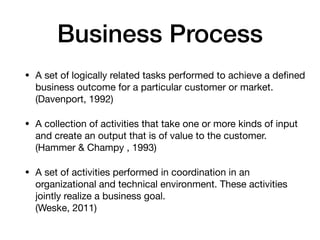
Business Process
• A set of logically related tasks performed to achieve a de
fi
ned
business outcome for a particular customer or market.

(Davenport, 1992)

• A collection of activities that take one or more kinds of input
and create an output that is of value to the customer. 

(Hammer & Champy , 1993)

• A set of activities performed in coordination in an
organizational and technical environment. These activities
jointly realize a business goal.

(Weske, 2011)
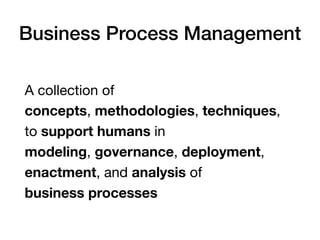
Business Process Management
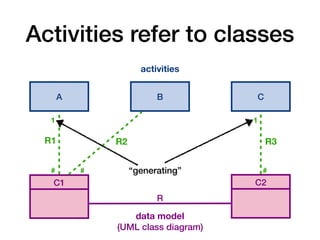
A collection of

concepts, methodologies, techniques,

to support humans in 

modeling, governance, deployment,
enactment, and analysis of

business processes
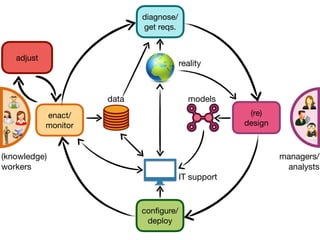
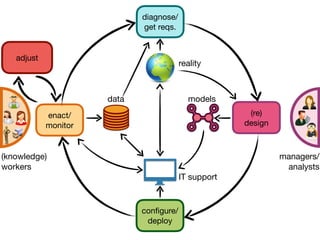
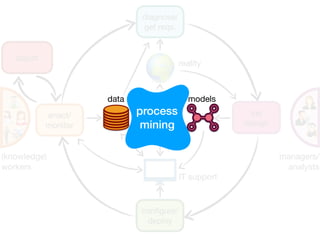
50%
data models
50%
con
fi
gure/
deploy
diagnose/

get reqs.
enact/
monitor
(re)

design
adjust
IT support
reality
(knowledge)

workers
managers/

analysts
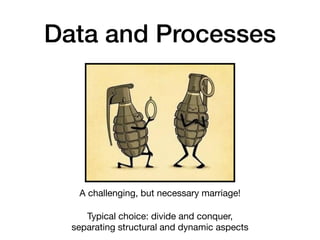
Data and Processes
A challenging, but necessary marriage!

Typical choice: divide and conquer, 

separating structural and dynamic aspects
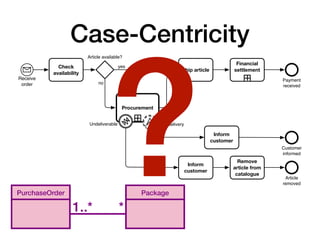
Case-Centricity
PurchaseOrder
…
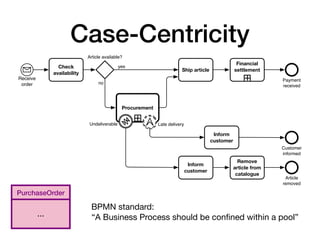
Case-Centricity
Receive
order
Check
availability
Article available?
Ship article
Financial
settlement
yes
Procurement
no
Payment
received
Inform
customer
Late delivery
Undeliverable
Customer
informed
Inform
customer
Article
removed
Remove
article from
catalogue
PurchaseOrder
…
BPMN standard:

“A Business Process should be con
fi
ned within a pool”
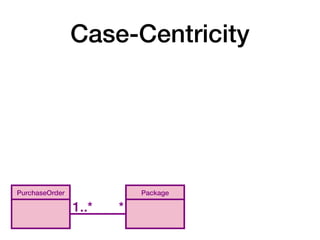
Case-Centricity
PurchaseOrder Package
1..* *
Case-Centricity
PurchaseOrder Package
1..* *
Receive
order
Check
availability
Article available?
Ship article
Financial
settlement
yes
Procurement
no
Payment
received
Inform
customer
Late delivery
Undeliverable
Customer
informed
Inform
customer
Article
removed
Remove
article from
catalogue
?
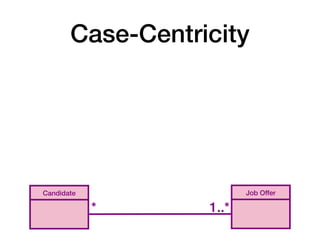
Case-Centricity
Candidate Job Offer
* 1..*
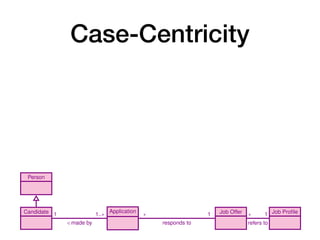
Case-Centricity
10 A. Artale, D. Calvanese, M. Montali, and W. van der Aalst
is about
1
1
creates
1
promotes
1
creates
1
1
stops
1
closes
1
Person
Candidate Application Job Offer Job Profile
1
/ made by
1..⇤ ⇤
responds to
1 ⇤
refers to
1
register
data submit
mark as
eligible
post
offer
cancel
hiring
determine
winner
Case-Centricity
10 A. Artale, D. Calvanese, M. Montali, and W. van der Aalst
is about
1
1
creates
1
promotes
1
creates
1
1
stops
1
closes
1
Person
Candidate Application Job Offer Job Profile
1
/ made by
1..⇤ ⇤
responds to
1 ⇤
refers to
1
register
data submit
mark as
eligible
post
offer
cancel
hiring
determine
winner
6 A. Artale, D. Calvanese, M. Montali, and W. van der Aalst
Hiring
Company
Candidate
post
offer
check if
eligible
Application
…
Job Offer
(a) A job hiring process receiving at most
one application
Hiring
Company
post
offer
Application
Job Offer
handle candidate
…
check if
eligible
Candidate
(b) A job hiring process receiving multiple applica-
tions in a sequential way; a new application is only han-
dled when the previous applications has been checked
for eligibility
Fig. 2: Common beginner mistakes when capturing a job hiring process (diagrams
inspired from [12])
Case-Centricity
10 A. Artale, D. Calvanese, M. Montali, and W. van der Aalst
is about
1
1
creates
1
promotes
1
creates
1
1
stops
1
closes
1
Person
Candidate Application Job Offer Job Profile
1
/ made by
1..⇤ ⇤
responds to
1 ⇤
refers to
1
register
data submit
mark as
eligible
post
offer
cancel
hiring
determine
winner
6 A. Artale, D. Calvanese, M. Montali, and W. van der Aalst
Hiring
Company
Candidate
post
offer
check if
eligible
Application
…
Job Offer
(a) A job hiring process receiving at most
one application
Hiring
Company
post
offer
Application
Job Offer
handle candidate
…
check if
eligible
Candidate
(b) A job hiring process receiving multiple applica-
tions in a sequential way; a new application is only han-
dled when the previous applications has been checked
for eligibility
Fig. 2: Common beginner mistakes when capturing a job hiring process (diagrams
inspired from [12])
Case-Centricity
10 A. Artale, D. Calvanese, M. Montali, and W. van der Aalst
is about
1
1
creates
1
promotes
1
creates
1
1
stops
1
closes
1
Person
Candidate Application Job Offer Job Profile
1
/ made by
1..⇤ ⇤
responds to
1 ⇤
refers to
1
register
data submit
mark as
eligible
post
offer
cancel
hiring
determine
winner
6 A. Artale, D. Calvanese, M. Montali, and W. van der Aalst
Hiring
Company
Candidate
post
offer
check if
eligible
Application
…
Job Offer
(a) A job hiring process receiving at most
one application
Hiring
Company
post
offer
Application
Job Offer
handle candidate
…
check if
eligible
Candidate
(b) A job hiring process receiving multiple applica-
tions in a sequential way; a new application is only han-
dled when the previous applications has been checked
for eligibility
Fig. 2: Common beginner mistakes when capturing a job hiring process (diagrams
inspired from [12])
Case-Centricity
10 A. Artale, D. Calvanese, M. Montali, and W. van der Aalst
is about
1
1
creates
1
promotes
1
creates
1
1
stops
1
closes
1
Person
Candidate Application Job Offer Job Profile
1
/ made by
1..⇤ ⇤
responds to
1 ⇤
refers to
1
register
data submit
mark as
eligible
post
offer
cancel
hiring
determine
winner
6 A. Artale, D. Calvanese, M. Montali, and W. van der Aalst
Hiring
Company
Candidate
post
offer
check if
eligible
Application
…
Job Offer
(a) A job hiring process receiving at most
one application
Hiring
Company
post
offer
Application
Job Offer
handle candidate
…
check if
eligible
Candidate
(b) A job hiring process receiving multiple applica-
tions in a sequential way; a new application is only han-
dled when the previous applications has been checked
for eligibility
Fig. 2: Common beginner mistakes when capturing a job hiring process (diagrams
inspired from [12])
6 A. Artale, D. Calvanese, M. Montali, and W. van der Aalst
Hiring
Company
Candidate
post
offer
check if
eligible
Application
…
Job Offer
(a) A job hiring process receiving at most
one application
Hiring
Company
post
offer
Application
Job Offer
handle candidate
…
check if
eligible
Candidate
(b) A job hiring process receiving multiple applica-
tions in a sequential way; a new application is only han-
dled when the previous applications has been checked
for eligibility
Fig. 2: Common beginner mistakes when capturing a job hiring process (diagrams
inspired from [12])
Case-Centricity
10 A. Artale, D. Calvanese, M. Montali, and W. van der Aalst
is about
1
1
creates
1
promotes
1
creates
1
1
stops
1
closes
1
Person
Candidate Application Job Offer Job Profile
1
/ made by
1..⇤ ⇤
responds to
1 ⇤
refers to
1
register
data submit
mark as
eligible
post
offer
cancel
hiring
determine
winner
6 A. Artale, D. Calvanese, M. Montali, and W. van der Aalst
Hiring
Company
Candidate
post
offer
check if
eligible
Application
…
Job Offer
(a) A job hiring process receiving at most
one application
Hiring
Company
post
offer
Application
Job Offer
handle candidate
…
check if
eligible
Candidate
(b) A job hiring process receiving multiple applica-
tions in a sequential way; a new application is only han-
dled when the previous applications has been checked
for eligibility
Fig. 2: Common beginner mistakes when capturing a job hiring process (diagrams
inspired from [12])
6 A. Artale, D. Calvanese, M. Montali, and W. van der Aalst
Hiring
Company
Candidate
post
offer
check if
eligible
Application
…
Job Offer
(a) A job hiring process receiving at most
one application
Hiring
Company
post
offer
Application
Job Offer
handle candidate
…
check if
eligible
Candidate
(b) A job hiring process receiving multiple applica-
tions in a sequential way; a new application is only han-
dled when the previous applications has been checked
for eligibility
Fig. 2: Common beginner mistakes when capturing a job hiring process (diagrams
inspired from [12])
serialisation
Case-Centricity
10 A. Artale, D. Calvanese, M. Montali, and W. van der Aalst
is about
1
1
creates
1
promotes
1
creates
1
1
stops
1
closes
1
Person
Candidate Application Job Offer Job Profile
1
/ made by
1..⇤ ⇤
responds to
1 ⇤
refers to
1
register
data submit
mark as
eligible
post
offer
cancel
hiring
determine
winner
6 A. Artale, D. Calvanese, M. Montali, and W. van der Aalst
Hiring
Company
Candidate
post
offer
check if
eligible
Application
…
Job Offer
(a) A job hiring process receiving at most
one application
Hiring
Company
post
offer
Application
Job Offer
handle candidate
…
check if
eligible
Candidate
(b) A job hiring process receiving multiple applica-
tions in a sequential way; a new application is only han-
dled when the previous applications has been checked
for eligibility
Fig. 2: Common beginner mistakes when capturing a job hiring process (diagrams
inspired from [12])
6 A. Artale, D. Calvanese, M. Montali, and W. van der Aalst
Hiring
Company
Candidate
post
offer
check if
eligible
Application
…
Job Offer
(a) A job hiring process receiving at most
one application
Hiring
Company
post
offer
Application
Job Offer
handle candidate
…
check if
eligible
Candidate
(b) A job hiring process receiving multiple applica-
tions in a sequential way; a new application is only han-
dled when the previous applications has been checked
for eligibility
Fig. 2: Common beginner mistakes when capturing a job hiring process (diagrams
inspired from [12])
serialisation
• Multiple pools required

• Additional synchronisation constructs needed
Not “Just” a Modeling
Issue…
50%
data models
50%
con
fi
gure/
deploy
diagnose/

get reqs.
enact/
monitor
(re)

design
adjust
IT support
reality
(knowledge)

workers
managers/

analysts
50% 50%
con
fi
gure/
deploy
diagnose/

get reqs.
enact/
monitor
(re)

design
adjust
IT support
reality
(knowledge)

workers
managers/

analysts
data models
process


mining
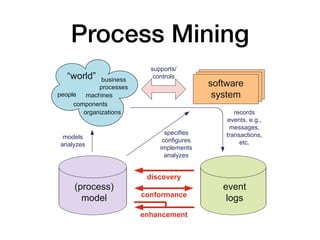
Process Mining
1.3 Process Mining 9
Fig. 1.4 Positioning of the three main types of process mining: discovery, conformance, and en-
hancement
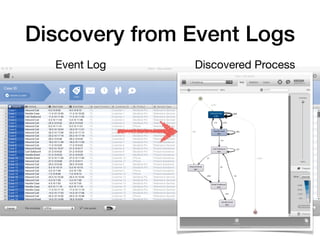
Discovery from Event Logs
• N
Event Log Discovered Process
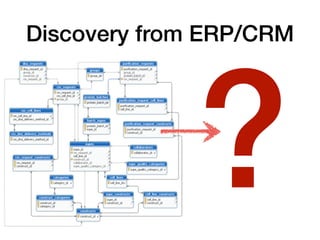
Discovery from ERP/CRM
• v
?
Object-Centric


Behavioral Constraints
• A data model expresses the structural aspects of the
domain of interest

• Activities of the process need to refer to classes present
there

• The execution of activities is regulated by temporal
constraints, which need to refer to the data model to
indicate “scopes” on the corresponding objects
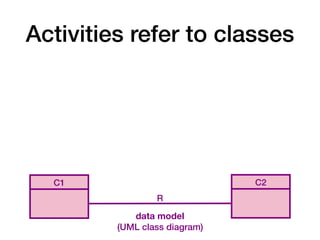
data model
(UML class diagram)
Activities refer to classes
C1 C2
R
data model
(UML class diagram)
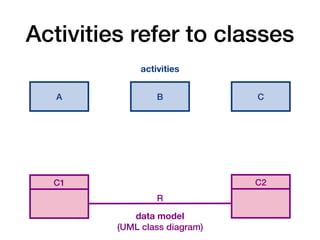
Activities refer to classes
C1 C2
R
activities
A B C
data model
(UML class diagram)
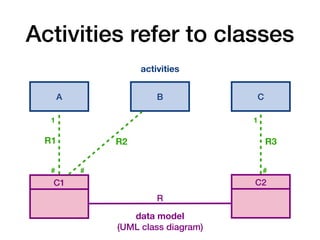
Activities refer to classes
C1 C2
R
activities
A B C
# # #
1 1
R1 R2 R3
data model
(UML class diagram)
Activities refer to classes
C1 C2
R
activities
A B C
# # #
1 1
R1 R2 R3
“generating”
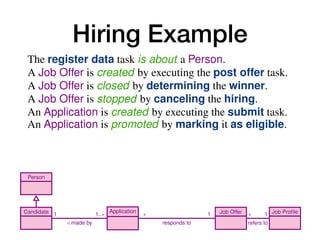
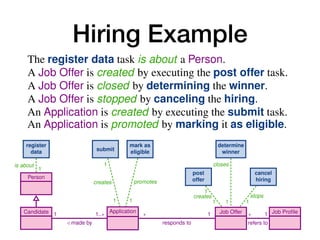
Hiring Example
10 A. Artale, D. Calvanese, M. Montali, and W. van der Aalst
is about
1
1
creates
1
promotes
1
creates
1
1
stops
1
closes
1
Person
Candidate Application Job Offer Job Profile
1
/ made by
1..⇤ ⇤
responds to
1 ⇤
refers to
1
register
data submit
mark as
eligible
post
offer
cancel
hiring
determine
winner
which instances of tasks are related by the constraint depending on
manipulate.
In particular, the relevant constraints for our job hiring example are:
C.1 The register data task is about a Person.
C.2 A Job Offer is created by executing the post offer task.
C.3 A Job Offer is closed by determining the winner.
C.4 A Job Offer is stopped by canceling the hiring.
Enriching Data Models with Behavioral Co
C.5 An Application is created by executing the submit task.
C.6 An Application is promoted by marking it as eligible.
C.7 An Application can be submitted only if, beforehand, the data a
date who made that Application have been registered.
C.8 A winner can be determined for a Job Offer only if at least o
responding to that Job Offer has been previously marked as el
C.9 For each Application responding to a Job Offer, if the Applica
as eligible then a winner must be finally determined for that
this is done only once for that Job Offer.
C.10 When a winner is determined for a Job Offer, Applications res
Hiring Example
10 A. Artale, D. Calvanese, M. Montali, and W. van der Aalst
is about
1
1
creates
1
promotes
1
creates
1
1
stops
1
closes
1
Person
Candidate Application Job Offer Job Profile
1
/ made by
1..⇤ ⇤
responds to
1 ⇤
refers to
1
register
data submit
mark as
eligible
post
offer
cancel
hiring
determine
winner
which instances of tasks are related by the constraint depending on
manipulate.
In particular, the relevant constraints for our job hiring example are:
C.1 The register data task is about a Person.
C.2 A Job Offer is created by executing the post offer task.
C.3 A Job Offer is closed by determining the winner.
C.4 A Job Offer is stopped by canceling the hiring.
Enriching Data Models with Behavioral Co
C.5 An Application is created by executing the submit task.
C.6 An Application is promoted by marking it as eligible.
C.7 An Application can be submitted only if, beforehand, the data a
date who made that Application have been registered.
C.8 A winner can be determined for a Job Offer only if at least o
responding to that Job Offer has been previously marked as el
C.9 For each Application responding to a Job Offer, if the Applica
as eligible then a winner must be finally determined for that
this is done only once for that Job Offer.
C.10 When a winner is determined for a Job Offer, Applications res
“Emerging”


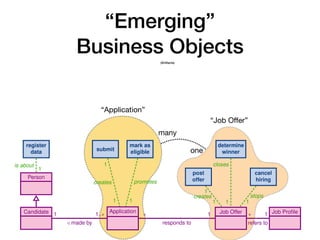
Business Objects
10 A. Artale, D. Calvanese, M. Montali, and W. van der Aalst
is about
1
1
creates
1
promotes
1
creates
1
1
stops
1
closes
1
Person
Candidate Application Job Offer Job Profile
1
/ made by
1..⇤ ⇤
responds to
1 ⇤
refers to
1
register
data submit
mark as
eligible
post
offer
cancel
hiring
determine
winner
“Application”
“Job O
ff
er”
many
one
(Artifacts)
Expressing the Process
10 A. Artale, D. Calvanese, M. Montali, and W. van der Aalst
is about
1
1
creates
1
promotes
1
creates
1
1
stops
1
closes
1
Person
Candidate Application Job Offer Job Profile
1
/ made by
1..⇤ ⇤
responds to
1 ⇤
refers to
1
register
data submit
mark as
eligible
post
offer
cancel
hiring
determine
winner
C.8 A winner can be determined for a Job Offer only if at least one Application
responding to that Job Offer has been previously marked as eligible.
C.9 For each Application responding to a Job Offer, if the Application is marked
as eligible then a winner must be finally determined for that Job Offer, and
this is done only once for that Job Offer.
.10 When a winner is determined for a Job Offer, Applications responding to that
Job Offer cannot be marked as eligible anymore.
.11 A Job Offer closed by a determine winner task cannot be stopped by executing
the cancel hiring task (and vice-versa).
2.2 Capturing the Job Hiring Example with Case-Centric Notations
The most fundamental issue when trying to capture the job hiring example of Section 2.1
using case-centric notation is to identify what is the case. This, in turn, determines
what is the orchestration point for the process, that is, which participant coordinates
process instances corresponding to different case objects. This problem is apparent when
looking at BPMN, which specifies that each process should correspond to a single locus
of control, i.e., confined within a single pool.4
In our example, we have two participants: candidates (in turn responsible for man-
aging Applications), and the job hiring organisation (in turn responsible for the
management of JobOffers). However, we cannot use neither of the two to act as unique
locus of control for the process: on the one hand, candidates may simultaneously create
and manage different applications for different job offers; on the other hand, the organi-
sation may simultaneously spawn and manage different job offers, each one resulting
Enriching Data Models with Behavioral Constraints 5
C.5 An Application is created by executing the submit task.
C.6 An Application is promoted by marking it as eligible.
C.7 An Application can be submitted only if, beforehand, the data about the Candi-
date who made that Application have been registered.
C.8 A winner can be determined for a Job Offer only if at least one Application
responding to that Job Offer has been previously marked as eligible.
C.9 For each Application responding to a Job Offer, if the Application is marked
as eligible then a winner must be finally determined for that Job Offer, and
this is done only once for that Job Offer.
.10 When a winner is determined for a Job Offer, Applications responding to that
Job Offer cannot be marked as eligible anymore.
.11 A Job Offer closed by a determine winner task cannot be stopped by executing
the cancel hiring task (and vice-versa).
2.2 Capturing the Job Hiring Example with Case-Centric Notations
Expressing the Process
10 A. Artale, D. Calvanese, M. Montali, and W. van der Aalst
is about
1
1
creates
1
promotes
1
creates
1
1
stops
1
closes
1
Person
Candidate Application Job Offer Job Profile
1
/ made by
1..⇤ ⇤
responds to
1 ⇤
refers to
1
register
data submit
mark as
eligible
post
offer
cancel
hiring
determine
winner
C.8 A winner can be determined for a Job Offer only if at least one Application
responding to that Job Offer has been previously marked as eligible.
C.9 For each Application responding to a Job Offer, if the Application is marked
as eligible then a winner must be finally determined for that Job Offer, and
this is done only once for that Job Offer.
.10 When a winner is determined for a Job Offer, Applications responding to that
Job Offer cannot be marked as eligible anymore.
.11 A Job Offer closed by a determine winner task cannot be stopped by executing
the cancel hiring task (and vice-versa).
2.2 Capturing the Job Hiring Example with Case-Centric Notations
The most fundamental issue when trying to capture the job hiring example of Section 2.1
using case-centric notation is to identify what is the case. This, in turn, determines
what is the orchestration point for the process, that is, which participant coordinates
process instances corresponding to different case objects. This problem is apparent when
looking at BPMN, which specifies that each process should correspond to a single locus
of control, i.e., confined within a single pool.4
In our example, we have two participants: candidates (in turn responsible for man-
aging Applications), and the job hiring organisation (in turn responsible for the
management of JobOffers). However, we cannot use neither of the two to act as unique
locus of control for the process: on the one hand, candidates may simultaneously create
and manage different applications for different job offers; on the other hand, the organi-
sation may simultaneously spawn and manage different job offers, each one resulting
Enriching Data Models with Behavioral Constraints 5
C.5 An Application is created by executing the submit task.
C.6 An Application is promoted by marking it as eligible.
C.7 An Application can be submitted only if, beforehand, the data about the Candi-
date who made that Application have been registered.
C.8 A winner can be determined for a Job Offer only if at least one Application
responding to that Job Offer has been previously marked as eligible.
C.9 For each Application responding to a Job Offer, if the Application is marked
as eligible then a winner must be finally determined for that Job Offer, and
this is done only once for that Job Offer.
.10 When a winner is determined for a Job Offer, Applications responding to that
Job Offer cannot be marked as eligible anymore.
.11 A Job Offer closed by a determine winner task cannot be stopped by executing
the cancel hiring task (and vice-versa).
2.2 Capturing the Job Hiring Example with Case-Centric Notations
temporal constraints
Temporal Constraints
8 A. Artale, D. Calvanese, M. Montali, and W. van der Aalst
A B
response
A B
unary-response
A B
non-response
A B
precedence
A B
unary-precedence
A B
non-precedence
A B
responded-existence
A B
non-coexistence
Fig. 3: Types of temporal constraints between activities
response(A, B) If A is executed, then B must be executed afterwards.
unary- response(A, B) If A is executed, then B must be executed exactly once after-
wards.
precedence(A, B) If A is executed, then B must have been executed before.
Inspired by the Declare declarative process modelling notation
Is That Enough? No!
10 A. Artale, D. Calvanese, M. Montali, and W. van der Aalst
is about
1
1
creates
1
promotes
1
creates
1
1
stops
1
closes
1
Person
Candidate Application Job Offer Job Profile
1
/ made by
1..⇤ ⇤
responds to
1 ⇤
refers to
1
register
data submit
mark as
eligible
post
offer
cancel
hiring
determine
winner
C.8 A winner can be determined for a Job Offer only if at least one Application
responding to that Job Offer has been previously marked as eligible.
C.9 For each Application responding to a Job Offer, if the Application is marked
as eligible then a winner must be finally determined for that Job Offer, and
this is done only once for that Job Offer.
.10 When a winner is determined for a Job Offer, Applications responding to that
Job Offer cannot be marked as eligible anymore.
.11 A Job Offer closed by a determine winner task cannot be stopped by executing
the cancel hiring task (and vice-versa).
2.2 Capturing the Job Hiring Example with Case-Centric Notations
The most fundamental issue when trying to capture the job hiring example of Section 2.1
using case-centric notation is to identify what is the case. This, in turn, determines
what is the orchestration point for the process, that is, which participant coordinates
process instances corresponding to different case objects. This problem is apparent when
looking at BPMN, which specifies that each process should correspond to a single locus
of control, i.e., confined within a single pool.4
In our example, we have two participants: candidates (in turn responsible for man-
aging Applications), and the job hiring organisation (in turn responsible for the
management of JobOffers). However, we cannot use neither of the two to act as unique
locus of control for the process: on the one hand, candidates may simultaneously create
and manage different applications for different job offers; on the other hand, the organi-
sation may simultaneously spawn and manage different job offers, each one resulting
Enriching Data Models with Behavioral Constraints 5
C.5 An Application is created by executing the submit task.
C.6 An Application is promoted by marking it as eligible.
C.7 An Application can be submitted only if, beforehand, the data about the Candi-
date who made that Application have been registered.
C.8 A winner can be determined for a Job Offer only if at least one Application
responding to that Job Offer has been previously marked as eligible.
C.9 For each Application responding to a Job Offer, if the Application is marked
as eligible then a winner must be finally determined for that Job Offer, and
this is done only once for that Job Offer.
.10 When a winner is determined for a Job Offer, Applications responding to that
Job Offer cannot be marked as eligible anymore.
.11 A Job Offer closed by a determine winner task cannot be stopped by executing
the cancel hiring task (and vice-versa).
2.2 Capturing the Job Hiring Example with Case-Centric Notations
temporal constraints
Is That Enough? No!
10 A. Artale, D. Calvanese, M. Montali, and W. van der Aalst
is about
1
1
creates
1
promotes
1
creates
1
1
stops
1
closes
1
Person
Candidate Application Job Offer Job Profile
1
/ made by
1..⇤ ⇤
responds to
1 ⇤
refers to
1
register
data submit
mark as
eligible
post
offer
cancel
hiring
determine
winner
C.8 A winner can be determined for a Job Offer only if at least one Application
responding to that Job Offer has been previously marked as eligible.
C.9 For each Application responding to a Job Offer, if the Application is marked
as eligible then a winner must be finally determined for that Job Offer, and
this is done only once for that Job Offer.
.10 When a winner is determined for a Job Offer, Applications responding to that
Job Offer cannot be marked as eligible anymore.
.11 A Job Offer closed by a determine winner task cannot be stopped by executing
the cancel hiring task (and vice-versa).
2.2 Capturing the Job Hiring Example with Case-Centric Notations
The most fundamental issue when trying to capture the job hiring example of Section 2.1
using case-centric notation is to identify what is the case. This, in turn, determines
what is the orchestration point for the process, that is, which participant coordinates
process instances corresponding to different case objects. This problem is apparent when
looking at BPMN, which specifies that each process should correspond to a single locus
of control, i.e., confined within a single pool.4
In our example, we have two participants: candidates (in turn responsible for man-
aging Applications), and the job hiring organisation (in turn responsible for the
management of JobOffers). However, we cannot use neither of the two to act as unique
locus of control for the process: on the one hand, candidates may simultaneously create
and manage different applications for different job offers; on the other hand, the organi-
sation may simultaneously spawn and manage different job offers, each one resulting
Enriching Data Models with Behavioral Constraints 5
C.5 An Application is created by executing the submit task.
C.6 An Application is promoted by marking it as eligible.
C.7 An Application can be submitted only if, beforehand, the data about the Candi-
date who made that Application have been registered.
C.8 A winner can be determined for a Job Offer only if at least one Application
responding to that Job Offer has been previously marked as eligible.
C.9 For each Application responding to a Job Offer, if the Application is marked
as eligible then a winner must be finally determined for that Job Offer, and
this is done only once for that Job Offer.
.10 When a winner is determined for a Job Offer, Applications responding to that
Job Offer cannot be marked as eligible anymore.
.11 A Job Offer closed by a determine winner task cannot be stopped by executing
the cancel hiring task (and vice-versa).
2.2 Capturing the Job Hiring Example with Case-Centric Notations
temporal constraints
co-reference on object (V co-reference)
co-reference on relation (U co-reference)
Behavioral Constraints
Temporal constraints + V/U co-reference through the data model
12 A. Artale, D. Calvanese, M. Montali, and W. van der Aalst
A1 A2
O
R1 R2
Every time an instance a1 of A1 is executed
on some object o of type O (i.e., with R1(a1, o)),
then an instance a2 of A2 must be executed afterwards
on the same object o (i.e., with R2(a2, o))
(a) Co-reference of response over an object class
A1 A2
O1 O2
R1 R2
Every time an instance a1 of A1 is executed
on some object o1 of type O1 (i.e., with R1(a1, o1)),
then an instance a2 of A2 must be executed afterwards
on some object o2 of type O2 (i.e., with R2(a2, o2))
that relates to o1 via R
12 A. Artale, D. Calvanese, M. Montali, and W. van der Aalst
A1 A2
O
R1 R2
Every time an instance a1 of A1 is executed
on some object o of type O (i.e., with R1(a1, o)),
then an instance a2 of A2 must be executed afterwards
on the same object o (i.e., with R2(a2, o))
(a) Co-reference of response over an object class
A1 A2
O1 O2
R
R1 R2
Every time an instance a1 of A1 is executed
on some object o1 of type O1 (i.e., with R1(a1, o1)),
then an instance a2 of A2 must be executed afterwards
on some object o2 of type O2 (i.e., with R2(a2, o2))
that relates to o1 via R
(i.e., having R(o1, o2) at the moment of execution of a2).
Hiring Constraints
C.8 A winner can be determined for a Job Offer only if at least one Application
responding to that Job Offer has been previously marked as eligible.
C.9 For each Application responding to a Job Offer, if the Application is marked
as eligible then a winner must be finally determined for that Job Offer, and
this is done only once for that Job Offer.
.10 When a winner is determined for a Job Offer, Applications responding to that
Job Offer cannot be marked as eligible anymore.
.11 A Job Offer closed by a determine winner task cannot be stopped by executing
the cancel hiring task (and vice-versa).
2.2 Capturing the Job Hiring Example with Case-Centric Notations
The most fundamental issue when trying to capture the job hiring example of Section 2.1
using case-centric notation is to identify what is the case. This, in turn, determines
what is the orchestration point for the process, that is, which participant coordinates
process instances corresponding to different case objects. This problem is apparent when
looking at BPMN, which specifies that each process should correspond to a single locus
of control, i.e., confined within a single pool.4
In our example, we have two participants: candidates (in turn responsible for man-
aging Applications), and the job hiring organisation (in turn responsible for the
management of JobOffers). However, we cannot use neither of the two to act as unique
locus of control for the process: on the one hand, candidates may simultaneously create
and manage different applications for different job offers; on the other hand, the organi-
sation may simultaneously spawn and manage different job offers, each one resulting
Enriching Data Models with Behavioral Constraints 5
C.5 An Application is created by executing the submit task.
C.6 An Application is promoted by marking it as eligible.
C.7 An Application can be submitted only if, beforehand, the data about the Candi-
date who made that Application have been registered.
C.8 A winner can be determined for a Job Offer only if at least one Application
responding to that Job Offer has been previously marked as eligible.
C.9 For each Application responding to a Job Offer, if the Application is marked
as eligible then a winner must be finally determined for that Job Offer, and
this is done only once for that Job Offer.
.10 When a winner is determined for a Job Offer, Applications responding to that
Job Offer cannot be marked as eligible anymore.
.11 A Job Offer closed by a determine winner task cannot be stopped by executing
the cancel hiring task (and vice-versa).
2.2 Capturing the Job Hiring Example with Case-Centric Notations
Enriching Data Models with Behavioral Constraints 13
is about
1
1
creates
1
promotes
1
creates
1
1
stops
1
closes
1
Person
Candidate Application Job Offer Job Profile
1
/ made by
1..⇤ ⇤
responds to
1 ⇤
refers to
1
register
data submit
mark as
eligible
post
offer
cancel
hiring
determine
winner
c
c
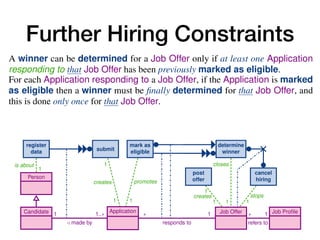
Further Hiring Constraints
Enriching Data Models with Behavioral Constraints 13
is about
1
1
creates
1
promotes
1
creates
1
1
stops
1
closes
1
Person
Candidate Application Job Offer Job Profile
1
/ made by
1..⇤ ⇤
responds to
1 ⇤
refers to
1
register
data submit
mark as
eligible
post
offer
cancel
hiring
determine
winner
c
c
5 An Application is created by executing the submit task.
6 An Application is promoted by marking it as eligible.
7 An Application can be submitted only if, beforehand, the data about the Candi-
date who made that Application have been registered.
8 A winner can be determined for a Job Offer only if at least one Application
responding to that Job Offer has been previously marked as eligible.
9 For each Application responding to a Job Offer, if the Application is marked
as eligible then a winner must be finally determined for that Job Offer, and
this is done only once for that Job Offer.
0 When a winner is determined for a Job Offer, Applications responding to that
Job Offer cannot be marked as eligible anymore.
1 A Job Offer closed by a determine winner task cannot be stopped by executing
the cancel hiring task (and vice-versa).
2 Capturing the Job Hiring Example with Case-Centric Notations
he most fundamental issue when trying to capture the job hiring example of Section 2.1
sing case-centric notation is to identify what is the case. This, in turn, determines
hat is the orchestration point for the process, that is, which participant coordinates
rocess instances corresponding to different case objects. This problem is apparent when
ooking at BPMN, which specifies that each process should correspond to a single locus
4
Further Hiring Constraints
Enriching Data Models with Behavioral Constraints 13
is about
1
1
creates
1
promotes
1
creates
1
1
stops
1
closes
1
Person
Candidate Application Job Offer Job Profile
1
/ made by
1..⇤ ⇤
responds to
1 ⇤
refers to
1
register
data submit
mark as
eligible
post
offer
cancel
hiring
determine
winner
5 An Application is created by executing the submit task.
6 An Application is promoted by marking it as eligible.
7 An Application can be submitted only if, beforehand, the data about the Candi-
date who made that Application have been registered.
8 A winner can be determined for a Job Offer only if at least one Application
responding to that Job Offer has been previously marked as eligible.
9 For each Application responding to a Job Offer, if the Application is marked
as eligible then a winner must be finally determined for that Job Offer, and
this is done only once for that Job Offer.
0 When a winner is determined for a Job Offer, Applications responding to that
Job Offer cannot be marked as eligible anymore.
1 A Job Offer closed by a determine winner task cannot be stopped by executing
the cancel hiring task (and vice-versa).
2 Capturing the Job Hiring Example with Case-Centric Notations
he most fundamental issue when trying to capture the job hiring example of Section 2.1
sing case-centric notation is to identify what is the case. This, in turn, determines
hat is the orchestration point for the process, that is, which participant coordinates
rocess instances corresponding to different case objects. This problem is apparent when
ooking at BPMN, which specifies that each process should correspond to a single locus
4
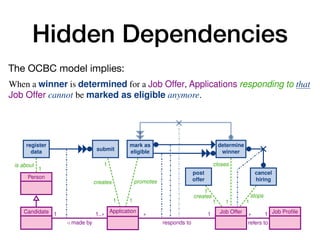
Hidden Dependencies
Enriching Data Models with Behavioral Constraints 13
is about
1
1
creates
1
promotes
1
creates
1
1
stops
1
closes
1
Person
Candidate Application Job Offer Job Profile
1
/ made by
1..⇤ ⇤
responds to
1 ⇤
refers to
1
register
data submit
mark as
eligible
post
offer
cancel
hiring
determine
winner
6 An Application is promoted by marking it as eligible.
7 An Application can be submitted only if, beforehand, the data about the Candi-
date who made that Application have been registered.
8 A winner can be determined for a Job Offer only if at least one Application
responding to that Job Offer has been previously marked as eligible.
9 For each Application responding to a Job Offer, if the Application is marked
as eligible then a winner must be finally determined for that Job Offer, and
this is done only once for that Job Offer.
0 When a winner is determined for a Job Offer, Applications responding to that
Job Offer cannot be marked as eligible anymore.
1 A Job Offer closed by a determine winner task cannot be stopped by executing
the cancel hiring task (and vice-versa).
.2 Capturing the Job Hiring Example with Case-Centric Notations
he most fundamental issue when trying to capture the job hiring example of Section 2.1
sing case-centric notation is to identify what is the case. This, in turn, determines
hat is the orchestration point for the process, that is, which participant coordinates
rocess instances corresponding to different case objects. This problem is apparent when
ooking at BPMN, which specifies that each process should correspond to a single locus
f control, i.e., confined within a single pool.4
In our example, we have two participants: candidates (in turn responsible for man-
ging Applications), and the job hiring organisation (in turn responsible for the
The OCBC model implies:
Semantics and Reasoning
OCBC model —> FO(<) theory

If all behavioural constraints co-refer the involved activities
through the data model (i.e., no global constraints):

• We “just” need the temporal DL

• Reasoning EXPTIME-complete

Is it essential for constraints to co-refer via the data model?

• Need to elaborate further on [Adamo et al, AI*IA2017]
considering how data objects participate to processes
n Example 3. Reasoning becomes therefore essential in the context
humans in ascertaining properties of the model, as well as in
ven execution trace conforms to the model.
CBC models presents at least two interesting challenges. First
ct techniques to carry out fundamental reasoning tasks such as
aint implication are needed. This requires, first, to understand the
ility and complexity for such reasoning tasks. While the seman-
irectly help towards this goal, we believe that capturing OCBC
s co-refer through the structural conceptual model can lead to a
sation. In particular, we are currently working on a formalisation
red within the temporal description logics TUSALCQI and frag-
28,29,30]. Such a formalisation would then provide a concrete
asoning, given that the main reasoning tasks for TUSALCQI are
ut also present the same worst-case complexity of reasoning on
QI knowledge bases.
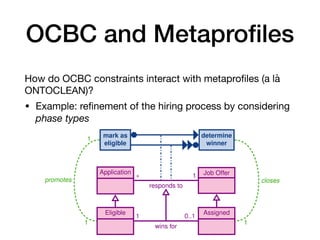
OCBC and Metapro
fi
les
How do OCBC constraints interact with metapro
fi
les (a là
ONTOCLEAN)?

• Example: re
fi
nement of the hiring process by considering
phase types
A. Artale, D. Calvanese, M. Montali, and W. van der Aalst
Application
Eligible
Job Offer
Assigned
⇤ 1
responds to
1 0..1
wins for
mark as
eligible
determine
winner
promotes
1
1
closes
1
Are OCBC Activities
Ontological Events?
Open question, which can be now attacked thanks to
Nicola’s work [Guizzardi et al, BPM2016] [Guarino, ER2017]

• From

• To
current time
Further Open Challenges
• Executing a case-centric process relates to Nicola’s notion
of an episode
• Executing an OCBC model seems to relate more to Nicola’s
notion of a process (no culminating part)

• Is it really so? 

• How can we carve out episodes from the overall process?

• What is an ongoing execution that violates a constraint?

• What is an ongoing execution that will surely lead to violate
a constraint?
It’s di
ffi
cult…
but why should it be simple?
“
”

Enriching Data Models with Behavioral Constraints

  • 1.
  • 2.
    This talk willbe an ontological mess
  • 4.
  • 5.
    Business Process • Aset of logically related tasks performed to achieve a de fi ned business outcome for a particular customer or market.
 (Davenport, 1992) • A collection of activities that take one or more kinds of input and create an output that is of value to the customer. 
 (Hammer & Champy , 1993) • A set of activities performed in coordination in an organizational and technical environment. These activities jointly realize a business goal.
 (Weske, 2011)
  • 6.
    Business Process Management Acollection of
 concepts, methodologies, techniques,
 to support humans in 
 modeling, governance, deployment, enactment, and analysis of
 business processes
  • 7.
  • 8.
    Data and Processes Achallenging, but necessary marriage! Typical choice: divide and conquer, 
 separating structural and dynamic aspects
  • 9.
  • 10.
    Case-Centricity Receive order Check availability Article available? Ship article Financial settlement yes Procurement no Payment received Inform customer Latedelivery Undeliverable Customer informed Inform customer Article removed Remove article from catalogue PurchaseOrder … BPMN standard: “A Business Process should be con fi ned within a pool”
  • 11.
  • 12.
    Case-Centricity PurchaseOrder Package 1..* * Receive order Check availability Articleavailable? Ship article Financial settlement yes Procurement no Payment received Inform customer Late delivery Undeliverable Customer informed Inform customer Article removed Remove article from catalogue ?
  • 13.
  • 14.
    Case-Centricity 10 A. Artale,D. Calvanese, M. Montali, and W. van der Aalst is about 1 1 creates 1 promotes 1 creates 1 1 stops 1 closes 1 Person Candidate Application Job Offer Job Profile 1 / made by 1..⇤ ⇤ responds to 1 ⇤ refers to 1 register data submit mark as eligible post offer cancel hiring determine winner
  • 15.
    Case-Centricity 10 A. Artale,D. Calvanese, M. Montali, and W. van der Aalst is about 1 1 creates 1 promotes 1 creates 1 1 stops 1 closes 1 Person Candidate Application Job Offer Job Profile 1 / made by 1..⇤ ⇤ responds to 1 ⇤ refers to 1 register data submit mark as eligible post offer cancel hiring determine winner 6 A. Artale, D. Calvanese, M. Montali, and W. van der Aalst Hiring Company Candidate post offer check if eligible Application … Job Offer (a) A job hiring process receiving at most one application Hiring Company post offer Application Job Offer handle candidate … check if eligible Candidate (b) A job hiring process receiving multiple applica- tions in a sequential way; a new application is only han- dled when the previous applications has been checked for eligibility Fig. 2: Common beginner mistakes when capturing a job hiring process (diagrams inspired from [12])
  • 16.
    Case-Centricity 10 A. Artale,D. Calvanese, M. Montali, and W. van der Aalst is about 1 1 creates 1 promotes 1 creates 1 1 stops 1 closes 1 Person Candidate Application Job Offer Job Profile 1 / made by 1..⇤ ⇤ responds to 1 ⇤ refers to 1 register data submit mark as eligible post offer cancel hiring determine winner 6 A. Artale, D. Calvanese, M. Montali, and W. van der Aalst Hiring Company Candidate post offer check if eligible Application … Job Offer (a) A job hiring process receiving at most one application Hiring Company post offer Application Job Offer handle candidate … check if eligible Candidate (b) A job hiring process receiving multiple applica- tions in a sequential way; a new application is only han- dled when the previous applications has been checked for eligibility Fig. 2: Common beginner mistakes when capturing a job hiring process (diagrams inspired from [12])
  • 17.
    Case-Centricity 10 A. Artale,D. Calvanese, M. Montali, and W. van der Aalst is about 1 1 creates 1 promotes 1 creates 1 1 stops 1 closes 1 Person Candidate Application Job Offer Job Profile 1 / made by 1..⇤ ⇤ responds to 1 ⇤ refers to 1 register data submit mark as eligible post offer cancel hiring determine winner 6 A. Artale, D. Calvanese, M. Montali, and W. van der Aalst Hiring Company Candidate post offer check if eligible Application … Job Offer (a) A job hiring process receiving at most one application Hiring Company post offer Application Job Offer handle candidate … check if eligible Candidate (b) A job hiring process receiving multiple applica- tions in a sequential way; a new application is only han- dled when the previous applications has been checked for eligibility Fig. 2: Common beginner mistakes when capturing a job hiring process (diagrams inspired from [12])
  • 18.
    Case-Centricity 10 A. Artale,D. Calvanese, M. Montali, and W. van der Aalst is about 1 1 creates 1 promotes 1 creates 1 1 stops 1 closes 1 Person Candidate Application Job Offer Job Profile 1 / made by 1..⇤ ⇤ responds to 1 ⇤ refers to 1 register data submit mark as eligible post offer cancel hiring determine winner 6 A. Artale, D. Calvanese, M. Montali, and W. van der Aalst Hiring Company Candidate post offer check if eligible Application … Job Offer (a) A job hiring process receiving at most one application Hiring Company post offer Application Job Offer handle candidate … check if eligible Candidate (b) A job hiring process receiving multiple applica- tions in a sequential way; a new application is only han- dled when the previous applications has been checked for eligibility Fig. 2: Common beginner mistakes when capturing a job hiring process (diagrams inspired from [12]) 6 A. Artale, D. Calvanese, M. Montali, and W. van der Aalst Hiring Company Candidate post offer check if eligible Application … Job Offer (a) A job hiring process receiving at most one application Hiring Company post offer Application Job Offer handle candidate … check if eligible Candidate (b) A job hiring process receiving multiple applica- tions in a sequential way; a new application is only han- dled when the previous applications has been checked for eligibility Fig. 2: Common beginner mistakes when capturing a job hiring process (diagrams inspired from [12])
  • 19.
    Case-Centricity 10 A. Artale,D. Calvanese, M. Montali, and W. van der Aalst is about 1 1 creates 1 promotes 1 creates 1 1 stops 1 closes 1 Person Candidate Application Job Offer Job Profile 1 / made by 1..⇤ ⇤ responds to 1 ⇤ refers to 1 register data submit mark as eligible post offer cancel hiring determine winner 6 A. Artale, D. Calvanese, M. Montali, and W. van der Aalst Hiring Company Candidate post offer check if eligible Application … Job Offer (a) A job hiring process receiving at most one application Hiring Company post offer Application Job Offer handle candidate … check if eligible Candidate (b) A job hiring process receiving multiple applica- tions in a sequential way; a new application is only han- dled when the previous applications has been checked for eligibility Fig. 2: Common beginner mistakes when capturing a job hiring process (diagrams inspired from [12]) 6 A. Artale, D. Calvanese, M. Montali, and W. van der Aalst Hiring Company Candidate post offer check if eligible Application … Job Offer (a) A job hiring process receiving at most one application Hiring Company post offer Application Job Offer handle candidate … check if eligible Candidate (b) A job hiring process receiving multiple applica- tions in a sequential way; a new application is only han- dled when the previous applications has been checked for eligibility Fig. 2: Common beginner mistakes when capturing a job hiring process (diagrams inspired from [12]) serialisation
  • 20.
    Case-Centricity 10 A. Artale,D. Calvanese, M. Montali, and W. van der Aalst is about 1 1 creates 1 promotes 1 creates 1 1 stops 1 closes 1 Person Candidate Application Job Offer Job Profile 1 / made by 1..⇤ ⇤ responds to 1 ⇤ refers to 1 register data submit mark as eligible post offer cancel hiring determine winner 6 A. Artale, D. Calvanese, M. Montali, and W. van der Aalst Hiring Company Candidate post offer check if eligible Application … Job Offer (a) A job hiring process receiving at most one application Hiring Company post offer Application Job Offer handle candidate … check if eligible Candidate (b) A job hiring process receiving multiple applica- tions in a sequential way; a new application is only han- dled when the previous applications has been checked for eligibility Fig. 2: Common beginner mistakes when capturing a job hiring process (diagrams inspired from [12]) 6 A. Artale, D. Calvanese, M. Montali, and W. van der Aalst Hiring Company Candidate post offer check if eligible Application … Job Offer (a) A job hiring process receiving at most one application Hiring Company post offer Application Job Offer handle candidate … check if eligible Candidate (b) A job hiring process receiving multiple applica- tions in a sequential way; a new application is only han- dled when the previous applications has been checked for eligibility Fig. 2: Common beginner mistakes when capturing a job hiring process (diagrams inspired from [12]) serialisation • Multiple pools required • Additional synchronisation constructs needed
  • 21.
    Not “Just” aModeling Issue…
  • 22.
  • 23.
    50% 50% con fi gure/ deploy diagnose/ get reqs. enact/ monitor (re) design adjust ITsupport reality (knowledge) workers managers/ analysts data models process mining
  • 24.
    Process Mining 1.3 ProcessMining 9 Fig. 1.4 Positioning of the three main types of process mining: discovery, conformance, and en- hancement
  • 25.
    Discovery from EventLogs • N Event Log Discovered Process
  • 26.
  • 27.
    Object-Centric Behavioral Constraints • Adata model expresses the structural aspects of the domain of interest • Activities of the process need to refer to classes present there • The execution of activities is regulated by temporal constraints, which need to refer to the data model to indicate “scopes” on the corresponding objects
  • 28.
    data model (UML classdiagram) Activities refer to classes C1 C2 R
  • 29.
    data model (UML classdiagram) Activities refer to classes C1 C2 R activities A B C
  • 30.
    data model (UML classdiagram) Activities refer to classes C1 C2 R activities A B C # # # 1 1 R1 R2 R3
  • 31.
    data model (UML classdiagram) Activities refer to classes C1 C2 R activities A B C # # # 1 1 R1 R2 R3 “generating”
  • 32.
    Hiring Example 10 A.Artale, D. Calvanese, M. Montali, and W. van der Aalst is about 1 1 creates 1 promotes 1 creates 1 1 stops 1 closes 1 Person Candidate Application Job Offer Job Profile 1 / made by 1..⇤ ⇤ responds to 1 ⇤ refers to 1 register data submit mark as eligible post offer cancel hiring determine winner which instances of tasks are related by the constraint depending on manipulate. In particular, the relevant constraints for our job hiring example are: C.1 The register data task is about a Person. C.2 A Job Offer is created by executing the post offer task. C.3 A Job Offer is closed by determining the winner. C.4 A Job Offer is stopped by canceling the hiring. Enriching Data Models with Behavioral Co C.5 An Application is created by executing the submit task. C.6 An Application is promoted by marking it as eligible. C.7 An Application can be submitted only if, beforehand, the data a date who made that Application have been registered. C.8 A winner can be determined for a Job Offer only if at least o responding to that Job Offer has been previously marked as el C.9 For each Application responding to a Job Offer, if the Applica as eligible then a winner must be finally determined for that this is done only once for that Job Offer. C.10 When a winner is determined for a Job Offer, Applications res
  • 33.
    Hiring Example 10 A.Artale, D. Calvanese, M. Montali, and W. van der Aalst is about 1 1 creates 1 promotes 1 creates 1 1 stops 1 closes 1 Person Candidate Application Job Offer Job Profile 1 / made by 1..⇤ ⇤ responds to 1 ⇤ refers to 1 register data submit mark as eligible post offer cancel hiring determine winner which instances of tasks are related by the constraint depending on manipulate. In particular, the relevant constraints for our job hiring example are: C.1 The register data task is about a Person. C.2 A Job Offer is created by executing the post offer task. C.3 A Job Offer is closed by determining the winner. C.4 A Job Offer is stopped by canceling the hiring. Enriching Data Models with Behavioral Co C.5 An Application is created by executing the submit task. C.6 An Application is promoted by marking it as eligible. C.7 An Application can be submitted only if, beforehand, the data a date who made that Application have been registered. C.8 A winner can be determined for a Job Offer only if at least o responding to that Job Offer has been previously marked as el C.9 For each Application responding to a Job Offer, if the Applica as eligible then a winner must be finally determined for that this is done only once for that Job Offer. C.10 When a winner is determined for a Job Offer, Applications res
  • 34.
    “Emerging” 
 Business Objects 10 A.Artale, D. Calvanese, M. Montali, and W. van der Aalst is about 1 1 creates 1 promotes 1 creates 1 1 stops 1 closes 1 Person Candidate Application Job Offer Job Profile 1 / made by 1..⇤ ⇤ responds to 1 ⇤ refers to 1 register data submit mark as eligible post offer cancel hiring determine winner “Application” “Job O ff er” many one (Artifacts)
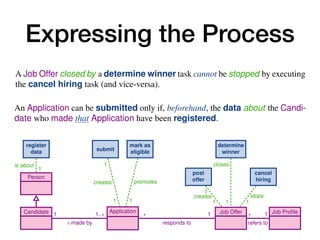
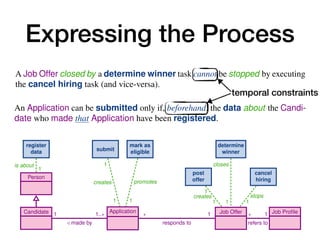
  • 35.
    Expressing the Process 10A. Artale, D. Calvanese, M. Montali, and W. van der Aalst is about 1 1 creates 1 promotes 1 creates 1 1 stops 1 closes 1 Person Candidate Application Job Offer Job Profile 1 / made by 1..⇤ ⇤ responds to 1 ⇤ refers to 1 register data submit mark as eligible post offer cancel hiring determine winner C.8 A winner can be determined for a Job Offer only if at least one Application responding to that Job Offer has been previously marked as eligible. C.9 For each Application responding to a Job Offer, if the Application is marked as eligible then a winner must be finally determined for that Job Offer, and this is done only once for that Job Offer. .10 When a winner is determined for a Job Offer, Applications responding to that Job Offer cannot be marked as eligible anymore. .11 A Job Offer closed by a determine winner task cannot be stopped by executing the cancel hiring task (and vice-versa). 2.2 Capturing the Job Hiring Example with Case-Centric Notations The most fundamental issue when trying to capture the job hiring example of Section 2.1 using case-centric notation is to identify what is the case. This, in turn, determines what is the orchestration point for the process, that is, which participant coordinates process instances corresponding to different case objects. This problem is apparent when looking at BPMN, which specifies that each process should correspond to a single locus of control, i.e., confined within a single pool.4 In our example, we have two participants: candidates (in turn responsible for man- aging Applications), and the job hiring organisation (in turn responsible for the management of JobOffers). However, we cannot use neither of the two to act as unique locus of control for the process: on the one hand, candidates may simultaneously create and manage different applications for different job offers; on the other hand, the organi- sation may simultaneously spawn and manage different job offers, each one resulting Enriching Data Models with Behavioral Constraints 5 C.5 An Application is created by executing the submit task. C.6 An Application is promoted by marking it as eligible. C.7 An Application can be submitted only if, beforehand, the data about the Candi- date who made that Application have been registered. C.8 A winner can be determined for a Job Offer only if at least one Application responding to that Job Offer has been previously marked as eligible. C.9 For each Application responding to a Job Offer, if the Application is marked as eligible then a winner must be finally determined for that Job Offer, and this is done only once for that Job Offer. .10 When a winner is determined for a Job Offer, Applications responding to that Job Offer cannot be marked as eligible anymore. .11 A Job Offer closed by a determine winner task cannot be stopped by executing the cancel hiring task (and vice-versa). 2.2 Capturing the Job Hiring Example with Case-Centric Notations
  • 36.
    Expressing the Process 10A. Artale, D. Calvanese, M. Montali, and W. van der Aalst is about 1 1 creates 1 promotes 1 creates 1 1 stops 1 closes 1 Person Candidate Application Job Offer Job Profile 1 / made by 1..⇤ ⇤ responds to 1 ⇤ refers to 1 register data submit mark as eligible post offer cancel hiring determine winner C.8 A winner can be determined for a Job Offer only if at least one Application responding to that Job Offer has been previously marked as eligible. C.9 For each Application responding to a Job Offer, if the Application is marked as eligible then a winner must be finally determined for that Job Offer, and this is done only once for that Job Offer. .10 When a winner is determined for a Job Offer, Applications responding to that Job Offer cannot be marked as eligible anymore. .11 A Job Offer closed by a determine winner task cannot be stopped by executing the cancel hiring task (and vice-versa). 2.2 Capturing the Job Hiring Example with Case-Centric Notations The most fundamental issue when trying to capture the job hiring example of Section 2.1 using case-centric notation is to identify what is the case. This, in turn, determines what is the orchestration point for the process, that is, which participant coordinates process instances corresponding to different case objects. This problem is apparent when looking at BPMN, which specifies that each process should correspond to a single locus of control, i.e., confined within a single pool.4 In our example, we have two participants: candidates (in turn responsible for man- aging Applications), and the job hiring organisation (in turn responsible for the management of JobOffers). However, we cannot use neither of the two to act as unique locus of control for the process: on the one hand, candidates may simultaneously create and manage different applications for different job offers; on the other hand, the organi- sation may simultaneously spawn and manage different job offers, each one resulting Enriching Data Models with Behavioral Constraints 5 C.5 An Application is created by executing the submit task. C.6 An Application is promoted by marking it as eligible. C.7 An Application can be submitted only if, beforehand, the data about the Candi- date who made that Application have been registered. C.8 A winner can be determined for a Job Offer only if at least one Application responding to that Job Offer has been previously marked as eligible. C.9 For each Application responding to a Job Offer, if the Application is marked as eligible then a winner must be finally determined for that Job Offer, and this is done only once for that Job Offer. .10 When a winner is determined for a Job Offer, Applications responding to that Job Offer cannot be marked as eligible anymore. .11 A Job Offer closed by a determine winner task cannot be stopped by executing the cancel hiring task (and vice-versa). 2.2 Capturing the Job Hiring Example with Case-Centric Notations temporal constraints
  • 37.
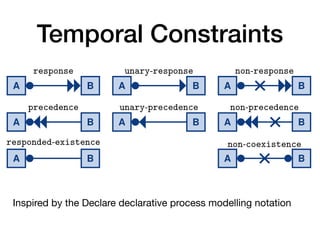
    Temporal Constraints 8 A.Artale, D. Calvanese, M. Montali, and W. van der Aalst A B response A B unary-response A B non-response A B precedence A B unary-precedence A B non-precedence A B responded-existence A B non-coexistence Fig. 3: Types of temporal constraints between activities response(A, B) If A is executed, then B must be executed afterwards. unary- response(A, B) If A is executed, then B must be executed exactly once after- wards. precedence(A, B) If A is executed, then B must have been executed before. Inspired by the Declare declarative process modelling notation
  • 38.
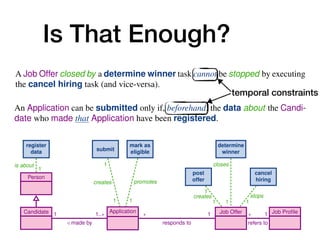
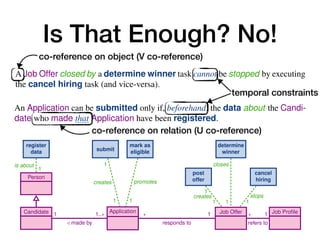
    Is That Enough?No! 10 A. Artale, D. Calvanese, M. Montali, and W. van der Aalst is about 1 1 creates 1 promotes 1 creates 1 1 stops 1 closes 1 Person Candidate Application Job Offer Job Profile 1 / made by 1..⇤ ⇤ responds to 1 ⇤ refers to 1 register data submit mark as eligible post offer cancel hiring determine winner C.8 A winner can be determined for a Job Offer only if at least one Application responding to that Job Offer has been previously marked as eligible. C.9 For each Application responding to a Job Offer, if the Application is marked as eligible then a winner must be finally determined for that Job Offer, and this is done only once for that Job Offer. .10 When a winner is determined for a Job Offer, Applications responding to that Job Offer cannot be marked as eligible anymore. .11 A Job Offer closed by a determine winner task cannot be stopped by executing the cancel hiring task (and vice-versa). 2.2 Capturing the Job Hiring Example with Case-Centric Notations The most fundamental issue when trying to capture the job hiring example of Section 2.1 using case-centric notation is to identify what is the case. This, in turn, determines what is the orchestration point for the process, that is, which participant coordinates process instances corresponding to different case objects. This problem is apparent when looking at BPMN, which specifies that each process should correspond to a single locus of control, i.e., confined within a single pool.4 In our example, we have two participants: candidates (in turn responsible for man- aging Applications), and the job hiring organisation (in turn responsible for the management of JobOffers). However, we cannot use neither of the two to act as unique locus of control for the process: on the one hand, candidates may simultaneously create and manage different applications for different job offers; on the other hand, the organi- sation may simultaneously spawn and manage different job offers, each one resulting Enriching Data Models with Behavioral Constraints 5 C.5 An Application is created by executing the submit task. C.6 An Application is promoted by marking it as eligible. C.7 An Application can be submitted only if, beforehand, the data about the Candi- date who made that Application have been registered. C.8 A winner can be determined for a Job Offer only if at least one Application responding to that Job Offer has been previously marked as eligible. C.9 For each Application responding to a Job Offer, if the Application is marked as eligible then a winner must be finally determined for that Job Offer, and this is done only once for that Job Offer. .10 When a winner is determined for a Job Offer, Applications responding to that Job Offer cannot be marked as eligible anymore. .11 A Job Offer closed by a determine winner task cannot be stopped by executing the cancel hiring task (and vice-versa). 2.2 Capturing the Job Hiring Example with Case-Centric Notations temporal constraints
  • 39.
    Is That Enough?No! 10 A. Artale, D. Calvanese, M. Montali, and W. van der Aalst is about 1 1 creates 1 promotes 1 creates 1 1 stops 1 closes 1 Person Candidate Application Job Offer Job Profile 1 / made by 1..⇤ ⇤ responds to 1 ⇤ refers to 1 register data submit mark as eligible post offer cancel hiring determine winner C.8 A winner can be determined for a Job Offer only if at least one Application responding to that Job Offer has been previously marked as eligible. C.9 For each Application responding to a Job Offer, if the Application is marked as eligible then a winner must be finally determined for that Job Offer, and this is done only once for that Job Offer. .10 When a winner is determined for a Job Offer, Applications responding to that Job Offer cannot be marked as eligible anymore. .11 A Job Offer closed by a determine winner task cannot be stopped by executing the cancel hiring task (and vice-versa). 2.2 Capturing the Job Hiring Example with Case-Centric Notations The most fundamental issue when trying to capture the job hiring example of Section 2.1 using case-centric notation is to identify what is the case. This, in turn, determines what is the orchestration point for the process, that is, which participant coordinates process instances corresponding to different case objects. This problem is apparent when looking at BPMN, which specifies that each process should correspond to a single locus of control, i.e., confined within a single pool.4 In our example, we have two participants: candidates (in turn responsible for man- aging Applications), and the job hiring organisation (in turn responsible for the management of JobOffers). However, we cannot use neither of the two to act as unique locus of control for the process: on the one hand, candidates may simultaneously create and manage different applications for different job offers; on the other hand, the organi- sation may simultaneously spawn and manage different job offers, each one resulting Enriching Data Models with Behavioral Constraints 5 C.5 An Application is created by executing the submit task. C.6 An Application is promoted by marking it as eligible. C.7 An Application can be submitted only if, beforehand, the data about the Candi- date who made that Application have been registered. C.8 A winner can be determined for a Job Offer only if at least one Application responding to that Job Offer has been previously marked as eligible. C.9 For each Application responding to a Job Offer, if the Application is marked as eligible then a winner must be finally determined for that Job Offer, and this is done only once for that Job Offer. .10 When a winner is determined for a Job Offer, Applications responding to that Job Offer cannot be marked as eligible anymore. .11 A Job Offer closed by a determine winner task cannot be stopped by executing the cancel hiring task (and vice-versa). 2.2 Capturing the Job Hiring Example with Case-Centric Notations temporal constraints co-reference on object (V co-reference) co-reference on relation (U co-reference)
  • 40.
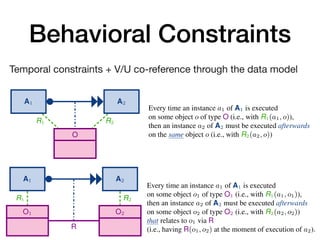
    Behavioral Constraints Temporal constraints+ V/U co-reference through the data model 12 A. Artale, D. Calvanese, M. Montali, and W. van der Aalst A1 A2 O R1 R2 Every time an instance a1 of A1 is executed on some object o of type O (i.e., with R1(a1, o)), then an instance a2 of A2 must be executed afterwards on the same object o (i.e., with R2(a2, o)) (a) Co-reference of response over an object class A1 A2 O1 O2 R1 R2 Every time an instance a1 of A1 is executed on some object o1 of type O1 (i.e., with R1(a1, o1)), then an instance a2 of A2 must be executed afterwards on some object o2 of type O2 (i.e., with R2(a2, o2)) that relates to o1 via R 12 A. Artale, D. Calvanese, M. Montali, and W. van der Aalst A1 A2 O R1 R2 Every time an instance a1 of A1 is executed on some object o of type O (i.e., with R1(a1, o)), then an instance a2 of A2 must be executed afterwards on the same object o (i.e., with R2(a2, o)) (a) Co-reference of response over an object class A1 A2 O1 O2 R R1 R2 Every time an instance a1 of A1 is executed on some object o1 of type O1 (i.e., with R1(a1, o1)), then an instance a2 of A2 must be executed afterwards on some object o2 of type O2 (i.e., with R2(a2, o2)) that relates to o1 via R (i.e., having R(o1, o2) at the moment of execution of a2).
  • 41.
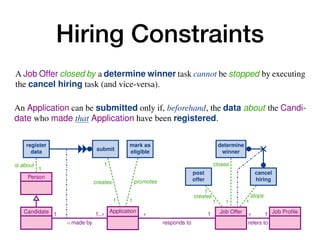
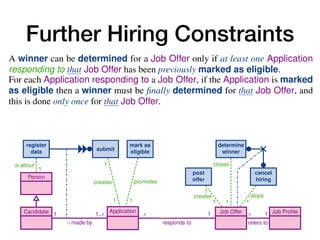
    Hiring Constraints C.8 Awinner can be determined for a Job Offer only if at least one Application responding to that Job Offer has been previously marked as eligible. C.9 For each Application responding to a Job Offer, if the Application is marked as eligible then a winner must be finally determined for that Job Offer, and this is done only once for that Job Offer. .10 When a winner is determined for a Job Offer, Applications responding to that Job Offer cannot be marked as eligible anymore. .11 A Job Offer closed by a determine winner task cannot be stopped by executing the cancel hiring task (and vice-versa). 2.2 Capturing the Job Hiring Example with Case-Centric Notations The most fundamental issue when trying to capture the job hiring example of Section 2.1 using case-centric notation is to identify what is the case. This, in turn, determines what is the orchestration point for the process, that is, which participant coordinates process instances corresponding to different case objects. This problem is apparent when looking at BPMN, which specifies that each process should correspond to a single locus of control, i.e., confined within a single pool.4 In our example, we have two participants: candidates (in turn responsible for man- aging Applications), and the job hiring organisation (in turn responsible for the management of JobOffers). However, we cannot use neither of the two to act as unique locus of control for the process: on the one hand, candidates may simultaneously create and manage different applications for different job offers; on the other hand, the organi- sation may simultaneously spawn and manage different job offers, each one resulting Enriching Data Models with Behavioral Constraints 5 C.5 An Application is created by executing the submit task. C.6 An Application is promoted by marking it as eligible. C.7 An Application can be submitted only if, beforehand, the data about the Candi- date who made that Application have been registered. C.8 A winner can be determined for a Job Offer only if at least one Application responding to that Job Offer has been previously marked as eligible. C.9 For each Application responding to a Job Offer, if the Application is marked as eligible then a winner must be finally determined for that Job Offer, and this is done only once for that Job Offer. .10 When a winner is determined for a Job Offer, Applications responding to that Job Offer cannot be marked as eligible anymore. .11 A Job Offer closed by a determine winner task cannot be stopped by executing the cancel hiring task (and vice-versa). 2.2 Capturing the Job Hiring Example with Case-Centric Notations Enriching Data Models with Behavioral Constraints 13 is about 1 1 creates 1 promotes 1 creates 1 1 stops 1 closes 1 Person Candidate Application Job Offer Job Profile 1 / made by 1..⇤ ⇤ responds to 1 ⇤ refers to 1 register data submit mark as eligible post offer cancel hiring determine winner c c
  • 42.
    Further Hiring Constraints EnrichingData Models with Behavioral Constraints 13 is about 1 1 creates 1 promotes 1 creates 1 1 stops 1 closes 1 Person Candidate Application Job Offer Job Profile 1 / made by 1..⇤ ⇤ responds to 1 ⇤ refers to 1 register data submit mark as eligible post offer cancel hiring determine winner c c 5 An Application is created by executing the submit task. 6 An Application is promoted by marking it as eligible. 7 An Application can be submitted only if, beforehand, the data about the Candi- date who made that Application have been registered. 8 A winner can be determined for a Job Offer only if at least one Application responding to that Job Offer has been previously marked as eligible. 9 For each Application responding to a Job Offer, if the Application is marked as eligible then a winner must be finally determined for that Job Offer, and this is done only once for that Job Offer. 0 When a winner is determined for a Job Offer, Applications responding to that Job Offer cannot be marked as eligible anymore. 1 A Job Offer closed by a determine winner task cannot be stopped by executing the cancel hiring task (and vice-versa). 2 Capturing the Job Hiring Example with Case-Centric Notations he most fundamental issue when trying to capture the job hiring example of Section 2.1 sing case-centric notation is to identify what is the case. This, in turn, determines hat is the orchestration point for the process, that is, which participant coordinates rocess instances corresponding to different case objects. This problem is apparent when ooking at BPMN, which specifies that each process should correspond to a single locus 4
  • 43.
    Further Hiring Constraints EnrichingData Models with Behavioral Constraints 13 is about 1 1 creates 1 promotes 1 creates 1 1 stops 1 closes 1 Person Candidate Application Job Offer Job Profile 1 / made by 1..⇤ ⇤ responds to 1 ⇤ refers to 1 register data submit mark as eligible post offer cancel hiring determine winner 5 An Application is created by executing the submit task. 6 An Application is promoted by marking it as eligible. 7 An Application can be submitted only if, beforehand, the data about the Candi- date who made that Application have been registered. 8 A winner can be determined for a Job Offer only if at least one Application responding to that Job Offer has been previously marked as eligible. 9 For each Application responding to a Job Offer, if the Application is marked as eligible then a winner must be finally determined for that Job Offer, and this is done only once for that Job Offer. 0 When a winner is determined for a Job Offer, Applications responding to that Job Offer cannot be marked as eligible anymore. 1 A Job Offer closed by a determine winner task cannot be stopped by executing the cancel hiring task (and vice-versa). 2 Capturing the Job Hiring Example with Case-Centric Notations he most fundamental issue when trying to capture the job hiring example of Section 2.1 sing case-centric notation is to identify what is the case. This, in turn, determines hat is the orchestration point for the process, that is, which participant coordinates rocess instances corresponding to different case objects. This problem is apparent when ooking at BPMN, which specifies that each process should correspond to a single locus 4
  • 44.
    Hidden Dependencies Enriching DataModels with Behavioral Constraints 13 is about 1 1 creates 1 promotes 1 creates 1 1 stops 1 closes 1 Person Candidate Application Job Offer Job Profile 1 / made by 1..⇤ ⇤ responds to 1 ⇤ refers to 1 register data submit mark as eligible post offer cancel hiring determine winner 6 An Application is promoted by marking it as eligible. 7 An Application can be submitted only if, beforehand, the data about the Candi- date who made that Application have been registered. 8 A winner can be determined for a Job Offer only if at least one Application responding to that Job Offer has been previously marked as eligible. 9 For each Application responding to a Job Offer, if the Application is marked as eligible then a winner must be finally determined for that Job Offer, and this is done only once for that Job Offer. 0 When a winner is determined for a Job Offer, Applications responding to that Job Offer cannot be marked as eligible anymore. 1 A Job Offer closed by a determine winner task cannot be stopped by executing the cancel hiring task (and vice-versa). .2 Capturing the Job Hiring Example with Case-Centric Notations he most fundamental issue when trying to capture the job hiring example of Section 2.1 sing case-centric notation is to identify what is the case. This, in turn, determines hat is the orchestration point for the process, that is, which participant coordinates rocess instances corresponding to different case objects. This problem is apparent when ooking at BPMN, which specifies that each process should correspond to a single locus f control, i.e., confined within a single pool.4 In our example, we have two participants: candidates (in turn responsible for man- ging Applications), and the job hiring organisation (in turn responsible for the The OCBC model implies:
  • 45.
    Semantics and Reasoning OCBCmodel —> FO(<) theory If all behavioural constraints co-refer the involved activities through the data model (i.e., no global constraints): • We “just” need the temporal DL • Reasoning EXPTIME-complete Is it essential for constraints to co-refer via the data model? • Need to elaborate further on [Adamo et al, AI*IA2017] considering how data objects participate to processes n Example 3. Reasoning becomes therefore essential in the context humans in ascertaining properties of the model, as well as in ven execution trace conforms to the model. CBC models presents at least two interesting challenges. First ct techniques to carry out fundamental reasoning tasks such as aint implication are needed. This requires, first, to understand the ility and complexity for such reasoning tasks. While the seman- irectly help towards this goal, we believe that capturing OCBC s co-refer through the structural conceptual model can lead to a sation. In particular, we are currently working on a formalisation red within the temporal description logics TUSALCQI and frag- 28,29,30]. Such a formalisation would then provide a concrete asoning, given that the main reasoning tasks for TUSALCQI are ut also present the same worst-case complexity of reasoning on QI knowledge bases.
  • 46.
    OCBC and Metapro fi les Howdo OCBC constraints interact with metapro fi les (a là ONTOCLEAN)? • Example: re fi nement of the hiring process by considering phase types A. Artale, D. Calvanese, M. Montali, and W. van der Aalst Application Eligible Job Offer Assigned ⇤ 1 responds to 1 0..1 wins for mark as eligible determine winner promotes 1 1 closes 1
  • 47.
    Are OCBC Activities OntologicalEvents? Open question, which can be now attacked thanks to Nicola’s work [Guizzardi et al, BPM2016] [Guarino, ER2017] • From • To current time
  • 48.
    Further Open Challenges •Executing a case-centric process relates to Nicola’s notion of an episode • Executing an OCBC model seems to relate more to Nicola’s notion of a process (no culminating part) • Is it really so? • How can we carve out episodes from the overall process? • What is an ongoing execution that violates a constraint? • What is an ongoing execution that will surely lead to violate a constraint?
  • 49.
    It’s di ffi cult… but whyshould it be simple? “ ”