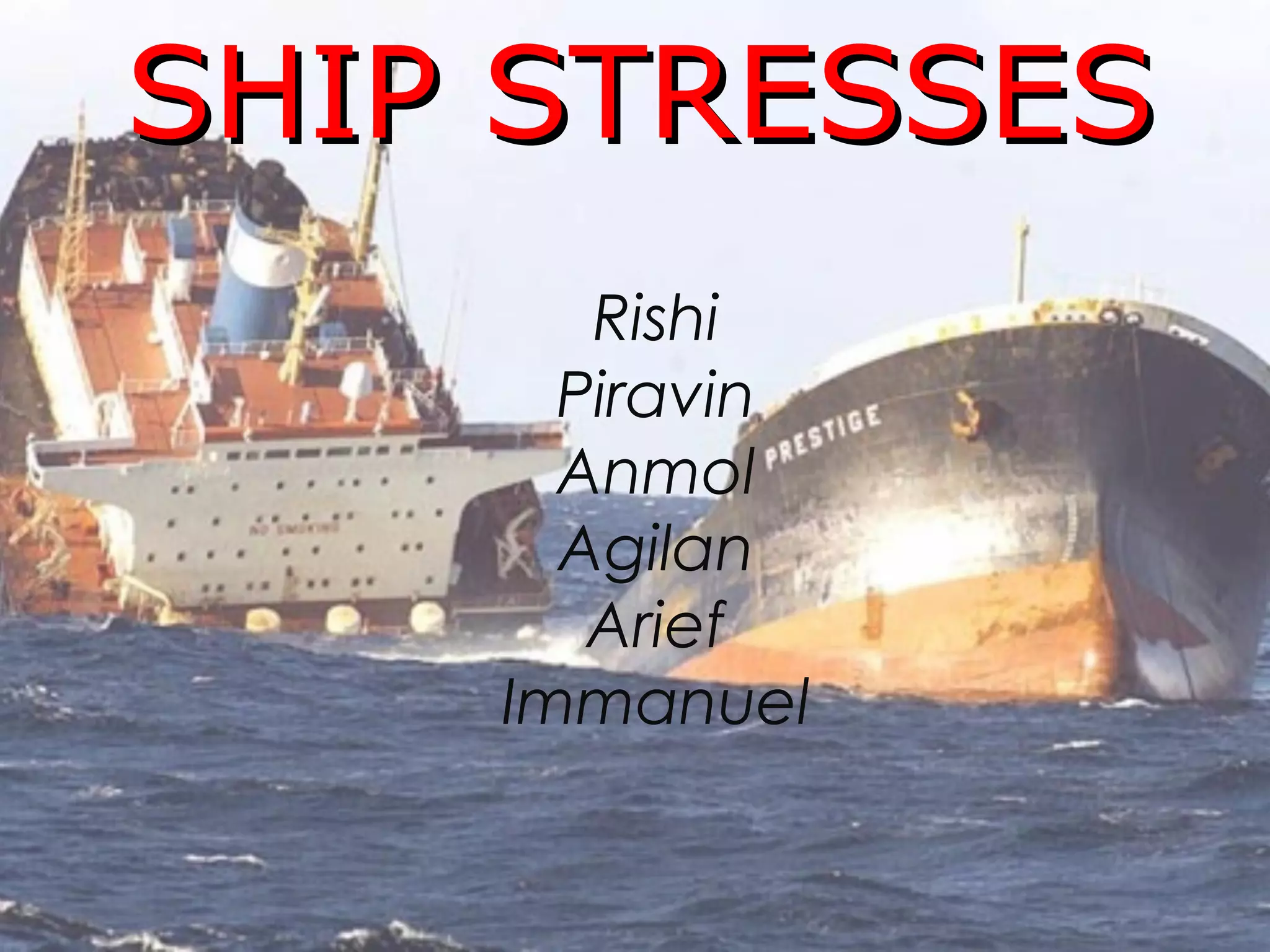
SHIP STRESSESSHIP STRESSES
Rishi
Piravin
Anmol
Agilan
Arief
Immanuel
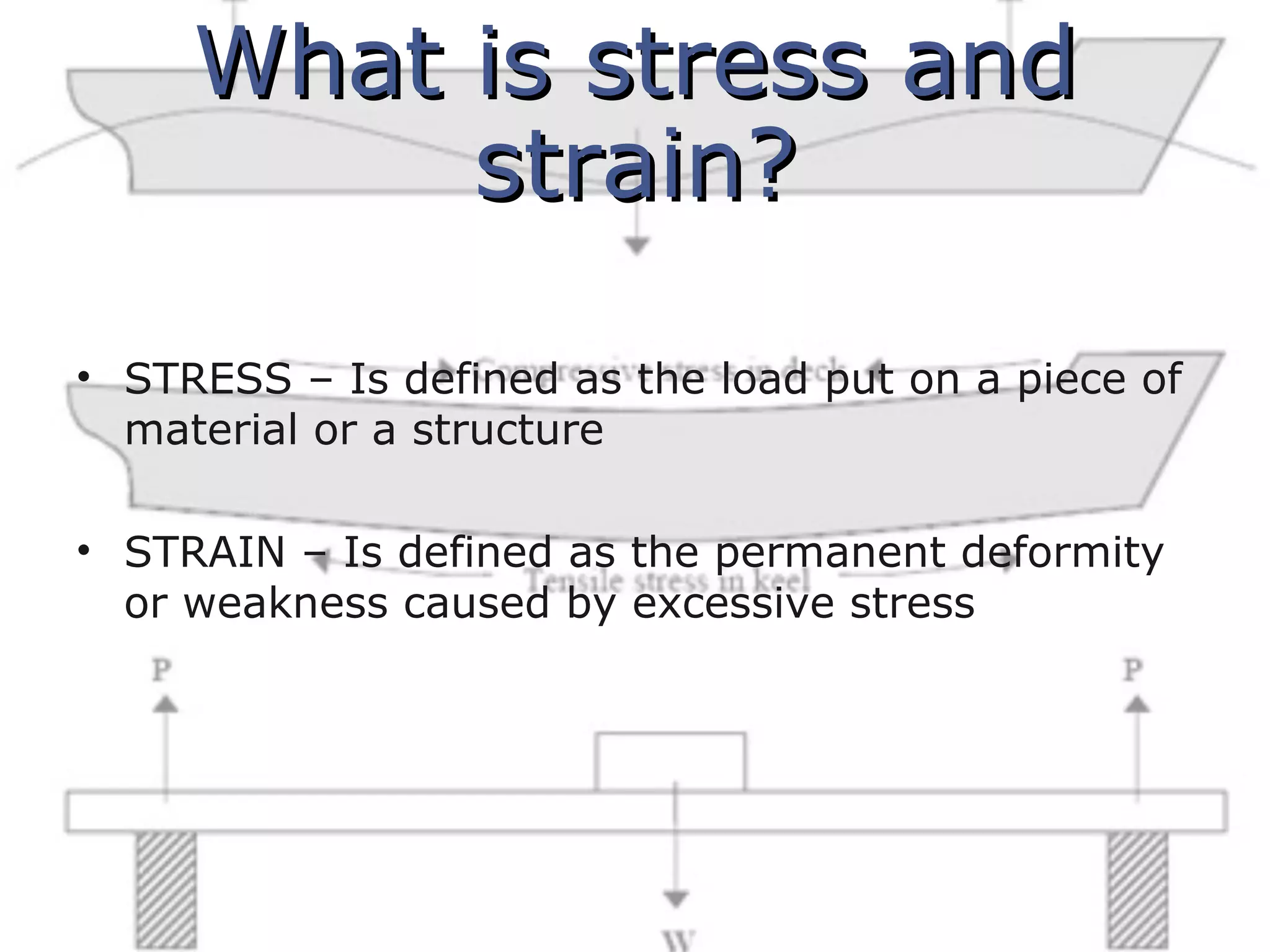
What is stress andWhat is stress and
strain?strain?
• STRESS – Is defined as the load put on a piece of
material or a structure
• STRAIN – Is defined as the permanent deformity
or weakness caused by excessive stress
There are 3 main types of stress:
•Tensile / Tensioning
•Compressive / Compression
•Shear
Tensioning
Compression
tendency to pull the material apart
tendency to crush the
material or to buckle
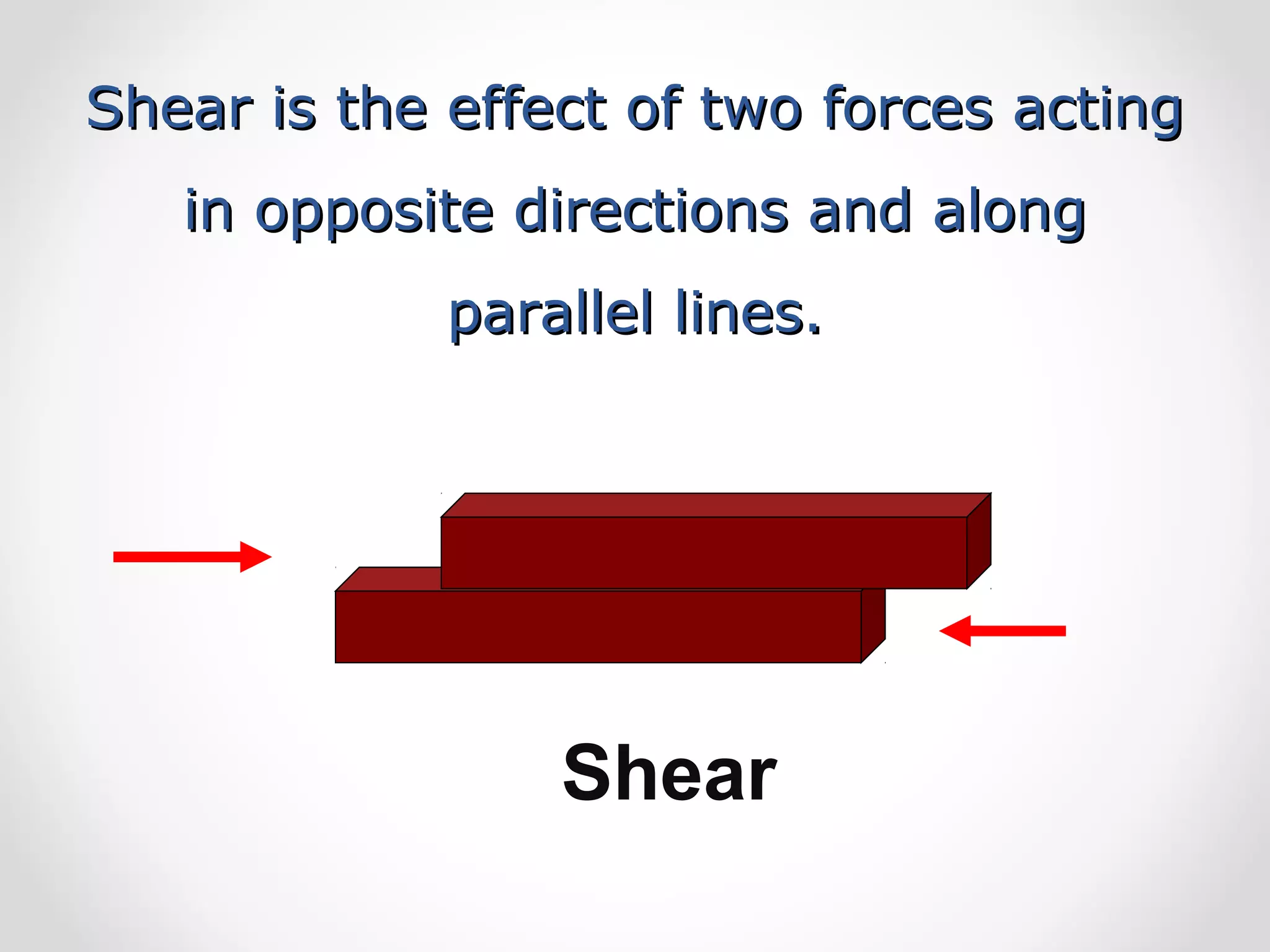
Shear
Shear is the effect of two forces actingShear is the effect of two forces acting
in opposite directions and alongin opposite directions and along
parallel lines.parallel lines.
Mechanical Properties of Metals
Elasticity - The case with which a metal may
be bent or molded into a given
shape.
Brittleness - The opposite of plasticity, lack or
elasticity
Malleability - The property possessed by a
metal of becoming permanently
flattened or stretched.
Hardness - The property of a metal
to resist wear and abrasion.
Fatigue - A metal subjected to
continually varying loads may
eventually suffer from fatigue.
Ductility - Ability to be drawn out
lengthwise, the amount of the
extension measures the ductility.
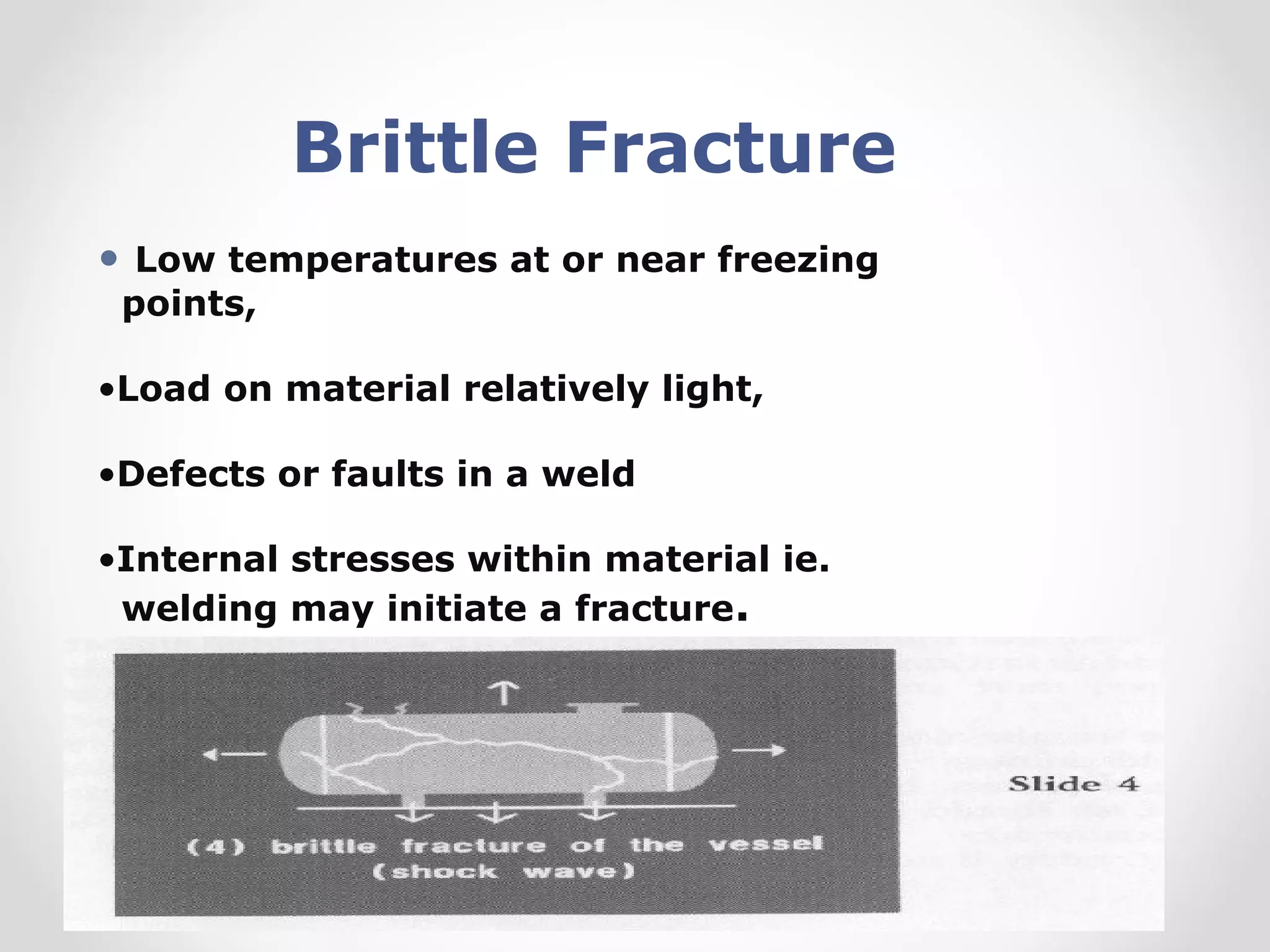
Brittle Fracture
• Low temperatures at or near freezing
points,
•Load on material relatively light,
•Defects or faults in a weld
•Internal stresses within material ie.
welding may initiate a fracture.
The ship at sea or lying in still water isThe ship at sea or lying in still water is
constantly being subjected to a wideconstantly being subjected to a wide
variety of stresses and strains, whichvariety of stresses and strains, which
result from the action of forces fromresult from the action of forces from
outside and within the ship.outside and within the ship.
These forces may initially be classified into:These forces may initially be classified into:
STATIC FORCESSTATIC FORCES
DYNAMIC FORCESDYNAMIC FORCES
STATIC FORCESSTATIC FORCES
These are due to
• Internal forces resulting from structural weight,
cargo and machinery weight.
• External static forces including the hydrostatic
pressure of the water on the hull.
Vessel at rest
Static forceStatic force
DYNAMICDYNAMIC FORCESFORCES
They result from
• The ship’s motion at sea.
• The action of wind and waves.
• The effects of operating machinery.
Dynamic ForcesDynamic Forces
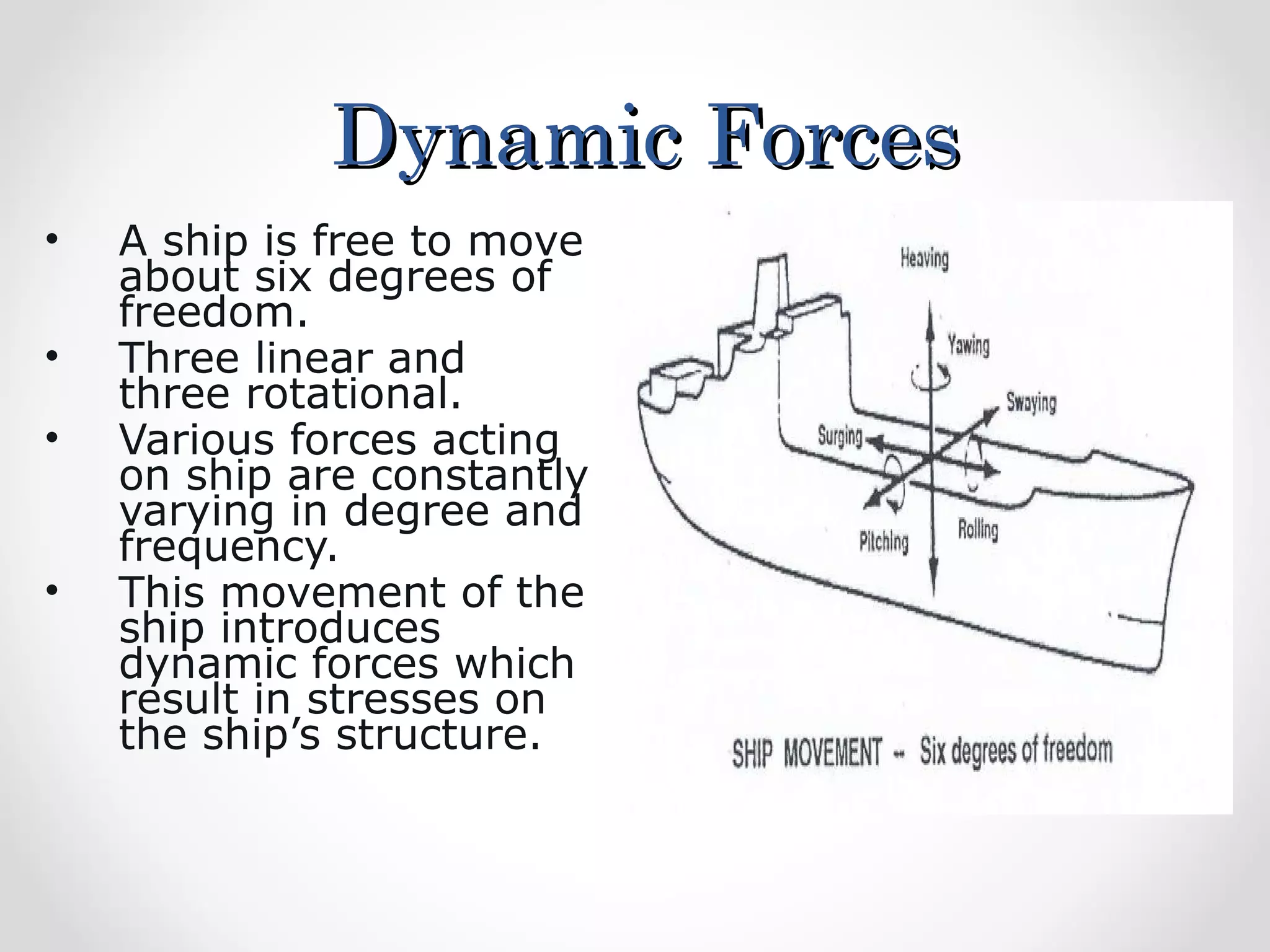
• A ship is free to move
about six degrees of
freedom.
• Three linear and
three rotational.
• Various forces acting
on ship are constantly
varying in degree and
frequency.
• This movement of the
ship introduces
dynamic forces which
result in stresses on
the ship’s structure.
• Heave is the motion of the ship when the ship
have being up by a wave or sea.
• Sway is the swing of a mast or bow of a ship from
side to side as the vessel progresses in a heavy
sea.
• Surge is the movement forward as the bow of a
ship rises and dips when it encounter waves
which are strong enough to life it. The ship surge
up the side of a wave, often shipping water as it
passes through the crest, then dips down the
other side of the wave.
• Pitch is the motion of a ship in rising the
crest of a wave then descending into the
following trough.
• Roll is the motion of a ship from side to
side as she moves through the water.
• Yaw is where the bow of a ship falls away
or sways erratically from side to side as
the vessel moves through the water.
Forces produce stresses in the ship’sForces produce stresses in the ship’s
structure which may be divided into twostructure which may be divided into two
categories:categories:
•Global stress – affects the whole ship
•Local stress- affects a particular part of a
ship
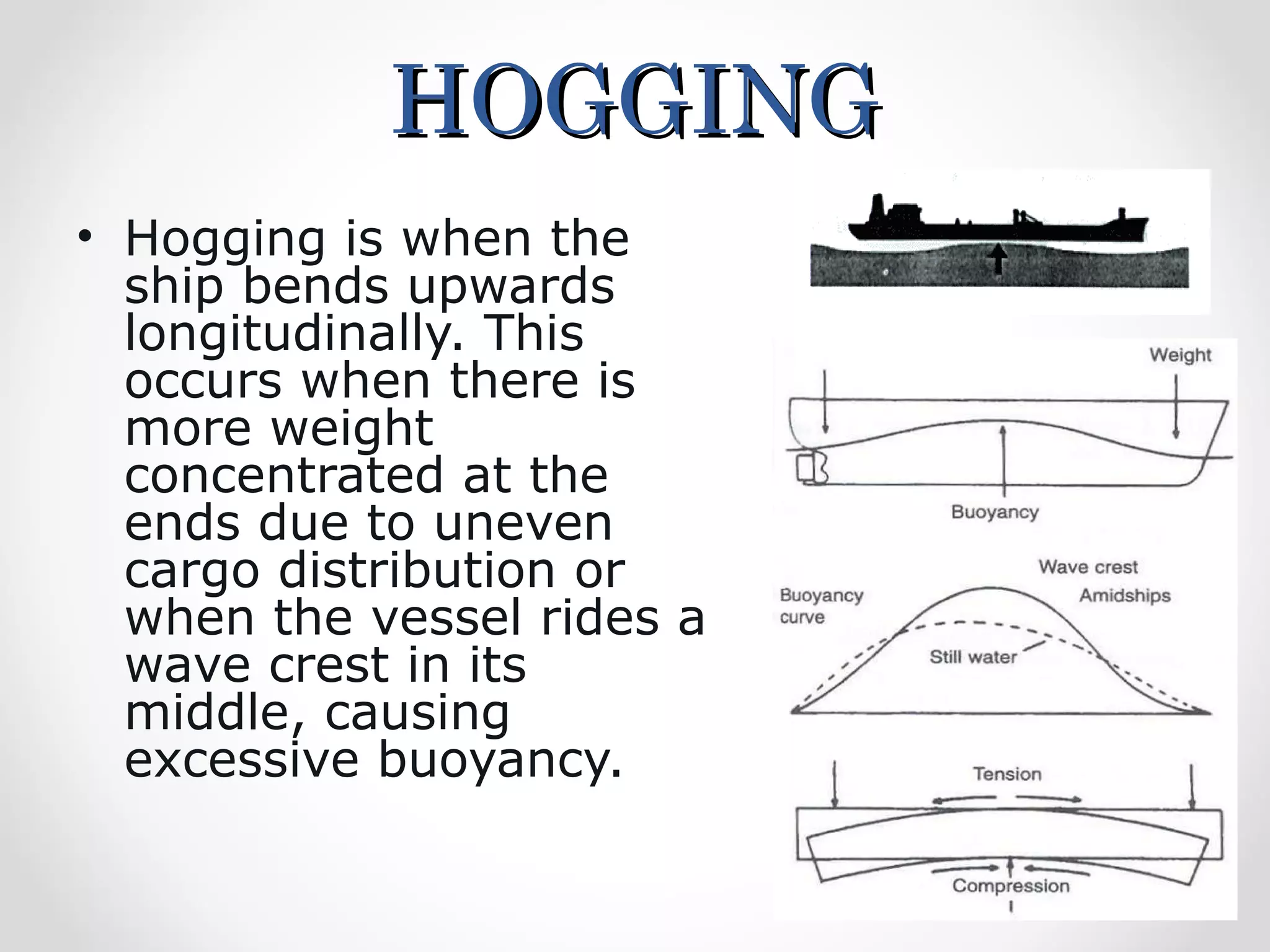
HOGGINGHOGGING
• Hogging is when the
ship bends upwards
longitudinally. This
occurs when there is
more weight
concentrated at the
ends due to uneven
cargo distribution or
when the vessel rides a
wave crest in its
middle, causing
excessive buoyancy.
SAGGINGSAGGING
• Sagging is the reverse of
hogging when the ship
bends longitudinally in the
downwards direction. This
occurs when there is more
weight concentrated in the
mid length of the vessel
due to uneven cargo
distribution or when the
vessel rides a wave trough
in its middle causing
excessive buoyancy at the
ends.
RACKINGRACKING
• When a ship is rolling,
the accelerations on
the ship’s structure
are liable to cause
distortion in the
transverse section.
• Greatest effect is
under light ship
condition.
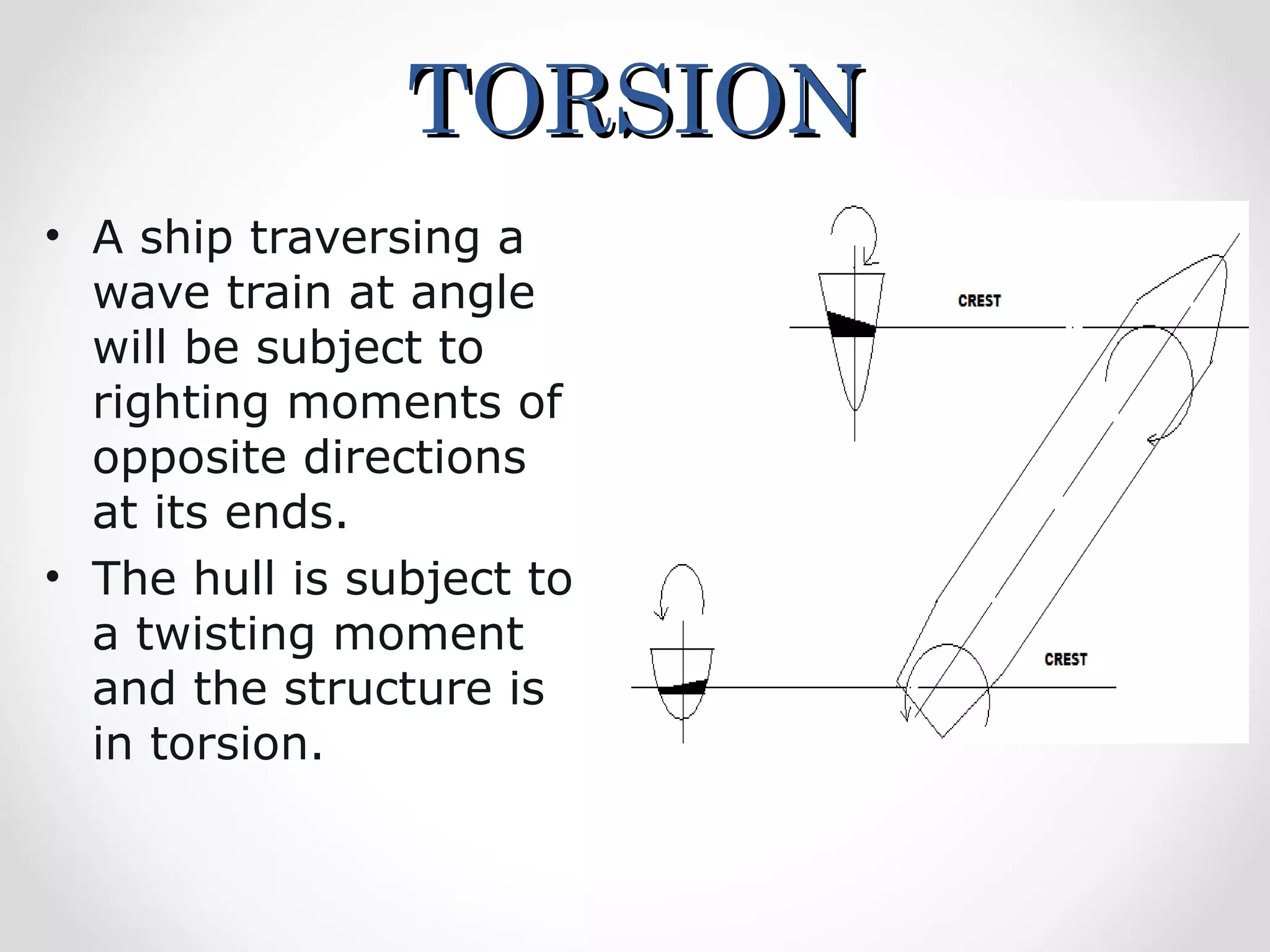
TORSIONTORSION
• A ship traversing a
wave train at angle
will be subject to
righting moments of
opposite directions
at its ends.
• The hull is subject to
a twisting moment
and the structure is
in torsion.
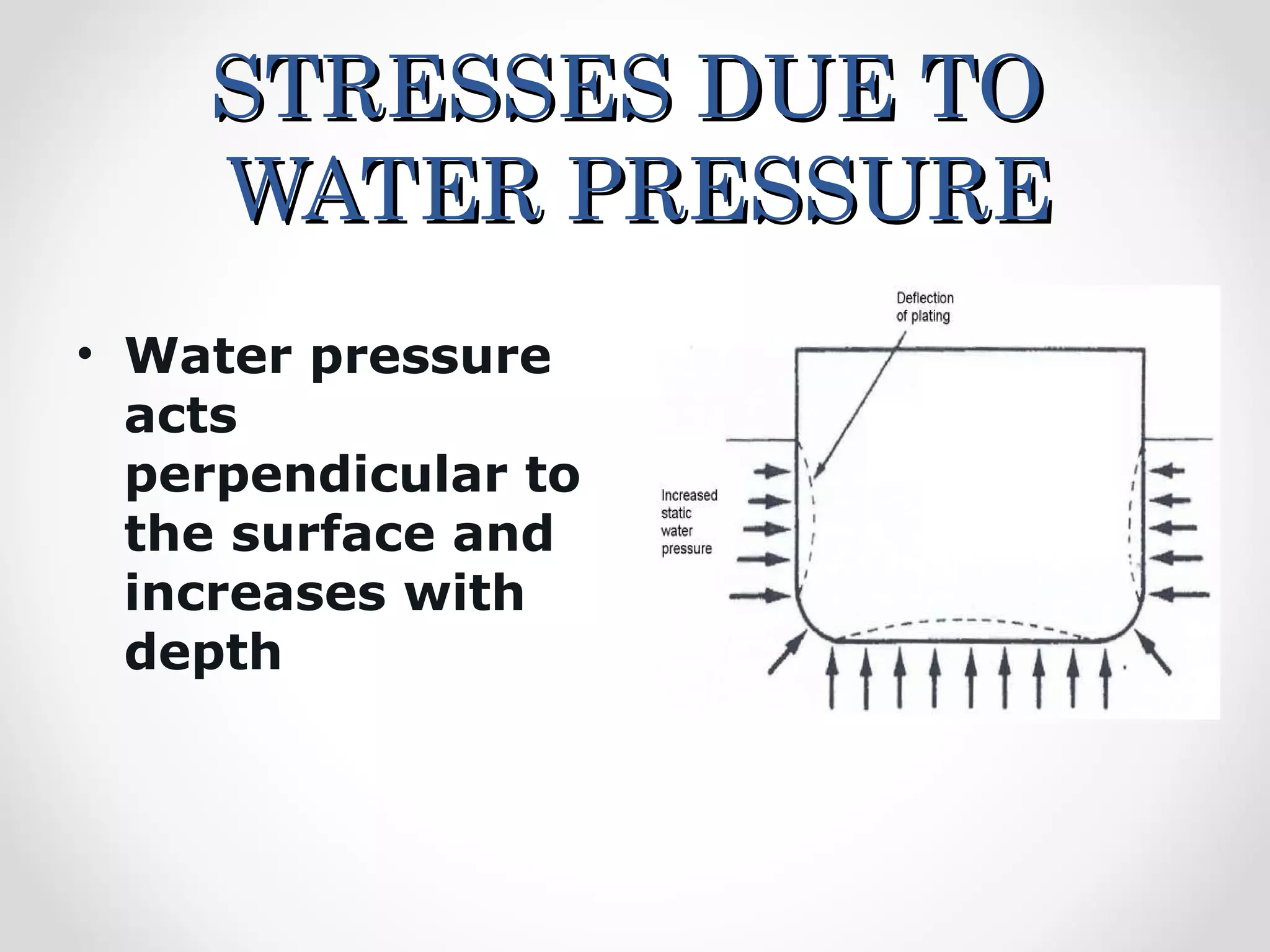
STRESSES DUE TOSTRESSES DUE TO
WATER PRESSUREWATER PRESSURE
• Water pressure
acts
perpendicular to
the surface and
increases with
depth
STRESSES DUE TOSTRESSES DUE TO
DRY-DOCKINGDRY-DOCKING
• Tends to set the keel
upwards.
• Due to the up-thrust
of the keel blocks.
• Tendency for the
ship’s sides to bulge
outwards.
• Bilges tend to sag.
PANTINGPANTING
• This is a stress,
which occurs at the
ends of a vessel
due to variations in
water pressure on
the shell plating as
the vessel pitches
in a seaway. The
effect is
accentuated at the
bow when making
headway
DMS-DO
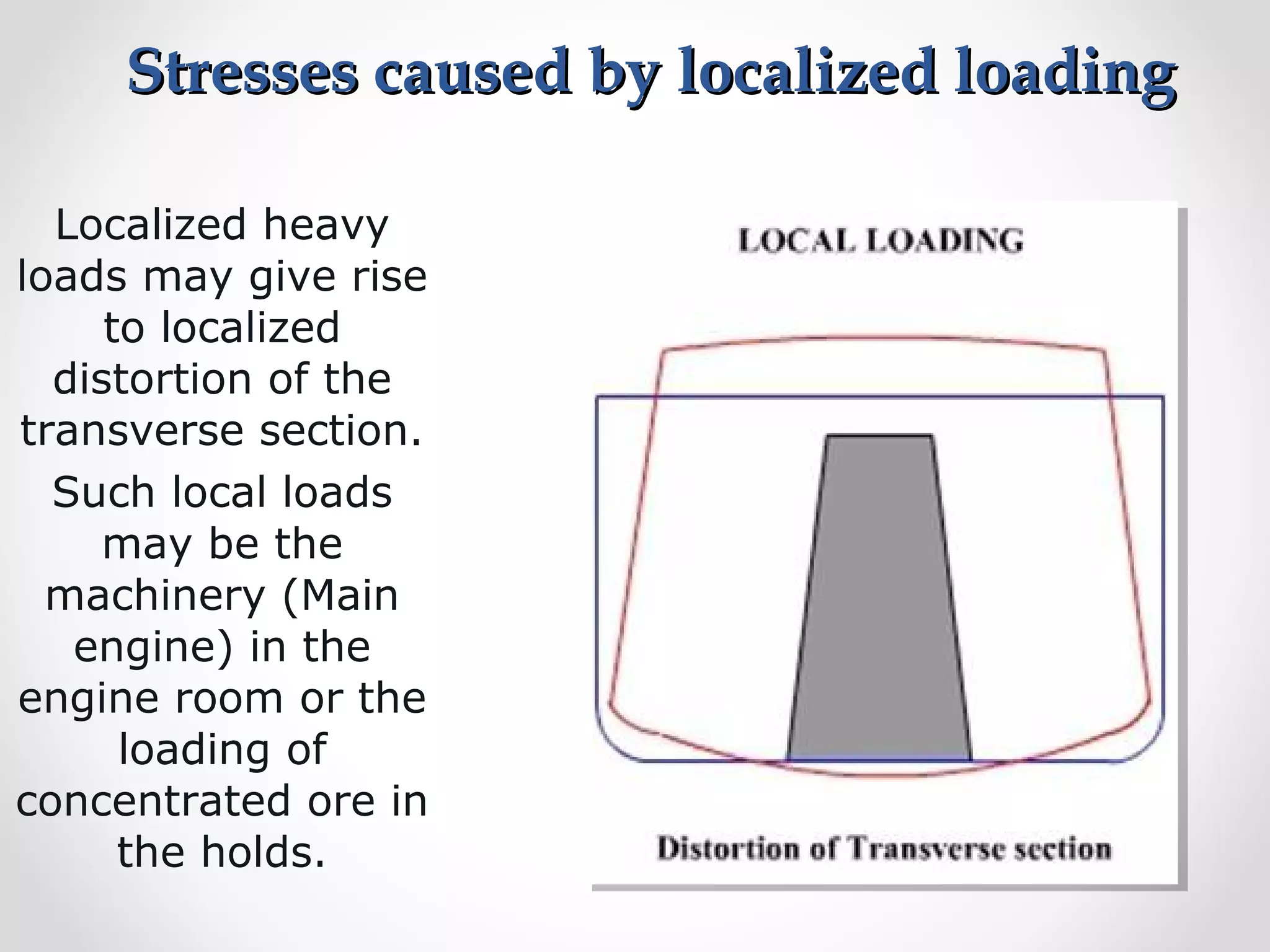
Stresses caused by localized loadingStresses caused by localized loading
Localized heavy
loads may give rise
to localized
distortion of the
transverse section.
Such local loads
may be the
machinery (Main
engine) in the
engine room or the
loading of
concentrated ore in
the holds.
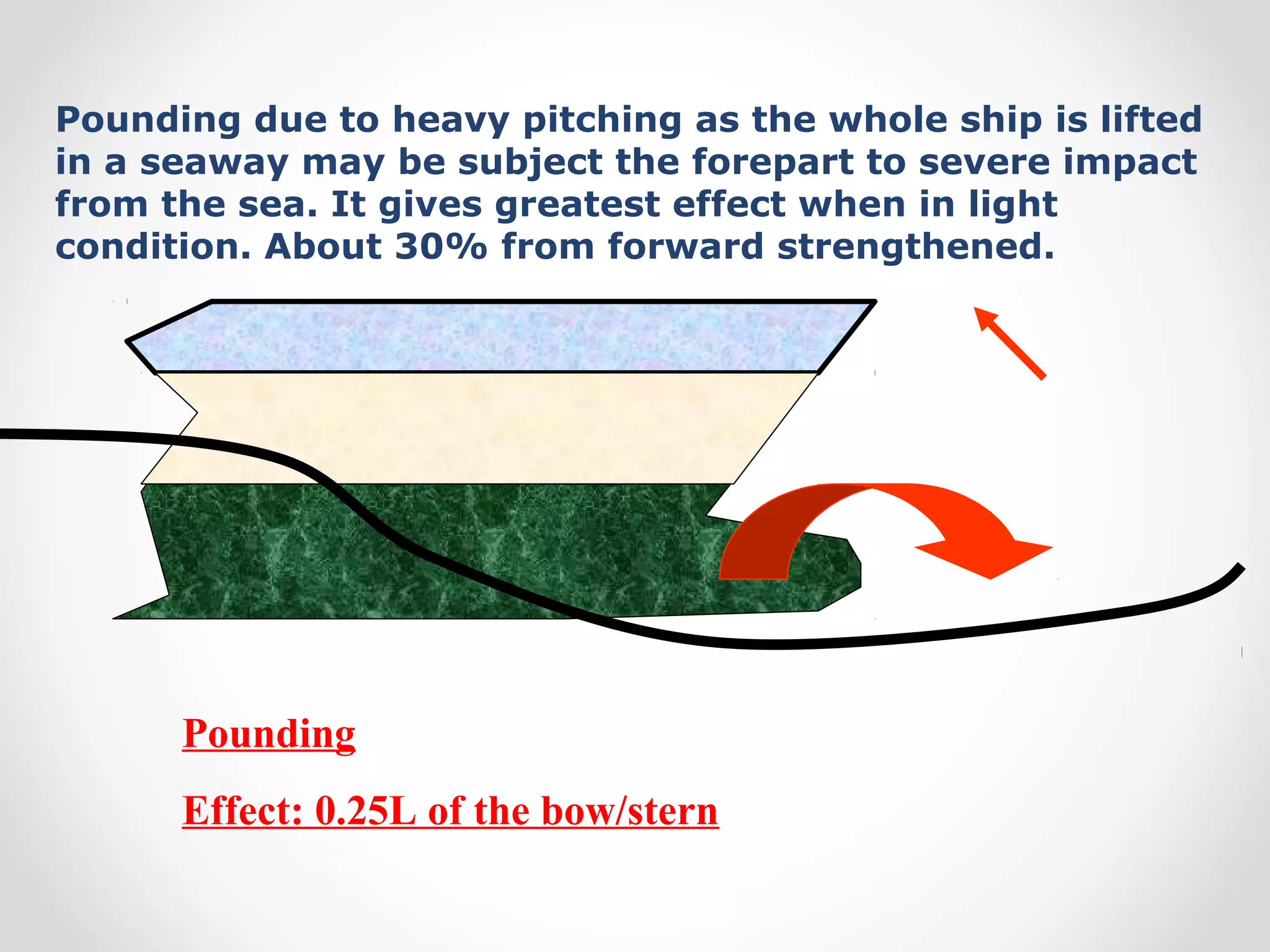
Pounding
Effect: 0.25L of the bow/stern
Pounding due to heavy pitching as the whole ship is lifted
in a seaway may be subject the forepart to severe impact
from the sea. It gives greatest effect when in light
condition. About 30% from forward strengthened.
Deck opening creates
areas of high local
stress due to lack of
continuity of Structure
Thank you and haveThank you and have
a great daya great day
everyone!everyone! 

Ship stresses

  • 1.
  • 2.
    What is stressandWhat is stress and strain?strain? • STRESS – Is defined as the load put on a piece of material or a structure • STRAIN – Is defined as the permanent deformity or weakness caused by excessive stress
  • 3.
    There are 3main types of stress: •Tensile / Tensioning •Compressive / Compression •Shear
  • 4.
    Tensioning Compression tendency to pullthe material apart tendency to crush the material or to buckle
  • 5.
    Shear Shear is theeffect of two forces actingShear is the effect of two forces acting in opposite directions and alongin opposite directions and along parallel lines.parallel lines.
  • 6.
    Mechanical Properties ofMetals Elasticity - The case with which a metal may be bent or molded into a given shape. Brittleness - The opposite of plasticity, lack or elasticity Malleability - The property possessed by a metal of becoming permanently flattened or stretched.
  • 7.
    Hardness - Theproperty of a metal to resist wear and abrasion. Fatigue - A metal subjected to continually varying loads may eventually suffer from fatigue. Ductility - Ability to be drawn out lengthwise, the amount of the extension measures the ductility.
  • 8.
    Brittle Fracture • Lowtemperatures at or near freezing points, •Load on material relatively light, •Defects or faults in a weld •Internal stresses within material ie. welding may initiate a fracture.
  • 10.
    The ship atsea or lying in still water isThe ship at sea or lying in still water is constantly being subjected to a wideconstantly being subjected to a wide variety of stresses and strains, whichvariety of stresses and strains, which result from the action of forces fromresult from the action of forces from outside and within the ship.outside and within the ship. These forces may initially be classified into:These forces may initially be classified into: STATIC FORCESSTATIC FORCES DYNAMIC FORCESDYNAMIC FORCES
  • 11.
    STATIC FORCESSTATIC FORCES Theseare due to • Internal forces resulting from structural weight, cargo and machinery weight. • External static forces including the hydrostatic pressure of the water on the hull.
  • 12.
    Vessel at rest StaticforceStatic force
  • 13.
    DYNAMICDYNAMIC FORCESFORCES They resultfrom • The ship’s motion at sea. • The action of wind and waves. • The effects of operating machinery.
  • 14.
    Dynamic ForcesDynamic Forces •A ship is free to move about six degrees of freedom. • Three linear and three rotational. • Various forces acting on ship are constantly varying in degree and frequency. • This movement of the ship introduces dynamic forces which result in stresses on the ship’s structure.
  • 16.
    • Heave isthe motion of the ship when the ship have being up by a wave or sea. • Sway is the swing of a mast or bow of a ship from side to side as the vessel progresses in a heavy sea. • Surge is the movement forward as the bow of a ship rises and dips when it encounter waves which are strong enough to life it. The ship surge up the side of a wave, often shipping water as it passes through the crest, then dips down the other side of the wave.
  • 18.
    • Pitch isthe motion of a ship in rising the crest of a wave then descending into the following trough. • Roll is the motion of a ship from side to side as she moves through the water. • Yaw is where the bow of a ship falls away or sways erratically from side to side as the vessel moves through the water.
  • 19.
    Forces produce stressesin the ship’sForces produce stresses in the ship’s structure which may be divided into twostructure which may be divided into two categories:categories: •Global stress – affects the whole ship •Local stress- affects a particular part of a ship
  • 20.
    HOGGINGHOGGING • Hogging iswhen the ship bends upwards longitudinally. This occurs when there is more weight concentrated at the ends due to uneven cargo distribution or when the vessel rides a wave crest in its middle, causing excessive buoyancy.
  • 21.
    SAGGINGSAGGING • Sagging isthe reverse of hogging when the ship bends longitudinally in the downwards direction. This occurs when there is more weight concentrated in the mid length of the vessel due to uneven cargo distribution or when the vessel rides a wave trough in its middle causing excessive buoyancy at the ends.
  • 22.
    RACKINGRACKING • When aship is rolling, the accelerations on the ship’s structure are liable to cause distortion in the transverse section. • Greatest effect is under light ship condition.
  • 23.
    TORSIONTORSION • A shiptraversing a wave train at angle will be subject to righting moments of opposite directions at its ends. • The hull is subject to a twisting moment and the structure is in torsion.
  • 24.
    STRESSES DUE TOSTRESSESDUE TO WATER PRESSUREWATER PRESSURE • Water pressure acts perpendicular to the surface and increases with depth
  • 25.
    STRESSES DUE TOSTRESSESDUE TO DRY-DOCKINGDRY-DOCKING • Tends to set the keel upwards. • Due to the up-thrust of the keel blocks. • Tendency for the ship’s sides to bulge outwards. • Bilges tend to sag.
  • 27.
    PANTINGPANTING • This isa stress, which occurs at the ends of a vessel due to variations in water pressure on the shell plating as the vessel pitches in a seaway. The effect is accentuated at the bow when making headway DMS-DO
  • 28.
    Stresses caused bylocalized loadingStresses caused by localized loading Localized heavy loads may give rise to localized distortion of the transverse section. Such local loads may be the machinery (Main engine) in the engine room or the loading of concentrated ore in the holds.
  • 29.
    Pounding Effect: 0.25L ofthe bow/stern Pounding due to heavy pitching as the whole ship is lifted in a seaway may be subject the forepart to severe impact from the sea. It gives greatest effect when in light condition. About 30% from forward strengthened.
  • 30.
    Deck opening creates areasof high local stress due to lack of continuity of Structure
  • 32.
    Thank you andhaveThank you and have a great daya great day everyone!everyone! 