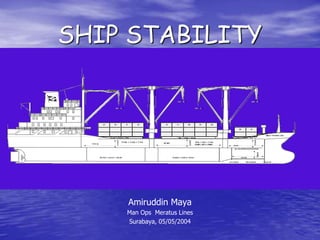
SHIP STABILITY
Amiruddin Maya
Man Ops Meratus Lines
Surabaya, 05/05/2004
What
Stability is the tendency of a vessel to
return to its original position after it
has been inclined due to external
forces.
Why
To analyze and review commercial and
safety decisions :
> The allocation of cargo’s on specific vessel
> Vessel Allocation Plan
> Safety and seaworthy of the vessel
When
`Cargo booking exceeded of ship capacity
> No’s of containers.
> Weight of cargo.
> Cargo type
`Ship Roll over / Change route
How
Assumptions » standards
Simple spreadsheet calculation
Variables
Light Ship
Constant
Ballast Water
Fresh Water
Fuel
Cargo
Free Surface
Main Factors
The condition of the vessel as regards
stability is determined almost wholly by
the location of three points in a vessel :
> Metacenter “M”
> Center of Gravity “G”
> Center of Buoyancy “B”
Metacenter “M”
The Metacentric height of the vessel depends upon
the vertical distance of two points above the keel.
Every change of draft, the position of M changes and
effects stability. Theoretically, M start to move of
the centerline as soon as a vessel inclines but
practically the movement is negligible for inclinations
up to 10 degrees or thereabouts depending upon
the form of the vessel.
Therefore, M can safely be used as a point which
each is Vertically above G for small inclination
Center of Gravity “G”
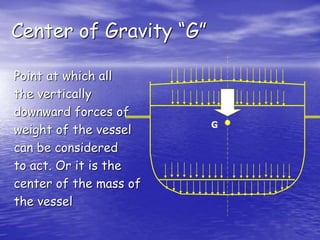
Point at which all
the vertically
downward forces of
weight of the vessel
can be considered
to act. Or it is the
center of the mass of
the vessel
G
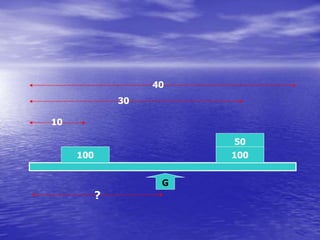
50
G
100 100
?
10
30
40
Center of Gravity “G”
• When a vessel is inclined due to some
external force, that is by the action of
seas. “G” will remain fixed in its location
in the vessel. Of course if weight are
free to move on the vessel, “G” will move
too but for the time being, it is assumed
that “G” does remain in its original
position
Center of Buoyancy “B”
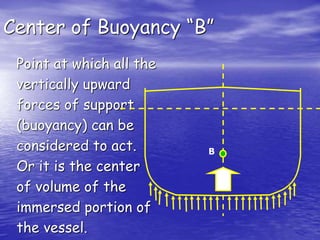
Point at which all the
vertically upward
forces of support
(buoyancy) can be
considered to act.
Or it is the center
of volume of the
immersed portion of
the vessel.
B
Center of Buoyancy “B”
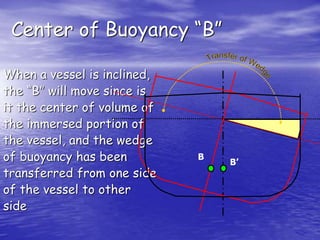
When a vessel is inclined,
the “B” will move since is
it the center of volume of
the immersed portion of
the vessel, and the wedge
of buoyancy has been
transferred from one side
of the vessel to other
side
B
B’
The Couple
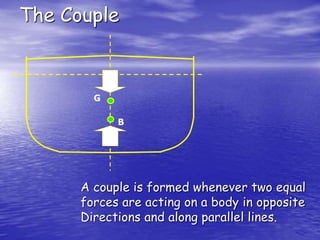
A couple is formed whenever two equal
forces are acting on a body in opposite
Directions and along parallel lines.
G
B
The Couple
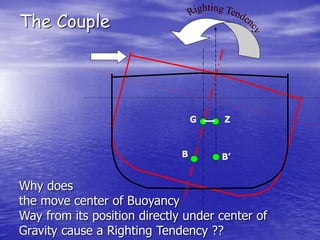
G Z
B B’
Why does
the move center of Buoyancy
Way from its position directly under center of
Gravity cause a Righting Tendency ??
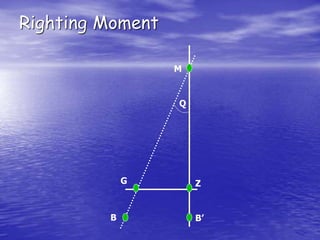
Righting Moment
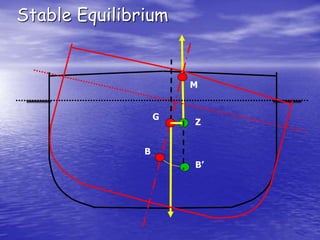
The tendency of vessel to return to an erect position
(called stability) can be determined for all angles of
inclination, by the value of the righting moment,
w x GZ, or solely by the length of the righting arm,
For small angles of inclination, or initial stability, it
can be determined by the distance that G is from M,
or metacentric height. In order to find GM it is
necessary to find KG and KM. Where the value of
KM is not available it may be necessary to calculate
it by finding KB and BM
Righting Moment
M
Z
G
B’
B
Q
Stable Equilibrium
G
B
B’
Z
M
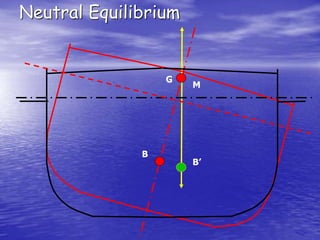
Neutral Equilibrium
G
M
B
B’
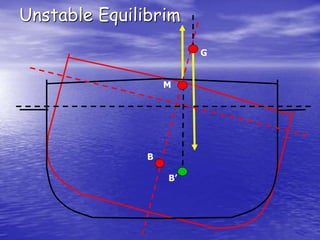
Unstable Equilibrim
G
M
B
B’
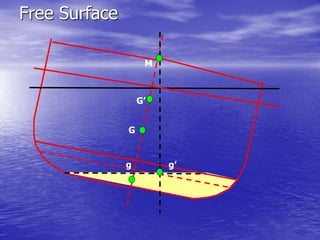
Free Surface
G
G’
M
g’
g
Free Surface
Whenever the surface of liquid within a
vessel is free to move, the condition known
as free surface is present. The effects of
Free Surface on transverse stability since
an excessive amount of free surface can
easily change a vessel with a positive GM
into one with a negative GM.
> The effects of free surface depend upon the
dimensions of the liquid and the volume of
displacement of the vessel
> The effect of free surface depend to minor degree
upon the relationship between the specific gravity
of the liquid in the tank and the specific gravity of
the liquid in which the vessel is floating
> The effect of weight and vertical position of the
liquid have an effect on transverse stability which
is not associated with free surface effect
Free Surface
Abbreviation
G : Gravity
B : Buoyancy
M : Metacenter
VCG : Vertical Center of Gravity
LCG : Longitudinal Center of Gravity
TPC : Ton per Centimetre
MTC : Moment to Change Trim
KG : Height of center of Gravity
KB : Height of center of Buoyancy
KM : Metacentric Height
LCB : Longitudinal Center of Buoyancy
LCF : Longitudinal Center of Floatation
FSM : Free surface moment
Abbreviation
Displacement: Total Dead weight plus Light ship
LOA : Length Over All
LBP : Length Between Perpendicular
DWT : Dead Weight Tons
Draft : Keel to Waterline
GRT : Gross Register Tonnage
NRT : Netto Register Tonnage

Ship_Stability.ppt

  • 1.
    SHIP STABILITY Amiruddin Maya ManOps Meratus Lines Surabaya, 05/05/2004
  • 2.
    What Stability is thetendency of a vessel to return to its original position after it has been inclined due to external forces.
  • 3.
    Why To analyze andreview commercial and safety decisions : > The allocation of cargo’s on specific vessel > Vessel Allocation Plan > Safety and seaworthy of the vessel
  • 4.
    When `Cargo booking exceededof ship capacity > No’s of containers. > Weight of cargo. > Cargo type `Ship Roll over / Change route
  • 5.
  • 6.
  • 7.
    Main Factors The conditionof the vessel as regards stability is determined almost wholly by the location of three points in a vessel : > Metacenter “M” > Center of Gravity “G” > Center of Buoyancy “B”
  • 8.
    Metacenter “M” The Metacentricheight of the vessel depends upon the vertical distance of two points above the keel. Every change of draft, the position of M changes and effects stability. Theoretically, M start to move of the centerline as soon as a vessel inclines but practically the movement is negligible for inclinations up to 10 degrees or thereabouts depending upon the form of the vessel. Therefore, M can safely be used as a point which each is Vertically above G for small inclination
  • 9.
    Center of Gravity“G” Point at which all the vertically downward forces of weight of the vessel can be considered to act. Or it is the center of the mass of the vessel G
  • 10.
  • 11.
    Center of Gravity“G” • When a vessel is inclined due to some external force, that is by the action of seas. “G” will remain fixed in its location in the vessel. Of course if weight are free to move on the vessel, “G” will move too but for the time being, it is assumed that “G” does remain in its original position
  • 12.
    Center of Buoyancy“B” Point at which all the vertically upward forces of support (buoyancy) can be considered to act. Or it is the center of volume of the immersed portion of the vessel. B
  • 13.
    Center of Buoyancy“B” When a vessel is inclined, the “B” will move since is it the center of volume of the immersed portion of the vessel, and the wedge of buoyancy has been transferred from one side of the vessel to other side B B’
  • 14.
    The Couple A coupleis formed whenever two equal forces are acting on a body in opposite Directions and along parallel lines. G B
  • 15.
    The Couple G Z BB’ Why does the move center of Buoyancy Way from its position directly under center of Gravity cause a Righting Tendency ??
  • 16.
    Righting Moment The tendencyof vessel to return to an erect position (called stability) can be determined for all angles of inclination, by the value of the righting moment, w x GZ, or solely by the length of the righting arm, For small angles of inclination, or initial stability, it can be determined by the distance that G is from M, or metacentric height. In order to find GM it is necessary to find KG and KM. Where the value of KM is not available it may be necessary to calculate it by finding KB and BM
  • 17.
  • 18.
  • 19.
  • 20.
  • 21.
  • 22.
    Free Surface Whenever thesurface of liquid within a vessel is free to move, the condition known as free surface is present. The effects of Free Surface on transverse stability since an excessive amount of free surface can easily change a vessel with a positive GM into one with a negative GM.
  • 23.
    > The effectsof free surface depend upon the dimensions of the liquid and the volume of displacement of the vessel > The effect of free surface depend to minor degree upon the relationship between the specific gravity of the liquid in the tank and the specific gravity of the liquid in which the vessel is floating > The effect of weight and vertical position of the liquid have an effect on transverse stability which is not associated with free surface effect Free Surface
  • 24.
    Abbreviation G : Gravity B: Buoyancy M : Metacenter VCG : Vertical Center of Gravity LCG : Longitudinal Center of Gravity TPC : Ton per Centimetre MTC : Moment to Change Trim KG : Height of center of Gravity KB : Height of center of Buoyancy KM : Metacentric Height LCB : Longitudinal Center of Buoyancy LCF : Longitudinal Center of Floatation FSM : Free surface moment
  • 25.
    Abbreviation Displacement: Total Deadweight plus Light ship LOA : Length Over All LBP : Length Between Perpendicular DWT : Dead Weight Tons Draft : Keel to Waterline GRT : Gross Register Tonnage NRT : Netto Register Tonnage