E-S4A1 BATCH 2014
E-S4A1 BATCH 2014
E-S4A1 BATCH 2014
E-S4A1 BATCH 2014
E-S4A1 BATCH 2014
E-S4A1 BATCH 2014
E-S4A1 BATCH 2014
E-S4A1 BATCH 2014
E-S4A1 BATCH 2014
E-S4A1 BATCH 2014
E-S4A1 BATCH 2014
E-S4A1 BATCH 2014
E-S4A1 BATCH 2014
E-S4A1 BATCH 2014
E-S4A1 BATCH 2014
E-S4A1 BATCH 2014
Regulation VIII/1
Fitness for duty
Each Administration shall, for the purpose of
preventing fatigue:
.1 establish and enforce rest period for watchkeeping
personnel and those whose
duties involve designated safety, security and prevention
of pollution duties in accordance with the provision of
section A-VIII/1 of the STCW Code; and
E-S4A1 BATCH 2014
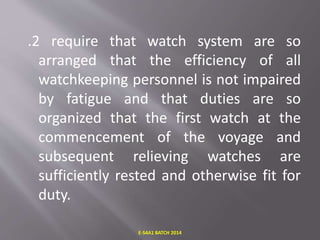
.2 require that watch system are so
arranged that the efficiency of all
watchkeeping personnel is not impaired
by fatigue and that duties are so
organized that the first watch at the
commencement of the voyage and
subsequent relieving watches are
sufficiently rested and otherwise fit for
duty.
E-S4A1 BATCH 2014
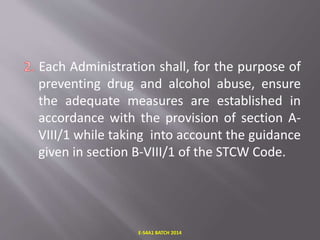
Each Administration shall, for the purpose of
preventing drug and alcohol abuse, ensure
the adequate measures are established in
accordance with the provision of section A-
VIII/1 while taking into account the guidance
given in section B-VIII/1 of the STCW Code.
E-S4A1 BATCH 2014
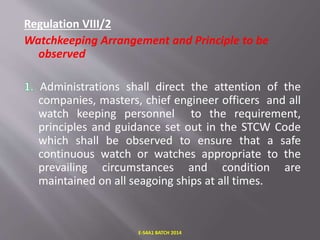
Regulation VIII/2
Watchkeeping Arrangement and Principle to be
observed
Administrations shall direct the attention of the
companies, masters, chief engineer officers and all
watch keeping personnel to the requirement,
principles and guidance set out in the STCW Code
which shall be observed to ensure that a safe
continuous watch or watches appropriate to the
prevailing circumstances and condition are
maintained on all seagoing ships at all times.
E-S4A1 BATCH 2014
Administration shall require the master of
every ship to ensure that watch keeping
arrangements are adequate for maintaining a
safe watch or watches, taking into account
the prevailing circumstances and condition
and that, under the master’s general
direction:
E-S4A1 BATCH 2014
.1 officer in charge of the navigational watch are
responsible for navigating the ship safely during
their periods of duty, when they shall physically
present on the navigational bridge or in a directly
associated location such as the chartroom or
bridge control room at all times.
.2 radio operators are responsible for maintaining
the continuous radio watch on appropriate
frequencies during their period of duty.
E-S4A1 BATCH 2014
.3 Officer in charge of an engineering watch, as
define in the STCW Code, under the
direction of the chief engineer officer, shall
be immediately available on call to attend
the machinery spaces and, when required,
shall be physically present in the machinery
spaces during their period of responsibility;
E-S4A1 BATCH 2014
.4 an appropriate and effective watch or watches are
maintained for the purpose of safety at all times,
while the ship id at anchor or moored and, if the
ship id carrying hazardous cargo, the organization
of such watch or watches takes full account of the
nature, quantity, packing and stowage of the
hazardous cargo and of any special condition
prevailing onboard, afloat, or ashore; and
E-S4A1 BATCH 2014
.5 as applicable, an appropriate and effective watch
or watches are maintained for the purpose of
security.
E-S4A1 BATCH 2014
E-S4A1 BATCH 2014
E-S4A1 BATCH 2014
E-S4A1 BATCH 2014
E-S4A1 BATCH 2014
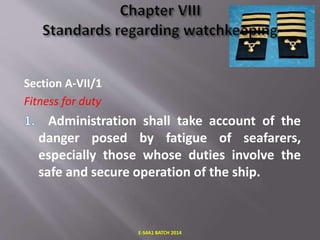
Section A-VII/1
Fitness for duty
Administration shall take account of the
danger posed by fatigue of seafarers,
especially those whose duties involve the
safe and secure operation of the ship.
E-S4A1 BATCH 2014
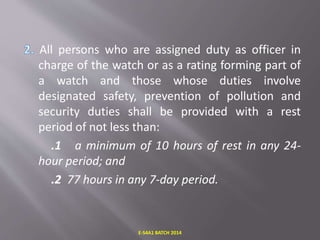
All persons who are assigned duty as officer in
charge of the watch or as a rating forming part of
a watch and those whose duties involve
designated safety, prevention of pollution and
security duties shall be provided with a rest
period of not less than:
.1 a minimum of 10 hours of rest in any 24-
hour period; and
.2 77 hours in any 7-day period.
E-S4A1 BATCH 2014
The hours of rest may be divided into no more than
two periods, one of which shall be at least l6 hours
in length, and the interval between consecutive
periods of rest shall not exceed 14 hours.
The requirements for rest periods laid down in
paragraphs 2 and 3 need not be maintained in the
case of an emergency or in other overriding
operational conditions. Musters, fire-fighting and
lifeboats drills, and drills prescribed by national
laws and regulations and by international
instruments, shall be conducted in a manner that
minimizes the disturbance of rest periods does not
induce fatigue.
E-S4A1 BATCH 2014
Administration shall require that watch
schedules be posted where they are easily
accessible. The schedules shall be established in
a standardized format in the working language
or languages of the ship and in English.
When a seafarer is on call, such as when a
machinery space is unattended. The seafarer
shall have an adequate compensatory rest
period if the normal period of rest is disturbed
by call-outs to work.
E-S4A1 BATCH 2014
Administration shall require that records of daily
hours of rest of seafarers be maintained in a
standardized format, in the working languages or
languages of the ship and in English, to allow
monitoring and verification of compliance with the
provisions of this section. The seafarers shall
receive a copy of the records pertaining to them,
which shall be endorsed by the master or by a
person authorized by the master and by the
seafarers.
E-S4A1 BATCH 2014
Nothing in this section shall be deemed to impair
the right of the master of a ship to require a
seafarer to perform any hours of work necessary for
the immediate safety of the ship, persons on board
or cargo, or for the purpose of giving assistance to
other ships or persons in a distress at sea.
Accordingly, the master may suspend the schedule
of hours of rest and require a seafarer to perform
any hours of necessary until the normal situation
has been restored. As soon as practicable after the
normal situation has been restored, the master
shall ensure that any seafarers who have performed
work in a schedule rest period are provided with an
adequate period of rest.
E-S4A1 BATCH 2014
Parties may allow exception from the required
hours of rest in paragraph 2.2 and 3 above provided
that the rest period is not less than 70 hours in any
7-day period.
Exceptions from the weekly rest period provided for
in paragraph 2.2 shall not be allowed for more than
two consecutive weeks. The intervals between two
periods of exceptions on board shall not be less
than twice the duration of the exception.
E-S4A1 BATCH 2014
The hours of rest provided for in paragraph 2.1 may
be divided into no more than three periods, one of
which shall be at least 6 hours in length, and
neither of the two periods shall not be less than
one-hour in length. The intervals between
consecutive periods of rest shall not exceed 14
hours. Exceptions shall not extend beyond two 24-
hour period s in any 7-day period.
Exceptions shall, as far as possible, take into
account the guidance regarding prevention of
fatigue in section B-VII/1.
E-S4A1 BATCH 2014
Each Administration shall established, for the
purpose of preventing alcohol abuse, a limit of not
greater than 0.05% blood alcohol level (BAC) or
0.25 mg/ alcohol in the breath or a quantity of
alcohol leading to such alcohol concentration for
masters, officers and other seafarers while
performing designated safety, security and marine
environment duties.
E-S4A1 BATCH 2014
 Watches shall be carried out based on the following
bridge and engine-room resource management
principles;
Proper arrangements for watchkeeping
personnel shall be ensured in accordance with
situations;
any limitation in qualification or fitness of
individuals shall be taken into account when
deploying watchkeeping personnel;
E-S4A1 BATCH 2014
understanding of watchkeeping personnel
regarding their individual roes, responsibility
and team roles shall be establish;
the master, chief engineer officer and officer
in charge of watch duties shall maintain a
proper watch, making the most effective use of
the resources available, such as information,
installations/equipment and other personnel;
E-S4A1 BATCH 2014
watchkeeping personnel shall understand
functions and operation of installations/equipment,
and be familiar with handling them;
watchkeeping personnel shall understand
information and how to respond to information
from each station/installation/equipment;
information from the stations/installations/
equipment shall be appropriately shared by all the
watchkeeping personnel;
E-S4A1 BATCH 2014
watchkeeping personnel shall maintain an
exchange of appropriate communication in any
situation; and
watchkeeping personnel shall notify the
master/chief engineer officer/officer in charge of
watch duties without any hesitation when in any
doubt as to what action to take in the interest of
safety.
E-S4A1 BATCH 2014
Principles applying to watchkeeping generally
 Parties shall direct the attention of companies, masters,
chief engineer officers and watchkeeping personnel to
the following principles, which shall be observed to
ensure that safe watches are maintained at all times.
 The master of every ship is bound to ensure that
watchkeeping arrangements are adequate for
maintaining a safe navigational or cargo watch. Under
the master’s general direction, the officers of the
navigational watch are responsible for navigating the
ship safely during their periods of duty, when they will
be particularly concerned with avoiding collision and
stranding.
E-S4A1 BATCH 2014
 The is bound, in
collision with the master, to ensure that
watchkeeping arrangements are adequate to
maintain a safe engineering watch.
E-S4A1 BATCH 2014
 The shall be
aware of the serious effects of operational or
accidental pollution of the marine environment and
shall take all possible precautions to prevent such
pollution, particularly within the framework of
relevant international and port regulations.
E-S4A1 BATCH 2014
 the term engineering watch as used parts 4-2, 5-2, and
5-4 of this section means either a person or personnel
comprising the watch or a period of responsibility for
an during which the physical presence in machinery
spaces of that officer may or may not be required.
 the officer in charge of the engineer watch is the chief
engineer officer’s representative and is primarily
responsible, at all times, for the safe and efficient
operation and upkeep of machinery affecting the safety
of the ship and is responsible for the inspection,
operating and testing, as required, of all machinery and
equipment under the responsibility of the engineering
watch.
E-S4A1 BATCH 2014
Watch arrangements
 The composition of the engineering watch shall’ at
all times, be adequate to ensure the safe operation
of all machinery affecting the operation of the ship,
in either automated or manual mode, and be
appropriate to the prevailing circumstances and
conditions.
 When deciding the composition of the engineering
watch, which may include appropriately qualified
rating, the following criteria, inter alia, shall be
taken into account:
E-S4A1 BATCH 2014
The type of ship and the type and condition of the
machinery;
The adequate supervision at all times, of machinery
affecting the safe operation of the ship;
any special modes of operation dictated by conditions such
as weather, ice, contaminated water, shallow water,
emergency conditions, damage containment or pollution
abatement;
The qualifications and experience of the engineering watch;
The safety of the life, ship, cargo and port, and protection of
the environment;
The observance of international, national and local
regulations and;
maintaining the normal operations of the ship.
E-S4A1 BATCH 2014
 The officer in charge of the engineering watch
shall not hand the watch to the relieving officer if
there is reason to believe that the latter is obviously
not capable of carrying out the watch keeping
duties effectively, in which case the chief engineer
officer shall be notified.
 The relieving officer of the engineering watch shall
ensure that the members of the relieving
engineering watch are apparently fully capable of
performing their duties effectively.
E-S4A1 BATCH 2014
 Prior to taking over the engineering watch,
relieving officers shall satisfy themselves
regarding at least the following:
the standing orders and special instructions
of the chief engineer officer relating to the
operation of the ship’s systems and machinery;
the nature of all work being performed on
machinery and system, the personnel involved
and potential hazards;
E-S4A1 BATCH 2014
the level and, where applicable, the condition of
water or residues in bilges, ballast tanks, slop tanks,
reserve tanks, fresh water tanks, sewage tank and
any special requirements for use or disposal of the
contents thereof;
the condition and level of the fuel in the reverse
tanks, settling tanks, day tank and other fuel
storage facilities;
any special requirements relating to sanitary
system disposals;
condition and model of operation of the various
main and auxiliary systems, including the electrical
power distribution system;
E-S4A1 BATCH 2014
where applicable, the condition of monitoring
and control console equipment, and which
equipment is being operated manually;
where applicable, the condition and the mode of
operation of automatic boiler controls such as
flame safeguard control systems, limit control
systems, combustion control systems, fuel-supply
control system and other equipment related to
the operation of steam boilers;
any potentially adverse conditions relating from
bad weather, ice or contaminated or shallow
water;
E-S4A1 BATCH 2014
any special modes of operation dictated by
equipment failure or adverse ship condition;
the reports of engine-room ratings relating to
their assigned duties;
the availability of fire-fighting appliances; and
the state of completion of the engine-room log.
E-S4A1 BATCH 2014
 All Engineers shall understand that the Chief Engineer is
always available and that they can always request the
Chief Engineer's presence whenever they judge it
necessary or appropriate.
 If in doubt about any instructions or orders, the
Engineers shall immediately seek clarification from the
Chief Engineer.
 Guidelines which as being laid out in C/E standing's
Instructions to be carried out without failure.
E-S4A1 BATCH 2014
The following familiarisation items are required for Engineers before taking over a watch:-
1) 1. Engine Room Familiarisation/Machinery Check List.
2) 2. Chief Engineer's Standing Orders.
3) 3. Engine related procedures, check lists and manuals.
4) 4. Equipment and controls in machinery spaces.
5) 5. Operation controls of Emergency systems.
6) 6. Main Engine emergency controls and stops.
7) 7. Boiler controls and emergency procedures.
8) 8. Auxiliary Engine controls and emergency stops.
9) 9. Fuel and Lubrication oil pump emergency stops and quick closing valve.
10) 10. Bilge and ballast systems.
11) 11. Fire alarms and equipment.
12) 12. Emergency escapes routes.
13) 13. Other emergency control systems or measures.
E-S4A1 BATCH 2014
 Preparation and anticipation of Port State Control
Inspections.
 Please be reminded that The Engine Log Book to be
kept clean and tidy and all entries to be neatly
written.
 Any mistakes or correction as when require to be
made by a slim line and corrected parameter to be
initiated with a small signature.
 Engine room floor plates to be oil free and dry at all
times/Arrange for cleaning
E-S4A1 BATCH 2014
 Sounding pipes of tanks shall always be properly
closed.
 Self closing cocks of tanks should be free to exactly
that - close positively.
 Oily rags and waste to be stored in metal bins which
should be kept closed at all times and emptied at
regular intervals for incineration.
 Safety data sheets for all chemicals must be read
and understood before hazardous products are
used.
E-S4A1 BATCH 2014
 Follow Company safety instructions and recommendations at
all times.
 Prior commencement of any job, a proper and extensive
Risk Assessment to be done.
 If you have any doubt about something, speak to somebody
or check the manuals.
 Sometime a small error or problem left unattended can lead
to a major problem.
 Think Safety Always.
E-S4A1 BATCH 2014
 Engine room to be examined as per checklist.
 NO alarm to be blocked and NO alarm limit to be changed
without Chief Engineer's approval.
 Watch keeping in the Engine Room
 Watch is kept from 0800 hrs to 0800 hrs (24 hrs).
 Watch keeping Engineers are 2E, 3E, and 4E.
 Before taking over the watch, the Relieving Engineer shall
inspect the Engine Room in accordance with the
 "Engine Room Familiasation/Machinery List" and fill in the
checklist Change of Duty Engineer.
 Changing of watch shall take place in the Engine Room.
 If an Engineer is found to be unfit for duty, the Chief
Engineer shall be informed.
E-S4A1 BATCH 2014
 In order to save energy and reduce air pollution, the
number of running engines shall be reduced to a
minimum.
 Any items found to be out of order, except as a result of
ongoing repairs, shall be recorded.
 Any fault or alarm conditions that can jeopardise the
smooth and efficient operation or safety of the vessel
shall be reported to the Chief Engineer and Second
Engineer immediately.
 If anything unusual is observed during watch keeping
rounds, such as abnormal temperatures, vibrations,
noises or smells, the Chief Engineer and Second
Engineer shall be informed immediately.
E-S4A1 BATCH 2014
 Make notes on important information on the white
board before handing over.
 Make sure that areas around machinery and
equipment are made safe. Guards and rails shall be
correctly mounted.
 Drip pans shall be clean and with open drain in
order to be able to indicate leakage.
 When pumping bilges overboard use is to be made
of the Oily Water Separator and recording in the Oil
Record Book.
E-S4A1 BATCH 2014
 Departure
 Inform C/E on 1 hour notice. One extra Engineer will assist Duty Engineer for departure.
 Examination of Engine Room as per Pre Departure Checklist, which to be completed.
 Full Away on Passage
 Examination of Engine Room as per Checklist.
 Main engine power and parameters as per instruction.
 Arrival
 Inform C/E on 1 hour notice. One extra Engineer will assist Duty Engineer for arrival.
 Examination of Engine Room as per Pre Arrival checklist which to be completed.
 Finished With Engine
 Ensure against accidental starting of main engine.
 Shutting down depends on notice given by Master.
 Lube oil pumps to run for at least 30 minutes before switching off if required
E-S4A1 BATCH 2014
 In emergency situations, take appropriate action
and inform the Bridge Duty Officer and the Chief
Engineer and all Engineers.
 The Chief Engineer shall take control of all
machinery spaces during emergency situations.
E-S4A1 BATCH 2014
1. Locate the fire. Sound the Emergency alarms,
Prepare for fire fighting.
2. Decide on the best way to fight the fire based on all
available information and knowledge of the affected
area and it's surroundings.
3. Pay attention to the probability for explosions and
spread of fire.
4. Pay attention to loss of stability when using water
E-S4A1 BATCH 2014
 Sound the Emergency alarms.
 Pump out the water using fixed pumping system.
 Minimise pollution whenever possible.
 If necessary switch designated pump to Emergency
Suction from tank top.
 Reduce the effect of flooding.
 Use onboard materials where possible to stem flow
of water.
E-S4A1 BATCH 2014
 Stop all relevant operations.
 Identify the source of the Oil Spill and
establish cause.
 Be aware of inflammable gasses and the risk
of fire.
 Start oil pollution emergency plan.
E-S4A1 BATCH 2014
 Call Chief Engineer and inform Bridge.
 Do as necessary to reduce Main Engine
speed after informing CE and Bridge.
 Check Main Engine systems
operational.
 Restart Main Engine.
E-S4A1 BATCH 2014
 If blacked out, restore electrical power. Locate fault.
 Immediate actions - Locate fault. Check Prime Mover
running.
 Check reverse power/ preference trip reset.
 Standby machinery and pumps to manual mode.
 Restore switch power. Check appropriate valves.
 Restart all pumps and aux. machinery.
 Restart vent fans. Restart main engine systems.
 Prepare for sea going.
 Inform Bridge that power is restored and ready to blow
through.
 Restart main engine. Standby pumps to automatic
mode.
E-S4A1 BATCH 2014
 All maintenance as per the COMPANY SPECIFIC
Maintenance Programme and Running Hours of
Machinery.
 Be careful when carrying out maintenance. Knowledge
of the system and component is important before the
removal or dismantling of any components.
 For correct dismantling, inspection and assembling, the
manufacturer's instructions and procedures from
company should be carefully studied and followed.
 Where appropriate, a Permit-to-Work must be filled in.
All precautions to be taken shall be strictly followed.
E-S4A1 BATCH 2014
 Always isolate electrical equipment from its power
supply and test the circuit to make sure that it is
dead.
 Before any lines, fittings or related items are
disconnected or removed, relieve all pressure in
side, steam, fuel, oil or water systems in question.
 Pay special attention when removing manhole
covers, always keep the minimum of four nuts on
the cover, two on each opposite end of cover when
breaking seal.
E-S4A1 BATCH 2014
 If a power tool should be used, check its power supply before use.
Make sure safety guards are securely fixed.
 When not in use or when changing accessories or guard, always
disconnect the tool from its power supply.
 Always keep electrical leads and pneumatic hoses clear of sharp
edges and hot surfaces.
 Do not work on anything that is supported only by fitting jacks or a
hoist. Always use proper stands to support the item before any
work is carried out.
 All appliances and gear used for lifting, lowering and handling
loads should be examined before use.
 All safe working loads marked on appliances or gear shall be
followed to the letter.
 Dust masks, respirators or breathing apparatus of appropriate
types shall be worn when working in dusty or toxic atmosphere or
when working with paint sprays etc.
E-S4A1 BATCH 2014
 The Engine Room must be switched to "Attended"
whenever Engine Room is manned (during the day
or at night while taking rounds). This ensures that
bridge personnel aware of engineer's presence in
engine room.
 Besides clearing all alarms before switching to
"UMS", ensure that all auto-standby machinery is
ready to start, all Engine Room fire doors are
closed, fire detecting loops are connected.
E-S4A1 BATCH 2014
 The officers in charge of the engineering watch
shall ensure that the established watch keeping
arrangement are maintained and that, under
direction, engine-room ratings, if forming part of
the engineering watch, assist in the safe and
efficient operation of the propulsion machinery and
auxiliary equipment.
E-S4A1 BATCH 2014
 The officer in charge of the engineering watch
shall continue to be responsible for machinery-
space operations, despite the presence of the chief
engineer officer in the machinery spaces, until
specially informed that the chief engineer officer
has assumed that responsibility and this is mutually
understood.
E-S4A1 BATCH 2014
 All members of the engineering watch shall be
familiar with their assigned watch keeping duties.

In addition, every member shall, with respect to
the ship they are serving in, have knowledge of:
the use of appropriate internal
communication systems;
the escape routes from machinery spaces;
E-S4A1 BATCH 2014
the engine-room alarm systems and be able to
distinguish between the various alarms, with
special reference to the fire-extinguishing
media alarm; and
the number, location and types of fire-fighting
equipment and damage-control gear in the
machinery spaces, together with their use and
the various safety precautions to be observed.
E-S4A1 BATCH 2014
 Any machinery not functioning properly,
expected to malfunction or requiring special
service shall be noted along with any action
already taken. Plans shall be made for any further
action if required.
 When the machinery spaces are in the manned
condition, the officer in charge of the engineering
watch shall at all times be readily capable of
operating the propulsion equipment in response
to needs for changes in direction or speed.
E-S4A1 BATCH 2014
 When the machinery spaces are in the unmanned
condition, the designated duty officer in charge of the
engineering watch shall be immediately available and
on call to attend the machinery spaces.
 All bridge order shall be promptly executed. Changes in
direction or speed of the main propulsion units shall be
recorded, except where an Administration has
determined that the size or characteristics of a
particular ship make such recording impracticable. The
officer in charge of engineering watch shall ensure that
the main propulsion units controls, when in the manual
mode of operation, are continuously attended under
stand-by or maneuverings conditions.
E-S4A1 BATCH 2014
 Due attention shall be paid to the ongoing
maintenance and support of all machinery,
including mechanical, electrical, electronics,
hydraulic and pneumatic systems, their control
apparatus and associated safety equipment, all
accommodation service systems equipment and
the recording of stores and spare gear usage.
E-S4A1 BATCH 2014
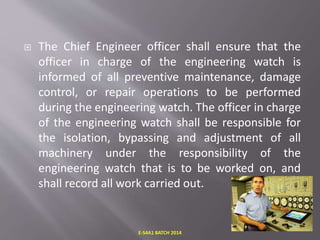
 The Chief Engineer officer shall ensure that the
officer in charge of the engineering watch is
informed of all preventive maintenance, damage
control, or repair operations to be performed
during the engineering watch. The officer in charge
of the engineering watch shall be responsible for
the isolation, bypassing and adjustment of all
machinery under the responsibility of the
engineering watch that is to be worked on, and
shall record all work carried out.
E-S4A1 BATCH 2014
 When the engine-room is put in a stand-by
condition, the officer in charge of the engineering
watch shall ensure that all machinery and
equipment which may be used during maneuvering
is in a state of immediate readiness and that an
adequate reserve of power is available for steering
gear and other requirements.
E-S4A1 BATCH 2014
 Officers in charge of an engineering watch shall
not be assigned or undertake any duties which
would interfere with their supervisory duties in
respect of the main propulsion system and ancillary
equipment. They shall keep the main propulsion
plant and auxiliary systems under constant
supervision until properly relieved, and shall
periodically inspect the machinery in their charge.
They shall also ensure the adequate rounds of the
machinery and steering-gear spaces are made for
the purpose of observing and reporting equipment
malfunctions or breakdowns, performing or
directing routine adjustments, required upkeep and
any other necessary tasks.
E-S4A1 BATCH 2014
 Officers in charge of an engineering watch shall
direct any other member of the engineering watch
to inform them of potentially hazardous conditions
which may adversely affect the machinery or
jeopardize the safety of life or of the ship.
E-S4A1 BATCH 2014
 The officer in charge of the engineering watch
shall ensure that the machinery space watch is
supervised and shall arrange for substitute
personnel in the event of the incapacity of any
engineering watch personnel. The engineering
watch shall not leave the machinery spaces
unsupervised in a manner that would prevent the
manual operation of the engine – room plant or
throttles.
E-S4A1 BATCH 2014
 The officer in charge of the engineering watch
shall take the action necessary to contain the
effects of damage resulting from equipment
breakdown, fire, flooding, rupture, collision,
stranding or other cause.
 Before going off duty, the officer in charge of the
engineering watch shall ensure that all events
related to the main and auxiliary machinery which
have occurred during the engineering watch are
suitably recorded.
E-S4A1 BATCH 2014
 The officer in charge of the engineering watch shall
co – operate with any engineer in charge of
maintenance work during all preventive
maintenance, damage control or repairs. This shall
include, but not necessarily be limited to:
E-S4A1 BATCH 2014
Isolating and bypassing machinery to be worked
on;
Adjusting the remaining plant to function
adequately and safely during the maintenance
period;
Recording in the engine – room log or other
suitable document, the equipment worked on and
the personnel involved, and which safety steps
have been taken and by whom, for the benefit of
relieving officers and for record purposes; and
Testing and putting into service, when necessary,
the repaired machinery or equipment.
E-S4A1 BATCH 2014
 The officer in charge of the engineering watch shall
ensure that any engine – room ratings who perform
maintenance duties are available to assist in the
manual operation of machinery in the event of
automatic equipment failure.
E-S4A1 BATCH 2014
 The officer in charge of the engineering watch shall
bear in mind that changes in speed, resulting from
machinery malfunction, or any loss of steering may
imperil the safety of the ship and life at sea. The bridge
shall be immediately notified in the event of fire and of
any impending action in machinery spaces that may
cause reduction in the ship’s speed, imminent steering
failure, stoppage of the ship’s propulsion system or any
alteration in the generation of electric power or similar
threat to safety. This notification, where possible, shall
be accomplished before changes are made, in order to
afford the bridge the maximum available time to take
whatever action is possible to avoid a potential marine
casualty.
E-S4A1 BATCH 2014
1. When engine damage or a malfunction occurs
which may be such as to endanger the safe
operation of the ship.
2. When any malfunction occurs which, it is believed,
may cause damage or breakdown of propulsion
machinery, auxiliary machinery or monitoring and
governing systems and
3. In any emergency or if in any doubt as to what
decision or measures to take.
E-S4A1 BATCH 2014
 Despite the requirement to notify the chief
engineer officer in the foregoing circumstances, the
officer in charge of the engineering watch shall not
hesitate to take immediate action for the safety of
the ship, its machinery and crew where
circumstances require.
E-S4A1 BATCH 2014
 The Officer In Charge of the engineering watch shall
give the watchkeeping personnel all appropriate
instructions and information which will ensure the
keeping of a safe engineering watch. Routine
machinery upkeep, performed as incidental tasks as
a part of keeping a safe watch, shall be set up as an
integral part of the watch routine. Detailed repair
maintenance involving repairs to electrical,
mechanical, hydraulic, pneumatic or applicable
electronic equipment throughout the ship shall be
performed with the cognizance of the officer in
charge of the engineering watch and chief engineer
officer. These repairs shall be recorded.
E-S4A1 BATCH 2014
 The officer in charge of the engineering watch shall
ensure that permanent air or steam pressure is
available for sound signals and that at all times
bridge orders relating to changes in speed or
direction of operation are immediately
implemented and, in addition, that auxiliary
machinery used for maneuvering is readily
available.
E-S4A1 BATCH 2014
 The officer in charge of the engineering watch
shall ensure that all machinery involved with the
maneuvering of the ship can immediately be placed
in the manual mode of operation when notified
that the ship is in congested waters. The officer in
charge of the engineering watch shall also ensure
that an adequate reserve of power is available for
steering and other maneuvering requirements.
Emergency steering and other auxiliary equipment
shall be ready for immediate operation.
E-S4A1 BATCH 2014
 At an unsheltered anchorage the chief engineer
officer shall consult with the master whether or not
to maintain the same engineering watch as when
under way.
E-S4A1 BATCH 2014
 When a ship is at anchor in an open roadstead or
any other virtually “at-sea” condition, the
engineer officer in charge of the engineering
watch shall ensure that:
an efficient engineering watch is kept;
periodic inspection is made of all operating
and stand-by machinery;
E-S4A1 BATCH 2014
main and auxiliary machinery is maintained in a
state of readiness in accordance with orders from
the bridge;
measures are taken to protect the environment
from pollution by the ship, and that applicable
pollution-prevention regulations are complied
with; and
all damage-control and fire-fighting systems are in
readiness.
E-S4A1 BATCH 2014
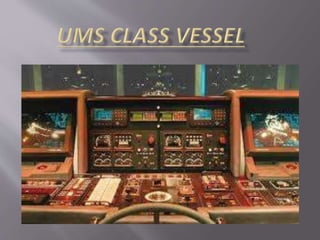
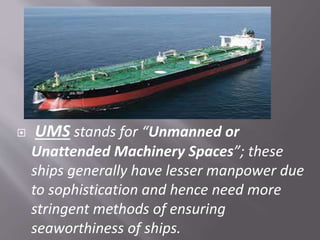
 UMS stands for “Unmanned or
Unattended Machinery Spaces”; these
ships generally have lesser manpower due
to sophistication and hence need more
stringent methods of ensuring
seaworthiness of ships.
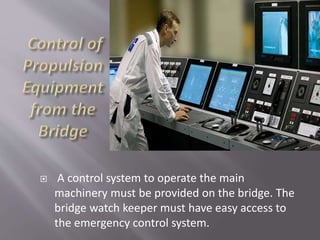
 A control system to operate the main
machinery must be provided on the bridge. The
bridge watch keeper must have easy access to
the emergency control system.
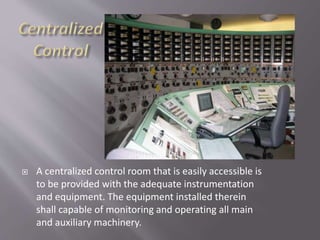
 A centralized control room that is easily accessible is
to be provided with the adequate instrumentation
and equipment. The equipment installed therein
shall capable of monitoring and operating all main
and auxiliary machinery.
 A detection and alarm system, which operates very
rapidly, should also be capable of giving an early
warning of fire in the machinery spaces especially for
the following:
 (a) The Boiler
 (b) The Scavenge air belt of the Main Engine
 (c) The Crankcase of the Main Engine
 This system should be capable of displaying (by means of a
mimic panel) any abnormality of the machinery, both on the
Bridge, as well as in the Accommodation spaces, including
the Duty Engineer’s cabin, the Chief Engineer’s cabin and all
public rooms.
 The power supply for this alarm system should have a back-
up from the emergency switchboard, in case of a blackout,
and there should be an alarm, to indicate this condition
 In addition to conventional portable
extinguishers, it is mandatory to have a fire
station that is remotely located from the
machinery space. The station must facilitate
the control of emergency pumps, generators,
valves, ventilators, extinguishing media, etc.
 In order to ensure protection against flooding, bilge
wells are to be monitored for excessive levels under
normal angles of heel and trim. For auto bilge
pumps, a ‘long-run’ alarm should be provided. This
indicates excessive filling of the bilge, since the pump
is generally not able to cope with the ingress of
water.
 This generator is almost always connected to separate
emergency bus bars in a dedicated switchboard,
located away from the main generating station. The
primary function of such a generator is to automatically
overcome electrical blackout or a dead ship conditions
within (a maximum of) 45 seconds. This generator is
almost always connected to separate emergency bus
bars in a dedicated switchboard, located away from the
main generating station. The primary function of such a
generator is to automatically overcome electrical
blackout or a dead ship conditions within (a maximum
of) 45 seconds.
 Local controllers operate certain machinery
that cannot be controlled automatically or
which is best controlled manually.
 The boiler system is controlled automatically with
the help of a level controller and amplifier; in
addition there is a combustion control system with
many safety features incorporated to prevent fires.
 The arrangements should ensure safety in all conditions, which
should be equivalent to running with manned machinery spaces.
 Adequately designed safety systems are to be provided for the
automatic shutdown of the main engine, auxiliary engines or the
boiler, in case of any serious malfunction.
 Auxiliary engines used for power generation must be capable of
automatic starting and loading in case of failure of the running
machine. This can be done by means of a stand-by feature.
 In the case of electrical power systems, means should be
provided for shedding excessive load, e.g. a preferential trip,
which will shed the load that is considered non-essential for the
immediate running of the main engine (e.g. galley power, deck
machinery, etc.).
 All pumps essential for the running of the main engine must be
provided in duplicate and an auto stand-by facility shall also be
provided. The stand-by pump shall be capable of automatically
starting, on detection of failure of the running pump, e.g. by
means of a pressure switch. Each pump must be capable of
performing the duty independently.
 Steering gear for U.M.S. operation must be of the type, such that
it can automatically isolate and regain steering control, in case of a
single failure, by automatic operation of the Isolating valves, e.g.,
the safe-matic steering system.
 There should be two separate steering gear pumps, which can
independently help to steer the vessel, and one of them must
have its power supply through the emergency switchboard, such
that it will continue to work, in spite of a blackout, by drawing its
power from the emergency supply.
 There must be an approved system for ensuring safety of the
personnel entering the machinery spaces, during U.M.S.
operation, for responding to alarms or carrying out essential
repairs; for example, there is a dead man alarm system (the alarm
operates by means of a timer, which is activated when the duty
engineer enters the machinery space. It must be manually reset,
after a pre-determined time interval, by means of reset switches
located in the engine room. In case of incapacitation of the Duty
Engineer, failure to reset the timer will sound the alarm on the
Bridge, and someone can be deputed to investigate and take
requisite action).
 There should be periodic inspections or rounds, before and after
the unmanning of the machinery spaces.
 The modern trend is towards a centralized control room, using a
totally integrated system for all aspects of ship operation,
including engineering, cargo, navigation and general
administration.
 In any system, most controlled elements will have one or
more of the following points of operation:
 a) Local manual control
 b) Remote manual control
 c) Automatic control.
 Local control implies that the point of control is in the
immediate area of the device, whereas for remote control the
point of control is at some distance away from the device, such
as in a control room. The operation of a bilge suction valve in
the engine room by its hand wheel is an example of local
manual control. If the valve was fitted with an extended spindle
through to the deck above and was operated from that point, it
would be remote manual control. In both these cases, a human
operator would operate the valve.
 If the bilge valve was fitted with a hydraulic motor to operate
the valve, and the valve opened and closed according to the
position of a float controller in the bilge well, this would be an
automatic control system. The human element is eliminated in
this case.
RECOMMENDATIONS ON WATCHKEEPING
E-S4A1 BATCH 2014
Section B-VIII/1
In observing the rest period requirements, “overriding
operational conditions” should be construed to mean
only essential shipboard work which cannot be delayed
for safety, security or environmental reasons or which
could not reasonably been anticipated at the
commencement of the voyage.
E-S4A1 BATCH 2014
Although there is no universally accepted technical
definition of fatigue, everyone involved in ship
operation should be alert to the factors which can
contribute to fatigue, including, but not limited to,
those identified by the Organization, and take them
into account when making decisions on ship
operations.
E-S4A1 BATCH 2014
In applying regulation VIII/1, the following should be
taken into account:
.1 provisions made to prevent fatigue should
ensure that excessive or unreasonable overall
working hours are not undertaken. In particular, the
minimum rest periods specified in section A-VIII/1
should not be interpreted as implying that all other
hours may be devoted to watchkeeping or other
duties;
E-S4A1 BATCH 2014
.2 the frequency and length of leave periods, and the
granting of compensatory leave, are material
factors in preventing fatigue from building up over a
period of time; and
.3 The provisions may be varies for ships on short sea
voyages, provided special safety arrangements are
put in place.
E-S4A1 BATCH 2014
4. Exceptions provided for in section A-VIII/1,
paragraph 9, should be construed to mean the
exceptions laid down by the ILO Convention o
Seafarers’ Hours of Works and the Manning of
Ships, 1996 (No.180) or the Maritime Labour
Convention, 2006, when it enters into force. The
circumstances under which such exceptions are
applied should be defined by the Parties.
5. Based on information received as a result of
investigating maritime casualties, Administration
should keep their provisions on prevention of
fatigue under review.
E-S4A1 BATCH 2014
6. Drug and alcohol abuse directly affect the fitness
and ability of a seafarer to perform watchkeeping
duties or duties that involve designated safety,
prevention of pollution and security duties.
Seafarers found to be under the influence of drugs
or alcohol should not be permitted to perform
watchkeeping duties or duties that involve
designated safety, prevention of pollution or
security duties, until they are no longer impaired in
their ability to perform those duties.
E-S4A1 BATCH 2014
7. Administration should ensure that adequate
measure are taken to prevent alcohol and drugs
from impairing the ability of watchkeeping
personnel and those whose duties involves
designated safety, prevention of pollution and
security duties, and should establish screening
programs as necessary which:
E-S4A1 BATCH 2014
.1 identify drug and alcohol abuse;
.2 Respect the dignity, privacy, confidentiality and
fundamental legal rights of the individuals
concerned; and
.3 Take into account relevant international guidelines.
E-S4A1 BATCH 2014
8. Companies should consider the implementation of a
clearly written policy of drug and alcohol abuse
prevention, including prohibition to consume
alcohol within four hours prior to serving as a
member of a watch either by inclusion in the
company’s quality-management system or by
means of providing adequate information and
education to the seafarers.
E-S4A1 BATCH 2014
9. Those involved in establishing drug and alcohol
abuse prevention programmes should take into
account the guidance contained in the ILO
publication Drug and Alcohol Prevention
Programmes in the Maritime Industry (A Manual
for Planners), as may be amended.
E-S4A1 BATCH 2014
 The following operational guidance should be taken
into account by companies, masters and watch-
keeping officers.
Part 1 – Guidance on Certification
(No provisions)
Part 2 – Guidance on Voyage Planning
(No provisions)
Part 3 – Watckeeping Principles in General
(No provisions)
Part 4 – Guidance on Watchkeeping at Sea
E-S4A1 BATCH 2014
 Particular guidance may be necessary for special
types of propulsion system or ancillary equipment
and for ship carrying hazardous, dangerous, toxic or
highly flammable materials or other special types of
cargo. The chief engineer officer should provide this
operational guidance as appropriate.
E-S4A1 BATCH 2014
 It is essential that the officer in charge of the
engineering watch appreciate that the efficient
performance of engineering watchkeeping duties is
necessary in the interest of the safety of life at sea
and of preventing pollution on the marine
environment.
E-S4A1 BATCH 2014
 The relieving officer, before assuming in charge of
the engineering watch, should:
.1 be familiar with the location and use of
the equipment provided for the safety of life in a
hazardous or toxic environment.
E-S4A1 BATCH 2014
.2 ascertain that materials for the administration of
emergency medical first aid are readily available,
particularly those required for the treatment of
burns an d scalds; and
.3 when in port, safety anchored and moored , be
aware of:
E-S4A1 BATCH 2014
.3.1 cargo activities . the status of maintenance
and repair functions and all other operations
affecting the watch , and
.3.2 the auxiliary machinery in use for passenger
or crew accommodation services, cargo operation,
operational water supplies and exhaust systems
E-S4A1 BATCH 2014
E-S4A1 BATCH 2014

engine watchkeeping practice and UMS checklist.pptx

  • 1.
  • 2.
  • 3.
  • 4.
  • 5.
  • 6.
  • 7.
  • 8.
  • 9.
  • 10.
  • 11.
  • 12.
  • 13.
  • 14.
  • 15.
  • 16.
  • 17.
    Regulation VIII/1 Fitness forduty Each Administration shall, for the purpose of preventing fatigue: .1 establish and enforce rest period for watchkeeping personnel and those whose duties involve designated safety, security and prevention of pollution duties in accordance with the provision of section A-VIII/1 of the STCW Code; and E-S4A1 BATCH 2014
  • 18.
    .2 require thatwatch system are so arranged that the efficiency of all watchkeeping personnel is not impaired by fatigue and that duties are so organized that the first watch at the commencement of the voyage and subsequent relieving watches are sufficiently rested and otherwise fit for duty. E-S4A1 BATCH 2014
  • 19.
    Each Administration shall,for the purpose of preventing drug and alcohol abuse, ensure the adequate measures are established in accordance with the provision of section A- VIII/1 while taking into account the guidance given in section B-VIII/1 of the STCW Code. E-S4A1 BATCH 2014
  • 20.
    Regulation VIII/2 Watchkeeping Arrangementand Principle to be observed Administrations shall direct the attention of the companies, masters, chief engineer officers and all watch keeping personnel to the requirement, principles and guidance set out in the STCW Code which shall be observed to ensure that a safe continuous watch or watches appropriate to the prevailing circumstances and condition are maintained on all seagoing ships at all times. E-S4A1 BATCH 2014
  • 21.
    Administration shall requirethe master of every ship to ensure that watch keeping arrangements are adequate for maintaining a safe watch or watches, taking into account the prevailing circumstances and condition and that, under the master’s general direction: E-S4A1 BATCH 2014
  • 22.
    .1 officer incharge of the navigational watch are responsible for navigating the ship safely during their periods of duty, when they shall physically present on the navigational bridge or in a directly associated location such as the chartroom or bridge control room at all times. .2 radio operators are responsible for maintaining the continuous radio watch on appropriate frequencies during their period of duty. E-S4A1 BATCH 2014
  • 23.
    .3 Officer incharge of an engineering watch, as define in the STCW Code, under the direction of the chief engineer officer, shall be immediately available on call to attend the machinery spaces and, when required, shall be physically present in the machinery spaces during their period of responsibility; E-S4A1 BATCH 2014
  • 24.
    .4 an appropriateand effective watch or watches are maintained for the purpose of safety at all times, while the ship id at anchor or moored and, if the ship id carrying hazardous cargo, the organization of such watch or watches takes full account of the nature, quantity, packing and stowage of the hazardous cargo and of any special condition prevailing onboard, afloat, or ashore; and E-S4A1 BATCH 2014
  • 25.
    .5 as applicable,an appropriate and effective watch or watches are maintained for the purpose of security. E-S4A1 BATCH 2014
  • 26.
  • 27.
  • 28.
  • 29.
  • 30.
    Section A-VII/1 Fitness forduty Administration shall take account of the danger posed by fatigue of seafarers, especially those whose duties involve the safe and secure operation of the ship. E-S4A1 BATCH 2014
  • 31.
    All persons whoare assigned duty as officer in charge of the watch or as a rating forming part of a watch and those whose duties involve designated safety, prevention of pollution and security duties shall be provided with a rest period of not less than: .1 a minimum of 10 hours of rest in any 24- hour period; and .2 77 hours in any 7-day period. E-S4A1 BATCH 2014
  • 32.
    The hours ofrest may be divided into no more than two periods, one of which shall be at least l6 hours in length, and the interval between consecutive periods of rest shall not exceed 14 hours. The requirements for rest periods laid down in paragraphs 2 and 3 need not be maintained in the case of an emergency or in other overriding operational conditions. Musters, fire-fighting and lifeboats drills, and drills prescribed by national laws and regulations and by international instruments, shall be conducted in a manner that minimizes the disturbance of rest periods does not induce fatigue. E-S4A1 BATCH 2014
  • 33.
    Administration shall requirethat watch schedules be posted where they are easily accessible. The schedules shall be established in a standardized format in the working language or languages of the ship and in English. When a seafarer is on call, such as when a machinery space is unattended. The seafarer shall have an adequate compensatory rest period if the normal period of rest is disturbed by call-outs to work. E-S4A1 BATCH 2014
  • 34.
    Administration shall requirethat records of daily hours of rest of seafarers be maintained in a standardized format, in the working languages or languages of the ship and in English, to allow monitoring and verification of compliance with the provisions of this section. The seafarers shall receive a copy of the records pertaining to them, which shall be endorsed by the master or by a person authorized by the master and by the seafarers. E-S4A1 BATCH 2014
  • 35.
    Nothing in thissection shall be deemed to impair the right of the master of a ship to require a seafarer to perform any hours of work necessary for the immediate safety of the ship, persons on board or cargo, or for the purpose of giving assistance to other ships or persons in a distress at sea. Accordingly, the master may suspend the schedule of hours of rest and require a seafarer to perform any hours of necessary until the normal situation has been restored. As soon as practicable after the normal situation has been restored, the master shall ensure that any seafarers who have performed work in a schedule rest period are provided with an adequate period of rest. E-S4A1 BATCH 2014
  • 36.
    Parties may allowexception from the required hours of rest in paragraph 2.2 and 3 above provided that the rest period is not less than 70 hours in any 7-day period. Exceptions from the weekly rest period provided for in paragraph 2.2 shall not be allowed for more than two consecutive weeks. The intervals between two periods of exceptions on board shall not be less than twice the duration of the exception. E-S4A1 BATCH 2014
  • 37.
    The hours ofrest provided for in paragraph 2.1 may be divided into no more than three periods, one of which shall be at least 6 hours in length, and neither of the two periods shall not be less than one-hour in length. The intervals between consecutive periods of rest shall not exceed 14 hours. Exceptions shall not extend beyond two 24- hour period s in any 7-day period. Exceptions shall, as far as possible, take into account the guidance regarding prevention of fatigue in section B-VII/1. E-S4A1 BATCH 2014
  • 38.
    Each Administration shallestablished, for the purpose of preventing alcohol abuse, a limit of not greater than 0.05% blood alcohol level (BAC) or 0.25 mg/ alcohol in the breath or a quantity of alcohol leading to such alcohol concentration for masters, officers and other seafarers while performing designated safety, security and marine environment duties. E-S4A1 BATCH 2014
  • 39.
     Watches shallbe carried out based on the following bridge and engine-room resource management principles; Proper arrangements for watchkeeping personnel shall be ensured in accordance with situations; any limitation in qualification or fitness of individuals shall be taken into account when deploying watchkeeping personnel; E-S4A1 BATCH 2014
  • 40.
    understanding of watchkeepingpersonnel regarding their individual roes, responsibility and team roles shall be establish; the master, chief engineer officer and officer in charge of watch duties shall maintain a proper watch, making the most effective use of the resources available, such as information, installations/equipment and other personnel; E-S4A1 BATCH 2014
  • 41.
    watchkeeping personnel shallunderstand functions and operation of installations/equipment, and be familiar with handling them; watchkeeping personnel shall understand information and how to respond to information from each station/installation/equipment; information from the stations/installations/ equipment shall be appropriately shared by all the watchkeeping personnel; E-S4A1 BATCH 2014
  • 42.
    watchkeeping personnel shallmaintain an exchange of appropriate communication in any situation; and watchkeeping personnel shall notify the master/chief engineer officer/officer in charge of watch duties without any hesitation when in any doubt as to what action to take in the interest of safety. E-S4A1 BATCH 2014
  • 43.
    Principles applying towatchkeeping generally  Parties shall direct the attention of companies, masters, chief engineer officers and watchkeeping personnel to the following principles, which shall be observed to ensure that safe watches are maintained at all times.  The master of every ship is bound to ensure that watchkeeping arrangements are adequate for maintaining a safe navigational or cargo watch. Under the master’s general direction, the officers of the navigational watch are responsible for navigating the ship safely during their periods of duty, when they will be particularly concerned with avoiding collision and stranding. E-S4A1 BATCH 2014
  • 44.
     The isbound, in collision with the master, to ensure that watchkeeping arrangements are adequate to maintain a safe engineering watch. E-S4A1 BATCH 2014
  • 45.
     The shallbe aware of the serious effects of operational or accidental pollution of the marine environment and shall take all possible precautions to prevent such pollution, particularly within the framework of relevant international and port regulations. E-S4A1 BATCH 2014
  • 46.
     the termengineering watch as used parts 4-2, 5-2, and 5-4 of this section means either a person or personnel comprising the watch or a period of responsibility for an during which the physical presence in machinery spaces of that officer may or may not be required.  the officer in charge of the engineer watch is the chief engineer officer’s representative and is primarily responsible, at all times, for the safe and efficient operation and upkeep of machinery affecting the safety of the ship and is responsible for the inspection, operating and testing, as required, of all machinery and equipment under the responsibility of the engineering watch. E-S4A1 BATCH 2014
  • 47.
    Watch arrangements  Thecomposition of the engineering watch shall’ at all times, be adequate to ensure the safe operation of all machinery affecting the operation of the ship, in either automated or manual mode, and be appropriate to the prevailing circumstances and conditions.  When deciding the composition of the engineering watch, which may include appropriately qualified rating, the following criteria, inter alia, shall be taken into account: E-S4A1 BATCH 2014
  • 48.
    The type ofship and the type and condition of the machinery; The adequate supervision at all times, of machinery affecting the safe operation of the ship; any special modes of operation dictated by conditions such as weather, ice, contaminated water, shallow water, emergency conditions, damage containment or pollution abatement; The qualifications and experience of the engineering watch; The safety of the life, ship, cargo and port, and protection of the environment; The observance of international, national and local regulations and; maintaining the normal operations of the ship. E-S4A1 BATCH 2014
  • 49.
     The officerin charge of the engineering watch shall not hand the watch to the relieving officer if there is reason to believe that the latter is obviously not capable of carrying out the watch keeping duties effectively, in which case the chief engineer officer shall be notified.  The relieving officer of the engineering watch shall ensure that the members of the relieving engineering watch are apparently fully capable of performing their duties effectively. E-S4A1 BATCH 2014
  • 50.
     Prior totaking over the engineering watch, relieving officers shall satisfy themselves regarding at least the following: the standing orders and special instructions of the chief engineer officer relating to the operation of the ship’s systems and machinery; the nature of all work being performed on machinery and system, the personnel involved and potential hazards; E-S4A1 BATCH 2014
  • 51.
    the level and,where applicable, the condition of water or residues in bilges, ballast tanks, slop tanks, reserve tanks, fresh water tanks, sewage tank and any special requirements for use or disposal of the contents thereof; the condition and level of the fuel in the reverse tanks, settling tanks, day tank and other fuel storage facilities; any special requirements relating to sanitary system disposals; condition and model of operation of the various main and auxiliary systems, including the electrical power distribution system; E-S4A1 BATCH 2014
  • 52.
    where applicable, thecondition of monitoring and control console equipment, and which equipment is being operated manually; where applicable, the condition and the mode of operation of automatic boiler controls such as flame safeguard control systems, limit control systems, combustion control systems, fuel-supply control system and other equipment related to the operation of steam boilers; any potentially adverse conditions relating from bad weather, ice or contaminated or shallow water; E-S4A1 BATCH 2014
  • 53.
    any special modesof operation dictated by equipment failure or adverse ship condition; the reports of engine-room ratings relating to their assigned duties; the availability of fire-fighting appliances; and the state of completion of the engine-room log. E-S4A1 BATCH 2014
  • 54.
     All Engineersshall understand that the Chief Engineer is always available and that they can always request the Chief Engineer's presence whenever they judge it necessary or appropriate.  If in doubt about any instructions or orders, the Engineers shall immediately seek clarification from the Chief Engineer.  Guidelines which as being laid out in C/E standing's Instructions to be carried out without failure. E-S4A1 BATCH 2014
  • 55.
    The following familiarisationitems are required for Engineers before taking over a watch:- 1) 1. Engine Room Familiarisation/Machinery Check List. 2) 2. Chief Engineer's Standing Orders. 3) 3. Engine related procedures, check lists and manuals. 4) 4. Equipment and controls in machinery spaces. 5) 5. Operation controls of Emergency systems. 6) 6. Main Engine emergency controls and stops. 7) 7. Boiler controls and emergency procedures. 8) 8. Auxiliary Engine controls and emergency stops. 9) 9. Fuel and Lubrication oil pump emergency stops and quick closing valve. 10) 10. Bilge and ballast systems. 11) 11. Fire alarms and equipment. 12) 12. Emergency escapes routes. 13) 13. Other emergency control systems or measures. E-S4A1 BATCH 2014
  • 56.
     Preparation andanticipation of Port State Control Inspections.  Please be reminded that The Engine Log Book to be kept clean and tidy and all entries to be neatly written.  Any mistakes or correction as when require to be made by a slim line and corrected parameter to be initiated with a small signature.  Engine room floor plates to be oil free and dry at all times/Arrange for cleaning E-S4A1 BATCH 2014
  • 57.
     Sounding pipesof tanks shall always be properly closed.  Self closing cocks of tanks should be free to exactly that - close positively.  Oily rags and waste to be stored in metal bins which should be kept closed at all times and emptied at regular intervals for incineration.  Safety data sheets for all chemicals must be read and understood before hazardous products are used. E-S4A1 BATCH 2014
  • 58.
     Follow Companysafety instructions and recommendations at all times.  Prior commencement of any job, a proper and extensive Risk Assessment to be done.  If you have any doubt about something, speak to somebody or check the manuals.  Sometime a small error or problem left unattended can lead to a major problem.  Think Safety Always. E-S4A1 BATCH 2014
  • 59.
     Engine roomto be examined as per checklist.  NO alarm to be blocked and NO alarm limit to be changed without Chief Engineer's approval.  Watch keeping in the Engine Room  Watch is kept from 0800 hrs to 0800 hrs (24 hrs).  Watch keeping Engineers are 2E, 3E, and 4E.  Before taking over the watch, the Relieving Engineer shall inspect the Engine Room in accordance with the  "Engine Room Familiasation/Machinery List" and fill in the checklist Change of Duty Engineer.  Changing of watch shall take place in the Engine Room.  If an Engineer is found to be unfit for duty, the Chief Engineer shall be informed. E-S4A1 BATCH 2014
  • 60.
     In orderto save energy and reduce air pollution, the number of running engines shall be reduced to a minimum.  Any items found to be out of order, except as a result of ongoing repairs, shall be recorded.  Any fault or alarm conditions that can jeopardise the smooth and efficient operation or safety of the vessel shall be reported to the Chief Engineer and Second Engineer immediately.  If anything unusual is observed during watch keeping rounds, such as abnormal temperatures, vibrations, noises or smells, the Chief Engineer and Second Engineer shall be informed immediately. E-S4A1 BATCH 2014
  • 61.
     Make noteson important information on the white board before handing over.  Make sure that areas around machinery and equipment are made safe. Guards and rails shall be correctly mounted.  Drip pans shall be clean and with open drain in order to be able to indicate leakage.  When pumping bilges overboard use is to be made of the Oily Water Separator and recording in the Oil Record Book. E-S4A1 BATCH 2014
  • 62.
     Departure  InformC/E on 1 hour notice. One extra Engineer will assist Duty Engineer for departure.  Examination of Engine Room as per Pre Departure Checklist, which to be completed.  Full Away on Passage  Examination of Engine Room as per Checklist.  Main engine power and parameters as per instruction.  Arrival  Inform C/E on 1 hour notice. One extra Engineer will assist Duty Engineer for arrival.  Examination of Engine Room as per Pre Arrival checklist which to be completed.  Finished With Engine  Ensure against accidental starting of main engine.  Shutting down depends on notice given by Master.  Lube oil pumps to run for at least 30 minutes before switching off if required E-S4A1 BATCH 2014
  • 63.
     In emergencysituations, take appropriate action and inform the Bridge Duty Officer and the Chief Engineer and all Engineers.  The Chief Engineer shall take control of all machinery spaces during emergency situations. E-S4A1 BATCH 2014
  • 64.
    1. Locate thefire. Sound the Emergency alarms, Prepare for fire fighting. 2. Decide on the best way to fight the fire based on all available information and knowledge of the affected area and it's surroundings. 3. Pay attention to the probability for explosions and spread of fire. 4. Pay attention to loss of stability when using water E-S4A1 BATCH 2014
  • 65.
     Sound theEmergency alarms.  Pump out the water using fixed pumping system.  Minimise pollution whenever possible.  If necessary switch designated pump to Emergency Suction from tank top.  Reduce the effect of flooding.  Use onboard materials where possible to stem flow of water. E-S4A1 BATCH 2014
  • 66.
     Stop allrelevant operations.  Identify the source of the Oil Spill and establish cause.  Be aware of inflammable gasses and the risk of fire.  Start oil pollution emergency plan. E-S4A1 BATCH 2014
  • 67.
     Call ChiefEngineer and inform Bridge.  Do as necessary to reduce Main Engine speed after informing CE and Bridge.  Check Main Engine systems operational.  Restart Main Engine. E-S4A1 BATCH 2014
  • 68.
     If blackedout, restore electrical power. Locate fault.  Immediate actions - Locate fault. Check Prime Mover running.  Check reverse power/ preference trip reset.  Standby machinery and pumps to manual mode.  Restore switch power. Check appropriate valves.  Restart all pumps and aux. machinery.  Restart vent fans. Restart main engine systems.  Prepare for sea going.  Inform Bridge that power is restored and ready to blow through.  Restart main engine. Standby pumps to automatic mode. E-S4A1 BATCH 2014
  • 69.
     All maintenanceas per the COMPANY SPECIFIC Maintenance Programme and Running Hours of Machinery.  Be careful when carrying out maintenance. Knowledge of the system and component is important before the removal or dismantling of any components.  For correct dismantling, inspection and assembling, the manufacturer's instructions and procedures from company should be carefully studied and followed.  Where appropriate, a Permit-to-Work must be filled in. All precautions to be taken shall be strictly followed. E-S4A1 BATCH 2014
  • 70.
     Always isolateelectrical equipment from its power supply and test the circuit to make sure that it is dead.  Before any lines, fittings or related items are disconnected or removed, relieve all pressure in side, steam, fuel, oil or water systems in question.  Pay special attention when removing manhole covers, always keep the minimum of four nuts on the cover, two on each opposite end of cover when breaking seal. E-S4A1 BATCH 2014
  • 71.
     If apower tool should be used, check its power supply before use. Make sure safety guards are securely fixed.  When not in use or when changing accessories or guard, always disconnect the tool from its power supply.  Always keep electrical leads and pneumatic hoses clear of sharp edges and hot surfaces.  Do not work on anything that is supported only by fitting jacks or a hoist. Always use proper stands to support the item before any work is carried out.  All appliances and gear used for lifting, lowering and handling loads should be examined before use.  All safe working loads marked on appliances or gear shall be followed to the letter.  Dust masks, respirators or breathing apparatus of appropriate types shall be worn when working in dusty or toxic atmosphere or when working with paint sprays etc. E-S4A1 BATCH 2014
  • 72.
     The EngineRoom must be switched to "Attended" whenever Engine Room is manned (during the day or at night while taking rounds). This ensures that bridge personnel aware of engineer's presence in engine room.  Besides clearing all alarms before switching to "UMS", ensure that all auto-standby machinery is ready to start, all Engine Room fire doors are closed, fire detecting loops are connected. E-S4A1 BATCH 2014
  • 73.
     The officersin charge of the engineering watch shall ensure that the established watch keeping arrangement are maintained and that, under direction, engine-room ratings, if forming part of the engineering watch, assist in the safe and efficient operation of the propulsion machinery and auxiliary equipment. E-S4A1 BATCH 2014
  • 74.
     The officerin charge of the engineering watch shall continue to be responsible for machinery- space operations, despite the presence of the chief engineer officer in the machinery spaces, until specially informed that the chief engineer officer has assumed that responsibility and this is mutually understood. E-S4A1 BATCH 2014
  • 75.
     All membersof the engineering watch shall be familiar with their assigned watch keeping duties. In addition, every member shall, with respect to the ship they are serving in, have knowledge of: the use of appropriate internal communication systems; the escape routes from machinery spaces; E-S4A1 BATCH 2014
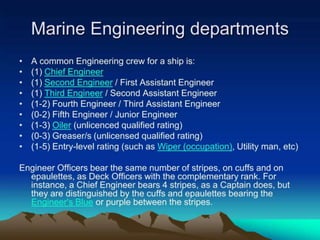
  • 76.
    the engine-room alarmsystems and be able to distinguish between the various alarms, with special reference to the fire-extinguishing media alarm; and the number, location and types of fire-fighting equipment and damage-control gear in the machinery spaces, together with their use and the various safety precautions to be observed. E-S4A1 BATCH 2014
  • 77.
     Any machinerynot functioning properly, expected to malfunction or requiring special service shall be noted along with any action already taken. Plans shall be made for any further action if required.  When the machinery spaces are in the manned condition, the officer in charge of the engineering watch shall at all times be readily capable of operating the propulsion equipment in response to needs for changes in direction or speed. E-S4A1 BATCH 2014
  • 78.
     When themachinery spaces are in the unmanned condition, the designated duty officer in charge of the engineering watch shall be immediately available and on call to attend the machinery spaces.  All bridge order shall be promptly executed. Changes in direction or speed of the main propulsion units shall be recorded, except where an Administration has determined that the size or characteristics of a particular ship make such recording impracticable. The officer in charge of engineering watch shall ensure that the main propulsion units controls, when in the manual mode of operation, are continuously attended under stand-by or maneuverings conditions. E-S4A1 BATCH 2014
  • 79.
     Due attentionshall be paid to the ongoing maintenance and support of all machinery, including mechanical, electrical, electronics, hydraulic and pneumatic systems, their control apparatus and associated safety equipment, all accommodation service systems equipment and the recording of stores and spare gear usage. E-S4A1 BATCH 2014
  • 80.
     The ChiefEngineer officer shall ensure that the officer in charge of the engineering watch is informed of all preventive maintenance, damage control, or repair operations to be performed during the engineering watch. The officer in charge of the engineering watch shall be responsible for the isolation, bypassing and adjustment of all machinery under the responsibility of the engineering watch that is to be worked on, and shall record all work carried out. E-S4A1 BATCH 2014
  • 81.
     When theengine-room is put in a stand-by condition, the officer in charge of the engineering watch shall ensure that all machinery and equipment which may be used during maneuvering is in a state of immediate readiness and that an adequate reserve of power is available for steering gear and other requirements. E-S4A1 BATCH 2014
  • 82.
     Officers incharge of an engineering watch shall not be assigned or undertake any duties which would interfere with their supervisory duties in respect of the main propulsion system and ancillary equipment. They shall keep the main propulsion plant and auxiliary systems under constant supervision until properly relieved, and shall periodically inspect the machinery in their charge. They shall also ensure the adequate rounds of the machinery and steering-gear spaces are made for the purpose of observing and reporting equipment malfunctions or breakdowns, performing or directing routine adjustments, required upkeep and any other necessary tasks. E-S4A1 BATCH 2014
  • 83.
     Officers incharge of an engineering watch shall direct any other member of the engineering watch to inform them of potentially hazardous conditions which may adversely affect the machinery or jeopardize the safety of life or of the ship. E-S4A1 BATCH 2014
  • 84.
     The officerin charge of the engineering watch shall ensure that the machinery space watch is supervised and shall arrange for substitute personnel in the event of the incapacity of any engineering watch personnel. The engineering watch shall not leave the machinery spaces unsupervised in a manner that would prevent the manual operation of the engine – room plant or throttles. E-S4A1 BATCH 2014
  • 85.
     The officerin charge of the engineering watch shall take the action necessary to contain the effects of damage resulting from equipment breakdown, fire, flooding, rupture, collision, stranding or other cause.  Before going off duty, the officer in charge of the engineering watch shall ensure that all events related to the main and auxiliary machinery which have occurred during the engineering watch are suitably recorded. E-S4A1 BATCH 2014
  • 86.
     The officerin charge of the engineering watch shall co – operate with any engineer in charge of maintenance work during all preventive maintenance, damage control or repairs. This shall include, but not necessarily be limited to: E-S4A1 BATCH 2014
  • 87.
    Isolating and bypassingmachinery to be worked on; Adjusting the remaining plant to function adequately and safely during the maintenance period; Recording in the engine – room log or other suitable document, the equipment worked on and the personnel involved, and which safety steps have been taken and by whom, for the benefit of relieving officers and for record purposes; and Testing and putting into service, when necessary, the repaired machinery or equipment. E-S4A1 BATCH 2014
  • 88.
     The officerin charge of the engineering watch shall ensure that any engine – room ratings who perform maintenance duties are available to assist in the manual operation of machinery in the event of automatic equipment failure. E-S4A1 BATCH 2014
  • 89.
     The officerin charge of the engineering watch shall bear in mind that changes in speed, resulting from machinery malfunction, or any loss of steering may imperil the safety of the ship and life at sea. The bridge shall be immediately notified in the event of fire and of any impending action in machinery spaces that may cause reduction in the ship’s speed, imminent steering failure, stoppage of the ship’s propulsion system or any alteration in the generation of electric power or similar threat to safety. This notification, where possible, shall be accomplished before changes are made, in order to afford the bridge the maximum available time to take whatever action is possible to avoid a potential marine casualty. E-S4A1 BATCH 2014
  • 90.
    1. When enginedamage or a malfunction occurs which may be such as to endanger the safe operation of the ship. 2. When any malfunction occurs which, it is believed, may cause damage or breakdown of propulsion machinery, auxiliary machinery or monitoring and governing systems and 3. In any emergency or if in any doubt as to what decision or measures to take. E-S4A1 BATCH 2014
  • 91.
     Despite therequirement to notify the chief engineer officer in the foregoing circumstances, the officer in charge of the engineering watch shall not hesitate to take immediate action for the safety of the ship, its machinery and crew where circumstances require. E-S4A1 BATCH 2014
  • 92.
     The OfficerIn Charge of the engineering watch shall give the watchkeeping personnel all appropriate instructions and information which will ensure the keeping of a safe engineering watch. Routine machinery upkeep, performed as incidental tasks as a part of keeping a safe watch, shall be set up as an integral part of the watch routine. Detailed repair maintenance involving repairs to electrical, mechanical, hydraulic, pneumatic or applicable electronic equipment throughout the ship shall be performed with the cognizance of the officer in charge of the engineering watch and chief engineer officer. These repairs shall be recorded. E-S4A1 BATCH 2014
  • 93.
     The officerin charge of the engineering watch shall ensure that permanent air or steam pressure is available for sound signals and that at all times bridge orders relating to changes in speed or direction of operation are immediately implemented and, in addition, that auxiliary machinery used for maneuvering is readily available. E-S4A1 BATCH 2014
  • 94.
     The officerin charge of the engineering watch shall ensure that all machinery involved with the maneuvering of the ship can immediately be placed in the manual mode of operation when notified that the ship is in congested waters. The officer in charge of the engineering watch shall also ensure that an adequate reserve of power is available for steering and other maneuvering requirements. Emergency steering and other auxiliary equipment shall be ready for immediate operation. E-S4A1 BATCH 2014
  • 95.
     At anunsheltered anchorage the chief engineer officer shall consult with the master whether or not to maintain the same engineering watch as when under way. E-S4A1 BATCH 2014
  • 96.
     When aship is at anchor in an open roadstead or any other virtually “at-sea” condition, the engineer officer in charge of the engineering watch shall ensure that: an efficient engineering watch is kept; periodic inspection is made of all operating and stand-by machinery; E-S4A1 BATCH 2014
  • 97.
    main and auxiliarymachinery is maintained in a state of readiness in accordance with orders from the bridge; measures are taken to protect the environment from pollution by the ship, and that applicable pollution-prevention regulations are complied with; and all damage-control and fire-fighting systems are in readiness. E-S4A1 BATCH 2014
  • 99.
     UMS standsfor “Unmanned or Unattended Machinery Spaces”; these ships generally have lesser manpower due to sophistication and hence need more stringent methods of ensuring seaworthiness of ships.
  • 100.
     A controlsystem to operate the main machinery must be provided on the bridge. The bridge watch keeper must have easy access to the emergency control system.
  • 101.
     A centralizedcontrol room that is easily accessible is to be provided with the adequate instrumentation and equipment. The equipment installed therein shall capable of monitoring and operating all main and auxiliary machinery.
  • 102.
     A detectionand alarm system, which operates very rapidly, should also be capable of giving an early warning of fire in the machinery spaces especially for the following:  (a) The Boiler  (b) The Scavenge air belt of the Main Engine  (c) The Crankcase of the Main Engine
  • 103.
     This systemshould be capable of displaying (by means of a mimic panel) any abnormality of the machinery, both on the Bridge, as well as in the Accommodation spaces, including the Duty Engineer’s cabin, the Chief Engineer’s cabin and all public rooms.  The power supply for this alarm system should have a back- up from the emergency switchboard, in case of a blackout, and there should be an alarm, to indicate this condition
  • 104.
     In additionto conventional portable extinguishers, it is mandatory to have a fire station that is remotely located from the machinery space. The station must facilitate the control of emergency pumps, generators, valves, ventilators, extinguishing media, etc.
  • 105.
     In orderto ensure protection against flooding, bilge wells are to be monitored for excessive levels under normal angles of heel and trim. For auto bilge pumps, a ‘long-run’ alarm should be provided. This indicates excessive filling of the bilge, since the pump is generally not able to cope with the ingress of water.
  • 106.
     This generatoris almost always connected to separate emergency bus bars in a dedicated switchboard, located away from the main generating station. The primary function of such a generator is to automatically overcome electrical blackout or a dead ship conditions within (a maximum of) 45 seconds. This generator is almost always connected to separate emergency bus bars in a dedicated switchboard, located away from the main generating station. The primary function of such a generator is to automatically overcome electrical blackout or a dead ship conditions within (a maximum of) 45 seconds.
  • 107.
     Local controllersoperate certain machinery that cannot be controlled automatically or which is best controlled manually.
  • 108.
     The boilersystem is controlled automatically with the help of a level controller and amplifier; in addition there is a combustion control system with many safety features incorporated to prevent fires.
  • 109.
     The arrangementsshould ensure safety in all conditions, which should be equivalent to running with manned machinery spaces.  Adequately designed safety systems are to be provided for the automatic shutdown of the main engine, auxiliary engines or the boiler, in case of any serious malfunction.  Auxiliary engines used for power generation must be capable of automatic starting and loading in case of failure of the running machine. This can be done by means of a stand-by feature.
  • 110.
     In thecase of electrical power systems, means should be provided for shedding excessive load, e.g. a preferential trip, which will shed the load that is considered non-essential for the immediate running of the main engine (e.g. galley power, deck machinery, etc.).  All pumps essential for the running of the main engine must be provided in duplicate and an auto stand-by facility shall also be provided. The stand-by pump shall be capable of automatically starting, on detection of failure of the running pump, e.g. by means of a pressure switch. Each pump must be capable of performing the duty independently.
  • 111.
     Steering gearfor U.M.S. operation must be of the type, such that it can automatically isolate and regain steering control, in case of a single failure, by automatic operation of the Isolating valves, e.g., the safe-matic steering system.  There should be two separate steering gear pumps, which can independently help to steer the vessel, and one of them must have its power supply through the emergency switchboard, such that it will continue to work, in spite of a blackout, by drawing its power from the emergency supply.
  • 112.
     There mustbe an approved system for ensuring safety of the personnel entering the machinery spaces, during U.M.S. operation, for responding to alarms or carrying out essential repairs; for example, there is a dead man alarm system (the alarm operates by means of a timer, which is activated when the duty engineer enters the machinery space. It must be manually reset, after a pre-determined time interval, by means of reset switches located in the engine room. In case of incapacitation of the Duty Engineer, failure to reset the timer will sound the alarm on the Bridge, and someone can be deputed to investigate and take requisite action).
  • 113.
     There shouldbe periodic inspections or rounds, before and after the unmanning of the machinery spaces.  The modern trend is towards a centralized control room, using a totally integrated system for all aspects of ship operation, including engineering, cargo, navigation and general administration.
  • 114.
     In anysystem, most controlled elements will have one or more of the following points of operation:  a) Local manual control  b) Remote manual control  c) Automatic control.
  • 115.
     Local controlimplies that the point of control is in the immediate area of the device, whereas for remote control the point of control is at some distance away from the device, such as in a control room. The operation of a bilge suction valve in the engine room by its hand wheel is an example of local manual control. If the valve was fitted with an extended spindle through to the deck above and was operated from that point, it would be remote manual control. In both these cases, a human operator would operate the valve.
  • 116.
     If thebilge valve was fitted with a hydraulic motor to operate the valve, and the valve opened and closed according to the position of a float controller in the bilge well, this would be an automatic control system. The human element is eliminated in this case.
  • 117.
  • 118.
    Section B-VIII/1 In observingthe rest period requirements, “overriding operational conditions” should be construed to mean only essential shipboard work which cannot be delayed for safety, security or environmental reasons or which could not reasonably been anticipated at the commencement of the voyage. E-S4A1 BATCH 2014
  • 119.
    Although there isno universally accepted technical definition of fatigue, everyone involved in ship operation should be alert to the factors which can contribute to fatigue, including, but not limited to, those identified by the Organization, and take them into account when making decisions on ship operations. E-S4A1 BATCH 2014
  • 120.
    In applying regulationVIII/1, the following should be taken into account: .1 provisions made to prevent fatigue should ensure that excessive or unreasonable overall working hours are not undertaken. In particular, the minimum rest periods specified in section A-VIII/1 should not be interpreted as implying that all other hours may be devoted to watchkeeping or other duties; E-S4A1 BATCH 2014
  • 121.
    .2 the frequencyand length of leave periods, and the granting of compensatory leave, are material factors in preventing fatigue from building up over a period of time; and .3 The provisions may be varies for ships on short sea voyages, provided special safety arrangements are put in place. E-S4A1 BATCH 2014
  • 122.
    4. Exceptions providedfor in section A-VIII/1, paragraph 9, should be construed to mean the exceptions laid down by the ILO Convention o Seafarers’ Hours of Works and the Manning of Ships, 1996 (No.180) or the Maritime Labour Convention, 2006, when it enters into force. The circumstances under which such exceptions are applied should be defined by the Parties. 5. Based on information received as a result of investigating maritime casualties, Administration should keep their provisions on prevention of fatigue under review. E-S4A1 BATCH 2014
  • 123.
    6. Drug andalcohol abuse directly affect the fitness and ability of a seafarer to perform watchkeeping duties or duties that involve designated safety, prevention of pollution and security duties. Seafarers found to be under the influence of drugs or alcohol should not be permitted to perform watchkeeping duties or duties that involve designated safety, prevention of pollution or security duties, until they are no longer impaired in their ability to perform those duties. E-S4A1 BATCH 2014
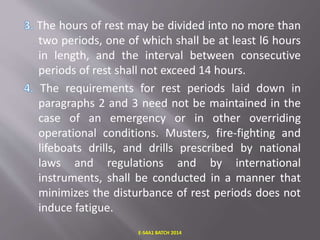
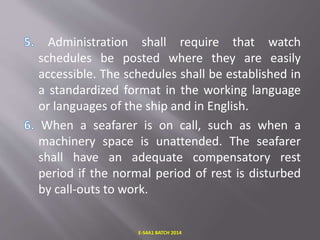
  • 124.
    7. Administration shouldensure that adequate measure are taken to prevent alcohol and drugs from impairing the ability of watchkeeping personnel and those whose duties involves designated safety, prevention of pollution and security duties, and should establish screening programs as necessary which: E-S4A1 BATCH 2014
  • 125.
    .1 identify drugand alcohol abuse; .2 Respect the dignity, privacy, confidentiality and fundamental legal rights of the individuals concerned; and .3 Take into account relevant international guidelines. E-S4A1 BATCH 2014
  • 126.
    8. Companies shouldconsider the implementation of a clearly written policy of drug and alcohol abuse prevention, including prohibition to consume alcohol within four hours prior to serving as a member of a watch either by inclusion in the company’s quality-management system or by means of providing adequate information and education to the seafarers. E-S4A1 BATCH 2014
  • 127.
    9. Those involvedin establishing drug and alcohol abuse prevention programmes should take into account the guidance contained in the ILO publication Drug and Alcohol Prevention Programmes in the Maritime Industry (A Manual for Planners), as may be amended. E-S4A1 BATCH 2014
  • 128.
     The followingoperational guidance should be taken into account by companies, masters and watch- keeping officers. Part 1 – Guidance on Certification (No provisions) Part 2 – Guidance on Voyage Planning (No provisions) Part 3 – Watckeeping Principles in General (No provisions) Part 4 – Guidance on Watchkeeping at Sea E-S4A1 BATCH 2014
  • 129.
     Particular guidancemay be necessary for special types of propulsion system or ancillary equipment and for ship carrying hazardous, dangerous, toxic or highly flammable materials or other special types of cargo. The chief engineer officer should provide this operational guidance as appropriate. E-S4A1 BATCH 2014
  • 130.
     It isessential that the officer in charge of the engineering watch appreciate that the efficient performance of engineering watchkeeping duties is necessary in the interest of the safety of life at sea and of preventing pollution on the marine environment. E-S4A1 BATCH 2014
  • 131.
     The relievingofficer, before assuming in charge of the engineering watch, should: .1 be familiar with the location and use of the equipment provided for the safety of life in a hazardous or toxic environment. E-S4A1 BATCH 2014
  • 132.
    .2 ascertain thatmaterials for the administration of emergency medical first aid are readily available, particularly those required for the treatment of burns an d scalds; and .3 when in port, safety anchored and moored , be aware of: E-S4A1 BATCH 2014
  • 133.
    .3.1 cargo activities. the status of maintenance and repair functions and all other operations affecting the watch , and .3.2 the auxiliary machinery in use for passenger or crew accommodation services, cargo operation, operational water supplies and exhaust systems E-S4A1 BATCH 2014
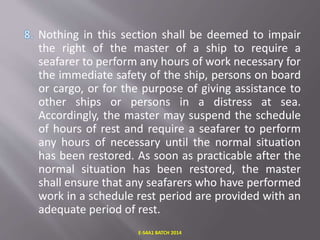
  • 134.