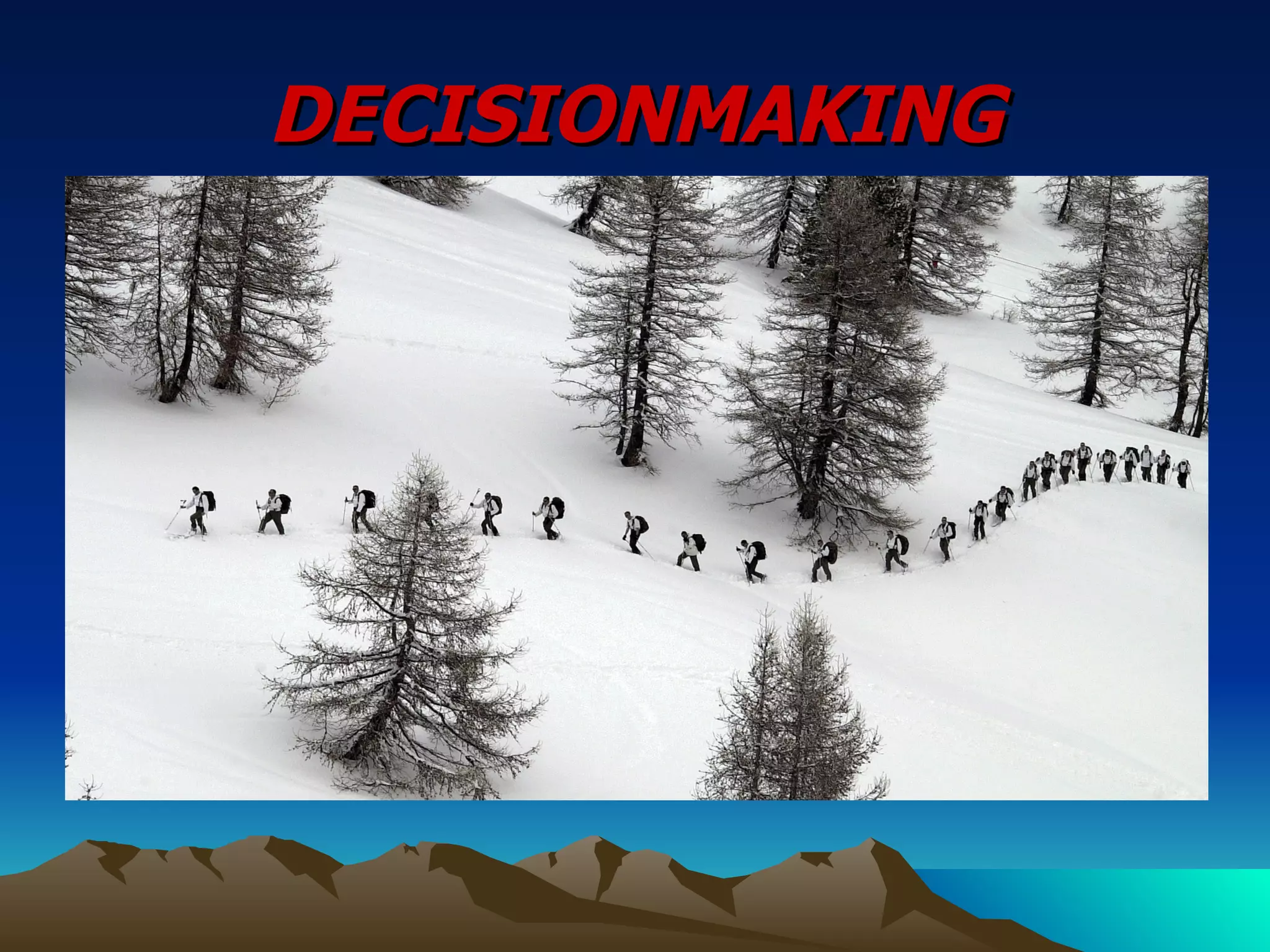
DECISIONMAKING
DECISIONMAKING 1 Objectives   Explore Decisionmaking Dynamics Discover Decisionmaking Styles Improve Decisionmaking Effectiveness Acquire Key Decisionmaking Skills
DECISIONMAKING 3   Decisions in Business Rand Corporation Survey ► Average Budget overrun 153% ► 74 % of costing errors were avoidable ► Managers blamed external factors   Study of 324 Chairman’s letters ►  83% claimed responsibility for success ►  19% accepted blame for failure
DECISIONMAKING 4  Organizational life revolves around team structure   CONTENT  -  what the team is talking about PROCESS  -  how the team handles its communication Who talks, for how long, how often ? Who do people look at when they talk ?   Individuals, the group, nobody… Who talks after whom, who interrupts ? What communication style is used  ? Assertions, questions, voice tone, volume, gestures, eye contact…
DECISIONMAKING 5  When people get together, they assume a role or function in relation to the group   Roles are relatively consistent A person may play a variety of roles in the same group Roles may vary with the dynamics of the meeting An individual’s role may vary from one group to another The method of dealing with an individual depends on the    group in which he is participating
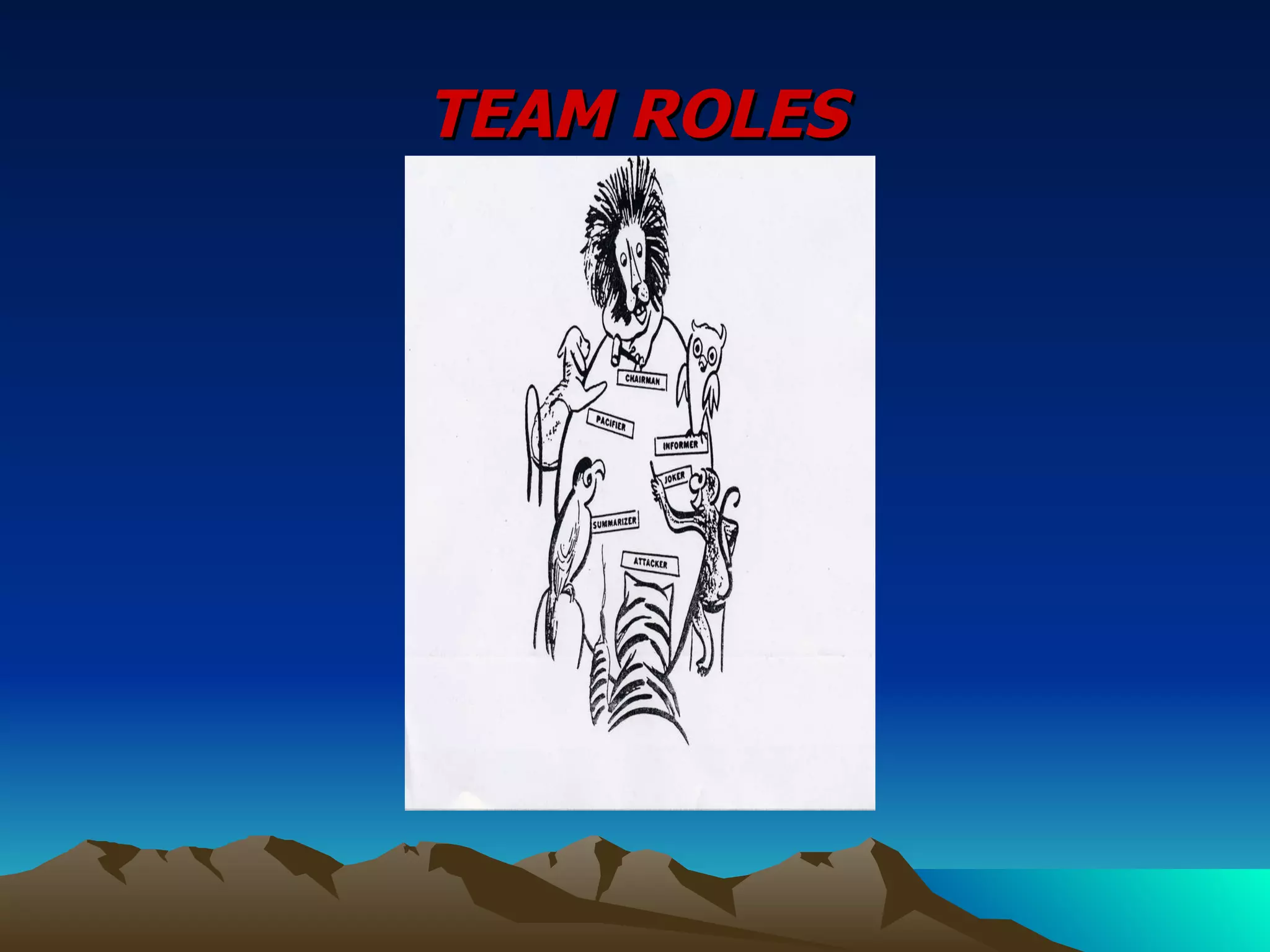
TEAM ROLES
DECISIONMAKING 6  TASK  BEHAVIOR Initiating Seeking/giving information or opinion Clarifying, elaborating, summarizing Consensus testing MAINTENANCE  BEHAVIOR Harmonizing, gatekeeping, encouraging, compromising Standard setting and testing SELF-ORIENTED  BEHAVIOR Identity, Power, Goals, Acceptance, Intimacy
DECISIONMAKING 7  TOUGH BATTLER  Power Competition Hostility Assertiveness FRIENDLY HELPER Affiliation Helpfulness Sympathy LOGICAL THINKER Logic & reason Understanding Knowledge & systems
DECISIONMAKING 8 Decisionmaking procedures Self-authorized agenda   « I think we should… » The duo   « I think we should… » « I agree… » Minority rule   « No objections ? Good, then we all agree » Majority vote Polling  « What does everyone think ? » Consensus testing   Exploring to test for opposition and  determine if it’s strong enough to refuse to implement the  decision. We need  to understand how a decision is being made  and decide if the method is appropriate.
DECISIONMAKING 9 Decisionmaking styles Indecisive/Go along Abdicates responsibility as well as consequences. Lacks knowledge or skill, prefers to follow others. Least resistance, low effort, avoid conflict. Status quo, influenced by environment. Compromising/Controlled delay   Advocates compromise, reflecting needs &  constraints of all  stakeholders, or stalls until adequate data is available. Gets results without relying on authority. Flexible, adjusts to changing circumstances.   Take charge/Extreme action  Clear, firm choice that may not be easy or popular. Comfortable with conflict, negotiation and pressure. Can damage relationships and alienate himself.  May be seen as inflexible and agressive.
DECISIONMAKING 10 COHESIVENESS INSULATION  HIGH STRESS STRONG DIRECTIVE LEADERSHIP Negative team behavior
DECISIONMAKING 11   Why group decisions often fail Premature agreement Feedback reinforces a « right » choice Members don’t see flaws in the thought process Polarization inhibits rational progress
DECISIONMAKING 12 SELF CENSORSHIP MAJORITY PRESSURE INVULNERABILITY ILLUSION  ERRONEOUS STEREOTYPING Groupthink
DECISIONMAKING 13 Too few alternatives are examined Too few objectives are fixed Biased analysis of data  Results of groupthink
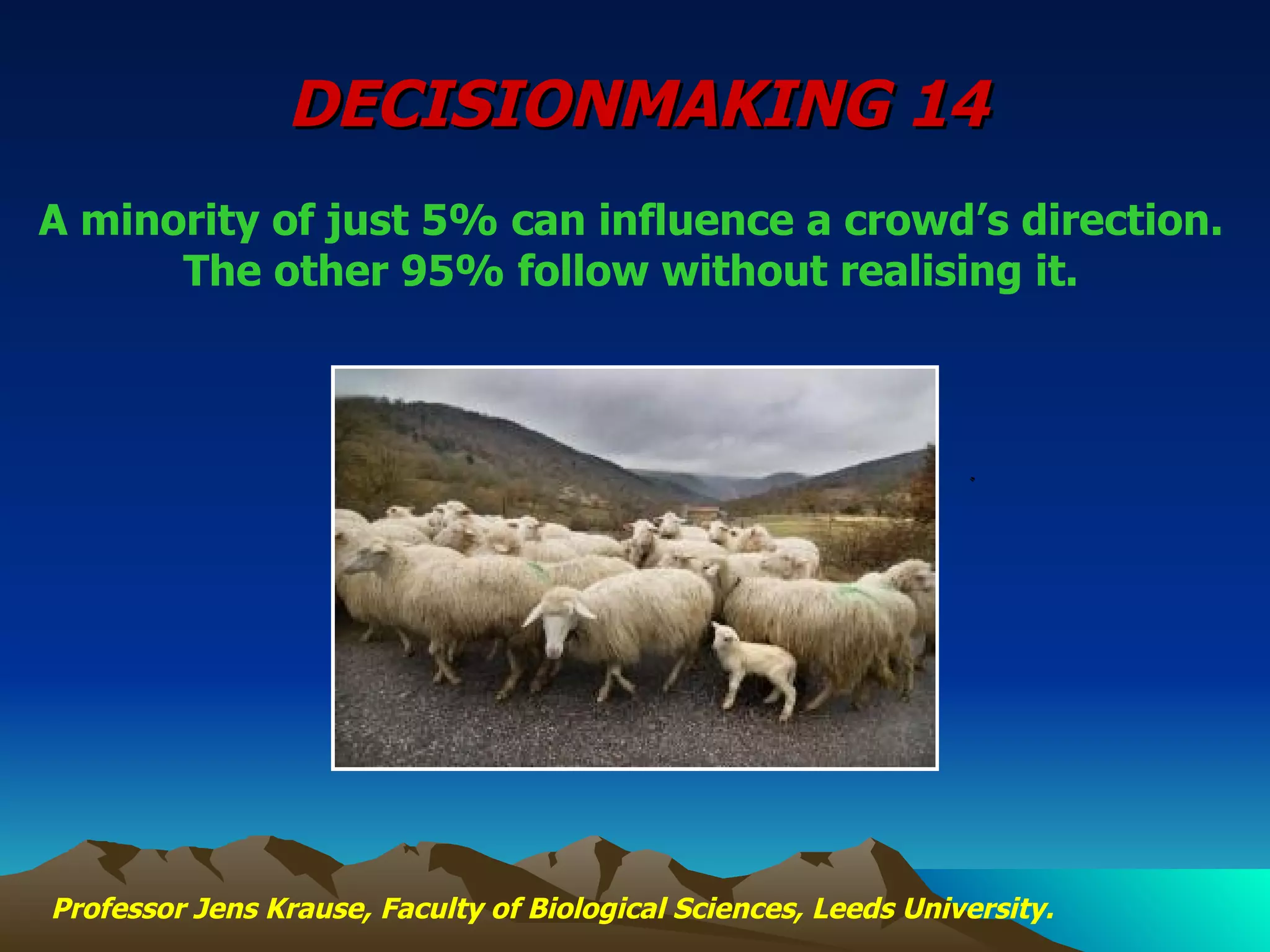
A minority of just 5% can influence a crowd’s direction. The other 95% follow without realising it.   Professor Jens Krause, Faculty of Biological Sciences, Leeds University.   DECISIONMAKING 14
DECISIONMAKING 15 Withholds his ideas at first Encourages divergence  Makes sure minority views are heard Separates facts from judgements Encourages each member to speak on all key issues Recognizes the risks of negative behaviour  A good team leader
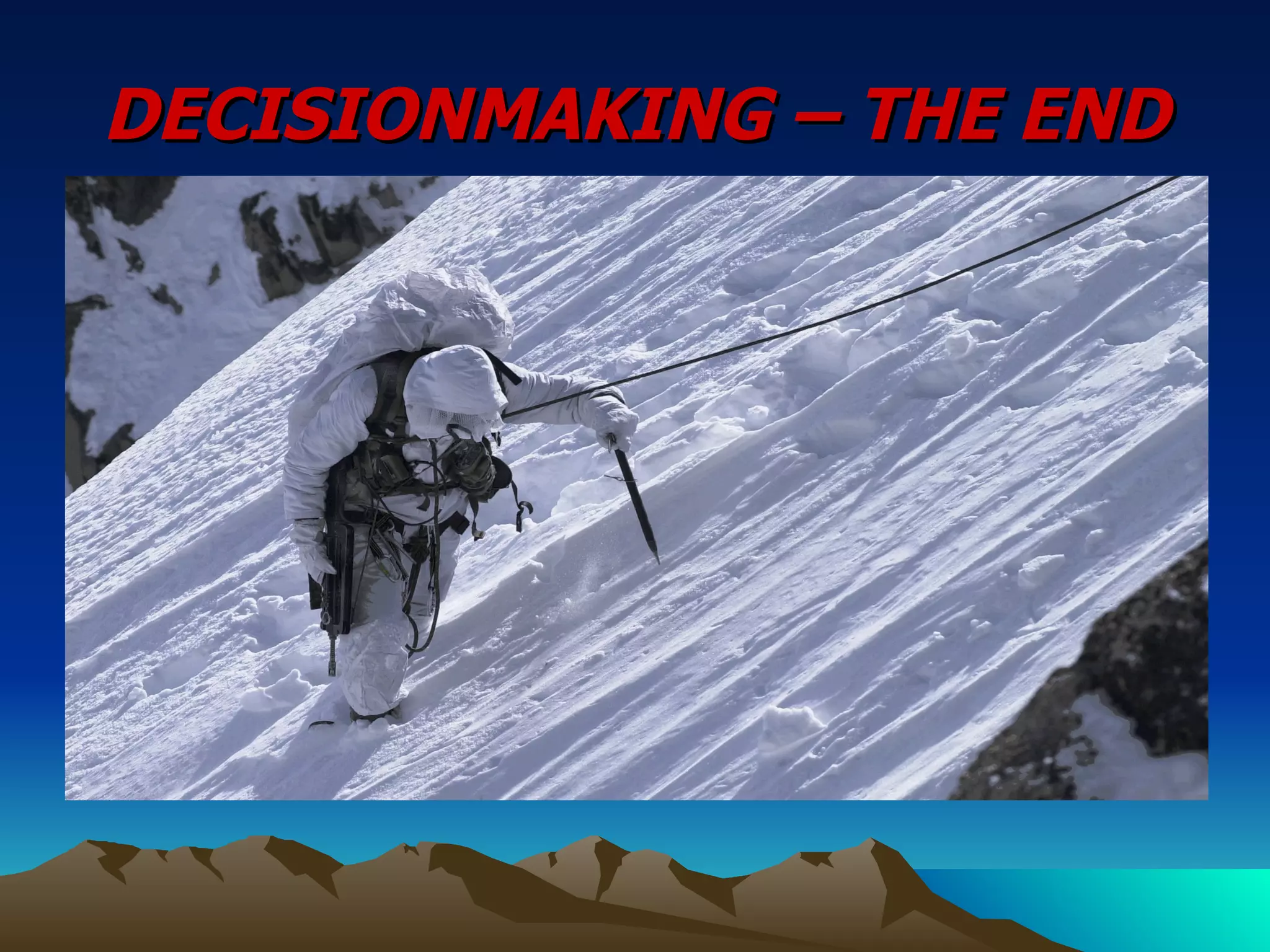
DECISIONMAKING – THE END

Decisionmaking

  • 1.
  • 2.
    DECISIONMAKING 1 Objectives Explore Decisionmaking Dynamics Discover Decisionmaking Styles Improve Decisionmaking Effectiveness Acquire Key Decisionmaking Skills
  • 3.
    DECISIONMAKING 3 Decisions in Business Rand Corporation Survey ► Average Budget overrun 153% ► 74 % of costing errors were avoidable ► Managers blamed external factors Study of 324 Chairman’s letters ► 83% claimed responsibility for success ► 19% accepted blame for failure
  • 4.
    DECISIONMAKING 4 Organizational life revolves around team structure CONTENT - what the team is talking about PROCESS - how the team handles its communication Who talks, for how long, how often ? Who do people look at when they talk ? Individuals, the group, nobody… Who talks after whom, who interrupts ? What communication style is used ? Assertions, questions, voice tone, volume, gestures, eye contact…
  • 5.
    DECISIONMAKING 5 When people get together, they assume a role or function in relation to the group Roles are relatively consistent A person may play a variety of roles in the same group Roles may vary with the dynamics of the meeting An individual’s role may vary from one group to another The method of dealing with an individual depends on the group in which he is participating
  • 6.
  • 7.
    DECISIONMAKING 6 TASK BEHAVIOR Initiating Seeking/giving information or opinion Clarifying, elaborating, summarizing Consensus testing MAINTENANCE BEHAVIOR Harmonizing, gatekeeping, encouraging, compromising Standard setting and testing SELF-ORIENTED BEHAVIOR Identity, Power, Goals, Acceptance, Intimacy
  • 8.
    DECISIONMAKING 7 TOUGH BATTLER Power Competition Hostility Assertiveness FRIENDLY HELPER Affiliation Helpfulness Sympathy LOGICAL THINKER Logic & reason Understanding Knowledge & systems
  • 9.
    DECISIONMAKING 8 Decisionmakingprocedures Self-authorized agenda « I think we should… » The duo « I think we should… » « I agree… » Minority rule « No objections ? Good, then we all agree » Majority vote Polling « What does everyone think ? » Consensus testing Exploring to test for opposition and determine if it’s strong enough to refuse to implement the decision. We need to understand how a decision is being made and decide if the method is appropriate.
  • 10.
    DECISIONMAKING 9 Decisionmakingstyles Indecisive/Go along Abdicates responsibility as well as consequences. Lacks knowledge or skill, prefers to follow others. Least resistance, low effort, avoid conflict. Status quo, influenced by environment. Compromising/Controlled delay Advocates compromise, reflecting needs & constraints of all stakeholders, or stalls until adequate data is available. Gets results without relying on authority. Flexible, adjusts to changing circumstances. Take charge/Extreme action Clear, firm choice that may not be easy or popular. Comfortable with conflict, negotiation and pressure. Can damage relationships and alienate himself. May be seen as inflexible and agressive.
  • 11.
    DECISIONMAKING 10 COHESIVENESSINSULATION HIGH STRESS STRONG DIRECTIVE LEADERSHIP Negative team behavior
  • 12.
    DECISIONMAKING 11 Why group decisions often fail Premature agreement Feedback reinforces a « right » choice Members don’t see flaws in the thought process Polarization inhibits rational progress
  • 13.
    DECISIONMAKING 12 SELFCENSORSHIP MAJORITY PRESSURE INVULNERABILITY ILLUSION ERRONEOUS STEREOTYPING Groupthink
  • 14.
    DECISIONMAKING 13 Toofew alternatives are examined Too few objectives are fixed Biased analysis of data Results of groupthink
  • 15.
    A minority ofjust 5% can influence a crowd’s direction. The other 95% follow without realising it. Professor Jens Krause, Faculty of Biological Sciences, Leeds University. DECISIONMAKING 14
  • 16.
    DECISIONMAKING 15 Withholdshis ideas at first Encourages divergence Makes sure minority views are heard Separates facts from judgements Encourages each member to speak on all key issues Recognizes the risks of negative behaviour A good team leader
  • 17.