Decision Tree
Report By: Ms.Lesly Anne Lising
Mr. Kevin Chester Cajigas
What is Decision Tree
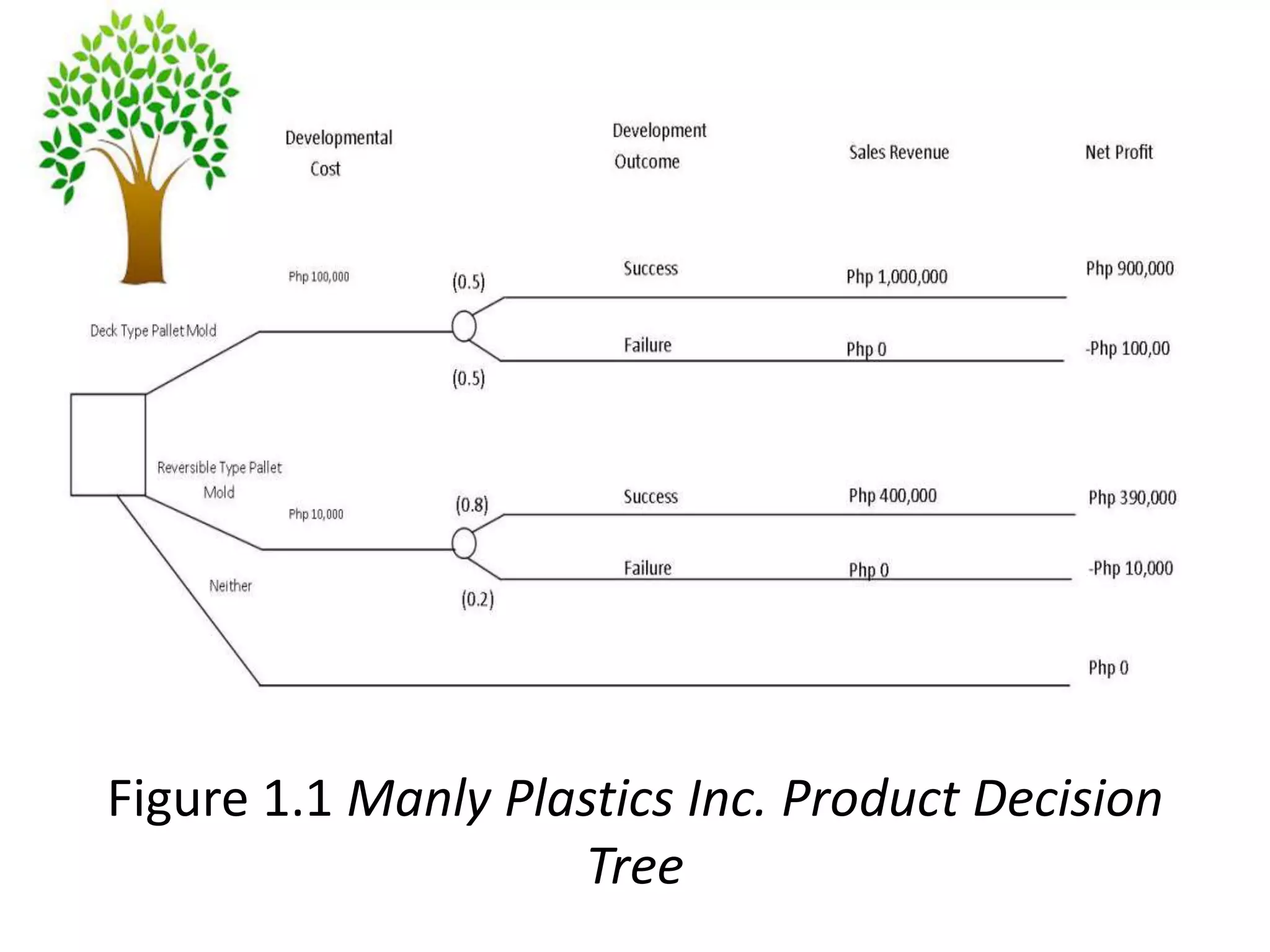
A diagram of a decision, as illustrated in Figure 1.1, is called a decision
tree. This diagram is read from left to right. The leftmost node in a
decision tree is called the root node. In Figure 1.1, this is a small
square called a decision node. The branches emanating to the right
from a decision node represent the set of decision alternatives that are
available. One, and only one, of these alternatives can be selected. The
small circles in the tree are called chance nodes. The number shown
in parentheses on each branch of a chance node is the probability that
the outcome shown on that branch will occur at the chance node. The
right end of each path through the tree is called an endpoint, and each
endpoint represents the final outcome of following a path from the root node
of the decision tree to that endpoint.
The process of successively calculating expected values from the endpoints
of the decision tree to the root node, is called a decision tree rollback.
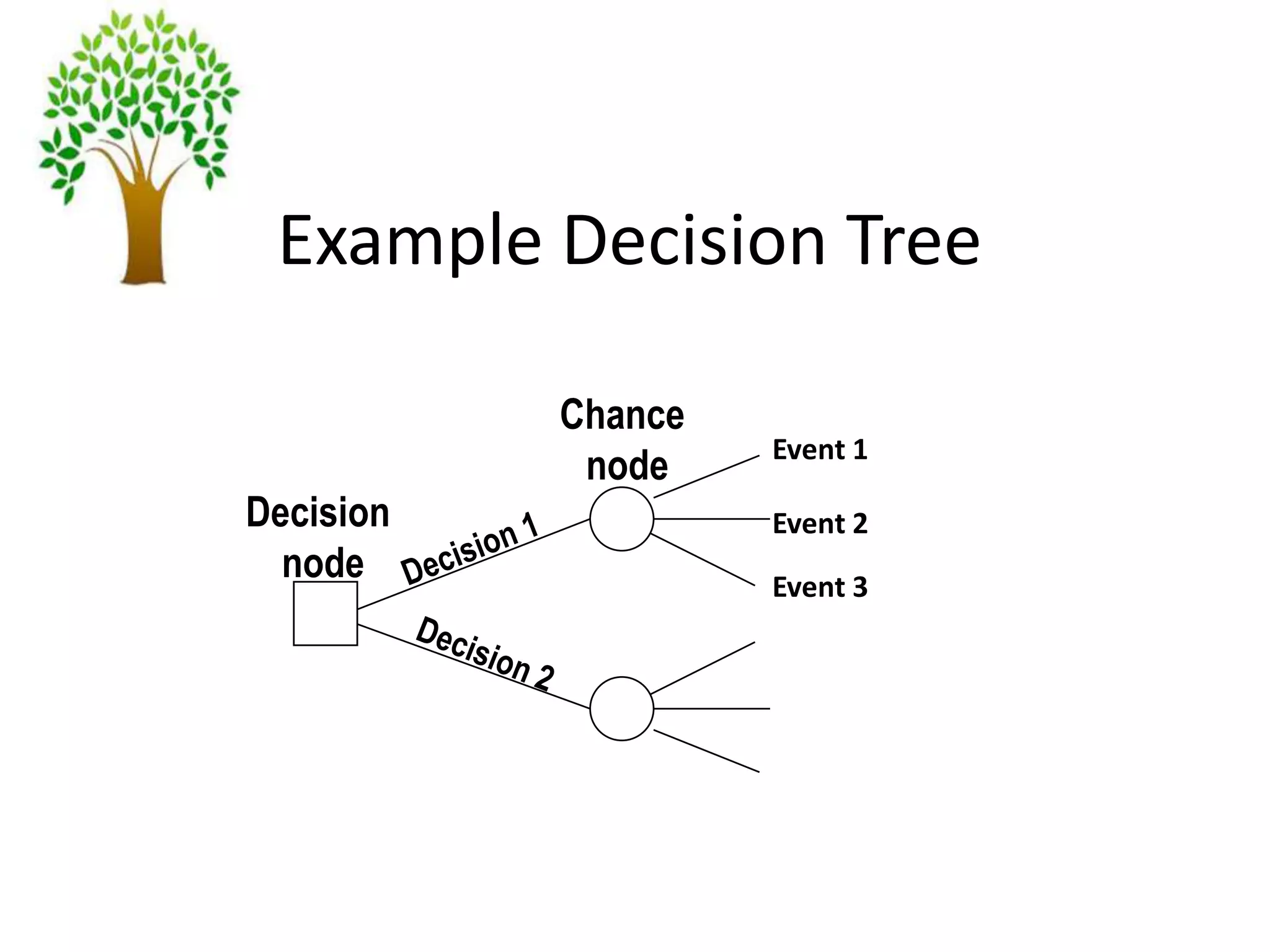
Example Decision Tree
Decision
node
Chance
node Event 1
Event 2
Event 3
• Solving the tree involves pruning all but the
best decisions at decision nodes, and finding
expected values of all possible states of nature
at chance nodes
• Create the tree from left to right
• Solve the tree from right to left
Types of Nodes
Decision node: Often represented by squares
showing decisions that can be made. Lines
emanating from a square show all distinct
options available at a node.
Chance node: Often represented by circles
showing chance outcomes. Chance outcomes
are events that can occur but are outside the
ability of the decision maker to control.
Terminal node: Often represented by triangles
or by lines having no further decision nodes or
chance nodes. Terminal nodes depict the final
outcomes of the decision making process.
Problem I Manly Plastics Inc.
Product Decision
Product decision. To absorb some short-term excess production capacity
at its Malabon plant, Manly Plastics Inc. is considering a short manufacturing
run for either of two new products, a Deck Type Pallet Mold or a Reversible Type
Pallet Mold. The market for each product is known if the products can be
successfully developed. However, there is some chance that it will not be possible to
successfully develop them.
Revenue of Php1,000,000 would be realized from selling the Deck Type Pallet Mold
and revenue of Php400,000 would be realized from selling the Reversible Type Pallet
Mold. Both of these amounts are net of production cost but do not include
development cost.
If development is unsuccessful for a product, then there will be no sales, and the
development cost will be totally lost. Development cost would be Php100,000 for
the Deck Type Pallet Mold and Php10,000 for the Reversible Type Pallet Mold.
The probability of development success is 0.5 for the Deck Type Pallet Mold and 0.8
for the Reversible Type Pallet Mold
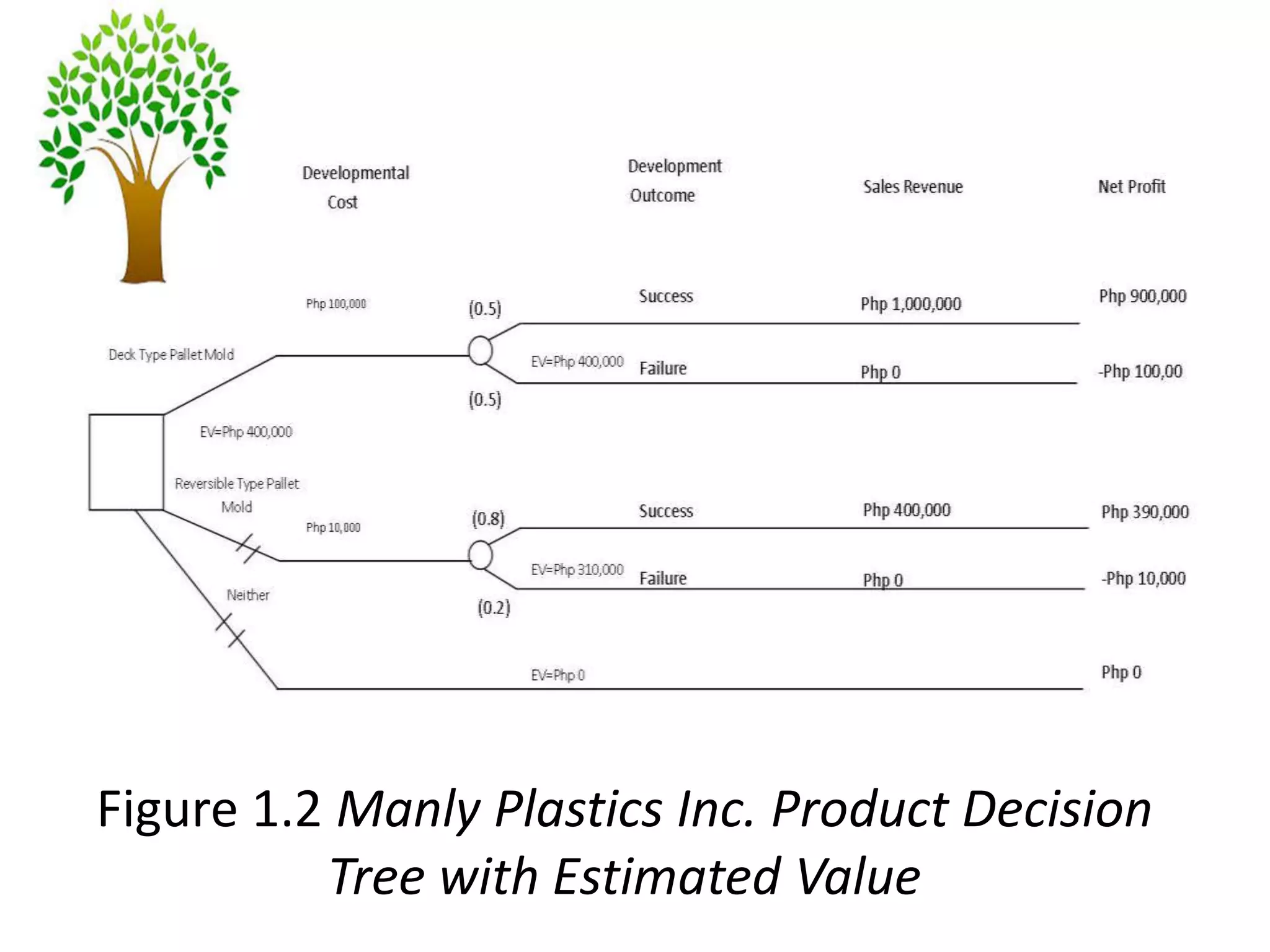
Figure 1.2 Manly Plastics Inc. Product Decision
Tree with Estimated Value
What is EV (Expected Value)?
The expected value for an uncertain alternative is
calculated by multiplying each possible outcome of the
uncertain alternative by its probability, and summing
the results. The expected value decision criterion
selects the alternative that has the best expected value.
In situations involving profits where more is better, the
alternative with the highest expected value is best, and
in situations involving costs, where less is better, the
alternative with the lowest expected value is best.
Let’s review Figure 1.2
Answer; Problem 1 Manly Plastics Inc.
Product Decision
The expected values for the Special Instrument Products
decision are designated by “EV" in Figure 1.2. These are
determined as follows: 1) For the Deck Type Pallet Mold,
0.5 (Php900,000) + 0.5 (Php100,000) = Php400, 000 2) for
the Reversible Type Pallet Mold , 0.8(390, 000)+0.2
(Php10,000) = Php310,000, and 3) for doing neither of
these Php0. Thus, the alternative with the highest
expected value is developing the temperature sensor,
and if the expected value criterion is applied, then the
Deck Type Pallet Mold should be developed.
Figure 1.1 Manly Plastics Inc. Product Decision
Tree
Problem II Vine Dessert Inc. Brownies
Kiosk
Consider a situation in which the management
of Vine Dessert Inc. must decide in choosing an
ideal location to open a new branch of Brownies
Kiosk.
The table below shows the different cost to
operate the business in different location and
probability on sales event.
Problem II Vine Dessert Inc. Brownies
Kiosk
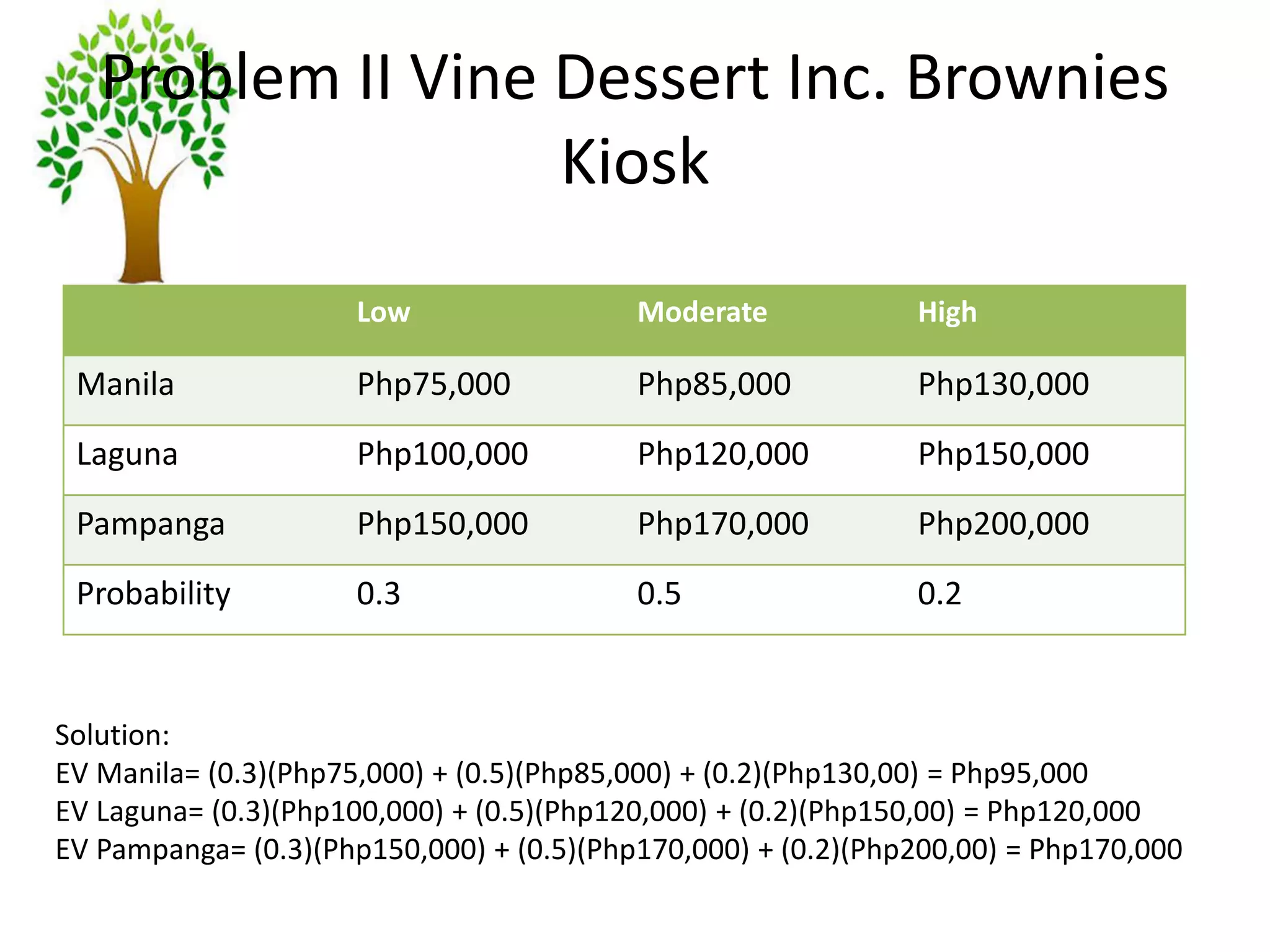
Low Moderate High
Manila Php75,000 Php85,000 Php130,000
Laguna Php100,000 Php120,000 Php150,000
Pampanga Php150,000 Php170,000 Php200,000
Probability 0.3 0.5 0.2
Solution:
EV Manila= (0.3)(Php75,000) + (0.5)(Php85,000) + (0.2)(Php130,00) = Php95,000
EV Laguna= (0.3)(Php100,000) + (0.5)(Php120,000) + (0.2)(Php150,00) = Php120,000
EV Pampanga= (0.3)(Php150,000) + (0.5)(Php170,000) + (0.2)(Php200,00) = Php170,000
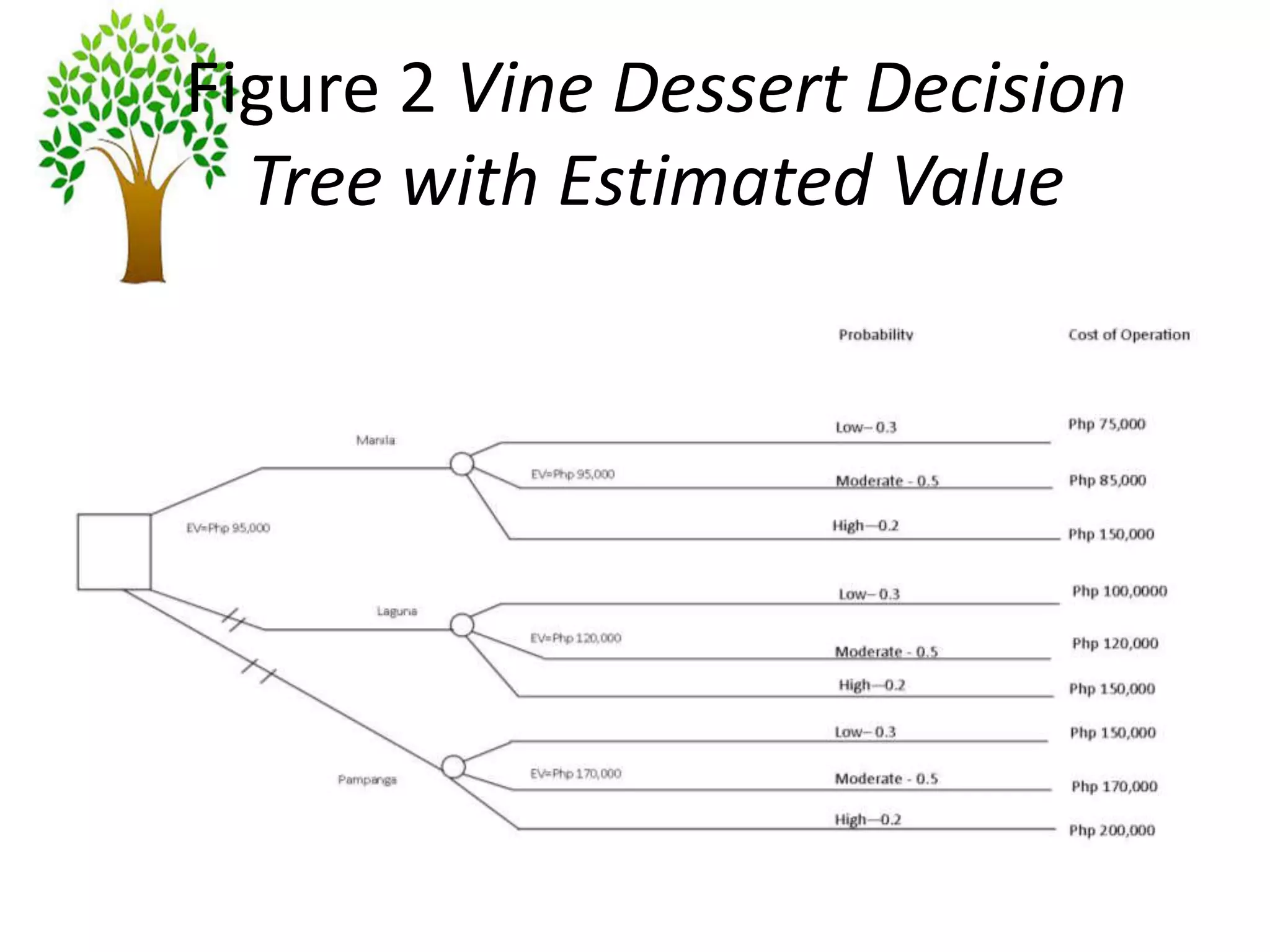
Figure 2 Vine Dessert Decision
Tree with Estimated Value
Answer; Problem II Vine Dessert Inc.
Brownies Kiosk
The problem has three alternatives one where to
open new kiosk of Brownies. There are three states
of nature or sales event in which of the said states
of nature will occur because it is not under his
control. He is just definite that any one among
these will happen. Considering the problem is
about the cost, thus the decision maker must
choose whichever is lower.
The management of Vine Dessert Inc. should open
the new Brownies Kiosk at Manila since it has the
lowest cost of business operation
Regression Trees
Decision trees can also be used to analyse data
when the y-outcome is a continuous measurement
(such as age, blood pressure, ejection fraction for
the heart, etc.). Such trees are called regression
trees.
Regression trees can be constructed using
recursive partitioning similar to classification trees.
Impurity is measured using mean-square error. The
terminal node values in a regression tree are
defined as the mean value (average) of outcomes
for patients within the terminal node. This is the
predicted value for the outcome
Survival Trees
Time-to-event data are often encountered in the
medical sciences. For such data, the analysis
focuses on understanding how time-to-event varies
in terms of different variables that might be
collected for a patient. Time-to-event can be time
to death from a certain disease, time until
recurrence (for cancer), time until first occurrence
of a symptom, or simple all-cause mortality.
http://www.ccs.miami.edu/~hishwaran/papers/decisionTree_intro_IR2009_EMDM.pd
http://www.treeplan.com/chapters/introduction-to-decision-trees.pdf
Quantitative Techniques in Business ( rex bookstore)

Decision Tree- M.B.A -DecSci

  • 1.
    Decision Tree Report By:Ms.Lesly Anne Lising Mr. Kevin Chester Cajigas
  • 2.
    What is DecisionTree A diagram of a decision, as illustrated in Figure 1.1, is called a decision tree. This diagram is read from left to right. The leftmost node in a decision tree is called the root node. In Figure 1.1, this is a small square called a decision node. The branches emanating to the right from a decision node represent the set of decision alternatives that are available. One, and only one, of these alternatives can be selected. The small circles in the tree are called chance nodes. The number shown in parentheses on each branch of a chance node is the probability that the outcome shown on that branch will occur at the chance node. The right end of each path through the tree is called an endpoint, and each endpoint represents the final outcome of following a path from the root node of the decision tree to that endpoint. The process of successively calculating expected values from the endpoints of the decision tree to the root node, is called a decision tree rollback.
  • 3.
  • 4.
    • Solving thetree involves pruning all but the best decisions at decision nodes, and finding expected values of all possible states of nature at chance nodes • Create the tree from left to right • Solve the tree from right to left
  • 5.
  • 6.
    Decision node: Oftenrepresented by squares showing decisions that can be made. Lines emanating from a square show all distinct options available at a node.
  • 7.
    Chance node: Oftenrepresented by circles showing chance outcomes. Chance outcomes are events that can occur but are outside the ability of the decision maker to control.
  • 8.
    Terminal node: Oftenrepresented by triangles or by lines having no further decision nodes or chance nodes. Terminal nodes depict the final outcomes of the decision making process.
  • 9.
    Problem I ManlyPlastics Inc. Product Decision Product decision. To absorb some short-term excess production capacity at its Malabon plant, Manly Plastics Inc. is considering a short manufacturing run for either of two new products, a Deck Type Pallet Mold or a Reversible Type Pallet Mold. The market for each product is known if the products can be successfully developed. However, there is some chance that it will not be possible to successfully develop them. Revenue of Php1,000,000 would be realized from selling the Deck Type Pallet Mold and revenue of Php400,000 would be realized from selling the Reversible Type Pallet Mold. Both of these amounts are net of production cost but do not include development cost. If development is unsuccessful for a product, then there will be no sales, and the development cost will be totally lost. Development cost would be Php100,000 for the Deck Type Pallet Mold and Php10,000 for the Reversible Type Pallet Mold. The probability of development success is 0.5 for the Deck Type Pallet Mold and 0.8 for the Reversible Type Pallet Mold
  • 10.
    Figure 1.2 ManlyPlastics Inc. Product Decision Tree with Estimated Value
  • 11.
    What is EV(Expected Value)? The expected value for an uncertain alternative is calculated by multiplying each possible outcome of the uncertain alternative by its probability, and summing the results. The expected value decision criterion selects the alternative that has the best expected value. In situations involving profits where more is better, the alternative with the highest expected value is best, and in situations involving costs, where less is better, the alternative with the lowest expected value is best. Let’s review Figure 1.2
  • 12.
    Answer; Problem 1Manly Plastics Inc. Product Decision The expected values for the Special Instrument Products decision are designated by “EV" in Figure 1.2. These are determined as follows: 1) For the Deck Type Pallet Mold, 0.5 (Php900,000) + 0.5 (Php100,000) = Php400, 000 2) for the Reversible Type Pallet Mold , 0.8(390, 000)+0.2 (Php10,000) = Php310,000, and 3) for doing neither of these Php0. Thus, the alternative with the highest expected value is developing the temperature sensor, and if the expected value criterion is applied, then the Deck Type Pallet Mold should be developed.
  • 13.
    Figure 1.1 ManlyPlastics Inc. Product Decision Tree
  • 14.
    Problem II VineDessert Inc. Brownies Kiosk Consider a situation in which the management of Vine Dessert Inc. must decide in choosing an ideal location to open a new branch of Brownies Kiosk. The table below shows the different cost to operate the business in different location and probability on sales event.
  • 15.
    Problem II VineDessert Inc. Brownies Kiosk Low Moderate High Manila Php75,000 Php85,000 Php130,000 Laguna Php100,000 Php120,000 Php150,000 Pampanga Php150,000 Php170,000 Php200,000 Probability 0.3 0.5 0.2 Solution: EV Manila= (0.3)(Php75,000) + (0.5)(Php85,000) + (0.2)(Php130,00) = Php95,000 EV Laguna= (0.3)(Php100,000) + (0.5)(Php120,000) + (0.2)(Php150,00) = Php120,000 EV Pampanga= (0.3)(Php150,000) + (0.5)(Php170,000) + (0.2)(Php200,00) = Php170,000
  • 16.
    Figure 2 VineDessert Decision Tree with Estimated Value
  • 17.
    Answer; Problem IIVine Dessert Inc. Brownies Kiosk The problem has three alternatives one where to open new kiosk of Brownies. There are three states of nature or sales event in which of the said states of nature will occur because it is not under his control. He is just definite that any one among these will happen. Considering the problem is about the cost, thus the decision maker must choose whichever is lower. The management of Vine Dessert Inc. should open the new Brownies Kiosk at Manila since it has the lowest cost of business operation
  • 18.
    Regression Trees Decision treescan also be used to analyse data when the y-outcome is a continuous measurement (such as age, blood pressure, ejection fraction for the heart, etc.). Such trees are called regression trees. Regression trees can be constructed using recursive partitioning similar to classification trees. Impurity is measured using mean-square error. The terminal node values in a regression tree are defined as the mean value (average) of outcomes for patients within the terminal node. This is the predicted value for the outcome
  • 19.
    Survival Trees Time-to-event dataare often encountered in the medical sciences. For such data, the analysis focuses on understanding how time-to-event varies in terms of different variables that might be collected for a patient. Time-to-event can be time to death from a certain disease, time until recurrence (for cancer), time until first occurrence of a symptom, or simple all-cause mortality.
  • 20.