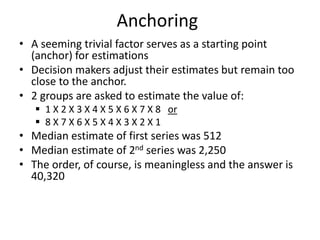
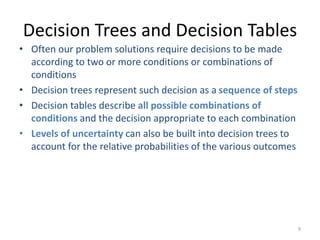
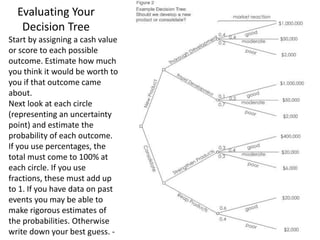
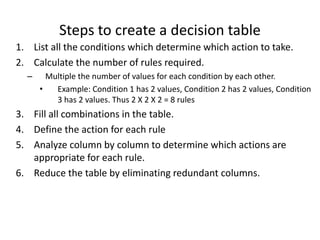
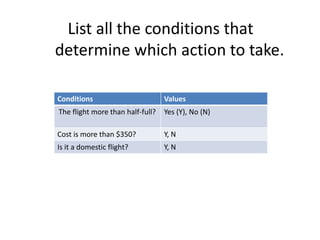
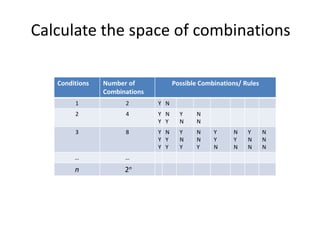
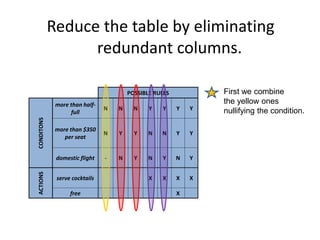
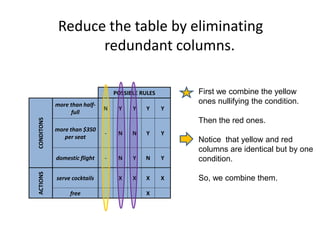
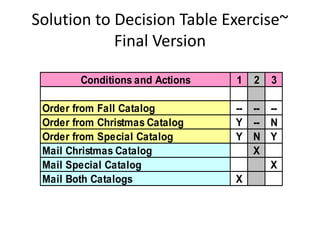
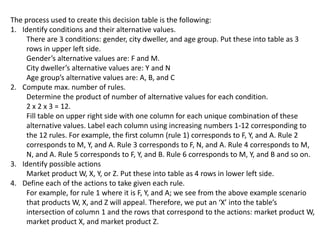
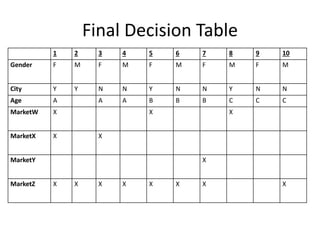
The document describes decision analysis and provides examples of how decision trees and tables can be used to analyze complex decisions. It discusses five parts of a decision-making model: identify the problem, formulate options, model the problem, analyze the model, and implement and test the solution. Anchoring and framing errors in judgment are described. Examples are provided to illustrate anchoring biases and how framing a problem as a sure win versus sure loss can influence choices. The use of decision trees to represent sequential decisions and incorporate uncertainty is demonstrated. Creating decision tables to systematically capture complex business rules is also illustrated.