Distance Function
Axioms of a Distance Measure
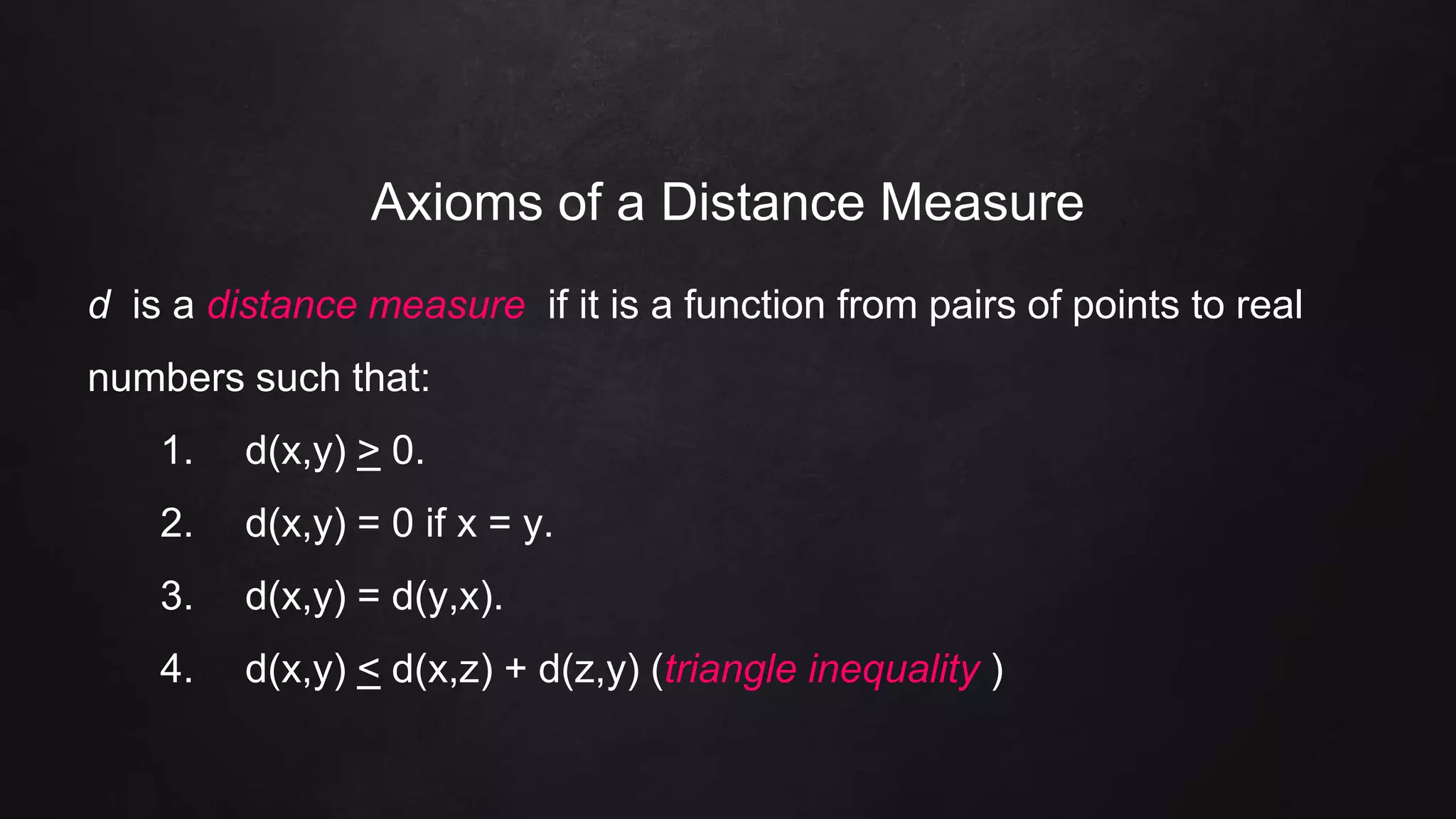
d is a distance measure if it is a function from pairs of points to real
numbers such that:
1. d(x,y) > 0.
2. d(x,y) = 0 if x = y.
3. d(x,y) = d(y,x).
4. d(x,y) < d(x,z) + d(z,y) (triangle inequality )
Distance Measure
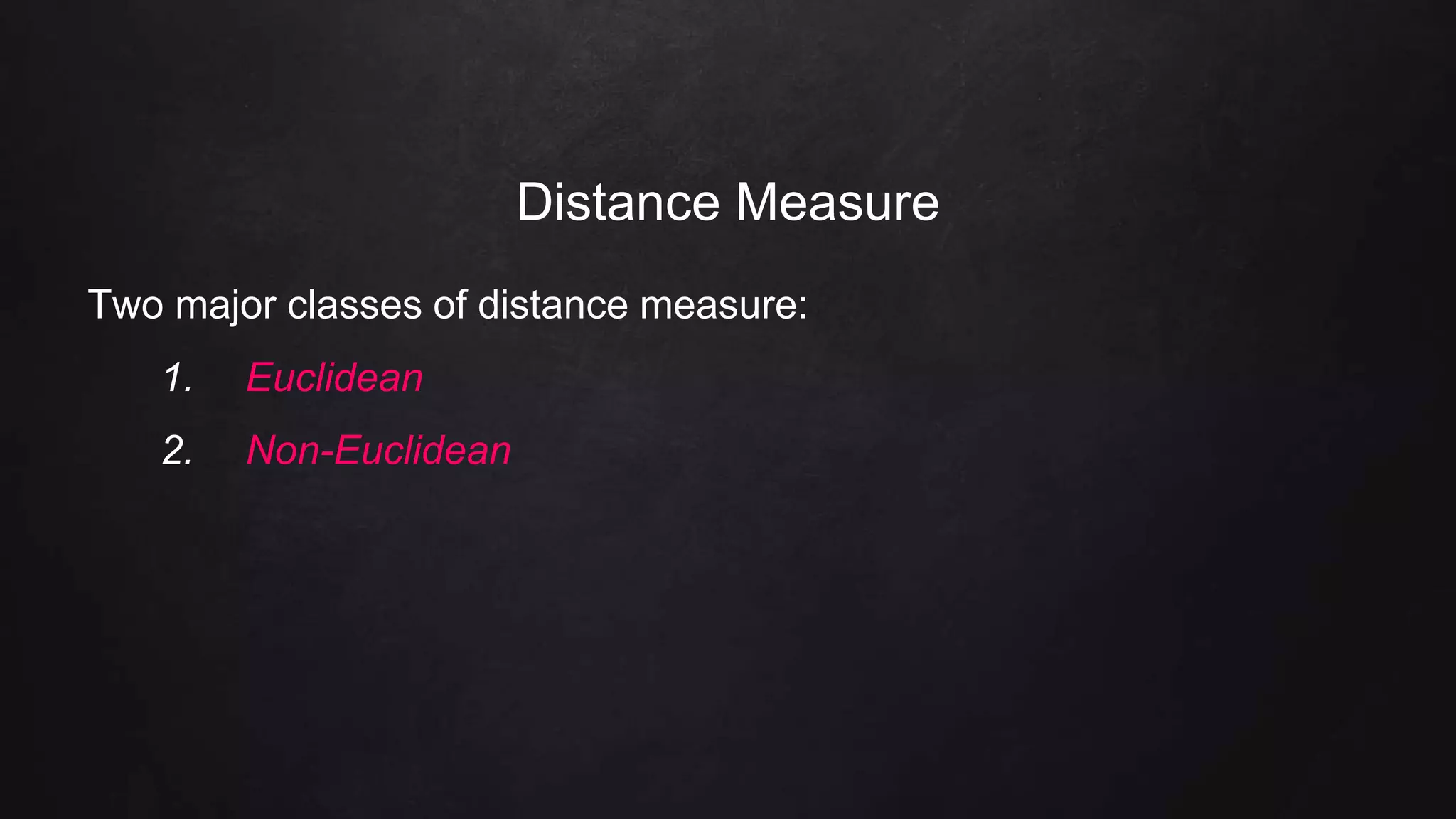
Two major classes of distance measure:
1. Euclidean
2. Non-Euclidean
Euclidean Vs. Non-Euclidean
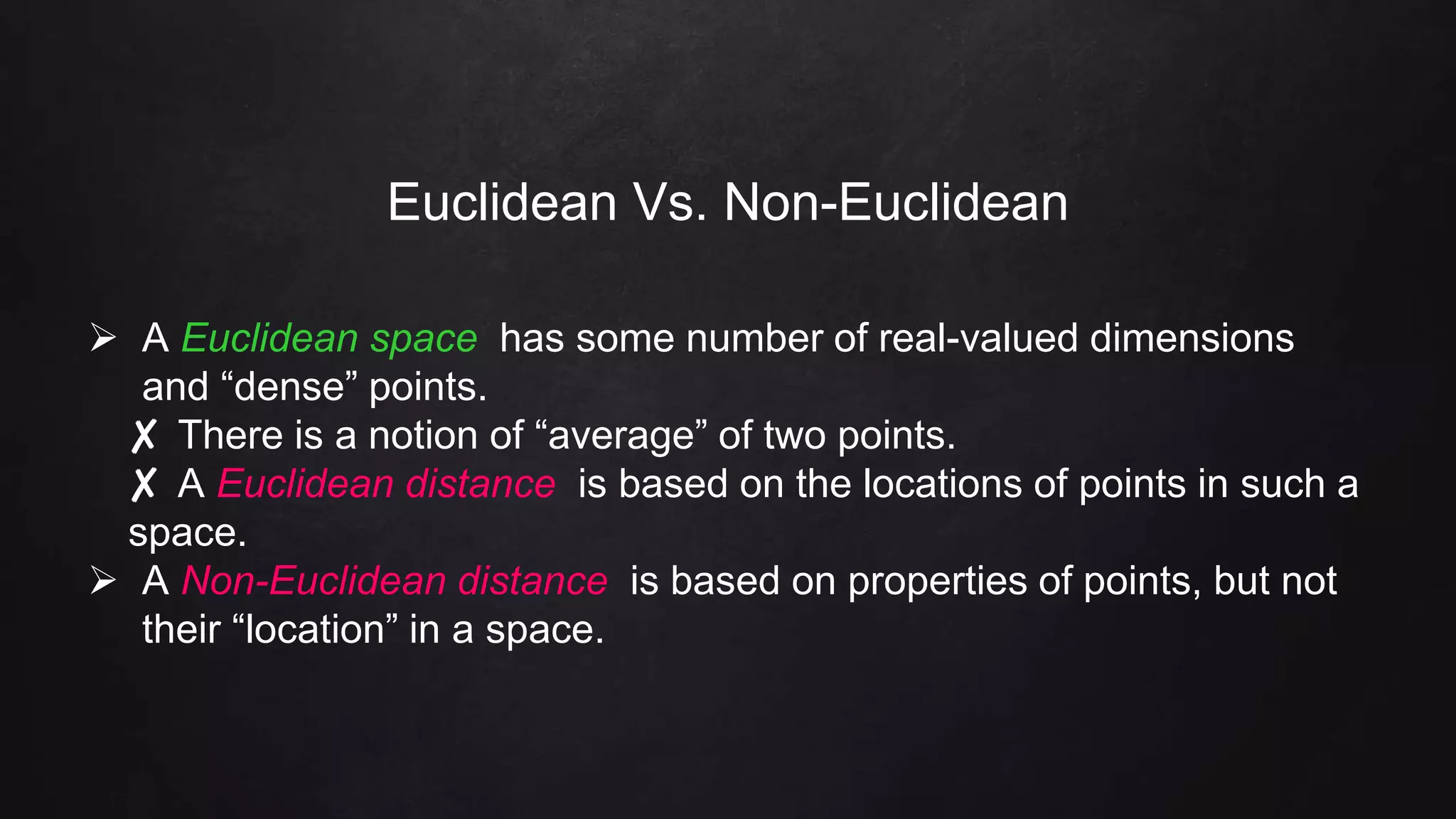
 A Euclidean space has some number of real-valued dimensions
and “dense” points.
✘ There is a notion of “average” of two points.
✘ A Euclidean distance is based on the locations of points in such a
space.
 A Non-Euclidean distance is based on properties of points, but not
their “location” in a space.
Some Euclidean Distances
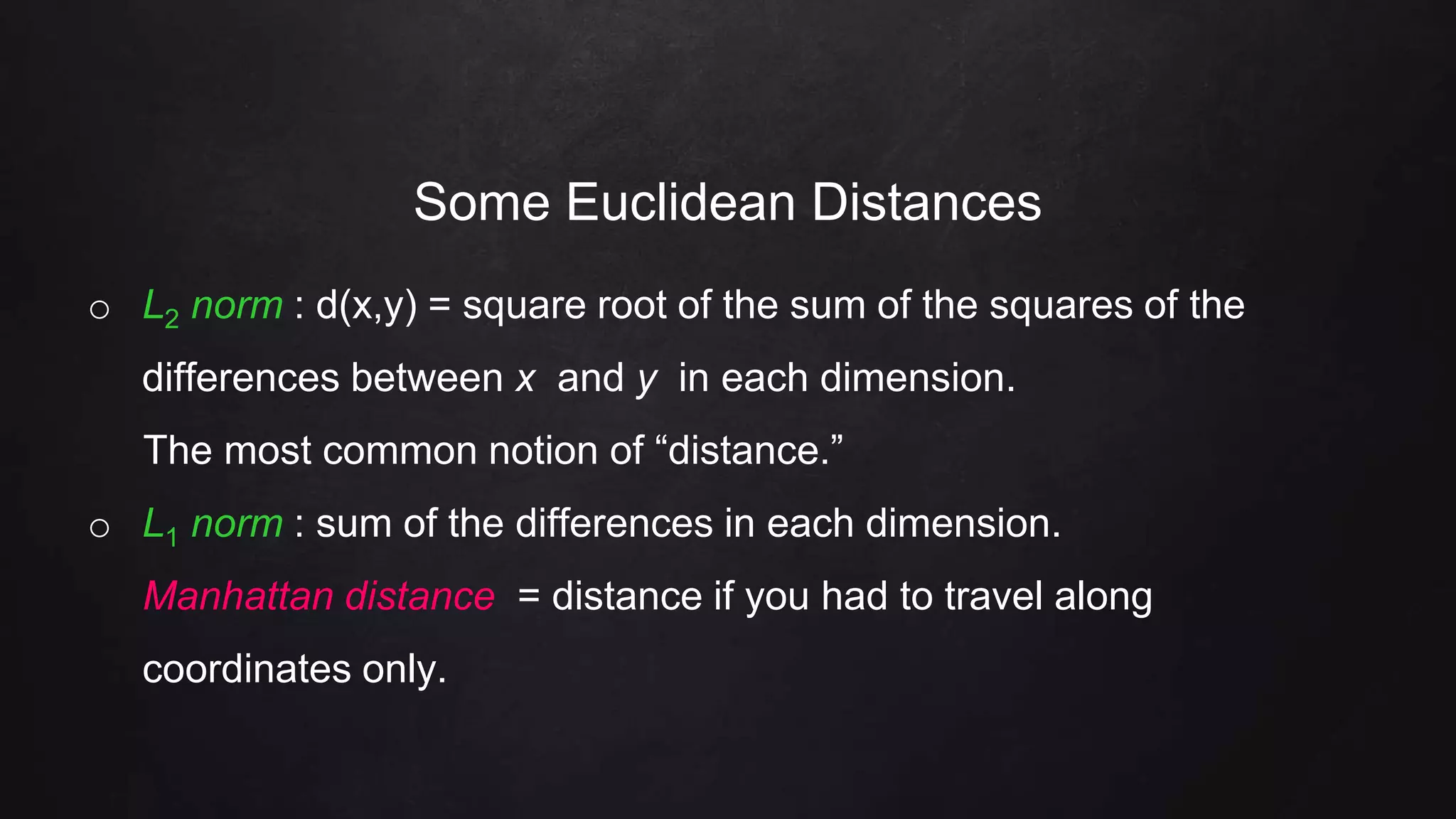
o L2 norm : d(x,y) = square root of the sum of the squares of the
differences between x and y in each dimension.
The most common notion of “distance.”
o L1 norm : sum of the differences in each dimension.
Manhattan distance = distance if you had to travel along
coordinates only.
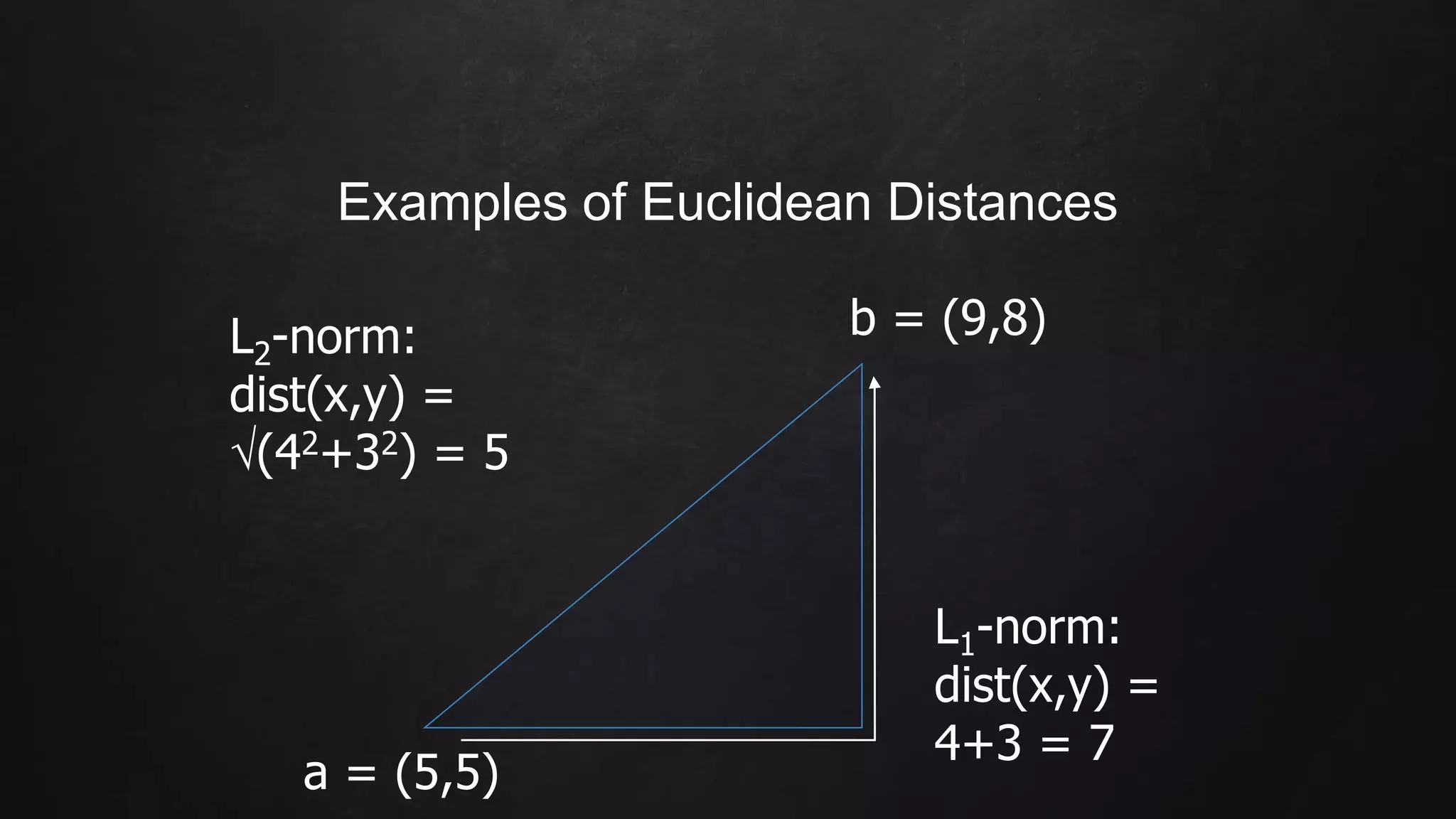
Examples of Euclidean Distances
a = (5,5)
b = (9,8)L2-norm:
dist(x,y) =
(42+32) = 5
L1-norm:
dist(x,y) =
4+3 = 7
Non-Euclidean Distances
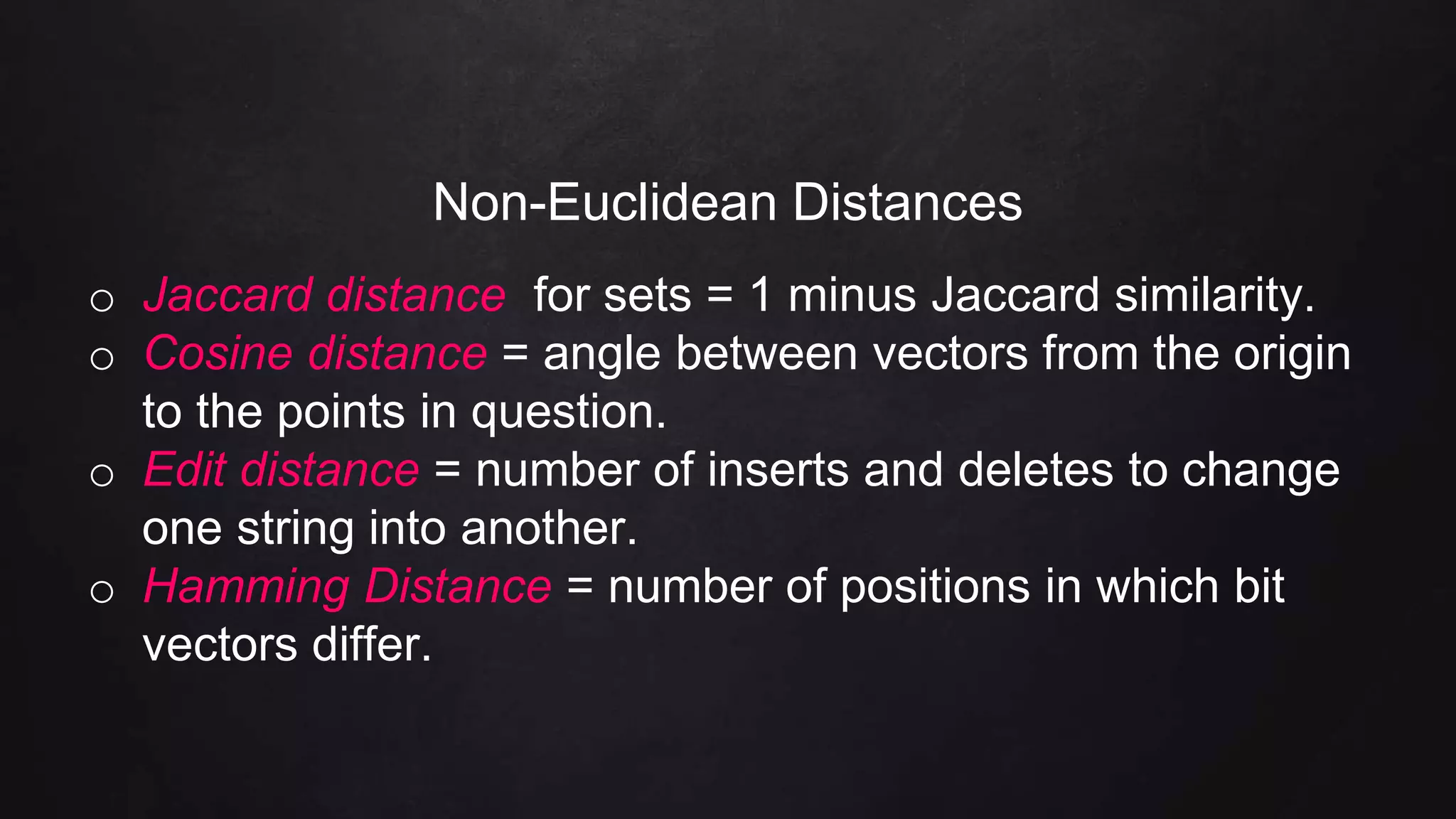
o Jaccard distance for sets = 1 minus Jaccard similarity.
o Cosine distance = angle between vectors from the origin
to the points in question.
o Edit distance = number of inserts and deletes to change
one string into another.
o Hamming Distance = number of positions in which bit
vectors differ.
Jaccard Distance for Sets (Bit-Vectors)
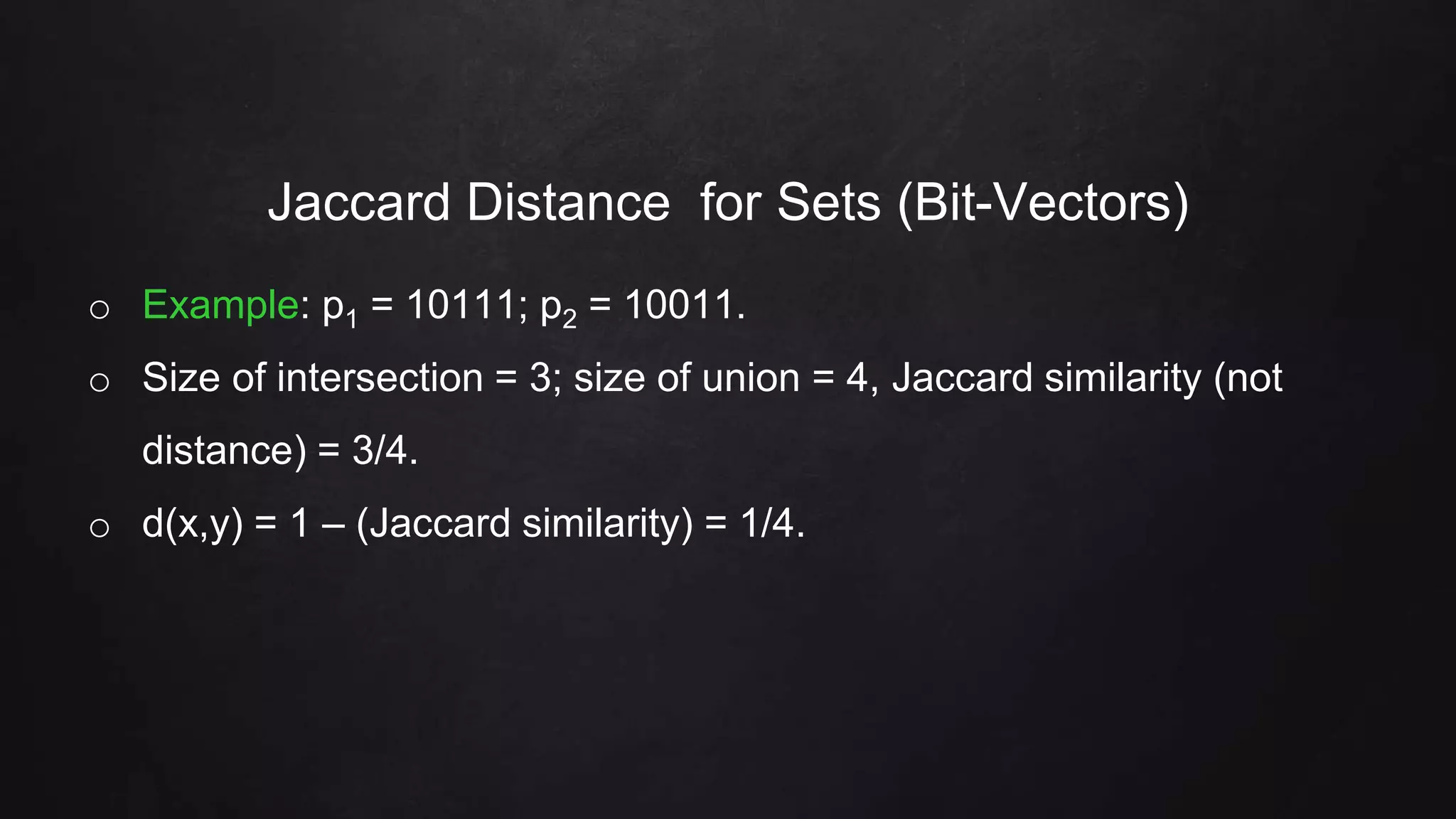
o Example: p1 = 10111; p2 = 10011.
o Size of intersection = 3; size of union = 4, Jaccard similarity (not
distance) = 3/4.
o d(x,y) = 1 – (Jaccard similarity) = 1/4.
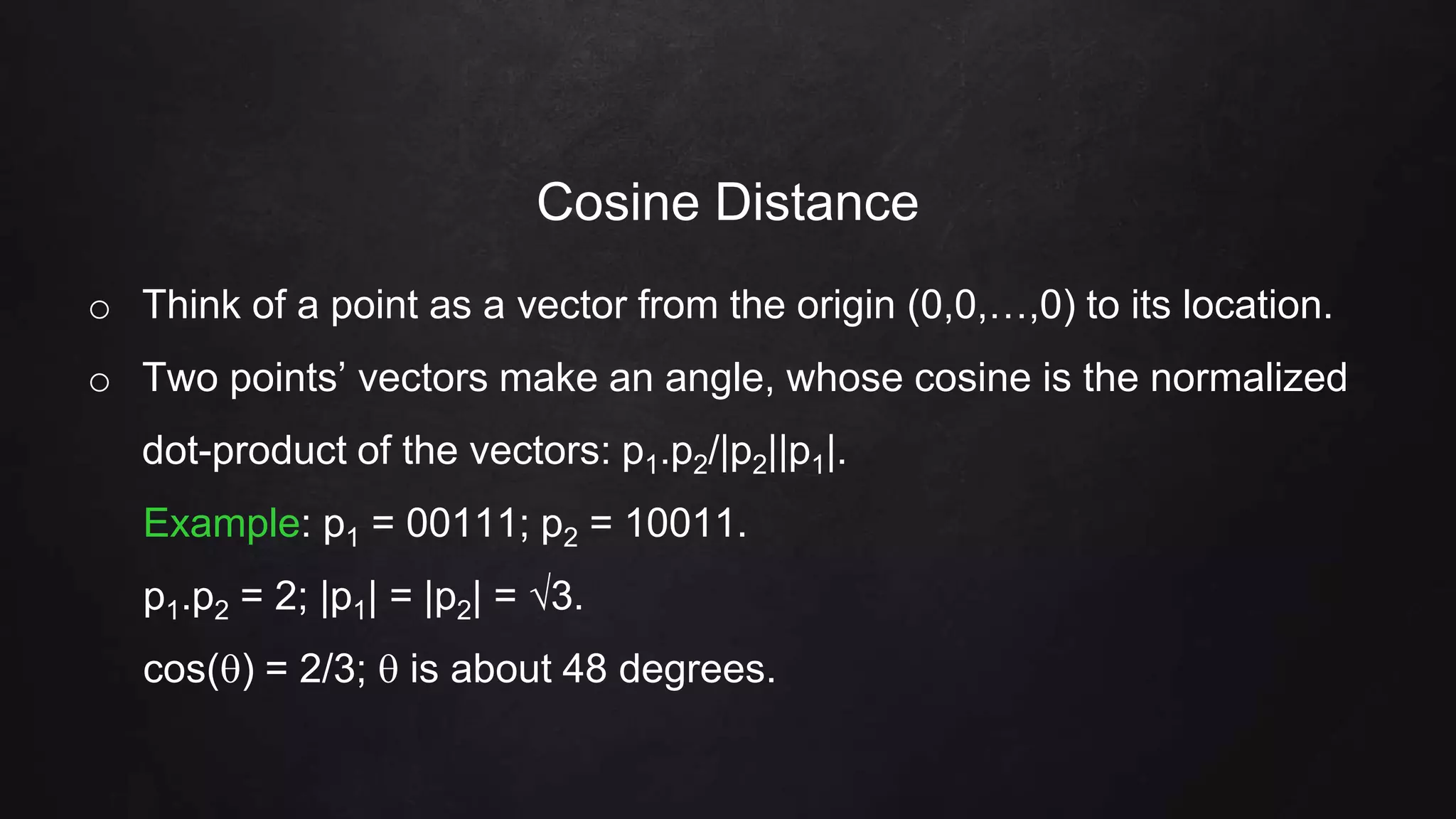
Cosine Distance
o Think of a point as a vector from the origin (0,0,…,0) to its location.
o Two points’ vectors make an angle, whose cosine is the normalized
dot-product of the vectors: p1.p2/|p2||p1|.
Example: p1 = 00111; p2 = 10011.
p1.p2 = 2; |p1| = |p2| = 3.
cos() = 2/3;  is about 48 degrees.
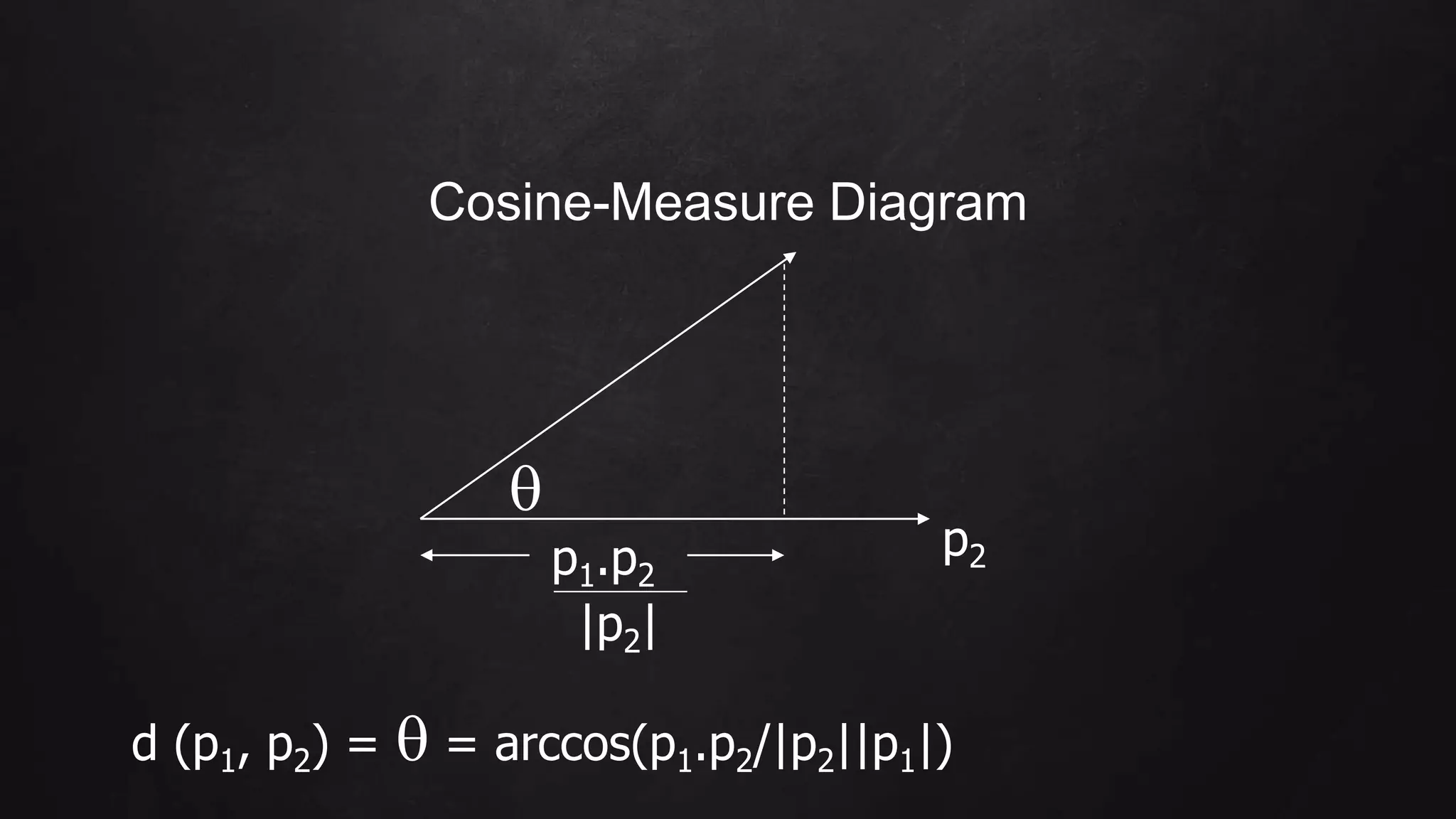
Cosine-Measure Diagram
p2p1.p2

|p2|
d (p1, p2) =  = arccos(p1.p2/|p2||p1|)
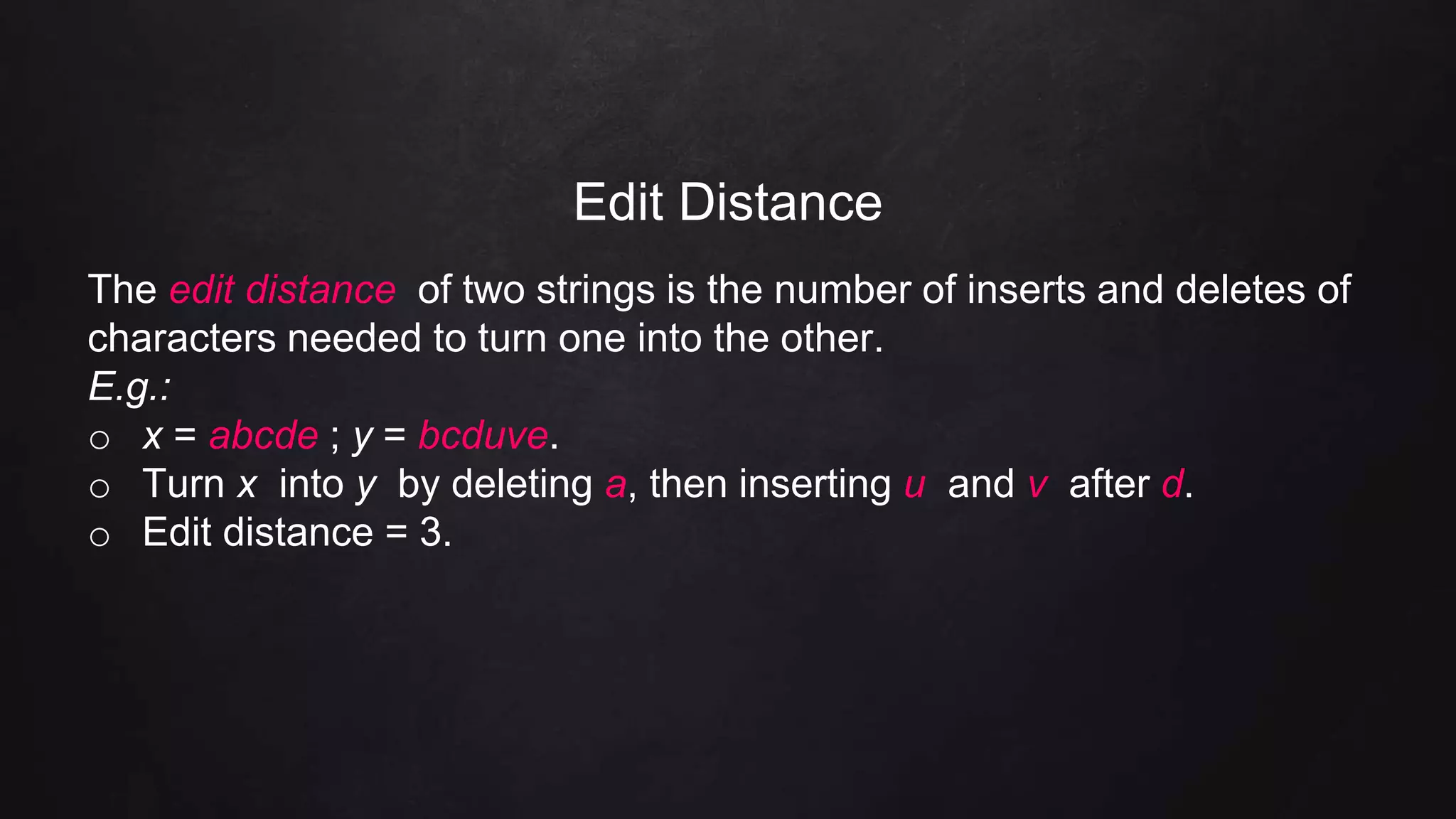
Edit Distance
The edit distance of two strings is the number of inserts and deletes of
characters needed to turn one into the other.
E.g.:
o x = abcde ; y = bcduve.
o Turn x into y by deleting a, then inserting u and v after d.
o Edit distance = 3.
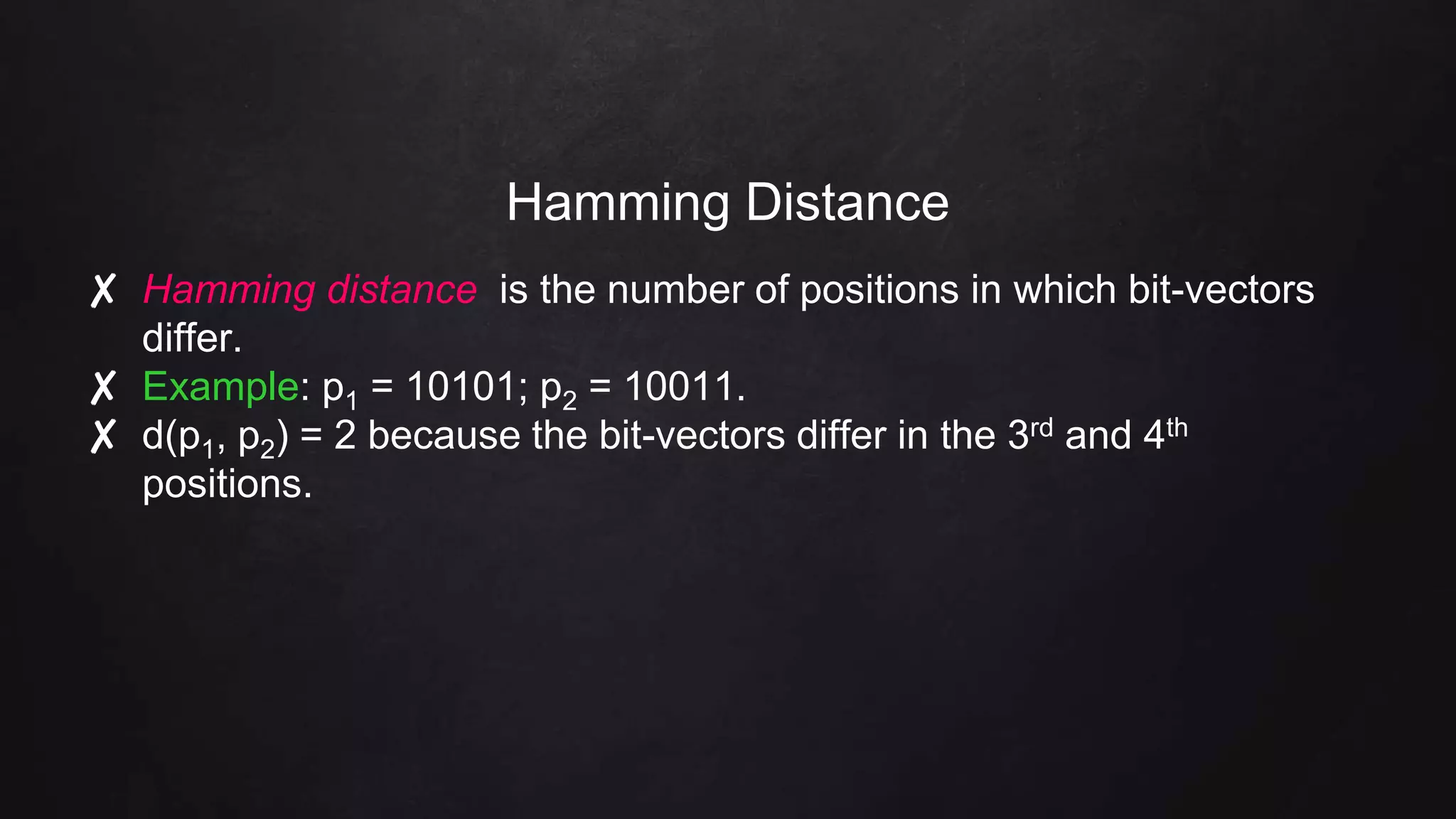
Hamming Distance
✘ Hamming distance is the number of positions in which bit-vectors
differ.
✘ Example: p1 = 10101; p2 = 10011.
✘ d(p1, p2) = 2 because the bit-vectors differ in the 3rd and 4th
positions.

Distance function

  • 1.
  • 2.
    Axioms of aDistance Measure d is a distance measure if it is a function from pairs of points to real numbers such that: 1. d(x,y) > 0. 2. d(x,y) = 0 if x = y. 3. d(x,y) = d(y,x). 4. d(x,y) < d(x,z) + d(z,y) (triangle inequality )
  • 3.
    Distance Measure Two majorclasses of distance measure: 1. Euclidean 2. Non-Euclidean
  • 4.
    Euclidean Vs. Non-Euclidean A Euclidean space has some number of real-valued dimensions and “dense” points. ✘ There is a notion of “average” of two points. ✘ A Euclidean distance is based on the locations of points in such a space.  A Non-Euclidean distance is based on properties of points, but not their “location” in a space.
  • 5.
    Some Euclidean Distances oL2 norm : d(x,y) = square root of the sum of the squares of the differences between x and y in each dimension. The most common notion of “distance.” o L1 norm : sum of the differences in each dimension. Manhattan distance = distance if you had to travel along coordinates only.
  • 6.
    Examples of EuclideanDistances a = (5,5) b = (9,8)L2-norm: dist(x,y) = (42+32) = 5 L1-norm: dist(x,y) = 4+3 = 7
  • 7.
    Non-Euclidean Distances o Jaccarddistance for sets = 1 minus Jaccard similarity. o Cosine distance = angle between vectors from the origin to the points in question. o Edit distance = number of inserts and deletes to change one string into another. o Hamming Distance = number of positions in which bit vectors differ.
  • 8.
    Jaccard Distance forSets (Bit-Vectors) o Example: p1 = 10111; p2 = 10011. o Size of intersection = 3; size of union = 4, Jaccard similarity (not distance) = 3/4. o d(x,y) = 1 – (Jaccard similarity) = 1/4.
  • 9.
    Cosine Distance o Thinkof a point as a vector from the origin (0,0,…,0) to its location. o Two points’ vectors make an angle, whose cosine is the normalized dot-product of the vectors: p1.p2/|p2||p1|. Example: p1 = 00111; p2 = 10011. p1.p2 = 2; |p1| = |p2| = 3. cos() = 2/3;  is about 48 degrees.
  • 10.
    Cosine-Measure Diagram p2p1.p2  |p2| d (p1,p2) =  = arccos(p1.p2/|p2||p1|)
  • 11.
    Edit Distance The editdistance of two strings is the number of inserts and deletes of characters needed to turn one into the other. E.g.: o x = abcde ; y = bcduve. o Turn x into y by deleting a, then inserting u and v after d. o Edit distance = 3.
  • 12.
    Hamming Distance ✘ Hammingdistance is the number of positions in which bit-vectors differ. ✘ Example: p1 = 10101; p2 = 10011. ✘ d(p1, p2) = 2 because the bit-vectors differ in the 3rd and 4th positions.