Management by Exception (MBE) is a management style where managers only intervene when employees fail to meet performance standards or when problems arise. Under MBE, managers delegate substantially to employees and only take action if metrics fall outside predetermined ranges. This focuses manager attention on important variances. For MBE to work requires an appropriate budget, a matrix defining exception levels and roles, and timely reporting. MBE allows employees autonomy as long as targets are met but risks demotivating staff and assumes budgets are perfect.
Management by Exceptionis an employee
empowerment and management style, policy or
philosophy wherein managers intervene only
when their employees fail to meet their
performance standards or when things go wrong.
The idea behind it is that management's
attention will be focused only on those areas in
need of action
If the personnel are performing as expected, the
manager will take no action.
MBE normally involves substantial delegation by
the manager to his team.
3.
The MBE issimilar to the vital signs
monitoring systems in hospital critical care
units (ICUs).
When one of the patient's vital signs goes
outside the range programmed into the
machine, an alarm sounds and staff runs to
the rescue.
If the machine is quiet, it's assumed that the
patient is stable, and they will receive only
regular staff attention.
4.
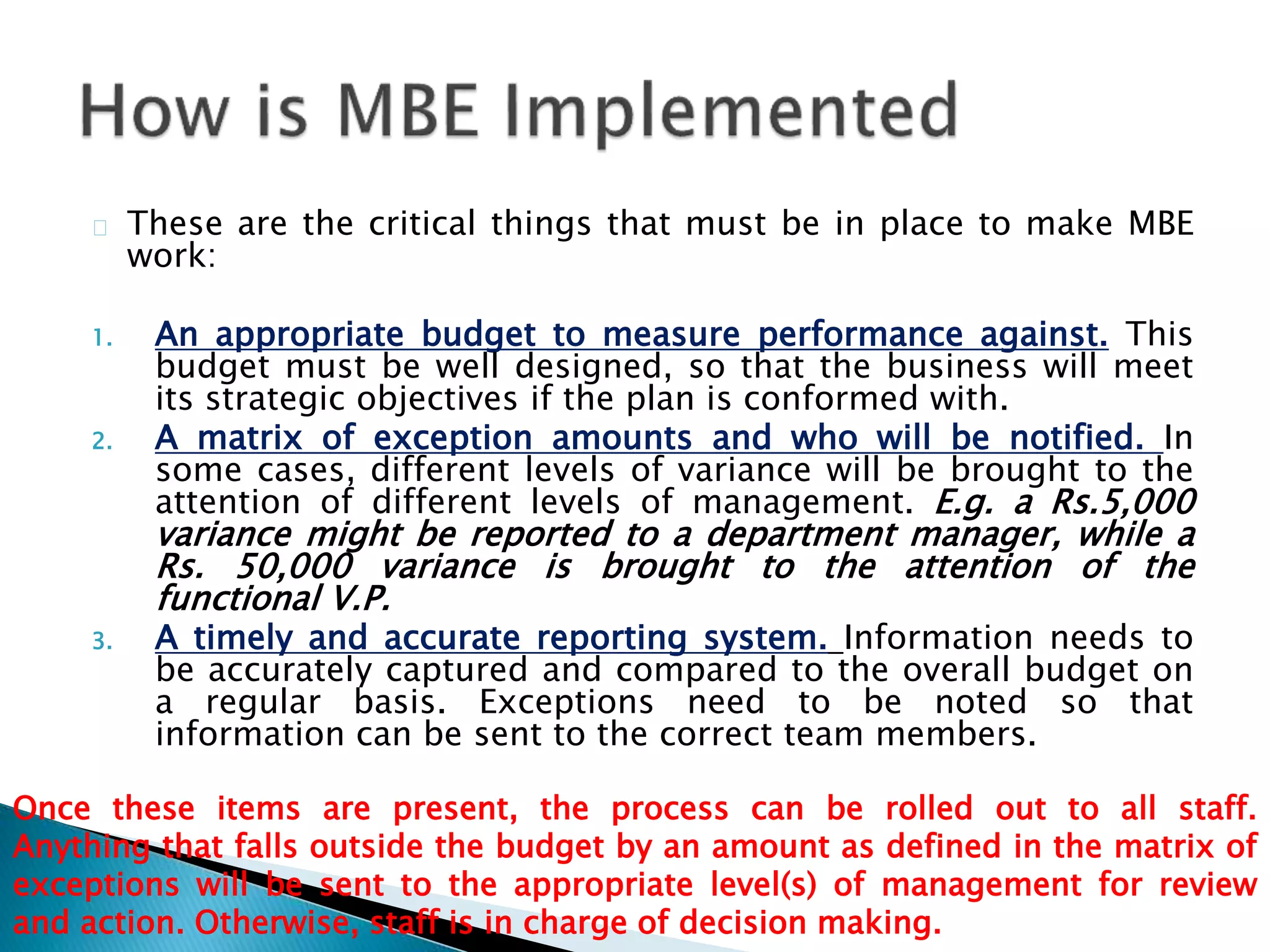
These are thecritical things that must be in place to make MBE
work:
1. An appropriate budget to measure performance against. This
budget must be well designed, so that the business will meet
its strategic objectives if the plan is conformed with.
2. A matrix of exception amounts and who will be notified. In
some cases, different levels of variance will be brought to the
attention of different levels of management. E.g. a Rs.5,000
variance might be reported to a department manager, while a
Rs. 50,000 variance is brought to the attention of the
functional V.P.
3. A timely and accurate reporting system. Information needs to
be accurately captured and compared to the overall budget on
a regular basis. Exceptions need to be noted so that
information can be sent to the correct team members.
Once these items are present, the process can be rolled out to all staff.
Anything that falls outside the budget by an amount as defined in the matrix of
exceptions will be sent to the appropriate level(s) of management for review
and action. Otherwise, staff is in charge of decision making.
5.
Some advantages ofMBE would include:
The process focuses management time and
attention on the most critical variances, which
should be a more efficient use of time.
The process allows staff to handle daily
operations per the business plan independent
of management; managers only step in when
variances reach the threshold. This should
give management more time for other
functions, such as strategic planning.
6.
Some disadvantages ofMBE would include:
The process assumes the budget is well designed,
and that there are no issues that need to be
addressed if results match the budget.
The process assumes staff cannot handle variances;
instead management must be brought in.
The process assumes that management's attention
should be focused on 'mistakes'. When staff manages
to the defined plan, nothing happens. When things
vary, management swoops down to fix them. This can
be very un-motivating to staff.