
UPES
UPES
Jul 2012
DECISION MAKING
The Selection from Among Alternatives of
a Course of Action
“Management means Decision-making”—
Moore
Jul 2012
CONCEPT OF DECISION-MAKING
“The Selection from Among
Alternatives of a Course of Actions. It
is the Core of Planning.”
Jul 2012
A manager’s life is filled with making decisions
after decisions, because they have to constantly
choose what is to be done, who is to do it, when
to do it, where to do it and how to do.
Jul 2012
Implies there are various alternatives available
and the most desirable alternative is chosen to
solve the problem or to arrive at the expected
results.
Jul 2012
Decision-making like any other managerial
process, is goal directed.
It implies that the decision maker attempts to
achieve some results through decision making.
It is an essential part of modern management.
Jul 2012
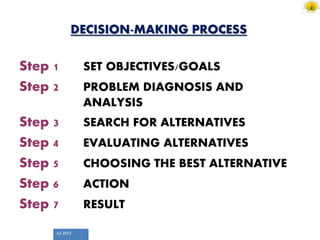
DECISION-MAKING PROCESS
Step 1 SET OBJECTIVES/GOALS
Step 2 PROBLEM DIAGNOSIS AND
ANALYSIS
Step 3 SEARCH FOR ALTERNATIVES
Step 4 EVALUATING ALTERNATIVES
Step 5 CHOOSING THE BEST ALTERNATIVE
Step 6 ACTION
Step 7 RESULT
Jul 2012
TYPES OF MANAGERIAL DECISIONS
 STRATEGIC DECISIONS
Have a major impact on the organization and
contribute to the achievement of organizational
objectives.
 OPERATIONAL DECISIONS
Are related to day-to-day operations of the
organization.
Jul 2012
PERSONAL AND ORGANIZATIONAL
DECISIONS
Personal decisions attempt to achieve personal
goals
Organizational decisions attempt to achieve
organizational goals.
Jul 2012
 BASIC AND ROUTINE DECISIONS
Basic decisions are unique, one-time decisions
involving long-range commitments of relative
permanence or duration, or those involving
large investments,
e.g., plant location, product line etc.
Jul 2012
Routine decisions are every day, highly
repetitive, management decisions which by
themselves have little impact on the overall
organization.
E.g., accountant’s decision on a new entry, a
personnel manager’s decision to appoint a new
worker etc.
Jul 2012
PROGRAMMED AND NON-PROGRAMMED
DECISIONS
Programmed decisions are routine, repetitive
decisions
Non-programmed decisions are unique, one-
shot decisions
Jul 2012
MODELS OF DECISION MAKING PROCESS
ECONOMIC MAN MODEL- Classical Economists
Man is completely rational in taking decisions. He takes
decisions based on the best alternative available
Steps taken:
• Discover the problem or difficulty
• Determine the goal to be achieved or define the problem
to be solved
• Identify all alternative courses of action
• Choose the best alternative
• Act or implement the decision
Jul 2012
ADMINISTRATIVE MAN MODEL- Herbert
Simon
In this man uses Rationality (reasonableness,
wisdom, prudence)
Steps are:
• Set the goal or define the problem.
• After identifying a desirable alternative
evaluate it to determine its acceptability
• Implement the solution
• Following the implementation
Jul 2012
SOCIAL MAN MODEL- Classical
Psychologists
Man being a Social Animal
Having a bundle of feelings and emotions
Guided by his desires
Also subject to social pressures and influences
Usually such a person cannot take rational
decisions.

Decision making

  • 1.
  • 2.
    Jul 2012 DECISION MAKING TheSelection from Among Alternatives of a Course of Action “Management means Decision-making”— Moore
  • 3.
    Jul 2012 CONCEPT OFDECISION-MAKING “The Selection from Among Alternatives of a Course of Actions. It is the Core of Planning.”
  • 4.
    Jul 2012 A manager’slife is filled with making decisions after decisions, because they have to constantly choose what is to be done, who is to do it, when to do it, where to do it and how to do.
  • 5.
    Jul 2012 Implies thereare various alternatives available and the most desirable alternative is chosen to solve the problem or to arrive at the expected results.
  • 6.
    Jul 2012 Decision-making likeany other managerial process, is goal directed. It implies that the decision maker attempts to achieve some results through decision making. It is an essential part of modern management.
  • 7.
    Jul 2012 DECISION-MAKING PROCESS Step1 SET OBJECTIVES/GOALS Step 2 PROBLEM DIAGNOSIS AND ANALYSIS Step 3 SEARCH FOR ALTERNATIVES Step 4 EVALUATING ALTERNATIVES Step 5 CHOOSING THE BEST ALTERNATIVE Step 6 ACTION Step 7 RESULT
  • 8.
    Jul 2012 TYPES OFMANAGERIAL DECISIONS  STRATEGIC DECISIONS Have a major impact on the organization and contribute to the achievement of organizational objectives.  OPERATIONAL DECISIONS Are related to day-to-day operations of the organization.
  • 9.
    Jul 2012 PERSONAL ANDORGANIZATIONAL DECISIONS Personal decisions attempt to achieve personal goals Organizational decisions attempt to achieve organizational goals.
  • 10.
    Jul 2012  BASICAND ROUTINE DECISIONS Basic decisions are unique, one-time decisions involving long-range commitments of relative permanence or duration, or those involving large investments, e.g., plant location, product line etc.
  • 11.
    Jul 2012 Routine decisionsare every day, highly repetitive, management decisions which by themselves have little impact on the overall organization. E.g., accountant’s decision on a new entry, a personnel manager’s decision to appoint a new worker etc.
  • 12.
    Jul 2012 PROGRAMMED ANDNON-PROGRAMMED DECISIONS Programmed decisions are routine, repetitive decisions Non-programmed decisions are unique, one- shot decisions
  • 13.
    Jul 2012 MODELS OFDECISION MAKING PROCESS ECONOMIC MAN MODEL- Classical Economists Man is completely rational in taking decisions. He takes decisions based on the best alternative available Steps taken: • Discover the problem or difficulty • Determine the goal to be achieved or define the problem to be solved • Identify all alternative courses of action • Choose the best alternative • Act or implement the decision
  • 14.
    Jul 2012 ADMINISTRATIVE MANMODEL- Herbert Simon In this man uses Rationality (reasonableness, wisdom, prudence) Steps are: • Set the goal or define the problem. • After identifying a desirable alternative evaluate it to determine its acceptability • Implement the solution • Following the implementation
  • 15.
    Jul 2012 SOCIAL MANMODEL- Classical Psychologists Man being a Social Animal Having a bundle of feelings and emotions Guided by his desires Also subject to social pressures and influences Usually such a person cannot take rational decisions.