Parenting Styles
and their Effects on
Children
Kathlyn Villalobos
Evergreen Valley College
Psych 001: Introduction to Psychology
Prof: Nirali Patel
December 11, 2022
PAGE
01
PAGE
04
PAGE
03
Introduction
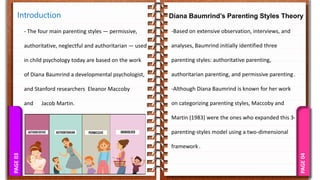
- The four main parenting styles — permissive,
authoritative, neglectful and authoritarian — used
in child psychology today are based on the work
of Diana Baumrind a developmental psychologist,
and Stanford researchers Eleanor Maccoby
and Jacob Martin.
-Based on extensive observation, interviews, and
analyses, Baumrind initially identified three
parenting styles: authoritative parenting,
authoritarian parenting, and permissive parenting.
-Although Diana Baumrind is known for her work
on categorizing parenting styles, Maccoby and
Martin (1983) were the ones who expanded this 3-
parenting-styles model using a two-dimensional
framework.
Diana Baumrind’s Parenting Styles Theory
PAGE
06
PAGE
05
- Maccoby and Martin expanded Baumrind’s
permissive parenting style into two different
parenting types: permissive style (also known as
indulgent parenting style) and neglectful parenting
(also known as uninvolved parenting style).
Diana Baumrind’s Parenting Styles Theory
Cont'd
Statistics On Different Types Of Parenting
Styles
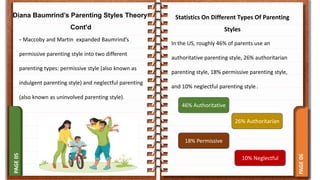
In the US, roughly 46% of parents use an
authoritative parenting style, 26% authoritarian
parenting style, 18% permissive parenting style,
and 10% neglectful parenting style .
46% Authoritative
26% Authoritarian
18% Permissive
10% Neglectful
PAGE
08
PAGE
07Cultural Background
What is Culture?
Culture refers to a pattern of social norms,
values, language, and behavior shared by
individuals parents are affected by their culture
• Parenting approaches vary across cultures concerning
promoting attention, compliance, delayed
gratification, executive function, and effortful control.
• Every parent has a different approach in how to
interact and guide their children. A child’s morals,
principles, and conduct are generally established
through this bond.
• Cultural backgrounds have a major impact on
how the family unit exists and how children are
reared. In the last several years, the population
of the United States of America has had a
makeup. Changes driven by immigration,
socioeconomic status, and single-parent families
are some of the factors that determine a variety
of parenting styles among families.
PAGE
10
PAGE
09
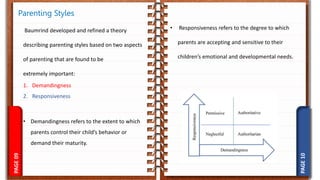
• Responsiveness refers to the degree to which
parents are accepting and sensitive to their
children’s emotional and developmental needs.
Parenting Styles
Baumrind developed and refined a theory
describing parenting styles based on two aspects
of parenting that are found to be
extremely important:
1. Demandingness
2. Responsiveness
• Demandingness refers to the extent to which
parents control their child’s behavior or
demand their maturity.
PAGE
12
PAGE
11
PAGE
14
PAGE
13
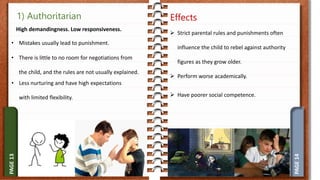
Effects
 Strict parental rules and punishments often
influence the child to rebel against authority
figures as they grow older.
 Perform worse academically.
1) Authoritarian
• There is little to no room for negotiations from
the child, and the rules are not usually explained.
• Mistakes usually lead to punishment.
High demandingness. Low responsiveness.
• Less nurturing and have high expectations
with limited flexibility.  Have poorer social competence.
PAGE
15
PAGE
14
2)Authoritative Effects
• Disciplinary methods are used as a way of
support instead of punishment
• Warm and responsive
• This type of parent normally develops a close,
nurturing relationship with their children
 Authoritative parenting results in children who are
confident, responsible, and able to self-regulate
 They can manage their negative emotions more
effectively, which leads to better social outcomes
and emotional health
 These children have a high level of academic
achievement and school performance
High demandingness. High responsiveness.
PAGE
17
PAGE
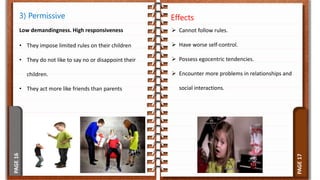
16 Effects
 Cannot follow rules.
 Have worse self-control.
 Possess egocentric tendencies.
 Encounter more problems in relationships and
social interactions.
3) Permissive
Low demandingness. High responsiveness
• They impose limited rules on their children
• They do not like to say no or disappoint their
children.
• They act more like friends than parents
PAGE
19
PAGE
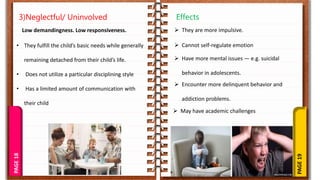
183)Neglectful/ Uninvolved
Low demandingness. Low responsiveness.
• They fulfill the child’s basic needs while generally
remaining detached from their child’s life.
• Does not utilize a particular disciplining style
• Has a limited amount of communication with
their child
Effects
 They are more impulsive.
 Cannot self-regulate emotion
 Have more mental issues — e.g. suicidal
behavior in adolescents.
 Encounter more delinquent behavior and
addiction problems.
 May have academic challenges
PAGE
21
PAGE
20
Other Types of Parenting
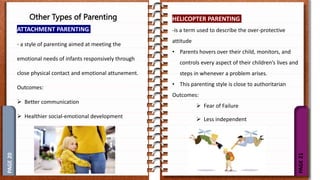
ATTACHMENT PARENTING
- a style of parenting aimed at meeting the
emotional needs of infants responsively through
close physical contact and emotional attunement.
Outcomes:
 Better communication
 Healthier social-emotional development
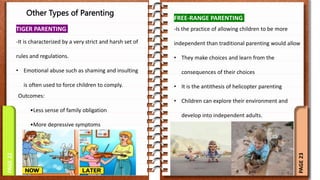
HELICOPTER PARENTING
-is a term used to describe the over-protective
attitude
• Parents hovers over their child, monitors, and
controls every aspect of their children’s lives and
steps in whenever a problem arises.
• This parenting style is close to authoritarian
Outcomes:
 Fear of Failure
 Less independent
PAGE
23
PAGE
22
Other Types of Parenting
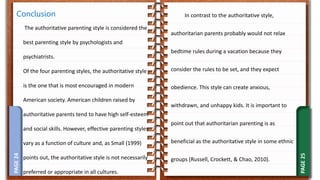
TIGER PARENTING
-It is characterized by a very strict and harsh set of
rules and regulations.
• Emotional abuse such as shaming and insulting
is often used to force children to comply.
-Is the practice of allowing children to be more
independent than traditional parenting would allow
• They make choices and learn from the
consequences of their choices
• It is the antithesis of helicopter parenting
• Children can explore their environment and
develop into independent adults.
Outcomes:
•Less sense of family obligation
•More depressive symptoms
FREE-RANGE PARENTING
PAGE
25
PAGE
24 In contrast to the authoritative style,
authoritarian parents probably would not relax
bedtime rules during a vacation because they
consider the rules to be set, and they expect
obedience. This style can create anxious,
withdrawn, and unhappy kids. It is important to
point out that authoritarian parenting is as
beneficial as the authoritative style in some ethnic
groups (Russell, Crockett, & Chao, 2010).
Conclusion
The authoritative parenting style is considered the
best parenting style by psychologists and
psychiatrists.
Of the four parenting styles, the authoritative style
is the one that is most encouraged in modern
American society. American children raised by
authoritative parents tend to have high self-esteem
and social skills. However, effective parenting styles
vary as a function of culture and, as Small (1999)
points out, the authoritative style is not necessarily
preferred or appropriate in all cultures.
PAGE
26
PAGE
26
Reference
•Mendez, M. (n.d.). Types of parenting styles and effects
on children - statpearls -
NCBI https://www.ncbi.nlm.nih.gov/books/NBK568743/
•Pamela Li, M. S. (n.d.). 4 types of parenting styles and
their effects on the child. Parenting For Brain. 11AD, from
https://www.parentingforbrain.com/4-baumrind-
parenting-styles/
•Worthy, L. D., Lavigne, T., & Romero, F. (2020, July 27).
Parenting styles. Culture and Psychology.
https://open.maricopa.edu/culturepsychology/chapter/p
arenting-styles/
THANK YOU

Parenting-Styles-final-ppt.pptx

  • 1.
    Parenting Styles and theirEffects on Children Kathlyn Villalobos Evergreen Valley College Psych 001: Introduction to Psychology Prof: Nirali Patel December 11, 2022
  • 2.
  • 3.
    PAGE 04 PAGE 03 Introduction - The fourmain parenting styles — permissive, authoritative, neglectful and authoritarian — used in child psychology today are based on the work of Diana Baumrind a developmental psychologist, and Stanford researchers Eleanor Maccoby and Jacob Martin. -Based on extensive observation, interviews, and analyses, Baumrind initially identified three parenting styles: authoritative parenting, authoritarian parenting, and permissive parenting. -Although Diana Baumrind is known for her work on categorizing parenting styles, Maccoby and Martin (1983) were the ones who expanded this 3- parenting-styles model using a two-dimensional framework. Diana Baumrind’s Parenting Styles Theory
  • 4.
    PAGE 06 PAGE 05 - Maccoby andMartin expanded Baumrind’s permissive parenting style into two different parenting types: permissive style (also known as indulgent parenting style) and neglectful parenting (also known as uninvolved parenting style). Diana Baumrind’s Parenting Styles Theory Cont'd Statistics On Different Types Of Parenting Styles In the US, roughly 46% of parents use an authoritative parenting style, 26% authoritarian parenting style, 18% permissive parenting style, and 10% neglectful parenting style . 46% Authoritative 26% Authoritarian 18% Permissive 10% Neglectful
  • 5.
    PAGE 08 PAGE 07Cultural Background What isCulture? Culture refers to a pattern of social norms, values, language, and behavior shared by individuals parents are affected by their culture • Parenting approaches vary across cultures concerning promoting attention, compliance, delayed gratification, executive function, and effortful control. • Every parent has a different approach in how to interact and guide their children. A child’s morals, principles, and conduct are generally established through this bond. • Cultural backgrounds have a major impact on how the family unit exists and how children are reared. In the last several years, the population of the United States of America has had a makeup. Changes driven by immigration, socioeconomic status, and single-parent families are some of the factors that determine a variety of parenting styles among families.
  • 6.
    PAGE 10 PAGE 09 • Responsiveness refersto the degree to which parents are accepting and sensitive to their children’s emotional and developmental needs. Parenting Styles Baumrind developed and refined a theory describing parenting styles based on two aspects of parenting that are found to be extremely important: 1. Demandingness 2. Responsiveness • Demandingness refers to the extent to which parents control their child’s behavior or demand their maturity.
  • 7.
  • 8.
    PAGE 14 PAGE 13 Effects  Strict parentalrules and punishments often influence the child to rebel against authority figures as they grow older.  Perform worse academically. 1) Authoritarian • There is little to no room for negotiations from the child, and the rules are not usually explained. • Mistakes usually lead to punishment. High demandingness. Low responsiveness. • Less nurturing and have high expectations with limited flexibility.  Have poorer social competence.
  • 9.
    PAGE 15 PAGE 14 2)Authoritative Effects • Disciplinarymethods are used as a way of support instead of punishment • Warm and responsive • This type of parent normally develops a close, nurturing relationship with their children  Authoritative parenting results in children who are confident, responsible, and able to self-regulate  They can manage their negative emotions more effectively, which leads to better social outcomes and emotional health  These children have a high level of academic achievement and school performance High demandingness. High responsiveness.
  • 10.
    PAGE 17 PAGE 16 Effects  Cannotfollow rules.  Have worse self-control.  Possess egocentric tendencies.  Encounter more problems in relationships and social interactions. 3) Permissive Low demandingness. High responsiveness • They impose limited rules on their children • They do not like to say no or disappoint their children. • They act more like friends than parents
  • 11.
    PAGE 19 PAGE 183)Neglectful/ Uninvolved Low demandingness.Low responsiveness. • They fulfill the child’s basic needs while generally remaining detached from their child’s life. • Does not utilize a particular disciplining style • Has a limited amount of communication with their child Effects  They are more impulsive.  Cannot self-regulate emotion  Have more mental issues — e.g. suicidal behavior in adolescents.  Encounter more delinquent behavior and addiction problems.  May have academic challenges
  • 12.
    PAGE 21 PAGE 20 Other Types ofParenting ATTACHMENT PARENTING - a style of parenting aimed at meeting the emotional needs of infants responsively through close physical contact and emotional attunement. Outcomes:  Better communication  Healthier social-emotional development HELICOPTER PARENTING -is a term used to describe the over-protective attitude • Parents hovers over their child, monitors, and controls every aspect of their children’s lives and steps in whenever a problem arises. • This parenting style is close to authoritarian Outcomes:  Fear of Failure  Less independent
  • 13.
    PAGE 23 PAGE 22 Other Types ofParenting TIGER PARENTING -It is characterized by a very strict and harsh set of rules and regulations. • Emotional abuse such as shaming and insulting is often used to force children to comply. -Is the practice of allowing children to be more independent than traditional parenting would allow • They make choices and learn from the consequences of their choices • It is the antithesis of helicopter parenting • Children can explore their environment and develop into independent adults. Outcomes: •Less sense of family obligation •More depressive symptoms FREE-RANGE PARENTING
  • 14.
    PAGE 25 PAGE 24 In contrastto the authoritative style, authoritarian parents probably would not relax bedtime rules during a vacation because they consider the rules to be set, and they expect obedience. This style can create anxious, withdrawn, and unhappy kids. It is important to point out that authoritarian parenting is as beneficial as the authoritative style in some ethnic groups (Russell, Crockett, & Chao, 2010). Conclusion The authoritative parenting style is considered the best parenting style by psychologists and psychiatrists. Of the four parenting styles, the authoritative style is the one that is most encouraged in modern American society. American children raised by authoritative parents tend to have high self-esteem and social skills. However, effective parenting styles vary as a function of culture and, as Small (1999) points out, the authoritative style is not necessarily preferred or appropriate in all cultures.
  • 15.
    PAGE 26 PAGE 26 Reference •Mendez, M. (n.d.).Types of parenting styles and effects on children - statpearls - NCBI https://www.ncbi.nlm.nih.gov/books/NBK568743/ •Pamela Li, M. S. (n.d.). 4 types of parenting styles and their effects on the child. Parenting For Brain. 11AD, from https://www.parentingforbrain.com/4-baumrind- parenting-styles/ •Worthy, L. D., Lavigne, T., & Romero, F. (2020, July 27). Parenting styles. Culture and Psychology. https://open.maricopa.edu/culturepsychology/chapter/p arenting-styles/
  • 16.