Stress and Anxiety in Youth
Sussex Hamilton High School
December 3rd, 2019
What we will cover
1. Stress
2. Anxiety Disorders
3. Treatment
4. Symptom Accommodation & Parent Education
5. Anxiety in School Setting
6. Questions
Stress
What is stress?
o Stressor-is a situation that the person experiences and
threatening in some way (e.g., academics, social stress, family
discord, world events, trauma, significant life changes)
o The threat exceeds one’s ability to cope
• How we interpret a stressor determines whether a stressor is + or
– and/or the severity of the impact (i.e., is divorce always an
unhappy event?; could my reaction to getting a flat tire make my
emotional suffering worse?)
o Stress Response-complex set of physiological changes that
help us deal with the stressor
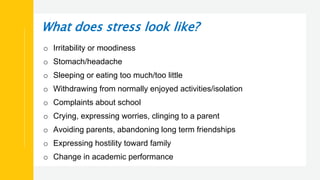
What does stress look like?
o Irritability or moodiness
o Stomach/headache
o Sleeping or eating too much/too little
o Withdrawing from normally enjoyed activities/isolation
o Complaints about school
o Crying, expressing worries, clinging to a parent
o Avoiding parents, abandoning long term friendships
o Expressing hostility toward family
o Change in academic performance
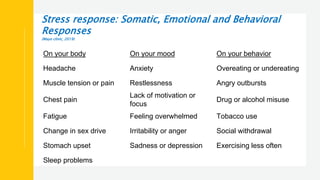
Stress response: Somatic, Emotional and Behavioral
Responses
(Mayo clinic, 2019)
On your body On your mood On your behavior
Headache Anxiety Overeating or undereating
Muscle tension or pain Restlessness Angry outbursts
Chest pain
Lack of motivation or
focus
Drug or alcohol misuse
Fatigue Feeling overwhelmed Tobacco use
Change in sex drive Irritability or anger Social withdrawal
Stomach upset Sadness or depression Exercising less often
Sleep problems
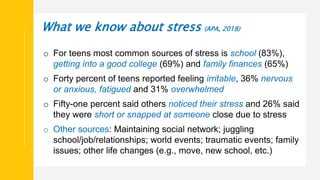
What we know about stress (APA, 2018)
o For teens most common sources of stress is school (83%),
getting into a good college (69%) and family finances (65%)
o Forty percent of teens reported feeling irritable, 36% nervous
or anxious, fatigued and 31% overwhelmed
o Fifty-one percent said others noticed their stress and 26% said
they were short or snapped at someone close due to stress
o Other sources: Maintaining social network; juggling
school/job/relationships; world events; traumatic events; family
issues; other life changes (e.g., move, new school, etc.)
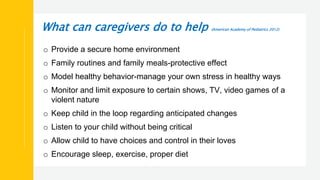
What can caregivers do to help (American Academy of Pediatrics 2012)
o Provide a secure home environment
o Family routines and family meals-protective effect
o Model healthy behavior-manage your own stress in healthy ways
o Monitor and limit exposure to certain shows, TV, video games of a
violent nature
o Keep child in the loop regarding anticipated changes
o Listen to your child without being critical
o Allow child to have choices and control in their loves
o Encourage sleep, exercise, proper diet
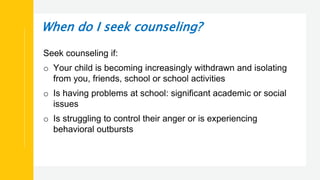
When do I seek counseling?
Seek counseling if:
o Your child is becoming increasingly withdrawn and isolating
from you, friends, school or school activities
o Is having problems at school: significant academic or social
issues
o Is struggling to control their anger or is experiencing
behavioral outbursts
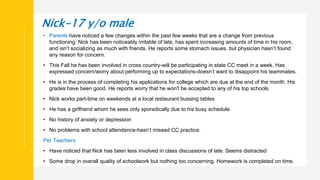
Nick-17 y/o male
• Parents have noticed a few changes within the past few weeks that are a change from previous
functioning: Nick has been noticeably irritable of late, has spent increasing amounts of time in his room,
and isn’t socializing as much with friends. He reports some stomach issues, but physician hasn’t found
any reason for concern.
• This Fall he has been involved in cross country-will be participating in state CC meet in a week. Has
expressed concern/worry about performing up to expectations-doesn’t want to disappoint his teammates.
• He is in the process of completing his applications for college which are due at the end of the month. His
grades have been good. He reports worry that he won't be accepted to any of his top schools
• Nick works part-time on weekends at a local restaurant bussing tables
• He has a girlfriend whom he sees only sporadically due to his busy schedule.
• No history of anxiety or depression
• No problems with school attendance-hasn’t missed CC practice.
Per Teachers:
• Have noticed that Nick has been less involved in class discussions of late. Seems distracted
• Some drop in overall quality of schoolwork but nothing too concerning. Homework is completed on time.
Anxiety & Anxiety Disorders
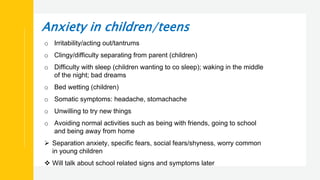
Anxiety in children/teens
o Irritability/acting out/tantrums
o Clingy/difficulty separating from parent (children)
o Difficulty with sleep (children wanting to co sleep); waking in the middle
of the night; bad dreams
o Bed wetting (children)
o Somatic symptoms: headache, stomachache
o Unwilling to try new things
o Avoiding normal activities such as being with friends, going to school
and being away from home
 Separation anxiety, specific fears, social fears/shyness, worry common
in young children
 Will talk about school related signs and symptoms later
When is it an anxiety disorder?
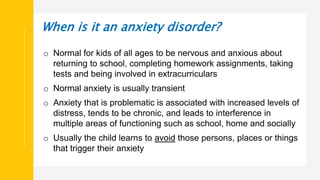
o Normal for kids of all ages to be nervous and anxious about
returning to school, completing homework assignments, taking
tests and being involved in extracurriculars
o Normal anxiety is usually transient
o Anxiety that is problematic is associated with increased levels of
distress, tends to be chronic, and leads to interference in
multiple areas of functioning such as school, home and socially
o Usually the child learns to avoid those persons, places or things
that trigger their anxiety
Anxiety vs. Fear
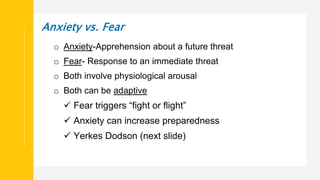
o Anxiety-Apprehension about a future threat
o Fear- Response to an immediate threat
o Both involve physiological arousal
o Both can be adaptive
 Fear triggers “fight or flight”
 Anxiety can increase preparedness
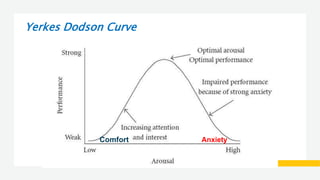
 Yerkes Dodson (next slide)
Yerkes Dodson Curve
Comfort Anxiety
Epidemiology of Anxiety Disorders
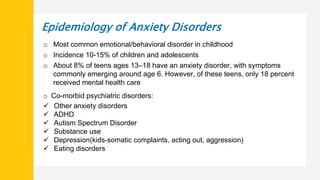
o Most common emotional/behavioral disorder in childhood
o Incidence 10-15% of children and adolescents
o About 8% of teens ages 13–18 have an anxiety disorder, with symptoms
commonly emerging around age 6. However, of these teens, only 18 percent
received mental health care
o Co-morbid psychiatric disorders:
 Other anxiety disorders
 ADHD
 Autism Spectrum Disorder
 Substance use
 Depression(kids-somatic complaints, acting out, aggression)
 Eating disorders
What are the anxiety disorders?
o Generalized anxiety disorder (GAD)
o Separation anxiety disorder
o Social anxiety disorder
o Selective mutism
o Panic disorder
 Obsessive-compulsive disorder (OCD) (obsessive compulsive and related
disorders) ex. BDD, Hair pulling disorder, Hoarding disorder
 Post-traumatic stress disorder (trauma and stressor related disorders) ex.
RAD, Disinhibited social engagement disorder, adjustment disorders
Generalized Anxiety Disorder
o Excessive/difficult to control worry (for at least 6 mos)
 About: welfare and safety of family and friends, finances,
relationships, punctuality, school performance, world
events
o Associated symptoms:
 Irritability, muscle tension, fatigue, unable to sit still, poor
concentration and sleep
o Not easily reassured
o May throw tantrums related to anxiety
o Poor concentration and attention, fidgety
 May present similar to a child with ADHD
Separation Anxiety
o Excessive anxiety focused on separating from home or parent
o More commonly diagnosed in pre-pubertal children
 More common in 5-7 and 11-12-year olds with transition into
elementary and middle school
o Typically occurs following a significant change or major life
event (e.g., divorce, illness, move)
o Behaviors: Clinging/shadowing behavior, nightmares,
expressing fear of losing loved one, school refusal, somatic
complaints
Social Anxiety Disorder
o Excessive fear in social situations where child is
exposed to unfamiliar people/evaluation by others
(e.g., Raising hand in class, class presentations,
friendships)
o Tremendous concern about social
failure/embarrassment/humiliation
o Fear is excessive and unreasonable
o Avoidance or endurance with extreme distress
o Interference in functioning (e.g., Unable to attend
school, few if any friendships, isolated from social
activities)
Selective Mutism
o Children either talk minimally or not at all in
certain settings or situations that are part of their
daily lives (e.g., with teachers and classmates,
meeting new people (especially adults)
o Reflects underlying problems with anxiety
o Often inadvertently reinforced
 speaking for the child
 permitting the use of nonverbal communication
o Considered a more severe form of social phobia
Panic Attacks vs. Panic Disorder
Panic attacks:
o Sudden, discrete episodes of intense fear, Intense desire to
escape, doom
o Activation of autonomic nervous system (Fight or flight)
o Duration 15-30 minutes
o Common 20-30% of adult population
Panic Disorder:
o Recurrent panic attacks
o Inter-episode worry about having a panic attack
o Worry about implications and consequences
o Changes in behavior
o More common in adolescents
Post-traumatic Stress Disorder
o Exposure to an actual or threatened death, serious injury or
sexual violence.
o Re-experiencing of the trauma (e.g., play echoing trauma
theme, frightening dreams, reenactment of trauma in play)
o Avoidance of thoughts, feelings people, places that are
associated with the trauma, anhedonia, feelings of detachment
o Negative changes to thoughts and mood(e.g. increased
negative emotions such as fear guilt sadness; anhedonia;
socially withdrawn; decreased expression of positive emotions)
o Arousal (e.g., irritability, hyper vigilance, exaggerated startle,
poor concentration and sleep)
OCD
Diagnosis: What are Obsessions?
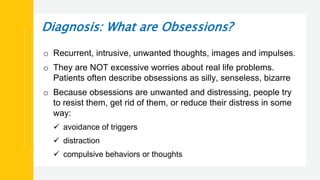
o Recurrent, intrusive, unwanted thoughts, images and impulses.
o They are NOT excessive worries about real life problems.
Patients often describe obsessions as silly, senseless, bizarre
o Because obsessions are unwanted and distressing, people try
to resist them, get rid of them, or reduce their distress in some
way:
 avoidance of triggers
 distraction
 compulsive behaviors or thoughts
Examples of Obsessions
o Fear of Contamination or Germs (chemicals,
pets/insects, sticky substances, doorknobs, public
bathrooms)
o Fear of Harm or Danger (to self, loved ones)
o Fear of Loss (books, papers, receipts, trash)
o Need for Symmetry (need to have room organized in
a certain way)
o Need for Perfection (need for certainty, fear of
anxiety)
Diagnosis: What are Compulsions?
o A compulsion is a behavior or mental act that a
person feels driven to perform over and over again
 to prevent or reduce anxiety, discomfort or distress
 to “prevent” something bad from happening
o Performed in response to an obsession
o Often performed according to rigid rules or until it
feels “just right”
Examples of Compulsions
o Washing/Cleaning (hand washing, grooming, toilet routine,
brushing teeth)
o Checking (stove, light switches, door locks, reassurance
seeking, calling Mom at work, going over homework to
make sure it is done correctly)
o Hoarding (collecting trash, saving receipts, old
magazines/books, other old, useless or dated materials)
o Ordering/Arranging (books and CDs on shelf, pillows on
bed, icons on computer)
o Repeating Rituals (rereading, rewriting, retracing steps, or
until feels “just right”)
What is not OCD?
o Pathological gambling (impulse-control).
o Kleptomania (impulse-control).
o Certain substance abuse disorders
o Video game “addiction”
 Thoughts are not unwanted.
 Derive pleasure from “compulsive” act.
 Typically, only want to stop because of negative
consequences of acts.
Jane-14 y/o female
Poor school attendance and subsequent academic decline
Per Parents
• Hx of anxiety since childhood
• Temper outbursts, irritability, sadness, crying, and power struggles
• Increased worry about being bullied, potential for potential for disasters (e.g. school
shootings)
• Fears about starting HS, “fitting in” and passing her classes despite no hx of
academic difficulty
• Confined to home but a few activities with church youth group
• School Avoidance school-shootings or bomb threats at schools in the news
Per Teachers
• Reports feelings of being “left out” and complains of “meanness” and possible
exclusion by several peers
• Appears connected to friend Jennifer
• Questions: clarification of assignments, checking to ensure she has properly
understood the material, confirmation her answers are correct, college preparedness
• Missed school or gone home early complaining of headaches or stomach aches
Treatment
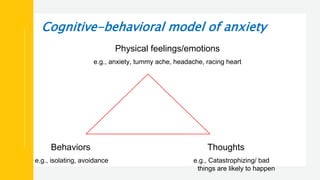
Cognitive-behavioral model of anxiety
Physical feelings/emotions
e.g., anxiety, tummy ache, headache, racing heart
Behaviors Thoughts
e.g., isolating, avoidance e.g., Catastrophizing/ bad
things are likely to happen
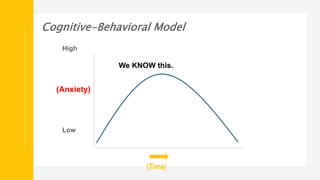
Cognitive-Behavioral Model
High
(Anxiety)
Low
(Time)
We KNOW this.
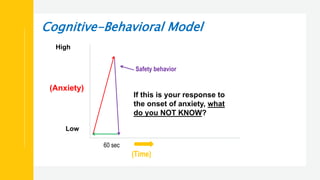
Cognitive-Behavioral Model
High
(Anxiety)
Low
Safety behavior
60 sec
(Time)
If this is your response to
the onset of anxiety, what
do you NOT KNOW?
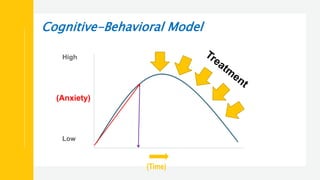
Cognitive-Behavioral Model
High
(Anxiety)
Low
(Time)
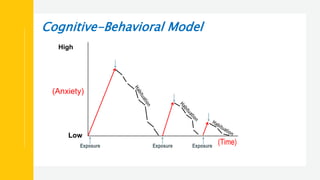
Cognitive-Behavioral Model
High
(Anxiety)
Low
(Time)
Exposures-confronting fears
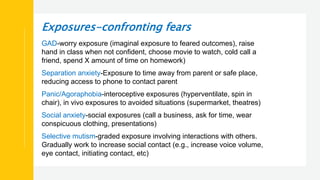
GAD-worry exposure (imaginal exposure to feared outcomes), raise
hand in class when not confident, choose movie to watch, cold call a
friend, spend X amount of time on homework)
Separation anxiety-Exposure to time away from parent or safe place,
reducing access to phone to contact parent
Panic/Agoraphobia-interoceptive exposures (hyperventilate, spin in
chair), in vivo exposures to avoided situations (supermarket, theatres)
Social anxiety-social exposures (call a business, ask for time, wear
conspicuous clothing, presentations)
Selective mutism-graded exposure involving interactions with others.
Gradually work to increase social contact (e.g., increase voice volume,
eye contact, initiating contact, etc)
General guidelines to help children manage anxiety
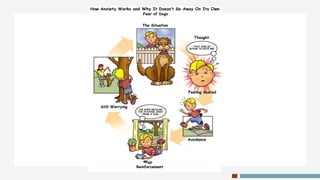
o Encourage child to confront fears, problem solve and thought
challenge. Don’t try to remove the stressor to alleviate anxiety
o Don’t avoid the things that make your child anxious. Avoidance
only makes the anxiety worse
o Don’t present an overly optimistic view of the world. It is possible
that many of the things your child fears could happen (e.g.,
failing a test, accidents, illnesses). Focus on managing anxiety
so it doesn’t become a bigger problem.
o Validate their fears in a way that isn’t reassuring or dismissive.
Show that you understand their experience and help them to
move forward to face their fears, problem solve and thought
challenge
Cont’d
o Be mindful of your response when your child is anxious. Are you
showing signs of anxiety? Are you wanting to alleviate your child's
anxiety because it will also reduce your anxiety?
o Having a plan in advance can help some kids (e.g., return to school,
dealing with bullies, academic concerns)
o As a teacher or parent are you modelling healthy ways of managing
your own anxiety?
Symptom Accommodation &
Parent Education
Accommodation in Anxiety Disorders:
Symptom accommodation: “…actions taken by the family members
to…
acquiesce to the child’s demands (e.g., allowing child to miss
activities to minimize anxiety),
provide reassurance to the child (e.g., answer questions
repeatedly),
decrease child’s responsibility (e.g., minimize attempts at
discipline), or
assist with or complete tasks for the child (e.g., provide extra
assistance with homework, chores, and so on)
o Applies to adults and non-family members as well
Family Accommodation-More Examples
• Opening doors or turning on light switches
• Changing your routine to be available to answer your child’s
calls or texts from school
• Avoidance -allowing your child to avoid certain activities,
places, objects or persons because of OCD/anxiety
• Checking – Having to check the closets, electrical items, door
locks, etc.
• Tolerating your child’s aggression
More than 97% of families accommodate!
(In reality all families accommodate)
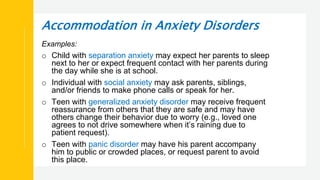
Accommodation in Anxiety Disorders
Examples:
o Child with separation anxiety may expect her parents to sleep
next to her or expect frequent contact with her parents during
the day while she is at school.
o Individual with social anxiety may ask parents, siblings,
and/or friends to make phone calls or speak for her.
o Teen with generalized anxiety disorder may receive frequent
reassurance from others that they are safe and may have
others change their behavior due to worry (e.g., loved one
agrees to not drive somewhere when it’s raining due to
patient request).
o Teen with panic disorder may have his parent accompany
him to public or crowded places, or request parent to avoid
this place.
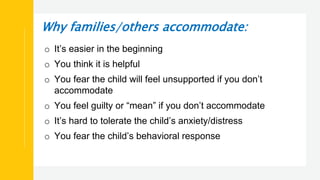
Why families/others accommodate:
o It’s easier in the beginning
o You think it is helpful
o You fear the child will feel unsupported if you don’t
accommodate
o You feel guilty or “mean” if you don’t accommodate
o It’s hard to tolerate the child’s anxiety/distress
o You fear the child’s behavioral response
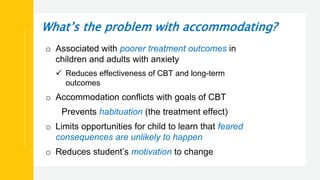
What’s the problem with accommodating?
o Associated with poorer treatment outcomes in
children and adults with anxiety
 Reduces effectiveness of CBT and long-term
outcomes
o Accommodation conflicts with goals of CBT
Prevents habituation (the treatment effect)
o Limits opportunities for child to learn that feared
consequences are unlikely to happen
o Reduces student’s motivation to change
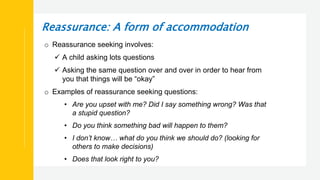
Reassurance: A form of accommodation
o Reassurance seeking involves:
 A child asking lots questions
 Asking the same question over and over in order to hear from
you that things will be “okay”
o Examples of reassurance seeking questions:
• Are you upset with me? Did I say something wrong? Was that
a stupid question?
• Do you think something bad will happen to them?
• I don’t know… what do you think we should do? (looking for
others to make decisions)
• Does that look right to you?
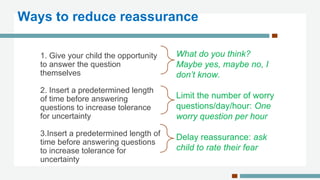
1. Give your child the opportunity
to answer the question
themselves
2. Insert a predetermined length
of time before answering
questions to increase tolerance
for uncertainty
3.Insert a predetermined length of
time before answering questions
to increase tolerance for
uncertainty
What do you think?
Maybe yes, maybe no, I
don’t know.
Limit the number of worry
questions/day/hour: One
worry question per hour
Delay reassurance: ask
child to rate their fear
Ways to reduce reassurance
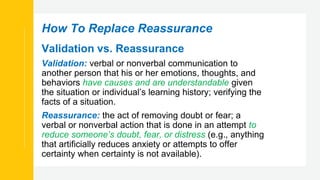
How To Replace Reassurance
Validation vs. Reassurance
Validation: verbal or nonverbal communication to
another person that his or her emotions, thoughts, and
behaviors have causes and are understandable given
the situation or individual’s learning history; verifying the
facts of a situation.
Reassurance: the act of removing doubt or fear; a
verbal or nonverbal action that is done in an attempt to
reduce someone’s doubt, fear, or distress (e.g., anything
that artificially reduces anxiety or attempts to offer
certainty when certainty is not available).
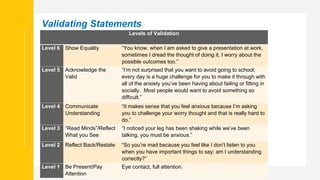
Validating Statements
Levels of Validation
Level 6 Show Equality “You know, when I am asked to give a presentation at work,
sometimes I dread the thought of doing it, I worry about the
possible outcomes too.”
Level 5 Acknowledge the
Valid
“I’m not surprised that you want to avoid going to school;
every day is a huge challenge for you to make it through with
all of the anxiety you’ve been having about failing or fitting in
socially. Most people would want to avoid something so
difficult.”
Level 4 Communicate
Understanding
“It makes sense that you feel anxious because I’m asking
you to challenge your worry thought and that is really hard to
do.”
Level 3 “Read Minds”/Reflect
What you See
“I noticed your leg has been shaking while we’ve been
talking, you must be anxious.”
Level 2 Reflect Back/Restate “So you’re mad because you feel like I don’t listen to you
when you have important things to say; am I understanding
correctly?”
Level 1 Be Present/Pay
Attention
Eye contact, full attention.
More Examples of How to Validate
Validating Invalidating
Actively Listen Providing your child undivided
attention; looking at them while they
talk
Checking your cell phone for
messages while talking to your child;
multitasking in any way
Be mindful of verbal and nonverbal
reactions
Making eye contact; nodding;
mirroring the child’s affect
Rolling eyes, walking away, sighing;
saying “you shouldn’t feel that way”
Observe what the other person is
feeling in the moment. Look for a
word or words to describe the
feeling.
“I want to make sure I understand.
You’re feeling anxious and worried
because you have a test coming up,
is that right?”
“I’m sure that’s not it”; “that’s no
reason to be upset”; “I don’t
understand”, “that doesn’t make
sense”
Reflect the feeling back without
judgement.
“Not having certainty about the
outcome of an exam is scary.” “I can
understand how much easier this
would be to handle if we knew that
everything is going to be alright.”
“I get that you’re anxious, but you
have to get this work done.” “If you
don’t get this under control, you’re
[insert consequence here].”
Show tolerance! Look for ways the
emotions, thoughts and actions
makes sense given the context of
the situation and your child’s
previous experiences.
“I don’t blame you for feeling
hopeless about school; things keep
piling up and you feel like you’re
drowning in expectations.”
“This is just the way it is”; “You have
to…”; “If you try harder, you can do
this”; “You’re too smart to let your
emotions get in the way”
Anxiety at School
Anxiety at school
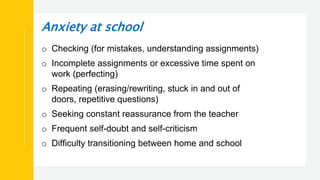
o Checking (for mistakes, understanding assignments)
o Incomplete assignments or excessive time spent on
work (perfecting)
o Repeating (erasing/rewriting, stuck in and out of
doors, repetitive questions)
o Seeking constant reassurance from the teacher
o Frequent self-doubt and self-criticism
o Difficulty transitioning between home and school
Anxiety at school cont’d
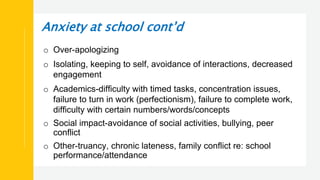
o Over-apologizing
o Isolating, keeping to self, avoidance of interactions, decreased
engagement
o Academics-difficulty with timed tasks, concentration issues,
failure to turn in work (perfectionism), failure to complete work,
difficulty with certain numbers/words/concepts
o Social impact-avoidance of social activities, bullying, peer
conflict
o Other-truancy, chronic lateness, family conflict re: school
performance/attendance
School-based interventions
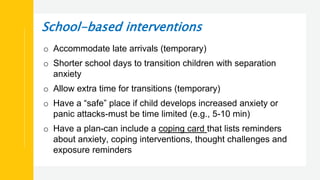
o Accommodate late arrivals (temporary)
o Shorter school days to transition children with separation
anxiety
o Allow extra time for transitions (temporary)
o Have a “safe” place if child develops increased anxiety or
panic attacks-must be time limited (e.g., 5-10 min)
o Have a plan-can include a coping card that lists reminders
about anxiety, coping interventions, thought challenges and
exposure reminders
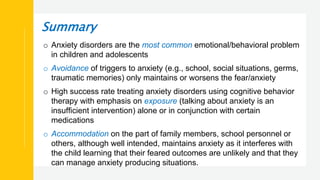
Summary
o Anxiety disorders are the most common emotional/behavioral problem
in children and adolescents
o Avoidance of triggers to anxiety (e.g., school, social situations, germs,
traumatic memories) only maintains or worsens the fear/anxiety
o High success rate treating anxiety disorders using cognitive behavior
therapy with emphasis on exposure (talking about anxiety is an
insufficient intervention) alone or in conjunction with certain
medications
o Accommodation on the part of family members, school personnel or
others, although well intended, maintains anxiety as it interferes with
the child learning that their feared outcomes are unlikely and that they
can manage anxiety producing situations.
Resources
• International Obsessive Compulsive Disorder Foundation
(IOCDF): www.ocfoundation.org
• Anxiety Canada:
www.anxietycanada.com
• Anxiety and Depression Association of America (ADAA):
www.adaa.org
Questions?
Call or visit:
800-767-4411
rogersbh.org
Thank you!

Anxiety in-youth

  • 1.
    Stress and Anxietyin Youth Sussex Hamilton High School December 3rd, 2019
  • 2.
    What we willcover 1. Stress 2. Anxiety Disorders 3. Treatment 4. Symptom Accommodation & Parent Education 5. Anxiety in School Setting 6. Questions
  • 3.
  • 4.
    What is stress? oStressor-is a situation that the person experiences and threatening in some way (e.g., academics, social stress, family discord, world events, trauma, significant life changes) o The threat exceeds one’s ability to cope • How we interpret a stressor determines whether a stressor is + or – and/or the severity of the impact (i.e., is divorce always an unhappy event?; could my reaction to getting a flat tire make my emotional suffering worse?) o Stress Response-complex set of physiological changes that help us deal with the stressor
  • 5.
    What does stresslook like? o Irritability or moodiness o Stomach/headache o Sleeping or eating too much/too little o Withdrawing from normally enjoyed activities/isolation o Complaints about school o Crying, expressing worries, clinging to a parent o Avoiding parents, abandoning long term friendships o Expressing hostility toward family o Change in academic performance
  • 6.
    Stress response: Somatic,Emotional and Behavioral Responses (Mayo clinic, 2019) On your body On your mood On your behavior Headache Anxiety Overeating or undereating Muscle tension or pain Restlessness Angry outbursts Chest pain Lack of motivation or focus Drug or alcohol misuse Fatigue Feeling overwhelmed Tobacco use Change in sex drive Irritability or anger Social withdrawal Stomach upset Sadness or depression Exercising less often Sleep problems
  • 7.
    What we knowabout stress (APA, 2018) o For teens most common sources of stress is school (83%), getting into a good college (69%) and family finances (65%) o Forty percent of teens reported feeling irritable, 36% nervous or anxious, fatigued and 31% overwhelmed o Fifty-one percent said others noticed their stress and 26% said they were short or snapped at someone close due to stress o Other sources: Maintaining social network; juggling school/job/relationships; world events; traumatic events; family issues; other life changes (e.g., move, new school, etc.)
  • 8.
    What can caregiversdo to help (American Academy of Pediatrics 2012) o Provide a secure home environment o Family routines and family meals-protective effect o Model healthy behavior-manage your own stress in healthy ways o Monitor and limit exposure to certain shows, TV, video games of a violent nature o Keep child in the loop regarding anticipated changes o Listen to your child without being critical o Allow child to have choices and control in their loves o Encourage sleep, exercise, proper diet
  • 9.
    When do Iseek counseling? Seek counseling if: o Your child is becoming increasingly withdrawn and isolating from you, friends, school or school activities o Is having problems at school: significant academic or social issues o Is struggling to control their anger or is experiencing behavioral outbursts
  • 10.
    Nick-17 y/o male •Parents have noticed a few changes within the past few weeks that are a change from previous functioning: Nick has been noticeably irritable of late, has spent increasing amounts of time in his room, and isn’t socializing as much with friends. He reports some stomach issues, but physician hasn’t found any reason for concern. • This Fall he has been involved in cross country-will be participating in state CC meet in a week. Has expressed concern/worry about performing up to expectations-doesn’t want to disappoint his teammates. • He is in the process of completing his applications for college which are due at the end of the month. His grades have been good. He reports worry that he won't be accepted to any of his top schools • Nick works part-time on weekends at a local restaurant bussing tables • He has a girlfriend whom he sees only sporadically due to his busy schedule. • No history of anxiety or depression • No problems with school attendance-hasn’t missed CC practice. Per Teachers: • Have noticed that Nick has been less involved in class discussions of late. Seems distracted • Some drop in overall quality of schoolwork but nothing too concerning. Homework is completed on time.
  • 11.
  • 12.
    Anxiety in children/teens oIrritability/acting out/tantrums o Clingy/difficulty separating from parent (children) o Difficulty with sleep (children wanting to co sleep); waking in the middle of the night; bad dreams o Bed wetting (children) o Somatic symptoms: headache, stomachache o Unwilling to try new things o Avoiding normal activities such as being with friends, going to school and being away from home  Separation anxiety, specific fears, social fears/shyness, worry common in young children  Will talk about school related signs and symptoms later
  • 13.
    When is itan anxiety disorder? o Normal for kids of all ages to be nervous and anxious about returning to school, completing homework assignments, taking tests and being involved in extracurriculars o Normal anxiety is usually transient o Anxiety that is problematic is associated with increased levels of distress, tends to be chronic, and leads to interference in multiple areas of functioning such as school, home and socially o Usually the child learns to avoid those persons, places or things that trigger their anxiety
  • 14.
    Anxiety vs. Fear oAnxiety-Apprehension about a future threat o Fear- Response to an immediate threat o Both involve physiological arousal o Both can be adaptive  Fear triggers “fight or flight”  Anxiety can increase preparedness  Yerkes Dodson (next slide)
  • 15.
  • 16.
    Epidemiology of AnxietyDisorders o Most common emotional/behavioral disorder in childhood o Incidence 10-15% of children and adolescents o About 8% of teens ages 13–18 have an anxiety disorder, with symptoms commonly emerging around age 6. However, of these teens, only 18 percent received mental health care o Co-morbid psychiatric disorders:  Other anxiety disorders  ADHD  Autism Spectrum Disorder  Substance use  Depression(kids-somatic complaints, acting out, aggression)  Eating disorders
  • 17.
    What are theanxiety disorders? o Generalized anxiety disorder (GAD) o Separation anxiety disorder o Social anxiety disorder o Selective mutism o Panic disorder  Obsessive-compulsive disorder (OCD) (obsessive compulsive and related disorders) ex. BDD, Hair pulling disorder, Hoarding disorder  Post-traumatic stress disorder (trauma and stressor related disorders) ex. RAD, Disinhibited social engagement disorder, adjustment disorders
  • 18.
    Generalized Anxiety Disorder oExcessive/difficult to control worry (for at least 6 mos)  About: welfare and safety of family and friends, finances, relationships, punctuality, school performance, world events o Associated symptoms:  Irritability, muscle tension, fatigue, unable to sit still, poor concentration and sleep o Not easily reassured o May throw tantrums related to anxiety o Poor concentration and attention, fidgety  May present similar to a child with ADHD
  • 19.
    Separation Anxiety o Excessiveanxiety focused on separating from home or parent o More commonly diagnosed in pre-pubertal children  More common in 5-7 and 11-12-year olds with transition into elementary and middle school o Typically occurs following a significant change or major life event (e.g., divorce, illness, move) o Behaviors: Clinging/shadowing behavior, nightmares, expressing fear of losing loved one, school refusal, somatic complaints
  • 20.
    Social Anxiety Disorder oExcessive fear in social situations where child is exposed to unfamiliar people/evaluation by others (e.g., Raising hand in class, class presentations, friendships) o Tremendous concern about social failure/embarrassment/humiliation o Fear is excessive and unreasonable o Avoidance or endurance with extreme distress o Interference in functioning (e.g., Unable to attend school, few if any friendships, isolated from social activities)
  • 21.
    Selective Mutism o Childreneither talk minimally or not at all in certain settings or situations that are part of their daily lives (e.g., with teachers and classmates, meeting new people (especially adults) o Reflects underlying problems with anxiety o Often inadvertently reinforced  speaking for the child  permitting the use of nonverbal communication o Considered a more severe form of social phobia
  • 22.
    Panic Attacks vs.Panic Disorder Panic attacks: o Sudden, discrete episodes of intense fear, Intense desire to escape, doom o Activation of autonomic nervous system (Fight or flight) o Duration 15-30 minutes o Common 20-30% of adult population Panic Disorder: o Recurrent panic attacks o Inter-episode worry about having a panic attack o Worry about implications and consequences o Changes in behavior o More common in adolescents
  • 23.
    Post-traumatic Stress Disorder oExposure to an actual or threatened death, serious injury or sexual violence. o Re-experiencing of the trauma (e.g., play echoing trauma theme, frightening dreams, reenactment of trauma in play) o Avoidance of thoughts, feelings people, places that are associated with the trauma, anhedonia, feelings of detachment o Negative changes to thoughts and mood(e.g. increased negative emotions such as fear guilt sadness; anhedonia; socially withdrawn; decreased expression of positive emotions) o Arousal (e.g., irritability, hyper vigilance, exaggerated startle, poor concentration and sleep)
  • 24.
  • 25.
    Diagnosis: What areObsessions? o Recurrent, intrusive, unwanted thoughts, images and impulses. o They are NOT excessive worries about real life problems. Patients often describe obsessions as silly, senseless, bizarre o Because obsessions are unwanted and distressing, people try to resist them, get rid of them, or reduce their distress in some way:  avoidance of triggers  distraction  compulsive behaviors or thoughts
  • 26.
    Examples of Obsessions oFear of Contamination or Germs (chemicals, pets/insects, sticky substances, doorknobs, public bathrooms) o Fear of Harm or Danger (to self, loved ones) o Fear of Loss (books, papers, receipts, trash) o Need for Symmetry (need to have room organized in a certain way) o Need for Perfection (need for certainty, fear of anxiety)
  • 27.
    Diagnosis: What areCompulsions? o A compulsion is a behavior or mental act that a person feels driven to perform over and over again  to prevent or reduce anxiety, discomfort or distress  to “prevent” something bad from happening o Performed in response to an obsession o Often performed according to rigid rules or until it feels “just right”
  • 28.
    Examples of Compulsions oWashing/Cleaning (hand washing, grooming, toilet routine, brushing teeth) o Checking (stove, light switches, door locks, reassurance seeking, calling Mom at work, going over homework to make sure it is done correctly) o Hoarding (collecting trash, saving receipts, old magazines/books, other old, useless or dated materials) o Ordering/Arranging (books and CDs on shelf, pillows on bed, icons on computer) o Repeating Rituals (rereading, rewriting, retracing steps, or until feels “just right”)
  • 29.
    What is notOCD? o Pathological gambling (impulse-control). o Kleptomania (impulse-control). o Certain substance abuse disorders o Video game “addiction”  Thoughts are not unwanted.  Derive pleasure from “compulsive” act.  Typically, only want to stop because of negative consequences of acts.
  • 30.
    Jane-14 y/o female Poorschool attendance and subsequent academic decline Per Parents • Hx of anxiety since childhood • Temper outbursts, irritability, sadness, crying, and power struggles • Increased worry about being bullied, potential for potential for disasters (e.g. school shootings) • Fears about starting HS, “fitting in” and passing her classes despite no hx of academic difficulty • Confined to home but a few activities with church youth group • School Avoidance school-shootings or bomb threats at schools in the news Per Teachers • Reports feelings of being “left out” and complains of “meanness” and possible exclusion by several peers • Appears connected to friend Jennifer • Questions: clarification of assignments, checking to ensure she has properly understood the material, confirmation her answers are correct, college preparedness • Missed school or gone home early complaining of headaches or stomach aches
  • 31.
  • 32.
    Cognitive-behavioral model ofanxiety Physical feelings/emotions e.g., anxiety, tummy ache, headache, racing heart Behaviors Thoughts e.g., isolating, avoidance e.g., Catastrophizing/ bad things are likely to happen
  • 34.
  • 35.
    Cognitive-Behavioral Model High (Anxiety) Low Safety behavior 60sec (Time) If this is your response to the onset of anxiety, what do you NOT KNOW?
  • 36.
  • 37.
  • 38.
    Exposures-confronting fears GAD-worry exposure(imaginal exposure to feared outcomes), raise hand in class when not confident, choose movie to watch, cold call a friend, spend X amount of time on homework) Separation anxiety-Exposure to time away from parent or safe place, reducing access to phone to contact parent Panic/Agoraphobia-interoceptive exposures (hyperventilate, spin in chair), in vivo exposures to avoided situations (supermarket, theatres) Social anxiety-social exposures (call a business, ask for time, wear conspicuous clothing, presentations) Selective mutism-graded exposure involving interactions with others. Gradually work to increase social contact (e.g., increase voice volume, eye contact, initiating contact, etc)
  • 39.
    General guidelines tohelp children manage anxiety o Encourage child to confront fears, problem solve and thought challenge. Don’t try to remove the stressor to alleviate anxiety o Don’t avoid the things that make your child anxious. Avoidance only makes the anxiety worse o Don’t present an overly optimistic view of the world. It is possible that many of the things your child fears could happen (e.g., failing a test, accidents, illnesses). Focus on managing anxiety so it doesn’t become a bigger problem. o Validate their fears in a way that isn’t reassuring or dismissive. Show that you understand their experience and help them to move forward to face their fears, problem solve and thought challenge
  • 40.
    Cont’d o Be mindfulof your response when your child is anxious. Are you showing signs of anxiety? Are you wanting to alleviate your child's anxiety because it will also reduce your anxiety? o Having a plan in advance can help some kids (e.g., return to school, dealing with bullies, academic concerns) o As a teacher or parent are you modelling healthy ways of managing your own anxiety?
  • 41.
  • 42.
    Accommodation in AnxietyDisorders: Symptom accommodation: “…actions taken by the family members to… acquiesce to the child’s demands (e.g., allowing child to miss activities to minimize anxiety), provide reassurance to the child (e.g., answer questions repeatedly), decrease child’s responsibility (e.g., minimize attempts at discipline), or assist with or complete tasks for the child (e.g., provide extra assistance with homework, chores, and so on) o Applies to adults and non-family members as well
  • 43.
    Family Accommodation-More Examples •Opening doors or turning on light switches • Changing your routine to be available to answer your child’s calls or texts from school • Avoidance -allowing your child to avoid certain activities, places, objects or persons because of OCD/anxiety • Checking – Having to check the closets, electrical items, door locks, etc. • Tolerating your child’s aggression
  • 44.
    More than 97%of families accommodate! (In reality all families accommodate)
  • 45.
    Accommodation in AnxietyDisorders Examples: o Child with separation anxiety may expect her parents to sleep next to her or expect frequent contact with her parents during the day while she is at school. o Individual with social anxiety may ask parents, siblings, and/or friends to make phone calls or speak for her. o Teen with generalized anxiety disorder may receive frequent reassurance from others that they are safe and may have others change their behavior due to worry (e.g., loved one agrees to not drive somewhere when it’s raining due to patient request). o Teen with panic disorder may have his parent accompany him to public or crowded places, or request parent to avoid this place.
  • 46.
    Why families/others accommodate: oIt’s easier in the beginning o You think it is helpful o You fear the child will feel unsupported if you don’t accommodate o You feel guilty or “mean” if you don’t accommodate o It’s hard to tolerate the child’s anxiety/distress o You fear the child’s behavioral response
  • 47.
    What’s the problemwith accommodating? o Associated with poorer treatment outcomes in children and adults with anxiety  Reduces effectiveness of CBT and long-term outcomes o Accommodation conflicts with goals of CBT Prevents habituation (the treatment effect) o Limits opportunities for child to learn that feared consequences are unlikely to happen o Reduces student’s motivation to change
  • 48.
    Reassurance: A formof accommodation o Reassurance seeking involves:  A child asking lots questions  Asking the same question over and over in order to hear from you that things will be “okay” o Examples of reassurance seeking questions: • Are you upset with me? Did I say something wrong? Was that a stupid question? • Do you think something bad will happen to them? • I don’t know… what do you think we should do? (looking for others to make decisions) • Does that look right to you?
  • 49.
    1. Give yourchild the opportunity to answer the question themselves 2. Insert a predetermined length of time before answering questions to increase tolerance for uncertainty 3.Insert a predetermined length of time before answering questions to increase tolerance for uncertainty What do you think? Maybe yes, maybe no, I don’t know. Limit the number of worry questions/day/hour: One worry question per hour Delay reassurance: ask child to rate their fear Ways to reduce reassurance
  • 50.
    How To ReplaceReassurance Validation vs. Reassurance Validation: verbal or nonverbal communication to another person that his or her emotions, thoughts, and behaviors have causes and are understandable given the situation or individual’s learning history; verifying the facts of a situation. Reassurance: the act of removing doubt or fear; a verbal or nonverbal action that is done in an attempt to reduce someone’s doubt, fear, or distress (e.g., anything that artificially reduces anxiety or attempts to offer certainty when certainty is not available).
  • 51.
    Validating Statements Levels ofValidation Level 6 Show Equality “You know, when I am asked to give a presentation at work, sometimes I dread the thought of doing it, I worry about the possible outcomes too.” Level 5 Acknowledge the Valid “I’m not surprised that you want to avoid going to school; every day is a huge challenge for you to make it through with all of the anxiety you’ve been having about failing or fitting in socially. Most people would want to avoid something so difficult.” Level 4 Communicate Understanding “It makes sense that you feel anxious because I’m asking you to challenge your worry thought and that is really hard to do.” Level 3 “Read Minds”/Reflect What you See “I noticed your leg has been shaking while we’ve been talking, you must be anxious.” Level 2 Reflect Back/Restate “So you’re mad because you feel like I don’t listen to you when you have important things to say; am I understanding correctly?” Level 1 Be Present/Pay Attention Eye contact, full attention.
  • 52.
    More Examples ofHow to Validate Validating Invalidating Actively Listen Providing your child undivided attention; looking at them while they talk Checking your cell phone for messages while talking to your child; multitasking in any way Be mindful of verbal and nonverbal reactions Making eye contact; nodding; mirroring the child’s affect Rolling eyes, walking away, sighing; saying “you shouldn’t feel that way” Observe what the other person is feeling in the moment. Look for a word or words to describe the feeling. “I want to make sure I understand. You’re feeling anxious and worried because you have a test coming up, is that right?” “I’m sure that’s not it”; “that’s no reason to be upset”; “I don’t understand”, “that doesn’t make sense” Reflect the feeling back without judgement. “Not having certainty about the outcome of an exam is scary.” “I can understand how much easier this would be to handle if we knew that everything is going to be alright.” “I get that you’re anxious, but you have to get this work done.” “If you don’t get this under control, you’re [insert consequence here].” Show tolerance! Look for ways the emotions, thoughts and actions makes sense given the context of the situation and your child’s previous experiences. “I don’t blame you for feeling hopeless about school; things keep piling up and you feel like you’re drowning in expectations.” “This is just the way it is”; “You have to…”; “If you try harder, you can do this”; “You’re too smart to let your emotions get in the way”
  • 53.
  • 54.
    Anxiety at school oChecking (for mistakes, understanding assignments) o Incomplete assignments or excessive time spent on work (perfecting) o Repeating (erasing/rewriting, stuck in and out of doors, repetitive questions) o Seeking constant reassurance from the teacher o Frequent self-doubt and self-criticism o Difficulty transitioning between home and school
  • 55.
    Anxiety at schoolcont’d o Over-apologizing o Isolating, keeping to self, avoidance of interactions, decreased engagement o Academics-difficulty with timed tasks, concentration issues, failure to turn in work (perfectionism), failure to complete work, difficulty with certain numbers/words/concepts o Social impact-avoidance of social activities, bullying, peer conflict o Other-truancy, chronic lateness, family conflict re: school performance/attendance
  • 56.
    School-based interventions o Accommodatelate arrivals (temporary) o Shorter school days to transition children with separation anxiety o Allow extra time for transitions (temporary) o Have a “safe” place if child develops increased anxiety or panic attacks-must be time limited (e.g., 5-10 min) o Have a plan-can include a coping card that lists reminders about anxiety, coping interventions, thought challenges and exposure reminders
  • 57.
    Summary o Anxiety disordersare the most common emotional/behavioral problem in children and adolescents o Avoidance of triggers to anxiety (e.g., school, social situations, germs, traumatic memories) only maintains or worsens the fear/anxiety o High success rate treating anxiety disorders using cognitive behavior therapy with emphasis on exposure (talking about anxiety is an insufficient intervention) alone or in conjunction with certain medications o Accommodation on the part of family members, school personnel or others, although well intended, maintains anxiety as it interferes with the child learning that their feared outcomes are unlikely and that they can manage anxiety producing situations.
  • 58.
    Resources • International ObsessiveCompulsive Disorder Foundation (IOCDF): www.ocfoundation.org • Anxiety Canada: www.anxietycanada.com • Anxiety and Depression Association of America (ADAA): www.adaa.org
  • 59.
  • 60.