Presented By: Mae Mendiola ED443G:  Assistive Technology in Special Education Dr. Jacqui Cyrus October 16, 2008
The students will: Know definition of Deaf and Hard of Hearing. Know the historical context. List and explain the major causes of hearing loss. Discuss the concept of Deaf culture, and describe its importance to the Deaf. List the major types of assistive technology specifically designed for people with hearing problems. Know some support groups or organizations.
Definition of Deafness:  Hearing impairment that is so severe that the child is impaired in processing linguistic information through hearing, with or without amplification, that adversely affects a child’s educational performance. Hard of Hearing: (Hearing Impairment)  Impairment in  hearing, whether permanent or fluctuating, that adversely affects a child’s educational performance but that is not included under the definition of deafness.
Nationally: - Deafness and Hard of Hearing is a low incidence disability for children affecting about 0.14% of all students Locally: - 38 % (60) of GPSS students identified
Pedro Ponce de Leon (1520 - 1584) first teacher (Spanish monk) to teach deaf students to read, write and speak. William Holder and John Wallis (1600’s) institute educational programs in England for deaf, using writing and manual communication to teach speech.  Schools for deaf have been established by others in Europe. Concept of special schools for deaf then came to America. (1700’s) Thomas Hopkins Gallaudet studied in England and France; started first special school for the deaf in the U.S. The French at the school started by Abbé Charles Michel de l’Epée experimented with methods of manual communication, mainly sign language.
(1817) Gallaudet and Laurent Clerc (deaf and well-known French educator of the deaf) started the first American school for deaf students in Hartford, Connecticut. (Many of the Deaf children of Martha’s Vineyard attended this residential school).
Hearing trumpet made sounds a little louder. Advances and Batteries (during World War II made battery-operated hearing aids possible Small hearing aid behind the ear were created. (1950’s) Today’s versions used microchips to customize sound amplification to the needs of the individual.
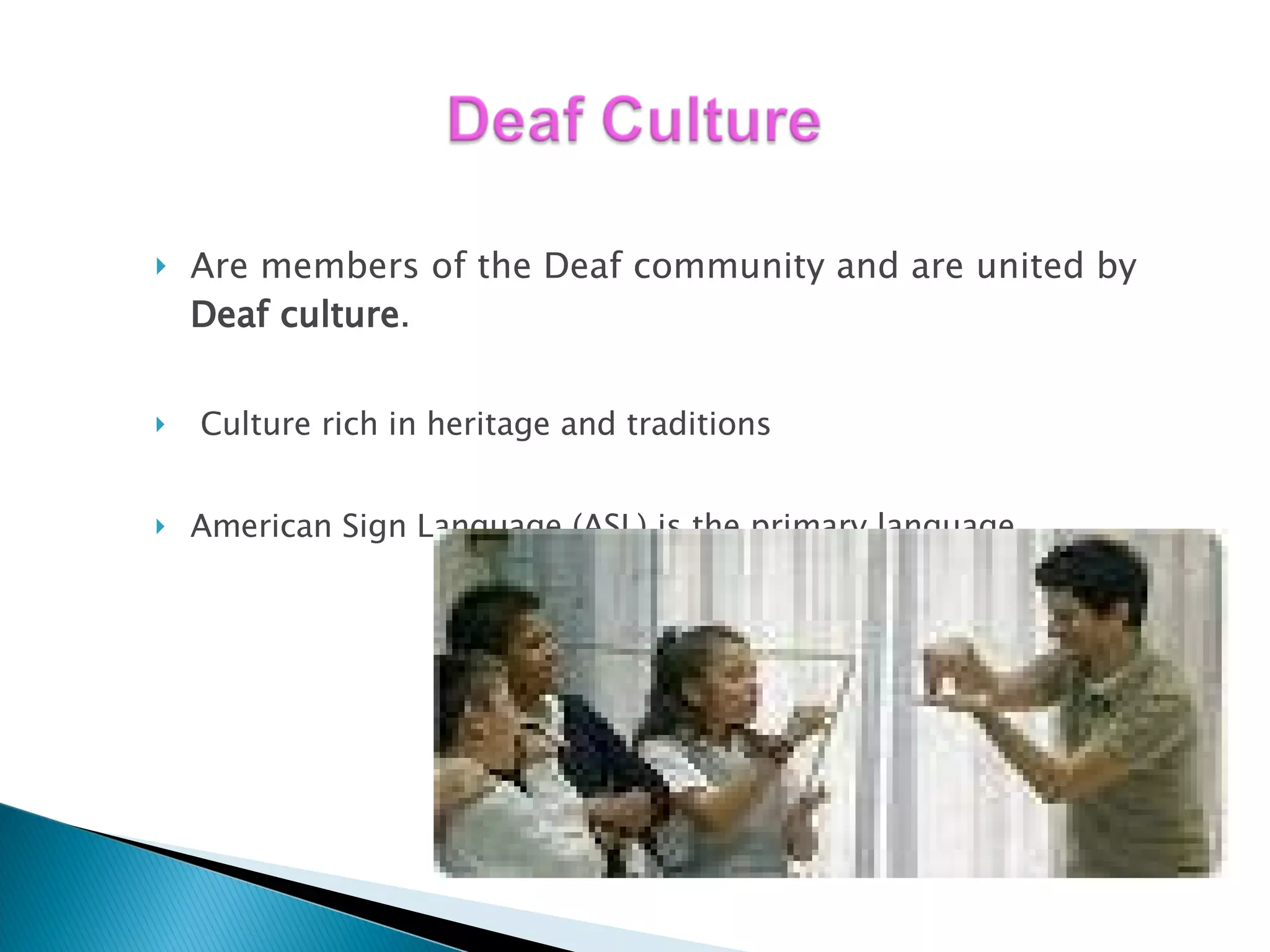
Are members of the Deaf community and are united by  Deaf culture .  Culture rich in heritage and traditions American Sign Language (ASL) is the primary language
Conductive hearing loss  caused by blockage or damage to outer or middle ear that prevents sound wave from traveling to inner ear. Sensorineural   hearing loss  caused by damage to inner ear or auditory nerve.
Cause of hearing loss  in   children  is unknown. Four Most Common known causes: Heredity and Genetics Meningitis Otitis media (Ear infection) Noise                                                                                                                                                                                                                                                                                                                                                   
Immunization Avoiding noises over 85 decibels (Lawn mower, garbage truck, dance club, car stereo turned all the way up).  Wearing ear plugs in places with loud noises (Ex. wood working shops).
Four categories of assistive devices: Assistive listening devices  Telecommunication devices Computerized speech-to-text translation Alerting devices
Organization - American Speech-Language-Hearing Association Organization - Hearing Loss Association of America Organization - Children of Deaf Adults Organization - American Society for Deaf Children Organization - World Federation of the Deaf Organization - Hands & Voices
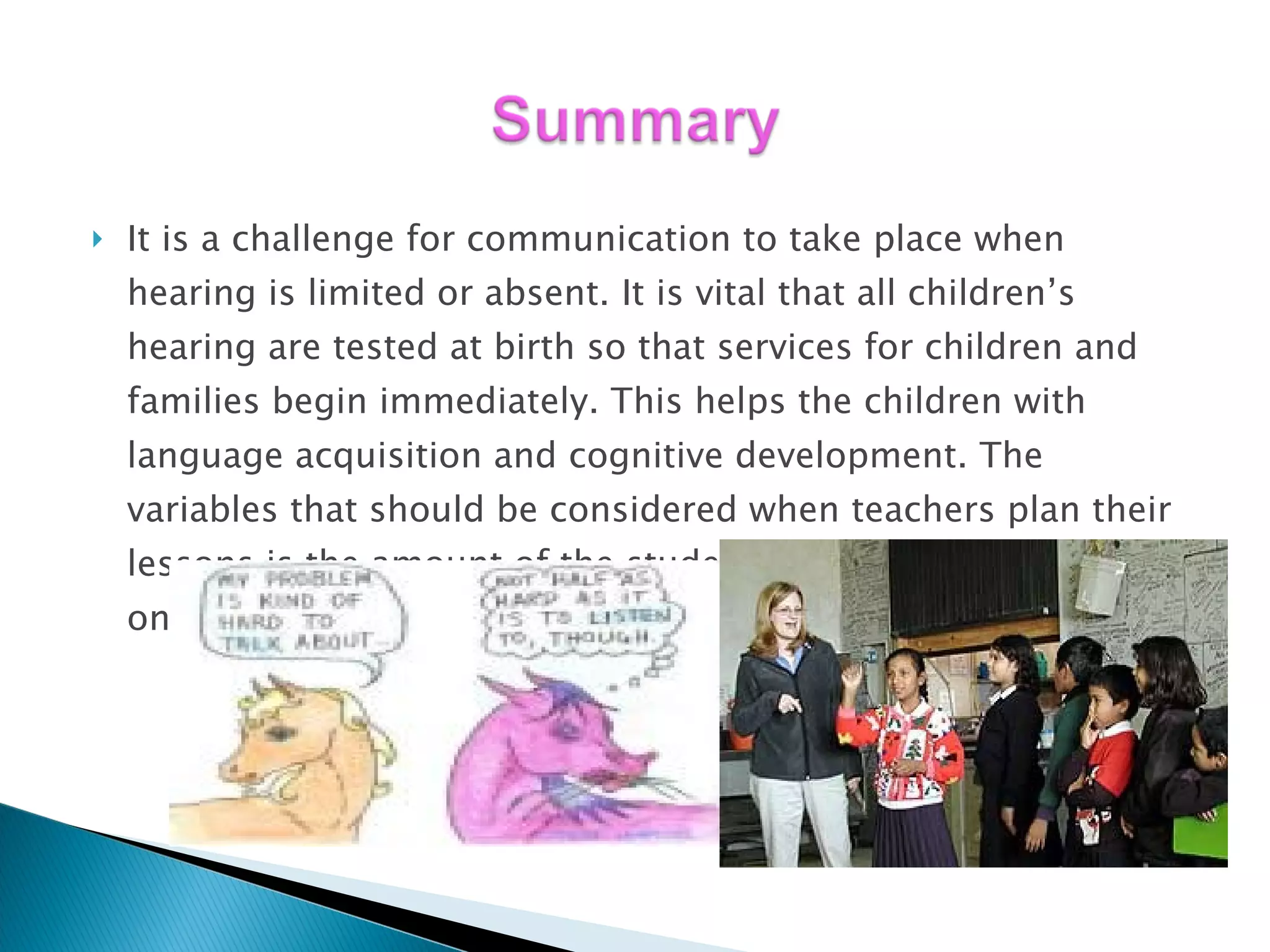
It is a challenge for communication to take place when hearing is limited or absent. It is vital that all children’s hearing are tested at birth so that services for children and families begin immediately. This helps the children with language acquisition and cognitive development. The variables that should be considered when teachers plan their lessons is the amount of the students hearing loss, age of onset, and type of loss.
Do the GovGuam agencies accommodate those who are deaf and hard of hearing? Do we have Deaf culture on Guam?  How well do we accommodate our students (deaf and hard of hearing) in the classroom with assistive technology? REFERENCE: Introduction to Special Education: Making a Difference Author: Deborah Deutsch Smith Sixth Edition

Deaf And Hard Of Hearing

  • 1.
    Presented By: MaeMendiola ED443G: Assistive Technology in Special Education Dr. Jacqui Cyrus October 16, 2008
  • 2.
    The students will:Know definition of Deaf and Hard of Hearing. Know the historical context. List and explain the major causes of hearing loss. Discuss the concept of Deaf culture, and describe its importance to the Deaf. List the major types of assistive technology specifically designed for people with hearing problems. Know some support groups or organizations.
  • 3.
    Definition of Deafness: Hearing impairment that is so severe that the child is impaired in processing linguistic information through hearing, with or without amplification, that adversely affects a child’s educational performance. Hard of Hearing: (Hearing Impairment) Impairment in hearing, whether permanent or fluctuating, that adversely affects a child’s educational performance but that is not included under the definition of deafness.
  • 4.
    Nationally: - Deafnessand Hard of Hearing is a low incidence disability for children affecting about 0.14% of all students Locally: - 38 % (60) of GPSS students identified
  • 5.
    Pedro Ponce deLeon (1520 - 1584) first teacher (Spanish monk) to teach deaf students to read, write and speak. William Holder and John Wallis (1600’s) institute educational programs in England for deaf, using writing and manual communication to teach speech. Schools for deaf have been established by others in Europe. Concept of special schools for deaf then came to America. (1700’s) Thomas Hopkins Gallaudet studied in England and France; started first special school for the deaf in the U.S. The French at the school started by Abbé Charles Michel de l’Epée experimented with methods of manual communication, mainly sign language.
  • 6.
    (1817) Gallaudet andLaurent Clerc (deaf and well-known French educator of the deaf) started the first American school for deaf students in Hartford, Connecticut. (Many of the Deaf children of Martha’s Vineyard attended this residential school).
  • 7.
    Hearing trumpet madesounds a little louder. Advances and Batteries (during World War II made battery-operated hearing aids possible Small hearing aid behind the ear were created. (1950’s) Today’s versions used microchips to customize sound amplification to the needs of the individual.
  • 8.
    Are members ofthe Deaf community and are united by Deaf culture . Culture rich in heritage and traditions American Sign Language (ASL) is the primary language
  • 9.
    Conductive hearing loss caused by blockage or damage to outer or middle ear that prevents sound wave from traveling to inner ear. Sensorineural hearing loss caused by damage to inner ear or auditory nerve.
  • 10.
    Cause of hearingloss in children is unknown. Four Most Common known causes: Heredity and Genetics Meningitis Otitis media (Ear infection) Noise                                                                                                                                                                                                                                                                                                                                             
  • 11.
    Immunization Avoiding noisesover 85 decibels (Lawn mower, garbage truck, dance club, car stereo turned all the way up). Wearing ear plugs in places with loud noises (Ex. wood working shops).
  • 12.
    Four categories ofassistive devices: Assistive listening devices Telecommunication devices Computerized speech-to-text translation Alerting devices
  • 13.
    Organization - AmericanSpeech-Language-Hearing Association Organization - Hearing Loss Association of America Organization - Children of Deaf Adults Organization - American Society for Deaf Children Organization - World Federation of the Deaf Organization - Hands & Voices
  • 14.
    It is achallenge for communication to take place when hearing is limited or absent. It is vital that all children’s hearing are tested at birth so that services for children and families begin immediately. This helps the children with language acquisition and cognitive development. The variables that should be considered when teachers plan their lessons is the amount of the students hearing loss, age of onset, and type of loss.
  • 15.
    Do the GovGuamagencies accommodate those who are deaf and hard of hearing? Do we have Deaf culture on Guam? How well do we accommodate our students (deaf and hard of hearing) in the classroom with assistive technology? REFERENCE: Introduction to Special Education: Making a Difference Author: Deborah Deutsch Smith Sixth Edition