DCOM 101Mid Term Review( Not in Order). Except CH 3  Professionalism.
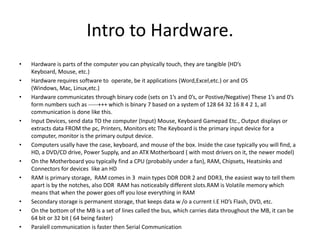
Intro to Hardware.Hardware is parts of the computer you can physically touch, they are tangible (HD’s Keyboard, Mouse, etc.)Hardware requires software to  operate, be it applications (Word,Excel,etc.) or and OS (Windows, Mac, Linux,etc.)Hardware communicates through binary code (sets on 1’s and 0’s, or Postive/Negative) These 1’s and 0’s form numbers such as -----+++ which is binary 7 based on a system of 128 64 32 16 8 4 2 1, all communication is done like this.Input Devices, send data TO the computer (Input) Mouse, Keyboard Gamepad Etc., Output displays or extracts data FROM the pc, Printers, Monitors etc The Keyboard is the primary input device for a computer, monitor is the primary output device.Computers usally have the case, keyboard, and mouse of the box. Inside the case typically you will find, a HD, a DVD/CD drive, Power Supply, and an ATX Motherboard ( with most drivers on it, the newer model)On the Motherboard you typically find a CPU (probabily under a fan), RAM, Chipsets, Heatsinks and Connectors for devices  like an HDRAM is primary storage,  RAM comes in 3  main types DDR DDR2 and DDR3, the easiest way to tell them apart is by the notches, also DDR  RAM has noticeabily different slots.RAM is Volatile memory which means that when the power goes off you lose everything in RAMSecondary storage is permanent storage, that keeps data w /o a current I.E HD’s Flash, DVD, etc.On the bottom of the MB is a set of lines called the bus, which carries data throughout the MB, it can be 64 bit or 32 bit ( 64 being faster)Paralell communication is faster then Serial Communication
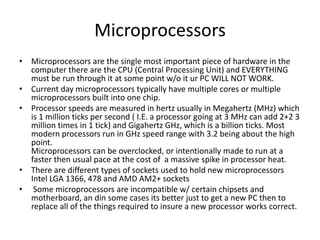
MicroprocessorsMicroprocessors are the single most important piece of hardware in the computer there are the CPU (Central Processing Unit) and EVERYTHING must be run through it at some point w/o it ur PC WILL NOT WORK.Current day microprocessors typically have multiple cores or multiple microprocessors built into one chip.Processor speeds are measured in hertz usually in Megahertz (MHz) which is 1 million ticks per second ( I.E. a processor going at 3 MHz can add 2+2 3 million times in 1 tick) and Gigahertz GHz, which is a billion ticks. Most modern processors run in GHz speed range with 3.2 being about the high point.Microprocessors can be overclocked, or intentionally made to run at a faster then usual pace at the cost of  a massive spike in processor heat. There are different types of sockets used to hold new microprocessors Intel LGA 1366, 478 and AMD AM2+ socketsSome microprocessors are incompatible w/ certain chipsets and motherboard, an din some cases its better just to get a new PC then to replace all of the things required to insure a new processor works correct.
Hard DrivesHard Drives come in three different types PATA( Parallel ATA) SATA ( Serial ATA) and SCSI. In order of speed/capacity its SCSI > SATA > PATAPATA hard drives have long gray data cables and 2 connectors to support 1 HD as master and 1 as slave. THE OS WILL ONLY LOAD OFF MASTER HD’s! If there are 3 or 4 HD’s the OS WILL ONLY LOAD ON THE PRIMARY MASTER HD.Master and Slave HD’s are determined by a set of jumpers on the PATA HD, a diagram of how to set them is usually printed on the HD itselfPrimary and Secondary is set by the data cables, The blue connector on the MB is the PRIMARY connector meaning whatever hd you set to be master on this cord will be your primary master HD where the OS will boot. The rest are just for storage.DVD drives and other hw can also be PATA based, and master slave rules apply, in the case of 2 HD’s and 2 other dives u should pair SIMILAR devices togeter, its not necessary but it is the most effective.SATA HD’s or devices CAN NONT be set as primary or slave, and a SATA cable only links up to 1 HD/Device per cable. The Master HD is the HD plugged into the light blue SATA connector the rest are backups and other devices.Both PATA & SATA are usually detected automatically by BIOS( system configuration stored in the  comp battery also known as CMOS) SCSI HD’s are bigger, faster and more expensive then either PATA or SATA but are typically used by networks and must be configured individually.HD’s are measure in bytes. Most newer HD’s storage capacity is the  GB (gigabyte range) which is the billionth factor ( 1 billion bytes) there are also Terabyte HD’s that are the Trillionth factor ( 1 trillion bytes).HD’s come in solid state(  more expensive, atypical and no moving parts) and Magnetic, which uses the magnetic read/write head to record data on the discs. HD’s are made of multiple physical disc’s that spin once and have data either recorded or pulled by the magnetic read/write head . And are divided into Tracks and sectors, Tracks and sectors and the mid section between the 2 are blocks which store dataTypically data is places sequentially so say you save a document normally it save in in block that are in order for example Track 1 Sector A,B,C,D, the disc  would spin once and all 4 of these sequential  blocks would be read easily in one spin, this is normal. Fragmented HD’s are HD’s that have files scattered throughout the disc’s. SO for example that same document that  in the example above would be on 4 different discs in 4 different sectors/tracks, that means the magnetic read/write head must spin each disc or one disc multiple times to look for data, this is called being FragmentedThere are several utilities ( that ill get into later) to maintain and restore HD’s .Disc Defragmenter, Disk Cleanup, Check Disk, and Computer Management ConsolesHD and Flash drives can be formatted in three different ways, FAT, FAT 32 and NTFS, FAT and FAT 32 are outdated junk but may still be used, the primary difference between FAT (32) and NTFS is NTFS allows you to assign permissions. Meaning you can assign what user can access what data on any given HD, VS FAT and FAT 32 everyone can see everything. So when your trying to hide your porn you want NTFS.Computers w/ multiple[le HD’s can be set to different storage options, RAID 0,where the computer splits data between both hd’s when saving files, so if one hd goes kaput u loose everything, but runs faster then RAID  lv 1, Raid 1  mirrors everythigngo n hd 1 to h2 so if one crashes your data is still safe, this is called FAULT TOLERANCE, and if you only have 1 hd then well yeah no  need to explain that
Windows/OS/CMOSWindows in an operating system, an Operating system’s is to control and coordinate the function of the hardware in the systemALL computers have OS’s, even things not normally associated as computers, Cell Phones, Game consoles etc.The OS main parts are the Kernel (NTOSKRNL.ete) which is the main file of the OS if it is damage or delete you will have to reinstall  windows. And The Registry, which stores all program and windows data, so I fyou change your desktop background that change is recorded in the registry, all your program data and settings is store there,, this can be altered with regeditThe type of operating system you can have depends on the microprocessor and the ram onboard the motherboardCMOS /BIOS is your motherboard configuration, it is stored in the computer battery onboard the pcCMOS’s primary function is to change settings and values for the motherboard, for example say you have a floppy drive in you computer but you take it out, you  would go to CMOS to change it so it doesn’t look for the drive. Also you can change your pc’s boot order, so if you wanted to boot from the DVD drive first vs the HD you could set it to do so
Power SupplyThe power supply provides power to the motherboard,  HD, CD DVD and other componentsYou should always be grounded when  dealing with  the power supply or related matters to avoid electrostatic discharge, not only to protect yourself but the parts in the PCIf you find your having issues with power, it may be bad cords. , bad power supply or problems with the socketIn order to check this you use a Volt meter, which checks the amount of voltage going from the power outlet, and Ohm meter which tests reistance in the cable to make sure electricty/data is flowing through the wire, or a multi-meter which does both
Other Notes/Basic concepts/Key pointsMicroprocessor is the most important part of a PCAll Computers have an OSRAM is primary storage, HD, Flash etc is  secondaryA hard boot is turning your PC on by the power button, soft is through windowsThe 3 main OS’s you will run across are Windows, MAC OSX, and LinuxSCSI > SATA > PATA in speed, capacity and sizeProcessor speed is measure in hertz ( MHz, GHz)Storage capacity is measured in byes ( Byte, Kilobyte Megabyte,Gigabyte,Terabyte)Al l data within and between computers is sent as binary code ( 1’s and 0’s) parallel  within PC serial between computersDrivers are required to run hardware, they are the software component that allows windows to operate the device and keeping them updated is crucialExpansion cards are card that go onto the slots on the MB usually near the bottom left, they can include video cards, graphics cards, network cards etc tec.The main difference between FAT , FAT 32 and NTFS is the ability to set permissionsCPUS can have multiple core, or more then one processor inside of a chipThe two major CPU manufactures are Intel and AMDDDR ram is faster then SRAMThe amount of RAM you can have is based on your bus speed, 32 bit holds 4gb max ram 64 gb holds 12 gb max ramThe north bridge of the bus  handles faster speed data, while the south handles slower speed dataPARALELL IS FASTER THEN SERIAL, parallel is multiple lines of data at one where as serial is just one, only in SATA and PATA devices is this not true

Dcom 101 midterm guide

  • 1.
    DCOM 101Mid TermReview( Not in Order). Except CH 3 Professionalism.
  • 2.
    Intro to Hardware.Hardwareis parts of the computer you can physically touch, they are tangible (HD’s Keyboard, Mouse, etc.)Hardware requires software to operate, be it applications (Word,Excel,etc.) or and OS (Windows, Mac, Linux,etc.)Hardware communicates through binary code (sets on 1’s and 0’s, or Postive/Negative) These 1’s and 0’s form numbers such as -----+++ which is binary 7 based on a system of 128 64 32 16 8 4 2 1, all communication is done like this.Input Devices, send data TO the computer (Input) Mouse, Keyboard Gamepad Etc., Output displays or extracts data FROM the pc, Printers, Monitors etc The Keyboard is the primary input device for a computer, monitor is the primary output device.Computers usally have the case, keyboard, and mouse of the box. Inside the case typically you will find, a HD, a DVD/CD drive, Power Supply, and an ATX Motherboard ( with most drivers on it, the newer model)On the Motherboard you typically find a CPU (probabily under a fan), RAM, Chipsets, Heatsinks and Connectors for devices like an HDRAM is primary storage, RAM comes in 3 main types DDR DDR2 and DDR3, the easiest way to tell them apart is by the notches, also DDR RAM has noticeabily different slots.RAM is Volatile memory which means that when the power goes off you lose everything in RAMSecondary storage is permanent storage, that keeps data w /o a current I.E HD’s Flash, DVD, etc.On the bottom of the MB is a set of lines called the bus, which carries data throughout the MB, it can be 64 bit or 32 bit ( 64 being faster)Paralell communication is faster then Serial Communication
  • 3.
    MicroprocessorsMicroprocessors are thesingle most important piece of hardware in the computer there are the CPU (Central Processing Unit) and EVERYTHING must be run through it at some point w/o it ur PC WILL NOT WORK.Current day microprocessors typically have multiple cores or multiple microprocessors built into one chip.Processor speeds are measured in hertz usually in Megahertz (MHz) which is 1 million ticks per second ( I.E. a processor going at 3 MHz can add 2+2 3 million times in 1 tick) and Gigahertz GHz, which is a billion ticks. Most modern processors run in GHz speed range with 3.2 being about the high point.Microprocessors can be overclocked, or intentionally made to run at a faster then usual pace at the cost of a massive spike in processor heat. There are different types of sockets used to hold new microprocessors Intel LGA 1366, 478 and AMD AM2+ socketsSome microprocessors are incompatible w/ certain chipsets and motherboard, an din some cases its better just to get a new PC then to replace all of the things required to insure a new processor works correct.
  • 4.
    Hard DrivesHard Drivescome in three different types PATA( Parallel ATA) SATA ( Serial ATA) and SCSI. In order of speed/capacity its SCSI > SATA > PATAPATA hard drives have long gray data cables and 2 connectors to support 1 HD as master and 1 as slave. THE OS WILL ONLY LOAD OFF MASTER HD’s! If there are 3 or 4 HD’s the OS WILL ONLY LOAD ON THE PRIMARY MASTER HD.Master and Slave HD’s are determined by a set of jumpers on the PATA HD, a diagram of how to set them is usually printed on the HD itselfPrimary and Secondary is set by the data cables, The blue connector on the MB is the PRIMARY connector meaning whatever hd you set to be master on this cord will be your primary master HD where the OS will boot. The rest are just for storage.DVD drives and other hw can also be PATA based, and master slave rules apply, in the case of 2 HD’s and 2 other dives u should pair SIMILAR devices togeter, its not necessary but it is the most effective.SATA HD’s or devices CAN NONT be set as primary or slave, and a SATA cable only links up to 1 HD/Device per cable. The Master HD is the HD plugged into the light blue SATA connector the rest are backups and other devices.Both PATA & SATA are usually detected automatically by BIOS( system configuration stored in the comp battery also known as CMOS) SCSI HD’s are bigger, faster and more expensive then either PATA or SATA but are typically used by networks and must be configured individually.HD’s are measure in bytes. Most newer HD’s storage capacity is the GB (gigabyte range) which is the billionth factor ( 1 billion bytes) there are also Terabyte HD’s that are the Trillionth factor ( 1 trillion bytes).HD’s come in solid state( more expensive, atypical and no moving parts) and Magnetic, which uses the magnetic read/write head to record data on the discs. HD’s are made of multiple physical disc’s that spin once and have data either recorded or pulled by the magnetic read/write head . And are divided into Tracks and sectors, Tracks and sectors and the mid section between the 2 are blocks which store dataTypically data is places sequentially so say you save a document normally it save in in block that are in order for example Track 1 Sector A,B,C,D, the disc would spin once and all 4 of these sequential blocks would be read easily in one spin, this is normal. Fragmented HD’s are HD’s that have files scattered throughout the disc’s. SO for example that same document that in the example above would be on 4 different discs in 4 different sectors/tracks, that means the magnetic read/write head must spin each disc or one disc multiple times to look for data, this is called being FragmentedThere are several utilities ( that ill get into later) to maintain and restore HD’s .Disc Defragmenter, Disk Cleanup, Check Disk, and Computer Management ConsolesHD and Flash drives can be formatted in three different ways, FAT, FAT 32 and NTFS, FAT and FAT 32 are outdated junk but may still be used, the primary difference between FAT (32) and NTFS is NTFS allows you to assign permissions. Meaning you can assign what user can access what data on any given HD, VS FAT and FAT 32 everyone can see everything. So when your trying to hide your porn you want NTFS.Computers w/ multiple[le HD’s can be set to different storage options, RAID 0,where the computer splits data between both hd’s when saving files, so if one hd goes kaput u loose everything, but runs faster then RAID lv 1, Raid 1 mirrors everythigngo n hd 1 to h2 so if one crashes your data is still safe, this is called FAULT TOLERANCE, and if you only have 1 hd then well yeah no need to explain that
  • 5.
    Windows/OS/CMOSWindows in anoperating system, an Operating system’s is to control and coordinate the function of the hardware in the systemALL computers have OS’s, even things not normally associated as computers, Cell Phones, Game consoles etc.The OS main parts are the Kernel (NTOSKRNL.ete) which is the main file of the OS if it is damage or delete you will have to reinstall windows. And The Registry, which stores all program and windows data, so I fyou change your desktop background that change is recorded in the registry, all your program data and settings is store there,, this can be altered with regeditThe type of operating system you can have depends on the microprocessor and the ram onboard the motherboardCMOS /BIOS is your motherboard configuration, it is stored in the computer battery onboard the pcCMOS’s primary function is to change settings and values for the motherboard, for example say you have a floppy drive in you computer but you take it out, you would go to CMOS to change it so it doesn’t look for the drive. Also you can change your pc’s boot order, so if you wanted to boot from the DVD drive first vs the HD you could set it to do so
  • 6.
    Power SupplyThe powersupply provides power to the motherboard, HD, CD DVD and other componentsYou should always be grounded when dealing with the power supply or related matters to avoid electrostatic discharge, not only to protect yourself but the parts in the PCIf you find your having issues with power, it may be bad cords. , bad power supply or problems with the socketIn order to check this you use a Volt meter, which checks the amount of voltage going from the power outlet, and Ohm meter which tests reistance in the cable to make sure electricty/data is flowing through the wire, or a multi-meter which does both
  • 7.
    Other Notes/Basic concepts/KeypointsMicroprocessor is the most important part of a PCAll Computers have an OSRAM is primary storage, HD, Flash etc is secondaryA hard boot is turning your PC on by the power button, soft is through windowsThe 3 main OS’s you will run across are Windows, MAC OSX, and LinuxSCSI > SATA > PATA in speed, capacity and sizeProcessor speed is measure in hertz ( MHz, GHz)Storage capacity is measured in byes ( Byte, Kilobyte Megabyte,Gigabyte,Terabyte)Al l data within and between computers is sent as binary code ( 1’s and 0’s) parallel within PC serial between computersDrivers are required to run hardware, they are the software component that allows windows to operate the device and keeping them updated is crucialExpansion cards are card that go onto the slots on the MB usually near the bottom left, they can include video cards, graphics cards, network cards etc tec.The main difference between FAT , FAT 32 and NTFS is the ability to set permissionsCPUS can have multiple core, or more then one processor inside of a chipThe two major CPU manufactures are Intel and AMDDDR ram is faster then SRAMThe amount of RAM you can have is based on your bus speed, 32 bit holds 4gb max ram 64 gb holds 12 gb max ramThe north bridge of the bus handles faster speed data, while the south handles slower speed dataPARALELL IS FASTER THEN SERIAL, parallel is multiple lines of data at one where as serial is just one, only in SATA and PATA devices is this not true