1. The Simulation of DC Motor Control Circuit
All Rights Reserved Copyright (C) Bee Technologies Inc. 2011 1
DC Motor Model
⇒The model features on transient characteristics of the motor.
LM555 Timer IC Model
⇒The model features on functions of the IC.
Key simulation models
MABUCHI MOTOR RS-380PH
• Voltage Range..........................12.0 V
• Normal Voltage.........................7.2 V
• Normal Load.............................9.8 mNm
• Speed at No Load.....................16,400 rpm
• At Normal Load
• Speed................................14,200 rpm
• Current...............................2.9A
2.1 Manufacturer Specification
All Rights Reserved Copyright (C) Bee Technologies Inc. 2011 2
• The Torque Constant KT is obtained as:
RS-380PH at Normal Load:
Torque = 9.8 mNm
INormal Load = 2.9 A
KT = 9.8/2.9 = 3.379 mNm/A
• The Back EMF Constant KE is obtained as:
RS-380PH at No Load:
Speed = 16,400 rpm
VEMF = VNormal - RMINo Load = 7.2-0.3456 = 6.8544 V
,RM=0.576 and INo Load =0.6A (measurement data).
KE =6.8544/16,400 = 0.41795 mV/rpm
2.2 Torque Constant and Back EMF Constant
All Rights Reserved Copyright (C) Bee Technologies Inc. 2011 3
1IKTorque T  (1)
SpeedKV EEMF  (2)
2.3 The Armature Inductance and Resistance
• The Armature Inductance and Resistance are obtained with a Precision Impedance
Anayzer (Agilent 4294A)
• LS = 165 uH and RS = 575.977 m
All Rights Reserved Copyright (C) Bee Technologies Inc. 2011 4
Calculated
Measured
Precision Impedance Analyzer |Z| vs. Frequency measured data.
2.5 Transient Response at No Load
• The test setup include 12Vdc source
,series resistor and the motor.
• The result is used to obtain the start-up
current and the steady state current.
• The time constant of the current
response will be used to determine the
parameters that model the motor shaft’s
inertia.
All Rights Reserved Copyright (C) Bee Technologies Inc. 2011 5
This figure is the motor current and voltage at
start-up transient (oscilloscope screen captured).
Start-up current
Steady-state current
Time constant
Measurement
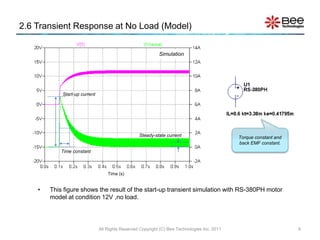
2.6 Transient Response at No Load (Model)
All Rights Reserved Copyright (C) Bee Technologies Inc. 2011 6
Start-up current
Steady-state current
Time constant
Simulation
• This figure shows the result of the start-up transient simulation with RS-380PH motor
model at condition 12V ,no load.
Torque constant and
back EMF constant.
Time (s)
2.7 Speed at No Load (Model)
• This figure shows the simulated speed at no load (16,400rpm). To monitor the speed ,trace
“ I(U1.Vrpm) ” inside the model .SUBCKT.
 Note: To show I(U1.Vrmp), select  "Save Subcircuit Device Currents“ ( Tool > Control Panel > Save Default [tab] ).
All Rights Reserved Copyright (C) Bee Technologies Inc. 2011 7
Speed at No Load
=16,400 rpm.
Simulation
Normal Voltage
=7.2V.
Motor current
Time (s)
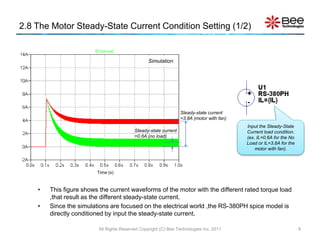
2.8 The Motor Steady-State Current Condition Setting (1/2)
All Rights Reserved Copyright (C) Bee Technologies Inc. 2011 8
Steady-state current
=0.6A (no load)
Simulation
• This figure shows the current waveforms of the motor with the different rated torque load
,that result as the different steady-state current.
• Since the simulations are focused on the electrical world ,the RS-380PH spice model is
directly conditioned by input the steady-state current.
Steady-state current
=3.8A (motor with fan)
Input the Steady-State
Current load condition.
(ex. IL=0.6A for the No
Load or IL=3.8A for the
motor with fan).
Time (s)
2.8 The Motor Steady-State Current Condition Setting (2/2)
All Rights Reserved Copyright (C) Bee Technologies Inc. 2011 9
Steady-state current
=0.6A
Simulation
Input the value of “IL”=1.1A
for the steady-state current
condition 0.6A (the value is
not matched).
• This figure shows the unmatched value of the steady-state current condition when Vcc condition is
7.2Vdc (not a 12Vdc).
 Steady-state current simulated result will match the model input value “IL” only when the condition Vcc is 12Vdc .
In the other case , “IL” value is changed until the desired steady-state current condition is met.
Time (s)
2.9 Transient Response at Load 3.8A
(Measurement vs. Simulation)
• This figure shows the result of the start-up transient simulation with RS-380PH motor model at
condition 12V ,3.8A load.
• The result is compared to the voltage and current waveforms obtained by the oscilloscope.
All Rights Reserved Copyright (C) Bee Technologies Inc. 2011 10
SimulationMeasurement
IM(t) ,2A/DIV
VM(t) ,5V/DIV
The test setup include 12Vdc source ,0.8 series resistor and the RS-380PH motor with fan.
Time (s)
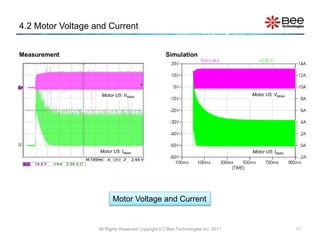
4.2 Motor Voltage and Current
All Rights Reserved Copyright (C) Bee Technologies Inc. 2011 11
Measurement Simulation
Motor Voltage and Current
Motor U5: IMotor
Motor U5: VMotor
Motor U5: IMotor
Motor U5: VMotor
Appendix A: Simulation Settings
All Rights Reserved Copyright (C) Bee Technologies Inc. 2011 12
select
SPICE Directive
Edit text for analysis
directives (.OPTIONS)

DC Motor Model

  • 1.
    1. The Simulationof DC Motor Control Circuit All Rights Reserved Copyright (C) Bee Technologies Inc. 2011 1 DC Motor Model ⇒The model features on transient characteristics of the motor. LM555 Timer IC Model ⇒The model features on functions of the IC. Key simulation models
  • 2.
    MABUCHI MOTOR RS-380PH •Voltage Range..........................12.0 V • Normal Voltage.........................7.2 V • Normal Load.............................9.8 mNm • Speed at No Load.....................16,400 rpm • At Normal Load • Speed................................14,200 rpm • Current...............................2.9A 2.1 Manufacturer Specification All Rights Reserved Copyright (C) Bee Technologies Inc. 2011 2
  • 3.
    • The TorqueConstant KT is obtained as: RS-380PH at Normal Load: Torque = 9.8 mNm INormal Load = 2.9 A KT = 9.8/2.9 = 3.379 mNm/A • The Back EMF Constant KE is obtained as: RS-380PH at No Load: Speed = 16,400 rpm VEMF = VNormal - RMINo Load = 7.2-0.3456 = 6.8544 V ,RM=0.576 and INo Load =0.6A (measurement data). KE =6.8544/16,400 = 0.41795 mV/rpm 2.2 Torque Constant and Back EMF Constant All Rights Reserved Copyright (C) Bee Technologies Inc. 2011 3 1IKTorque T  (1) SpeedKV EEMF  (2)
  • 4.
    2.3 The ArmatureInductance and Resistance • The Armature Inductance and Resistance are obtained with a Precision Impedance Anayzer (Agilent 4294A) • LS = 165 uH and RS = 575.977 m All Rights Reserved Copyright (C) Bee Technologies Inc. 2011 4 Calculated Measured Precision Impedance Analyzer |Z| vs. Frequency measured data.
  • 5.
    2.5 Transient Responseat No Load • The test setup include 12Vdc source ,series resistor and the motor. • The result is used to obtain the start-up current and the steady state current. • The time constant of the current response will be used to determine the parameters that model the motor shaft’s inertia. All Rights Reserved Copyright (C) Bee Technologies Inc. 2011 5 This figure is the motor current and voltage at start-up transient (oscilloscope screen captured). Start-up current Steady-state current Time constant Measurement
  • 6.
    2.6 Transient Responseat No Load (Model) All Rights Reserved Copyright (C) Bee Technologies Inc. 2011 6 Start-up current Steady-state current Time constant Simulation • This figure shows the result of the start-up transient simulation with RS-380PH motor model at condition 12V ,no load. Torque constant and back EMF constant. Time (s)
  • 7.
    2.7 Speed atNo Load (Model) • This figure shows the simulated speed at no load (16,400rpm). To monitor the speed ,trace “ I(U1.Vrpm) ” inside the model .SUBCKT.  Note: To show I(U1.Vrmp), select  "Save Subcircuit Device Currents“ ( Tool > Control Panel > Save Default [tab] ). All Rights Reserved Copyright (C) Bee Technologies Inc. 2011 7 Speed at No Load =16,400 rpm. Simulation Normal Voltage =7.2V. Motor current Time (s)
  • 8.
    2.8 The MotorSteady-State Current Condition Setting (1/2) All Rights Reserved Copyright (C) Bee Technologies Inc. 2011 8 Steady-state current =0.6A (no load) Simulation • This figure shows the current waveforms of the motor with the different rated torque load ,that result as the different steady-state current. • Since the simulations are focused on the electrical world ,the RS-380PH spice model is directly conditioned by input the steady-state current. Steady-state current =3.8A (motor with fan) Input the Steady-State Current load condition. (ex. IL=0.6A for the No Load or IL=3.8A for the motor with fan). Time (s)
  • 9.
    2.8 The MotorSteady-State Current Condition Setting (2/2) All Rights Reserved Copyright (C) Bee Technologies Inc. 2011 9 Steady-state current =0.6A Simulation Input the value of “IL”=1.1A for the steady-state current condition 0.6A (the value is not matched). • This figure shows the unmatched value of the steady-state current condition when Vcc condition is 7.2Vdc (not a 12Vdc).  Steady-state current simulated result will match the model input value “IL” only when the condition Vcc is 12Vdc . In the other case , “IL” value is changed until the desired steady-state current condition is met. Time (s)
  • 10.
    2.9 Transient Responseat Load 3.8A (Measurement vs. Simulation) • This figure shows the result of the start-up transient simulation with RS-380PH motor model at condition 12V ,3.8A load. • The result is compared to the voltage and current waveforms obtained by the oscilloscope. All Rights Reserved Copyright (C) Bee Technologies Inc. 2011 10 SimulationMeasurement IM(t) ,2A/DIV VM(t) ,5V/DIV The test setup include 12Vdc source ,0.8 series resistor and the RS-380PH motor with fan. Time (s)
  • 11.
    4.2 Motor Voltageand Current All Rights Reserved Copyright (C) Bee Technologies Inc. 2011 11 Measurement Simulation Motor Voltage and Current Motor U5: IMotor Motor U5: VMotor Motor U5: IMotor Motor U5: VMotor
  • 12.
    Appendix A: SimulationSettings All Rights Reserved Copyright (C) Bee Technologies Inc. 2011 12 select SPICE Directive Edit text for analysis directives (.OPTIONS)