DATABASE MANAGEMENT SYSTEMS
PRESENT BY:
RUSHIT BHADANIYA
RELATIONAL ALGEBRA
 Introduction
 Join Operation
INRODUCTION
 Relational Algebra is a procedural query
language.
 It consists of a set of operations that take one
or two relations as input and produce a new
relation as their result.
FUNDAMENTAL OPERATION IN RELATIONAL
ALGEBRA ARE:
 Selection
 Projection
 Union
 Set Difference
 Cartesian Product
 Join
JOIN
 The JOIN operation is denoted by the R|X|S symbol
and is used to compound similar tuples from two
Relations into single longer tuples.
 Join operation is generally the cross product of two
relation.
 The notation used is
 R JOIN S
join condition
TYPES OF JOIN
 Theta Join
 Equi Join
 Natural Join
 Outer Join
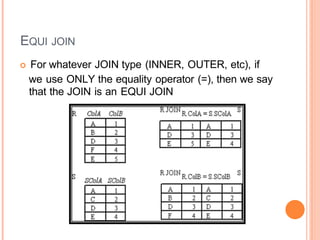
EQUI JOIN
 For whatever JOIN type (INNER, OUTER, etc), if
we use ONLY the equality operator (=), then we say
that the JOIN is an EQUI JOIN
THETA JOIN
 This is same as EQUI JOIN but it allows all other
operators like >, <, >= etc.
NATURAL JOIN
 The JOIN involves an equality test, and thus is
often described as an equi-join.
 Such joins result in two attributes in the resulting
relation having exactly the same value.
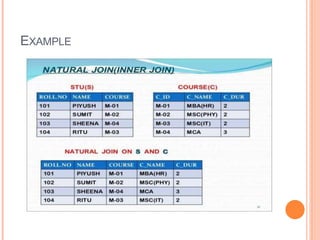
 A natural join will remove the duplicate attributes.
EXAMPLE
OUTER JOIN
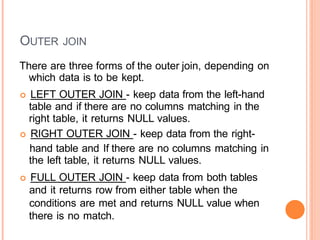
There are three forms of the outer join, depending on
which data is to be kept.
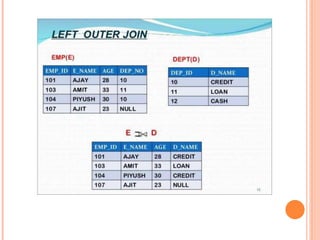
 LEFT OUTER JOIN - keep data from the left-hand
table and if there are no columns matching in the
right table, it returns NULL values.
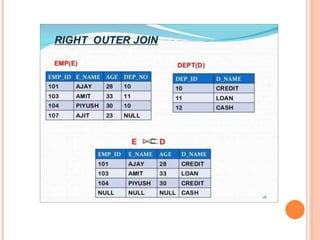
 RIGHT OUTER JOIN - keep data from the right-
hand table and If there are no columns matching in
the left table, it returns NULL values.
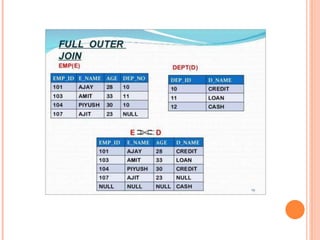
 FULL OUTER JOIN - keep data from both tables
and it returns row from either table when the
conditions are met and returns NULL value when
there is no match.
THANK YOU

dbmspresentation-161126155322.pptx

  • 1.
  • 2.
  • 3.
    INRODUCTION  Relational Algebrais a procedural query language.  It consists of a set of operations that take one or two relations as input and produce a new relation as their result.
  • 4.
    FUNDAMENTAL OPERATION INRELATIONAL ALGEBRA ARE:  Selection  Projection  Union  Set Difference  Cartesian Product  Join
  • 5.
    JOIN  The JOINoperation is denoted by the R|X|S symbol and is used to compound similar tuples from two Relations into single longer tuples.  Join operation is generally the cross product of two relation.  The notation used is  R JOIN S join condition
  • 6.
    TYPES OF JOIN Theta Join  Equi Join  Natural Join  Outer Join
  • 7.
    EQUI JOIN  Forwhatever JOIN type (INNER, OUTER, etc), if we use ONLY the equality operator (=), then we say that the JOIN is an EQUI JOIN
  • 8.
    THETA JOIN  Thisis same as EQUI JOIN but it allows all other operators like >, <, >= etc.
  • 9.
    NATURAL JOIN  TheJOIN involves an equality test, and thus is often described as an equi-join.  Such joins result in two attributes in the resulting relation having exactly the same value.  A natural join will remove the duplicate attributes.
  • 10.
  • 11.
    OUTER JOIN There arethree forms of the outer join, depending on which data is to be kept.  LEFT OUTER JOIN - keep data from the left-hand table and if there are no columns matching in the right table, it returns NULL values.  RIGHT OUTER JOIN - keep data from the right- hand table and If there are no columns matching in the left table, it returns NULL values.  FULL OUTER JOIN - keep data from both tables and it returns row from either table when the conditions are met and returns NULL value when there is no match.
  • 15.