The  Relational Algebra and  Relational Calculus Chapter 6
Unary Relational Operations Relational Algebra Operations from Set Theory Binary relational Operations Additional Relational Operations The Tuple Relational Calculus The Domain Relational Calculus  Chapter Outline
The  relational algebra  is a set of operators that take and return relations Unary operations take one relation, and return one relation: SELECT operation PROJECT operation Sequences of unary operations RENAME operation Unary Relational Operations
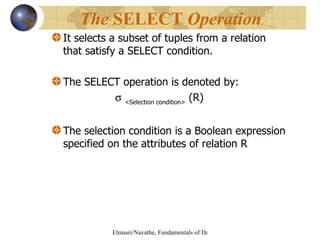
It selects a subset of tuples from a relation that satisfy a SELECT condition. The SELECT operation is denoted by:    <Selection condition>  (R)  The selection condition is a Boolean expression specified on the attributes of relation R The  SELECT  Operation
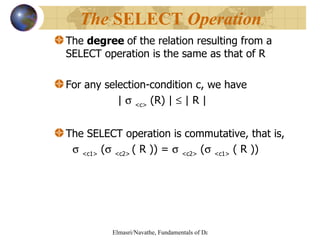
The  degree  of the relation resulting from a SELECT operation is the same as that of R For any selection-condition c, we have  |     <c>  (R) |    | R | The SELECT operation is commutative, that is,    <c1>  (    <c2>  ( R )) =     <c2>  (    <c1>  ( R ))   The  SELECT  Operation
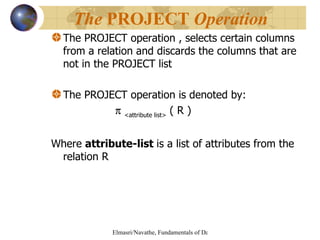
The PROJECT operation , selects certain columns from a relation and discards the columns that are not in the PROJECT list The PROJECT operation is denoted by:    <attribute list>  ( R )   Where  attribute-list  is a list of attributes from the relation R The  PROJECT  Operation
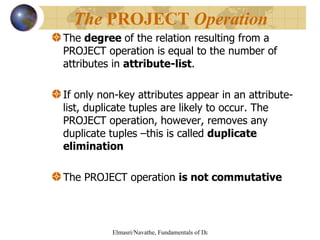
The  degree  of the relation resulting from a PROJECT operation is equal to the number of attributes in  attribute-list . If only non-key attributes appear in an attribute-list, duplicate tuples are likely to occur. The PROJECT operation, however, removes any duplicate tuples –this is called  duplicate elimination The PROJECT operation  is not commutative The  PROJECT  Operation
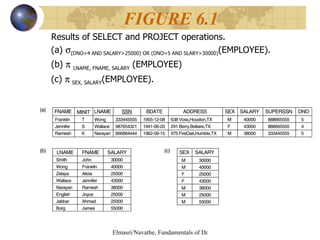
Results of SELECT and PROJECT operations.  (a)   (DNO=4 AND SALARY>25000) OR (DNO=5 AND SLARY>30000) (EMPLOYEE).  (b)     LNAME, FNAME, SALARY  (EMPLOYEE)  (c)   SEX, SALARY (EMPLOYEE). FIGURE 6.1
Two relations R 1  and R 2  are said to be  union compatible  if they have the same degree and all their attributes (correspondingly) have the same domain. The UNION, INTERSECTION, and SET DIFFERENCE operations are applicable on union compatible relations  The resulting relation has the same attribute names as the first relation Relational Algebra Operations
The result of UNION operation on two relations, R 1  and R 2 , is a relation, R 3 , that includes all tuples that are either in R 1 , or in R 2 , or in both R 1  and R 2 . The UNION operation is denoted by: R 3  = R 1     R 2   The UNION operation eliminates duplicate tuples The  UNION operation
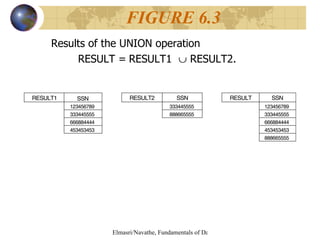
Results of the UNION operation  RESULT =  RESULT1    RESULT2. FIGURE 6.3
The result of INTERSECTION operation on two relations, R 1  and R 2 , is a relation, R 3 , that includes all tuples that are in both R 1  and R 2 . The INTERSECTION operation is denoted by: R 3  = R 1     R 2 The both UNION and INTERSECTION operations are  commutative  and  associative  operations The  INTERSECTION  operation
The result of SET DIFFERENCE operation on two relations, R 1  and R 2 , is a relation, R 3 , that includes all tuples that are in R 1  but not in R 2 . The SET DIFFERENCE operation is denoted by: R 3  = R 1  – R 2 The SET DIFFERENCE (or MINUS) operation  is not   commutative The  SET DIFFERENCE  Operation
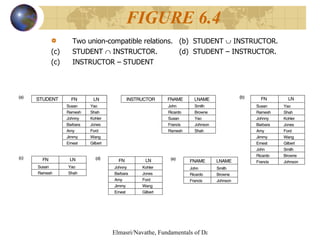
Two union-compatible relations.  (b)  STUDENT    INSTRUCTOR. (c) STUDENT    INSTRUCTOR.  (d)  STUDENT – INSTRUCTOR.  INSTRUCTOR – STUDENT FIGURE 6.4
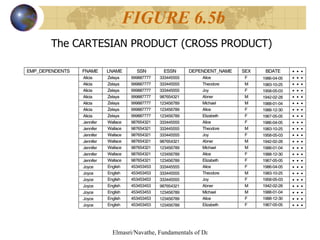
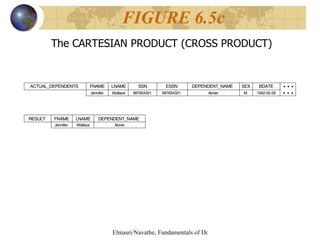
This operation (also known as CROSS PRODUCT or CROSS JOIN) denoted by: R 3  = R 1     R 2   The resulting relation, R 3 , includes all combined tuples from two relations R 1  and R 2 Degree (R 3 ) = Degree (R 1 ) + Degree (R 2 ) |R 3 | = |R 1 |    |R 2 | The  CARTESIAN PRODUCT  Operation
The CARTESIAN PRODUCT (CROSS PRODUCT) FIGURE 6.5b
The CARTESIAN PRODUCT (CROSS PRODUCT)  FIGURE 6.5c
An important operation   for any relational database is the JOIN operation, because it enables us to combine  related tuples  from two relations into single tuple The JOIN operation is denoted by: R 3  = R 1   ⋈   <join condition>  R 2 The degree of resulting relation is  degree(R 1 ) + degree(R 2 ) Binary Relational Operations
The difference between CARTESIAN PRODUCT and JOIN is that the resulting relation from JOIN consists only those tuples that satisfy the  join condition The JOIN operation is equivalent to CARTESIAN PRODUCT and then SELECT operation on the result of CARTESIAN PRODUCT operation, if the  select-condition  is the same as the  join condition The  JOIN  Operation
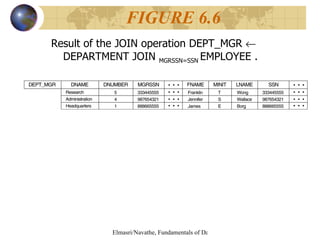
Result of the JOIN operation DEPT_MGR    DEPARTMENT JOIN  MGRSSN=SSN  EMPLOYEE . FIGURE 6.6
If the JOIN operation has equality comparison only (that is, = operation), then it is called an EQUIJOIN operation In the resulting relation on an EQUIJOIN operation, we always have one or more pairs of attributes that have  identical values  in every   tuples The  EQUIJOIN  Operation
In EQUIJOIN operation, if the two attributes in the join condition have the same name, then in the resulting relation we will have two identical columns. In order to avoid this problem, we define the NATURAL JOIN operation  The NATURAL JOIN operation is denoted by: R 3  = R 1  * <attribute list>  R 2   In R 3  only one of the duplicate attributes from the list are kept The  NATURAL JOIN  Operation
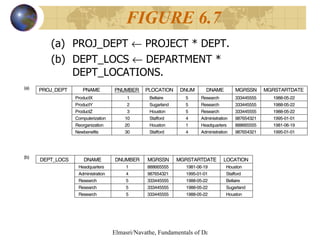
(a)  PROJ_DEPT    PROJECT * DEPT.  (b) DEPT_LOCS    DEPARTMENT * DEPT_LOCATIONS. FIGURE 6.7
The set of relational algebra operations  {σ, π,   , -, x }   Is a  complete set . That is, any of the other relational algebra operations can be expressed as a sequence of operations from this set. For example: R    S = (R    S) – ((R – S)    (S – R))  A Complete Set of Relational Algebra
The DIVISION operation is useful for some queries. For example, “Retrieve the name of employees who work on  all  the projects that ‘John Smith’ works on.”  The Division operation is denoted by: R 3  = R 1   ÷ R 2  In general, attributes in R 2  are a subset of attributes in R 1 The  DIVISION  Operation
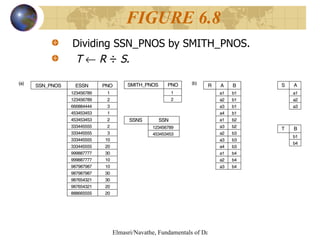
Dividing SSN_PNOS by SMITH_PNOS.  T      R  ÷  S . FIGURE 6.8
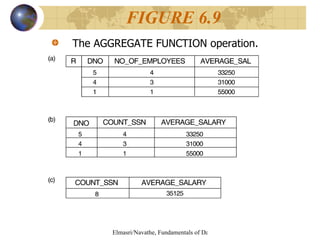
Statistical queries cannot be specified in the basic relational algebra operation We define  aggregate functions  that can be applied over numeric values such as, SUM, AVERAGE, MAXIMUM, MINIMUM, and COUNT The aggregate function is denoted by   <grouping attributes>  δ  <function list>  (R) where aggregation (grouping) is based on the <attributes-list>. If not present, just 1 group Additional Relational Operations
The AGGREGATE FUNCTION operation. FIGURE 6.9
The  relational algebra  is  procedural The  relational calculus  is  nonprocedural Any query that can be specified in the basic relational algebra can also be specified in relational calculus, and vice versa (their  expressive power  are identical) A relational query language is said to be  relationally complete  if any query can be expressed in that language The Tuple Relational Calculus
The tuple relational calculus is based on specifying a number of  tuple variables The  range  of each tuple variable is a relation A tuple relational calculus query is denoted by {t | COND(t)},  where t is a tuple variable and COND(t) is a conditional expression involving t. For example, {t | EMPLOYEE(t) AND t.SALARY>50000} Tuple Variables and Range Relations
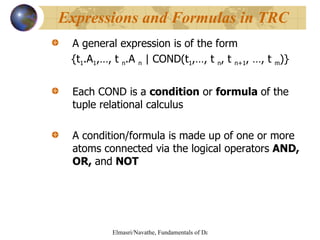
A general expression is of the form {t 1 .A 1 ,…, t  n .A  n  | COND(t 1 ,…, t  n , t  n+1 , …, t  m )} Each COND is a  condition  or  formula  of the tuple relational calculus A condition/formula is made up of one or more atoms connected via the logical operators  AND, OR,  and  NOT Expressions and Formulas in TRC
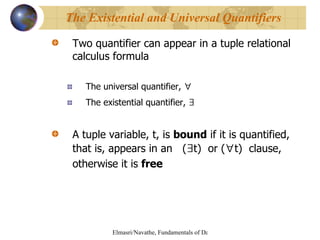
Two quantifier can appear in a tuple relational calculus formula The universal quantifier,  ∀   The existential quantifier,  ∃   A tuple variable, t, is  bound  if it is quantified, that is, appears in an  ( ∃ t)  or ( ∀ t)  clause, otherwise it is  free The Existential and Universal Quantifiers
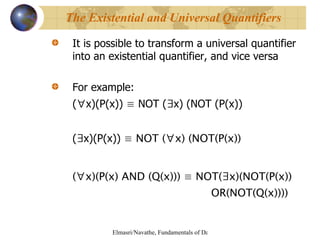
It is possible to transform a universal quantifier into an existential quantifier, and vice versa For example: ( ∀ x)(P(x))  ≡  NOT ( ∃ x) (NOT (P(x)) ( ∃ x)(P(x))  ≡ NOT ( ∀ x) (NOT(P(x)) ( ∀ x)(P(x) AND (Q(x))) ≡ NOT(∃x)(NOT(P(x))  OR(NOT(Q(x)))) The Existential and Universal Quantifiers
In relational calculus, an expression is said to be  safe  if it guaranteed to yield a finite number of tuples as its result The expression {t | NOT (EMPLOYEE(t))} is  unsafe , because it yields all tuples in the universe that are not EMPLOYEE tuples In a  safe expression  all resulting values are from the domain of the expression Safe and Unsafe Expressions
In domain relational calculus, the variables range over single values from domains of attributes SQL is based on tuple relational calculus, while QBE(Query-by-Example) is developed over the domain relational calculus To form a relation of degree ‘n’ for a query result, we must have ‘n’  domain variables The Domain Relational Calculus
A domain relational calculus expression is of the form  {x 1 , …, x n  | COND(x 1 , …, x n , x  n+1 , …, x  n+m )}  where x 1 , …, x  n+m  are domain variables that range over domain of attributes, and COND is a  condition  or  formula.  For example,  {uv | ( ∃ q)( ∃ r)( ∃ s)( ∃ t)( ∃ w)( ∃ x)( ∃ y)( ∃ z) (EMPLOYEE (qrstuvwxyz) AND (q = ‘John’) AND (r=‘B’) AND (s=‘Smith’))} Alternatively, we can write   {uv | EMPLOYEE(‘John’, ‘B’, ‘Smith’, t,u,v,w,x,y,z)} The Domain Relational Calculus

Chapter6

  • 1.
  • 2.
    The RelationalAlgebra and Relational Calculus Chapter 6
  • 3.
    Unary Relational OperationsRelational Algebra Operations from Set Theory Binary relational Operations Additional Relational Operations The Tuple Relational Calculus The Domain Relational Calculus Chapter Outline
  • 4.
    The relationalalgebra is a set of operators that take and return relations Unary operations take one relation, and return one relation: SELECT operation PROJECT operation Sequences of unary operations RENAME operation Unary Relational Operations
  • 5.
    It selects asubset of tuples from a relation that satisfy a SELECT condition. The SELECT operation is denoted by:  <Selection condition> (R) The selection condition is a Boolean expression specified on the attributes of relation R The SELECT Operation
  • 6.
    The degree of the relation resulting from a SELECT operation is the same as that of R For any selection-condition c, we have |  <c> (R) |  | R | The SELECT operation is commutative, that is,  <c1> (  <c2> ( R )) =  <c2> (  <c1> ( R )) The SELECT Operation
  • 7.
    The PROJECT operation, selects certain columns from a relation and discards the columns that are not in the PROJECT list The PROJECT operation is denoted by:  <attribute list> ( R ) Where attribute-list is a list of attributes from the relation R The PROJECT Operation
  • 8.
    The degree of the relation resulting from a PROJECT operation is equal to the number of attributes in attribute-list . If only non-key attributes appear in an attribute-list, duplicate tuples are likely to occur. The PROJECT operation, however, removes any duplicate tuples –this is called duplicate elimination The PROJECT operation is not commutative The PROJECT Operation
  • 9.
    Results of SELECTand PROJECT operations. (a)  (DNO=4 AND SALARY>25000) OR (DNO=5 AND SLARY>30000) (EMPLOYEE). (b)  LNAME, FNAME, SALARY (EMPLOYEE) (c)  SEX, SALARY (EMPLOYEE). FIGURE 6.1
  • 10.
    Two relations R1 and R 2 are said to be union compatible if they have the same degree and all their attributes (correspondingly) have the same domain. The UNION, INTERSECTION, and SET DIFFERENCE operations are applicable on union compatible relations The resulting relation has the same attribute names as the first relation Relational Algebra Operations
  • 11.
    The result ofUNION operation on two relations, R 1 and R 2 , is a relation, R 3 , that includes all tuples that are either in R 1 , or in R 2 , or in both R 1 and R 2 . The UNION operation is denoted by: R 3 = R 1  R 2 The UNION operation eliminates duplicate tuples The UNION operation
  • 12.
    Results of theUNION operation RESULT =  RESULT1  RESULT2. FIGURE 6.3
  • 13.
    The result ofINTERSECTION operation on two relations, R 1 and R 2 , is a relation, R 3 , that includes all tuples that are in both R 1 and R 2 . The INTERSECTION operation is denoted by: R 3 = R 1  R 2 The both UNION and INTERSECTION operations are commutative and associative operations The INTERSECTION operation
  • 14.
    The result ofSET DIFFERENCE operation on two relations, R 1 and R 2 , is a relation, R 3 , that includes all tuples that are in R 1 but not in R 2 . The SET DIFFERENCE operation is denoted by: R 3 = R 1 – R 2 The SET DIFFERENCE (or MINUS) operation is not commutative The SET DIFFERENCE Operation
  • 15.
    Two union-compatible relations. (b) STUDENT  INSTRUCTOR. (c) STUDENT  INSTRUCTOR. (d) STUDENT – INSTRUCTOR. INSTRUCTOR – STUDENT FIGURE 6.4
  • 16.
    This operation (alsoknown as CROSS PRODUCT or CROSS JOIN) denoted by: R 3 = R 1  R 2 The resulting relation, R 3 , includes all combined tuples from two relations R 1 and R 2 Degree (R 3 ) = Degree (R 1 ) + Degree (R 2 ) |R 3 | = |R 1 |  |R 2 | The CARTESIAN PRODUCT Operation
  • 17.
    The CARTESIAN PRODUCT(CROSS PRODUCT) FIGURE 6.5b
  • 18.
    The CARTESIAN PRODUCT(CROSS PRODUCT) FIGURE 6.5c
  • 19.
    An important operation for any relational database is the JOIN operation, because it enables us to combine related tuples from two relations into single tuple The JOIN operation is denoted by: R 3 = R 1 ⋈ <join condition> R 2 The degree of resulting relation is degree(R 1 ) + degree(R 2 ) Binary Relational Operations
  • 20.
    The difference betweenCARTESIAN PRODUCT and JOIN is that the resulting relation from JOIN consists only those tuples that satisfy the join condition The JOIN operation is equivalent to CARTESIAN PRODUCT and then SELECT operation on the result of CARTESIAN PRODUCT operation, if the select-condition is the same as the join condition The JOIN Operation
  • 21.
    Result of theJOIN operation DEPT_MGR  DEPARTMENT JOIN MGRSSN=SSN EMPLOYEE . FIGURE 6.6
  • 22.
    If the JOINoperation has equality comparison only (that is, = operation), then it is called an EQUIJOIN operation In the resulting relation on an EQUIJOIN operation, we always have one or more pairs of attributes that have identical values in every tuples The EQUIJOIN Operation
  • 23.
    In EQUIJOIN operation,if the two attributes in the join condition have the same name, then in the resulting relation we will have two identical columns. In order to avoid this problem, we define the NATURAL JOIN operation The NATURAL JOIN operation is denoted by: R 3 = R 1 * <attribute list> R 2 In R 3 only one of the duplicate attributes from the list are kept The NATURAL JOIN Operation
  • 24.
    (a) PROJ_DEPT  PROJECT * DEPT. (b) DEPT_LOCS  DEPARTMENT * DEPT_LOCATIONS. FIGURE 6.7
  • 25.
    The set ofrelational algebra operations {σ, π,  , -, x } Is a complete set . That is, any of the other relational algebra operations can be expressed as a sequence of operations from this set. For example: R  S = (R  S) – ((R – S)  (S – R)) A Complete Set of Relational Algebra
  • 26.
    The DIVISION operationis useful for some queries. For example, “Retrieve the name of employees who work on all the projects that ‘John Smith’ works on.” The Division operation is denoted by: R 3 = R 1 ÷ R 2 In general, attributes in R 2 are a subset of attributes in R 1 The DIVISION Operation
  • 27.
    Dividing SSN_PNOS bySMITH_PNOS. T  R ÷ S . FIGURE 6.8
  • 28.
    Statistical queries cannotbe specified in the basic relational algebra operation We define aggregate functions that can be applied over numeric values such as, SUM, AVERAGE, MAXIMUM, MINIMUM, and COUNT The aggregate function is denoted by <grouping attributes> δ <function list> (R) where aggregation (grouping) is based on the <attributes-list>. If not present, just 1 group Additional Relational Operations
  • 29.
    The AGGREGATE FUNCTIONoperation. FIGURE 6.9
  • 30.
    The relationalalgebra is procedural The relational calculus is nonprocedural Any query that can be specified in the basic relational algebra can also be specified in relational calculus, and vice versa (their expressive power are identical) A relational query language is said to be relationally complete if any query can be expressed in that language The Tuple Relational Calculus
  • 31.
    The tuple relationalcalculus is based on specifying a number of tuple variables The range of each tuple variable is a relation A tuple relational calculus query is denoted by {t | COND(t)}, where t is a tuple variable and COND(t) is a conditional expression involving t. For example, {t | EMPLOYEE(t) AND t.SALARY>50000} Tuple Variables and Range Relations
  • 32.
    A general expressionis of the form {t 1 .A 1 ,…, t n .A n | COND(t 1 ,…, t n , t n+1 , …, t m )} Each COND is a condition or formula of the tuple relational calculus A condition/formula is made up of one or more atoms connected via the logical operators AND, OR, and NOT Expressions and Formulas in TRC
  • 33.
    Two quantifier canappear in a tuple relational calculus formula The universal quantifier, ∀ The existential quantifier, ∃ A tuple variable, t, is bound if it is quantified, that is, appears in an ( ∃ t) or ( ∀ t) clause, otherwise it is free The Existential and Universal Quantifiers
  • 34.
    It is possibleto transform a universal quantifier into an existential quantifier, and vice versa For example: ( ∀ x)(P(x)) ≡ NOT ( ∃ x) (NOT (P(x)) ( ∃ x)(P(x)) ≡ NOT ( ∀ x) (NOT(P(x)) ( ∀ x)(P(x) AND (Q(x))) ≡ NOT(∃x)(NOT(P(x)) OR(NOT(Q(x)))) The Existential and Universal Quantifiers
  • 35.
    In relational calculus,an expression is said to be safe if it guaranteed to yield a finite number of tuples as its result The expression {t | NOT (EMPLOYEE(t))} is unsafe , because it yields all tuples in the universe that are not EMPLOYEE tuples In a safe expression all resulting values are from the domain of the expression Safe and Unsafe Expressions
  • 36.
    In domain relationalcalculus, the variables range over single values from domains of attributes SQL is based on tuple relational calculus, while QBE(Query-by-Example) is developed over the domain relational calculus To form a relation of degree ‘n’ for a query result, we must have ‘n’ domain variables The Domain Relational Calculus
  • 37.
    A domain relationalcalculus expression is of the form {x 1 , …, x n | COND(x 1 , …, x n , x n+1 , …, x n+m )} where x 1 , …, x n+m are domain variables that range over domain of attributes, and COND is a condition or formula. For example, {uv | ( ∃ q)( ∃ r)( ∃ s)( ∃ t)( ∃ w)( ∃ x)( ∃ y)( ∃ z) (EMPLOYEE (qrstuvwxyz) AND (q = ‘John’) AND (r=‘B’) AND (s=‘Smith’))} Alternatively, we can write {uv | EMPLOYEE(‘John’, ‘B’, ‘Smith’, t,u,v,w,x,y,z)} The Domain Relational Calculus