Good Morning
SEMINAR ON IPv4
-Group Member’s
KUMAR KAUSHAL (43)
NEERAJ KUMAR(45)
ABHISHEK KUMAR BOBY (21)
MOHAMMED FAIJAN (20)
ACHARYA INSTITUTES OF GRADUATE STUDIES
(BANGALORE)
What is INTERNET PROTOCOL
(IP) ?
• The Internet Protocol (IP) is the principal communications
protocol in the Internet protocol suite for relaying datagrams
across network boundaries.
• The Internet protocol suite therefore often referred to as
TCP/IP.
• The first major version of IP, Internet Protocol Version 4
(IPv4), is the dominant protocol of the Internet. Its successor
is Internet Protocol Version 6 (IPv6).
Internet Protocol.
• Internet Protocol version 4 (IPv4) is the fourth version in the
development of the Internet Protocol (IP) Internet, and routes
most traffic on the Internet .
• IPv4 is a connectionless protocol for use on packet-switched
networks.
• It operates on a best effort delivery model, in that it does not
guarantee delivery, nor does it assure proper sequencing or
avoidance of duplicate delivery.
IPv4.
Position of IPv4 in TCP/IP protocol suite
Communication at the network layer in the Internet
is connectionless.
Note-
• An IPv4 address is a 32-bit address that uniquely
and universally defines the connection of a
device (for
example, a computer or a router) to the Internet.
• The IPv4 addresses are unique and universal.
• They are unique in the sense that each address
defines one, and only one, connection to the
Internet.
• The IPv4 addresses are universal in the sense that
the addressing system must be accepted by any
host that wants to be connected to the Internet.
IPv4 Addresses.
• An address space is the total number of addresses used by the
protocol.
• If a protocol uses N bits to define an address, the address space is
2N because each bit can have two different values (0 or 1) and N
bits can have 2N values.
• IPv4 uses 32-bit addresses, which means that the address space is
2^32 or 4,294,967,296 .
• This means that, theoretically, if there were no restrictions, more
than 4 billion devices could be connected to the Internet.
Address Space.
Notation.
• There are two Types of notations to show an IPv4 address:
binary notation and dotted-decimal notation.
Binary Notation
• In binary notation, the IPv4 address is displayed as 32 bits.
• Each octet is often referred to as a byte.
• The following is an example of an IPv4 address in binary
notation:
01110101 10010101 00011101 00000010
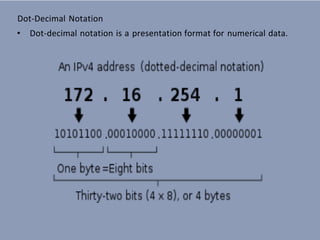
Dot-Decimal Notation
• Dot-decimal notation is a presentation format for numerical data.
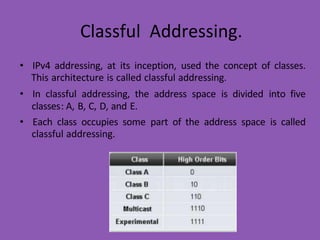
Classful Addressing.
• IPv4 addressing, at its inception, used the concept of classes.
This architecture is called classful addressing.
• In classful addressing, the address space is divided into five
classes: A, B, C, D, and E.
• Each class occupies some part of the address space is called
classful addressing.
Example
Find the class of each address.
a. 00000001 00001011 00001011 11101111
b. 11000001 10000011 00011011 11111111
c. 14.23.120.8
d. 252.5.15.111
Solution
a. The first bit is O. This is a class A address.
b. The first 2 bits are 1; the third bit is O. This is a class C address.
c. The first byte is 14 (between 0 and 127); the class is A.
d. The first byte is 252 (between 240 and 255); the class is E.
IPv4-ppt.k.pptx
IPv4-ppt.k.pptx

IPv4-ppt.k.pptx

  • 1.
  • 2.
    SEMINAR ON IPv4 -GroupMember’s KUMAR KAUSHAL (43) NEERAJ KUMAR(45) ABHISHEK KUMAR BOBY (21) MOHAMMED FAIJAN (20) ACHARYA INSTITUTES OF GRADUATE STUDIES (BANGALORE)
  • 3.
    What is INTERNETPROTOCOL (IP) ?
  • 4.
    • The InternetProtocol (IP) is the principal communications protocol in the Internet protocol suite for relaying datagrams across network boundaries. • The Internet protocol suite therefore often referred to as TCP/IP. • The first major version of IP, Internet Protocol Version 4 (IPv4), is the dominant protocol of the Internet. Its successor is Internet Protocol Version 6 (IPv6). Internet Protocol.
  • 6.
    • Internet Protocolversion 4 (IPv4) is the fourth version in the development of the Internet Protocol (IP) Internet, and routes most traffic on the Internet . • IPv4 is a connectionless protocol for use on packet-switched networks. • It operates on a best effort delivery model, in that it does not guarantee delivery, nor does it assure proper sequencing or avoidance of duplicate delivery. IPv4.
  • 7.
    Position of IPv4in TCP/IP protocol suite Communication at the network layer in the Internet is connectionless. Note-
  • 8.
    • An IPv4address is a 32-bit address that uniquely and universally defines the connection of a device (for example, a computer or a router) to the Internet. • The IPv4 addresses are unique and universal. • They are unique in the sense that each address defines one, and only one, connection to the Internet. • The IPv4 addresses are universal in the sense that the addressing system must be accepted by any host that wants to be connected to the Internet. IPv4 Addresses.
  • 10.
    • An addressspace is the total number of addresses used by the protocol. • If a protocol uses N bits to define an address, the address space is 2N because each bit can have two different values (0 or 1) and N bits can have 2N values. • IPv4 uses 32-bit addresses, which means that the address space is 2^32 or 4,294,967,296 . • This means that, theoretically, if there were no restrictions, more than 4 billion devices could be connected to the Internet. Address Space.
  • 11.
    Notation. • There aretwo Types of notations to show an IPv4 address: binary notation and dotted-decimal notation. Binary Notation • In binary notation, the IPv4 address is displayed as 32 bits. • Each octet is often referred to as a byte. • The following is an example of an IPv4 address in binary notation: 01110101 10010101 00011101 00000010
  • 12.
    Dot-Decimal Notation • Dot-decimalnotation is a presentation format for numerical data.
  • 14.
    Classful Addressing. • IPv4addressing, at its inception, used the concept of classes. This architecture is called classful addressing. • In classful addressing, the address space is divided into five classes: A, B, C, D, and E. • Each class occupies some part of the address space is called classful addressing.
  • 15.
    Example Find the classof each address. a. 00000001 00001011 00001011 11101111 b. 11000001 10000011 00011011 11111111 c. 14.23.120.8 d. 252.5.15.111 Solution a. The first bit is O. This is a class A address. b. The first 2 bits are 1; the third bit is O. This is a class C address. c. The first byte is 14 (between 0 and 127); the class is A. d. The first byte is 252 (between 240 and 255); the class is E.