Good Morning
Microservices
NEERAJ KUMAR
P18AJ21S0111
ACHARYA INSTITUTES OF GRADUATE STUDIES
(BANGALORE)
Microservices
 Microservices is a popular architectural paradigm that
addresses the limitations and drawbacks of legacy
applications.
 Microservices are an architectural and organizational approach
to software development where software is composed of small
independent services that communicate over well-defined
APIs. These services are owned by small, self-contained
teams.
 It is an Architecture style that structure an application as a
collection of service that are Loosely coupled and
Independently deployable.
4/30/2023
3
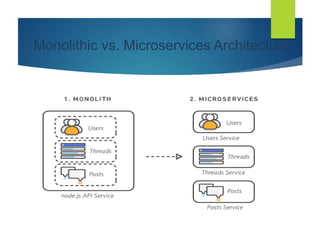
Monolithic vs. Microservices Architecture
Monolithic
monolithic architectures, all processes are tightly
coupled and run as a single service. This means that if
one process of the application experiences a spike in
demand, the entire architecture must be scaled. Adding
or improving a monolithic application’s features becomes
more complex as the code base grows. This complexity
limits experimentation and makes it difficult to implement
new ideas. Monolithic architectures add risk for
application availability because many dependent and
tightly coupled processes increase the impact of a single
process failure 4/30/2023
5
Microservices Architecture
 Microservices architectures make applications easier
to scale and faster to develop, enabling innovation and
accelerating time-to-market for new features.
 a microservices architecture, is an Architecture Style
that structures an application as a collection of small
autonomous services , modelled around a Business
Domain.
 In Microservice Architecture , each service its self
contained and implements a single Business
Capability. 4/30/2023
6
Advantage of Microservice
 Loosely Coupled
 Independently Deployable
 Independent Development
 Fault Isolation
 Dynamic Scaling
Disadvantages of microservice
 Distributed system so overhead to
communication in between services.
 Decompose the application in order to
facilitate agile application development
and deployment.
Characteristics of Microservices
 Autonomous
 Specialized
 Autonomous
 Each component service in a microservices architecture can be
developed, deployed, operated, and scaled without affecting the
functioning of other services. Services do not need to share any of their
code or implementation with other services. Any communication
between individual components happens via well-defined APIs.
 Specialized
 Each service is designed for a set of capabilities
and focuses on solving a specific problem. If
developers contribute more code to a service over
time and the service becomes complex, it can be
broken into smaller services.
Benefits of Microservices
 Agility
 Microservices faster an organization of small, independent teams that take
ownership of their services. Teams act within a small and well understood
context, and are empowered to work more independently and more quickly.
 Flexible Scaling
 Microservices allow each service to be independently scaled to meet demand
for the application feature it supports.
 Easy Deployment
 Microservices enable continuous integration and continuous delivery, making it
easy to try out new ideas and to roll back if something doesn’t work.
 Technological Freedom
 Microservices architectures don’t follow a “one size fits all” approach. Teams
have the freedom to choose the best tool to solve their specific problems.
Thanks

Microservice.pptx

  • 1.
  • 2.
  • 3.
    Microservices  Microservices isa popular architectural paradigm that addresses the limitations and drawbacks of legacy applications.  Microservices are an architectural and organizational approach to software development where software is composed of small independent services that communicate over well-defined APIs. These services are owned by small, self-contained teams.  It is an Architecture style that structure an application as a collection of service that are Loosely coupled and Independently deployable. 4/30/2023 3
  • 4.
  • 5.
    Monolithic monolithic architectures, allprocesses are tightly coupled and run as a single service. This means that if one process of the application experiences a spike in demand, the entire architecture must be scaled. Adding or improving a monolithic application’s features becomes more complex as the code base grows. This complexity limits experimentation and makes it difficult to implement new ideas. Monolithic architectures add risk for application availability because many dependent and tightly coupled processes increase the impact of a single process failure 4/30/2023 5
  • 6.
    Microservices Architecture  Microservicesarchitectures make applications easier to scale and faster to develop, enabling innovation and accelerating time-to-market for new features.  a microservices architecture, is an Architecture Style that structures an application as a collection of small autonomous services , modelled around a Business Domain.  In Microservice Architecture , each service its self contained and implements a single Business Capability. 4/30/2023 6
  • 7.
    Advantage of Microservice Loosely Coupled  Independently Deployable  Independent Development  Fault Isolation  Dynamic Scaling
  • 8.
    Disadvantages of microservice Distributed system so overhead to communication in between services.  Decompose the application in order to facilitate agile application development and deployment.
  • 9.
    Characteristics of Microservices Autonomous  Specialized  Autonomous  Each component service in a microservices architecture can be developed, deployed, operated, and scaled without affecting the functioning of other services. Services do not need to share any of their code or implementation with other services. Any communication between individual components happens via well-defined APIs.
  • 10.
     Specialized  Eachservice is designed for a set of capabilities and focuses on solving a specific problem. If developers contribute more code to a service over time and the service becomes complex, it can be broken into smaller services.
  • 11.
    Benefits of Microservices Agility  Microservices faster an organization of small, independent teams that take ownership of their services. Teams act within a small and well understood context, and are empowered to work more independently and more quickly.  Flexible Scaling  Microservices allow each service to be independently scaled to meet demand for the application feature it supports.  Easy Deployment  Microservices enable continuous integration and continuous delivery, making it easy to try out new ideas and to roll back if something doesn’t work.  Technological Freedom  Microservices architectures don’t follow a “one size fits all” approach. Teams have the freedom to choose the best tool to solve their specific problems.
  • 12.