Taking Stock of MAP’s Portfolio
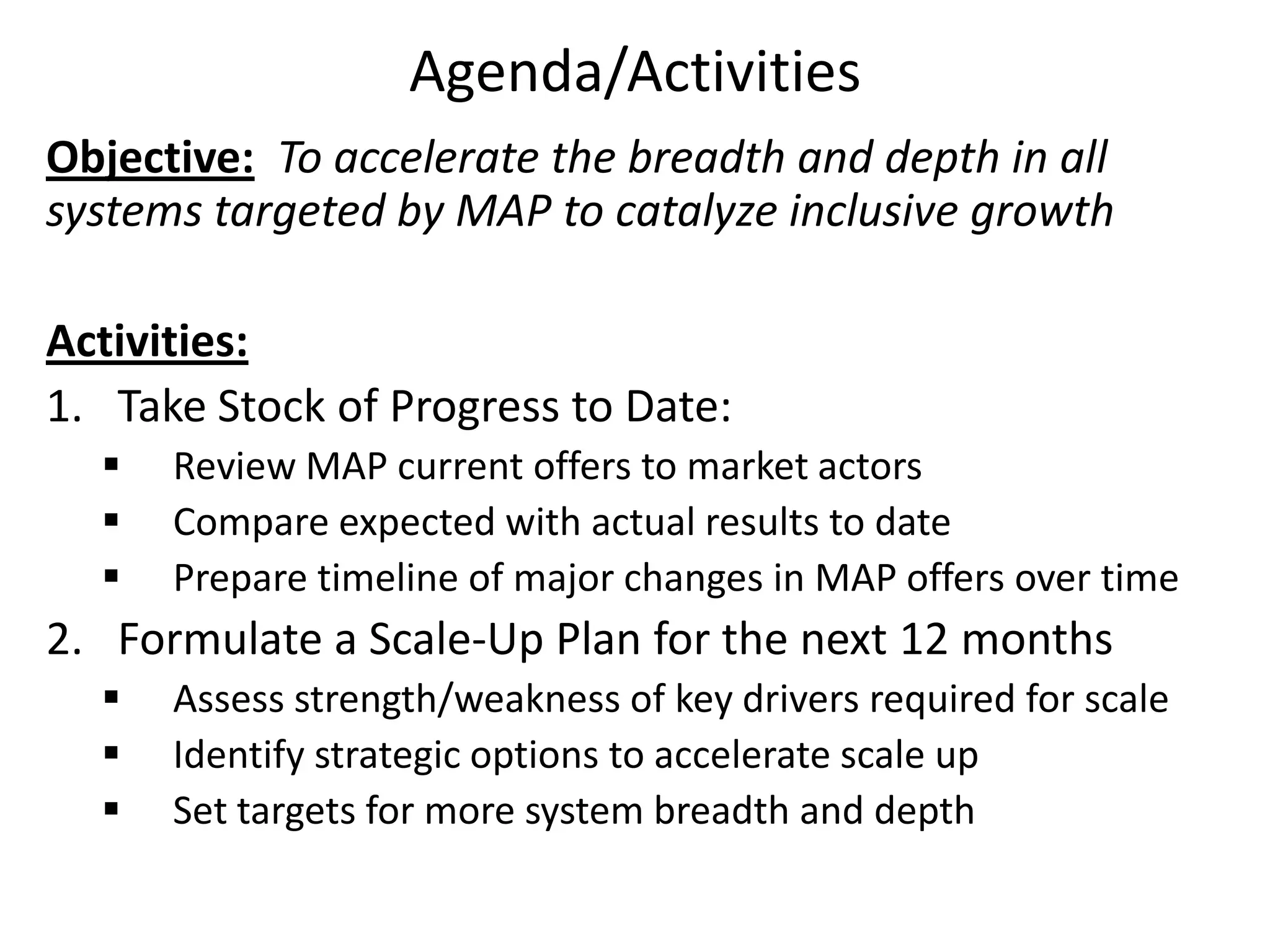
Agenda/Activities
Objective: To accelerate the breadth and depth in all
systems targeted by MAP to catalyze inclusive growth
Activities:
1. Take Stock of Progress to Date:
 Review MAP current offers to market actors
 Compare expected with actual results to date
 Prepare timeline of major changes in MAP offers over time
2. Formulate a Scale-Up Plan for the next 12 months
 Assess strength/weakness of key drivers required for scale
 Identify strategic options to accelerate scale up
 Set targets for more system breadth and depth
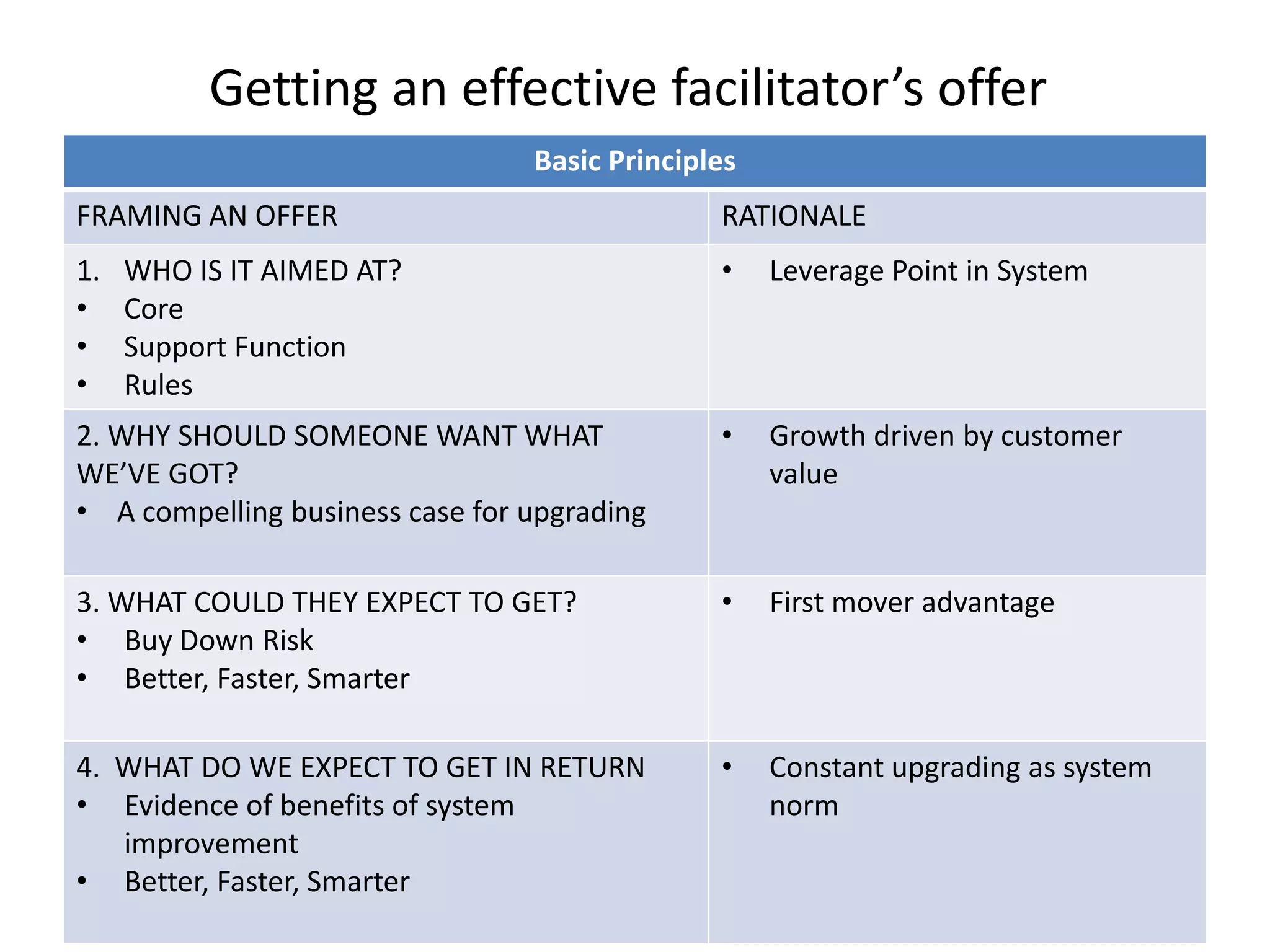
Getting an effective facilitator’s offer
Basic Principles
FRAMING AN OFFER RATIONALE
1. WHO IS IT AIMED AT?
• Core
• Support Function
• Rules
• Leverage Point in System
2. WHY SHOULD SOMEONE WANT WHAT
WE’VE GOT?
• A compelling business case for upgrading
• Growth driven by customer
value
3. WHAT COULD THEY EXPECT TO GET?
• Buy Down Risk
• Better, Faster, Smarter
• First mover advantage
4. WHAT DO WE EXPECT TO GET IN RETURN
• Evidence of benefits of system
improvement
• Better, Faster, Smarter
• Constant upgrading as system
norm
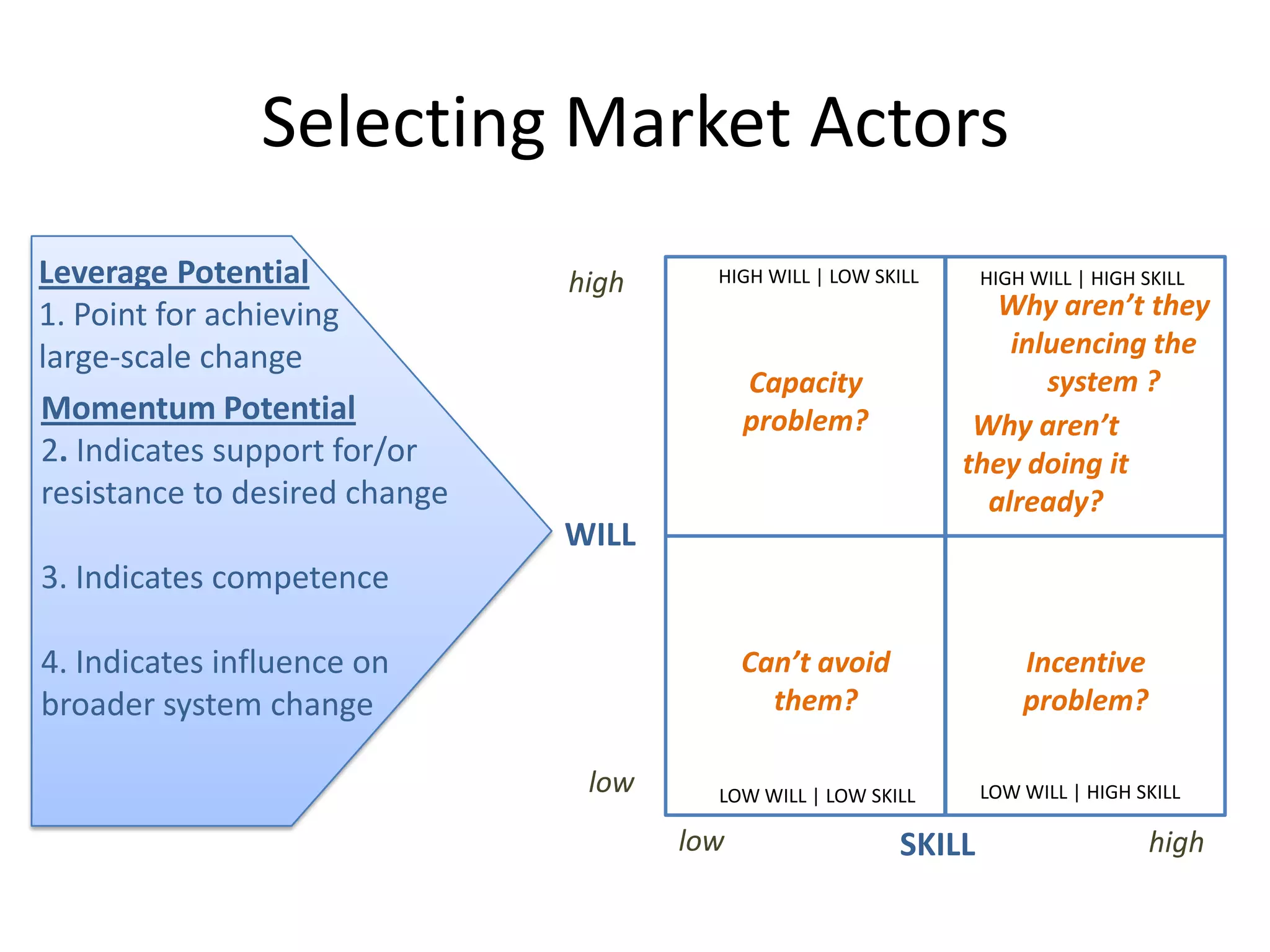
Selecting Market Actors
Momentum Potential
2. Indicates support for/or
resistance to desired change
3. Indicates competence
4. Indicates influence on
broader system change
Leverage Potential
1. Point for achieving
large-scale change
WILL
SKILL
high
high
low
low
Capacity
problem?
Incentive
problem?
Why aren’t
they doing it
already?
Can’t avoid
them?
Why aren’t they
inluencing the
system ?
HIGH WILL | LOW SKILL HIGH WILL | HIGH SKILL
LOW WILL | LOW SKILL LOW WILL | HIGH SKILL
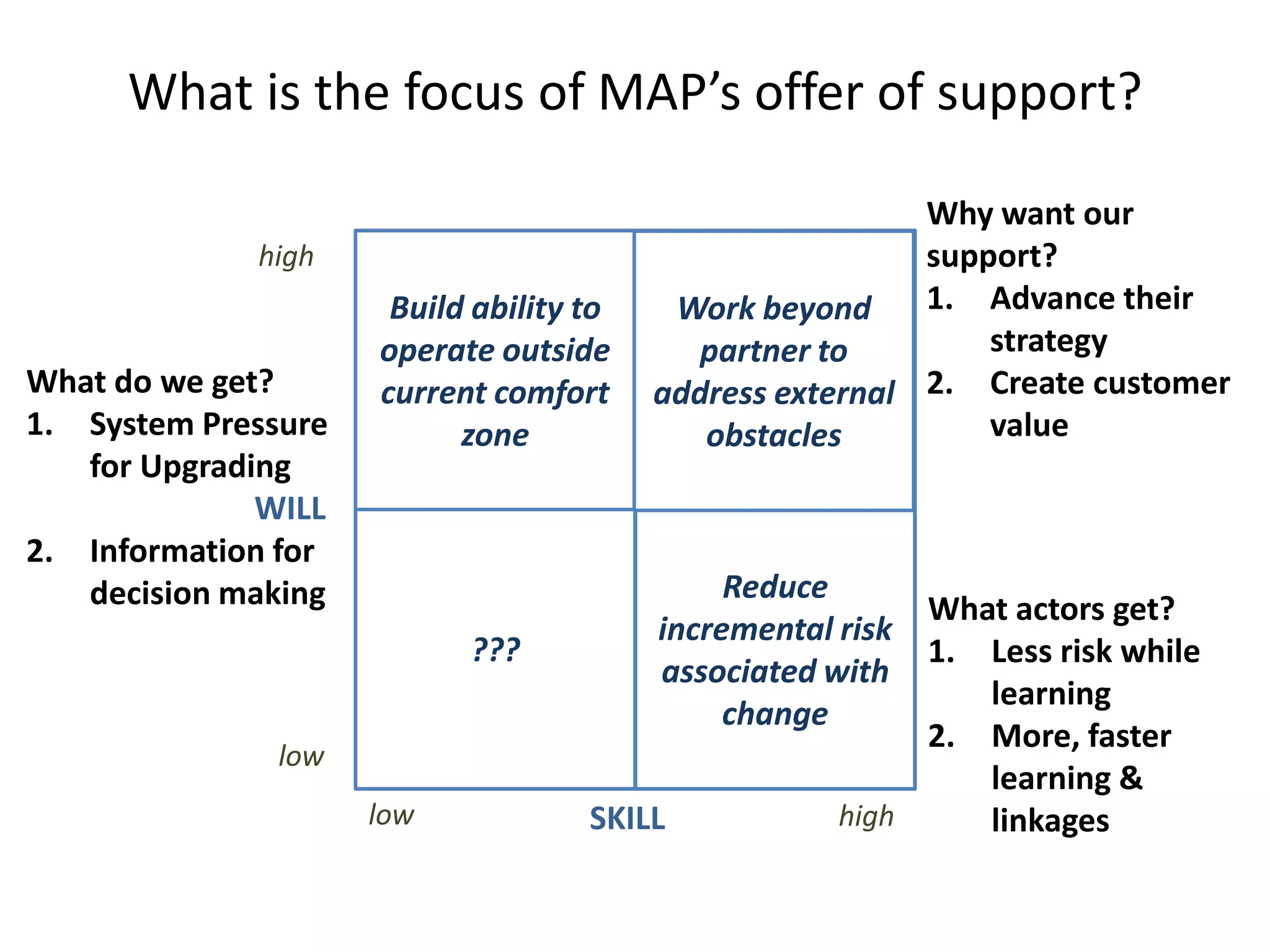
What is the focus of MAP’s offer of support?
WILL
SKILL
high
high
low
low
Capacity
problem?
Incentive
problem?
Why aren’t
they doing it
already?
Why work
with them?
Build ability to
operate outside
current comfort
zone
Reduce
incremental risk
associated with
change
???
Why aren’t they
influential in
the system?
Work beyond
partner to
address external
obstacles
What actors get?
1. Less risk while
learning
2. More, faster
learning &
linkages
Why want our
support?
1. Advance their
strategy
2. Create customer
value
What do we get?
1. System Pressure
for Upgrading
2. Information for
decision making
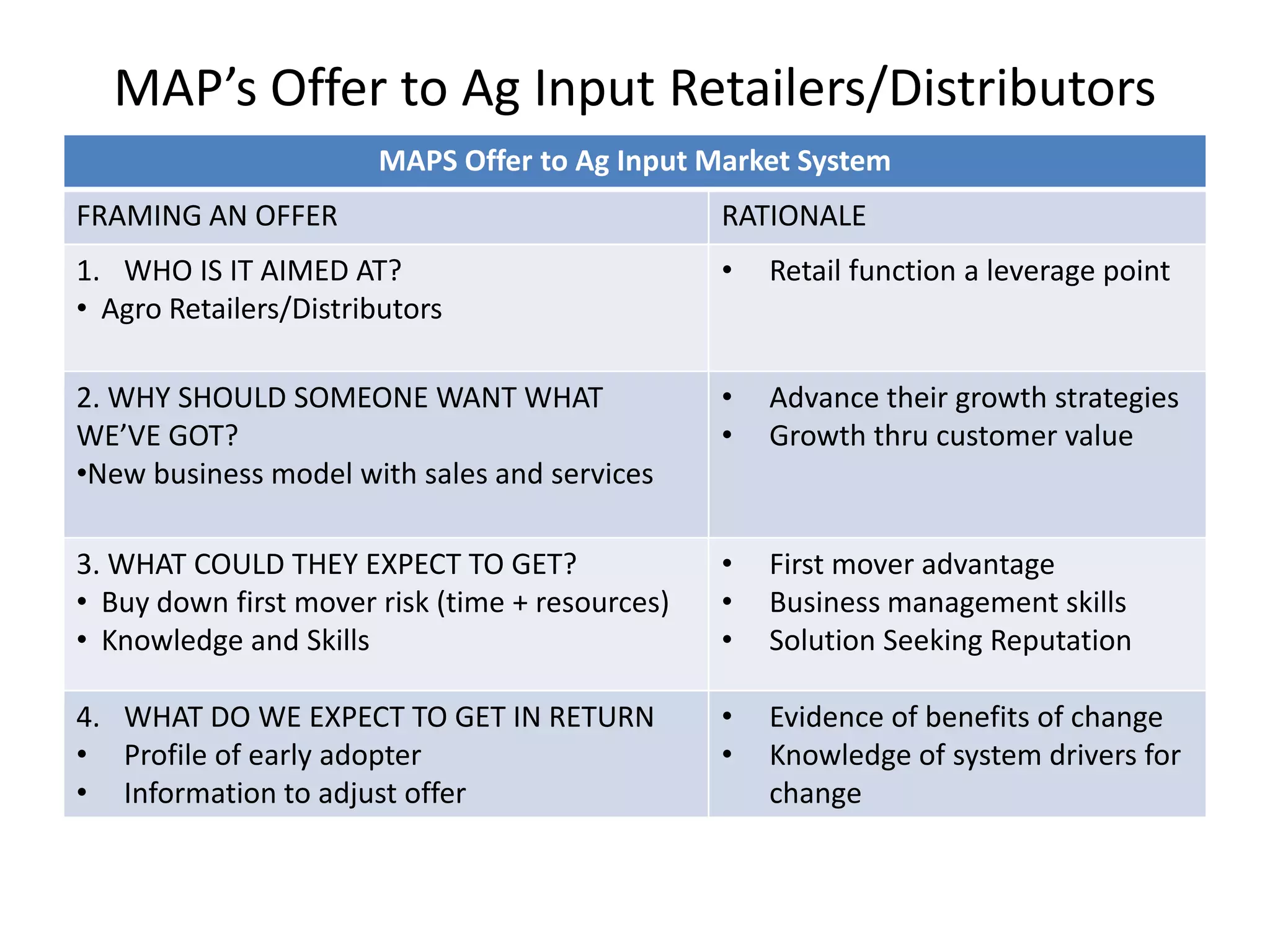
MAP’s Offer to Ag Input Retailers/Distributors
MAPS Offer to Ag Input Market System
FRAMING AN OFFER RATIONALE
1. WHO IS IT AIMED AT?
• Agro Retailers/Distributors
• Retail function a leverage point
2. WHY SHOULD SOMEONE WANT WHAT
WE’VE GOT?
•New business model with sales and services
• Advance their growth strategies
• Growth thru customer value
3. WHAT COULD THEY EXPECT TO GET?
• Buy down first mover risk (time + resources)
• Knowledge and Skills
• First mover advantage
• Business management skills
• Solution Seeking Reputation
4. WHAT DO WE EXPECT TO GET IN RETURN
• Profile of early adopter
• Information to adjust offer
• Evidence of benefits of change
• Knowledge of system drivers for
change
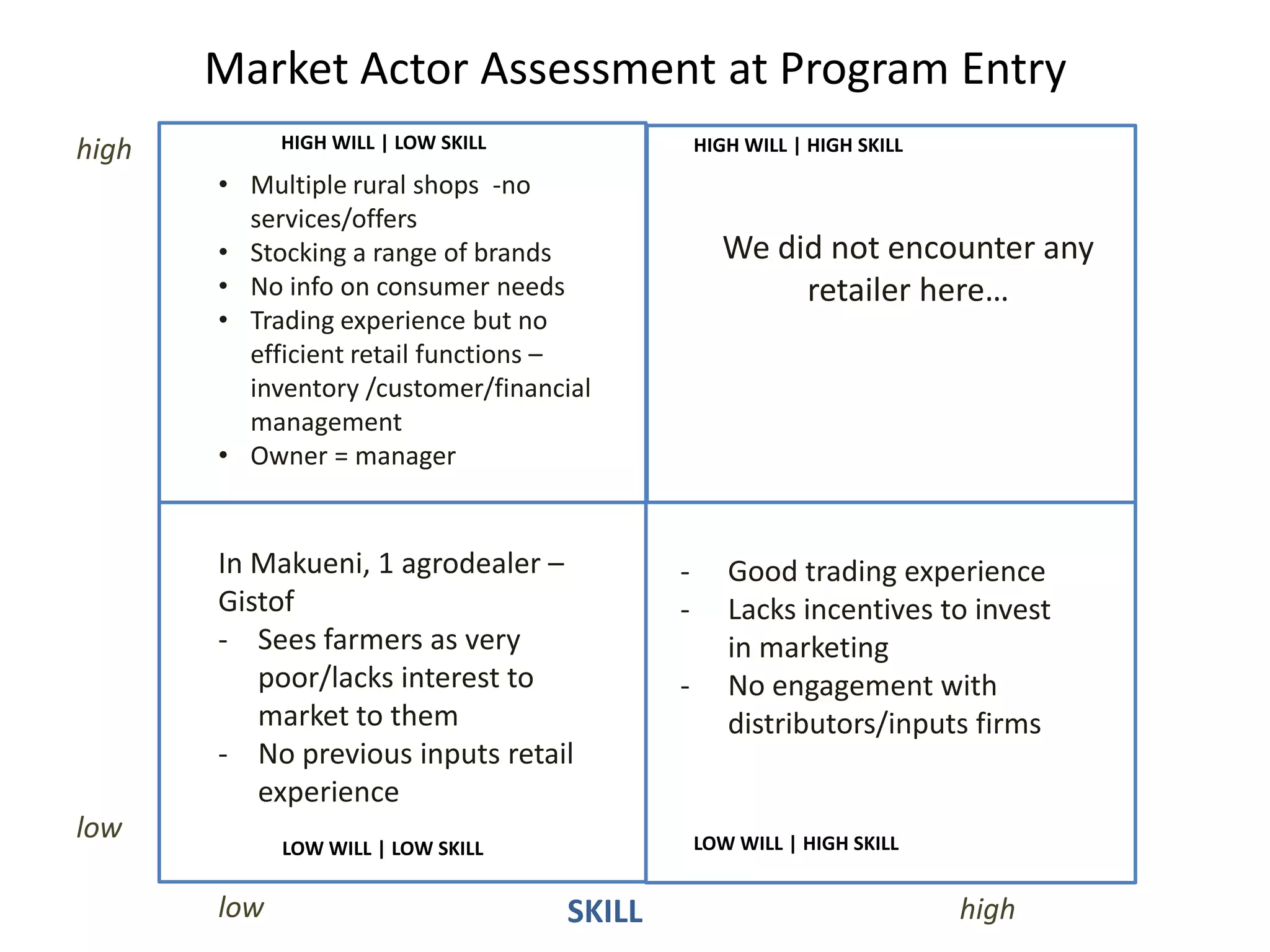
Market Actor Assessment at Program Entry
SKILL high
low
low
HIGH WILL | LOW SKILL HIGH WILL | HIGH SKILL
LOW WILL | LOW SKILL LOW WILL | HIGH SKILL
high
• Multiple rural shops -no
services/offers
• Stocking a range of brands
• No info on consumer needs
• Trading experience but no
efficient retail functions –
inventory /customer/financial
management
• Owner = manager
- Good trading experience
- Lacks incentives to invest
in marketing
- No engagement with
distributors/inputs firms
We did not encounter any
retailer here…
In Makueni, 1 agrodealer –
Gistof
- Sees farmers as very
poor/lacks interest to
market to them
- No previous inputs retail
experience
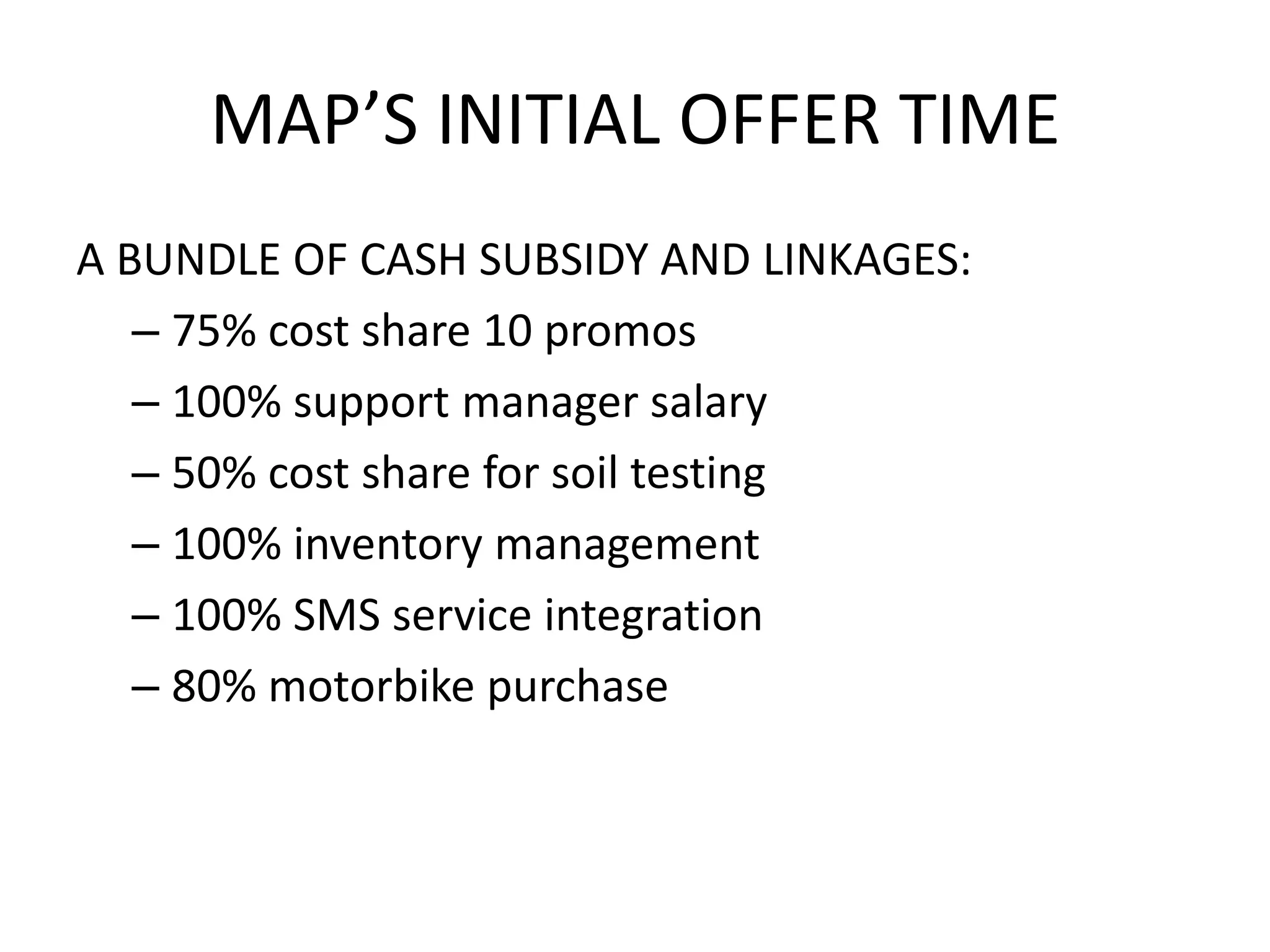
MAP’S INITIAL OFFER TIME
A BUNDLE OF CASH SUBSIDY AND LINKAGES:
– 75% cost share 10 promos
– 100% support manager salary
– 50% cost share for soil testing
– 100% inventory management
– 100% SMS service integration
– 80% motorbike purchase
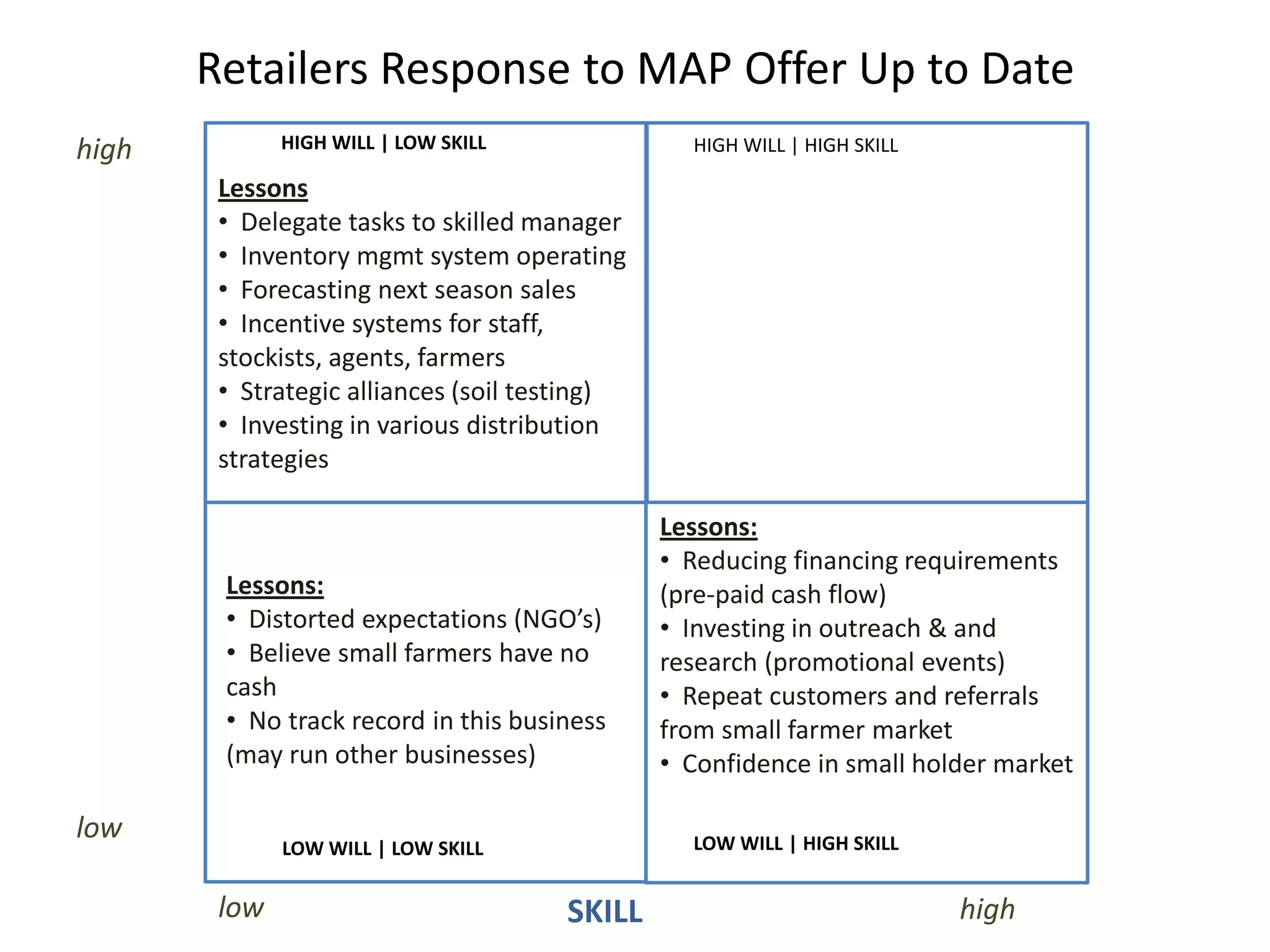
Retailers Response to MAP Offer Up to Date
SKILL high
low
low
HIGH WILL | LOW SKILL HIGH WILL | HIGH SKILL
LOW WILL | LOW SKILL LOW WILL | HIGH SKILL
high
Lessons
• Delegate tasks to skilled manager
• Inventory mgmt system operating
• Forecasting next season sales
• Incentive systems for staff,
stockists, agents, farmers
• Strategic alliances (soil testing)
• Investing in various distribution
strategies
Lessons:
• Reducing financing requirements
(pre-paid cash flow)
• Investing in outreach & and
research (promotional events)
• Repeat customers and referrals
from small farmer market
• Confidence in small holder market
Lessons:
• Distorted expectations (NGO’s)
• Believe small farmers have no
cash
• No track record in this business
(may run other businesses)
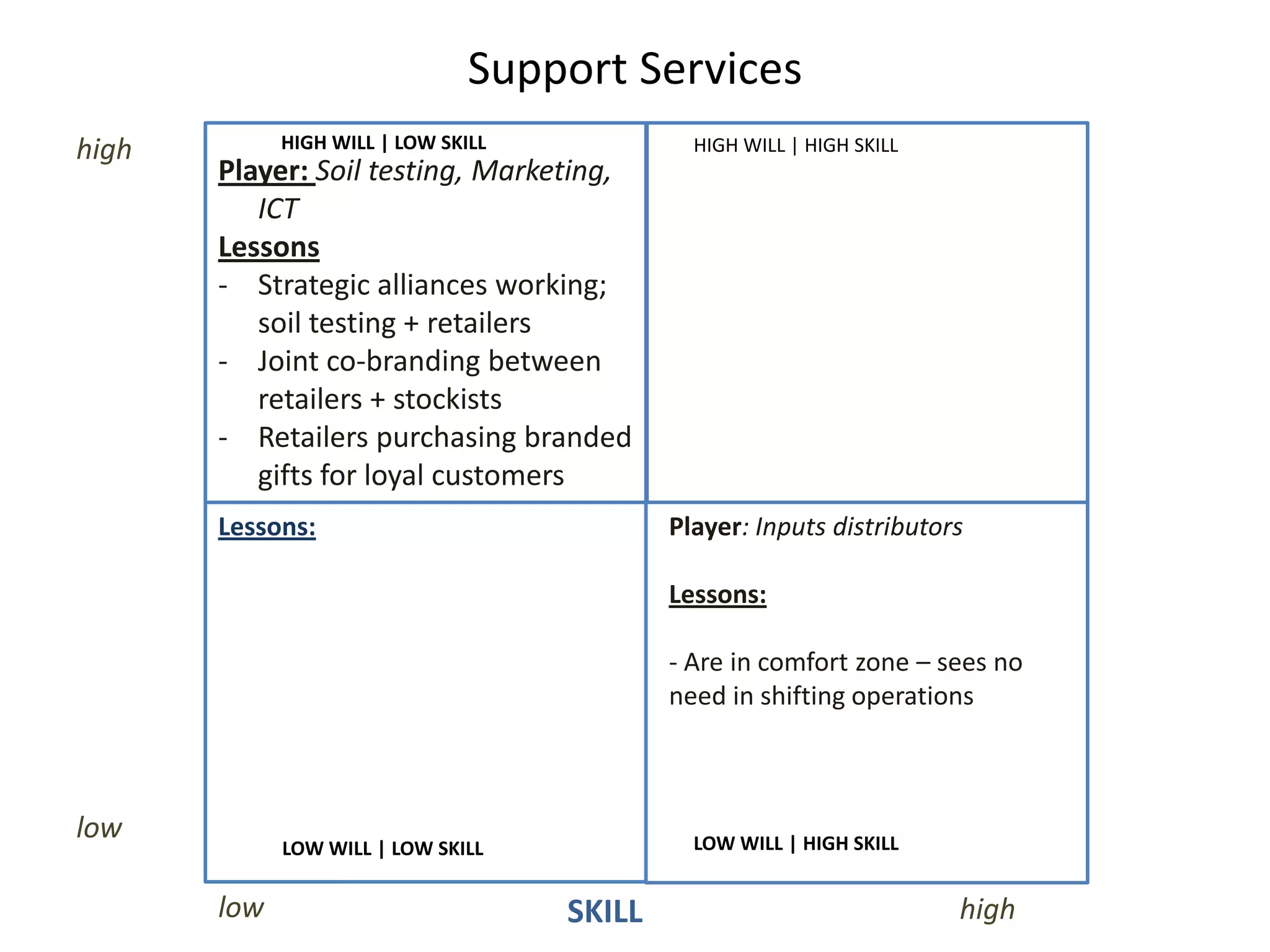
Support Services
Lessons:
SKILL high
low
low
HIGH WILL | LOW SKILL HIGH WILL | HIGH SKILL
LOW WILL | LOW SKILL LOW WILL | HIGH SKILL
high
Player: Inputs distributors
Lessons:
- Are in comfort zone – sees no
need in shifting operations
Player: Soil testing, Marketing,
ICT
Lessons
- Strategic alliances working;
soil testing + retailers
- Joint co-branding between
retailers + stockists
- Retailers purchasing branded
gifts for loyal customers
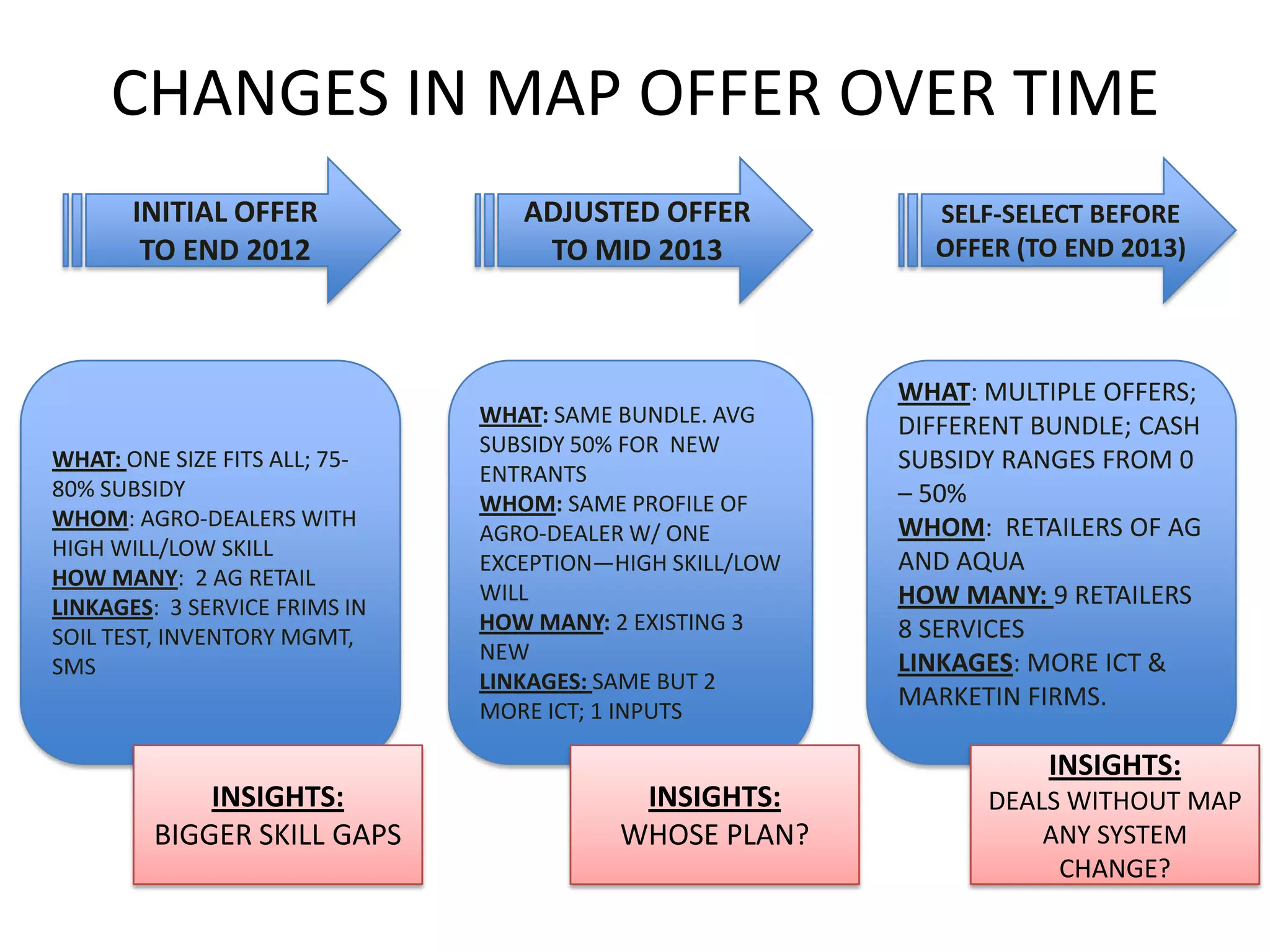
CHANGES IN MAP OFFER OVER TIME
INITIAL OFFER
TO END 2012
WHAT: ONE SIZE FITS ALL; 75-
80% SUBSIDY
WHOM: AGRO-DEALERS WITH
HIGH WILL/LOW SKILL
HOW MANY: 2 AG RETAIL
LINKAGES: 3 SERVICE FRIMS IN
SOIL TEST, INVENTORY MGMT,
SMS
ADJUSTED OFFER
TO MID 2013
WHAT: SAME BUNDLE. AVG
SUBSIDY 50% FOR NEW
ENTRANTS
WHOM: SAME PROFILE OF
AGRO-DEALER W/ ONE
EXCEPTION—HIGH SKILL/LOW
WILL
HOW MANY: 2 EXISTING 3
NEW
LINKAGES: SAME BUT 2
MORE ICT; 1 INPUTS
SELF-SELECT BEFORE
OFFER (TO END 2013)
WHAT: MULTIPLE OFFERS;
DIFFERENT BUNDLE; CASH
SUBSIDY RANGES FROM 0
– 50%
WHOM: RETAILERS OF AG
AND AQUA
HOW MANY: 9 RETAILERS
8 SERVICES
LINKAGES: MORE ICT &
MARKETIN FIRMS.
INSIGHTS:
BIGGER SKILL GAPS
INSIGHTS:
WHOSE PLAN?
INSIGHTS:
DEALS WITHOUT MAP
ANY SYSTEM
CHANGE?
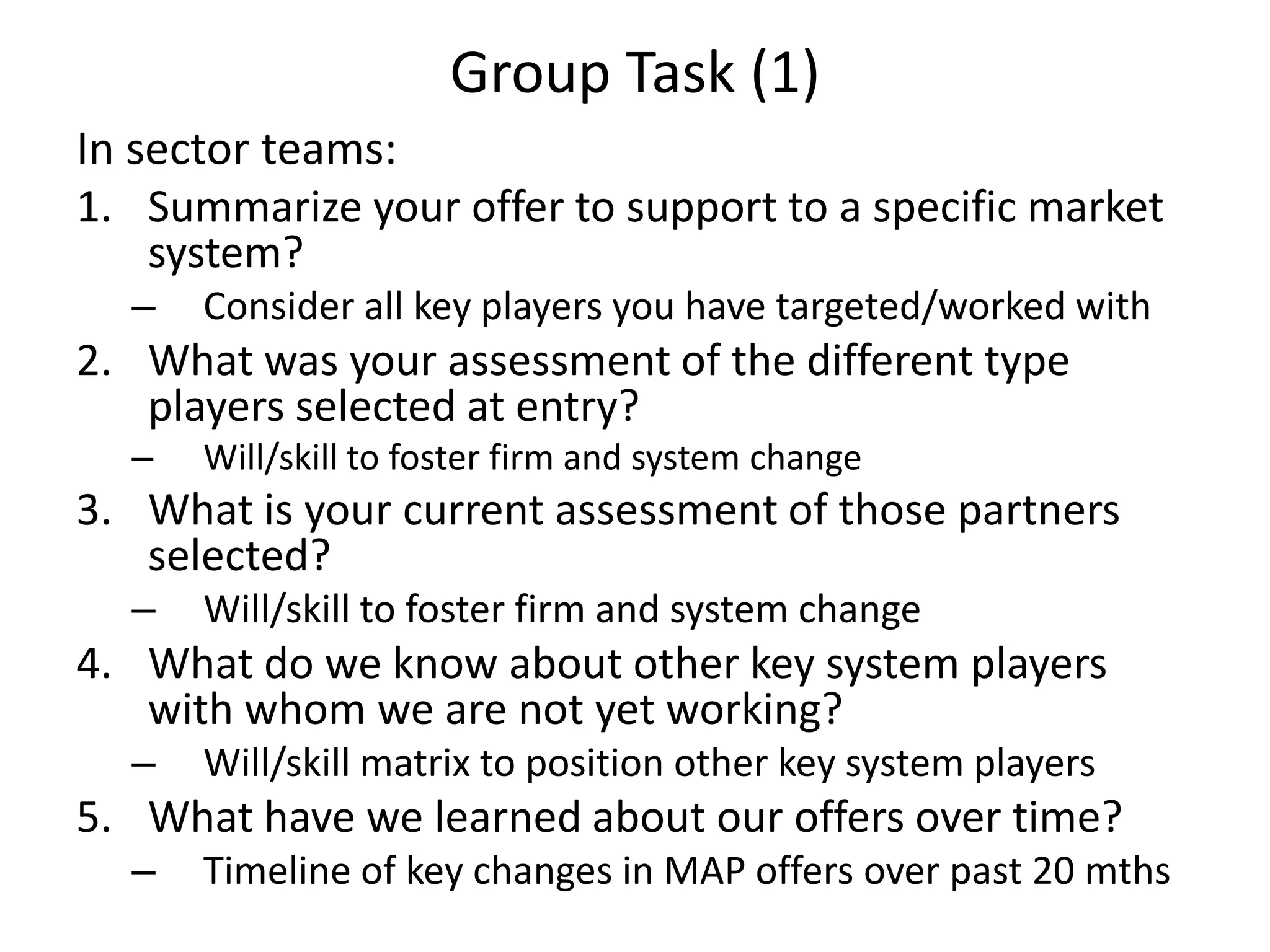
Group Task (1)
In sector teams:
1. Summarize your offer to support to a specific market
system?
– Consider all key players you have targeted/worked with
2. What was your assessment of the different type
players selected at entry?
– Will/skill to foster firm and system change
3. What is your current assessment of those partners
selected?
– Will/skill to foster firm and system change
4. What do we know about other key system players
with whom we are not yet working?
– Will/skill matrix to position other key system players
5. What have we learned about our offers over time?
– Timeline of key changes in MAP offers over past 20 mths
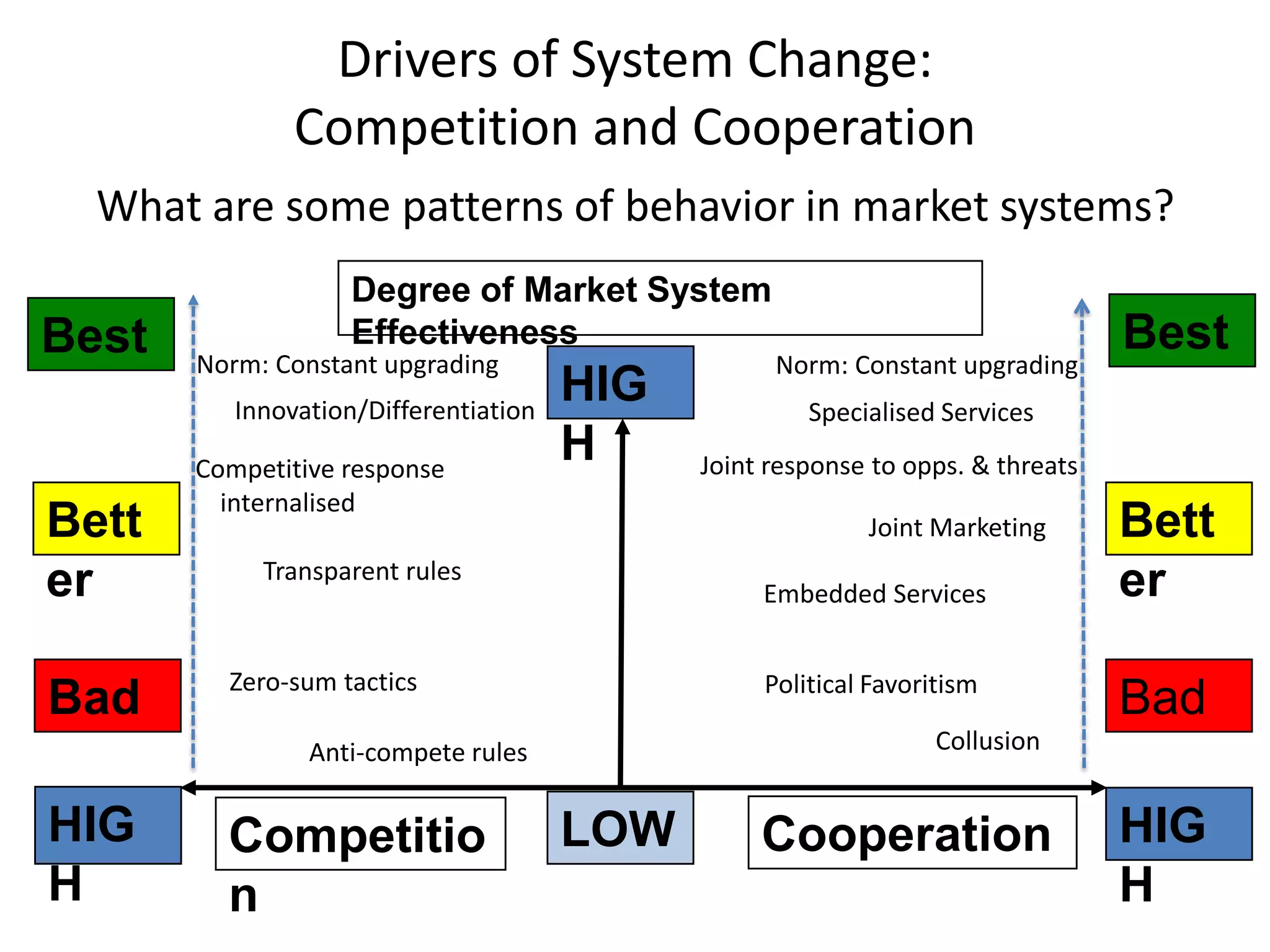
Drivers of System Change:
Competition and Cooperation
What are some patterns of behavior in market systems?
Bad
Best
Bett
er
Bad
Best
Bett
er
Competitio
n
Cooperation
Degree of Market System
Effectiveness
LOW
HIG
H
HIG
H
HIG
H
Transparent rules
Embedded Services
Collusion
Zero-sum tactics Political Favoritism
Joint response to opps. & threats
Norm: Constant upgrading
Anti-compete rules
Joint Marketing
Norm: Constant upgrading
Competitive response
internalised
Specialised ServicesInnovation/Differentiation
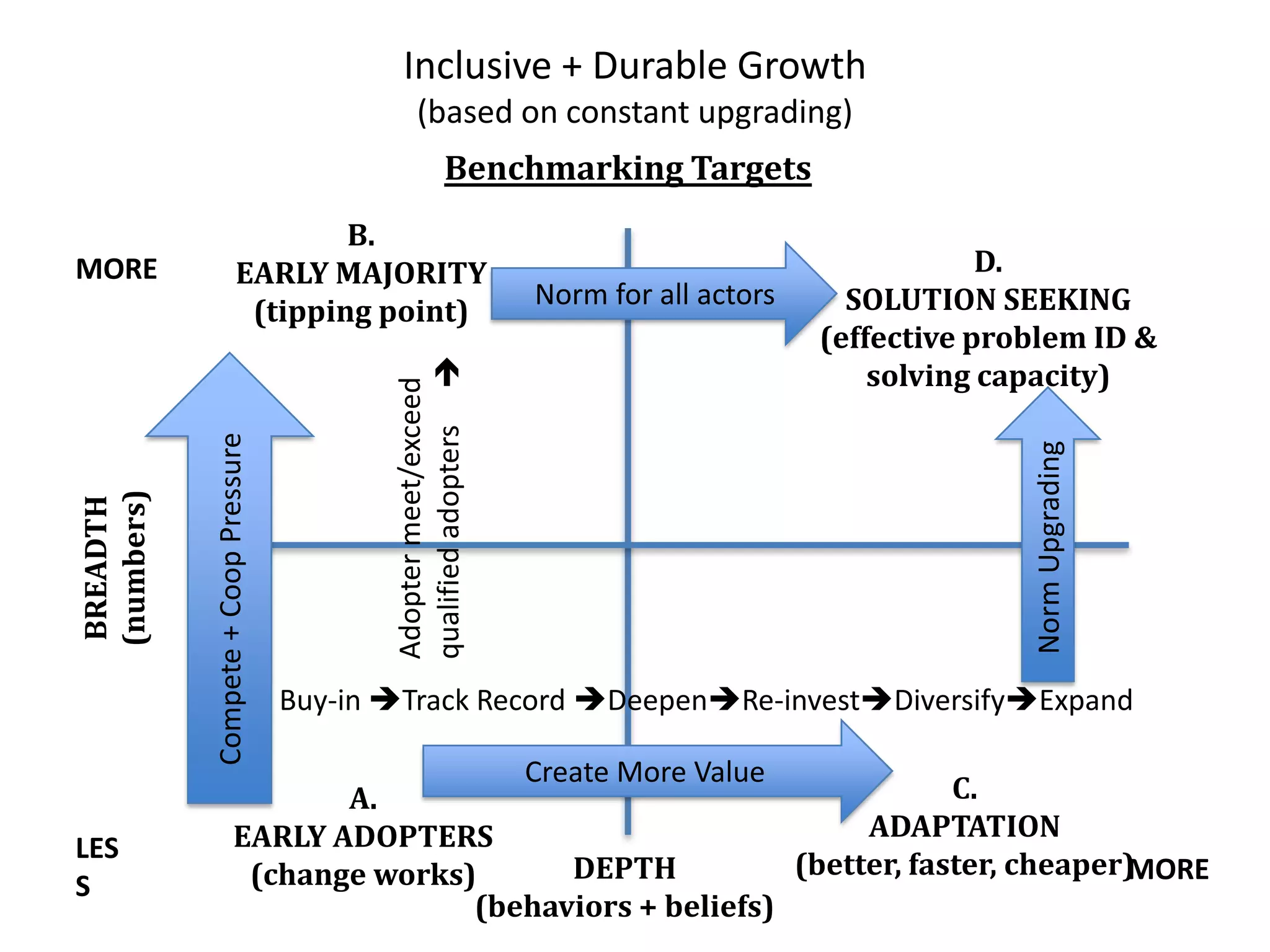
Inclusive + Durable Growth
(based on constant upgrading)
Benchmarking Targets
A.
EARLY ADOPTERS
(change works)
B.
EARLY MAJORITY
(tipping point)
D.
SOLUTION SEEKING
(effective problem ID &
solving capacity)
C.
ADAPTATION
(better, faster, cheaper)
Buy-in Track Record DeepenRe-investDiversifyExpand
Create More Value
Compete+CoopPressure
Norm for all actors
NormUpgrading
Adoptermeet/exceed
qualifiedadopters
BREADTH
(numbers)
LES
S
MORE
DEPTH
(behaviors + beliefs)
MORE
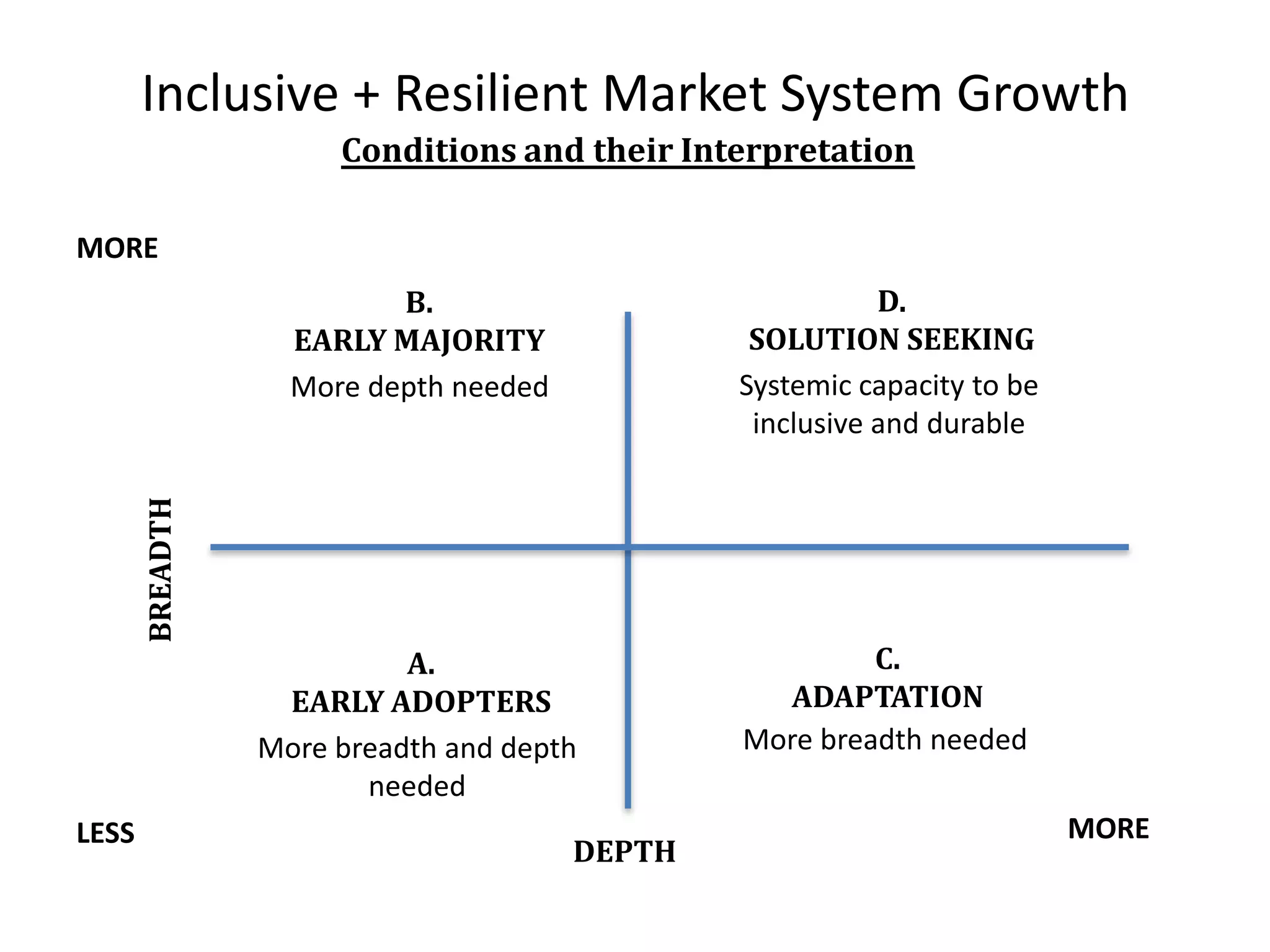
Inclusive + Resilient Market System Growth
Conditions and their Interpretation
A.
EARLY ADOPTERS
B.
EARLY MAJORITY
BREADTH
DEPTH
D.
SOLUTION SEEKING
C.
ADAPTATION
More breadth and depth
needed
LESS
MORE
MORE
Systemic capacity to be
inclusive and durable
More depth needed
More breadth needed
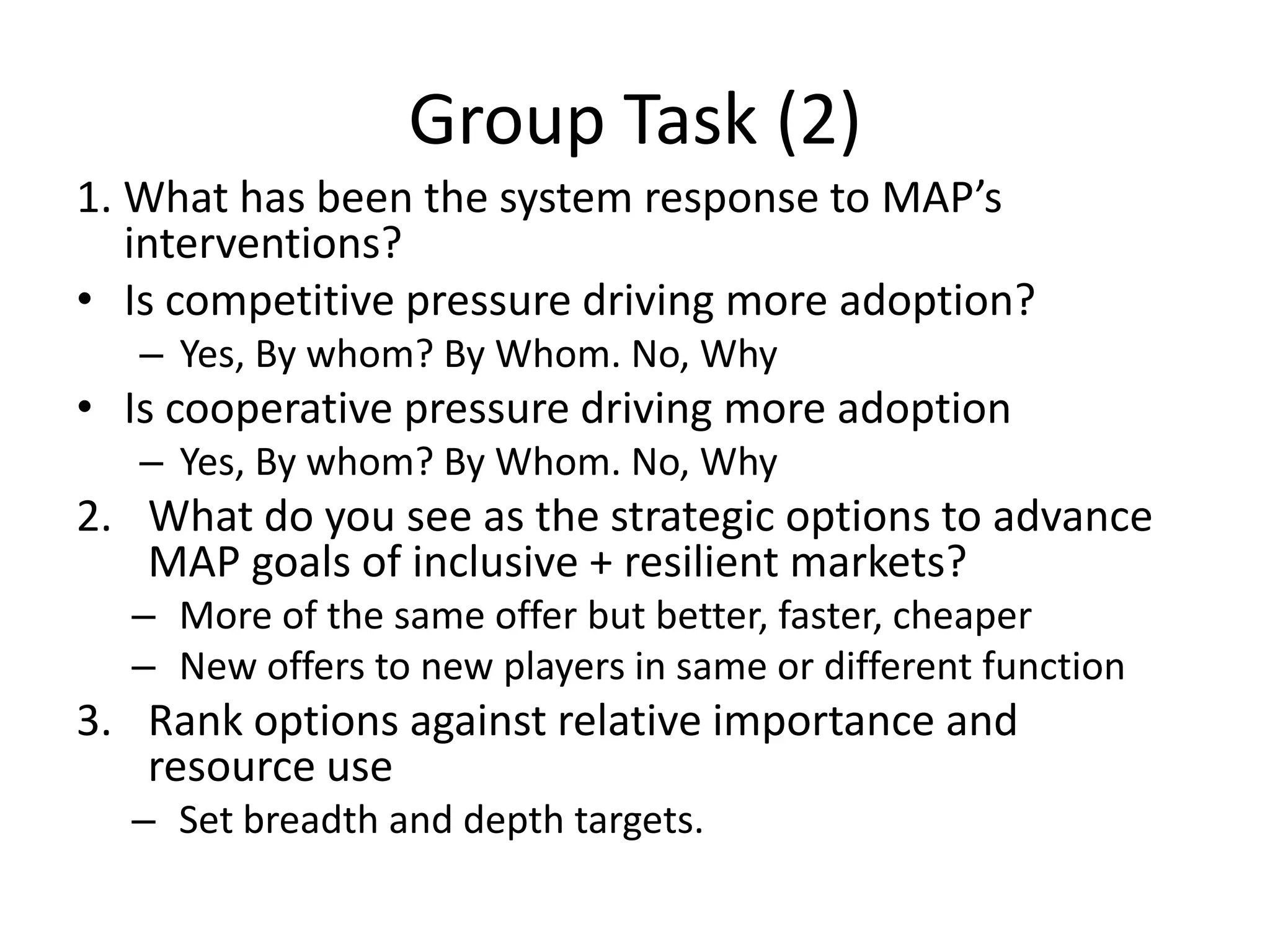
Group Task (2)
1. What has been the system response to MAP’s
interventions?
• Is competitive pressure driving more adoption?
– Yes, By whom? By Whom. No, Why
• Is cooperative pressure driving more adoption
– Yes, By whom? By Whom. No, Why
2. What do you see as the strategic options to advance
MAP goals of inclusive + resilient markets?
– More of the same offer but better, faster, cheaper
– New offers to new players in same or different function
3. Rank options against relative importance and
resource use
– Set breadth and depth targets.
17
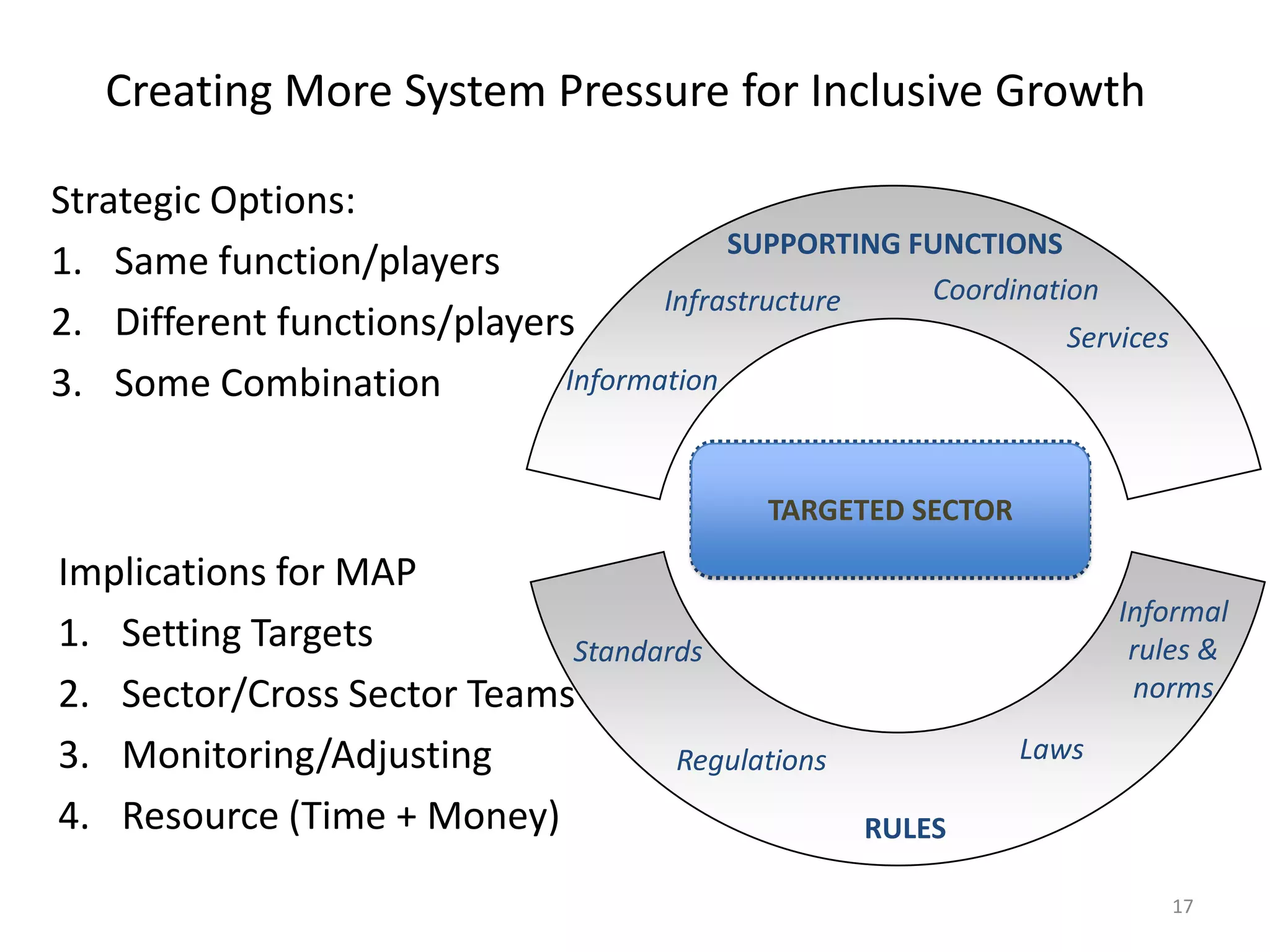
Strategic Options:
1. Same function/players
2. Different functions/players
3. Some Combination
Creating More System Pressure for Inclusive Growth
Implications for MAP
1. Setting Targets
2. Sector/Cross Sector Teams
3. Monitoring/Adjusting
4. Resource (Time + Money)
Demand Supply
SUPPORTING FUNCTIONS
RULES
Information
Services
Infrastructure
Informal
rules &
norms
Laws
Standards
Regulations
CORETARGETED SECTOR
Coordination
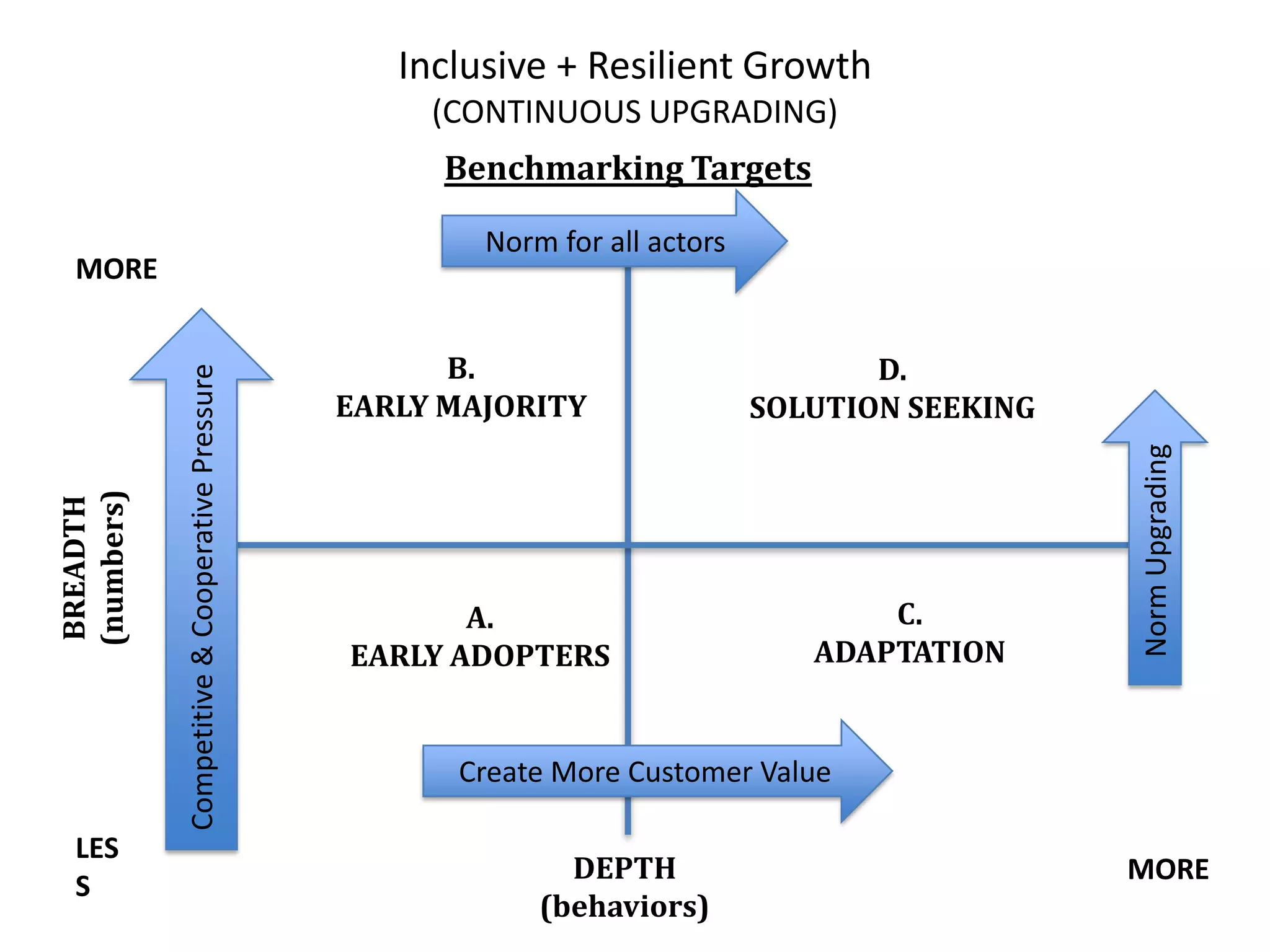
Inclusive + Resilient Growth
(CONTINUOUS UPGRADING)
Benchmarking Targets
A.
EARLY ADOPTERS
B.
EARLY MAJORITY
BREADTH
(numbers)
DEPTH
(behaviors)
D.
SOLUTION SEEKING
C.
ADAPTATION
Create More Customer Value
Competitive&CooperativePressure
Norm for all actors
NormUpgrading
LES
S
MORE
MORE

Day 2 Skills Building Training

  • 1.
    Taking Stock ofMAP’s Portfolio
  • 2.
    Agenda/Activities Objective: To acceleratethe breadth and depth in all systems targeted by MAP to catalyze inclusive growth Activities: 1. Take Stock of Progress to Date:  Review MAP current offers to market actors  Compare expected with actual results to date  Prepare timeline of major changes in MAP offers over time 2. Formulate a Scale-Up Plan for the next 12 months  Assess strength/weakness of key drivers required for scale  Identify strategic options to accelerate scale up  Set targets for more system breadth and depth
  • 3.
    Getting an effectivefacilitator’s offer Basic Principles FRAMING AN OFFER RATIONALE 1. WHO IS IT AIMED AT? • Core • Support Function • Rules • Leverage Point in System 2. WHY SHOULD SOMEONE WANT WHAT WE’VE GOT? • A compelling business case for upgrading • Growth driven by customer value 3. WHAT COULD THEY EXPECT TO GET? • Buy Down Risk • Better, Faster, Smarter • First mover advantage 4. WHAT DO WE EXPECT TO GET IN RETURN • Evidence of benefits of system improvement • Better, Faster, Smarter • Constant upgrading as system norm
  • 4.
    Selecting Market Actors MomentumPotential 2. Indicates support for/or resistance to desired change 3. Indicates competence 4. Indicates influence on broader system change Leverage Potential 1. Point for achieving large-scale change WILL SKILL high high low low Capacity problem? Incentive problem? Why aren’t they doing it already? Can’t avoid them? Why aren’t they inluencing the system ? HIGH WILL | LOW SKILL HIGH WILL | HIGH SKILL LOW WILL | LOW SKILL LOW WILL | HIGH SKILL
  • 5.
    What is thefocus of MAP’s offer of support? WILL SKILL high high low low Capacity problem? Incentive problem? Why aren’t they doing it already? Why work with them? Build ability to operate outside current comfort zone Reduce incremental risk associated with change ??? Why aren’t they influential in the system? Work beyond partner to address external obstacles What actors get? 1. Less risk while learning 2. More, faster learning & linkages Why want our support? 1. Advance their strategy 2. Create customer value What do we get? 1. System Pressure for Upgrading 2. Information for decision making
  • 6.
    MAP’s Offer toAg Input Retailers/Distributors MAPS Offer to Ag Input Market System FRAMING AN OFFER RATIONALE 1. WHO IS IT AIMED AT? • Agro Retailers/Distributors • Retail function a leverage point 2. WHY SHOULD SOMEONE WANT WHAT WE’VE GOT? •New business model with sales and services • Advance their growth strategies • Growth thru customer value 3. WHAT COULD THEY EXPECT TO GET? • Buy down first mover risk (time + resources) • Knowledge and Skills • First mover advantage • Business management skills • Solution Seeking Reputation 4. WHAT DO WE EXPECT TO GET IN RETURN • Profile of early adopter • Information to adjust offer • Evidence of benefits of change • Knowledge of system drivers for change
  • 7.
    Market Actor Assessmentat Program Entry SKILL high low low HIGH WILL | LOW SKILL HIGH WILL | HIGH SKILL LOW WILL | LOW SKILL LOW WILL | HIGH SKILL high • Multiple rural shops -no services/offers • Stocking a range of brands • No info on consumer needs • Trading experience but no efficient retail functions – inventory /customer/financial management • Owner = manager - Good trading experience - Lacks incentives to invest in marketing - No engagement with distributors/inputs firms We did not encounter any retailer here… In Makueni, 1 agrodealer – Gistof - Sees farmers as very poor/lacks interest to market to them - No previous inputs retail experience
  • 8.
    MAP’S INITIAL OFFERTIME A BUNDLE OF CASH SUBSIDY AND LINKAGES: – 75% cost share 10 promos – 100% support manager salary – 50% cost share for soil testing – 100% inventory management – 100% SMS service integration – 80% motorbike purchase
  • 9.
    Retailers Response toMAP Offer Up to Date SKILL high low low HIGH WILL | LOW SKILL HIGH WILL | HIGH SKILL LOW WILL | LOW SKILL LOW WILL | HIGH SKILL high Lessons • Delegate tasks to skilled manager • Inventory mgmt system operating • Forecasting next season sales • Incentive systems for staff, stockists, agents, farmers • Strategic alliances (soil testing) • Investing in various distribution strategies Lessons: • Reducing financing requirements (pre-paid cash flow) • Investing in outreach & and research (promotional events) • Repeat customers and referrals from small farmer market • Confidence in small holder market Lessons: • Distorted expectations (NGO’s) • Believe small farmers have no cash • No track record in this business (may run other businesses)
  • 10.
    Support Services Lessons: SKILL high low low HIGHWILL | LOW SKILL HIGH WILL | HIGH SKILL LOW WILL | LOW SKILL LOW WILL | HIGH SKILL high Player: Inputs distributors Lessons: - Are in comfort zone – sees no need in shifting operations Player: Soil testing, Marketing, ICT Lessons - Strategic alliances working; soil testing + retailers - Joint co-branding between retailers + stockists - Retailers purchasing branded gifts for loyal customers
  • 11.
    CHANGES IN MAPOFFER OVER TIME INITIAL OFFER TO END 2012 WHAT: ONE SIZE FITS ALL; 75- 80% SUBSIDY WHOM: AGRO-DEALERS WITH HIGH WILL/LOW SKILL HOW MANY: 2 AG RETAIL LINKAGES: 3 SERVICE FRIMS IN SOIL TEST, INVENTORY MGMT, SMS ADJUSTED OFFER TO MID 2013 WHAT: SAME BUNDLE. AVG SUBSIDY 50% FOR NEW ENTRANTS WHOM: SAME PROFILE OF AGRO-DEALER W/ ONE EXCEPTION—HIGH SKILL/LOW WILL HOW MANY: 2 EXISTING 3 NEW LINKAGES: SAME BUT 2 MORE ICT; 1 INPUTS SELF-SELECT BEFORE OFFER (TO END 2013) WHAT: MULTIPLE OFFERS; DIFFERENT BUNDLE; CASH SUBSIDY RANGES FROM 0 – 50% WHOM: RETAILERS OF AG AND AQUA HOW MANY: 9 RETAILERS 8 SERVICES LINKAGES: MORE ICT & MARKETIN FIRMS. INSIGHTS: BIGGER SKILL GAPS INSIGHTS: WHOSE PLAN? INSIGHTS: DEALS WITHOUT MAP ANY SYSTEM CHANGE?
  • 12.
    Group Task (1) Insector teams: 1. Summarize your offer to support to a specific market system? – Consider all key players you have targeted/worked with 2. What was your assessment of the different type players selected at entry? – Will/skill to foster firm and system change 3. What is your current assessment of those partners selected? – Will/skill to foster firm and system change 4. What do we know about other key system players with whom we are not yet working? – Will/skill matrix to position other key system players 5. What have we learned about our offers over time? – Timeline of key changes in MAP offers over past 20 mths
  • 13.
    Drivers of SystemChange: Competition and Cooperation What are some patterns of behavior in market systems? Bad Best Bett er Bad Best Bett er Competitio n Cooperation Degree of Market System Effectiveness LOW HIG H HIG H HIG H Transparent rules Embedded Services Collusion Zero-sum tactics Political Favoritism Joint response to opps. & threats Norm: Constant upgrading Anti-compete rules Joint Marketing Norm: Constant upgrading Competitive response internalised Specialised ServicesInnovation/Differentiation
  • 14.
    Inclusive + DurableGrowth (based on constant upgrading) Benchmarking Targets A. EARLY ADOPTERS (change works) B. EARLY MAJORITY (tipping point) D. SOLUTION SEEKING (effective problem ID & solving capacity) C. ADAPTATION (better, faster, cheaper) Buy-in Track Record DeepenRe-investDiversifyExpand Create More Value Compete+CoopPressure Norm for all actors NormUpgrading Adoptermeet/exceed qualifiedadopters BREADTH (numbers) LES S MORE DEPTH (behaviors + beliefs) MORE
  • 15.
    Inclusive + ResilientMarket System Growth Conditions and their Interpretation A. EARLY ADOPTERS B. EARLY MAJORITY BREADTH DEPTH D. SOLUTION SEEKING C. ADAPTATION More breadth and depth needed LESS MORE MORE Systemic capacity to be inclusive and durable More depth needed More breadth needed
  • 16.
    Group Task (2) 1.What has been the system response to MAP’s interventions? • Is competitive pressure driving more adoption? – Yes, By whom? By Whom. No, Why • Is cooperative pressure driving more adoption – Yes, By whom? By Whom. No, Why 2. What do you see as the strategic options to advance MAP goals of inclusive + resilient markets? – More of the same offer but better, faster, cheaper – New offers to new players in same or different function 3. Rank options against relative importance and resource use – Set breadth and depth targets.
  • 17.
    17 Strategic Options: 1. Samefunction/players 2. Different functions/players 3. Some Combination Creating More System Pressure for Inclusive Growth Implications for MAP 1. Setting Targets 2. Sector/Cross Sector Teams 3. Monitoring/Adjusting 4. Resource (Time + Money) Demand Supply SUPPORTING FUNCTIONS RULES Information Services Infrastructure Informal rules & norms Laws Standards Regulations CORETARGETED SECTOR Coordination
  • 18.
    Inclusive + ResilientGrowth (CONTINUOUS UPGRADING) Benchmarking Targets A. EARLY ADOPTERS B. EARLY MAJORITY BREADTH (numbers) DEPTH (behaviors) D. SOLUTION SEEKING C. ADAPTATION Create More Customer Value Competitive&CooperativePressure Norm for all actors NormUpgrading LES S MORE MORE

Editor's Notes

  • #3 MB: 5 minsWalk thru the agenda for this 90 min sessionQ/A on the agenda
  • #4 MB to set up SusanWhy: Ag Input Markets and Why Focus on the Retail function initiallyMAP’s Offer summarizedQuestions: What was the profile of the early adopter – use Will/Skill matrix
  • #5 MB/MEF – to introduce and summarize
  • #7 MB to integrate detailsWhy: Ag Input Markets and Why Focus on the Retail function initiallyMAP’s Offer summarizedQuestions: What was the profile of the early adopter – use Will/Skill matrix
  • #8 Susan:Take us into the team’s assessment of the retailers at the start of the program:Fill in as many of the quadrants that help us to understand the baseline:X of Y total retailers per county; per regionAllocate numbers into the different quadrantsBrief profiles of retailer will/skill relative to our offer of growth thru customer value and continued solution seeking
  • #10 Susan:RetailersWhat have we learned about other key players.Wholesalers: High Skill/No will – Secure position in comfort zone – only threat if Syngenta to go directlyInput Supplier: High Will/High Skill upper right right don’t know what their responseCooperative/Franchise retailer: High will/Low skill
  • #11 Susan:RetailersWhat have we learned about other key players.Wholesalers: High Skill/No will – Secure position in comfort zone – only threat if Syngenta to go directlyInput Supplier: High Will/High Skill upper right right don’t know what their responseCooperative/Franchise retailer: High will/Low skill
  • #13 MB + MEF to facilitate feedback
  • #15 MB +MEF Introduce and Walk Thru the basics using this and the next slide
  • #16 MB/MEF to facilitate
  • #19 MB +MEF Introduce and Walk Thru the basics using this and the next slide