*Blue Ocean Strategy (BOS)
Understanding and Development
  *Adapted from the book Blue Ocean Strategy by W. Chan Kim and Renée Mauborgne.


               Enterprise Architects Helping You
                    Build a Better Business
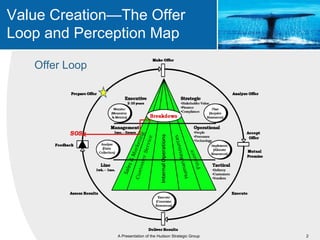
Value Creation—The Offer
Loop and Perception Map

   Offer Loop


                A Presentation of the Hudson Strategic Group   2
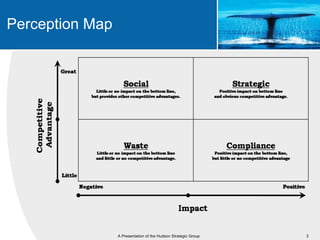
Perception Map


                 A Presentation of the Hudson Strategic Group   3
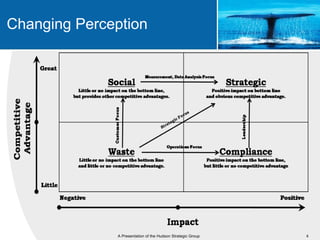
Changing Perception


              A Presentation of the Hudson Strategic Group   4
Agenda


   • What is Blue Ocean?

   • Why do it?

   • How to do it?
     – Strategy Canvas Exercises


              A Presentation of the Hudson Strategic Group   5
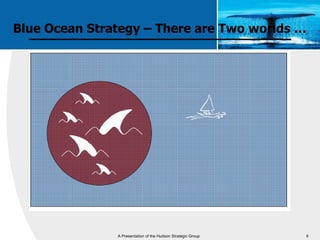
Blue Ocean Strategy – There are Two worlds …


               A Presentation of the Hudson Strategic Group   6
Blue Ocean Strategy

   • Achieve strategic and planning success by
     developing and aligning the three strategy
     propositions: Value Proposition, Profit
     Proposition, and People Proposition.
   • Strategically transform your organization
     quickly and at low cost by focusing in
     disproportionate influence factors.
   • Make the competition irrelevant by using this
     approach to create breakthroughs in value for
     both your customers and your organization

                 A Presentation of the Hudson Strategic Group   7
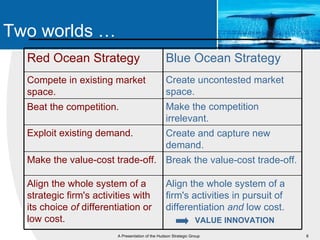
Two worlds …
  Red Ocean Strategy                              Blue Ocean Strategy
  Compete in existing market                      Create uncontested market
  space.                                          space.
  Beat the competition.                           Make the competition
                                                  irrelevant.
  Exploit existing demand.                        Create and capture new
                                                  demand.
  Make the value-cost trade-off. Break the value-cost trade-off.

  Align the whole system of a                     Align the whole system of a
  strategic firm's activities with                firm's activities in pursuit of
  its choice of differentiation or                differentiation and low cost.
  low cost.                                                       VALUE INNOVATION
                         A Presentation of the Hudson Strategic Group                8
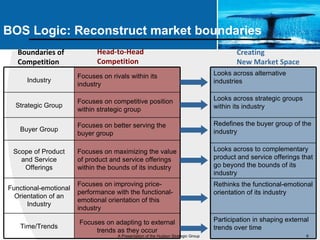
BOS Logic: Reconstruct market boundaries
   Boundaries of             Head-to-Head                                                   Creating
   Competition               Competition                                                    New Market Space
                       Focuses on rivals within its                                 Looks across alternative
      Industry                                                                      industries
                       industry

                       Focuses on competitive position                              Looks across strategic groups
  Strategic Group                                                                   within its industry
                       within strategic group

                       Focuses on better serving the                                Redefines the buyer group of the
   Buyer Group                                                                      industry
                       buyer group

 Scope of Product      Focuses on maximizing the value                              Looks across to complementary
   and Service         of product and service offerings                             product and service offerings that
    Offerings          within the bounds of its industry                            go beyond the bounds of its
                                                                                    industry
                       Focuses on improving price-                                  Rethinks the functional-emotional
Functional-emotional
                       performance with the functional-                             orientation of its industry
  Orientation of an
                       emotional orientation of this
      Industry
                       industry

                       Focuses on adapting to external                              Participation in shaping external
   Time/Trends                                                                      trends over time
                            trends as they occur
                                     A Presentation of the Hudson Strategic Group                                   9
Value Proposition

   • Is created in the region where an
     organization’s actions favorably affect it’s
     cost structure and it’s value proposition to
     buyers. Cost savings are made by
     eliminating and reducing the factors an
     industry competes on. Buyer value is
     lifted by raisin and creating elements the
     industry has never offered.


                A Presentation of the Hudson Strategic Group   10
Profit Proposition

    • Financial success of an idea is created where
      exceptional buyer utility, price accessibility for the
      masses, and cost targeting meet.
    • Exceptional buyer utility identifies a compelling
      reason for the mass of people to purchase or use
    • Price accessibility attracts the mass of target buyers
      or users in a way that they have a compelling ability
      to pay for the offering
    • Cost targeting identifies the necessary streamlining,
      partnering, and pricing innovation that can be
      leveraged to produce a healthy profit margin

                     A Presentation of the Hudson Strategic Group   11
People Proposition

   • Strategy implementation success
     requires engaging employees, business
     partners, and the general public about
     the idea.
   • Overcoming awareness, resource,
     motivational, and political hurdles to
     innovation through engagement
     facilitates smooth adoption of the idea.


                A Presentation of the Hudson Strategic Group   12
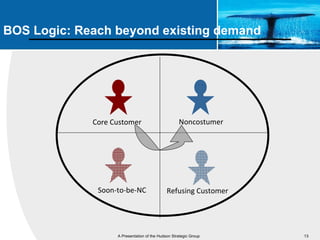
BOS Logic: Reach beyond existing demand


             Core Customer                         Noncostumer


              Soon-to-be-NC                  Refusing Customer


                   A Presentation of the Hudson Strategic Group   13
Buying Behavior is Driven by the
Three Laws of Performance
1. How people perform correlates to how
   situations occur to them
  – Market Leaders have a say, and give others a say, in
    how situations occur
2. How a situation occurs arises in language
  – Market Leaders master the conversational
    environment
3. Future-based language transforms how
   situations occur to people
    – Market Leaders listen for the future of their
        organization
Steve Zaffron and Dave Logan – Three Laws of Performance
                           A Presentation of the Hudson Strategic Group   14
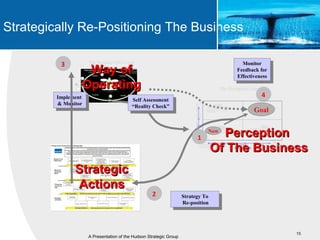
Strategically Re-Positioning The Business

           3                              The Business Offer Loop                                                                                                                                                                                                                                                    Monitor
                             Way of
                                PREPARE OFFER
                                          or Respond to Bid

                                                 Supplier                      1
                                                                                                    MAKE
                                                                                                    OFFER


                                                                                                                                           Customer
                                                                                                                                                           ANALYZE OFFER
                                                                                                                                                                                    Establish Conditions of
                                                                                                                                                                                       Satisfaction
                                                                                                                                                                                                                                                                                                                   Feedback for
                                                                                                                                                                                                                                                                                                                   Effectiveness
                            Operating
                            5
                                                                 Strategy Issues

                                                                                                                                                    - Markets
                                                                2 - 10 Yrs             Monitor                                                       - Financial
                                                                                       Progress                       Strategic Plan                  - Compliance

                        START                                                                        Executive        w/Priorities &
                                                                                                                       Initiatives

                                                                  Operational Issues


                                                                                                                                                                                          2
                                                                                                                                                         - Business Process
                                                                 1mo - 2 Years                                                                             - Skills Development
                                                                                                  Middle Management                                   - Work Place

                        FEEDBACK                                         Operational                                         Organize Resources          - Project & Process
                                                                                                                                                          Management
                                                                                                                                                                                                       ACCEPT


                                                                                                                                                                                                                                                                                             The Perception Map
                  Bad              Good
                                                                         Measurements


                                                                                                                                                                                                       OFFER
                                                                                                       LI N E

                                                                                                                                                  - Orders


                        4                                                                                                                                                                             (Mutual
                                                                  Execution Issues                                                                        - Internal Transactions
                                                                                                           Execute
                                                                                                                                                          - System Usage Issues
                                                                 1 Mo. -1 Wk

                                                                                                                                                                                                       Promise)
                                                                                                                                                     - Complaints
                                                              Today


                                                                                                                                                                                                                                                                                                                                              4
                                                                                                    Custo me rs


                                                Customer

         ImplementRESULTS
                                                                                                                                                  Supplier
                 ASSESS                                                                                     3
                                                                                                                                                                                    EXECUTE
                                                                                                                                                                                          Self Assessment


                                                                                                                                                                                                                                                           High
                             Use the


         & Monitor          Deliverables                                                            DELIVER
                                                                                                                                           HSG Confidential © 1996 Hudson Strategic Group


                                                                                                                                                                                          “Reality Check”


                                                                                                                                                                                                                           Enthusiasm Voluntary Spending
                                                                                                                                                          (404) 7681 313 (hudgroup@hudgroup.com)
                                                                                                                                                                   -
                                                                                                                                                                                                                                                                                   “Social”                                                  Pro-Active

                                                                                                                                                                                                                                                                                                                                    Goal
                                                                                                                                                                                                                                                                        Those Expenditures which have little or
                                                                                                                                                                                                                                                                         no positive impact on the bottom line.                    •Those Expenditures which Create
                                                                                                                                                                                                                                                                      n But you believe they are “The Right                        • Competitive Advantage
                                                                                                                                                                                                                                                                        Things to Do”                                              •New Tech, Skills, Markets, etc.
                                                                                                                                                                                                                                                                                                                                   •Extraordinary ROI


                                                                                                                                                                                                                                                           Neutral
                                                                                                                                                                                                                                    
                                                                                                                                                                                                                                                                                         “Waste”                                              Reactive


                                                                                                                                                                                                                                                                               Perception
                                                                                                                                                                                                                                                                      •Those Expenditures which have little or                  •Expenditures made in Response to

                                                                                                                                                                                                                                                                          Now


                                                                                                                                                                                                                                                           Negative
                                                                                                                                                                                                                                                                      • no positive impact on the bottom line.                  • Competitive or Environmental
                                                                                                                                                                                                                                                                      •Poor Quality Efforts, Rework, etc.                       Challenges


                                                                                                                                                                                                                                                1
                                                                                                                                                                                                                                                                                                                                •Positive ROI
                                                                                                                                                                                                                                                                                                                                •Requires forced Changes in Org/Culture


                                                                                                                                                                                                                                                                             Of The Business
                                                                                                                                                                                                                                                                Pure                                                                                          Strategic
                                                                                                                                                                                                                                                              Expense                     Negative                    Neutral              High              Investment
                                                                                                                                                                                                                                                           (no value-add)                                                                                 (high value-add)
                                                                                                                                                                                                                                                                                                                  Perceived ROI


                  Strategic
                  Actions
                                                                                                                                                                                                                  2   Strategy To
                                                                                                                                                                                                                      Re-position


                                                                                                                                                                                                                                                                                                                                                                             15
                                          A Presentation of the Hudson Strategic Group
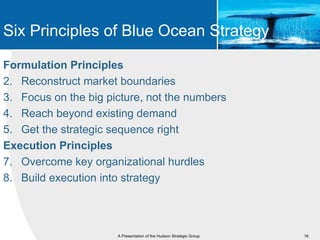
Six Principles of Blue Ocean Strategy

Formulation Principles
2. Reconstruct market boundaries
3. Focus on the big picture, not the numbers
4. Reach beyond existing demand
5. Get the strategic sequence right
Execution Principles
7. Overcome key organizational hurdles
8. Build execution into strategy


                      A Presentation of the Hudson Strategic Group   16
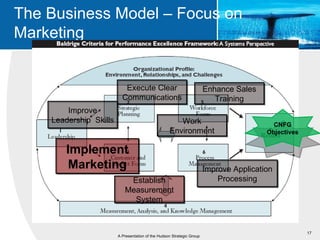
The Business Model – Focus on
Marketing


                           Execute Clear                               Enhance Sales
                          Communications                                  Training
        Improve
    Leadership Skills                                 Work                                CNFG
                                                   Environment                          Objectives


        Implement
        Marketing                                                      Improve Application
                            Establish                                      Processing
                           Measurement
                             System


                                                                                                     17
                        A Presentation of the Hudson Strategic Group
Blue Ocean Development – “As-Is”

• Value Curve - "As-is"
  – Where is current investment? What are the
    factors you and the industry compete on?
    What do customers receive from market
    offerings?
• Value Curve - "As-is"
  – What are the offering levels buyers receive
    across all the key competing factors from
    you and the industry? (Rows: Competing
    factors. Columns: client, industry)
                   A Presentation of the Hudson Strategic Group   18
Blue Ocean Development – “To-Be”
•   Market Boundaries
     – What are the alternatives, strategic groups, chain of buyers,
        complements, appeals, and trends in your industry?
•   Value Curve - "To-be"
     – What factors should be created that the industry has never
        offered?
•   Value Curve - "To-be"
     – Which factors should be eliminated, reduced well below the
        industry standard, raised well above the industry standard, or
        created? (Rows: new offerings. Columns: Eliminate, reduce, raise,
        create)
•   Portfolio
     – What are your current and future portfolio offerings?
•   Portfolio Map
     – Assess the potential for growth and profit by identifying the offerings that
        have a divergent value curve, improved value, or industry value curve.
        (Rows: Portfolio offerings. Columns: Pioneers, Migratory, Settlers)
                                  A Presentation of the Hudson Strategic Group        19
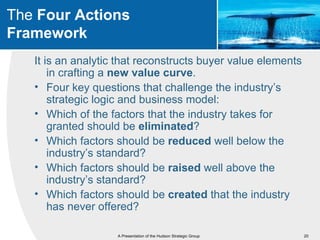
The Four Actions
Framework
   It is an analytic that reconstructs buyer value elements
       in crafting a new value curve.
   • Four key questions that challenge the industry’s
       strategic logic and business model:
   • Which of the factors that the industry takes for
       granted should be eliminated?
   • Which factors should be reduced well below the
       industry’s standard?
   • Which factors should be raised well above the
       industry’s standard?
   • Which factors should be created that the industry
       has never offered?

                    A Presentation of the Hudson Strategic Group   20
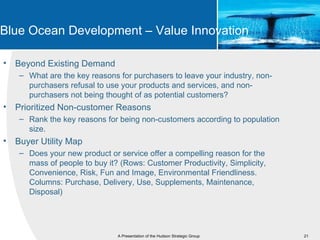
Blue Ocean Development – Value Innovation

• Beyond Existing Demand
   – What are the key reasons for purchasers to leave your industry, non-
     purchasers refusal to use your products and services, and non-
     purchasers not being thought of as potential customers?
• Prioritized Non-customer Reasons
   – Rank the key reasons for being non-customers according to population
     size.
• Buyer Utility Map
   – Does your new product or service offer a compelling reason for the
     mass of people to buy it? (Rows: Customer Productivity, Simplicity,
     Convenience, Risk, Fun and Image, Environmental Friendliness.
     Columns: Purchase, Delivery, Use, Supplements, Maintenance,
     Disposal)


                              A Presentation of the Hudson Strategic Group   21
Barriers to Non Customers

•   Fear of Marketing / Prospecting to Non Customers
•   No relationship (No access to information)
•   Lack of Leadership Skills
•   Fear of repeating bad experiences
•   Lack of Education
•   Perceived Affordability


                       A Presentation of the Hudson Strategic Group   22
Address Implementation Hurdles with a Fair
Process
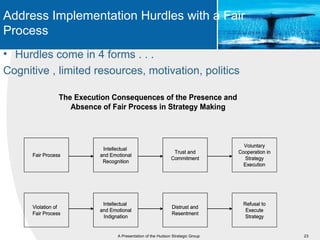
• Hurdles come in 4 forms . . .
Cognitive , limited resources, motivation, politics

                 The Execution Consequences of the Presence and
                    Absence of Fair Process in Strategy Making


                                                                                   Voluntary
                            Intellectual
                                                               Trust and         Cooperation in
      Fair Process         and Emotional
                                                              Commitment            Strategy
                            Recognition
                                                                                   Execution


                            Intellectual                                           Refusal to
      Violation of                                             Distrust and
                           and Emotional                                            Execute
      Fair Process                                             Resentment
                            Indignation                                             Strategy


                                  A Presentation of the Hudson Strategic Group                    23
Hudson Strategic Group


               A Presentation of the Hudson Strategic Group   24

Blue ocean strategy pp education (short version)

  • 1.
    *Blue Ocean Strategy(BOS) Understanding and Development *Adapted from the book Blue Ocean Strategy by W. Chan Kim and Renée Mauborgne. Enterprise Architects Helping You Build a Better Business
  • 2.
    Value Creation—The Offer Loopand Perception Map Offer Loop A Presentation of the Hudson Strategic Group 2
  • 3.
    Perception Map A Presentation of the Hudson Strategic Group 3
  • 4.
    Changing Perception A Presentation of the Hudson Strategic Group 4
  • 5.
    Agenda • What is Blue Ocean? • Why do it? • How to do it? – Strategy Canvas Exercises A Presentation of the Hudson Strategic Group 5
  • 6.
    Blue Ocean Strategy– There are Two worlds … A Presentation of the Hudson Strategic Group 6
  • 7.
    Blue Ocean Strategy • Achieve strategic and planning success by developing and aligning the three strategy propositions: Value Proposition, Profit Proposition, and People Proposition. • Strategically transform your organization quickly and at low cost by focusing in disproportionate influence factors. • Make the competition irrelevant by using this approach to create breakthroughs in value for both your customers and your organization A Presentation of the Hudson Strategic Group 7
  • 8.
    Two worlds … Red Ocean Strategy Blue Ocean Strategy Compete in existing market Create uncontested market space. space. Beat the competition. Make the competition irrelevant. Exploit existing demand. Create and capture new demand. Make the value-cost trade-off. Break the value-cost trade-off. Align the whole system of a Align the whole system of a strategic firm's activities with firm's activities in pursuit of its choice of differentiation or differentiation and low cost. low cost. VALUE INNOVATION A Presentation of the Hudson Strategic Group 8
  • 9.
    BOS Logic: Reconstructmarket boundaries Boundaries of Head-to-Head Creating Competition Competition New Market Space Focuses on rivals within its Looks across alternative Industry industries industry Focuses on competitive position Looks across strategic groups Strategic Group within its industry within strategic group Focuses on better serving the Redefines the buyer group of the Buyer Group industry buyer group Scope of Product Focuses on maximizing the value Looks across to complementary and Service of product and service offerings product and service offerings that Offerings within the bounds of its industry go beyond the bounds of its industry Focuses on improving price- Rethinks the functional-emotional Functional-emotional performance with the functional- orientation of its industry Orientation of an emotional orientation of this Industry industry Focuses on adapting to external Participation in shaping external Time/Trends trends over time trends as they occur A Presentation of the Hudson Strategic Group 9
  • 10.
    Value Proposition • Is created in the region where an organization’s actions favorably affect it’s cost structure and it’s value proposition to buyers. Cost savings are made by eliminating and reducing the factors an industry competes on. Buyer value is lifted by raisin and creating elements the industry has never offered. A Presentation of the Hudson Strategic Group 10
  • 11.
    Profit Proposition • Financial success of an idea is created where exceptional buyer utility, price accessibility for the masses, and cost targeting meet. • Exceptional buyer utility identifies a compelling reason for the mass of people to purchase or use • Price accessibility attracts the mass of target buyers or users in a way that they have a compelling ability to pay for the offering • Cost targeting identifies the necessary streamlining, partnering, and pricing innovation that can be leveraged to produce a healthy profit margin A Presentation of the Hudson Strategic Group 11
  • 12.
    People Proposition • Strategy implementation success requires engaging employees, business partners, and the general public about the idea. • Overcoming awareness, resource, motivational, and political hurdles to innovation through engagement facilitates smooth adoption of the idea. A Presentation of the Hudson Strategic Group 12
  • 13.
    BOS Logic: Reachbeyond existing demand Core Customer Noncostumer Soon-to-be-NC Refusing Customer A Presentation of the Hudson Strategic Group 13
  • 14.
    Buying Behavior isDriven by the Three Laws of Performance 1. How people perform correlates to how situations occur to them – Market Leaders have a say, and give others a say, in how situations occur 2. How a situation occurs arises in language – Market Leaders master the conversational environment 3. Future-based language transforms how situations occur to people – Market Leaders listen for the future of their organization Steve Zaffron and Dave Logan – Three Laws of Performance A Presentation of the Hudson Strategic Group 14
  • 15.
    Strategically Re-Positioning TheBusiness 3 The Business Offer Loop Monitor Way of PREPARE OFFER or Respond to Bid Supplier 1 MAKE OFFER Customer ANALYZE OFFER Establish Conditions of Satisfaction Feedback for Effectiveness Operating 5 Strategy Issues - Markets 2 - 10 Yrs Monitor - Financial Progress Strategic Plan - Compliance START Executive w/Priorities & Initiatives Operational Issues 2 - Business Process 1mo - 2 Years - Skills Development Middle Management - Work Place FEEDBACK Operational Organize Resources - Project & Process Management ACCEPT The Perception Map Bad Good Measurements OFFER LI N E - Orders 4 (Mutual Execution Issues - Internal Transactions Execute - System Usage Issues 1 Mo. -1 Wk Promise) - Complaints Today 4 Custo me rs Customer ImplementRESULTS Supplier ASSESS 3 EXECUTE Self Assessment High Use the & Monitor Deliverables DELIVER HSG Confidential © 1996 Hudson Strategic Group “Reality Check” Enthusiasm Voluntary Spending (404) 7681 313 (hudgroup@hudgroup.com) - “Social” Pro-Active Goal Those Expenditures which have little or no positive impact on the bottom line. •Those Expenditures which Create n But you believe they are “The Right • Competitive Advantage Things to Do” •New Tech, Skills, Markets, etc. •Extraordinary ROI Neutral  “Waste” Reactive Perception •Those Expenditures which have little or •Expenditures made in Response to Now Negative • no positive impact on the bottom line. • Competitive or Environmental •Poor Quality Efforts, Rework, etc. Challenges 1 •Positive ROI •Requires forced Changes in Org/Culture Of The Business Pure Strategic Expense Negative Neutral High Investment (no value-add) (high value-add) Perceived ROI Strategic Actions 2 Strategy To Re-position 15 A Presentation of the Hudson Strategic Group
  • 16.
    Six Principles ofBlue Ocean Strategy Formulation Principles 2. Reconstruct market boundaries 3. Focus on the big picture, not the numbers 4. Reach beyond existing demand 5. Get the strategic sequence right Execution Principles 7. Overcome key organizational hurdles 8. Build execution into strategy A Presentation of the Hudson Strategic Group 16
  • 17.
    The Business Model– Focus on Marketing Execute Clear Enhance Sales Communications Training Improve Leadership Skills Work CNFG Environment Objectives Implement Marketing Improve Application Establish Processing Measurement System 17 A Presentation of the Hudson Strategic Group
  • 18.
    Blue Ocean Development– “As-Is” • Value Curve - "As-is" – Where is current investment? What are the factors you and the industry compete on? What do customers receive from market offerings? • Value Curve - "As-is" – What are the offering levels buyers receive across all the key competing factors from you and the industry? (Rows: Competing factors. Columns: client, industry) A Presentation of the Hudson Strategic Group 18
  • 19.
    Blue Ocean Development– “To-Be” • Market Boundaries – What are the alternatives, strategic groups, chain of buyers, complements, appeals, and trends in your industry? • Value Curve - "To-be" – What factors should be created that the industry has never offered? • Value Curve - "To-be" – Which factors should be eliminated, reduced well below the industry standard, raised well above the industry standard, or created? (Rows: new offerings. Columns: Eliminate, reduce, raise, create) • Portfolio – What are your current and future portfolio offerings? • Portfolio Map – Assess the potential for growth and profit by identifying the offerings that have a divergent value curve, improved value, or industry value curve. (Rows: Portfolio offerings. Columns: Pioneers, Migratory, Settlers) A Presentation of the Hudson Strategic Group 19
  • 20.
    The Four Actions Framework It is an analytic that reconstructs buyer value elements in crafting a new value curve. • Four key questions that challenge the industry’s strategic logic and business model: • Which of the factors that the industry takes for granted should be eliminated? • Which factors should be reduced well below the industry’s standard? • Which factors should be raised well above the industry’s standard? • Which factors should be created that the industry has never offered? A Presentation of the Hudson Strategic Group 20
  • 21.
    Blue Ocean Development– Value Innovation • Beyond Existing Demand – What are the key reasons for purchasers to leave your industry, non- purchasers refusal to use your products and services, and non- purchasers not being thought of as potential customers? • Prioritized Non-customer Reasons – Rank the key reasons for being non-customers according to population size. • Buyer Utility Map – Does your new product or service offer a compelling reason for the mass of people to buy it? (Rows: Customer Productivity, Simplicity, Convenience, Risk, Fun and Image, Environmental Friendliness. Columns: Purchase, Delivery, Use, Supplements, Maintenance, Disposal) A Presentation of the Hudson Strategic Group 21
  • 22.
    Barriers to NonCustomers • Fear of Marketing / Prospecting to Non Customers • No relationship (No access to information) • Lack of Leadership Skills • Fear of repeating bad experiences • Lack of Education • Perceived Affordability A Presentation of the Hudson Strategic Group 22
  • 23.
    Address Implementation Hurdleswith a Fair Process • Hurdles come in 4 forms . . . Cognitive , limited resources, motivation, politics The Execution Consequences of the Presence and Absence of Fair Process in Strategy Making Voluntary Intellectual Trust and Cooperation in Fair Process and Emotional Commitment Strategy Recognition Execution Intellectual Refusal to Violation of Distrust and and Emotional Execute Fair Process Resentment Indignation Strategy A Presentation of the Hudson Strategic Group 23
  • 24.
    Hudson Strategic Group A Presentation of the Hudson Strategic Group 24

Editor's Notes

  • #7 To win in the future New Market Space, companies must stop competing with each other. Because the only way to beat the competition is to stop trying to beat the competition. To understand this idea, imagine a market universe composed to two sorts of oceans: -red oceans and -blue oceans.
  • #9 Red oceans represent all the industries in existence today. This is the known market space. Blue oceans denote all the industries not in existence today. This is the unknown market space. In the red oceans, industry boundaries are defined and accepted, and the competitive rules of the game are known. Here, companies try to outperform their rivals to grab a greater share of existing demand. As the market space gets crowed, prospects for profits and growth are reduced. Products become commodities, and cutthroat competition turns the red ocean bloody. Blue Oceans , in contrast, are defined by untapped market space, demand creation, and the opportunity for highly profitable growth. Although some blue oceans are created well beyond existing industry boundaries, most are created from within red oceans by expanding existing industry boundaries. In blue oceans competition is irrelevant because the rules of the game are waiting to be set. Logic of Blue Ocean Strategy is so called value innovation and is the cornerstone of Blue Ocean Strategy Value innovation places equal emphasis on value and innovation. It is a new way of thinking about and executing strategy that results in the creation of a blue ocean and a break from the competition. Importantly, value innovation defies one of the most commonly accepted dogmas of competition-based strategy: The value-cost trade-off.  It is conventionally believed that companies can either create greater value to the customers at higher cost or create reasonable value at a lower cost. Here strategy is seen as making a choice between differentiation and low cost. In contrast , those that seek to create blue oceans pursue differentiation and low cost simultaneously. Now turn the clock back only thirty years, How many industries of today's industries were then unknown? Mutual funds, cell phones, gas-fired electricity plants, biotechnology, discount retail, snowboards and coffee bars to name a few.
  • #10 There are a clear pattern for creating blue oceans, with six basics approaches to remarking market boundaries: The six paths framework In the first path companies in the red ocean define their industry similarly and focus on being the best within it. But to create new market space companies must look across alternative industries because a company competes not only with the other firms in its own industry, but also with companies in those other industries that produce alternative products and services. The second path: The next boundary is the strategic group. A strategic group is companies within an industry that pursue a similar strategy. The key in creating new market space is to understand what factors determine buyers´ decision to switch from one strategic group to another. The third path: In most industries, competitors converge on the definition of the target buyer. In the reality, though, there is a chain of buyer who directly or indirectly involved in the buying decision: the purchaser, the user, for example. But by looking across buyer groups, companies can gain new insights into how to redesign their value curves to focus on a previously overlooked set of buyers. The fourth path: In the red ocean: few products and services are used in a vacuum. In most cases, other products and services affect their value. But companies can create new market space by focusing on the complements that detract from the value of their product or service. The fifth path: Competition in an industry tends to converge around two bases of appeal: -Some industries compete principally on price and function, their appeal is rational. Other industries compete largely on feelings, their appeal is emotional. Companies can find new market spaces when they are willing to challenge the functional-emotional orientation of their industry. The sixth path: All industries are subject to external trends that affect their business over time. Firms tend to pace their own thinking to keep up with the development of the trends they are tracking. By finding insights trends that are observable today, firms can unlock innovation that creates new market spaces.
  • #14 Instead of concentration on customers, they need to look to noncustomers. And instead of focusing on customer differences, they need to build on powerful commonalities in what buyers value. That allows companies to reach beyond existing demand to unlock a new mass of customers that did not exist before. There are three types of noncustomer that can be transformed into customers. They differ in their relative distance from the market. -The first of noncustomers is closest to the market. They are buyers who nominally purchase an industry's offering out of necessity, but are mentally noncustomers of the industry. -The second type of noncustomers is people who refuse to use the industry's offerings. These are buyers who have seen the industry's offerings as an option to fulfill their needs but have voted against them. -The third type of noncustomers is farthest from the market. They are noncustomers who have never thought of the market´s offerings as an option. You must look at each of the three types of noncustomers to understand how you can attract them and expand the own blue ocean.
  • #16 Strategic Management - Setting Strategic Direction (c) 2002 Hudson Strategic Group - Henry Whitlow 404-202-6464 www.hudgroup.com 18