Session	
  6:	
  
Market	
  Systems	
  Approach	
  
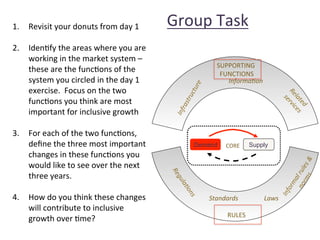
1.  Revisit	
  your	
  donuts	
  from	
  day	
  1	
  
2.  IdenHfy	
  the	
  areas	
  where	
  you	
  are	
  
working	
  in	
  the	
  market	
  system	
  –	
  
these	
  are	
  the	
  funcHons	
  of	
  the	
  
system	
  you	
  circled	
  in	
  the	
  day	
  1	
  
exercise.	
  	
  Focus	
  on	
  the	
  two	
  
funcHons	
  you	
  think	
  are	
  most	
  
important	
  for	
  inclusive	
  growth	
  
3.  For	
  each	
  of	
  the	
  two	
  funcHons,	
  
define	
  the	
  three	
  most	
  important	
  
changes	
  in	
  these	
  funcHons	
  you	
  
would	
  like	
  to	
  see	
  over	
  the	
  next	
  
three	
  years.	
  
4.  How	
  do	
  you	
  think	
  these	
  changes	
  
will	
  contribute	
  to	
  inclusive	
  
growth	
  over	
  Hme?	
  

Group	
  Task	
  
SUPPORTING	


FUNCTIONS
Informa.on


Demand

CORE

Standards
	
  
RULES


Supply

Laws


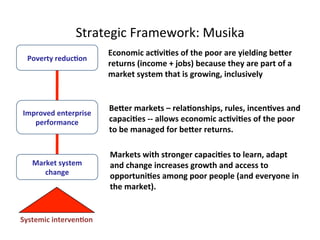
Strategic	
  Framework:	
  Musika	
  
Poverty	
  reduc-on	


Economic	
  ac-vi-es	
  of	
  the	
  poor	
  are	
  yielding	
  be=er	
  
returns	
  (income	
  +	
  jobs)	
  because	
  they	
  are	
  part	
  of	
  a	
  
market	
  system	
  that	
  is	
  growing,	
  inclusively	
  

Improved	
  enterprise	
  
performance	
  

Be=er	
  markets	
  –	
  rela-onships,	
  rules,	
  incen-ves	
  and	
  
capaci-es	
  -­‐-­‐	
  allows	
  economic	
  ac-vi-es	
  of	
  the	
  poor	
  
to	
  be	
  managed	
  for	
  be=er	
  returns.	
  

Market	
  system	
  
change	
  

Markets	
  with	
  stronger	
  capaci-es	
  to	
  learn,	
  adapt	
  
and	
  change	
  increases	
  growth	
  and	
  access	
  to	
  
opportuni-es	
  among	
  poor	
  people	
  (and	
  everyone	
  in	
  
the	
  market).	


Systemic	
  interven-on	
  
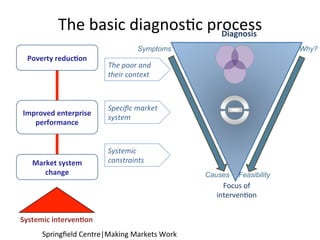
The	
  basic	
  diagnosHc	
  process	
  
Diagnosis	
  
Symptoms

Poverty	
  reduc-on	
  

Improved	
  enterprise	
  
performance	
  

Market	
  system	
  
change	
  

Why?

The	
  poor	
  and	
  
their	
  context	
  

Specific	
  market	
  
system	
  

Systemic	
  
constraints	
  
Causes

Feasibility

Focus	
  of	
  
intervenHon	
  
Systemic	
  interven-on	
  
Springfield	
  Centre|Making	
  Markets	
  Work	
  
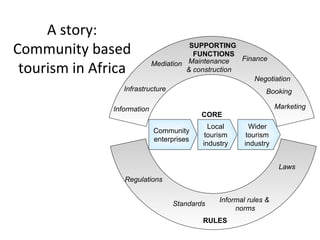
A	
  story:	
  	
  
Community	
  based	
  
tourism	
  in	
  Africa	
  

SUPPORTING
FUNCTIONS
Finance
Mediation Maintenance
& construction
Negotiation
Infrastructure
Booking
Marketing

Information

CORE
Community
enterprises

Local
tourism
industry

Wider
tourism
industry
Laws

Regulations
Standards

Informal rules &
norms

RULES
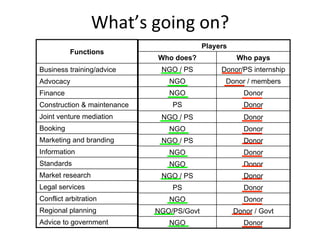
What’s	
  going	
  on?	
  
Functions

Players
Who does?

Who pays

NGO / PS

Donor/PS internship

Advocacy

NGO

Donor / members

Finance

NGO

Donor

PS

Donor

NGO / PS

Donor

NGO

Donor

NGO / PS

Donor

Information

NGO

Donor

Standards

NGO

Donor

NGO / PS

Donor

PS

Donor

Conflict arbitration

NGO

Donor

Regional planning

NGO/PS/Govt

Donor / Govt

NGO

Donor

Business training/advice

Construction & maintenance
Joint venture mediation
Booking
Marketing and branding

Market research
Legal services

Advice to government
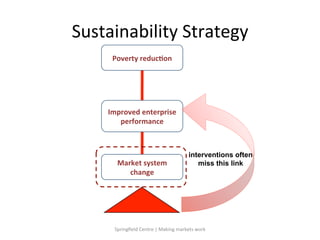
Sustainability	
  Strategy	
  
Poverty	
  reduc-on	
  

Improved	
  enterprise	
  
performance	
  

Market	
  system	
  
change	
  
Resources	
  

interventions often
miss this link

Ac.vi.es


Systemic	
  interven-on	
  
Springfield	
  Centre	
  |	
  Making	
  markets	
  work	
  
Who	
  Does/Who	
  Pays	
  
•  Musika	
  matrix	
  
•  Set	
  up	
  slide	
  for	
  exercise	
  
FacilitaHon	
  Principles:	
  Why	
  
To increase the performance of the whole industry over
time to:
o  Meet/exceed

changing market requirements (REFER BACK
earlier slide on performance)

o  Foster

§ 
§ 
§ 

a systemic change process towards:
Broader and deeper commercial relationships
Ongoing innovation and upgrading
Benefit flows that drive better relationships and innovation

o  Bring

about inclusive growth
Is	
  this	
  facilitaHon	
  of	
  market	
  system	
  change?	
  
•  Task	
  (class	
  discussion)	
  
–  Patrick	
  Boateng,	
  project	
  manager	
  of	
  the	
  Rice	
  
Value	
  Chain	
  Project,	
  reports	
  to	
  donor	
  Shiela	
  
Quayson	
  on	
  the	
  project’s	
  achievements	
  in	
  
meeHng	
  annual	
  targets	
  and	
  what	
  lies	
  behind	
  their	
  
success	
  
–  Can	
  this	
  case	
  be	
  described	
  as	
  “facilitaHon”?	
  Give	
  
reasons	
  why/why	
  not?	
  
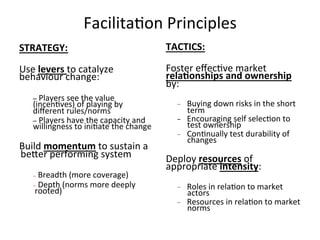
FacilitaHon	
  Principles	
  
STRATEGY:	


Use	
  levers	
  to	
  catalyze	
  
behaviour	
  change:	


– 	
  Players	
  see	
  the	
  value	


(incenHves)	
  of	
  playing	
  by	
  
different	
  rules/norms	
  
– 	
  Players	
  have	
  the	
  capacity	
  and	
  
willingness	
  to	
  iniHate	
  the	
  change	
  

Build	
  momentum	
  to	
  sustain	
  a	
  
beder	
  performing	
  system	


  Breadth	
  (more	
  coverage)	
  
– 	
  Depth	
  (norms	
  more	
  deeply	
  
rooted)	
  
– 

TACTICS:	


Foster	
  effecHve	
  market	
  
rela-onships	
  and	
  ownership	
  
by:	


- 
- 
- 

Buying	
  down	
  risks	
  in	
  the	
  short	
  
term	
  
Encouraging	
  self	
  selecHon	
  to	
  
test	
  ownership	
  
ConHnually	
  test	
  durability	
  of	
  
changes	
  

Deploy	
  resources	
  of	
  
appropriate	
  intensity:	


- 
- 


Roles	
  in	
  relaHon	
  to	
  market	
  
actors	
  
Resources	
  in	
  relaHon	
  to	
  market	
  
norms	
  
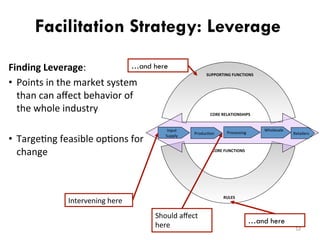
Facilitation Strategy: Leverage
…and here
Finding	
  Leverage:	
  
•  Points	
  in	
  the	
  market	
  system	
  
than	
  can	
  affect	
  behavior	
  of	
  
the	
  whole	
  industry	
  

•  TargeHng	
  feasible	
  opHons	
  for	
  
change	


Input	
  
Supply	
  

SUPPORTING	
  FUNCTIONS


CORE	
  RELATIONSHIPS


ProducHon	
  

Processing	
  

Wholesale


Retailers	
  

CORE	
  FUNCTIONS


RULES


Intervening	
  here	
  
Should	
  affect	
  
here	
  

…and here
12	
  
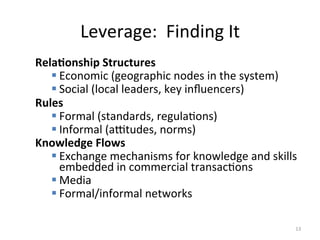
Leverage:	
  	
  Finding	
  It	
  
Rela-onship	
  Structures	
  	
  
§ Economic	
  (geographic	
  nodes	
  in	
  the	
  system)	
  
§ Social	
  (local	
  leaders,	
  key	
  influencers)	
  
Rules	
  
§ Formal	
  (standards,	
  regulaHons)	
  
§ Informal	
  (aftudes,	
  norms)	
  
Knowledge	
  Flows	
  
§ Exchange	
  mechanisms	
  for	
  knowledge	
  and	
  skills	
  
embedded	
  in	
  commercial	
  transacHons	
  	
  
§ Media	
  
§ Formal/informal	
  networks	


13	
  
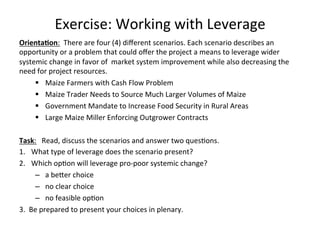
Exercise:	
  Working	
  with	
  Leverage	
  
Orienta-on:	
  	
  There	
  are	
  four	
  (4)	
  different	
  scenarios.	
  Each	
  scenario	
  describes	
  an	
  
opportunity	
  or	
  a	
  problem	
  that	
  could	
  offer	
  the	
  project	
  a	
  means	
  to	
  leverage	
  wider	
  
systemic	
  change	
  in	
  favor	
  of	
  	
  market	
  system	
  improvement	
  while	
  also	
  decreasing	
  the	
  
need	
  for	
  project	
  resources.	
  
§  Maize	
  Farmers	
  with	
  Cash	
  Flow	
  Problem	
  
§  Maize	
  Trader	
  Needs	
  to	
  Source	
  Much	
  Larger	
  Volumes	
  of	
  Maize	
  
§  Government	
  Mandate	
  to	
  Increase	
  Food	
  Security	
  in	
  Rural	
  Areas	
  
§  Large	
  Maize	
  Miller	
  Enforcing	
  Outgrower	
  Contracts	


Task:	
  	
  	
  Read,	
  discuss	
  the	
  scenarios	
  and	
  answer	
  two	
  quesHons.	
  
1.  What	
  type	
  of	
  leverage	
  does	
  the	
  scenario	
  present?	
  
2.  Which	
  opHon	
  will	
  leverage	
  pro-­‐poor	
  systemic	
  change?	


–  a	
  beder	
  choice	
  
–  no	
  clear	
  choice	
  
–  no	
  feasible	
  opHon	
  
3.	
  	
  Be	
  prepared	
  to	
  present	
  your	
  choices	
  in	
  plenary.	


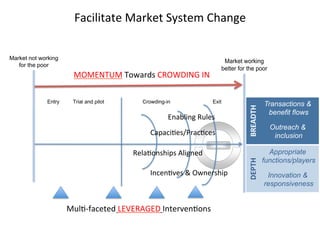
Facilitate	
  Market	
  System	
  Change	


Market not working
for the poor

Entry

Trial and pilot

Crowding-in

Exit

Enabling	
  Rules	
  
CapaciHes/PracHces	
  
RelaHonships	
  Aligned	
  
IncenHves	
  &	
  Ownership	
  

MulH-­‐faceted	
  LEVERAGED	
  IntervenHons	
  

DEPTH	
  

MOMENTUM	
  Towards	
  CROWDING	
  IN	
  

BREADTH	
  

Market working
better for the poor

Transactions &
benefit flows
Outreach &
inclusion
Appropriate
functions/players
Innovation &
responsiveness
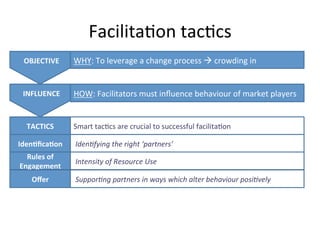
FacilitaHon	
  tacHcs	
  
OBJECTIVE	
  

WHY:	
  To	
  leverage	
  a	
  change	
  process	
  à	
  crowding	
  in	
  

INFLUENCE	
  

HOW:	
  Facilitators	
  must	
  influence	
  behaviour	
  of	
  market	
  players	
  

TACTICS	
  

Smart	
  tacHcs	
  are	
  crucial	
  to	
  successful	
  facilitaHon	
  

Iden-fica-on	


  Iden.fying	
  the	
  right	
  ‘partners’	
  

Rules	
  of	
  
Engagement	


  Intensity	
  of	
  Resource	
  Use	
  

Offer	


  Suppor.ng	
  partners	
  in	
  ways	
  which	
  alter	
  behaviour	
  posi.vely	
  
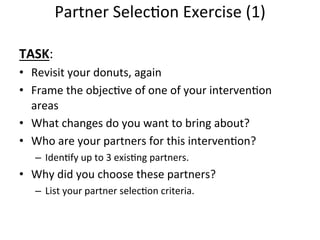
Partner	
  SelecHon	
  Exercise	
  (1)	


TASK:	


•  Revisit	
  your	
  donuts,	
  again	
  	
  
•  Frame	
  the	
  objecHve	
  of	
  one	
  of	
  your	
  intervenHon	
  
areas	
  
•  What	
  changes	
  do	
  you	
  want	
  to	
  bring	
  about?	
  
•  Who	
  are	
  your	
  partners	
  for	
  this	
  intervenHon?	
  	
  
–  IdenHfy	
  up	
  to	
  3	
  exisHng	
  partners.	
  

•  Why	
  did	
  you	
  choose	
  these	
  partners?	
  
–  List	
  your	
  partner	
  selecHon	
  criteria.	


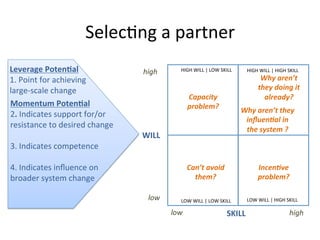
SelecHng	
  a	
  partner	
  
Leverage	
  Poten-al	
  
1.	
  Point	
  for	
  achieving	
  
large-­‐scale	
  change	


Momentum	
  Poten-al	
  
2.	
  Indicates	
  support	
  for/or	
  
resistance	
  to	
  desired	
  change	


3.	
  Indicates	
  competence	


4.	
  Indicates	
  influence	
  on	
  
broader	
  system	
  change	


high	
  

HIGH	
  WILL	
  |	
  LOW	
  SKILL	
  

Capacity	
  
problem?	
  

HIGH	
  WILL	
  |	
  HIGH	
  SKILL	
  

Why	
  aren’t	
  
they	
  doing	
  it	
  
already?	
  

Why	
  aren’t	
  they	
  
influen2al	
  in	
  
the	
  system	
  ?	
  

WILL	
  
Can’t	
  avoid	
  
them?	
  
low	
  

Incen2ve	
  
problem?	
  

LOW	
  WILL	
  |	
  LOW	
  SKILL	
  

low	
  

LOW	
  WILL	
  |	
  HIGH	
  SKILL	
  

SKILL	
  

high	
  
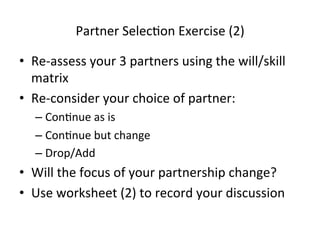
Partner	
  SelecHon	
  Exercise	
  (2)	
  
•  Re-­‐assess	
  your	
  3	
  partners	
  using	
  the	
  will/skill	
  
matrix	
  
•  Re-­‐consider	
  your	
  choice	
  of	
  partner:	
  
–  ConHnue	
  as	
  is	
  
–  ConHnue	
  but	
  change	
  	
  
–  Drop/Add	
  

•  Will	
  the	
  focus	
  of	
  your	
  partnership	
  change?	
  
•  Use	
  worksheet	
  (2)	
  to	
  record	
  your	
  discussion	


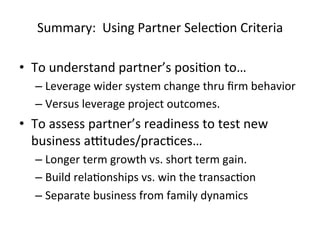
Summary:	
  	
  Using	
  Partner	
  SelecHon	
  Criteria	


•  To	
  understand	
  partner’s	
  posiHon	
  to…	
  
–  Leverage	
  wider	
  system	
  change	
  thru	
  firm	
  behavior	
  
–  Versus	
  leverage	
  project	
  outcomes.	
  

•  To	
  assess	
  partner’s	
  readiness	
  to	
  test	
  new	
  
business	
  aftudes/pracHces…	
  	
  
–  Longer	
  term	
  growth	
  vs.	
  short	
  term	
  gain.	
  
–  Build	
  relaHonships	
  vs.	
  win	
  the	
  transacHon	
  
–  Separate	
  business	
  from	
  family	
  dynamics	


Market Systems Approach

  • 1.
    Session  6:   Market  Systems  Approach  
  • 2.
    1.  Revisit  your  donuts  from  day  1   2.  IdenHfy  the  areas  where  you  are   working  in  the  market  system  –   these  are  the  funcHons  of  the   system  you  circled  in  the  day  1   exercise.    Focus  on  the  two   funcHons  you  think  are  most   important  for  inclusive  growth   3.  For  each  of  the  two  funcHons,   define  the  three  most  important   changes  in  these  funcHons  you   would  like  to  see  over  the  next   three  years.   4.  How  do  you  think  these  changes   will  contribute  to  inclusive   growth  over  Hme?   Group  Task   SUPPORTING     FUNCTIONS Informa.on   Demand CORE Standards   RULES   Supply Laws  
  • 3.
      Strategic  Framework:  Musika   Poverty  reduc-on     Economic  ac-vi-es  of  the  poor  are  yielding  be=er   returns  (income  +  jobs)  because  they  are  part  of  a   market  system  that  is  growing,  inclusively   Improved  enterprise   performance   Be=er  markets  –  rela-onships,  rules,  incen-ves  and   capaci-es  -­‐-­‐  allows  economic  ac-vi-es  of  the  poor   to  be  managed  for  be=er  returns.   Market  system   change   Markets  with  stronger  capaci-es  to  learn,  adapt   and  change  increases  growth  and  access  to   opportuni-es  among  poor  people  (and  everyone  in   the  market).     Systemic  interven-on  
  • 4.
    The  basic  diagnosHc  process   Diagnosis   Symptoms Poverty  reduc-on   Improved  enterprise   performance   Market  system   change   Why? The  poor  and   their  context   Specific  market   system   Systemic   constraints   Causes Feasibility Focus  of   intervenHon   Systemic  interven-on   Springfield  Centre|Making  Markets  Work  
  • 5.
    A  story:     Community  based   tourism  in  Africa   SUPPORTING FUNCTIONS Finance Mediation Maintenance & construction Negotiation Infrastructure Booking Marketing Information CORE Community enterprises Local tourism industry Wider tourism industry Laws Regulations Standards Informal rules & norms RULES
  • 6.
    What’s  going  on?   Functions Players Who does? Who pays NGO / PS Donor/PS internship Advocacy NGO Donor / members Finance NGO Donor PS Donor NGO / PS Donor NGO Donor NGO / PS Donor Information NGO Donor Standards NGO Donor NGO / PS Donor PS Donor Conflict arbitration NGO Donor Regional planning NGO/PS/Govt Donor / Govt NGO Donor Business training/advice Construction & maintenance Joint venture mediation Booking Marketing and branding Market research Legal services Advice to government
  • 7.
    Sustainability  Strategy   Poverty  reduc-on   Improved  enterprise   performance   Market  system   change   Resources   interventions often miss this link Ac.vi.es   Systemic  interven-on   Springfield  Centre  |  Making  markets  work  
  • 8.
    Who  Does/Who  Pays   •  Musika  matrix   •  Set  up  slide  for  exercise  
  • 9.
    FacilitaHon  Principles:  Why   To increase the performance of the whole industry over time to: o  Meet/exceed changing market requirements (REFER BACK earlier slide on performance) o  Foster §  §  §  a systemic change process towards: Broader and deeper commercial relationships Ongoing innovation and upgrading Benefit flows that drive better relationships and innovation o  Bring about inclusive growth
  • 10.
    Is  this  facilitaHon  of  market  system  change?   •  Task  (class  discussion)   –  Patrick  Boateng,  project  manager  of  the  Rice   Value  Chain  Project,  reports  to  donor  Shiela   Quayson  on  the  project’s  achievements  in   meeHng  annual  targets  and  what  lies  behind  their   success   –  Can  this  case  be  described  as  “facilitaHon”?  Give   reasons  why/why  not?  
  • 11.
    FacilitaHon  Principles   STRATEGY:     Use  levers  to  catalyze   behaviour  change:     –   Players  see  the  value     (incenHves)  of  playing  by   different  rules/norms   –   Players  have  the  capacity  and   willingness  to  iniHate  the  change   Build  momentum  to  sustain  a   beder  performing  system      Breadth  (more  coverage)   –   Depth  (norms  more  deeply   rooted)   –  TACTICS:     Foster  effecHve  market   rela-onships  and  ownership   by:     -  -  -  Buying  down  risks  in  the  short   term   Encouraging  self  selecHon  to   test  ownership   ConHnually  test  durability  of   changes   Deploy  resources  of   appropriate  intensity:     -  -    Roles  in  relaHon  to  market   actors   Resources  in  relaHon  to  market   norms  
  • 12.
    Facilitation Strategy: Leverage …andhere Finding  Leverage:   •  Points  in  the  market  system   than  can  affect  behavior  of   the  whole  industry   •  TargeHng  feasible  opHons  for   change     Input   Supply   SUPPORTING  FUNCTIONS   CORE  RELATIONSHIPS   ProducHon   Processing   Wholesale     Retailers   CORE  FUNCTIONS   RULES   Intervening  here   Should  affect   here   …and here 12  
  • 13.
    Leverage:    Finding  It   Rela-onship  Structures     § Economic  (geographic  nodes  in  the  system)   § Social  (local  leaders,  key  influencers)   Rules   § Formal  (standards,  regulaHons)   § Informal  (aftudes,  norms)   Knowledge  Flows   § Exchange  mechanisms  for  knowledge  and  skills   embedded  in  commercial  transacHons     § Media   § Formal/informal  networks     13  
  • 14.
    Exercise:  Working  with  Leverage   Orienta-on:    There  are  four  (4)  different  scenarios.  Each  scenario  describes  an   opportunity  or  a  problem  that  could  offer  the  project  a  means  to  leverage  wider   systemic  change  in  favor  of    market  system  improvement  while  also  decreasing  the   need  for  project  resources.   §  Maize  Farmers  with  Cash  Flow  Problem   §  Maize  Trader  Needs  to  Source  Much  Larger  Volumes  of  Maize   §  Government  Mandate  to  Increase  Food  Security  in  Rural  Areas   §  Large  Maize  Miller  Enforcing  Outgrower  Contracts       Task:      Read,  discuss  the  scenarios  and  answer  two  quesHons.   1.  What  type  of  leverage  does  the  scenario  present?   2.  Which  opHon  will  leverage  pro-­‐poor  systemic  change?       –  a  beder  choice   –  no  clear  choice   –  no  feasible  opHon   3.    Be  prepared  to  present  your  choices  in  plenary.    
  • 15.
    Facilitate  Market  System  Change     Market not working for the poor Entry Trial and pilot Crowding-in Exit Enabling  Rules   CapaciHes/PracHces   RelaHonships  Aligned   IncenHves  &  Ownership   MulH-­‐faceted  LEVERAGED  IntervenHons   DEPTH   MOMENTUM  Towards  CROWDING  IN   BREADTH   Market working better for the poor Transactions & benefit flows Outreach & inclusion Appropriate functions/players Innovation & responsiveness
  • 16.
    FacilitaHon  tacHcs   OBJECTIVE   WHY:  To  leverage  a  change  process  à  crowding  in   INFLUENCE   HOW:  Facilitators  must  influence  behaviour  of  market  players   TACTICS   Smart  tacHcs  are  crucial  to  successful  facilitaHon   Iden-fica-on    Iden.fying  the  right  ‘partners’   Rules  of   Engagement    Intensity  of  Resource  Use   Offer    Suppor.ng  partners  in  ways  which  alter  behaviour  posi.vely  
  • 17.
    Partner  SelecHon  Exercise  (1)       TASK:       •  Revisit  your  donuts,  again     •  Frame  the  objecHve  of  one  of  your  intervenHon   areas   •  What  changes  do  you  want  to  bring  about?   •  Who  are  your  partners  for  this  intervenHon?     –  IdenHfy  up  to  3  exisHng  partners.   •  Why  did  you  choose  these  partners?   –  List  your  partner  selecHon  criteria.      
  • 18.
    SelecHng  a  partner   Leverage  Poten-al   1.  Point  for  achieving   large-­‐scale  change     Momentum  Poten-al   2.  Indicates  support  for/or   resistance  to  desired  change     3.  Indicates  competence       4.  Indicates  influence  on   broader  system  change             high   HIGH  WILL  |  LOW  SKILL   Capacity   problem?   HIGH  WILL  |  HIGH  SKILL   Why  aren’t   they  doing  it   already?   Why  aren’t  they   influen2al  in   the  system  ?   WILL   Can’t  avoid   them?   low   Incen2ve   problem?   LOW  WILL  |  LOW  SKILL   low   LOW  WILL  |  HIGH  SKILL   SKILL   high  
  • 19.
    Partner  SelecHon  Exercise  (2)   •  Re-­‐assess  your  3  partners  using  the  will/skill   matrix   •  Re-­‐consider  your  choice  of  partner:   –  ConHnue  as  is   –  ConHnue  but  change     –  Drop/Add   •  Will  the  focus  of  your  partnership  change?   •  Use  worksheet  (2)  to  record  your  discussion  
  • 20.
      Summary:    Using  Partner  SelecHon  Criteria     •  To  understand  partner’s  posiHon  to…   –  Leverage  wider  system  change  thru  firm  behavior   –  Versus  leverage  project  outcomes.   •  To  assess  partner’s  readiness  to  test  new   business  aftudes/pracHces…     –  Longer  term  growth  vs.  short  term  gain.   –  Build  relaHonships  vs.  win  the  transacHon   –  Separate  business  from  family  dynamics