FACILITATOR NOTES
MODULE 2: UNDERSTANDING SYSTEM DYNAMICS
Module Learning Objective
To understand the forces of change in a dynamic system
Session 1: Assessing System Dynamics

Facilitator Notes: Module 2

1
Objectives

•
•

Key Messages

•

•

Examine all factors of individual performance and how this performance is
influenced by rules and interconnected systems
To examine these forces from the perspectives of both individual actors and the
system as a whole
A good understanding of dynamics (how things work) starts with a good picture
of how things are at any one point of time. A value chain map is useful tool to
plot the current alignment between value chain functions and the actors who
perform these functions in serving end markets.
To understand why systems work the way they do, the analyst must examine
the nature of relationships between players, the rules that influence their
behavior and external support systems that enable them to act in their own and
the system’s interests.

Methodology

•

Activity with discussion, reinforced by PowerPoint slides

Timing

•

150 minutes (see breakdown by activity)

Materials

•
•

PowerPoint to set the rice value chain context prior to mapping
Flipchart with rice markets across the top and the rice value chain functions
along the left hand side (as seen in slide 5 of PowerPoint).
Role cards (quantity 14) with the names of rice value chain actors
Situation cards (quantity 14) describing the incentives and issues faced by these
actors
Blank, brightly colored index cards
Markers
Flipchart matrix for what is working/not working (see template in Activity 2
below)

•
•
•
•
•
Activities

•
ACTIVITY 1: (40 minutes) Mapping Exercise (Rice Value Chain System)
• Briefly introduce to the strengths and limitations of mapping as an analysis tool (slide
1)
• Introduce the Rice Market, its products and consumer preferences/trends (slides 24)
• Use slide 5 to introduce the mapping exercise by summarizing the markets
(differentiated by price alone) and the value added functions
• Handout name cards for 14 system actors (cards with names only); TIP - make
duplicates of producers and some actor cards to ensure there are enough for all
training participants.
• Ask participants to place their cards on a pre-prepared flipchart with the two rice
markets on top and the rice value chain on the left hand side. (as in slide 5)
• After all the cards are mapped (see the Rice Value Chain Map for reference)
summarize the rice map (slide 7) and then emphasize three main points already
mentioned in icebreaker and in Module 1:
a. Relationships – types: vertical and horizontal, nature, strong and/or weak
b. Rules – these are formal and informal rules of the game that influence the
behaviors of all market players
c. Inter-connected systems: These are critical to the performance of the rice value
chain but are outside of the tightly linked value chain relationships. Make sure to
point out that relationships between actors in the value chain and in interconnected systems are vertical relationships.

ACTIVITY 2 (60 m): Small group card exercise: Is the system working for your
market actor?
Facilitator Notes: Module 2
Organize participants into 4 groups and hand out a pre-determined mix of market2
players to each of the groups. If following from Activity 1, they should keep their roles
and you will distribute corresponding situation cards. If starting with Activity 2, hand
out role and situation cards to each player. Each “cluster of players” is meant to
Session 2: Defining Driving Forces of Change
Objectives

•

To understand the systemic forces of competition and cooperation and their
effectiveness in driving performance

Key Messages

•

Value chains are not static, so we must understand the forces that drive system
performance in meeting end market requirements (which—when successful—
results in wealth creation).
These forces can be summarized as competition and cooperation that result in
benefits.
Both competition and cooperation can be both effective and ineffective.
Benefits are the range of economic, social, political, and cultural factors that
motivate people’s behavior. Systems are shaped by all these various incentives,
rather than by economic gain alone.
Competition is most effective when it is between actors performing the same
function. Therefore, vertical relationships (between actors performing different
functions) in general should be more cooperative than competitive to develop
the strategic alliances needed to ensure ongoing system performance
improvements.
Horizontal relationships in general should be both competitive (to drive
innovation and upgrading) and cooperative (to respond to joint threats and
opportunities).
Avoid confusing one supply chain with a system: a value chain system
comprises alternative and competing supply chains or channels targeting
similar and/or different end markets. As a general rule, there are typically
three channels in value chains in developing countries: the traditional,
fragmented channel where each function is performed by a different firm; the
private sector or modern chain where vertical integration of some form or
another has evolved; and a third chain where there is some mix of public and
private taking on different functions in the chain.

•
•
•
•

•
•

Methodology

•
•

Synthesis presentation
Group activity with feedback/discussion in plenary

Timing

•

95 minutes (see breakdown by activity)

Materials

•
•
•
•
•

PowerPoint slides
“Have you heard” exercise task sheet and accompanying cards
Large pre-prepared flipchart with CC4U matrix for feedback in plenary
CC4U Matrix Handout
Handout: Summary of rice case (who are the actors, what do they do, and how
does the system work for them and as a whole?) Participants may notice this
map is different than the mapping answer key they just received. This version
presents an expanded set of actors beyond what was covered in the previous
activity to allow us to discuss the value chain more deeply.

Facilitator Notes: Module 2

3
Activities

ACTIVITY 1: PowerPoint Presentation (20 minutes)
• Clarify the driving forces and reveal the CC4U framework as a diagnostic tool
ACTIVITY 2: “Have you heard” Group Exercise (40 minutes)
• Facilitators introduce the exercise (see PowerPoint task set up) (20m):
o introduce the “have you heard” exercise
o read out all three statements
o ask: what type of relationship is this (farmer to farmer)
o re-read each statement and ask participants to shout out answers to
these questions:
1. What does the statement imply about the nature and degree of
competition and/or cooperation?
2. Are there any rules that may have influenced the statement?
•
•

Arrange participants in as many groups as there are actors. Hand out “Have you
heard” statements to each group and introduce the task (one actor per group).
Group Task:
• In groups, answer these questions for each actor quote:
1. Is this an example of a horizontal or vertical relationship?
2. What does the statement imply about the nature and degree of
competition and/or cooperation?
3. Are there any rules that may have influenced the statement?
•
•

Pin your cards onto the CC4U flipchart where you think it captures the
meaning of the statement.
Be prepared to answer the above questions in plenary.

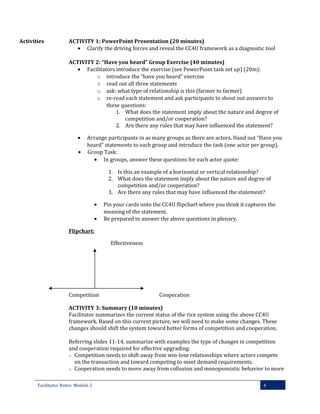
Flipchart:
Effectiveness

Competition

Cooperation

ACTIVITY 3: Summary (10 minutes)
Facilitator summarizes the current status of the rice system using the above CC4U
framework. Based on this current picture, we will need to make some changes. These
changes should shift the system toward better forms of competition and cooperation.
Referring slides 11-14, summarize with examples the type of changes in competition
and cooperation required for effective upgrading:
o Competition needs to shift away from win-lose relationships where actors compete
on the transaction and toward competing to meet demand requirements.
o Cooperation needs to move away from collusion and monopsonistic behavior to more
Facilitator Notes: Module 2

4
o

joint action to respond to opportunities and guard against threats faced in common
by players in the system.
The “have you heard” exercise is simply a teaching device to assess the current
picture of how a system works. You will need to be aware a range of diagnostic tools
—such as mapping, individual interview, focus group discussion or possibly survey
methods to gather information that is both useful and comprehensive for informed
analysis and decision making.

ACTIVITY 4 (15m): Charades with Words (Not case-specific)
• This activity reinforces the CC4U matrix by asking groups to act out scenarios
representing examples of the different boxes. If the participants act the
scenario well, the audience should be able to guess which box it is meant to
represent.
• 4 groups each do 2 skits of pre-assigned scenarios (4 groups x 2 or 8 boxes of
the 16 box matrix)
• Perform eight 60-second skits to dramatize the points without revealing the box
• Ask audience to plot the scenario on the CC4U matrix
• Group with the most points wins (audience correctly plotted the skit)
• Present award for the winning team
Preparation/
Facilitation Tips

•

•

Adaptations/
variations

Pre-prepare a CC4U matrix on a flip chart for your context before you begin—
some quadrants may not be filled in if they do not apply to your context (e.g., a
high degree of vertical competition that is effective is typically found only in
highly developed economies).
You want to get all participants on the “same page” in terms of the current
picture of your context. You will re-visit this context in the next module on
envisaging a future picture of a better performing system. The future visions
will differ from group to group so it will be important that they all have a
common starting point.

Prior to the “Have You Heard” exercise, the facilitators reveal the CC4U matrix, which
examines the nature of vertical and horizontal relationships against two variables: how
they compete or cooperate and how this relationship contributes or not to a strategy of
industry upgrading. Participants are asked in the “Have You Heard” exercise to use the
CC4U matrix in plotting the nature of the relationship in their case.
As an alternative, the facilitator and not the participants would plot group feedback on
a large CC4U matrix. There are a number benefits of plotting the matrix in plenary:
• a more efficient way to plot each relationship on the matrix with greater accuracy
• envisaging a system as a collection of many different types of vertical and horizontal
relationship as the matrix is populated
• clarifying what is meant by good competition (e.g., around upgrading), bad
competition (e.g., only on the transaction), bad cooperation (e.g., collusion) and good
cooperation (e.g., joint action to address threats in common).

Facilitator Notes: Module 2

5
o

joint action to respond to opportunities and guard against threats faced in common
by players in the system.
The “have you heard” exercise is simply a teaching device to assess the current
picture of how a system works. You will need to be aware a range of diagnostic tools
—such as mapping, individual interview, focus group discussion or possibly survey
methods to gather information that is both useful and comprehensive for informed
analysis and decision making.

ACTIVITY 4 (15m): Charades with Words (Not case-specific)
• This activity reinforces the CC4U matrix by asking groups to act out scenarios
representing examples of the different boxes. If the participants act the
scenario well, the audience should be able to guess which box it is meant to
represent.
• 4 groups each do 2 skits of pre-assigned scenarios (4 groups x 2 or 8 boxes of
the 16 box matrix)
• Perform eight 60-second skits to dramatize the points without revealing the box
• Ask audience to plot the scenario on the CC4U matrix
• Group with the most points wins (audience correctly plotted the skit)
• Present award for the winning team
Preparation/
Facilitation Tips

•

•

Adaptations/
variations

Pre-prepare a CC4U matrix on a flip chart for your context before you begin—
some quadrants may not be filled in if they do not apply to your context (e.g., a
high degree of vertical competition that is effective is typically found only in
highly developed economies).
You want to get all participants on the “same page” in terms of the current
picture of your context. You will re-visit this context in the next module on
envisaging a future picture of a better performing system. The future visions
will differ from group to group so it will be important that they all have a
common starting point.

Prior to the “Have You Heard” exercise, the facilitators reveal the CC4U matrix, which
examines the nature of vertical and horizontal relationships against two variables: how
they compete or cooperate and how this relationship contributes or not to a strategy of
industry upgrading. Participants are asked in the “Have You Heard” exercise to use the
CC4U matrix in plotting the nature of the relationship in their case.
As an alternative, the facilitator and not the participants would plot group feedback on
a large CC4U matrix. There are a number benefits of plotting the matrix in plenary:
• a more efficient way to plot each relationship on the matrix with greater accuracy
• envisaging a system as a collection of many different types of vertical and horizontal
relationship as the matrix is populated
• clarifying what is meant by good competition (e.g., around upgrading), bad
competition (e.g., only on the transaction), bad cooperation (e.g., collusion) and good
cooperation (e.g., joint action to address threats in common).

Facilitator Notes: Module 2

5

USAID Module 2: Understanding System Dynamics

  • 1.
    FACILITATOR NOTES MODULE 2:UNDERSTANDING SYSTEM DYNAMICS Module Learning Objective To understand the forces of change in a dynamic system Session 1: Assessing System Dynamics Facilitator Notes: Module 2 1
  • 2.
    Objectives • • Key Messages • • Examine allfactors of individual performance and how this performance is influenced by rules and interconnected systems To examine these forces from the perspectives of both individual actors and the system as a whole A good understanding of dynamics (how things work) starts with a good picture of how things are at any one point of time. A value chain map is useful tool to plot the current alignment between value chain functions and the actors who perform these functions in serving end markets. To understand why systems work the way they do, the analyst must examine the nature of relationships between players, the rules that influence their behavior and external support systems that enable them to act in their own and the system’s interests. Methodology • Activity with discussion, reinforced by PowerPoint slides Timing • 150 minutes (see breakdown by activity) Materials • • PowerPoint to set the rice value chain context prior to mapping Flipchart with rice markets across the top and the rice value chain functions along the left hand side (as seen in slide 5 of PowerPoint). Role cards (quantity 14) with the names of rice value chain actors Situation cards (quantity 14) describing the incentives and issues faced by these actors Blank, brightly colored index cards Markers Flipchart matrix for what is working/not working (see template in Activity 2 below) • • • • • Activities • ACTIVITY 1: (40 minutes) Mapping Exercise (Rice Value Chain System) • Briefly introduce to the strengths and limitations of mapping as an analysis tool (slide 1) • Introduce the Rice Market, its products and consumer preferences/trends (slides 24) • Use slide 5 to introduce the mapping exercise by summarizing the markets (differentiated by price alone) and the value added functions • Handout name cards for 14 system actors (cards with names only); TIP - make duplicates of producers and some actor cards to ensure there are enough for all training participants. • Ask participants to place their cards on a pre-prepared flipchart with the two rice markets on top and the rice value chain on the left hand side. (as in slide 5) • After all the cards are mapped (see the Rice Value Chain Map for reference) summarize the rice map (slide 7) and then emphasize three main points already mentioned in icebreaker and in Module 1: a. Relationships – types: vertical and horizontal, nature, strong and/or weak b. Rules – these are formal and informal rules of the game that influence the behaviors of all market players c. Inter-connected systems: These are critical to the performance of the rice value chain but are outside of the tightly linked value chain relationships. Make sure to point out that relationships between actors in the value chain and in interconnected systems are vertical relationships. ACTIVITY 2 (60 m): Small group card exercise: Is the system working for your market actor? Facilitator Notes: Module 2 Organize participants into 4 groups and hand out a pre-determined mix of market2 players to each of the groups. If following from Activity 1, they should keep their roles and you will distribute corresponding situation cards. If starting with Activity 2, hand out role and situation cards to each player. Each “cluster of players” is meant to
  • 3.
    Session 2: DefiningDriving Forces of Change Objectives • To understand the systemic forces of competition and cooperation and their effectiveness in driving performance Key Messages • Value chains are not static, so we must understand the forces that drive system performance in meeting end market requirements (which—when successful— results in wealth creation). These forces can be summarized as competition and cooperation that result in benefits. Both competition and cooperation can be both effective and ineffective. Benefits are the range of economic, social, political, and cultural factors that motivate people’s behavior. Systems are shaped by all these various incentives, rather than by economic gain alone. Competition is most effective when it is between actors performing the same function. Therefore, vertical relationships (between actors performing different functions) in general should be more cooperative than competitive to develop the strategic alliances needed to ensure ongoing system performance improvements. Horizontal relationships in general should be both competitive (to drive innovation and upgrading) and cooperative (to respond to joint threats and opportunities). Avoid confusing one supply chain with a system: a value chain system comprises alternative and competing supply chains or channels targeting similar and/or different end markets. As a general rule, there are typically three channels in value chains in developing countries: the traditional, fragmented channel where each function is performed by a different firm; the private sector or modern chain where vertical integration of some form or another has evolved; and a third chain where there is some mix of public and private taking on different functions in the chain. • • • • • • Methodology • • Synthesis presentation Group activity with feedback/discussion in plenary Timing • 95 minutes (see breakdown by activity) Materials • • • • • PowerPoint slides “Have you heard” exercise task sheet and accompanying cards Large pre-prepared flipchart with CC4U matrix for feedback in plenary CC4U Matrix Handout Handout: Summary of rice case (who are the actors, what do they do, and how does the system work for them and as a whole?) Participants may notice this map is different than the mapping answer key they just received. This version presents an expanded set of actors beyond what was covered in the previous activity to allow us to discuss the value chain more deeply. Facilitator Notes: Module 2 3
  • 4.
    Activities ACTIVITY 1: PowerPointPresentation (20 minutes) • Clarify the driving forces and reveal the CC4U framework as a diagnostic tool ACTIVITY 2: “Have you heard” Group Exercise (40 minutes) • Facilitators introduce the exercise (see PowerPoint task set up) (20m): o introduce the “have you heard” exercise o read out all three statements o ask: what type of relationship is this (farmer to farmer) o re-read each statement and ask participants to shout out answers to these questions: 1. What does the statement imply about the nature and degree of competition and/or cooperation? 2. Are there any rules that may have influenced the statement? • • Arrange participants in as many groups as there are actors. Hand out “Have you heard” statements to each group and introduce the task (one actor per group). Group Task: • In groups, answer these questions for each actor quote: 1. Is this an example of a horizontal or vertical relationship? 2. What does the statement imply about the nature and degree of competition and/or cooperation? 3. Are there any rules that may have influenced the statement? • • Pin your cards onto the CC4U flipchart where you think it captures the meaning of the statement. Be prepared to answer the above questions in plenary. Flipchart: Effectiveness Competition Cooperation ACTIVITY 3: Summary (10 minutes) Facilitator summarizes the current status of the rice system using the above CC4U framework. Based on this current picture, we will need to make some changes. These changes should shift the system toward better forms of competition and cooperation. Referring slides 11-14, summarize with examples the type of changes in competition and cooperation required for effective upgrading: o Competition needs to shift away from win-lose relationships where actors compete on the transaction and toward competing to meet demand requirements. o Cooperation needs to move away from collusion and monopsonistic behavior to more Facilitator Notes: Module 2 4
  • 5.
    o joint action torespond to opportunities and guard against threats faced in common by players in the system. The “have you heard” exercise is simply a teaching device to assess the current picture of how a system works. You will need to be aware a range of diagnostic tools —such as mapping, individual interview, focus group discussion or possibly survey methods to gather information that is both useful and comprehensive for informed analysis and decision making. ACTIVITY 4 (15m): Charades with Words (Not case-specific) • This activity reinforces the CC4U matrix by asking groups to act out scenarios representing examples of the different boxes. If the participants act the scenario well, the audience should be able to guess which box it is meant to represent. • 4 groups each do 2 skits of pre-assigned scenarios (4 groups x 2 or 8 boxes of the 16 box matrix) • Perform eight 60-second skits to dramatize the points without revealing the box • Ask audience to plot the scenario on the CC4U matrix • Group with the most points wins (audience correctly plotted the skit) • Present award for the winning team Preparation/ Facilitation Tips • • Adaptations/ variations Pre-prepare a CC4U matrix on a flip chart for your context before you begin— some quadrants may not be filled in if they do not apply to your context (e.g., a high degree of vertical competition that is effective is typically found only in highly developed economies). You want to get all participants on the “same page” in terms of the current picture of your context. You will re-visit this context in the next module on envisaging a future picture of a better performing system. The future visions will differ from group to group so it will be important that they all have a common starting point. Prior to the “Have You Heard” exercise, the facilitators reveal the CC4U matrix, which examines the nature of vertical and horizontal relationships against two variables: how they compete or cooperate and how this relationship contributes or not to a strategy of industry upgrading. Participants are asked in the “Have You Heard” exercise to use the CC4U matrix in plotting the nature of the relationship in their case. As an alternative, the facilitator and not the participants would plot group feedback on a large CC4U matrix. There are a number benefits of plotting the matrix in plenary: • a more efficient way to plot each relationship on the matrix with greater accuracy • envisaging a system as a collection of many different types of vertical and horizontal relationship as the matrix is populated • clarifying what is meant by good competition (e.g., around upgrading), bad competition (e.g., only on the transaction), bad cooperation (e.g., collusion) and good cooperation (e.g., joint action to address threats in common). Facilitator Notes: Module 2 5
  • 6.
    o joint action torespond to opportunities and guard against threats faced in common by players in the system. The “have you heard” exercise is simply a teaching device to assess the current picture of how a system works. You will need to be aware a range of diagnostic tools —such as mapping, individual interview, focus group discussion or possibly survey methods to gather information that is both useful and comprehensive for informed analysis and decision making. ACTIVITY 4 (15m): Charades with Words (Not case-specific) • This activity reinforces the CC4U matrix by asking groups to act out scenarios representing examples of the different boxes. If the participants act the scenario well, the audience should be able to guess which box it is meant to represent. • 4 groups each do 2 skits of pre-assigned scenarios (4 groups x 2 or 8 boxes of the 16 box matrix) • Perform eight 60-second skits to dramatize the points without revealing the box • Ask audience to plot the scenario on the CC4U matrix • Group with the most points wins (audience correctly plotted the skit) • Present award for the winning team Preparation/ Facilitation Tips • • Adaptations/ variations Pre-prepare a CC4U matrix on a flip chart for your context before you begin— some quadrants may not be filled in if they do not apply to your context (e.g., a high degree of vertical competition that is effective is typically found only in highly developed economies). You want to get all participants on the “same page” in terms of the current picture of your context. You will re-visit this context in the next module on envisaging a future picture of a better performing system. The future visions will differ from group to group so it will be important that they all have a common starting point. Prior to the “Have You Heard” exercise, the facilitators reveal the CC4U matrix, which examines the nature of vertical and horizontal relationships against two variables: how they compete or cooperate and how this relationship contributes or not to a strategy of industry upgrading. Participants are asked in the “Have You Heard” exercise to use the CC4U matrix in plotting the nature of the relationship in their case. As an alternative, the facilitator and not the participants would plot group feedback on a large CC4U matrix. There are a number benefits of plotting the matrix in plenary: • a more efficient way to plot each relationship on the matrix with greater accuracy • envisaging a system as a collection of many different types of vertical and horizontal relationship as the matrix is populated • clarifying what is meant by good competition (e.g., around upgrading), bad competition (e.g., only on the transaction), bad cooperation (e.g., collusion) and good cooperation (e.g., joint action to address threats in common). Facilitator Notes: Module 2 5