May 4, 2015
Sarah Vacher
 Smyth County Community Hospital (SCCH)
◦ Dietitian: Mary Riggins
 Health Trust at SCCH
◦ Subcommittee: Nutrition Action Network (NAN)
 Charged with creating the Family Fitness Challenge
(FFC)
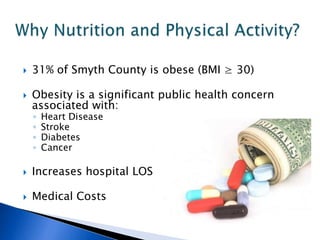
 31% of Smyth County is obese (BMI ≥ 30)
 Obesity is a significant public health concern
associated with:
◦ Heart Disease
◦ Stroke
◦ Diabetes
◦ Cancer
 Increases hospital LOS
 Medical Costs
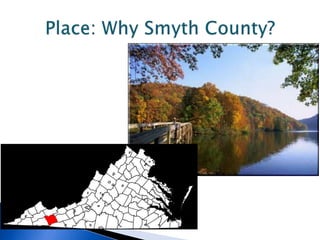
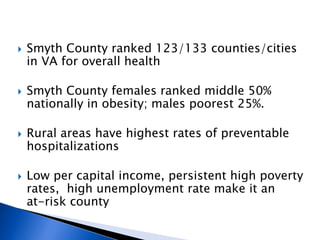
 Smyth County ranked 123/133 counties/cities
in VA for overall health
 Smyth County females ranked middle 50%
nationally in obesity; males poorest 25%.
 Rural areas have highest rates of preventable
hospitalizations
 Low per capital income, persistent high poverty
rates, high unemployment rate make it an
at-risk county
 Often underserved
 Significant barriers to positive health
behaviors
 Cultural norms in these areas may foster poor
nutrition and physical activity habits
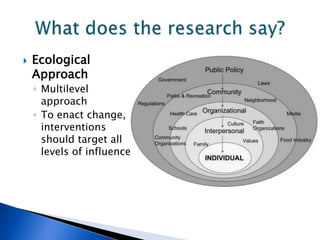
 Ecological
Approach
◦ Multilevel
approach
◦ To enact change,
interventions
should target all
levels of influence
 Utilize Gatekeepers
◦ Gatekeepers can provide information to individuals
from outside with access and relevant information
to their communities
◦ Someone on the inside
◦ Important to have someone who knows the culture
and preferences in your target population!
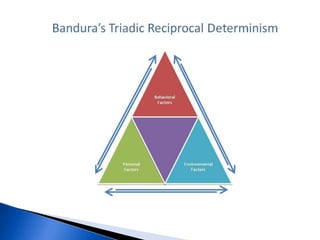
Reciprocal determinism
The individual, the environment and the
individual’s behavior all interact to influence
each other in a dynamic manner
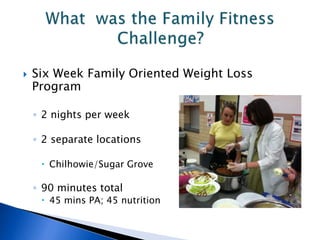
 Six Week Family Oriented Weight Loss
Program
◦ 2 nights per week
◦ 2 separate locations
 Chilhowie/Sugar Grove
◦ 90 minutes total
 45 mins PA; 45 nutrition
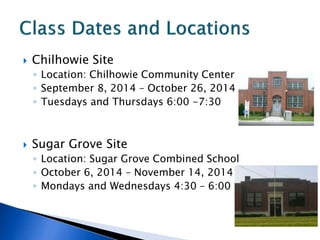
 Chilhowie Site
◦ Location: Chilhowie Community Center
◦ September 8, 2014 – October 26, 2014
◦ Tuesdays and Thursdays 6:00 -7:30
 Sugar Grove Site
◦ Location: Sugar Grove Combined School
◦ October 6, 2014 – November 14, 2014
◦ Mondays and Wednesdays 4:30 – 6:00
◦ Word of Mouth
◦ Flyers in local businesses, doctors’ offices, the
Wellness Center, and the hospital
◦ Radio interview on local station
◦ Short ad in local classifieds newspaper
◦ Back-To-School Night
 Preferred families with at risk of or diagnosed
with:
◦ Diabetes
◦ Hypertension
◦ Heart Disease
◦ Overweight/Obesity
 Originally wanted 1 adult and 1 child per
family
◦ In practice allowed anyone in family
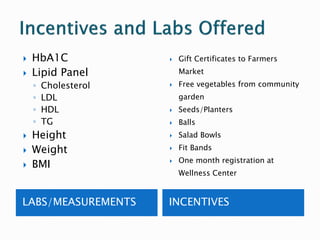
LABS/MEASUREMENTS INCENTIVES
 HbA1C
 Lipid Panel
◦ Cholesterol
◦ LDL
◦ HDL
◦ TG
 Height
 Weight
 BMI
 Gift Certificates to Farmers
Market
 Free vegetables from community
garden
 Seeds/Planters
 Balls
 Salad Bowls
 Fit Bands
 One month registration at
Wellness Center
 Validated Questionnaire
◦ Used to evaluate published school based
interventions
 Used to gauge knowledge at baseline
 Used the parent version and the child version
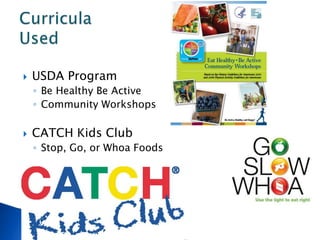
 USDA Program
◦ Be Healthy Be Active
◦ Community Workshops
 CATCH Kids Club
◦ Stop, Go, or Whoa Foods
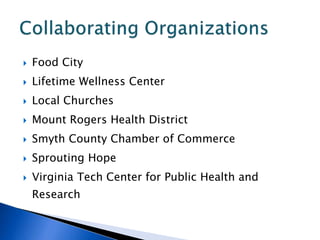
 Food City
 Lifetime Wellness Center
 Local Churches
 Mount Rogers Health District
 Smyth County Chamber of Commerce
 Sprouting Hope
 Virginia Tech Center for Public Health and
Research
Results from Initial Labs
and Measurements
0
10
20
30
40
50
60
1 2 3 4 5 6 7 8
BMI
Participant
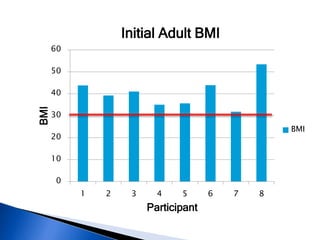
Initial Adult BMI
BMI
0
50
100
150
200
250
300
350
1 2 3 4 5 6 7 8
Weight(lbs)
Participants
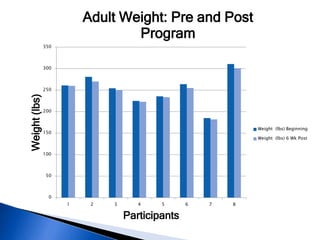
Adult Weight: Pre and Post
Program
Weight (lbs) Beginning
Weight (lbs) 6 Wk Post
0
20
40
60
80
100
120
1 2 3 4 5 6 7 8 9
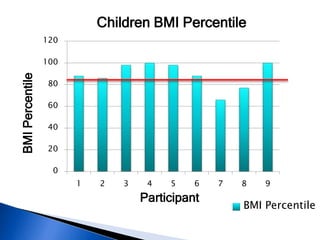
BMIPercentile
Participant
Children BMI Percentile
BMI Percentile
0
1
2
3
4
5
6
7
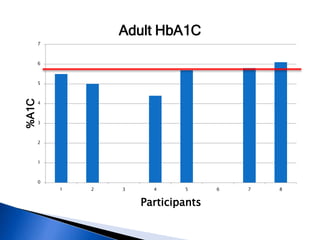
1 2 3 4 5 6 7 8
%A1C
Participants
Adult HbA1C
0
50
100
150
200
250
300
350
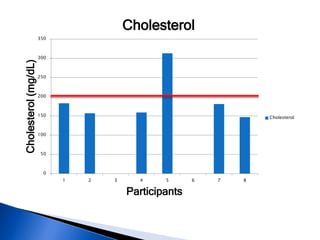
1 2 3 4 5 6 7 8
Cholesterol(mg/dL)
Participants
Cholesterol
Cholesterol
Results from Practicum
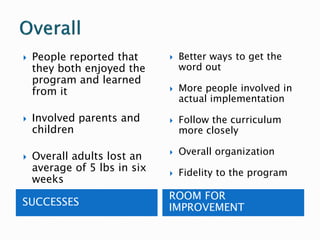
SUCCESSES
ROOM FOR
IMPROVEMENT
 People reported that
they both enjoyed the
program and learned
from it
 Involved parents and
children
 Overall adults lost an
average of 5 lbs in six
weeks
 Better ways to get the
word out
 More people involved in
actual implementation
 Follow the curriculum
more closely
 Overall organization
 Fidelity to the program
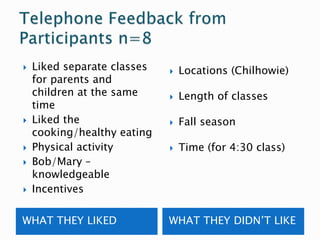
WHAT THEY LIKED WHAT THEY DIDN’T LIKE
 Liked separate classes
for parents and
children at the same
time
 Liked the
cooking/healthy eating
 Physical activity
 Bob/Mary –
knowledgeable
 Incentives
 Locations (Chilhowie)
 Length of classes
 Fall season
 Time (for 4:30 class)
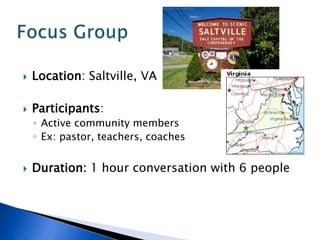
Focus Group
 Location: Saltville, VA
 Participants:
◦ Active community members
◦ Ex: pastor, teachers, coaches
 Duration: 1 hour conversation with 6 people
 10 Open Ended Questions
 Led by a trained focus group moderator
 Snacks and refreshments provided
 Audio Recorded
 Each participant compensated with $15
Wal-Mart gift card
 Transcribed verbatim for thematic coding
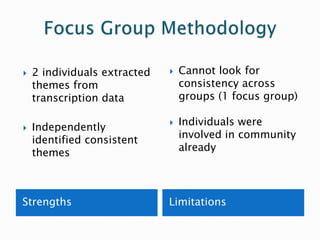
Strengths Limitations
 2 individuals extracted
themes from
transcription data
 Independently
identified consistent
themes
 Cannot look for
consistency across
groups (1 focus group)
 Individuals were
involved in community
already
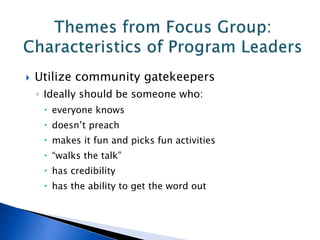
 Utilize community gatekeepers
◦ Ideally should be someone who:
 everyone knows
 doesn’t preach
 makes it fun and picks fun activities
 “walks the talk”
 has credibility
 has the ability to get the word out
 Reach parents through children
 Schools as primary location
 Group activities
◦ Biking, zumba, walking, “old fashioned fun”
 Provide childcare for participating parents
◦ Ex: Homework help
 Marketing: People need to know about it
 Should not be administered online
 Emphasis of healthy habits on a budget
 Give the families choices
◦ When they go, the rigor of activities, where they go
 Focus on positives
Successful Approaches from
Other Under Served Rural
Areas
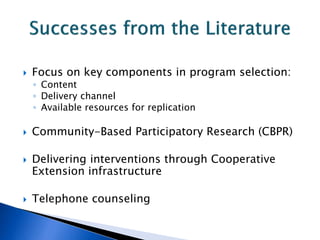
 Focus on key components in program selection:
◦ Content
◦ Delivery channel
◦ Available resources for replication
 Community-Based Participatory Research (CBPR)
 Delivering interventions through Cooperative
Extension infrastructure
 Telephone counseling
Recommendations for Smyth County
 Choose content relevant to population
◦ Healthy foods that are inexpensive
◦ Healthy foods that do not require travel to obtain
◦ Positively framed alternatives to their current methods
of food preparation
 Involve community champions from the start
◦ People who are well known
◦ People who are well liked
◦ People seen as role models
◦ People who are known as experts
 Continue to foster collaborative partnerships
between:
◦ Community leaders
◦ Institutions of higher education
 Ex: Virginia Tech
Emory and Henry
◦ Any other individuals or organizations willing to provide
resources
 Community gardens
 Local grocery stores
 Local health practitioners
 Churches
 Cooperative extension
Sincere thanks for all of your support
throughout my practicum and capstone
experiences.
 VT CPHPR
 Dr. Hosig
 Mary Riggins
 HealthTrust at Smyth County Community
Hospital
Adult Obesity Facts. (2014, September 9). Retrieved May 2, 2015, from http://www.cdc.gov/obesity/data/adult.html
Bandura psychology is a good research paper topic for psychology enthusiasts. (2015, March 10). Retrieved May 2, 2015,
from http://blog.questia.com/2015/03/bandura-psychology-is-a-good-research-paper-topic-for-psychology-enthusiasts/
Caprio, S., Daniels, S. R., Drewnowski, A., Kaufman, F. R., Palinkas, L. A., Rosenbloom, A. L., ... & Kirkman, M. S. (2008).
Influence of race, ethnicity, and culture on childhood obesity: implications for prevention and treatment.Obesity, 16(12),
2566-2577.
CATCH | Coordinated Approach To Child Health. (n.d.). Retrieved May 2, 2015, from http://catchinfo.org/
COUNTY PROFILE: Smyth County, VA. (n.d.). Retrieved May 3, 2015, from
http://www.healthdata.org/sites/default/files/files/county_profiles/US/County_Report_Smyth_County_Virginia.pdf
Hooper, M. B. (2014). Selection of an Evidence-Based Pediatric Weight Management Program for the Dan River
Region (Doctoral dissertation, Virginia Tech).
Perri, M. G., Limacher, M. C., Durning, P. E., Janicke, D. M., Lutes, L. D., Bobroff, L. B., ... & Martin, A. D. (2008).
Extended-care programs for weight management in rural communities: the treatment of obesity in underserved rural
settings (TOURS) randomized trial. Archives of internal medicine, 168(21), 2347-2354.
Michael and Susan Dell Center for Healthy Living. (n.d.). Retrieved May 2, 2015, from
https://sph.uth.edu/research/centers/dell/project.htm?project=3037edaa-201e-492a-b42f-f0208ccf8b29
Simons-Morton, B., McLeroy, K. R., & Wendel, M. (2011). Behavior theory in health promotion practice and research.
Jones & Bartlett Publishers.
Zoellner, J., Motley, M., Wilkinson, M. E., Jackman, B., Barlow, M. L., & Hill, J. L. (2012). Engaging the Dan river region to
reduce obesity: application of the comprehensive participatory planning and evaluation process. Family & community
health, 35(1), 44-56
QUESTIONS?

Capstone presentation vacher

  • 1.
  • 3.
     Smyth CountyCommunity Hospital (SCCH) ◦ Dietitian: Mary Riggins  Health Trust at SCCH ◦ Subcommittee: Nutrition Action Network (NAN)  Charged with creating the Family Fitness Challenge (FFC)
  • 5.
     31% ofSmyth County is obese (BMI ≥ 30)  Obesity is a significant public health concern associated with: ◦ Heart Disease ◦ Stroke ◦ Diabetes ◦ Cancer  Increases hospital LOS  Medical Costs
  • 7.
     Smyth Countyranked 123/133 counties/cities in VA for overall health  Smyth County females ranked middle 50% nationally in obesity; males poorest 25%.  Rural areas have highest rates of preventable hospitalizations  Low per capital income, persistent high poverty rates, high unemployment rate make it an at-risk county
  • 8.
     Often underserved Significant barriers to positive health behaviors  Cultural norms in these areas may foster poor nutrition and physical activity habits
  • 10.
     Ecological Approach ◦ Multilevel approach ◦To enact change, interventions should target all levels of influence
  • 11.
     Utilize Gatekeepers ◦Gatekeepers can provide information to individuals from outside with access and relevant information to their communities ◦ Someone on the inside ◦ Important to have someone who knows the culture and preferences in your target population!
  • 12.
    Reciprocal determinism The individual,the environment and the individual’s behavior all interact to influence each other in a dynamic manner
  • 15.
     Six WeekFamily Oriented Weight Loss Program ◦ 2 nights per week ◦ 2 separate locations  Chilhowie/Sugar Grove ◦ 90 minutes total  45 mins PA; 45 nutrition
  • 16.
     Chilhowie Site ◦Location: Chilhowie Community Center ◦ September 8, 2014 – October 26, 2014 ◦ Tuesdays and Thursdays 6:00 -7:30  Sugar Grove Site ◦ Location: Sugar Grove Combined School ◦ October 6, 2014 – November 14, 2014 ◦ Mondays and Wednesdays 4:30 – 6:00
  • 17.
    ◦ Word ofMouth ◦ Flyers in local businesses, doctors’ offices, the Wellness Center, and the hospital ◦ Radio interview on local station ◦ Short ad in local classifieds newspaper ◦ Back-To-School Night
  • 18.
     Preferred familieswith at risk of or diagnosed with: ◦ Diabetes ◦ Hypertension ◦ Heart Disease ◦ Overweight/Obesity  Originally wanted 1 adult and 1 child per family ◦ In practice allowed anyone in family
  • 19.
    LABS/MEASUREMENTS INCENTIVES  HbA1C Lipid Panel ◦ Cholesterol ◦ LDL ◦ HDL ◦ TG  Height  Weight  BMI  Gift Certificates to Farmers Market  Free vegetables from community garden  Seeds/Planters  Balls  Salad Bowls  Fit Bands  One month registration at Wellness Center
  • 20.
     Validated Questionnaire ◦Used to evaluate published school based interventions  Used to gauge knowledge at baseline  Used the parent version and the child version
  • 21.
     USDA Program ◦Be Healthy Be Active ◦ Community Workshops  CATCH Kids Club ◦ Stop, Go, or Whoa Foods
  • 22.
     Food City Lifetime Wellness Center  Local Churches  Mount Rogers Health District  Smyth County Chamber of Commerce  Sprouting Hope  Virginia Tech Center for Public Health and Research
  • 23.
    Results from InitialLabs and Measurements
  • 24.
    0 10 20 30 40 50 60 1 2 34 5 6 7 8 BMI Participant Initial Adult BMI BMI
  • 25.
    0 50 100 150 200 250 300 350 1 2 34 5 6 7 8 Weight(lbs) Participants Adult Weight: Pre and Post Program Weight (lbs) Beginning Weight (lbs) 6 Wk Post
  • 26.
    0 20 40 60 80 100 120 1 2 34 5 6 7 8 9 BMIPercentile Participant Children BMI Percentile BMI Percentile
  • 27.
    0 1 2 3 4 5 6 7 1 2 34 5 6 7 8 %A1C Participants Adult HbA1C
  • 28.
    0 50 100 150 200 250 300 350 1 2 34 5 6 7 8 Cholesterol(mg/dL) Participants Cholesterol Cholesterol
  • 29.
  • 30.
    SUCCESSES ROOM FOR IMPROVEMENT  Peoplereported that they both enjoyed the program and learned from it  Involved parents and children  Overall adults lost an average of 5 lbs in six weeks  Better ways to get the word out  More people involved in actual implementation  Follow the curriculum more closely  Overall organization  Fidelity to the program
  • 31.
    WHAT THEY LIKEDWHAT THEY DIDN’T LIKE  Liked separate classes for parents and children at the same time  Liked the cooking/healthy eating  Physical activity  Bob/Mary – knowledgeable  Incentives  Locations (Chilhowie)  Length of classes  Fall season  Time (for 4:30 class)
  • 32.
  • 33.
     Location: Saltville,VA  Participants: ◦ Active community members ◦ Ex: pastor, teachers, coaches  Duration: 1 hour conversation with 6 people
  • 34.
     10 OpenEnded Questions  Led by a trained focus group moderator  Snacks and refreshments provided  Audio Recorded  Each participant compensated with $15 Wal-Mart gift card  Transcribed verbatim for thematic coding
  • 35.
    Strengths Limitations  2individuals extracted themes from transcription data  Independently identified consistent themes  Cannot look for consistency across groups (1 focus group)  Individuals were involved in community already
  • 36.
     Utilize communitygatekeepers ◦ Ideally should be someone who:  everyone knows  doesn’t preach  makes it fun and picks fun activities  “walks the talk”  has credibility  has the ability to get the word out
  • 37.
     Reach parentsthrough children  Schools as primary location  Group activities ◦ Biking, zumba, walking, “old fashioned fun”  Provide childcare for participating parents ◦ Ex: Homework help  Marketing: People need to know about it
  • 38.
     Should notbe administered online  Emphasis of healthy habits on a budget  Give the families choices ◦ When they go, the rigor of activities, where they go  Focus on positives
  • 39.
    Successful Approaches from OtherUnder Served Rural Areas
  • 40.
     Focus onkey components in program selection: ◦ Content ◦ Delivery channel ◦ Available resources for replication  Community-Based Participatory Research (CBPR)  Delivering interventions through Cooperative Extension infrastructure  Telephone counseling
  • 41.
  • 42.
     Choose contentrelevant to population ◦ Healthy foods that are inexpensive ◦ Healthy foods that do not require travel to obtain ◦ Positively framed alternatives to their current methods of food preparation  Involve community champions from the start ◦ People who are well known ◦ People who are well liked ◦ People seen as role models ◦ People who are known as experts
  • 43.
     Continue tofoster collaborative partnerships between: ◦ Community leaders ◦ Institutions of higher education  Ex: Virginia Tech Emory and Henry ◦ Any other individuals or organizations willing to provide resources  Community gardens  Local grocery stores  Local health practitioners  Churches  Cooperative extension
  • 44.
    Sincere thanks forall of your support throughout my practicum and capstone experiences.  VT CPHPR  Dr. Hosig  Mary Riggins  HealthTrust at Smyth County Community Hospital
  • 45.
    Adult Obesity Facts.(2014, September 9). Retrieved May 2, 2015, from http://www.cdc.gov/obesity/data/adult.html Bandura psychology is a good research paper topic for psychology enthusiasts. (2015, March 10). Retrieved May 2, 2015, from http://blog.questia.com/2015/03/bandura-psychology-is-a-good-research-paper-topic-for-psychology-enthusiasts/ Caprio, S., Daniels, S. R., Drewnowski, A., Kaufman, F. R., Palinkas, L. A., Rosenbloom, A. L., ... & Kirkman, M. S. (2008). Influence of race, ethnicity, and culture on childhood obesity: implications for prevention and treatment.Obesity, 16(12), 2566-2577. CATCH | Coordinated Approach To Child Health. (n.d.). Retrieved May 2, 2015, from http://catchinfo.org/ COUNTY PROFILE: Smyth County, VA. (n.d.). Retrieved May 3, 2015, from http://www.healthdata.org/sites/default/files/files/county_profiles/US/County_Report_Smyth_County_Virginia.pdf Hooper, M. B. (2014). Selection of an Evidence-Based Pediatric Weight Management Program for the Dan River Region (Doctoral dissertation, Virginia Tech). Perri, M. G., Limacher, M. C., Durning, P. E., Janicke, D. M., Lutes, L. D., Bobroff, L. B., ... & Martin, A. D. (2008). Extended-care programs for weight management in rural communities: the treatment of obesity in underserved rural settings (TOURS) randomized trial. Archives of internal medicine, 168(21), 2347-2354. Michael and Susan Dell Center for Healthy Living. (n.d.). Retrieved May 2, 2015, from https://sph.uth.edu/research/centers/dell/project.htm?project=3037edaa-201e-492a-b42f-f0208ccf8b29 Simons-Morton, B., McLeroy, K. R., & Wendel, M. (2011). Behavior theory in health promotion practice and research. Jones & Bartlett Publishers. Zoellner, J., Motley, M., Wilkinson, M. E., Jackman, B., Barlow, M. L., & Hill, J. L. (2012). Engaging the Dan river region to reduce obesity: application of the comprehensive participatory planning and evaluation process. Family & community health, 35(1), 44-56
  • 46.

Editor's Notes

  • #6 http://www.cdc.gov/obesity/data/adult.html http://dreamatico.com/money.html http://www.hivehealthmedia.com/wp-content/uploads/2012/05/hospital-patient1.jpg Compare it to state and nation (context)
  • #7 http://sph.tamhsc.edu/srhrc/docs/rhp-2010-volume2.pdf https://familysearch.org/learn/wiki/en/images/f/fa/Location_of_Smyth_County,_Virginia.png http://www.acorridor.com/profiles/images/hungrymotherlake.jpg
  • #8 Compare it to state and nation (context)
  • #13 Explain HealthTrust’s rational of reaching children through the parents Cite Bandura
  • #14 https://wikispaces.psu.edu/download/attachments/41095606/Slide2.JPG?version=2&modificationDate=1267291569000&api=v2
  • #15 (practicum)
  • #16 Maybe out of place here, move it to methods?
  • #18 The Wellness Center seemed to be the most helpful part because there was accountability in the small town of seeing the participant at the gym and then at
  • #22 We used the USDA program more for the parental education and CATCH for the children http://neighborsforkids.org/wp-content/uploads/2014/10/CATCH-kids-club-logo.jpg http://www.health.gov/images/2010/dga-workshops-intro-cover.jpg
  • #23 These are organizations that worked with Nutrition Action Network to help create or contribute to FFC
  • #25 Should I calculate Post BMI as well? Talk about here: Only have baseline data for all data except weight because we were only able to do the labs Average attendance for each participant was 4 classes
  • #27 BMI percentile - the percentile indicates the relative position of the child's BMI number among children of the same sex and age. According to the CDC Here: Average is 89th Percentile, which according to the CDC is OVERWEIGHT for children and teens mention that we use BMI percentile, 85th is considered overweight and 95th is considered obese. 7 of 9 were either overweight or obese at baseline. How many people attended at least half the classes? Focus on the Chilhowie one if easier, know which one it is
  • #28 http://diabetes.niddk.nih.gov/dm/pubs/A1CTest/ the A1C test reflects the average of a person’s blood glucose levels over the past 3 months. The A1C test result is reported as a percentage. The higher the percentage, the higher a person’s blood glucose levels have been. A normal A1C level is below 5.7 percent.
  • #29 Less than 200 milligrams per deciliter is desirable Above 240 is HIGH
  • #31 Mary was basically the only person doing this A few other people involved, but they became burnt out because they have lots of commitments, need more people committed from the start! ORGANIZATION AND COMMUNICATION! Email/Cell Service not as prevalent out there, many instances of failed communication and confusion resulting from it Somewhat last minute organization seems to be preferred – gather whoever you can find and do what you can. Hard to coordinate with that from VT
  • #32 DOUBLE CHECK THIS 9 people total, couldn’t get one person to answer but one couple was from the same family 7 said they liked class with kids 1 said either All said they’d attend a similar class One thing you could change? location not as long do it before kids get out of school in the spring
  • #33 Moving forward with healthtrust
  • #34 Explain all- even how it was slightly thrown together http://www.bestplaces.net/images/city/Saltville_VA.gif http://www.rlrouse.com/pic-of-the-day/saltville-sign.jpg
  • #35 Should I talk about how it is usually done (through a program) or how we just looked for major themes? Audio recorded, trained moderator (Dr. Hosig), followed guidelines Krueger Transcribed 2 independent people Limitation- no consistency across groups because we only had one Krueger, R., & Casey, M. (2015). Focus groups: A practical guide for applied research (5th ed.). Thousand Oaks, CA: SAGE.
  • #37 Emphasize how important it was to this group that they were familiar with leaders They should have good personality, be credible, have a positive attitude, and live up to their recommendations
  • #38 Explain choices These could include: Fitting families schedules by providing multiple lessons per week with the same material so that the parents could pick the easiest day Multiple times of day offered Different levels of rigor/intensity (offer a beginners and an experienced group)
  • #41 CBPR- creating sense of community power and promoting community ownership engaging the community in all steps of the research process (starting from design, data collection, data analysis, interpretation) Community members are seen as full partners Hooper, M. B. (2014). Selection of an Evidence-Based Pediatric Weight Management Program for the Dan River Region (Doctoral dissertation, Virginia Tech). Zoellner, J., Motley, M., Wilkinson, M. E., Jackman, B., Barlow, M. L., & Hill, J. L. (2012). Engaging the Dan river region to reduce obesity: application of the comprehensive participatory planning and evaluation process. Family & community health, 35(1), 44-56 Perri, M. G., Limacher, M. C., Durning, P. E., Janicke, D. M., Lutes, L. D., Bobroff, L. B., ... & Martin, A. D. (2008). Extended-care programs for weight management in rural communities: the treatment of obesity in underserved rural settings (TOURS) randomized trial. Archives of internal medicine, 168(21), 2347-2354.
  • #43 Something that came up a few times in focus group; people perceived that “healthy grocery stores” like Whole Foods were expensive and far away
  • #44 Continue VT relationship Work to increase relationship with Emory and Henry (because it’s closer!) In focus group they mentioned maybe homework help from Emory and Henry students while parents get education
  • #47 http://resumerust.com/home/wp-content/uploads/2014/11/Question-marks-1.jpg