1
NOLA’s KIDS IN MOTION
Jasmine Alexis
José A. Colón
Christian Morfaw
SBPS 6340: Monitoring and Evaluation of Health Programs
Dr. Megan Weemer
July 2, 2023
2
I. PROGRAM DESCRIPTION
Name of the program/intervention
NOLA’s Kids in Motion
The location where the program/intervention is implemented:
The program will be implemented in New Orleans, Louisiana.
Brief description of the program/intervention and target population
NOLA’s Kids in motion is a four-month intervention designed to teach children ages 6-11 and their parents about nutrition,
physical activity, and stress coping skills. Participants in the intervention will participate in a series of games twice a week for 45
minutes each time. Also, the participants will engage in weekly 90-minute Dance Dance exergames.
The target population are children 6-11 years old reported with body mass index (BMI) greater than or equal to the 95th
percentile and their parents. The children are students at elementary schools in the Jefferson Parish district. The four elementary
schools participating in the intervention are Ella C. Pittman, A.C. Alexander, Geraldine Boudreaux, and Greenlawn Terrace.
3
II. THEORIES OF CHANGE
4
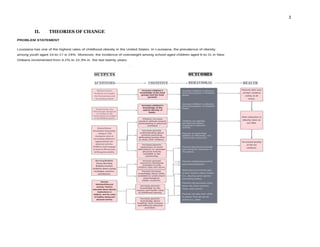
1. Theory of Change Narrative
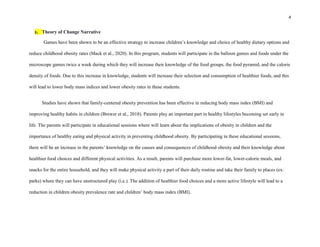
Games have been shown to be an effective strategy to increase children’s knowledge and choice of healthy dietary options and
reduce childhood obesity rates (Mack et al., 2020). In this program, students will participate in the balloon games and foods under the
microscope games twice a week during which they will increase their knowledge of the food groups, the food pyramid, and the calorie
density of foods. Due to this increase in knowledge, students will increase their selection and consumption of healthier foods, and this
will lead to lower body mass indices and lower obesity rates in these students.
Studies have shown that family-centered obesity prevention has been effective in reducing body mass index (BMI) and
improving healthy habits in children (Brewer et al., 2018). Parents play an important part in healthy lifestyles becoming set early in
life. The parents will participate in educational sessions where will learn about the implications of obesity in children and the
importance of healthy eating and physical activity in preventing childhood obesity. By participating in these educational sessions,
there will be an increase in the parents’ knowledge on the causes and consequences of childhood obesity and their knowledge about
healthier food choices and different physical activities. As a result, parents will purchase more lower-fat, lower-calorie meals, and
snacks for the entire household, and they will make physical activity a part of their daily routine and take their family to places (ex:
parks) where they can have unstructured play (i.e.). The addition of healthier food choices and a more active lifestyle will lead to a
reduction in children obesity prevalence rate and children’ body mass index (BMI).
5
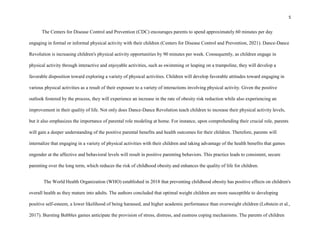
The Centers for Disease Control and Prevention (CDC) encourages parents to spend approximately 60 minutes per day
engaging in formal or informal physical activity with their children (Centers for Disease Control and Prevention, 2021). Dance-Dance
Revolution is increasing children's physical activity opportunities by 90 minutes per week. Consequently, as children engage in
physical activity through interactive and enjoyable activities, such as swimming or leaping on a trampoline, they will develop a
favorable disposition toward exploring a variety of physical activities. Children will develop favorable attitudes toward engaging in
various physical activities as a result of their exposure to a variety of interactions involving physical activity. Given the positive
outlook fostered by the process, they will experience an increase in the rate of obesity risk reduction while also experiencing an
improvement in their quality of life. Not only does Dance-Dance Revolution teach children to increase their physical activity levels,
but it also emphasizes the importance of parental role modeling at home. For instance, upon comprehending their crucial role, parents
will gain a deeper understanding of the positive parental benefits and health outcomes for their children. Therefore, parents will
internalize that engaging in a variety of physical activities with their children and taking advantage of the health benefits that games
engender at the affective and behavioral levels will result in positive parenting behaviors. This practice leads to consistent, secure
parenting over the long term, which reduces the risk of childhood obesity and enhances the quality of life for children.
The World Health Organization (WHO) established in 2018 that preventing childhood obesity has positive effects on children's
overall health as they mature into adults. The authors concluded that optimal weight children are more susceptible to developing
positive self-esteem, a lower likelihood of being harassed, and higher academic performance than overweight children (Lobstein et al.,
2017). Bursting Bubbles games anticipate the provision of stress, distress, and eustress coping mechanisms. The parents of children
6
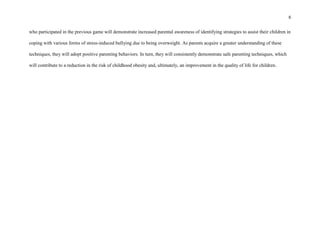
who participated in the previous game will demonstrate increased parental awareness of identifying strategies to assist their children in
coping with various forms of stress-induced bullying due to being overweight. As parents acquire a greater understanding of these
techniques, they will adopt positive parenting behaviors. In turn, they will consistently demonstrate safe parenting techniques, which
will contribute to a reduction in the risk of childhood obesity and, ultimately, an improvement in the quality of life for children.
7
III. PROCESS EVALUATION PLAN
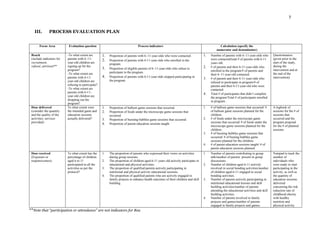
Focus Area Evaluation question Process indicators Calculation (specify the
numerator and denominator)
Reach
(include indicators for
recruitment,
refusal, attrition)**
-To what extent are
parents with 6–11-
year-old children are
signing up for the
program?
-To what extent are
parents with 6-11-
year-old children are
refusing to participate?
-To what extent are
parents with 6-11-
year-old children are
dropping out the
program?
1. Proportion of parents with 6–11-year-olds who were contacted.
2. Proportion of parents with 6-11-year-olds who enrolled in the
program.
3. Proportion of eligible parents of 6–11-year-olds who refuse to
participate in the program.
4. Proportion of parents with 6-11-year-olds stopped participating in
the program.
1. Number of parents with 6–11-year-olds who
were contacted/total # of parents with 6-11
years old.
2. # of parents and their 6-11-year-olds who
enrolled in the program/# of parents and
their 6–11-year-old contacted.
3. # of parents and their 6-11-year-olds who
refused to participate in program/# of
parents and their 6-11-year-old who were
contacted.
4. Total # of participants that didn’t complete
the program/Total # of participants enrolled
in program .
Questionnaires
(given prior to the
start of the study,
during the
intervention and at
the end of the
intervention)
Dose delivered
(consider the quantity
and the quality of the
activities, services
provided)
To what extent were
the intended game and
education sessions
actually delivered?
1. Proportion of balloon game sessions that occurred.
2. Proportion of foods under the microscope game sessions that
occurred.
3. Proportion of bursting bubbles game sessions that occurred.
4. Proportion of parent education sessions taught
1. # of balloon game sessions that occurred/ #
of balloon game sessions planned for the
children.
2. # of foods under the microscope game
sessions that occurred/ # of foods under the
microscope game sessions planned for the
children.
3. # of bursting bubbles game sessions that
occurred/ # of busting bubbles game
sessions planned for the children.
4. # of parent education sessions taught/ # of
parent education sessions planned.
A logbook of
sessions for the # of
sessions that
occurred and the
program proposal
for the # of planned
sessions
Dose received
(Exposure or
responsiveness)
To what extent has the
percentage of children
aged 6 to 11
participated in all the
activities as per the
protocol?
1. The proportion of parents who expressed their views on activities
during group sessions.
2. The proportion of children aged 6-11 years old actively participate in
educational and physical activities.
3. The proportion of qualified parents actively participating in
nutritional and physical activity educational sessions.
4. The proportion of qualified parents who are actively engaged in
family projects to enhance health outcomes of their children and skill
building.
1. Number of parents contributing to group
talk/number of parents present in group
discussions.
2. Number of children aged 6-11 actively
involved in social bonding activities/number
of children aged 6-11 engaged in social
bonding activities.
3. Number of parents actively participating in
nutritional educational lessons and skill
building activities/number of parents
attending the educational activities and skill
building activities.
4. Number of parents involved in family
projects and games/number of parents
engaged in family projects and games.
Notepad to track the
number of
individuals who
were ready to start
participating in the
activity, as well as
the quantity of
education sessions
delivered
concerning the risk
reduction rate of
childhood obesity
with healthy
nutrition and
physical activity.
**Note that “participation or attendance” are not indicators for Rea
8
References
Brewer, J., Gentile, N., Kaufman, T.K., Klein, D.M., Lynch B.A., Maxson, J., Merten, S., Narr, C., Price, M., Rajjo, T., Swenson, L.,
Weaver, A.L., & Ziebarth, S. (2018). The effectiveness of a family-centered childhood obesity intervention at the YMCA: A
pilot study. Journal of Community Medicine & Health Education, 08(01). https://doi.org/10.4172/2161-0711.1000591
Lakshman, R., Elks, C. E., & Ong, K. K. (2012). Childhood obesity. Circulation, 126(14), 1770-1779.
Lobstein, Baur, & Uauy . (2017). Obesity reviews 5. In International Obesity Task Force (IOTF).
Mack, I., Reiband, N., Etges, C., Eichhorn, S., Schaeffeler, N., Zurstiege, G., Gawrilow, C., Weimer, K., Peeraully, R., Teufel, M.,
Blumenstock, G., Giel, K. E., Junne, F., & Zipfel, S. (2020). The kid’s obesity prevention program: cluster randomized
controlled trial to evaluate a serious game for the prevention and treatment of childhood obesity. Journal of Medical Internet
Research, 22(4), e15725. https://doi.org/10.2196/15725
Robert Wood Johnson Foundation. (2022, September 27). State Data. State of Childhood Obesity.
https://stateofchildhoodobesity.org/state-data/?state=la
The Center for Disease Control and Prevention. (2022, August). Making Physical Activity a Part of a Child’s Life | Physical Activity |
CDC. Retrieved July 2, 2023, from https://www.cdc.gov/physicalactivity/basics/adding-pa/activities-children.html
9
World Health Organization Taking Action on Childhood Obesity. (2018). In World Obesity Federation, World Health Organization.
Taking action on childhood obesity. Retrieved July 1, 2023, from
https://apps.who.int/iris/bitstream/handle/10665/274792/WHO-NMH-PND-ECHO-18.1-eng.pdf
10

SBPS 6340 Evaluation Section_DRAFT.docx

  • 1.
    1 NOLA’s KIDS INMOTION Jasmine Alexis José A. Colón Christian Morfaw SBPS 6340: Monitoring and Evaluation of Health Programs Dr. Megan Weemer July 2, 2023
  • 2.
    2 I. PROGRAM DESCRIPTION Nameof the program/intervention NOLA’s Kids in Motion The location where the program/intervention is implemented: The program will be implemented in New Orleans, Louisiana. Brief description of the program/intervention and target population NOLA’s Kids in motion is a four-month intervention designed to teach children ages 6-11 and their parents about nutrition, physical activity, and stress coping skills. Participants in the intervention will participate in a series of games twice a week for 45 minutes each time. Also, the participants will engage in weekly 90-minute Dance Dance exergames. The target population are children 6-11 years old reported with body mass index (BMI) greater than or equal to the 95th percentile and their parents. The children are students at elementary schools in the Jefferson Parish district. The four elementary schools participating in the intervention are Ella C. Pittman, A.C. Alexander, Geraldine Boudreaux, and Greenlawn Terrace.
  • 3.
  • 4.
    4 1. Theory ofChange Narrative Games have been shown to be an effective strategy to increase children’s knowledge and choice of healthy dietary options and reduce childhood obesity rates (Mack et al., 2020). In this program, students will participate in the balloon games and foods under the microscope games twice a week during which they will increase their knowledge of the food groups, the food pyramid, and the calorie density of foods. Due to this increase in knowledge, students will increase their selection and consumption of healthier foods, and this will lead to lower body mass indices and lower obesity rates in these students. Studies have shown that family-centered obesity prevention has been effective in reducing body mass index (BMI) and improving healthy habits in children (Brewer et al., 2018). Parents play an important part in healthy lifestyles becoming set early in life. The parents will participate in educational sessions where will learn about the implications of obesity in children and the importance of healthy eating and physical activity in preventing childhood obesity. By participating in these educational sessions, there will be an increase in the parents’ knowledge on the causes and consequences of childhood obesity and their knowledge about healthier food choices and different physical activities. As a result, parents will purchase more lower-fat, lower-calorie meals, and snacks for the entire household, and they will make physical activity a part of their daily routine and take their family to places (ex: parks) where they can have unstructured play (i.e.). The addition of healthier food choices and a more active lifestyle will lead to a reduction in children obesity prevalence rate and children’ body mass index (BMI).
  • 5.
    5 The Centers forDisease Control and Prevention (CDC) encourages parents to spend approximately 60 minutes per day engaging in formal or informal physical activity with their children (Centers for Disease Control and Prevention, 2021). Dance-Dance Revolution is increasing children's physical activity opportunities by 90 minutes per week. Consequently, as children engage in physical activity through interactive and enjoyable activities, such as swimming or leaping on a trampoline, they will develop a favorable disposition toward exploring a variety of physical activities. Children will develop favorable attitudes toward engaging in various physical activities as a result of their exposure to a variety of interactions involving physical activity. Given the positive outlook fostered by the process, they will experience an increase in the rate of obesity risk reduction while also experiencing an improvement in their quality of life. Not only does Dance-Dance Revolution teach children to increase their physical activity levels, but it also emphasizes the importance of parental role modeling at home. For instance, upon comprehending their crucial role, parents will gain a deeper understanding of the positive parental benefits and health outcomes for their children. Therefore, parents will internalize that engaging in a variety of physical activities with their children and taking advantage of the health benefits that games engender at the affective and behavioral levels will result in positive parenting behaviors. This practice leads to consistent, secure parenting over the long term, which reduces the risk of childhood obesity and enhances the quality of life for children. The World Health Organization (WHO) established in 2018 that preventing childhood obesity has positive effects on children's overall health as they mature into adults. The authors concluded that optimal weight children are more susceptible to developing positive self-esteem, a lower likelihood of being harassed, and higher academic performance than overweight children (Lobstein et al., 2017). Bursting Bubbles games anticipate the provision of stress, distress, and eustress coping mechanisms. The parents of children
  • 6.
    6 who participated inthe previous game will demonstrate increased parental awareness of identifying strategies to assist their children in coping with various forms of stress-induced bullying due to being overweight. As parents acquire a greater understanding of these techniques, they will adopt positive parenting behaviors. In turn, they will consistently demonstrate safe parenting techniques, which will contribute to a reduction in the risk of childhood obesity and, ultimately, an improvement in the quality of life for children.
  • 7.
    7 III. PROCESS EVALUATIONPLAN Focus Area Evaluation question Process indicators Calculation (specify the numerator and denominator) Reach (include indicators for recruitment, refusal, attrition)** -To what extent are parents with 6–11- year-old children are signing up for the program? -To what extent are parents with 6-11- year-old children are refusing to participate? -To what extent are parents with 6-11- year-old children are dropping out the program? 1. Proportion of parents with 6–11-year-olds who were contacted. 2. Proportion of parents with 6-11-year-olds who enrolled in the program. 3. Proportion of eligible parents of 6–11-year-olds who refuse to participate in the program. 4. Proportion of parents with 6-11-year-olds stopped participating in the program. 1. Number of parents with 6–11-year-olds who were contacted/total # of parents with 6-11 years old. 2. # of parents and their 6-11-year-olds who enrolled in the program/# of parents and their 6–11-year-old contacted. 3. # of parents and their 6-11-year-olds who refused to participate in program/# of parents and their 6-11-year-old who were contacted. 4. Total # of participants that didn’t complete the program/Total # of participants enrolled in program . Questionnaires (given prior to the start of the study, during the intervention and at the end of the intervention) Dose delivered (consider the quantity and the quality of the activities, services provided) To what extent were the intended game and education sessions actually delivered? 1. Proportion of balloon game sessions that occurred. 2. Proportion of foods under the microscope game sessions that occurred. 3. Proportion of bursting bubbles game sessions that occurred. 4. Proportion of parent education sessions taught 1. # of balloon game sessions that occurred/ # of balloon game sessions planned for the children. 2. # of foods under the microscope game sessions that occurred/ # of foods under the microscope game sessions planned for the children. 3. # of bursting bubbles game sessions that occurred/ # of busting bubbles game sessions planned for the children. 4. # of parent education sessions taught/ # of parent education sessions planned. A logbook of sessions for the # of sessions that occurred and the program proposal for the # of planned sessions Dose received (Exposure or responsiveness) To what extent has the percentage of children aged 6 to 11 participated in all the activities as per the protocol? 1. The proportion of parents who expressed their views on activities during group sessions. 2. The proportion of children aged 6-11 years old actively participate in educational and physical activities. 3. The proportion of qualified parents actively participating in nutritional and physical activity educational sessions. 4. The proportion of qualified parents who are actively engaged in family projects to enhance health outcomes of their children and skill building. 1. Number of parents contributing to group talk/number of parents present in group discussions. 2. Number of children aged 6-11 actively involved in social bonding activities/number of children aged 6-11 engaged in social bonding activities. 3. Number of parents actively participating in nutritional educational lessons and skill building activities/number of parents attending the educational activities and skill building activities. 4. Number of parents involved in family projects and games/number of parents engaged in family projects and games. Notepad to track the number of individuals who were ready to start participating in the activity, as well as the quantity of education sessions delivered concerning the risk reduction rate of childhood obesity with healthy nutrition and physical activity. **Note that “participation or attendance” are not indicators for Rea
  • 8.
    8 References Brewer, J., Gentile,N., Kaufman, T.K., Klein, D.M., Lynch B.A., Maxson, J., Merten, S., Narr, C., Price, M., Rajjo, T., Swenson, L., Weaver, A.L., & Ziebarth, S. (2018). The effectiveness of a family-centered childhood obesity intervention at the YMCA: A pilot study. Journal of Community Medicine & Health Education, 08(01). https://doi.org/10.4172/2161-0711.1000591 Lakshman, R., Elks, C. E., & Ong, K. K. (2012). Childhood obesity. Circulation, 126(14), 1770-1779. Lobstein, Baur, & Uauy . (2017). Obesity reviews 5. In International Obesity Task Force (IOTF). Mack, I., Reiband, N., Etges, C., Eichhorn, S., Schaeffeler, N., Zurstiege, G., Gawrilow, C., Weimer, K., Peeraully, R., Teufel, M., Blumenstock, G., Giel, K. E., Junne, F., & Zipfel, S. (2020). The kid’s obesity prevention program: cluster randomized controlled trial to evaluate a serious game for the prevention and treatment of childhood obesity. Journal of Medical Internet Research, 22(4), e15725. https://doi.org/10.2196/15725 Robert Wood Johnson Foundation. (2022, September 27). State Data. State of Childhood Obesity. https://stateofchildhoodobesity.org/state-data/?state=la The Center for Disease Control and Prevention. (2022, August). Making Physical Activity a Part of a Child’s Life | Physical Activity | CDC. Retrieved July 2, 2023, from https://www.cdc.gov/physicalactivity/basics/adding-pa/activities-children.html
  • 9.
    9 World Health OrganizationTaking Action on Childhood Obesity. (2018). In World Obesity Federation, World Health Organization. Taking action on childhood obesity. Retrieved July 1, 2023, from https://apps.who.int/iris/bitstream/handle/10665/274792/WHO-NMH-PND-ECHO-18.1-eng.pdf
  • 10.