11
Strategy Review,Strategy Review,
Evaluation, & ControlEvaluation, & Control
[ADDIE- Assesment, Design,[ADDIE- Assesment, Design,
Development, Initiation,Development, Initiation,
Evaluation]Evaluation]
[PESTEL -Political, Economical,[PESTEL -Political, Economical,
Social, Technological,Social, Technological,
Environmental, Legal]Environmental, Legal]
22
Strategy ReviewStrategy Review
Strategy Evaluation—the 3 BasicsStrategy Evaluation—the 3 Basics
• Examining the underlying basis of theExamining the underlying basis of the
firm’s strategyfirm’s strategy
• Comparing actual to expected resultsComparing actual to expected results
• Taking corrective action to addressTaking corrective action to address
performance gapsperformance gaps
33
Strategy ReviewStrategy Review
Effective Strategy EvaluationEffective Strategy Evaluation
• Adequate and timely feedbackAdequate and timely feedback
The cornerstone of effectiveThe cornerstone of effective
evaluationevaluation
44
Strategy ReviewStrategy Review
Strategy EvaluationStrategy Evaluation
• Must haveMust have bothboth
Short- & long-term focusShort- & long-term focus
55
Strategy ReviewStrategy Review
Four CriteriaFour Criteria (Richard Rumelt):(Richard Rumelt):
• ConsistencyConsistency
• ConsonanceConsonance
• FeasibilityFeasibility
• AdvantageAdvantage
66
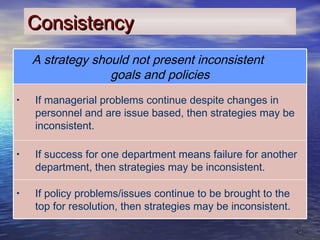
ConsistencyConsistency
• If policy problems/issues continue to be brought to the
top for resolution, then strategies may be inconsistent.
• If success for one department means failure for another
department, then strategies may be inconsistent.
• If managerial problems continue despite changes in
personnel and are issue based, then strategies may be
inconsistent.
A strategy should not present inconsistent
goals and policies
77
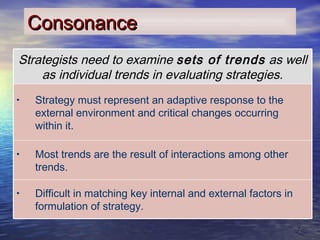
ConsonanceConsonance
• Difficult in matching key internal and external factors in
formulation of strategy.
• Most trends are the result of interactions among other
trends.
• Strategy must represent an adaptive response to the
external environment and critical changes occurring
within it.
Strategists need to examine sets of trends as well
as individual trends in evaluating strategies.
88
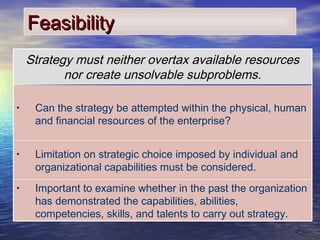
FeasibilityFeasibility
• Important to examine whether in the past the organization
has demonstrated the capabilities, abilities,
competencies, skills, and talents to carry out strategy.
• Limitation on strategic choice imposed by individual and
organizational capabilities must be considered.
• Can the strategy be attempted within the physical, human
and financial resources of the enterprise?
Strategy must neither overtax available resources
nor create unsolvable subproblems.
99
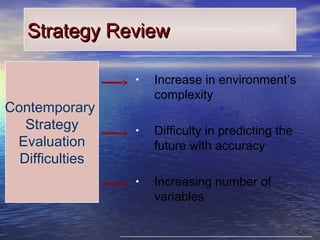
Strategy ReviewStrategy Review
• Increase in environment’s
complexity
• Difficulty in predicting the
future with accuracy
• Increasing number of
variables
Contemporary
Strategy
Evaluation
Difficulties
1010
Strategy ReviewStrategy Review
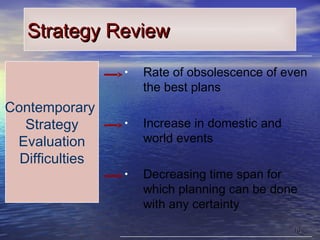
• Rate of obsolescence of even
the best plans
• Increase in domestic and
world events
• Decreasing time span for
which planning can be done
with any certainty
Contemporary
Strategy
Evaluation
Difficulties
1111
Strategy ReviewStrategy Review
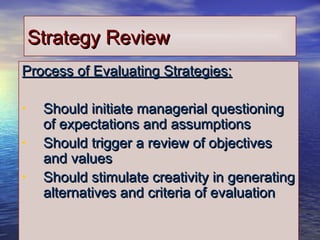
Process of Evaluating Strategies:Process of Evaluating Strategies:
• Should initiate managerial questioningShould initiate managerial questioning
of expectations and assumptionsof expectations and assumptions
• Should trigger a review of objectivesShould trigger a review of objectives
and valuesand values
• Should stimulate creativity in generatingShould stimulate creativity in generating
alternatives and criteria of evaluationalternatives and criteria of evaluation
1212
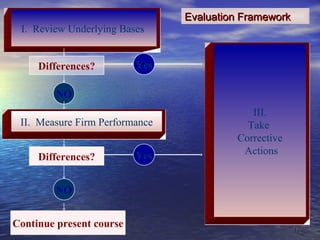
Evaluation FrameworkEvaluation Framework
I. Review Underlying Bases
Continue present course
II. Measure Firm Performance
III.
Take
Corrective
Actions
Differences?
Differences?
Yes
NO
Yes
NO
1313
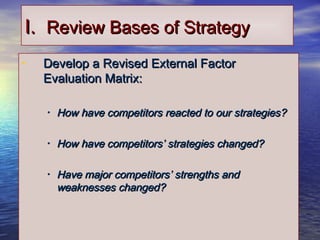
I.I. Review Bases of StrategyReview Bases of Strategy
• Develop a Revised External FactorDevelop a Revised External Factor
Evaluation Matrix:Evaluation Matrix:
• How have competitors reacted to our strategies?How have competitors reacted to our strategies?
• How have competitors’ strategies changed?How have competitors’ strategies changed?
• Have major competitors’ strengths andHave major competitors’ strengths and
weaknesses changed?weaknesses changed?
1414
I.I. Review Bases of StrategyReview Bases of Strategy
• Why are competitors making certainWhy are competitors making certain
strategic changes?strategic changes?
• Why are some competitors’ strategiesWhy are some competitors’ strategies
more successful than others?more successful than others?
• How satisfied are our competitors withHow satisfied are our competitors with
their present market positions andtheir present market positions and
profitability?profitability?
1515
I.I. Review Bases of StrategyReview Bases of Strategy
• How far can our major competitors beHow far can our major competitors be
pushed before retaliating?pushed before retaliating?
• How could we more effectivelyHow could we more effectively
cooperate with our competitors?cooperate with our competitors?
1616
I.I. Review Bases of StrategyReview Bases of Strategy
Key Questions in Evaluating Strategy:Key Questions in Evaluating Strategy:
• Are our internal strengths still strengths?Are our internal strengths still strengths?
• Have we added other internal strengths?Have we added other internal strengths?
• Are our internal weaknesses stillAre our internal weaknesses still
weaknesses?weaknesses?
1717
I.I. Review Bases of StrategyReview Bases of Strategy
• Do we now have other internalDo we now have other internal
weaknesses?weaknesses?
• Are our external opportunities stillAre our external opportunities still
opportunities?opportunities?
• Are there now external opportunities?Are there now external opportunities?
1818
I.I. Review Bases of StrategyReview Bases of Strategy
• Are our external threats still threats?Are our external threats still threats?
• Are there now other external threats?Are there now other external threats?
• Are we vulnerable to a hostileAre we vulnerable to a hostile
takeover?takeover?
1919
II.II. Measure PerformanceMeasure Performance
• Compare the firm’s performanceCompare the firm’s performance
over different time periods.over different time periods.
• Compare the firm’s performance toCompare the firm’s performance to
competitors.competitors.
• Compare the firm’s performance toCompare the firm’s performance to
industry averages.industry averages.
2020
II.II. Measure PerformanceMeasure Performance
Quantitative Analysis:Quantitative Analysis:
 Return on investmentReturn on investment
 Return on equityReturn on equity
 Profit marginProfit margin
 Market shareMarket share
 Debt to equityDebt to equity
 Earnings per shareEarnings per share
 Sales growthSales growth
 Asset growthAsset growth
2121
II.II. Measure PerformanceMeasure Performance
Qualitative Analysis:Qualitative Analysis:
 Is the strategy internally consistent?Is the strategy internally consistent?
 Is the strategy consistent with theIs the strategy consistent with the
environment?environment?
 Is the strategy appropriate in view ofIs the strategy appropriate in view of
available resources?available resources?
 Does the strategy involve anDoes the strategy involve an
acceptable degree of risk?acceptable degree of risk?
2222
II.II. Measure PerformanceMeasure Performance
Qualitative Analysis:Qualitative Analysis:
 Does the strategy have an appropriateDoes the strategy have an appropriate
time framework?time framework?
 Is the strategy workable?Is the strategy workable?
2323
III.III. Take Corrective ActionTake Corrective Action
Making changes to reposition a firmMaking changes to reposition a firm
competitively for the futurecompetitively for the future
2424
Strategy-Evaluation Assessment MatrixStrategy-Evaluation Assessment Matrix
Continue courseYesNoNo
Corrective actionsNoYesNo
Corrective actionsYesYesNo
Corrective actionsNoNoYes
Corrective actionsYesNoYes
Corrective actionsNoYesYes
Corrective actionsYesYesYes
Corrective actionsNoNoNo
Result
Has the firm
progressed
satisfactorily toward
achieving its stated
objectives?
Have major
changes
occurred in
the firm’s
external
strategic
position?
Have major
changes
occurred in
the firm’s
internal
strategic
position?
2525
Strategy ReviewStrategy Review
Characteristics of an effectiveCharacteristics of an effective
systemsystem
• Evaluation activities must beEvaluation activities must be
economical.economical.
• Evaluation activities must beEvaluation activities must be
meaningful.meaningful.
2626
Strategy ReviewStrategy Review
Characteristics of an effectiveCharacteristics of an effective
systemsystem
• Evaluation activities must provide timelyEvaluation activities must provide timely
information.information.
• Evaluation system should be designedEvaluation system should be designed
to provide a true picture of what isto provide a true picture of what is
happening.happening.
2727
Strategy ReviewStrategy Review
Characteristics of an effectiveCharacteristics of an effective
systemsystem
• Information derived from evaluationInformation derived from evaluation
process should facilitate action.process should facilitate action.
• Evaluation process should notEvaluation process should not
dominate decisions.dominate decisions.
2828
Strategy ReviewStrategy Review
Contingency PlanningContingency Planning
• Identify both beneficial and unfavorableIdentify both beneficial and unfavorable
events that could possibly derail theevents that could possibly derail the
strategy or strategies.strategy or strategies.
• Specify trigger points. Calculate aboutSpecify trigger points. Calculate about
when contingent events are likely towhen contingent events are likely to
occur.occur.
2929
Strategy ReviewStrategy Review
Contingency PlanningContingency Planning
• Assess the impact of each contingentAssess the impact of each contingent
event. Estimate the potential benefit orevent. Estimate the potential benefit or
harm of each contingent event.harm of each contingent event.
• Develop contingency plans. Insure thatDevelop contingency plans. Insure that
they are compatible with currentthey are compatible with current
strategy and are economically feasible.strategy and are economically feasible.
3030
Strategy ReviewStrategy Review
Contingency PlanningContingency Planning
• Assess the counterimpact of eachAssess the counterimpact of each
contingency plan. This quantifies thecontingency plan. This quantifies the
potential value of each plan.potential value of each plan.
• Determine early warning signals for keyDetermine early warning signals for key
contingent events.contingent events.
• Develop advance action plans to takeDevelop advance action plans to take
advantage of available lead time.advantage of available lead time.
3131
Strategy ReviewStrategy Review
AuditingAuditing
• Financial audits to determineFinancial audits to determine
correspondence between assertionscorrespondence between assertions
based on strategic plans andbased on strategic plans and
established criteriaestablished criteria
• Environmental audits to insure soundEnvironmental audits to insure sound
and safe practicesand safe practices
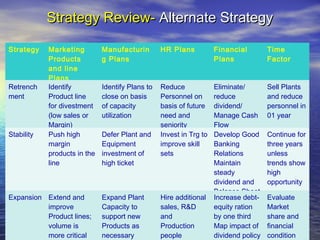
Strategy Review-Strategy Review- Alternate StrategyAlternate Strategy
3232
Strategy Marketing
Products
and line
Plans
Manufacturin
g Plans
HR Plans Financial
Plans
Time
Factor
Retrench
ment
Identify
Product line
for divestment
(low sales or
Margin)
Identify Plans to
close on basis
of capacity
utilization
Reduce
Personnel on
basis of future
need and
seniority
Eliminate/
reduce
dividend/
Manage Cash
Flow
Sell Plants
and reduce
personnel in
01 year
Stability Push high
margin
products in the
line
Defer Plant and
Equipment
investment of
high ticket
Invest in Trg to
improve skill
sets
Develop Good
Banking
Relations
Maintain
steady
dividend and
Balance Sheet
Continue for
three years
unless
trends show
high
opportunity
Expansion Extend and
improve
Product lines;
volume is
more critical
Expand Plant
Capacity to
support new
Products as
necessary
Hire additional
sales, R&D
and
Production
people
Increase debt-
equity ration
by one third
Map impact of
dividend policy
Evaluate
Market
share and
financial
condition

Unit 1 3 strategy evaluation

  • 1.
    11 Strategy Review,Strategy Review, Evaluation,& ControlEvaluation, & Control [ADDIE- Assesment, Design,[ADDIE- Assesment, Design, Development, Initiation,Development, Initiation, Evaluation]Evaluation] [PESTEL -Political, Economical,[PESTEL -Political, Economical, Social, Technological,Social, Technological, Environmental, Legal]Environmental, Legal]
  • 2.
    22 Strategy ReviewStrategy Review StrategyEvaluation—the 3 BasicsStrategy Evaluation—the 3 Basics • Examining the underlying basis of theExamining the underlying basis of the firm’s strategyfirm’s strategy • Comparing actual to expected resultsComparing actual to expected results • Taking corrective action to addressTaking corrective action to address performance gapsperformance gaps
  • 3.
    33 Strategy ReviewStrategy Review EffectiveStrategy EvaluationEffective Strategy Evaluation • Adequate and timely feedbackAdequate and timely feedback The cornerstone of effectiveThe cornerstone of effective evaluationevaluation
  • 4.
    44 Strategy ReviewStrategy Review StrategyEvaluationStrategy Evaluation • Must haveMust have bothboth Short- & long-term focusShort- & long-term focus
  • 5.
    55 Strategy ReviewStrategy Review FourCriteriaFour Criteria (Richard Rumelt):(Richard Rumelt): • ConsistencyConsistency • ConsonanceConsonance • FeasibilityFeasibility • AdvantageAdvantage
  • 6.
    66 ConsistencyConsistency • If policyproblems/issues continue to be brought to the top for resolution, then strategies may be inconsistent. • If success for one department means failure for another department, then strategies may be inconsistent. • If managerial problems continue despite changes in personnel and are issue based, then strategies may be inconsistent. A strategy should not present inconsistent goals and policies
  • 7.
    77 ConsonanceConsonance • Difficult inmatching key internal and external factors in formulation of strategy. • Most trends are the result of interactions among other trends. • Strategy must represent an adaptive response to the external environment and critical changes occurring within it. Strategists need to examine sets of trends as well as individual trends in evaluating strategies.
  • 8.
    88 FeasibilityFeasibility • Important toexamine whether in the past the organization has demonstrated the capabilities, abilities, competencies, skills, and talents to carry out strategy. • Limitation on strategic choice imposed by individual and organizational capabilities must be considered. • Can the strategy be attempted within the physical, human and financial resources of the enterprise? Strategy must neither overtax available resources nor create unsolvable subproblems.
  • 9.
    99 Strategy ReviewStrategy Review •Increase in environment’s complexity • Difficulty in predicting the future with accuracy • Increasing number of variables Contemporary Strategy Evaluation Difficulties
  • 10.
    1010 Strategy ReviewStrategy Review •Rate of obsolescence of even the best plans • Increase in domestic and world events • Decreasing time span for which planning can be done with any certainty Contemporary Strategy Evaluation Difficulties
  • 11.
    1111 Strategy ReviewStrategy Review Processof Evaluating Strategies:Process of Evaluating Strategies: • Should initiate managerial questioningShould initiate managerial questioning of expectations and assumptionsof expectations and assumptions • Should trigger a review of objectivesShould trigger a review of objectives and valuesand values • Should stimulate creativity in generatingShould stimulate creativity in generating alternatives and criteria of evaluationalternatives and criteria of evaluation
  • 12.
    1212 Evaluation FrameworkEvaluation Framework I.Review Underlying Bases Continue present course II. Measure Firm Performance III. Take Corrective Actions Differences? Differences? Yes NO Yes NO
  • 13.
    1313 I.I. Review Basesof StrategyReview Bases of Strategy • Develop a Revised External FactorDevelop a Revised External Factor Evaluation Matrix:Evaluation Matrix: • How have competitors reacted to our strategies?How have competitors reacted to our strategies? • How have competitors’ strategies changed?How have competitors’ strategies changed? • Have major competitors’ strengths andHave major competitors’ strengths and weaknesses changed?weaknesses changed?
  • 14.
    1414 I.I. Review Basesof StrategyReview Bases of Strategy • Why are competitors making certainWhy are competitors making certain strategic changes?strategic changes? • Why are some competitors’ strategiesWhy are some competitors’ strategies more successful than others?more successful than others? • How satisfied are our competitors withHow satisfied are our competitors with their present market positions andtheir present market positions and profitability?profitability?
  • 15.
    1515 I.I. Review Basesof StrategyReview Bases of Strategy • How far can our major competitors beHow far can our major competitors be pushed before retaliating?pushed before retaliating? • How could we more effectivelyHow could we more effectively cooperate with our competitors?cooperate with our competitors?
  • 16.
    1616 I.I. Review Basesof StrategyReview Bases of Strategy Key Questions in Evaluating Strategy:Key Questions in Evaluating Strategy: • Are our internal strengths still strengths?Are our internal strengths still strengths? • Have we added other internal strengths?Have we added other internal strengths? • Are our internal weaknesses stillAre our internal weaknesses still weaknesses?weaknesses?
  • 17.
    1717 I.I. Review Basesof StrategyReview Bases of Strategy • Do we now have other internalDo we now have other internal weaknesses?weaknesses? • Are our external opportunities stillAre our external opportunities still opportunities?opportunities? • Are there now external opportunities?Are there now external opportunities?
  • 18.
    1818 I.I. Review Basesof StrategyReview Bases of Strategy • Are our external threats still threats?Are our external threats still threats? • Are there now other external threats?Are there now other external threats? • Are we vulnerable to a hostileAre we vulnerable to a hostile takeover?takeover?
  • 19.
    1919 II.II. Measure PerformanceMeasurePerformance • Compare the firm’s performanceCompare the firm’s performance over different time periods.over different time periods. • Compare the firm’s performance toCompare the firm’s performance to competitors.competitors. • Compare the firm’s performance toCompare the firm’s performance to industry averages.industry averages.
  • 20.
    2020 II.II. Measure PerformanceMeasurePerformance Quantitative Analysis:Quantitative Analysis:  Return on investmentReturn on investment  Return on equityReturn on equity  Profit marginProfit margin  Market shareMarket share  Debt to equityDebt to equity  Earnings per shareEarnings per share  Sales growthSales growth  Asset growthAsset growth
  • 21.
    2121 II.II. Measure PerformanceMeasurePerformance Qualitative Analysis:Qualitative Analysis:  Is the strategy internally consistent?Is the strategy internally consistent?  Is the strategy consistent with theIs the strategy consistent with the environment?environment?  Is the strategy appropriate in view ofIs the strategy appropriate in view of available resources?available resources?  Does the strategy involve anDoes the strategy involve an acceptable degree of risk?acceptable degree of risk?
  • 22.
    2222 II.II. Measure PerformanceMeasurePerformance Qualitative Analysis:Qualitative Analysis:  Does the strategy have an appropriateDoes the strategy have an appropriate time framework?time framework?  Is the strategy workable?Is the strategy workable?
  • 23.
    2323 III.III. Take CorrectiveActionTake Corrective Action Making changes to reposition a firmMaking changes to reposition a firm competitively for the futurecompetitively for the future
  • 24.
    2424 Strategy-Evaluation Assessment MatrixStrategy-EvaluationAssessment Matrix Continue courseYesNoNo Corrective actionsNoYesNo Corrective actionsYesYesNo Corrective actionsNoNoYes Corrective actionsYesNoYes Corrective actionsNoYesYes Corrective actionsYesYesYes Corrective actionsNoNoNo Result Has the firm progressed satisfactorily toward achieving its stated objectives? Have major changes occurred in the firm’s external strategic position? Have major changes occurred in the firm’s internal strategic position?
  • 25.
    2525 Strategy ReviewStrategy Review Characteristicsof an effectiveCharacteristics of an effective systemsystem • Evaluation activities must beEvaluation activities must be economical.economical. • Evaluation activities must beEvaluation activities must be meaningful.meaningful.
  • 26.
    2626 Strategy ReviewStrategy Review Characteristicsof an effectiveCharacteristics of an effective systemsystem • Evaluation activities must provide timelyEvaluation activities must provide timely information.information. • Evaluation system should be designedEvaluation system should be designed to provide a true picture of what isto provide a true picture of what is happening.happening.
  • 27.
    2727 Strategy ReviewStrategy Review Characteristicsof an effectiveCharacteristics of an effective systemsystem • Information derived from evaluationInformation derived from evaluation process should facilitate action.process should facilitate action. • Evaluation process should notEvaluation process should not dominate decisions.dominate decisions.
  • 28.
    2828 Strategy ReviewStrategy Review ContingencyPlanningContingency Planning • Identify both beneficial and unfavorableIdentify both beneficial and unfavorable events that could possibly derail theevents that could possibly derail the strategy or strategies.strategy or strategies. • Specify trigger points. Calculate aboutSpecify trigger points. Calculate about when contingent events are likely towhen contingent events are likely to occur.occur.
  • 29.
    2929 Strategy ReviewStrategy Review ContingencyPlanningContingency Planning • Assess the impact of each contingentAssess the impact of each contingent event. Estimate the potential benefit orevent. Estimate the potential benefit or harm of each contingent event.harm of each contingent event. • Develop contingency plans. Insure thatDevelop contingency plans. Insure that they are compatible with currentthey are compatible with current strategy and are economically feasible.strategy and are economically feasible.
  • 30.
    3030 Strategy ReviewStrategy Review ContingencyPlanningContingency Planning • Assess the counterimpact of eachAssess the counterimpact of each contingency plan. This quantifies thecontingency plan. This quantifies the potential value of each plan.potential value of each plan. • Determine early warning signals for keyDetermine early warning signals for key contingent events.contingent events. • Develop advance action plans to takeDevelop advance action plans to take advantage of available lead time.advantage of available lead time.
  • 31.
    3131 Strategy ReviewStrategy Review AuditingAuditing •Financial audits to determineFinancial audits to determine correspondence between assertionscorrespondence between assertions based on strategic plans andbased on strategic plans and established criteriaestablished criteria • Environmental audits to insure soundEnvironmental audits to insure sound and safe practicesand safe practices
  • 32.
    Strategy Review-Strategy Review-Alternate StrategyAlternate Strategy 3232 Strategy Marketing Products and line Plans Manufacturin g Plans HR Plans Financial Plans Time Factor Retrench ment Identify Product line for divestment (low sales or Margin) Identify Plans to close on basis of capacity utilization Reduce Personnel on basis of future need and seniority Eliminate/ reduce dividend/ Manage Cash Flow Sell Plants and reduce personnel in 01 year Stability Push high margin products in the line Defer Plant and Equipment investment of high ticket Invest in Trg to improve skill sets Develop Good Banking Relations Maintain steady dividend and Balance Sheet Continue for three years unless trends show high opportunity Expansion Extend and improve Product lines; volume is more critical Expand Plant Capacity to support new Products as necessary Hire additional sales, R&D and Production people Increase debt- equity ration by one third Map impact of dividend policy Evaluate Market share and financial condition