1
Strategic Management
Concepts & Cases
Chapter 9:
Strategy Review,
Evaluation, & Control
Western New England College
2
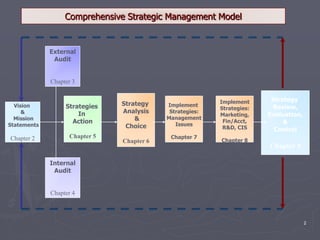
Comprehensive Strategic Management Model
Strategy
Review,
Evaluation,
&
Control
Chapter 9
Vision
&
Mission
Statements
Chapter 2
External
Audit
Chapter 3
Internal
Audit
Chapter 4
Strategies
In
Action
Chapter 5
Strategy
Analysis
&
Choice
Chapter 6
Implement
Strategies:
Management
Issues
Chapter 7
Implement
Strategies:
Marketing,
Fin/Acct,
R&D, CIS
Chapter 8
3
Strategy Review
“Complicated controls do not work.
They confuse. They misdirect attention
from what is to be controlled to the
mechanics and methodology of the
control.”
—Seymour Tilles—
4
Strategy Review
“Organizations are most vulnerable when
they are at the peak of their success.”
—R.T. Lenz—
5
Strategy Review
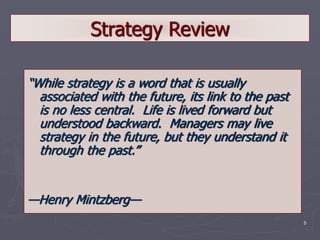
“While strategy is a word that is usually
associated with the future, its link to the past
is no less central. Life is lived forward but
understood backward. Managers may live
strategy in the future, but they understand it
through the past.”
—Henry Mintzberg—
6
Strategy Review
The firm’s internal and external
environments are dynamic. Therefore,
the best conceived and implemented
strategies become obsolete!
7
Strategy Review
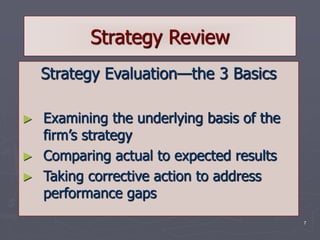
Strategy Evaluation—the 3 Basics
► Examining the underlying basis of the
firm’s strategy
► Comparing actual to expected results
► Taking corrective action to address
performance gaps
8
Strategy Review
Effective Strategy Evaluation
► Adequate and timely feedback
The cornerstone of effective
evaluation
9
Strategy Review
Strategy Evaluation
► Must have both
Short- & long-term focus
10
Strategy Review
Four Criteria (Richard Rumelt):
► Consistency
► Consonance
► Feasibility
► Advantage
11
Consistency
• If policy problems/issues continue to be brought to the
top for resolution, then strategies may be inconsistent.
• If success for one department means failure for another
department, then strategies may be inconsistent.
• If managerial problems continue despite changes in
personnel and are issue based, then strategies may be
inconsistent.
A strategy should not present inconsistent
goals and policies
12
Consonance
• Difficult in matching key internal and external factors in
formulation of strategy.
• Most trends are the result of interactions among other
trends.
• Strategy must represent an adaptive response to the
external environment and critical changes occurring
within it.
Strategists need to examine sets of trends as well
as individual trends in evaluating strategies.
13
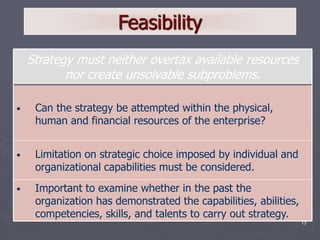
Feasibility
• Important to examine whether in the past the
organization has demonstrated the capabilities, abilities,
competencies, skills, and talents to carry out strategy.
• Limitation on strategic choice imposed by individual and
organizational capabilities must be considered.
• Can the strategy be attempted within the physical,
human and financial resources of the enterprise?
Strategy must neither overtax available resources
nor create unsolvable subproblems.
14
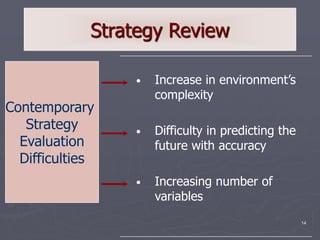
Strategy Review
• Increase in environment’s
complexity
• Difficulty in predicting the
future with accuracy
• Increasing number of
variables
Contemporary
Strategy
Evaluation
Difficulties
15
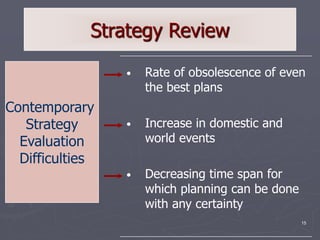
Strategy Review
• Rate of obsolescence of even
the best plans
• Increase in domestic and
world events
• Decreasing time span for
which planning can be done
with any certainty
Contemporary
Strategy
Evaluation
Difficulties
16
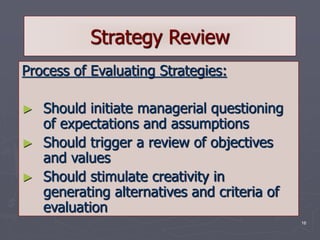
Strategy Review
Process of Evaluating Strategies:
► Should initiate managerial questioning
of expectations and assumptions
► Should trigger a review of objectives
and values
► Should stimulate creativity in
generating alternatives and criteria of
evaluation
17
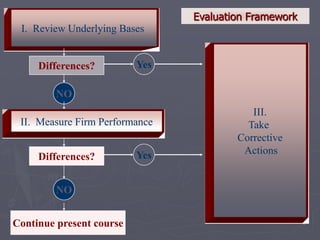
Evaluation Framework
I. Review Underlying Bases
Continue present course
II. Measure Firm Performance
III.
Take
Corrective
Actions
Differences?
Differences?
Yes
NO
Yes
NO
18
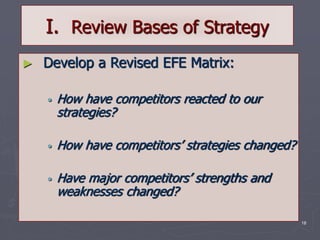
I. Review Bases of Strategy
► Develop a Revised EFE Matrix:
• How have competitors reacted to our
strategies?
• How have competitors’ strategies changed?
• Have major competitors’ strengths and
weaknesses changed?
19
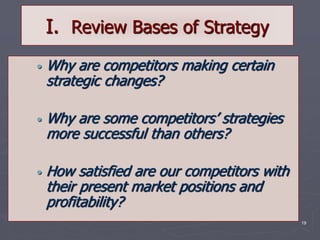
I. Review Bases of Strategy
• Why are competitors making certain
strategic changes?
• Why are some competitors’ strategies
more successful than others?
• How satisfied are our competitors with
their present market positions and
profitability?
20
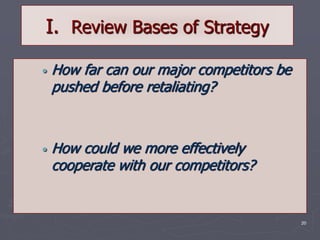
I. Review Bases of Strategy
• How far can our major competitors be
pushed before retaliating?
• How could we more effectively
cooperate with our competitors?
21
I. Review Bases of Strategy
Key Questions in Evaluating Strategy:
• Are our internal strengths still strengths?
• Have we added other internal strengths?
• Are our internal weaknesses still
weaknesses?
22
I. Review Bases of Strategy
• Do we now have other internal
weaknesses?
• Are our external opportunities still
opportunities?
• Are there now external opportunities?
23
I. Review Bases of Strategy
• Are our external threats still threats?
• Are there now other external threats?
• Are we vulnerable to a hostile takeover?
24
II. Measure Performance
► Compare the firm’s performance
over different time periods.
► Compare the firm’s performance to
competitors.
► Compare the firm’s performance to
industry averages.
25
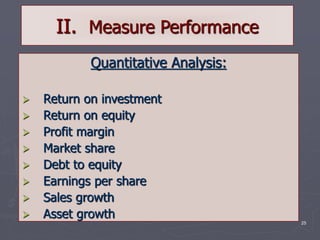
II. Measure Performance
Quantitative Analysis:
 Return on investment
 Return on equity
 Profit margin
 Market share
 Debt to equity
 Earnings per share
 Sales growth
 Asset growth
26
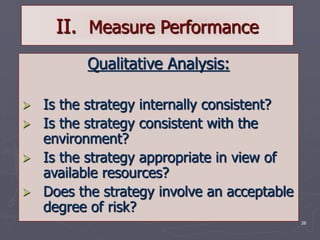
II. Measure Performance
Qualitative Analysis:
 Is the strategy internally consistent?
 Is the strategy consistent with the
environment?
 Is the strategy appropriate in view of
available resources?
 Does the strategy involve an acceptable
degree of risk?
27
II. Measure Performance
Qualitative Analysis:
 Does the strategy have an appropriate
time framework?
 Is the strategy workable?
28
III. Take Corrective Action
Making changes to reposition a firm
competitively for the future
29
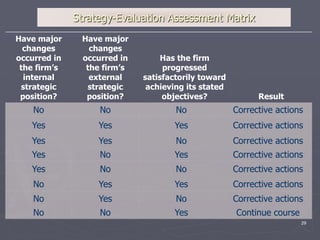
Strategy-Evaluation Assessment Matrix
Continue course
Yes
No
No
Corrective actions
No
Yes
No
Corrective actions
Yes
Yes
No
Corrective actions
No
No
Yes
Corrective actions
Yes
No
Yes
Corrective actions
No
Yes
Yes
Corrective actions
Yes
Yes
Yes
Corrective actions
No
No
No
Result
Has the firm
progressed
satisfactorily toward
achieving its stated
objectives?
Have major
changes
occurred in
the firm’s
external
strategic
position?
Have major
changes
occurred in
the firm’s
internal
strategic
position?
30
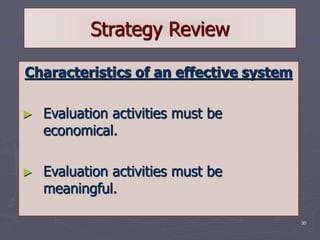
Strategy Review
Characteristics of an effective system
► Evaluation activities must be
economical.
► Evaluation activities must be
meaningful.
31
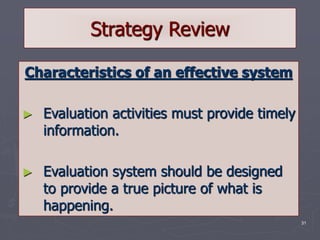
Strategy Review
Characteristics of an effective system
► Evaluation activities must provide timely
information.
► Evaluation system should be designed
to provide a true picture of what is
happening.
32
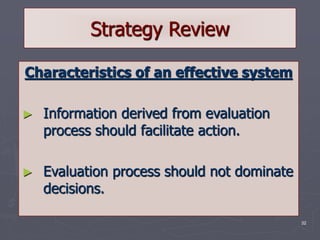
Strategy Review
Characteristics of an effective system
► Information derived from evaluation
process should facilitate action.
► Evaluation process should not dominate
decisions.
33
Strategy Review
Contingency Planning
► Identify both beneficial and unfavorable
events that could possibly derail the
strategy or strategies.
► Specify trigger points. Calculate about
when contingent events are likely to
occur.
34
Strategy Review
Contingency Planning
► Assess the impact of each contingent
event. Estimate the potential benefit or
harm of each contingent event.
► Develop contingency plans. Insure that
they are compatible with current
strategy and are economically feasible.
35
Strategy Review
Contingency Planning
► Assess the counterimpact of each
contingency plan. This quantifies the
potential value of each plan.
► Determine early warning signals for key
contingent events.
► Develop advance action plans to take
advantage of available lead time.
36
Strategy Review
Auditing
► Financial audits to determine
correspondence between assertions
based on strategic plans and
established criteria
► Environmental audits to insure sound
and safe practices
37
Key Terms & Concepts
► Advantage
► Auditing
► Consistency
► Consonance
► Contingency plans
► Corporate agility
► Feasibility
► Future shock
► MBWA
► Measuring
organizational
performance
► Planning process
audit
► Reviewing the
underlying bases of
an organization’s
strategy
► Revised EFE matrix
38
Key Terms & Concepts
► Revised IFE matrix
► Taking corrective
actions

chap09.ppt

  • 1.
    1 Strategic Management Concepts &Cases Chapter 9: Strategy Review, Evaluation, & Control Western New England College
  • 2.
    2 Comprehensive Strategic ManagementModel Strategy Review, Evaluation, & Control Chapter 9 Vision & Mission Statements Chapter 2 External Audit Chapter 3 Internal Audit Chapter 4 Strategies In Action Chapter 5 Strategy Analysis & Choice Chapter 6 Implement Strategies: Management Issues Chapter 7 Implement Strategies: Marketing, Fin/Acct, R&D, CIS Chapter 8
  • 3.
    3 Strategy Review “Complicated controlsdo not work. They confuse. They misdirect attention from what is to be controlled to the mechanics and methodology of the control.” —Seymour Tilles—
  • 4.
    4 Strategy Review “Organizations aremost vulnerable when they are at the peak of their success.” —R.T. Lenz—
  • 5.
    5 Strategy Review “While strategyis a word that is usually associated with the future, its link to the past is no less central. Life is lived forward but understood backward. Managers may live strategy in the future, but they understand it through the past.” —Henry Mintzberg—
  • 6.
    6 Strategy Review The firm’sinternal and external environments are dynamic. Therefore, the best conceived and implemented strategies become obsolete!
  • 7.
    7 Strategy Review Strategy Evaluation—the3 Basics ► Examining the underlying basis of the firm’s strategy ► Comparing actual to expected results ► Taking corrective action to address performance gaps
  • 8.
    8 Strategy Review Effective StrategyEvaluation ► Adequate and timely feedback The cornerstone of effective evaluation
  • 9.
    9 Strategy Review Strategy Evaluation ►Must have both Short- & long-term focus
  • 10.
    10 Strategy Review Four Criteria(Richard Rumelt): ► Consistency ► Consonance ► Feasibility ► Advantage
  • 11.
    11 Consistency • If policyproblems/issues continue to be brought to the top for resolution, then strategies may be inconsistent. • If success for one department means failure for another department, then strategies may be inconsistent. • If managerial problems continue despite changes in personnel and are issue based, then strategies may be inconsistent. A strategy should not present inconsistent goals and policies
  • 12.
    12 Consonance • Difficult inmatching key internal and external factors in formulation of strategy. • Most trends are the result of interactions among other trends. • Strategy must represent an adaptive response to the external environment and critical changes occurring within it. Strategists need to examine sets of trends as well as individual trends in evaluating strategies.
  • 13.
    13 Feasibility • Important toexamine whether in the past the organization has demonstrated the capabilities, abilities, competencies, skills, and talents to carry out strategy. • Limitation on strategic choice imposed by individual and organizational capabilities must be considered. • Can the strategy be attempted within the physical, human and financial resources of the enterprise? Strategy must neither overtax available resources nor create unsolvable subproblems.
  • 14.
    14 Strategy Review • Increasein environment’s complexity • Difficulty in predicting the future with accuracy • Increasing number of variables Contemporary Strategy Evaluation Difficulties
  • 15.
    15 Strategy Review • Rateof obsolescence of even the best plans • Increase in domestic and world events • Decreasing time span for which planning can be done with any certainty Contemporary Strategy Evaluation Difficulties
  • 16.
    16 Strategy Review Process ofEvaluating Strategies: ► Should initiate managerial questioning of expectations and assumptions ► Should trigger a review of objectives and values ► Should stimulate creativity in generating alternatives and criteria of evaluation
  • 17.
    17 Evaluation Framework I. ReviewUnderlying Bases Continue present course II. Measure Firm Performance III. Take Corrective Actions Differences? Differences? Yes NO Yes NO
  • 18.
    18 I. Review Basesof Strategy ► Develop a Revised EFE Matrix: • How have competitors reacted to our strategies? • How have competitors’ strategies changed? • Have major competitors’ strengths and weaknesses changed?
  • 19.
    19 I. Review Basesof Strategy • Why are competitors making certain strategic changes? • Why are some competitors’ strategies more successful than others? • How satisfied are our competitors with their present market positions and profitability?
  • 20.
    20 I. Review Basesof Strategy • How far can our major competitors be pushed before retaliating? • How could we more effectively cooperate with our competitors?
  • 21.
    21 I. Review Basesof Strategy Key Questions in Evaluating Strategy: • Are our internal strengths still strengths? • Have we added other internal strengths? • Are our internal weaknesses still weaknesses?
  • 22.
    22 I. Review Basesof Strategy • Do we now have other internal weaknesses? • Are our external opportunities still opportunities? • Are there now external opportunities?
  • 23.
    23 I. Review Basesof Strategy • Are our external threats still threats? • Are there now other external threats? • Are we vulnerable to a hostile takeover?
  • 24.
    24 II. Measure Performance ►Compare the firm’s performance over different time periods. ► Compare the firm’s performance to competitors. ► Compare the firm’s performance to industry averages.
  • 25.
    25 II. Measure Performance QuantitativeAnalysis:  Return on investment  Return on equity  Profit margin  Market share  Debt to equity  Earnings per share  Sales growth  Asset growth
  • 26.
    26 II. Measure Performance QualitativeAnalysis:  Is the strategy internally consistent?  Is the strategy consistent with the environment?  Is the strategy appropriate in view of available resources?  Does the strategy involve an acceptable degree of risk?
  • 27.
    27 II. Measure Performance QualitativeAnalysis:  Does the strategy have an appropriate time framework?  Is the strategy workable?
  • 28.
    28 III. Take CorrectiveAction Making changes to reposition a firm competitively for the future
  • 29.
    29 Strategy-Evaluation Assessment Matrix Continuecourse Yes No No Corrective actions No Yes No Corrective actions Yes Yes No Corrective actions No No Yes Corrective actions Yes No Yes Corrective actions No Yes Yes Corrective actions Yes Yes Yes Corrective actions No No No Result Has the firm progressed satisfactorily toward achieving its stated objectives? Have major changes occurred in the firm’s external strategic position? Have major changes occurred in the firm’s internal strategic position?
  • 30.
    30 Strategy Review Characteristics ofan effective system ► Evaluation activities must be economical. ► Evaluation activities must be meaningful.
  • 31.
    31 Strategy Review Characteristics ofan effective system ► Evaluation activities must provide timely information. ► Evaluation system should be designed to provide a true picture of what is happening.
  • 32.
    32 Strategy Review Characteristics ofan effective system ► Information derived from evaluation process should facilitate action. ► Evaluation process should not dominate decisions.
  • 33.
    33 Strategy Review Contingency Planning ►Identify both beneficial and unfavorable events that could possibly derail the strategy or strategies. ► Specify trigger points. Calculate about when contingent events are likely to occur.
  • 34.
    34 Strategy Review Contingency Planning ►Assess the impact of each contingent event. Estimate the potential benefit or harm of each contingent event. ► Develop contingency plans. Insure that they are compatible with current strategy and are economically feasible.
  • 35.
    35 Strategy Review Contingency Planning ►Assess the counterimpact of each contingency plan. This quantifies the potential value of each plan. ► Determine early warning signals for key contingent events. ► Develop advance action plans to take advantage of available lead time.
  • 36.
    36 Strategy Review Auditing ► Financialaudits to determine correspondence between assertions based on strategic plans and established criteria ► Environmental audits to insure sound and safe practices
  • 37.
    37 Key Terms &Concepts ► Advantage ► Auditing ► Consistency ► Consonance ► Contingency plans ► Corporate agility ► Feasibility ► Future shock ► MBWA ► Measuring organizational performance ► Planning process audit ► Reviewing the underlying bases of an organization’s strategy ► Revised EFE matrix
  • 38.
    38 Key Terms &Concepts ► Revised IFE matrix ► Taking corrective actions