

DataRobot R Package
Ron Pearson
DataRobot
Today’s agenda:
1. What is DataRobot?
a. A Boston-based software company
b. A massively parallel modeling engine
c. An R package (today’s focus)
2. An example to demonstrate the R package:
a. Predicting compressive strength of concrete
b. Shows typical DataRobot modeling project
c. Demonstrates partial dependence plots
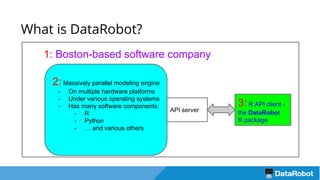
What is DataRobot?
1: Boston-based software company
2: Massively parallel modeling engine
- On multiple hardware platforms
- Under various operating systems
- Has many software components:
- R
- Python
- … and various others
API server
3: R API client -
the DataRobot
R package
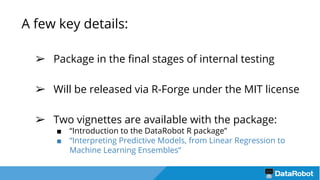
A few key details:
➢ Package in the final stages of internal testing
➢ Will be released via R-Forge under the MIT license
➢ Two vignettes are available with the package:
■ “Introduction to the DataRobot R package”
■ “Interpreting Predictive Models, from Linear Regression to
Machine Learning Ensembles”
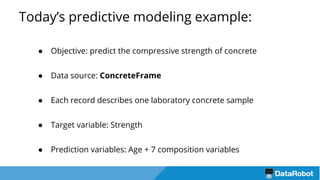
Today’s predictive modeling example:
● Objective: predict the compressive strength of concrete
● Data source: ConcreteFrame
● Each record describes one laboratory concrete sample
● Target variable: Strength
● Prediction variables: Age + 7 composition variables
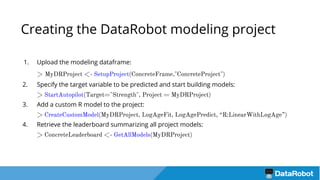
Creating the DataRobot modeling project
1. Upload the modeling dataframe:
> MyDRProject <- SetupProject(ConcreteFrame,"ConcreteProject")
2. Specify the target variable to be predicted and start building models:
> StartAutopilot(Target="Strength", Project = MyDRProject)
3. Add a custom R model to the project:
> CreateCustomModel(MyDRProject, LogAgeFit, LogAgePredict, “R:LinearWithLogAge”)
4. Retrieve the leaderboard summarizing all project models:
> ConcreteLeaderboard <- GetAllModels(MyDRProject)
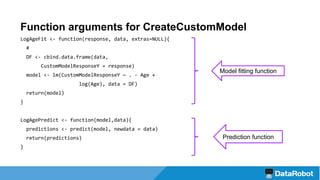
Function arguments for CreateCustomModel
LogAgeFit <- function(response, data, extras=NULL){
#
DF <- cbind.data.frame(data,
CustomModelResponseY = response)
model <- lm(CustomModelResponseY ~ . - Age +
log(Age), data = DF)
return(model)
}
LogAgePredict <- function(model,data){
predictions <- predict(model, newdata = data)
return(predictions)
}
Model fitting function
Prediction function
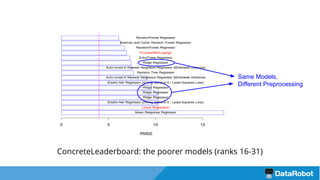
ConcreteLeaderboard: the poorer models (ranks 16-31)
Same Models,
Different Preprocessing
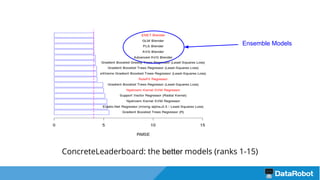
ConcreteLeaderboard: the better models (ranks 1-15)
Ensemble Models
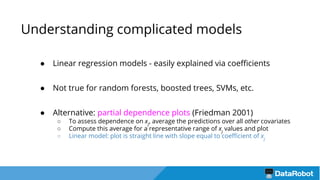
Understanding complicated models
● Linear regression models - easily explained via coefficients
● Not true for random forests, boosted trees, SVMs, etc.
● Alternative: partial dependence plots (Friedman 2001)
○ To assess dependence on xj
, average the predictions over all other covariates
○ Compute this average for a representative range of xj
values and plot
○ Linear model: plot is straight line with slope equal to coefficient of xj
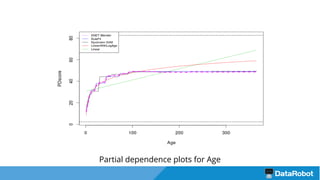
Partial dependence plots for Age
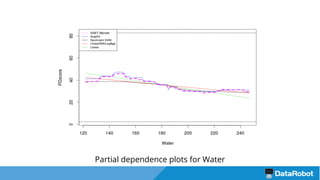
Partial dependence plots for Water
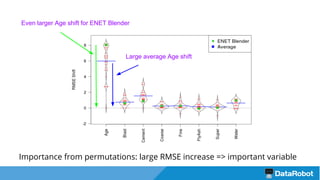
Importance from permutations: large RMSE increase => important variable
Large average Age shift
Even larger Age shift for ENET Blender
Summary of the concrete strength example
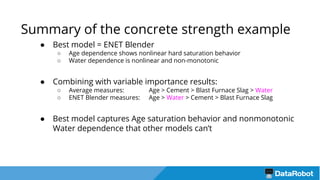
● Best model = ENET Blender
○ Age dependence shows nonlinear hard saturation behavior
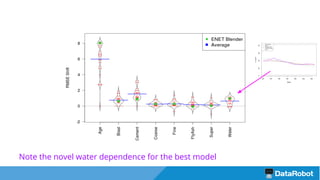
○ Water dependence is nonlinear and non-monotonic
● Combining with variable importance results:
○ Average measures: Age > Cement > Blast Furnace Slag > Water
○ ENET Blender measures: Age > Water > Cement > Blast Furnace Slag
● Best model captures Age saturation behavior and nonmonotonic
Water dependence that other models can’t
Note the novel water dependence for the best model
Questions?
Ronald K. Pearson | Data Scientist @DataRobot | ron@datarobot.com
Slides available at: bit.ly/UseR2015
Vignette - Intro to DataRobot: bit.ly/1dzgppC
Vignette - Two Applications: bit.ly/1KtWCGI
Want to use the DataRobot
R package?
Email us at:
useR2015@datarobot.com

DataRobot R Package

  • 1.
    DataRobot R Package RonPearson DataRobot
  • 2.
    Today’s agenda: 1. Whatis DataRobot? a. A Boston-based software company b. A massively parallel modeling engine c. An R package (today’s focus) 2. An example to demonstrate the R package: a. Predicting compressive strength of concrete b. Shows typical DataRobot modeling project c. Demonstrates partial dependence plots
  • 3.
    What is DataRobot? 1:Boston-based software company 2: Massively parallel modeling engine - On multiple hardware platforms - Under various operating systems - Has many software components: - R - Python - … and various others API server 3: R API client - the DataRobot R package
  • 5.
    A few keydetails: ➢ Package in the final stages of internal testing ➢ Will be released via R-Forge under the MIT license ➢ Two vignettes are available with the package: ■ “Introduction to the DataRobot R package” ■ “Interpreting Predictive Models, from Linear Regression to Machine Learning Ensembles”
  • 6.
    Today’s predictive modelingexample: ● Objective: predict the compressive strength of concrete ● Data source: ConcreteFrame ● Each record describes one laboratory concrete sample ● Target variable: Strength ● Prediction variables: Age + 7 composition variables
  • 7.
    Creating the DataRobotmodeling project 1. Upload the modeling dataframe: > MyDRProject <- SetupProject(ConcreteFrame,"ConcreteProject") 2. Specify the target variable to be predicted and start building models: > StartAutopilot(Target="Strength", Project = MyDRProject) 3. Add a custom R model to the project: > CreateCustomModel(MyDRProject, LogAgeFit, LogAgePredict, “R:LinearWithLogAge”) 4. Retrieve the leaderboard summarizing all project models: > ConcreteLeaderboard <- GetAllModels(MyDRProject)
  • 8.
    Function arguments forCreateCustomModel LogAgeFit <- function(response, data, extras=NULL){ # DF <- cbind.data.frame(data, CustomModelResponseY = response) model <- lm(CustomModelResponseY ~ . - Age + log(Age), data = DF) return(model) } LogAgePredict <- function(model,data){ predictions <- predict(model, newdata = data) return(predictions) } Model fitting function Prediction function
  • 9.
    ConcreteLeaderboard: the poorermodels (ranks 16-31) Same Models, Different Preprocessing
  • 10.
    ConcreteLeaderboard: the bettermodels (ranks 1-15) Ensemble Models
  • 11.
    Understanding complicated models ●Linear regression models - easily explained via coefficients ● Not true for random forests, boosted trees, SVMs, etc. ● Alternative: partial dependence plots (Friedman 2001) ○ To assess dependence on xj , average the predictions over all other covariates ○ Compute this average for a representative range of xj values and plot ○ Linear model: plot is straight line with slope equal to coefficient of xj
  • 12.
  • 13.
  • 14.
    Importance from permutations:large RMSE increase => important variable Large average Age shift Even larger Age shift for ENET Blender
  • 15.
    Summary of theconcrete strength example ● Best model = ENET Blender ○ Age dependence shows nonlinear hard saturation behavior ○ Water dependence is nonlinear and non-monotonic ● Combining with variable importance results: ○ Average measures: Age > Cement > Blast Furnace Slag > Water ○ ENET Blender measures: Age > Water > Cement > Blast Furnace Slag ● Best model captures Age saturation behavior and nonmonotonic Water dependence that other models can’t
  • 16.
    Note the novelwater dependence for the best model
  • 17.
  • 18.
    Ronald K. Pearson| Data Scientist @DataRobot | ron@datarobot.com Slides available at: bit.ly/UseR2015 Vignette - Intro to DataRobot: bit.ly/1dzgppC Vignette - Two Applications: bit.ly/1KtWCGI Want to use the DataRobot R package? Email us at: useR2015@datarobot.com