TOPOLOGICAL DATA ANALYSIS
HJ vanVeen· Data Science· Nubank Brasil
TOPOLOGY I
• "When a truth is necessary, the reason for it can be
found by analysis, that is, by resolving it into simpler
ideas and truths until the primary ones are reached."
- Leibniz
TOPOLOGY II
• Topology is the mathematical study of topological
spaces.
• Topology is interested in shapes,
• More specifically: the concept of 'connectedness'
TOPOLOGY III
• A topologist is someone who does not see the
difference between a coffee mug and a donut.


HISTORY I
• “Nothing at all takes place in the universe in which
some rule of maximum or minimum does not
appear.” - Euler
• Seven Bridges of Koningsbrucke: devise a walk
through the city that would cross each bridge
once and only once.
HISTORY II
HISTORY III
• Euler's big insights:
• Doesn’t matter where you start walking, only matters which bridges
you cross.
• A similar solution should be found, regardless where you start your
walk.
• only the connectedness of bridges matter,
• a solution should also apply to all other bridges that are connected
in a similar fashion, no matter the distances between them.
HISTORY IV
• We now call these graph walks ‘Eulerian walks’ in
Euler’s honor.
• Euler's first proven graph theory theorem:
• 'Euler walks' are possible if exactly zero or two nodes
have an odd number of edges.
TDA I
• TDA marries 300-year old maths with
modern data analysis.
• Captures the shape of data
• Is invariant
• Compresses large datasets
• Functions well in the presence of noise / missing variables
TDA II
• Capturing the shape of data


•Traditional techniques like clustering or dimensionality reduction have
trouble capturing this shape.

TDA III
• Invariance.


• Euler showed that only connectedness matters.The size, position, or
pose of an object doesn't change that object.
TDA IV
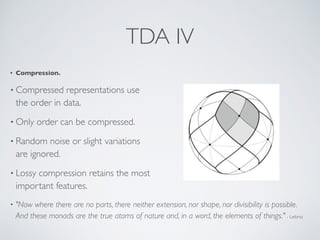
• Compression.
• Compressed representations use 

the order in data.
• Only order can be compressed.
• Random noise or slight variations 

are ignored.
• Lossy compression retains the most

important features.
• "Now where there are no parts, there neither extension, nor shape, nor divisibility is possible.
And these monads are the true atoms of nature and, in a word, the elements of things." - Leibniz
MAPPER I
• Mapper was created by Ayasdi Co-founder
Gurjeet Singh during his PhD under Gunnar
Carlsson.
• Based on the idea of partial clustering of the data
guided by a set of functions defined on the data.
MAPPER II
• Mapper was inspired by the Reeb Graph.


MAPPER III
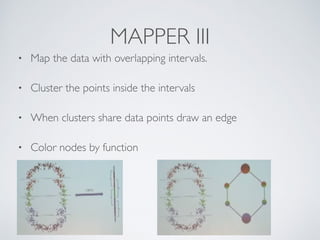
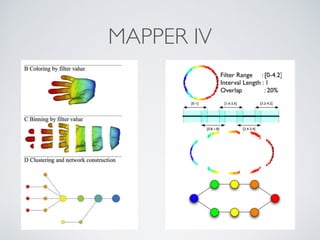
• Map the data with overlapping intervals.
• Cluster the points inside the intervals
• When clusters share data points draw an edge
• Color nodes by function
MAPPER IV
MAPPERV
Distance_to_median(row) x y z
1.5 1.5 1.5 1.5
1.5 -0.5 -0.5 -0.5
0 1 1 1
0 1 0.9 1.1
3 2 2 2
3 2.1 1.9 2
Y
MAPPERVI
• In conclusion:
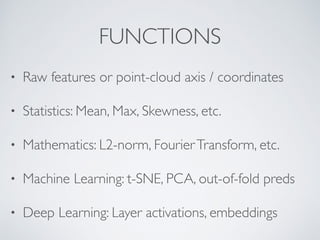
FUNCTIONS
• Raw features or point-cloud axis / coordinates
• Statistics: Mean, Max, Skewness, etc.
• Mathematics: L2-norm, FourierTransform, etc.
• Machine Learning: t-SNE, PCA, out-of-fold preds
• Deep Learning: Layer activations, embeddings
CLUSTER ALGO’S
• DBSCAN / HDBSCAN:
• Handles noise well.
• No need to set number of clusters.
• K-Means:
• Creates visually nice simplicial complexes/graphs
SOME GENERAL USE CASES
• ComputerVision
• Model and feature inspection
• Computational Biology / Healthcare
• Persistent Homology
COMPUTERVISION
• Demo


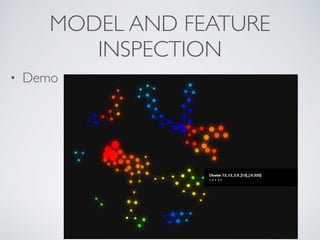
MODEL AND FEATURE
INSPECTION
• Demo


COMPUTATIONAL BIOLOGY
• Example


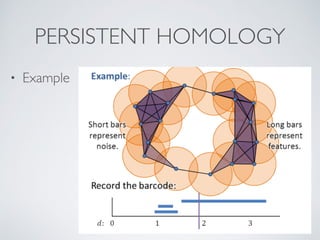
PERSISTENT HOMOLOGY
• Example


SOME FINANCE USE CASES
• Customer Segmentation
• Transactional Fraud
• Accurate Interpretable Models
• Exploration / Analysis
CUSTOMER SEGMENTATION
• Demo


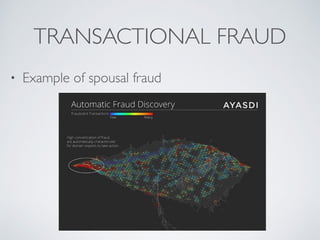
TRANSACTIONAL FRAUD
• Example of spousal fraud


ACCURATE INTERPRETABLE
MODELS
• Create: global linear model
• Function: L2-norm
• Color: Heatmap by ground truth and animate to out-of-fold model predictions
• Identify: Low accuracy sub graphs
• Select: Features that are most important for sub graphs
• Create: Local linear models on sub graphs
• Stack: DecisionTree
• Compare: Divide-and-Conquer and LIME
• DEMO
EXPLORATION / ANALYSIS
• Demo


QUESTIONS?
FURTHER READING
• Google terms:
• Ayasdi,Topological Data Analysis, Robert Ghrist, Gurjeet Singh, Gunnar Carlsson,
Anthony Bak,Allison Gilmore, Simplicial Complex, Python Mapper.
• Videos:
• https://www.youtube.com/watch?v=4RNpuZydlKY
• https://www.youtube.com/watch?v=x3Hl85OBuc0
• https://www.youtube.com/watch?v=cJ8W0ASsnp0
• https://www.youtube.com/watch?v=kctyag2Xi8o

Tda presentation

  • 1.
    TOPOLOGICAL DATA ANALYSIS HJvanVeen· Data Science· Nubank Brasil
  • 2.
    TOPOLOGY I • "Whena truth is necessary, the reason for it can be found by analysis, that is, by resolving it into simpler ideas and truths until the primary ones are reached." - Leibniz
  • 3.
    TOPOLOGY II • Topologyis the mathematical study of topological spaces. • Topology is interested in shapes, • More specifically: the concept of 'connectedness'
  • 4.
    TOPOLOGY III • Atopologist is someone who does not see the difference between a coffee mug and a donut.


  • 5.
    HISTORY I • “Nothingat all takes place in the universe in which some rule of maximum or minimum does not appear.” - Euler • Seven Bridges of Koningsbrucke: devise a walk through the city that would cross each bridge once and only once.
  • 6.
  • 7.
    HISTORY III • Euler'sbig insights: • Doesn’t matter where you start walking, only matters which bridges you cross. • A similar solution should be found, regardless where you start your walk. • only the connectedness of bridges matter, • a solution should also apply to all other bridges that are connected in a similar fashion, no matter the distances between them.
  • 8.
    HISTORY IV • Wenow call these graph walks ‘Eulerian walks’ in Euler’s honor. • Euler's first proven graph theory theorem: • 'Euler walks' are possible if exactly zero or two nodes have an odd number of edges.
  • 9.
    TDA I • TDAmarries 300-year old maths with modern data analysis. • Captures the shape of data • Is invariant • Compresses large datasets • Functions well in the presence of noise / missing variables
  • 10.
    TDA II • Capturingthe shape of data


 •Traditional techniques like clustering or dimensionality reduction have trouble capturing this shape.

  • 11.
    TDA III • Invariance.


 •Euler showed that only connectedness matters.The size, position, or pose of an object doesn't change that object.
  • 12.
    TDA IV • Compression. •Compressed representations use 
 the order in data. • Only order can be compressed. • Random noise or slight variations 
 are ignored. • Lossy compression retains the most
 important features. • "Now where there are no parts, there neither extension, nor shape, nor divisibility is possible. And these monads are the true atoms of nature and, in a word, the elements of things." - Leibniz
  • 13.
    MAPPER I • Mapperwas created by Ayasdi Co-founder Gurjeet Singh during his PhD under Gunnar Carlsson. • Based on the idea of partial clustering of the data guided by a set of functions defined on the data.
  • 14.
    MAPPER II • Mapperwas inspired by the Reeb Graph.


  • 15.
    MAPPER III • Mapthe data with overlapping intervals. • Cluster the points inside the intervals • When clusters share data points draw an edge • Color nodes by function
  • 16.
  • 17.
    MAPPERV Distance_to_median(row) x yz 1.5 1.5 1.5 1.5 1.5 -0.5 -0.5 -0.5 0 1 1 1 0 1 0.9 1.1 3 2 2 2 3 2.1 1.9 2 Y
  • 18.
  • 19.
    FUNCTIONS • Raw featuresor point-cloud axis / coordinates • Statistics: Mean, Max, Skewness, etc. • Mathematics: L2-norm, FourierTransform, etc. • Machine Learning: t-SNE, PCA, out-of-fold preds • Deep Learning: Layer activations, embeddings
  • 20.
    CLUSTER ALGO’S • DBSCAN/ HDBSCAN: • Handles noise well. • No need to set number of clusters. • K-Means: • Creates visually nice simplicial complexes/graphs
  • 21.
    SOME GENERAL USECASES • ComputerVision • Model and feature inspection • Computational Biology / Healthcare • Persistent Homology
  • 22.
  • 23.
    MODEL AND FEATURE INSPECTION •Demo


  • 24.
  • 25.
  • 26.
    SOME FINANCE USECASES • Customer Segmentation • Transactional Fraud • Accurate Interpretable Models • Exploration / Analysis
  • 27.
  • 28.
    TRANSACTIONAL FRAUD • Exampleof spousal fraud


  • 29.
    ACCURATE INTERPRETABLE MODELS • Create:global linear model • Function: L2-norm • Color: Heatmap by ground truth and animate to out-of-fold model predictions • Identify: Low accuracy sub graphs • Select: Features that are most important for sub graphs • Create: Local linear models on sub graphs • Stack: DecisionTree • Compare: Divide-and-Conquer and LIME • DEMO
  • 30.
    EXPLORATION / ANALYSIS •Demo


  • 31.
  • 32.
    FURTHER READING • Googleterms: • Ayasdi,Topological Data Analysis, Robert Ghrist, Gurjeet Singh, Gunnar Carlsson, Anthony Bak,Allison Gilmore, Simplicial Complex, Python Mapper. • Videos: • https://www.youtube.com/watch?v=4RNpuZydlKY • https://www.youtube.com/watch?v=x3Hl85OBuc0 • https://www.youtube.com/watch?v=cJ8W0ASsnp0 • https://www.youtube.com/watch?v=kctyag2Xi8o