


Data Mining with R
Regression models
Hamideh Iraj
Hamideh.iraj@ut.ac.ir
Slides Reference

This a curation from:
Data Analysis Course
Weeks 4-5-6
https://www.coursera.org/course/dataanalysis
Galton Data – Introduction
library(UsingR)
data(galton)
---------------------------------Head(galton)
Tail(galton)
---------------------------------Dim(galton)
Str(galton)
summary(galton)
summary(galton$child)
Galton Data - Plotting
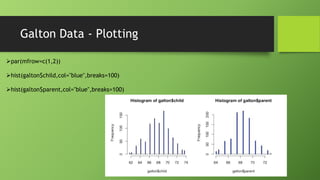
par(mfrow=c(1,2))
hist(galton$child,col="blue",breaks=100)

hist(galton$parent,col="blue",breaks=100)
Galton Data – Plotting
pairs(galton)

- cont.
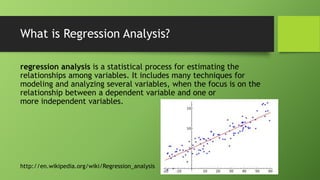
What is Regression Analysis?
regression analysis is a statistical process for estimating the
relationships among variables. It includes many techniques for
modeling and analyzing several variables, when the focus is on the
relationship between a dependent variable and one or
more independent variables.

http://en.wikipedia.org/wiki/Regression_analysis
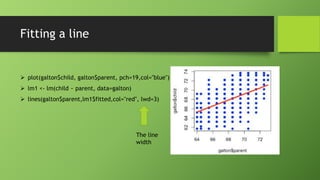
Fitting a line

 plot(galton$child, galton$parent, pch=19,col="blue")
 lm1 <- lm(child ~ parent, data=galton)
 lines(galton$parent,lm1$fitted,col="red", lwd=3)

The line
width
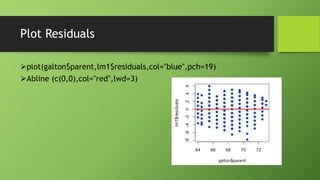
Plot Residuals
plot(galton$parent,lm1$residuals,col="blue",pch=19)
Abline (c(0,0),col="red",lwd=3)
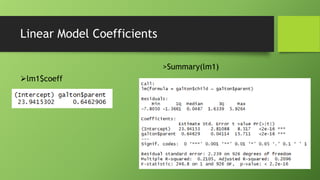
Linear Model Coefficients
>Summary(lm1)
lm1$coeff
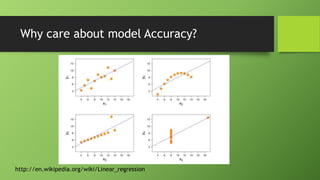
Why care about model Accuracy?

http://en.wikipedia.org/wiki/Linear_regression
Model Accuracy Measures
P-value
Confidence Interval
R2
Adjusted R2
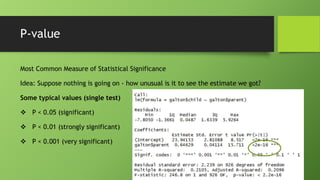
P-value
Most Common Measure of Statistical Significance
Idea: Suppose nothing is going on - how unusual is it to see the estimate we got?
Some typical values (single test)

 P < 0.05 (significant)
 P < 0.01 (strongly significant)
 P < 0.001 (very significant)
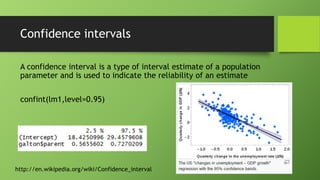
Confidence intervals
A confidence interval is a type of interval estimate of a population
parameter and is used to indicate the reliability of an estimate
confint(lm1,level=0.95)

http://en.wikipedia.org/wiki/Confidence_interval
2
R
R2 : the proportion of response variation "explained" by the
regressors in the model.
R2= 1 :the fitted model explains all variability in
R2 = 0 indicates no 'linear' relationship (for straight line
regression, this means that the straight line model is a constant line
(slope=0, intercept=bar{y}) between the response variable and
regressors).

http://en.wikipedia.org/wiki/Coefficient_of_determination
Adjusted R2
The use of an adjusted R2 (often written as bar R^2 and pronounced
"R bar squared") is an attempt to take account of the phenomenon
of the R2 automatically and spuriously increasing when extra
explanatory variables are added to the model.

http://en.wikipedia.org/wiki/Coefficient_of_determination
Predicting with Linear Regression
coef(lm1)[1] + coef(lm1)[2]*80

newdata <- data.frame(parent=80)
predict(lm1,newdata)
Multivariate Linear Regression
WHO childhood hunger data
Dataset:
http://apps.who.int/gho/athena/data/GHO/WHOSIS_000008.csv?pr
ofile=text&filter=COUNTRY:*
hunger <- read.csv("./hunger.csv")
hunger <- hunger[hunger$Sex!="Both sexes", ]
Multivariate Linear Regression

– cont.

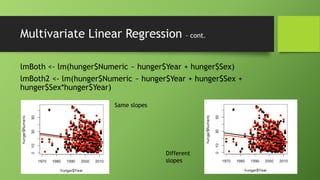
lmBoth <- lm(hunger$Numeric ~ hunger$Year + hunger$Sex)
lmBoth2 <- lm(hunger$Numeric ~ hunger$Year + hunger$Sex +
hunger$Sex*hunger$Year)
Same slopes

Different
slopes
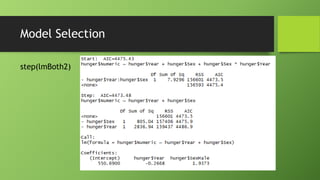
Model Selection
step(lmBoth2)
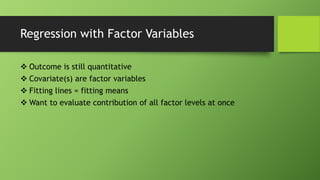
Regression with Factor Variables
 Outcome is still quantitative
 Covariate(s) are factor variables
 Fitting lines = fitting means
 Want to evaluate contribution of all factor levels at once
Regression with Factor Variables – cont.
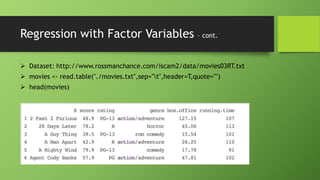
 Dataset: http://www.rossmanchance.com/iscam2/data/movies03RT.txt
 movies <- read.table("./movies.txt",sep="t",header=T,quote="")
 head(movies)
Regression with Factor Variables – cont.
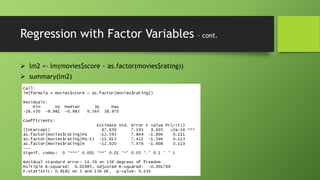
 lm2 <- lm(movies$score ~ as.factor(movies$rating))
 summary(lm2)
Data mining with R- regression models

Data mining with R- regression models

  • 1.
    Data Mining withR Regression models Hamideh Iraj Hamideh.iraj@ut.ac.ir
  • 2.
    Slides Reference This acuration from: Data Analysis Course Weeks 4-5-6 https://www.coursera.org/course/dataanalysis
  • 3.
    Galton Data –Introduction library(UsingR) data(galton) ---------------------------------Head(galton) Tail(galton) ---------------------------------Dim(galton) Str(galton) summary(galton) summary(galton$child)
  • 4.
    Galton Data -Plotting par(mfrow=c(1,2)) hist(galton$child,col="blue",breaks=100) hist(galton$parent,col="blue",breaks=100)
  • 5.
    Galton Data –Plotting pairs(galton) - cont.
  • 6.
    What is RegressionAnalysis? regression analysis is a statistical process for estimating the relationships among variables. It includes many techniques for modeling and analyzing several variables, when the focus is on the relationship between a dependent variable and one or more independent variables. http://en.wikipedia.org/wiki/Regression_analysis
  • 7.
    Fitting a line plot(galton$child, galton$parent, pch=19,col="blue")  lm1 <- lm(child ~ parent, data=galton)  lines(galton$parent,lm1$fitted,col="red", lwd=3) The line width
  • 8.
  • 9.
  • 10.
    Why care aboutmodel Accuracy? http://en.wikipedia.org/wiki/Linear_regression
  • 11.
  • 12.
    P-value Most Common Measureof Statistical Significance Idea: Suppose nothing is going on - how unusual is it to see the estimate we got? Some typical values (single test)  P < 0.05 (significant)  P < 0.01 (strongly significant)  P < 0.001 (very significant)
  • 13.
    Confidence intervals A confidenceinterval is a type of interval estimate of a population parameter and is used to indicate the reliability of an estimate confint(lm1,level=0.95) http://en.wikipedia.org/wiki/Confidence_interval
  • 14.
    2 R R2 : theproportion of response variation "explained" by the regressors in the model. R2= 1 :the fitted model explains all variability in R2 = 0 indicates no 'linear' relationship (for straight line regression, this means that the straight line model is a constant line (slope=0, intercept=bar{y}) between the response variable and regressors). http://en.wikipedia.org/wiki/Coefficient_of_determination
  • 15.
    Adjusted R2 The useof an adjusted R2 (often written as bar R^2 and pronounced "R bar squared") is an attempt to take account of the phenomenon of the R2 automatically and spuriously increasing when extra explanatory variables are added to the model. http://en.wikipedia.org/wiki/Coefficient_of_determination
  • 16.
    Predicting with LinearRegression coef(lm1)[1] + coef(lm1)[2]*80 newdata <- data.frame(parent=80) predict(lm1,newdata)
  • 17.
    Multivariate Linear Regression WHOchildhood hunger data Dataset: http://apps.who.int/gho/athena/data/GHO/WHOSIS_000008.csv?pr ofile=text&filter=COUNTRY:* hunger <- read.csv("./hunger.csv") hunger <- hunger[hunger$Sex!="Both sexes", ]
  • 18.
    Multivariate Linear Regression –cont. lmBoth <- lm(hunger$Numeric ~ hunger$Year + hunger$Sex) lmBoth2 <- lm(hunger$Numeric ~ hunger$Year + hunger$Sex + hunger$Sex*hunger$Year) Same slopes Different slopes
  • 19.
  • 20.
    Regression with FactorVariables  Outcome is still quantitative  Covariate(s) are factor variables  Fitting lines = fitting means  Want to evaluate contribution of all factor levels at once
  • 21.
    Regression with FactorVariables – cont.  Dataset: http://www.rossmanchance.com/iscam2/data/movies03RT.txt  movies <- read.table("./movies.txt",sep="t",header=T,quote="")  head(movies)
  • 22.
    Regression with FactorVariables – cont.  lm2 <- lm(movies$score ~ as.factor(movies$rating))  summary(lm2)