© 2014 Health Catalyst
www.healthcatalyst.comProprietary. Feel free to share but we would appreciate a Health Catalyst citation.
© 2014 Health Catalyst
www.healthcatalyst.com
Proprietary. Feel free to share but we would appreciate a Health Catalyst citation.
What is Data Mining in Healthcare?
How Health Systems Can Improve Quality and Reduce Costs
By David Crockett, Ryan Johnson and Brian Eliason
© 2014 Health Catalyst
www.healthcatalyst.comProprietary. Feel free to share but we would appreciate a Health Catalyst citation.
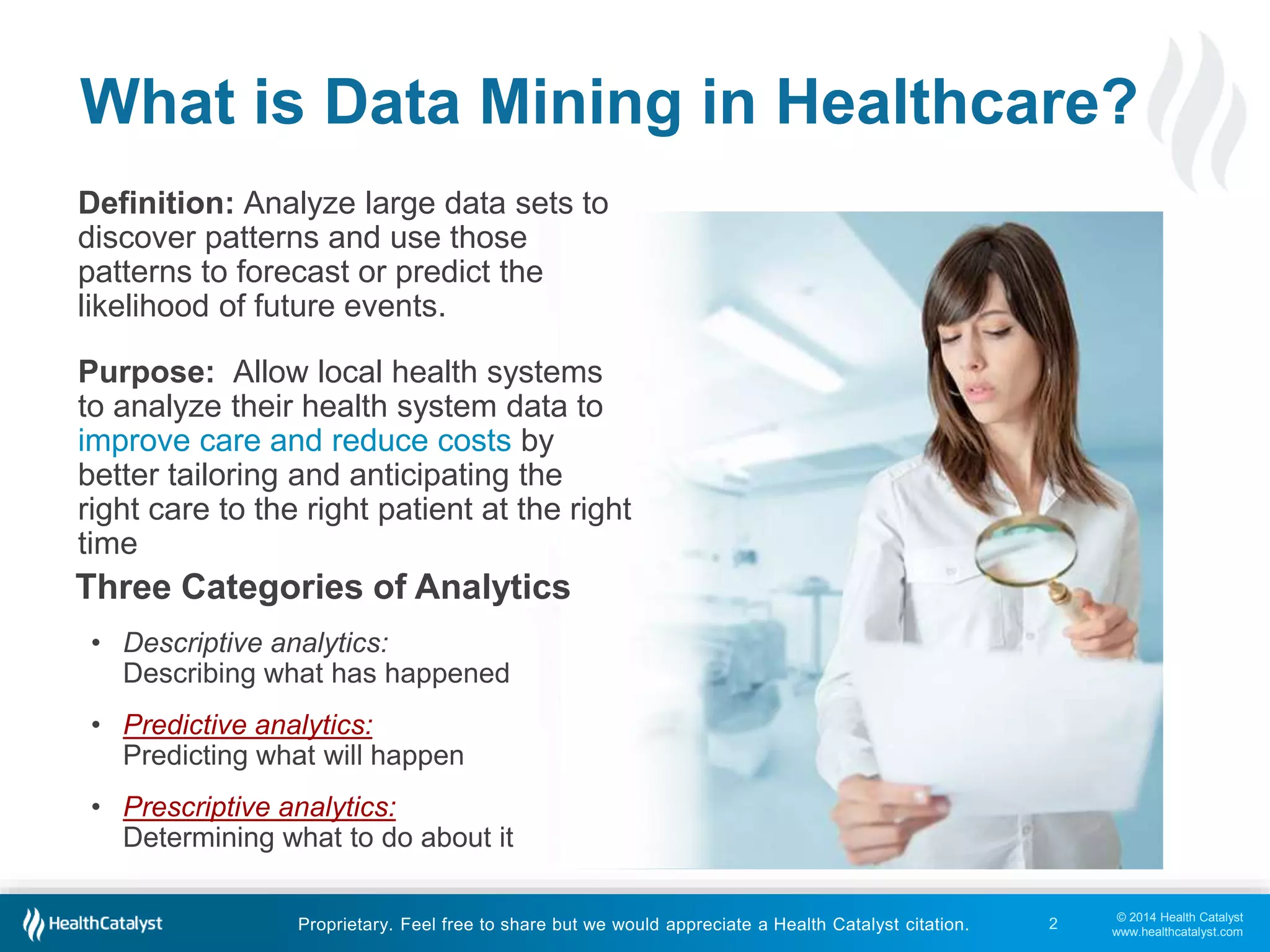
What is Data Mining in Healthcare?
2
Definition: Analyze large data sets to
discover patterns and use those
patterns to forecast or predict the
likelihood of future events.
Purpose: Allow local health systems
to analyze their health system data to
improve care and reduce costs by
better tailoring and anticipating the
right care to the right patient at the right
time
Three Categories of Analytics
• Descriptive analytics:
Describing what has happened
• Predictive analytics:
Predicting what will happen
• Prescriptive analytics:
Determining what to do about it
© 2014 Health Catalyst
www.healthcatalyst.comProprietary. Feel free to share but we would appreciate a Health Catalyst citation.
Predictive Analytics
3
Data mining involves uncovering patterns
from vast data stores and using that
information to build predictive models.
Data mining in healthcare today is, for the
most part, an academic exercise with few
pragmatic success stories. Academicians
are using data-mining approaches to
publish research. Healthcare has been
slow to incorporate the latest research
into everyday practice.
Data warehouse practitioners are asking:
how do we narrow adoption time from the
bench (research) to the bedside
(pragmatic quality improvement) and
directly affect outcomes?
© 2014 Health Catalyst
www.healthcatalyst.comProprietary. Feel free to share but we would appreciate a Health Catalyst citation.
The Three Systems Approach
4
The most effective strategy for taking data mining beyond the realm of
academic research is the three systems approach. Implementing all
three systems is the key to driving real-world improvement with any
analytics initiative in healthcare.
Analytics System
This system includes the
technology and the expertise
to gather data, make sense of
it and standardize measure-
ments. Aggregating clinical,
financial, patient satisfaction,
and other data into an
enterprise data warehouse
(EDW) is the foundational
piece of this system.
Content System
Involves standardizing
knowledge work then
applying evidence-based best
practices to care delivery. A
strong content system
enables organizations to put
the latest medical evidence
into practice quickly.
Deployment System
Involves driving change
management through new
organizational structures. In
particular, it involves
implementing team structures
that will enable consistent,
enterprise-wide deployment
of best practices. This system
requires real organizational
change to drive adoption of
best practices.
© 2014 Health Catalyst
www.healthcatalyst.comProprietary. Feel free to share but we would appreciate a Health Catalyst citation.
Pragmatic Application of Data
Mining in Healthcare–Today
5
Once an institution implements the
analytics foundation to mine data and
have content and organizational
systems in place to make data mining
insights actionable, they are now
ready to use predictive analytics in
new and innovative ways.
One health system is using data
mining to lower its census for patients
under risk contracts, while at the
same time keeping its patient volume
steady for patients not included in
these contracts. We are mining the
data to predict what the volumes will
be for each category of patient.
© 2014 Health Catalyst
www.healthcatalyst.comProprietary. Feel free to share but we would appreciate a Health Catalyst citation.
Pragmatic Application of Data
Mining in Healthcare–Today
6
Another healthcare provider is
mining data to predict 30-day
readmissions based on census.
We apply a risk model (based on
comorbidity, severity score,
physician scoring, and other
factors) to patients in the census,
run the data through regression
analysis, and assign a risk score
to each patient.
The health system uses this
score to inform which care-path
patients take after discharge so
that they receive the appropriate
follow-up care.
© 2014 Health Catalyst
www.healthcatalyst.comProprietary. Feel free to share but we would appreciate a Health Catalyst citation.
Using Analytics to Track Fee-for-Service
and Value-based Payer Contracts
7
Data mining and predictive analytics
address a major trend in healthcare
today: effecting a smooth transition
from fee-for-service (FFS) to a value-
based reimbursement model.
One integrated delivery network (IDN)
making the transition to value-based
purchasing is using data mining to
effectively navigate the ongoing trends
in healthcare.
They understand the need to lower
their census for patients under risk
contracts and also keep patient volume
steady for patients not included in
these contracts.
© 2014 Health Catalyst
www.healthcatalyst.comProprietary. Feel free to share but we would appreciate a Health Catalyst citation.
Monitoring and Predicting Fee-for-
service Volumes
8
This same IDN’s gets a significant
amount of revenue out-of-state
referrals. To ensure these FFS
contracts remain in place they
implemented an enterprise data
warehouse (EDW) with advanced
analytics applications to monitor
payer, financial and costs.
This system enables the team to
mine data, viewing trends in volume
and margin from each payer and
react quickly where needed. Using
sophisticated algorithms to forecast
decreases in volume or margin is key
to becoming a truly predictive and
reactive system.
Participating in Shared-risk
Contracts
9
The IDN is an accountable care
organization (ACO) with shared-risk
contracts that cover tens of
thousands of patients. While bringing
referrals into the hospital, they are
optimizing care to keep their at-risk
population out of the hospital. They
are using the EDW to help ensure
patients in this population are being
treated in the most appropriate,
lowest-cost setting.
Analytics enables the team to monitor
care is delivered in the appropriate
setting, identify at-risk patients within
the population, and ensure that those
patients have a care manager.
© 2014 Health Catalyst
www.healthcatalyst.comProprietary. Feel free to share but we would appreciate a Health Catalyst citation.
Pragmatic Application of Data
Mining to Population Health Mgmt
10
Using the flexibility of an EDW allows
providers to concurrently pursue multiple
population health management initiatives
on a single analytics platform.
© 2014 Health Catalyst
www.healthcatalyst.comProprietary. Feel free to share but we would appreciate a Health Catalyst citation.
Data Mining to Improve Primary
Care Reporting
11
Mining historical EDW data
enables primary care providers
(PCPs) to meet population
health regulatory measures.
PCPs must demonstrate to
regulatory bodies that they are
giving the appropriate
screenings and treatment to
certain populations of patients.
Having this data readily on hand
has also enabled clinics to
streamline patient care
processes—enabling front-desk
staff and nurses to handle
screening processes early in a
patient visit.
© 2014 Health Catalyst
www.healthcatalyst.comProprietary. Feel free to share but we would appreciate a Health Catalyst citation.
Data Mining to Predict Patient
Population Risk
12
The second initiative involves
applying predictive algorithms to
EDW data to predict risk within
certain populations. This process
of stratifying patients into high-,
medium- or low-risk groups is
key to the success of any
population health management
initiative.
By applying a tailored algorithm
to the data, the clinic has been
able to pinpoint which patients
need the most attention and
integrated this insight into its
workflow with a simple ranking
of priority patients.
© 2014 Health Catalyst
www.healthcatalyst.comProprietary. Feel free to share but we would appreciate a Health Catalyst citation.
Data Mining to Prevent Hospital
Readmissions
13
Reducing 30- and 90-day
readmissions rates is another
important issue health systems
are tackling today. We have used
data mining to create algorithms
that identity those patients at risk
for readmission.
Steps to learn from a historical cohort and create an algorithm:
1. Define a time period (the parameters of the historical data).
2. Identify patients flagged for readmission in that time period.
3. Find everything those patients have in common.
4. Determine which of these variables impact readmissions.
© 2014 Health Catalyst
www.healthcatalyst.comProprietary. Feel free to share but we would appreciate a Health Catalyst citation.
An Introduction to Training
Predictive Algorithms
14
The process of building and
refining an algorithm based on
historical data is called training
the algorithm.
Using an algorithm to make an
impact in today’s care requires
buy-in from the clinicians
delivering care on the
frontlines. For them to own the
algorithm, trust the data, and
incorporate new processes into
their workflow, incorporating
their feedback is critical.
© 2014 Health Catalyst
www.healthcatalyst.comProprietary. Feel free to share but we would appreciate a Health Catalyst citation.
The More Specific the Algorithm,
the Better
15
Rather than train an algorithm
specific to cases like heart
transplant or heart failure,
many organizations rely on all-
cause or general readmissions
data to predict readmissions.
Most generic algorithms are
only about 75% accurate.
The extra effort to train an
algorithm based on a specific
population will jump the
accuracy above 90%. Identify
those characteristics unique to
that population and the
algorithm will always be better.
© 2014 Health Catalyst
www.healthcatalyst.comProprietary. Feel free to share but we would appreciate a Health Catalyst citation.
Readmissions in the Real World: A
Health System’s Improvement Initiative
16
Ideally, health systems would
quickly start using predictive
analytics to reduce readmissions. In
the real world, things aren’t so tidy.
Sometimes the health system has
to improve documentation first and
build up the necessary data before
launching predictive analytics.
One of our health system clients
used an EDW and advanced
analytics applications to begin a
readmissions initiative with only
general readmissions baselines to
guide them.
© 2014 Health Catalyst
www.healthcatalyst.comProprietary. Feel free to share but we would appreciate a Health Catalyst citation.
Readmissions in the Real World: A
Health System’s Improvement Initiative
17
This client decided to begin by
focusing on a specific cohort: heart
failure (HF) patients. We worked
with them to create a data mart for
their HF population so they could
track readmissions rates and
assess how the quality
interventions they implemented
affected those rates.
The health system’s team gathered
best practices from the medical
literature and decided to use
interventions that included
medication review, follow-up phone
calls and scheduling follow-up
appointment at discharge.
© 2014 Health Catalyst
www.healthcatalyst.comProprietary. Feel free to share but we would appreciate a Health Catalyst citation.
Readmissions in the Real World: A
Health System’s Improvement Initiative
18
As they implemented these best
practices, data flowed into the EDW,
and the team was able to see:
1) How compliant clinicians were
in using the best practices.
2) How these best-practices affected
30- and 90-day readmissions.
The team is now turning its attention
to predictive algorithms as a method
for streamlining its processes and
making more effective interventions.
© 2014 Health Catalyst
www.healthcatalyst.comProprietary. Feel free to share but we would appreciate a Health Catalyst citation.
Data Mining in Healthcare Holds
Great Potential
19
Today’s healthcare data mining takes
place primarily in an academic
setting. Getting it out into health
systems and making real
improvements requires three
systems: analytics, content, and
deployment, along with a culture of
improvement.
We hope that showing these real-
world examples inspires your team to
think about what is possible when
data mining is done right.
© 2013 Health Catalyst
www.healthcatalyst.com
Other Clinical Quality Improvement Resources
Learn about why prescriptive analytics beats simple prediction for
improving healthcare or read more about the best organization structure
for successful healthcare analytics.
Brian Eliason brings more than 10 years of Healthcare IT experience to Health Catalyst,
specializing in data warehousing and data architecture. His work has been presented at
HDWA and AMIA. Prior to coming to Catalyst, Mr. Eliason was the technical lead at The
Children's Hospital at Denver with experience using I2B2. Previously, he was a senior data
architect for Intermountain Healthcare, working closely with the disease management and
care management groups.
David K. Crockett, Ph.D. is the Senior Director of Research and Predictive Analytics. He brings
nearly 20 years of translational research experience in pathology, laboratory and clinical
diagnostics. His recent work includes patents in computer prediction models for phenotype
effect of uncertain gene variants. Dr. Crockett has published more than 50 peer-reviewed
journal articles in areas such as bioinformatics, biomarker discovery, immunology, molecular
oncology, genomics and proteomics. He holds a BA in molecular biology from Brigham Young
University, and a Ph.D. in biomedical informatics from the University of Utah, recognized as
one of the top training programs for informatics in the world.
Ryan Johnson joined Health Catalyst in June 2012 as a Senior Data Architect. Prior to coming to
HC, he worked 6 years as a software developer for a government contractor, Fast Enterprises, in
Utah and Colorado. Ryan has a degree in Mathematics (number theory) from BYU.

Data Mining in Healthcare: How Health Systems Can Improve Quality and Reduce Costs

  • 1.
    © 2014 HealthCatalyst www.healthcatalyst.comProprietary. Feel free to share but we would appreciate a Health Catalyst citation. © 2014 Health Catalyst www.healthcatalyst.com Proprietary. Feel free to share but we would appreciate a Health Catalyst citation. What is Data Mining in Healthcare? How Health Systems Can Improve Quality and Reduce Costs By David Crockett, Ryan Johnson and Brian Eliason
  • 2.
    © 2014 HealthCatalyst www.healthcatalyst.comProprietary. Feel free to share but we would appreciate a Health Catalyst citation. What is Data Mining in Healthcare? 2 Definition: Analyze large data sets to discover patterns and use those patterns to forecast or predict the likelihood of future events. Purpose: Allow local health systems to analyze their health system data to improve care and reduce costs by better tailoring and anticipating the right care to the right patient at the right time Three Categories of Analytics • Descriptive analytics: Describing what has happened • Predictive analytics: Predicting what will happen • Prescriptive analytics: Determining what to do about it
  • 3.
    © 2014 HealthCatalyst www.healthcatalyst.comProprietary. Feel free to share but we would appreciate a Health Catalyst citation. Predictive Analytics 3 Data mining involves uncovering patterns from vast data stores and using that information to build predictive models. Data mining in healthcare today is, for the most part, an academic exercise with few pragmatic success stories. Academicians are using data-mining approaches to publish research. Healthcare has been slow to incorporate the latest research into everyday practice. Data warehouse practitioners are asking: how do we narrow adoption time from the bench (research) to the bedside (pragmatic quality improvement) and directly affect outcomes?
  • 4.
    © 2014 HealthCatalyst www.healthcatalyst.comProprietary. Feel free to share but we would appreciate a Health Catalyst citation. The Three Systems Approach 4 The most effective strategy for taking data mining beyond the realm of academic research is the three systems approach. Implementing all three systems is the key to driving real-world improvement with any analytics initiative in healthcare. Analytics System This system includes the technology and the expertise to gather data, make sense of it and standardize measure- ments. Aggregating clinical, financial, patient satisfaction, and other data into an enterprise data warehouse (EDW) is the foundational piece of this system. Content System Involves standardizing knowledge work then applying evidence-based best practices to care delivery. A strong content system enables organizations to put the latest medical evidence into practice quickly. Deployment System Involves driving change management through new organizational structures. In particular, it involves implementing team structures that will enable consistent, enterprise-wide deployment of best practices. This system requires real organizational change to drive adoption of best practices.
  • 5.
    © 2014 HealthCatalyst www.healthcatalyst.comProprietary. Feel free to share but we would appreciate a Health Catalyst citation. Pragmatic Application of Data Mining in Healthcare–Today 5 Once an institution implements the analytics foundation to mine data and have content and organizational systems in place to make data mining insights actionable, they are now ready to use predictive analytics in new and innovative ways. One health system is using data mining to lower its census for patients under risk contracts, while at the same time keeping its patient volume steady for patients not included in these contracts. We are mining the data to predict what the volumes will be for each category of patient.
  • 6.
    © 2014 HealthCatalyst www.healthcatalyst.comProprietary. Feel free to share but we would appreciate a Health Catalyst citation. Pragmatic Application of Data Mining in Healthcare–Today 6 Another healthcare provider is mining data to predict 30-day readmissions based on census. We apply a risk model (based on comorbidity, severity score, physician scoring, and other factors) to patients in the census, run the data through regression analysis, and assign a risk score to each patient. The health system uses this score to inform which care-path patients take after discharge so that they receive the appropriate follow-up care.
  • 7.
    © 2014 HealthCatalyst www.healthcatalyst.comProprietary. Feel free to share but we would appreciate a Health Catalyst citation. Using Analytics to Track Fee-for-Service and Value-based Payer Contracts 7 Data mining and predictive analytics address a major trend in healthcare today: effecting a smooth transition from fee-for-service (FFS) to a value- based reimbursement model. One integrated delivery network (IDN) making the transition to value-based purchasing is using data mining to effectively navigate the ongoing trends in healthcare. They understand the need to lower their census for patients under risk contracts and also keep patient volume steady for patients not included in these contracts.
  • 8.
    © 2014 HealthCatalyst www.healthcatalyst.comProprietary. Feel free to share but we would appreciate a Health Catalyst citation. Monitoring and Predicting Fee-for- service Volumes 8 This same IDN’s gets a significant amount of revenue out-of-state referrals. To ensure these FFS contracts remain in place they implemented an enterprise data warehouse (EDW) with advanced analytics applications to monitor payer, financial and costs. This system enables the team to mine data, viewing trends in volume and margin from each payer and react quickly where needed. Using sophisticated algorithms to forecast decreases in volume or margin is key to becoming a truly predictive and reactive system.
  • 9.
    Participating in Shared-risk Contracts 9 TheIDN is an accountable care organization (ACO) with shared-risk contracts that cover tens of thousands of patients. While bringing referrals into the hospital, they are optimizing care to keep their at-risk population out of the hospital. They are using the EDW to help ensure patients in this population are being treated in the most appropriate, lowest-cost setting. Analytics enables the team to monitor care is delivered in the appropriate setting, identify at-risk patients within the population, and ensure that those patients have a care manager.
  • 10.
    © 2014 HealthCatalyst www.healthcatalyst.comProprietary. Feel free to share but we would appreciate a Health Catalyst citation. Pragmatic Application of Data Mining to Population Health Mgmt 10 Using the flexibility of an EDW allows providers to concurrently pursue multiple population health management initiatives on a single analytics platform.
  • 11.
    © 2014 HealthCatalyst www.healthcatalyst.comProprietary. Feel free to share but we would appreciate a Health Catalyst citation. Data Mining to Improve Primary Care Reporting 11 Mining historical EDW data enables primary care providers (PCPs) to meet population health regulatory measures. PCPs must demonstrate to regulatory bodies that they are giving the appropriate screenings and treatment to certain populations of patients. Having this data readily on hand has also enabled clinics to streamline patient care processes—enabling front-desk staff and nurses to handle screening processes early in a patient visit.
  • 12.
    © 2014 HealthCatalyst www.healthcatalyst.comProprietary. Feel free to share but we would appreciate a Health Catalyst citation. Data Mining to Predict Patient Population Risk 12 The second initiative involves applying predictive algorithms to EDW data to predict risk within certain populations. This process of stratifying patients into high-, medium- or low-risk groups is key to the success of any population health management initiative. By applying a tailored algorithm to the data, the clinic has been able to pinpoint which patients need the most attention and integrated this insight into its workflow with a simple ranking of priority patients.
  • 13.
    © 2014 HealthCatalyst www.healthcatalyst.comProprietary. Feel free to share but we would appreciate a Health Catalyst citation. Data Mining to Prevent Hospital Readmissions 13 Reducing 30- and 90-day readmissions rates is another important issue health systems are tackling today. We have used data mining to create algorithms that identity those patients at risk for readmission. Steps to learn from a historical cohort and create an algorithm: 1. Define a time period (the parameters of the historical data). 2. Identify patients flagged for readmission in that time period. 3. Find everything those patients have in common. 4. Determine which of these variables impact readmissions.
  • 14.
    © 2014 HealthCatalyst www.healthcatalyst.comProprietary. Feel free to share but we would appreciate a Health Catalyst citation. An Introduction to Training Predictive Algorithms 14 The process of building and refining an algorithm based on historical data is called training the algorithm. Using an algorithm to make an impact in today’s care requires buy-in from the clinicians delivering care on the frontlines. For them to own the algorithm, trust the data, and incorporate new processes into their workflow, incorporating their feedback is critical.
  • 15.
    © 2014 HealthCatalyst www.healthcatalyst.comProprietary. Feel free to share but we would appreciate a Health Catalyst citation. The More Specific the Algorithm, the Better 15 Rather than train an algorithm specific to cases like heart transplant or heart failure, many organizations rely on all- cause or general readmissions data to predict readmissions. Most generic algorithms are only about 75% accurate. The extra effort to train an algorithm based on a specific population will jump the accuracy above 90%. Identify those characteristics unique to that population and the algorithm will always be better.
  • 16.
    © 2014 HealthCatalyst www.healthcatalyst.comProprietary. Feel free to share but we would appreciate a Health Catalyst citation. Readmissions in the Real World: A Health System’s Improvement Initiative 16 Ideally, health systems would quickly start using predictive analytics to reduce readmissions. In the real world, things aren’t so tidy. Sometimes the health system has to improve documentation first and build up the necessary data before launching predictive analytics. One of our health system clients used an EDW and advanced analytics applications to begin a readmissions initiative with only general readmissions baselines to guide them.
  • 17.
    © 2014 HealthCatalyst www.healthcatalyst.comProprietary. Feel free to share but we would appreciate a Health Catalyst citation. Readmissions in the Real World: A Health System’s Improvement Initiative 17 This client decided to begin by focusing on a specific cohort: heart failure (HF) patients. We worked with them to create a data mart for their HF population so they could track readmissions rates and assess how the quality interventions they implemented affected those rates. The health system’s team gathered best practices from the medical literature and decided to use interventions that included medication review, follow-up phone calls and scheduling follow-up appointment at discharge.
  • 18.
    © 2014 HealthCatalyst www.healthcatalyst.comProprietary. Feel free to share but we would appreciate a Health Catalyst citation. Readmissions in the Real World: A Health System’s Improvement Initiative 18 As they implemented these best practices, data flowed into the EDW, and the team was able to see: 1) How compliant clinicians were in using the best practices. 2) How these best-practices affected 30- and 90-day readmissions. The team is now turning its attention to predictive algorithms as a method for streamlining its processes and making more effective interventions.
  • 19.
    © 2014 HealthCatalyst www.healthcatalyst.comProprietary. Feel free to share but we would appreciate a Health Catalyst citation. Data Mining in Healthcare Holds Great Potential 19 Today’s healthcare data mining takes place primarily in an academic setting. Getting it out into health systems and making real improvements requires three systems: analytics, content, and deployment, along with a culture of improvement. We hope that showing these real- world examples inspires your team to think about what is possible when data mining is done right.
  • 20.
    © 2013 HealthCatalyst www.healthcatalyst.com Other Clinical Quality Improvement Resources Learn about why prescriptive analytics beats simple prediction for improving healthcare or read more about the best organization structure for successful healthcare analytics. Brian Eliason brings more than 10 years of Healthcare IT experience to Health Catalyst, specializing in data warehousing and data architecture. His work has been presented at HDWA and AMIA. Prior to coming to Catalyst, Mr. Eliason was the technical lead at The Children's Hospital at Denver with experience using I2B2. Previously, he was a senior data architect for Intermountain Healthcare, working closely with the disease management and care management groups. David K. Crockett, Ph.D. is the Senior Director of Research and Predictive Analytics. He brings nearly 20 years of translational research experience in pathology, laboratory and clinical diagnostics. His recent work includes patents in computer prediction models for phenotype effect of uncertain gene variants. Dr. Crockett has published more than 50 peer-reviewed journal articles in areas such as bioinformatics, biomarker discovery, immunology, molecular oncology, genomics and proteomics. He holds a BA in molecular biology from Brigham Young University, and a Ph.D. in biomedical informatics from the University of Utah, recognized as one of the top training programs for informatics in the world. Ryan Johnson joined Health Catalyst in June 2012 as a Senior Data Architect. Prior to coming to HC, he worked 6 years as a software developer for a government contractor, Fast Enterprises, in Utah and Colorado. Ryan has a degree in Mathematics (number theory) from BYU.