Shri Shivaji Institute of Engineering
Parbhani
Presented By :-
Mohd Osman Ansari
(Department of Computer Science & Engineering)
A Presentation on
Advances in Data Mining: Healthcare Applications
1
Contents……
 Introduction
 Knowledge Discovery Process
 Data Warehouse Architecture
 Data Mining Techniques
 Applications
 Challenges of Data Mining
 Conclusion
 References
2
Introduction
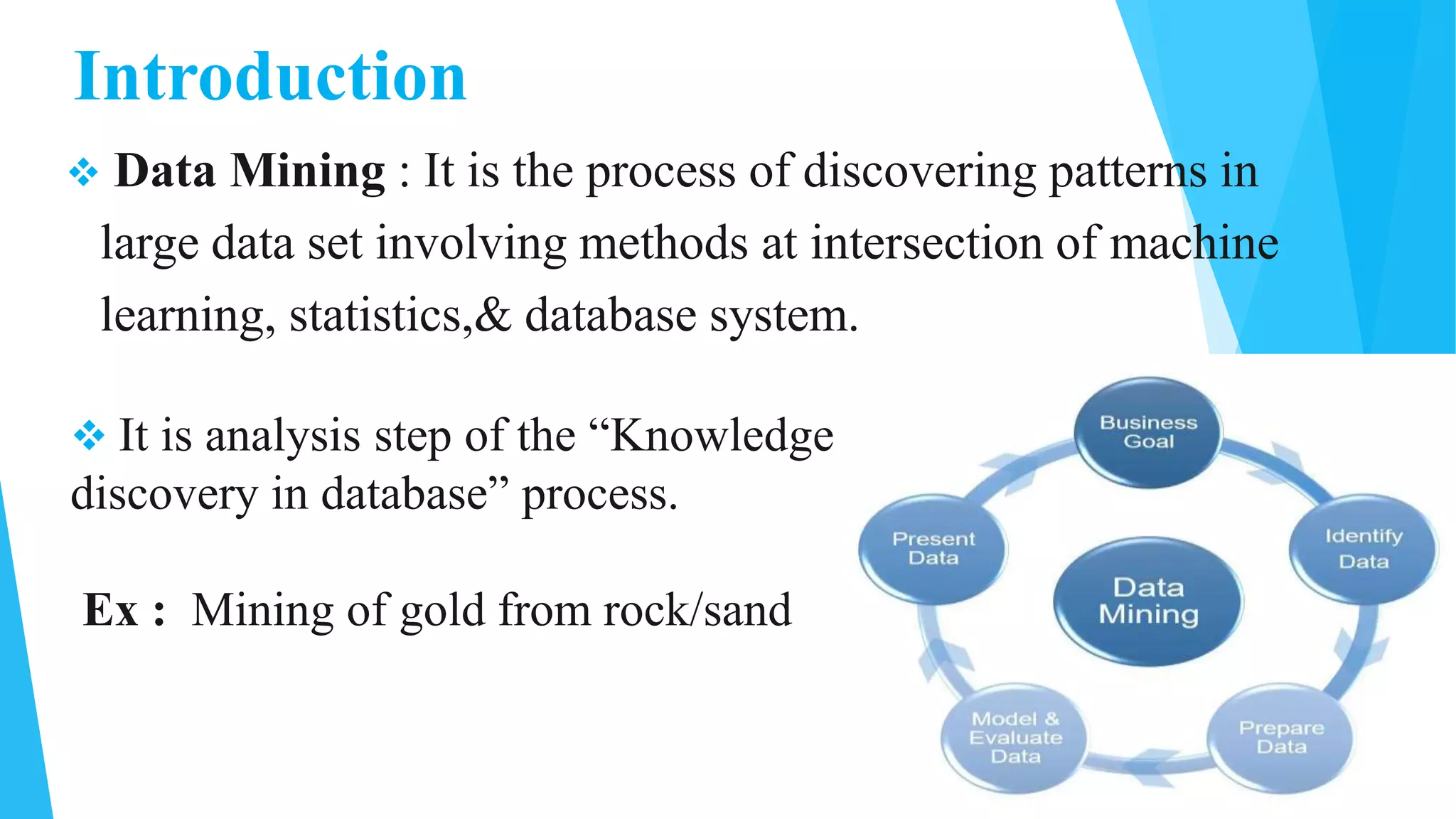
 Data Mining : It is the process of discovering patterns in
large data set involving methods at intersection of machine
learning, statistics,& database system.
3
 It is analysis step of the “Knowledge
discovery in database” process.
Ex : Mining of gold from rock/sand
Knowledge Discovery Process
4
 Data Selection
 Data Preprocessing
- Data Cleaning
- Data Integration
 Data Transformation
 Data Mining
 Interpretation & Presentation
Data Warehouse Architecture
 Bottom Tier - Feed data into the bottom tier which perform
the Extract, Clean, Load, and refresh functions.
 Middle Tier - implemented in either of the following ways.
ROLAP & MOLAP
 Top-Tier - This layer holds the query tools and reporting
tools, analysis tools and data mining tools.
5
6
Data Mining Techniques
Data Mining tasks can be modified into two
models :
1. Predictive - use some unknown variables &
predict future values of other variable.
“what will happen in future”.
2. Descriptive – Have to find pattern which
describes data & “what happened in past”.
[1] Classification
7
 Data analysis task where a classifier is constructed to predict class labels.
 Every class should be labeled.
 Class Labels can be represented by discrete values.
Ordering does not matter.
Applications Class Labels
For Medical Application Data “Treatment A” or “B” or “C”
For Marketing Application Data “Yes” or “No”
For Loan Application Data “Safe” or “Risky”
[3] Clustering
8
 Given a set of data points, each having a set of attributes, and a similarity measure among
them, find cluster such that
 Data points in one cluster are more similar to one another.
 Data points in separate cluster are less similar to one another.
Ex: Enhance costumer relationship management.
[2] Regression
 Based on dependent & independent variable .
 linear relationship .
 It is trying to model the relationship between dependent & independent variable.
Ex: Seasonal Sale Of E-commerce website
9
[4] Association Rule
 Given a set of transactions, find rules that will predict the occurrence of
an item based on occurrence of other items in the transaction
[5] Sequence Discovery
 An Ability to determine Sequential Pattern
in data
Ex: If someone buys a DVD player they’ll
probably buy DVD disks within a week.
10
Applications
 Customer Relationship Management
DM can be used to improve level of satisfaction of patient.
- future and current needs, and the preference of an individual
- predict the purchase strategies of healthcare customer
 Disease Detection and Doctor Recommendation
An intelligent system for disease prediction plays a major role in controlling the disease.
To detect the heart failure (HF), Saqlain et al. proposed a multinomial Naïve Bayes (NB) algorithm in 2016 [16].
11
 Inpatient length to stay prediction
To shorten patient length of stay.
In 2018, Graham, et al. proposed a method to predict admission in hospital
from the emergency department (ED) for improving patient flow and
stop overcrowding using data mining [14].
 Effective Treatment, Diagnosis & Prognosis
Majali et al. proposed a system in 2016 using
Classification and Association approach in data
mining for diagnosis and prognosis of cancer. [19]
Challenges of Data mining in Healthcare
12
 Mining methodology & user interaction
- Mining different kind of knowledge in database
- Pattern Evaluation & Presentation
 Performance Issue
- Efficiency & scalability of data mining
- Parallel distributed & incremental mining algorithm
 Diverse Data Types
- Handling inconsistent, non-standardized, missing data
- Mining information from different heterogeneous system
- Issues related to data such as ethical, social, & legal issues.
Conclusion
13
 Application of this emerging technology has not utilized properly in the healthcare
sector.
 The benefit not only include prediction of medical condition but also hospital
management systems such as emergency division.
 Though data mining technique in the healthcare is indeed complex its benefit is
boundless.
References
14
I. M. Saqlain, W. Hussain, N. A. Saqib, Nazar, and M.A. Kha, “Identification
of Heart Failure by Using Unstructured Data of Cardiac Patients,” in Proc.
45th International Conference on Parallel Processing Workshops, pp.426-
431, 2016.
II. B. Graham, R. Bond, M. Quinn, and M. Mulvenna, “Using Data Mining to
Predict Hospital Admissions From the Emergency Department,” IEEE
Access, vol. 6, pp. 10458-10469, 2018.
III. Majali et al. proposed a system in 2016 using Classification and
Association approach in data mining for diagnosis and prognosis of cancer.
15
Thank You

Data Mining : Healthcare Application

  • 1.
    Shri Shivaji Instituteof Engineering Parbhani Presented By :- Mohd Osman Ansari (Department of Computer Science & Engineering) A Presentation on Advances in Data Mining: Healthcare Applications 1
  • 2.
    Contents……  Introduction  KnowledgeDiscovery Process  Data Warehouse Architecture  Data Mining Techniques  Applications  Challenges of Data Mining  Conclusion  References 2
  • 3.
    Introduction  Data Mining: It is the process of discovering patterns in large data set involving methods at intersection of machine learning, statistics,& database system. 3  It is analysis step of the “Knowledge discovery in database” process. Ex : Mining of gold from rock/sand
  • 4.
    Knowledge Discovery Process 4 Data Selection  Data Preprocessing - Data Cleaning - Data Integration  Data Transformation  Data Mining  Interpretation & Presentation
  • 5.
    Data Warehouse Architecture Bottom Tier - Feed data into the bottom tier which perform the Extract, Clean, Load, and refresh functions.  Middle Tier - implemented in either of the following ways. ROLAP & MOLAP  Top-Tier - This layer holds the query tools and reporting tools, analysis tools and data mining tools. 5
  • 6.
    6 Data Mining Techniques DataMining tasks can be modified into two models : 1. Predictive - use some unknown variables & predict future values of other variable. “what will happen in future”. 2. Descriptive – Have to find pattern which describes data & “what happened in past”.
  • 7.
    [1] Classification 7  Dataanalysis task where a classifier is constructed to predict class labels.  Every class should be labeled.  Class Labels can be represented by discrete values. Ordering does not matter. Applications Class Labels For Medical Application Data “Treatment A” or “B” or “C” For Marketing Application Data “Yes” or “No” For Loan Application Data “Safe” or “Risky”
  • 8.
    [3] Clustering 8  Givena set of data points, each having a set of attributes, and a similarity measure among them, find cluster such that  Data points in one cluster are more similar to one another.  Data points in separate cluster are less similar to one another. Ex: Enhance costumer relationship management. [2] Regression  Based on dependent & independent variable .  linear relationship .  It is trying to model the relationship between dependent & independent variable. Ex: Seasonal Sale Of E-commerce website
  • 9.
    9 [4] Association Rule Given a set of transactions, find rules that will predict the occurrence of an item based on occurrence of other items in the transaction [5] Sequence Discovery  An Ability to determine Sequential Pattern in data Ex: If someone buys a DVD player they’ll probably buy DVD disks within a week.
  • 10.
    10 Applications  Customer RelationshipManagement DM can be used to improve level of satisfaction of patient. - future and current needs, and the preference of an individual - predict the purchase strategies of healthcare customer  Disease Detection and Doctor Recommendation An intelligent system for disease prediction plays a major role in controlling the disease. To detect the heart failure (HF), Saqlain et al. proposed a multinomial Naïve Bayes (NB) algorithm in 2016 [16].
  • 11.
    11  Inpatient lengthto stay prediction To shorten patient length of stay. In 2018, Graham, et al. proposed a method to predict admission in hospital from the emergency department (ED) for improving patient flow and stop overcrowding using data mining [14].  Effective Treatment, Diagnosis & Prognosis Majali et al. proposed a system in 2016 using Classification and Association approach in data mining for diagnosis and prognosis of cancer. [19]
  • 12.
    Challenges of Datamining in Healthcare 12  Mining methodology & user interaction - Mining different kind of knowledge in database - Pattern Evaluation & Presentation  Performance Issue - Efficiency & scalability of data mining - Parallel distributed & incremental mining algorithm  Diverse Data Types - Handling inconsistent, non-standardized, missing data - Mining information from different heterogeneous system - Issues related to data such as ethical, social, & legal issues.
  • 13.
    Conclusion 13  Application ofthis emerging technology has not utilized properly in the healthcare sector.  The benefit not only include prediction of medical condition but also hospital management systems such as emergency division.  Though data mining technique in the healthcare is indeed complex its benefit is boundless.
  • 14.
    References 14 I. M. Saqlain,W. Hussain, N. A. Saqib, Nazar, and M.A. Kha, “Identification of Heart Failure by Using Unstructured Data of Cardiac Patients,” in Proc. 45th International Conference on Parallel Processing Workshops, pp.426- 431, 2016. II. B. Graham, R. Bond, M. Quinn, and M. Mulvenna, “Using Data Mining to Predict Hospital Admissions From the Emergency Department,” IEEE Access, vol. 6, pp. 10458-10469, 2018. III. Majali et al. proposed a system in 2016 using Classification and Association approach in data mining for diagnosis and prognosis of cancer.
  • 15.