Health Care Analytics
Author: Rohit Bisht
๏‚ค What is Healthcare Analytics
๏‚ค Objectives of Healthcare Analytics
๏‚ค Types of Analytics
๏‚ค Source of Data
๏‚ค What do Healthcare companies achieve with healthcare analytics
๏‚ค Booming Technologies in the Healthcare Industries with some of their uses
๏‚ค Existing Healthcare analytics tool in the market
Table Of Content
What is Healthcare Analytics ?
Healthcare analytics focuses on the technologies and processes that measure, manage, and analyze healthcare data. Using
healthcare analytics properly enables you to make more effective and efficient operational and clinical decisions.
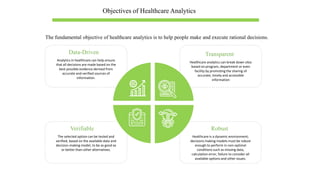
Objectives of Healthcare Analytics
Data-Driven
Analytics in healthcare can help ensure
that all decisions are made based on the
best possible evidence derived from
accurate and verified sources of
information.
Transparent
Healthcare analytics can break down silos
based on program, department or even
facility by promoting the sharing of
accurate, timely and accessible
information
Verifiable
The selected option can be tested and
verified, based on the available data and
decision-making model, to be as good as
or better than other alternatives.
Robust
Healthcare is a dynamic environment;
decisions making models must be robust
enough to perform in non-optimal
conditions such as missing data,
calculation error, failure to consider all
available options and other issues.
The fundamental objective of healthcare analytics is to help people make and execute rational decisions.
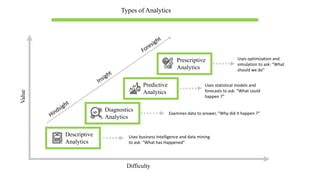
Uses business Intelligence and data mining
to ask: โ€œWhat has Happenedโ€
Uses statistical models and
forecasts to ask: โ€œWhat could
happen ?โ€
Uses optimization and
simulation to ask: โ€œWhat
should we doโ€
Examines data to answer, โ€œWhy did it happen ?โ€
Descriptive
Analytics
Prescriptive
Analytics
Diagnostics
Analytics
Predictive
Analytics
Value
Difficulty
Types of Analytics
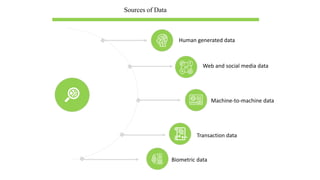
Human generated data
Web and social media data
Machine-to-machine data
Transaction data
Biometric data
Sources of Data
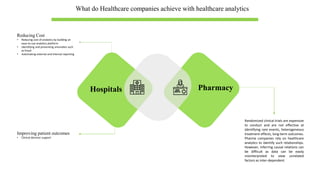
Hospitals Pharmacy
Reducing Cost
โ€ข Reducing cost of analytics by building an
easy-to-use analytics platform
โ€ข Identifying and preventing anomalies such
as fraud
โ€ข Automating external and internal reporting
What do Healthcare companies achieve with healthcare analytics
Improving patient outcomes
โ€ข Clinical decision support
Randomized clinical trials are expensive
to conduct and are not effective at
identifying rare events, heterogeneous
treatment effects, long-term outcomes.
Pharma companies rely on healthcare
analytics to identify such relationships.
However, inferring causal relations can
be difficult as data can be easily
misinterpreted to view unrelated
factors as inter-dependent.
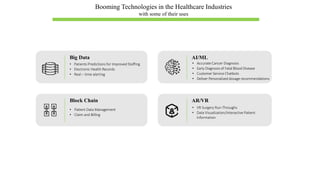
Big Data
โ€ข Patients Predictions for Improved Staffing
โ€ข Electronic Health Records
โ€ข Real โ€“ time alerting
AI/ML
โ€ข Accurate Cancer Diagnosis
โ€ข Early Diagnosis of Fatal Blood Disease
โ€ข Customer Service Chatbots
โ€ข Deliver Personalized dosage recommendations
Block Chain AR/VR
โ€ข VR Surgery Run-Throughs
โ€ข Data Visualization/Interactive Patient
Information
Booming Technologies in the Healthcare Industries
with some of their uses
โ€ข Patient Data Management
โ€ข Claim and Billing
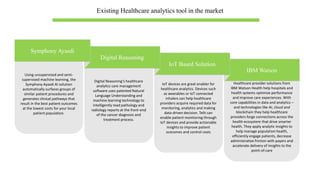
Digital Reasoningโ€™s healthcare
analytics care management
software uses patented Natural
Language Understanding and
machine learning technology to
intelligently read pathology and
radiology reports at the front-end
of the cancer diagnosis and
treatment process.
IoT devices are great enabler for
healthcare analytics. Devices such
as wearables or IoT connected
inhalers can help healthcare
providers acquire required data for
monitoring, analytics and making
data-driven decision. Telit can
enable patient monitoring through
IoT devices and provide actionable
insights to improve patient
outcomes and control costs
Using unsupervised and semi-
supervised machine learning, the
Symphony Ayasdi AI solution
automatically surfaces groups of
similar patient procedures and
generates clinical pathways that
result in the best patient outcomes
at the lowest costs for your local
patient population.
Healthcare provider solutions from
IBM Watson Health help hospitals and
health systems optimize performance
and improve care experiences. With
core capabilities in data and analytics โ€“
and technologies like AI, cloud and
blockchain they help healthcare
providers forge connections across the
health ecosystem that drive smarter
health. They apply analytic insights to
help manage population health,
efficiently engage patients, decrease
administrative friction with payers and
accelerate delivery of insights to the
point-of-care
Existing Healthcare analytics tool in the market
IBM Watson
IoT Based Solution
Digital Reasoning
Symphony Ayasdi
Thank you
Hope it helped !
- Rohit Bisht

Health care analytics

  • 1.
  • 2.
    ๏‚ค What isHealthcare Analytics ๏‚ค Objectives of Healthcare Analytics ๏‚ค Types of Analytics ๏‚ค Source of Data ๏‚ค What do Healthcare companies achieve with healthcare analytics ๏‚ค Booming Technologies in the Healthcare Industries with some of their uses ๏‚ค Existing Healthcare analytics tool in the market Table Of Content
  • 3.
    What is HealthcareAnalytics ? Healthcare analytics focuses on the technologies and processes that measure, manage, and analyze healthcare data. Using healthcare analytics properly enables you to make more effective and efficient operational and clinical decisions.
  • 4.
    Objectives of HealthcareAnalytics Data-Driven Analytics in healthcare can help ensure that all decisions are made based on the best possible evidence derived from accurate and verified sources of information. Transparent Healthcare analytics can break down silos based on program, department or even facility by promoting the sharing of accurate, timely and accessible information Verifiable The selected option can be tested and verified, based on the available data and decision-making model, to be as good as or better than other alternatives. Robust Healthcare is a dynamic environment; decisions making models must be robust enough to perform in non-optimal conditions such as missing data, calculation error, failure to consider all available options and other issues. The fundamental objective of healthcare analytics is to help people make and execute rational decisions.
  • 5.
    Uses business Intelligenceand data mining to ask: โ€œWhat has Happenedโ€ Uses statistical models and forecasts to ask: โ€œWhat could happen ?โ€ Uses optimization and simulation to ask: โ€œWhat should we doโ€ Examines data to answer, โ€œWhy did it happen ?โ€ Descriptive Analytics Prescriptive Analytics Diagnostics Analytics Predictive Analytics Value Difficulty Types of Analytics
  • 6.
    Human generated data Weband social media data Machine-to-machine data Transaction data Biometric data Sources of Data
  • 7.
    Hospitals Pharmacy Reducing Cost โ€ขReducing cost of analytics by building an easy-to-use analytics platform โ€ข Identifying and preventing anomalies such as fraud โ€ข Automating external and internal reporting What do Healthcare companies achieve with healthcare analytics Improving patient outcomes โ€ข Clinical decision support Randomized clinical trials are expensive to conduct and are not effective at identifying rare events, heterogeneous treatment effects, long-term outcomes. Pharma companies rely on healthcare analytics to identify such relationships. However, inferring causal relations can be difficult as data can be easily misinterpreted to view unrelated factors as inter-dependent.
  • 8.
    Big Data โ€ข PatientsPredictions for Improved Staffing โ€ข Electronic Health Records โ€ข Real โ€“ time alerting AI/ML โ€ข Accurate Cancer Diagnosis โ€ข Early Diagnosis of Fatal Blood Disease โ€ข Customer Service Chatbots โ€ข Deliver Personalized dosage recommendations Block Chain AR/VR โ€ข VR Surgery Run-Throughs โ€ข Data Visualization/Interactive Patient Information Booming Technologies in the Healthcare Industries with some of their uses โ€ข Patient Data Management โ€ข Claim and Billing
  • 9.
    Digital Reasoningโ€™s healthcare analyticscare management software uses patented Natural Language Understanding and machine learning technology to intelligently read pathology and radiology reports at the front-end of the cancer diagnosis and treatment process. IoT devices are great enabler for healthcare analytics. Devices such as wearables or IoT connected inhalers can help healthcare providers acquire required data for monitoring, analytics and making data-driven decision. Telit can enable patient monitoring through IoT devices and provide actionable insights to improve patient outcomes and control costs Using unsupervised and semi- supervised machine learning, the Symphony Ayasdi AI solution automatically surfaces groups of similar patient procedures and generates clinical pathways that result in the best patient outcomes at the lowest costs for your local patient population. Healthcare provider solutions from IBM Watson Health help hospitals and health systems optimize performance and improve care experiences. With core capabilities in data and analytics โ€“ and technologies like AI, cloud and blockchain they help healthcare providers forge connections across the health ecosystem that drive smarter health. They apply analytic insights to help manage population health, efficiently engage patients, decrease administrative friction with payers and accelerate delivery of insights to the point-of-care Existing Healthcare analytics tool in the market IBM Watson IoT Based Solution Digital Reasoning Symphony Ayasdi
  • 10.
    Thank you Hope ithelped ! - Rohit Bisht