September 2014 
Page 1 
MANAGING HEALTH TODAY 
Serious News & Ideas for Healthcare Executives 
September 2014 
Volume 19 Issue 2 
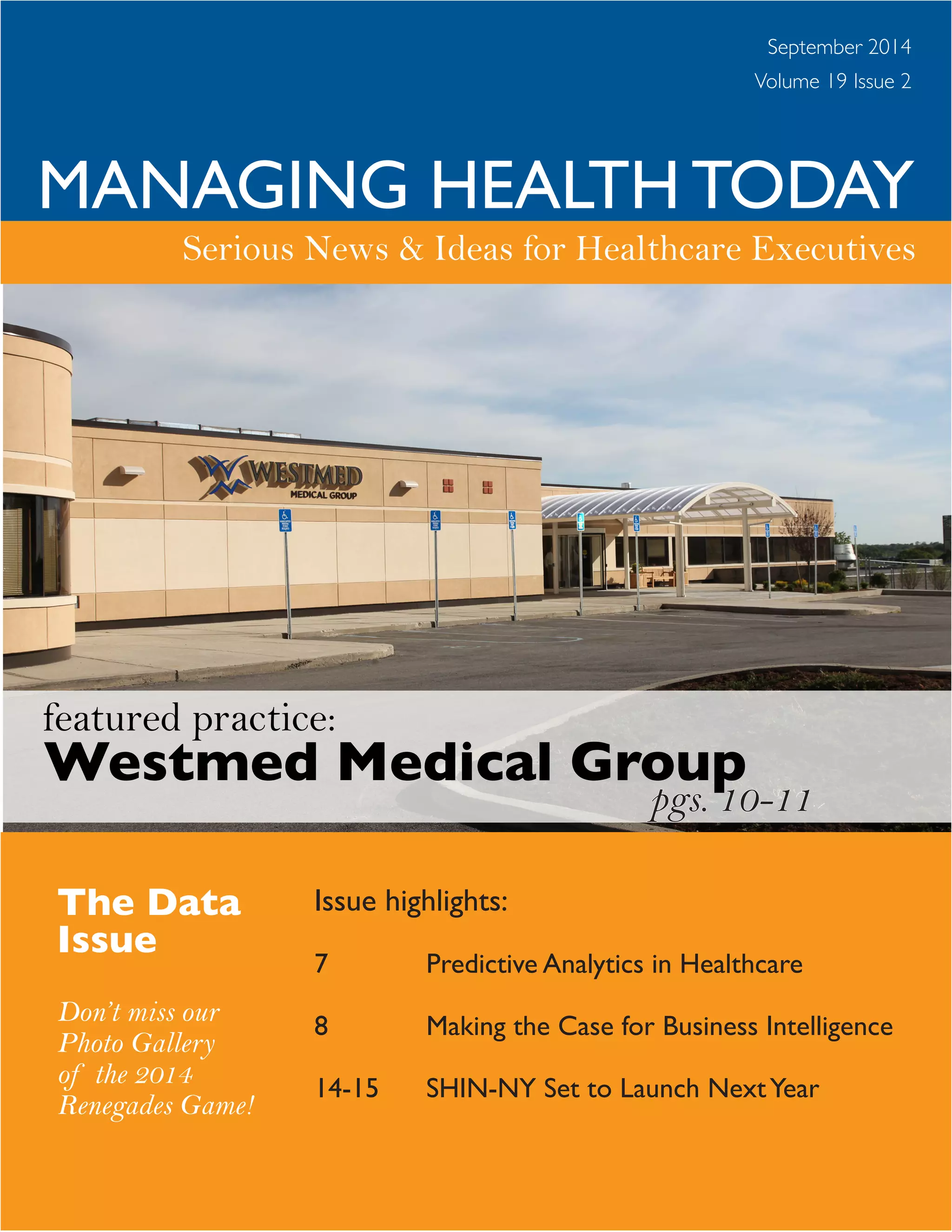
Westmed Medical Group 
Issue highlights: 
7 Predictive Analytics in Healthcare 
8 Making the Case for Business Intelligence 
14-15 SHIN-NY Set to Launch Next Year 
pgs. 10-11 
featured practice: 
The Data 
Issue 
Don’t miss our 
Photo Gallery 
of the 2014 
Renegades Game!
September 2014 
Page 7 
featured article 
Predictive Analytics in Healthcare 
Jim Hoffman, COO, Besler Consulting 
Predictive analytics has been used for many years in other in-dustries, 
but the concept has only recently come into favor in 
healthcare. 
What does “predictive analytics” mean? At a high level, pre-dictive 
analytics involves feeding a software tool a large vol-ume 
of historical data to determine patterns of factors that 
relate to a particular outcome. The software calculates a set 
of rules that can be applied to current data in order to make 
a prediction. The outcomes can be anything from “will this 
patient be readmitted?” to “will this claim be denied?” to “how 
many nurses should I schedule for next Tuesday?” 
You interact with predictive analytics every time you visit 
a supermarket. The coupons that print out at checkout are 
based on analyzing your current order and your past orders 
(if you use a membership card), and determining what else 
you’re likely to buy. If you buy hot dogs and ketchup, you 
might receive a coupon for hot dog buns. This is predictive 
analytics at work. On Amazon.com, when you see the section 
under an item with the heading “Customers Who Bought This 
Item Also Bought,” this list of products is also generated via 
predictive analytics. 
In healthcare, predictive analytics is being used in a number 
of areas: 
• Readmissions: Identifying patients likely to be read-mitted 
is becoming a popular use of predictive analytics in 
healthcare. With increasing Medicare penalties for excess 
readmissions, hospitals are incentivized to reduce them. Pre-dictive 
analytics can allow limited resources for discharge 
planning and post-discharge follow-up to be dedicated to the 
patients most likely to be readmitted. 
Some payers are using predictive analytics to identify ben-eficiaries 
likely to be readmitted. The payer then proactively 
communicates with the patient to be sure prescriptions are 
filled and primary care appointments are made, in an effort to 
reduce expenses related to readmissions. 
• Observation: Medical necessity audits by various gov-ernment 
and private payers have led hospitals to very care-fully 
consider the use of inpatient admission vs. observa-tion. 
Overusing observation status can result in reduced 
patient revenue, and underutilizing observation status can 
lead to medical necessity denials. Efforts are underway to 
use predictive analytics to help to determine, in conjunction 
with caregiver expertise, the most likely patient classification 
based on the demographics, vital signs and medical history 
of a patient. 
• Denials: By examining thousands of previously billed 
claims and their subsequent adjudication, predictive analytics 
has been used to identify the claims most likely to be denied 
before the bill is dropped. By routing these high risk claims 
to a review workflow, denials can be prevented and cash flow 
improved. 
• Propensity to Pay: Predictive analytics models are also 
being used to determine a patient’s ability to pay his or her 
out of pocket expenses prior to an elective procedure. Demo-graphics 
and credit scores are combined to create a risk score, 
and this is used make a decision about whether to extend 
credit or to require payment prior to provision of services. 
Not every problem is a good candidate for a predictive analytics 
solution. If a definitive answer can be derived from the data at 
hand, then predictive analytics is a poor fit. For example, one 
could use predictive analytics to assign a Medicare DRG to a 
claim before it’s billed. Predictive analytics could determine 
which DRG the claim “looks like.” However, a DRG grouper 
can definitively determine the appropriate DRG, and is what 
should be used. 
When utilizing predictive analytics, there is often a tradeoff 
between ease of implementation and effectiveness. If a pre-dictive 
analytics model to determine risk of readmission is 
built solely on claims data, which is easily obtainable, then the 
model is relatively simple to create and implement - simply 
run UB-04 data through the predictive model and generate a 
risk score at the time of billing. However, many of the more 
accurate readmission predictive models require EMR data and 
lab test results, as well as socioeconomic data unrelated to bill-ing. 
Interfacing with multiple hospital IT systems and modi-fying 
admission processes may be required to gain the benefits 
of a more accurate prediction. 
Healthcare is beginning to catch up to many other industries 
when it comes to the use of predictive analytics. Providers 
should monitor the expanding implementation of the tech-nology 
to determine when the price point and accuracy can 
provide a solid return on investment based on their particular 
needs. 
Jim Hoffman brings twenty-five years of 
technology and operations experience to 
his position as COO of BESLER Consulting. 
Most recently, he was President and General 
Manager of Accuro Revenue Management 
for MedAssets. Prior to the acquisition of 
Accuro Healthcare by MedAssets, he served as President and 
Chief Operating Officer of the Accuro Revenue Management 
business unit, and Chief Operating Officer of Innovative Health 
Solutions, acquired by Accuro from Besler Consulting in 2005. 
Jim is a graduate of the University of Virginia.

Predictive Analytics in Healthcare

  • 1.
    September 2014 Page1 MANAGING HEALTH TODAY Serious News & Ideas for Healthcare Executives September 2014 Volume 19 Issue 2 Westmed Medical Group Issue highlights: 7 Predictive Analytics in Healthcare 8 Making the Case for Business Intelligence 14-15 SHIN-NY Set to Launch Next Year pgs. 10-11 featured practice: The Data Issue Don’t miss our Photo Gallery of the 2014 Renegades Game!
  • 2.
    September 2014 Page7 featured article Predictive Analytics in Healthcare Jim Hoffman, COO, Besler Consulting Predictive analytics has been used for many years in other in-dustries, but the concept has only recently come into favor in healthcare. What does “predictive analytics” mean? At a high level, pre-dictive analytics involves feeding a software tool a large vol-ume of historical data to determine patterns of factors that relate to a particular outcome. The software calculates a set of rules that can be applied to current data in order to make a prediction. The outcomes can be anything from “will this patient be readmitted?” to “will this claim be denied?” to “how many nurses should I schedule for next Tuesday?” You interact with predictive analytics every time you visit a supermarket. The coupons that print out at checkout are based on analyzing your current order and your past orders (if you use a membership card), and determining what else you’re likely to buy. If you buy hot dogs and ketchup, you might receive a coupon for hot dog buns. This is predictive analytics at work. On Amazon.com, when you see the section under an item with the heading “Customers Who Bought This Item Also Bought,” this list of products is also generated via predictive analytics. In healthcare, predictive analytics is being used in a number of areas: • Readmissions: Identifying patients likely to be read-mitted is becoming a popular use of predictive analytics in healthcare. With increasing Medicare penalties for excess readmissions, hospitals are incentivized to reduce them. Pre-dictive analytics can allow limited resources for discharge planning and post-discharge follow-up to be dedicated to the patients most likely to be readmitted. Some payers are using predictive analytics to identify ben-eficiaries likely to be readmitted. The payer then proactively communicates with the patient to be sure prescriptions are filled and primary care appointments are made, in an effort to reduce expenses related to readmissions. • Observation: Medical necessity audits by various gov-ernment and private payers have led hospitals to very care-fully consider the use of inpatient admission vs. observa-tion. Overusing observation status can result in reduced patient revenue, and underutilizing observation status can lead to medical necessity denials. Efforts are underway to use predictive analytics to help to determine, in conjunction with caregiver expertise, the most likely patient classification based on the demographics, vital signs and medical history of a patient. • Denials: By examining thousands of previously billed claims and their subsequent adjudication, predictive analytics has been used to identify the claims most likely to be denied before the bill is dropped. By routing these high risk claims to a review workflow, denials can be prevented and cash flow improved. • Propensity to Pay: Predictive analytics models are also being used to determine a patient’s ability to pay his or her out of pocket expenses prior to an elective procedure. Demo-graphics and credit scores are combined to create a risk score, and this is used make a decision about whether to extend credit or to require payment prior to provision of services. Not every problem is a good candidate for a predictive analytics solution. If a definitive answer can be derived from the data at hand, then predictive analytics is a poor fit. For example, one could use predictive analytics to assign a Medicare DRG to a claim before it’s billed. Predictive analytics could determine which DRG the claim “looks like.” However, a DRG grouper can definitively determine the appropriate DRG, and is what should be used. When utilizing predictive analytics, there is often a tradeoff between ease of implementation and effectiveness. If a pre-dictive analytics model to determine risk of readmission is built solely on claims data, which is easily obtainable, then the model is relatively simple to create and implement - simply run UB-04 data through the predictive model and generate a risk score at the time of billing. However, many of the more accurate readmission predictive models require EMR data and lab test results, as well as socioeconomic data unrelated to bill-ing. Interfacing with multiple hospital IT systems and modi-fying admission processes may be required to gain the benefits of a more accurate prediction. Healthcare is beginning to catch up to many other industries when it comes to the use of predictive analytics. Providers should monitor the expanding implementation of the tech-nology to determine when the price point and accuracy can provide a solid return on investment based on their particular needs. Jim Hoffman brings twenty-five years of technology and operations experience to his position as COO of BESLER Consulting. Most recently, he was President and General Manager of Accuro Revenue Management for MedAssets. Prior to the acquisition of Accuro Healthcare by MedAssets, he served as President and Chief Operating Officer of the Accuro Revenue Management business unit, and Chief Operating Officer of Innovative Health Solutions, acquired by Accuro from Besler Consulting in 2005. Jim is a graduate of the University of Virginia.