Putting it All Together:
Integrating Data from External Sources For
Decision Support in Population Health
Dale Sanders
Executive Vice President, Product Development
Health Catalyst
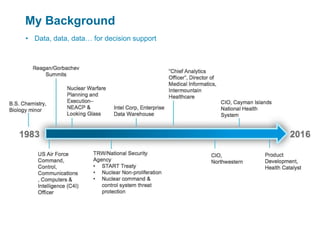
• Data, data, data… for decision support
My Background
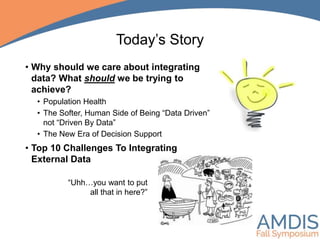
Today’s Story
• Why should we care about integrating
data? What should we be trying to
achieve?
• Population Health
• The Softer, Human Side of Being “Data Driven”
not “Driven By Data”
• The New Era of Decision Support
• Top 10 Challenges To Integrating
External Data
“Uhh…you want to put
all that in here?”
Concepts and Philosophies:
Why and What Are We Trying To Do?
The Data Requirements of Population Health
The Softer, Human Issues of Becoming Data Driven
Software and Decision Support
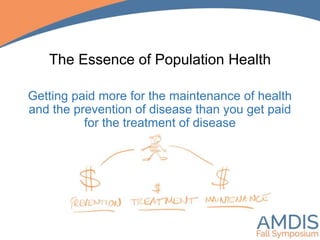
The Essence of Population Health
Getting paid more for the maintenance of health
and the prevention of disease than you get paid
for the treatment of disease
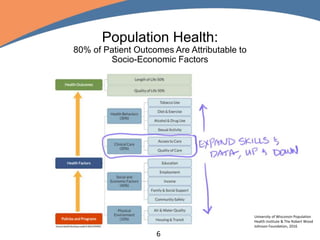
Population Health:
80% of Patient Outcomes Are Attributable to
Socio-Economic Factors
6
University of Wisconsin Population
Health Institute & The Robert Wood
Johnson Foundation, 2016
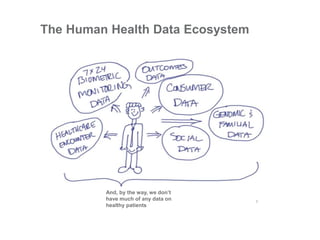
The Human Health Data Ecosystem
7
And, by the way, we don’t
have much of any data on
healthy patients
8
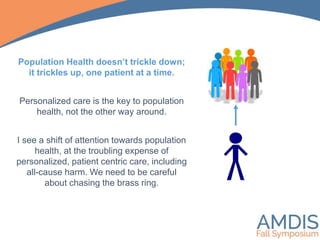
Population Health doesn’t trickle down;
it trickles up, one patient at a time.
Personalized care is the key to population
health, not the other way around.
I see a shift of attention towards population
health, at the troubling expense of
personalized, patient centric care, including
all-cause harm. We need to be careful
about chasing the brass ring.
“93% of our revenue is still associated with
fee-for-service medicine.”
--CFO, Midwest 13 hospital system
“Over 90% of our revenue comes from fee-for-
service care.”
--CEO, Northwest 5 hospital system
But…
Population Health Economics Are Not There Yet
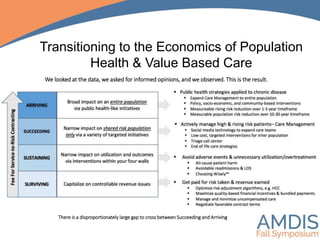
Transitioning to the Economics of Population
Health & Value Based Care
We looked at the data, we asked for informed opinions, and we observed. This is the result.
There is a disproportionately large gap to cross between Succeeding and Arriving
Human Nature and
The Softer Side of Data
• Data… Measures...Metrics...Facts are the most politically hot
and contentious thing you’ll ever deal with because they
challenge the perception of truth, from the highest levels of the
organization to the lowest
• How you deliver data… measures... metrics... and facts, in the
human context is more important than the technology, by far
The human relations of data are more important than the
data relations of data
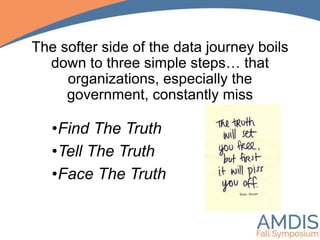
The softer side of the data journey boils
down to three simple steps… that
organizations, especially the
government, constantly miss
•Find The Truth
•Tell The Truth
•Face The Truth
Find, Tell, Face
• Finding the truth in data takes time, and you better include lots
of people with you on that journey. The outcome better be more
than your version of the truth.
• Telling the truth better be handled with diplomacy and a human-
centered perspective because the truth in data, when never
seen before, can be very disturbing.
• When you’ve found the truth and you are telling the truth, you
need to help people face the truth about themselves and the
organization, and they need to perceive this truth as helping
them and their purpose in life.
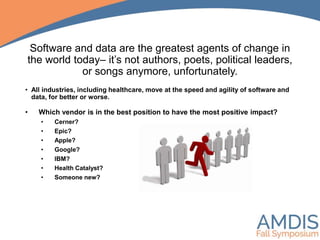
Software and data are the greatest agents of change in
the world today– it’s not authors, poets, political leaders,
or songs anymore, unfortunately.
• Which vendor is in the best position to have the most positive impact?
• Cerner?
• Epic?
• Apple?
• Google?
• IBM?
• Health Catalyst?
• Someone new?
• All industries, including healthcare, move at the speed and agility of software and
data, for better or worse.
There isn’t a cultural change problem among physicians in
healthcare. There’s a software and data problem.
Bad software and poor data are burning out our clinicians. We
send physicians out to drive without a speedometer– while
CMS, insurance companies, and administrators have a radar
gun-- then we penalize those physicians when they drive too
fast or too slow, retroactively.
We need to give clinicians the data– the speedometer-- and
eventually, the radar gun.
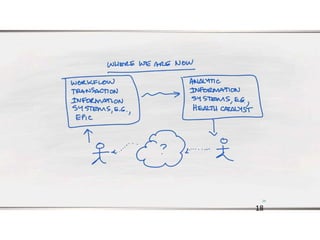
1
7
18
29
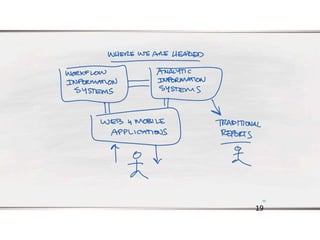
19
30
c
20
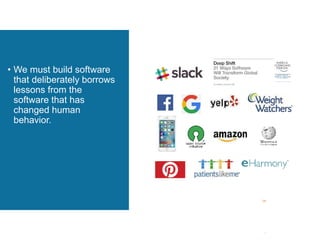
• We must build software
that deliberately borrows
lessons from the
software that has
changed human
behavior.
28
c
21
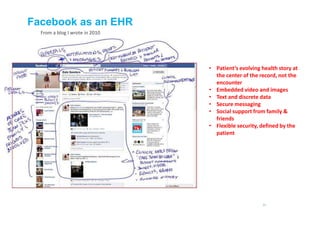
Facebook as an EHR
From a blog I wrote in 2010
• Patient’s evolving health story at
the center of the record, not the
encounter
• Embedded video and images
• Text and discrete data
• Secure messaging
• Social support from family &
friends
• Flexible security, defined by the
patient
c
22
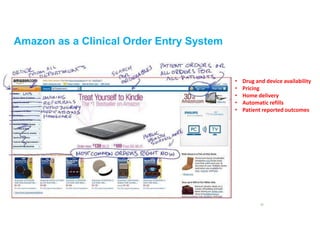
Amazon as a Clinical Order Entry System
• Drug and device availability
• Pricing
• Home delivery
• Automatic refills
• Patient reported outcomes
90% of the screen space is driven dynamically, by context,
through analytics and algorithms
in the background that are nudging your decisions through
suggestions based on the data from collective intelligence
2
3
It’s not predictive analytics… it’s
ambient, suggestive analytics
Physicians are 15x more likely to change their ordering
and treatment protocols if presented with substantiating
data at the point of care vs. presented with the same
data in a clinical process improvement meeting.
Kawamoto et al, University of Utah, BMJ, 2005
2
4
“Conference room analytics”
vs.
Point of decision cognitive support
Physicians (and military officers) prefer
Suggestive Analytics over Prescriptive and
Invasive Analytics
Don’t tell me what to do and don’t blast me with invasive
pop up alerts, overloaded with false positives
Give me a trustful, data-driven suggestion
and then let me make the final decision
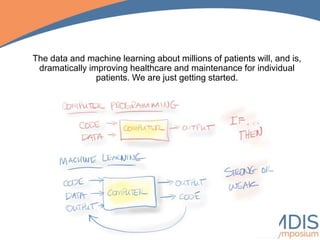
The data and machine learning about millions of patients will, and is,
dramatically improving healthcare and maintenance for individual
patients. We are just getting started.
27
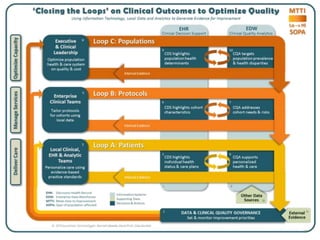
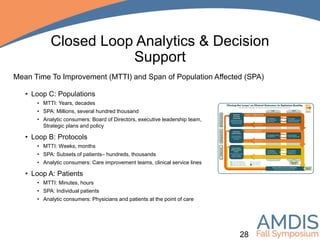
Closed Loop Analytics & Decision
Support
• Loop C: Populations
• MTTI: Years, decades
• SPA: Millions, several hundred thousand
• Analytic consumers: Board of Directors, executive leadership team,
Strategic plans and policy
• Loop B: Protocols
• MTTI: Weeks, months
• SPA: Subsets of patients– hundreds, thousands
• Analytic consumers: Care improvement teams, clinical service lines
• Loop A: Patients
• MTTI: Minutes, hours
• SPA: Individual patients
• Analytic consumers: Physicians and patients at the point of care
Mean Time To Improvement (MTTI) and Span of Population Affected (SPA)
28
External Data Integration:
Top 10 Challenges
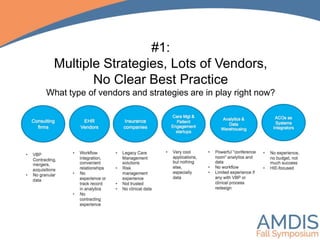
#1:
Multiple Strategies, Lots of Vendors,
No Clear Best Practice
What type of vendors and strategies are in play right now?
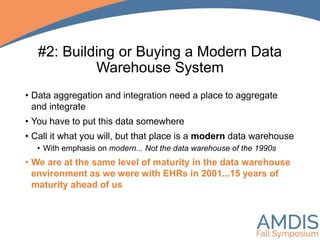
#2: Building or Buying a Modern Data
Warehouse System
• Data aggregation and integration need a place to aggregate
and integrate
• You have to put this data somewhere
• Call it what you will, but that place is a modern data warehouse
• With emphasis on modern... Not the data warehouse of the 1990s
• We are at the same level of maturity in the data warehouse
environment as we were with EHRs in 2001...15 years of
maturity ahead of us
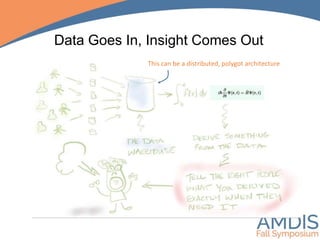
Data Goes In, Insight Comes Out
This can be a distributed, polygot architecture
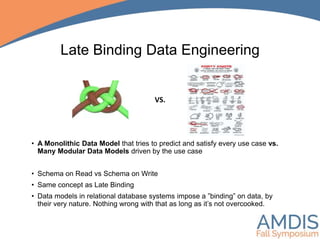
Late Binding Data Engineering
• A Monolithic Data Model that tries to predict and satisfy every use case vs.
Many Modular Data Models driven by the use case
• Schema on Read vs Schema on Write
• Same concept as Late Binding
• Data models in relational database systems impose a ”binding” on data, by
their very nature. Nothing wrong with that as long as it’s not overcooked.
VS.
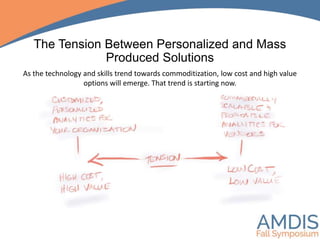
The Tension Between Personalized and Mass
Produced Solutions
As the technology and skills trend towards commoditization, low cost and high value
options will emerge. That trend is starting now.
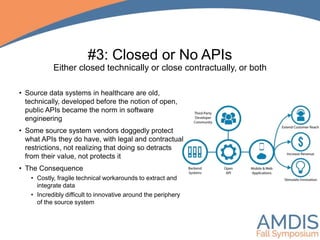
#3: Closed or No APIs
Either closed technically or close contractually, or both
• Source data systems in healthcare are old,
technically, developed before the notion of open,
public APIs became the norm in software
engineering
• Some source system vendors doggedly protect
what APIs they do have, with legal and contractual
restrictions, not realizing that doing so detracts
from their value, not protects it
• The Consequence
• Costly, fragile technical workarounds to extract and
integrate data
• Incredibly difficult to innovative around the periphery
of the source system
#4: Negotiating and Gaining Access to
Information Systems
Takes forever to get access to systems– executives agree to share data, but
the enthusiasm at that level gets lost in lower levels of the organizations
• The Consequence: Months and months of delays
• Count on at least 3 months per source system; six months is
the median
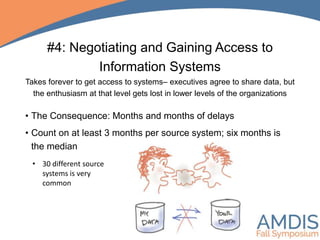
• 30 different source
systems is very
common
#5: Lack of Existing or
Experience in Data Governance
Resolving variation in data vocabularies
Harmonizing local and slowing changing vocabularies
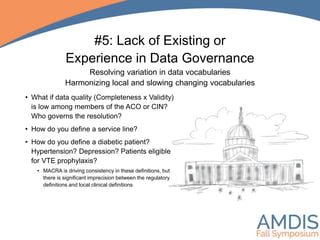
• What if data quality (Completeness x Validity)
is low among members of the ACO or CIN?
Who governs the resolution?
• How do you define a service line?
• How do you define a diabetic patient?
Hypertension? Depression? Patients eligible
for VTE prophylaxis?
• MACRA is driving consistency in these definitions, but
there is significant imprecision between the regulatory
definitions and local clinical definitions
#6: Data Integration in the Virtual Enterprise:
Clinically Integrated Networks and ACOs
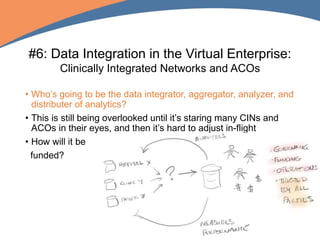
• Who’s going to be the data integrator, aggregator, analyzer, and
distributer of analytics?
• This is still being overlooked until it’s staring many CINs and
ACOs in their eyes, and then it’s hard to adjust in-flight
• How will it be
funded?
#7: Information Security Debates
By it’s very nature, analytics is all about access to more data. That
threatens the traditional mindset in the IT organization and your
HIPAA compliance committees.
• The Consequence: Circuitous debates across organizational cultures, for
months
• Who should get access to which information?
• Too much emphasis and love affair with the nightmare known as row level
security
• Roll based access control is less effective and harder to manage than
information classification access control
• The number of roles and their definitions across organizations trends
toward exponential chaos, but there are relatively few (`12) information
classification categories in healthcare
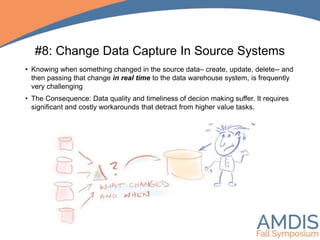
#8: Change Data Capture In Source Systems
• Knowing when something changed in the source data– create, update, delete-- and
then passing that change in real time to the data warehouse system, is frequently
very challenging
• The Consequence: Data quality and timeliness of decion making suffer. It requires
significant and costly workarounds that detract from higher value tasks.
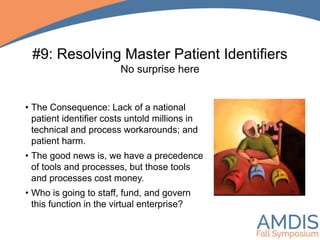
#9: Resolving Master Patient Identifiers
No surprise here
• The Consequence: Lack of a national
patient identifier costs untold millions in
technical and process workarounds; and
patient harm.
• The good news is, we have a precedence
of tools and processes, but those tools
and processes cost money.
• Who is going to staff, fund, and govern
this function in the virtual enterprise?
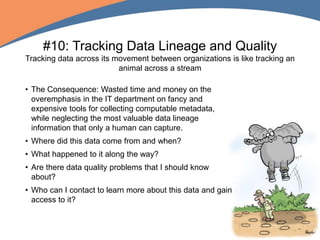
#10: Tracking Data Lineage and Quality
Tracking data across its movement between organizations is like tracking an
animal across a stream
• The Consequence: Wasted time and money on the
overemphasis in the IT department on fancy and
expensive tools for collecting computable metadata,
while neglecting the most valuable data lineage
information that only a human can capture.
• Where did this data come from and when?
• What happened to it along the way?
• Are there data quality problems that I should know
about?
• Who can I contact to learn more about this data and gain
access to it?
In Summary
• Most– 80%?-- of the data we need for Population Health lies
outside the walls of our traditional healthcare delivery systems.
• Don’t forget about the $646B of waste and harm in the current
healthcare system.
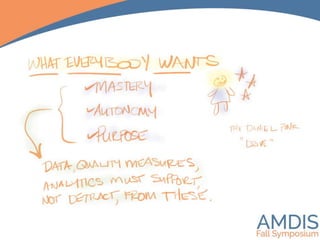
• The drive to be data driven must enhance Mastery, Autonomy, and
Purpose, otherwise it will fail.
• The best decision support is suggestive and ambient. It fuses
transaction data and analytics into the same user experience.
• Populations, Protocols, Patients
• We must infuse data and decision support into each closed loop
• 6 out of 10 data integration challenges are cultural not technical.

AMDIS CHIME Fall Symposium

  • 1.
    Putting it AllTogether: Integrating Data from External Sources For Decision Support in Population Health Dale Sanders Executive Vice President, Product Development Health Catalyst
  • 2.
    • Data, data,data… for decision support My Background
  • 3.
    Today’s Story • Whyshould we care about integrating data? What should we be trying to achieve? • Population Health • The Softer, Human Side of Being “Data Driven” not “Driven By Data” • The New Era of Decision Support • Top 10 Challenges To Integrating External Data “Uhh…you want to put all that in here?”
  • 4.
    Concepts and Philosophies: Whyand What Are We Trying To Do? The Data Requirements of Population Health The Softer, Human Issues of Becoming Data Driven Software and Decision Support
  • 5.
    The Essence ofPopulation Health Getting paid more for the maintenance of health and the prevention of disease than you get paid for the treatment of disease
  • 6.
    Population Health: 80% ofPatient Outcomes Are Attributable to Socio-Economic Factors 6 University of Wisconsin Population Health Institute & The Robert Wood Johnson Foundation, 2016
  • 7.
    The Human HealthData Ecosystem 7 And, by the way, we don’t have much of any data on healthy patients
  • 8.
  • 9.
    Population Health doesn’ttrickle down; it trickles up, one patient at a time. Personalized care is the key to population health, not the other way around. I see a shift of attention towards population health, at the troubling expense of personalized, patient centric care, including all-cause harm. We need to be careful about chasing the brass ring.
  • 10.
    “93% of ourrevenue is still associated with fee-for-service medicine.” --CFO, Midwest 13 hospital system “Over 90% of our revenue comes from fee-for- service care.” --CEO, Northwest 5 hospital system But… Population Health Economics Are Not There Yet
  • 11.
    Transitioning to theEconomics of Population Health & Value Based Care We looked at the data, we asked for informed opinions, and we observed. This is the result. There is a disproportionately large gap to cross between Succeeding and Arriving
  • 12.
    Human Nature and TheSofter Side of Data • Data… Measures...Metrics...Facts are the most politically hot and contentious thing you’ll ever deal with because they challenge the perception of truth, from the highest levels of the organization to the lowest • How you deliver data… measures... metrics... and facts, in the human context is more important than the technology, by far The human relations of data are more important than the data relations of data
  • 13.
    The softer sideof the data journey boils down to three simple steps… that organizations, especially the government, constantly miss •Find The Truth •Tell The Truth •Face The Truth
  • 14.
    Find, Tell, Face •Finding the truth in data takes time, and you better include lots of people with you on that journey. The outcome better be more than your version of the truth. • Telling the truth better be handled with diplomacy and a human- centered perspective because the truth in data, when never seen before, can be very disturbing. • When you’ve found the truth and you are telling the truth, you need to help people face the truth about themselves and the organization, and they need to perceive this truth as helping them and their purpose in life.
  • 16.
    Software and dataare the greatest agents of change in the world today– it’s not authors, poets, political leaders, or songs anymore, unfortunately. • Which vendor is in the best position to have the most positive impact? • Cerner? • Epic? • Apple? • Google? • IBM? • Health Catalyst? • Someone new? • All industries, including healthcare, move at the speed and agility of software and data, for better or worse.
  • 17.
    There isn’t acultural change problem among physicians in healthcare. There’s a software and data problem. Bad software and poor data are burning out our clinicians. We send physicians out to drive without a speedometer– while CMS, insurance companies, and administrators have a radar gun-- then we penalize those physicians when they drive too fast or too slow, retroactively. We need to give clinicians the data– the speedometer-- and eventually, the radar gun. 1 7
  • 18.
  • 19.
  • 20.
    c 20 • We mustbuild software that deliberately borrows lessons from the software that has changed human behavior. 28
  • 21.
    c 21 Facebook as anEHR From a blog I wrote in 2010 • Patient’s evolving health story at the center of the record, not the encounter • Embedded video and images • Text and discrete data • Secure messaging • Social support from family & friends • Flexible security, defined by the patient
  • 22.
    c 22 Amazon as aClinical Order Entry System • Drug and device availability • Pricing • Home delivery • Automatic refills • Patient reported outcomes
  • 23.
    90% of thescreen space is driven dynamically, by context, through analytics and algorithms in the background that are nudging your decisions through suggestions based on the data from collective intelligence 2 3 It’s not predictive analytics… it’s ambient, suggestive analytics
  • 24.
    Physicians are 15xmore likely to change their ordering and treatment protocols if presented with substantiating data at the point of care vs. presented with the same data in a clinical process improvement meeting. Kawamoto et al, University of Utah, BMJ, 2005 2 4 “Conference room analytics” vs. Point of decision cognitive support
  • 25.
    Physicians (and militaryofficers) prefer Suggestive Analytics over Prescriptive and Invasive Analytics Don’t tell me what to do and don’t blast me with invasive pop up alerts, overloaded with false positives Give me a trustful, data-driven suggestion and then let me make the final decision
  • 26.
    The data andmachine learning about millions of patients will, and is, dramatically improving healthcare and maintenance for individual patients. We are just getting started.
  • 27.
  • 28.
    Closed Loop Analytics& Decision Support • Loop C: Populations • MTTI: Years, decades • SPA: Millions, several hundred thousand • Analytic consumers: Board of Directors, executive leadership team, Strategic plans and policy • Loop B: Protocols • MTTI: Weeks, months • SPA: Subsets of patients– hundreds, thousands • Analytic consumers: Care improvement teams, clinical service lines • Loop A: Patients • MTTI: Minutes, hours • SPA: Individual patients • Analytic consumers: Physicians and patients at the point of care Mean Time To Improvement (MTTI) and Span of Population Affected (SPA) 28
  • 29.
  • 30.
    #1: Multiple Strategies, Lotsof Vendors, No Clear Best Practice What type of vendors and strategies are in play right now?
  • 31.
    #2: Building orBuying a Modern Data Warehouse System • Data aggregation and integration need a place to aggregate and integrate • You have to put this data somewhere • Call it what you will, but that place is a modern data warehouse • With emphasis on modern... Not the data warehouse of the 1990s • We are at the same level of maturity in the data warehouse environment as we were with EHRs in 2001...15 years of maturity ahead of us
  • 32.
    Data Goes In,Insight Comes Out This can be a distributed, polygot architecture
  • 33.
    Late Binding DataEngineering • A Monolithic Data Model that tries to predict and satisfy every use case vs. Many Modular Data Models driven by the use case • Schema on Read vs Schema on Write • Same concept as Late Binding • Data models in relational database systems impose a ”binding” on data, by their very nature. Nothing wrong with that as long as it’s not overcooked. VS.
  • 34.
    The Tension BetweenPersonalized and Mass Produced Solutions As the technology and skills trend towards commoditization, low cost and high value options will emerge. That trend is starting now.
  • 35.
    #3: Closed orNo APIs Either closed technically or close contractually, or both • Source data systems in healthcare are old, technically, developed before the notion of open, public APIs became the norm in software engineering • Some source system vendors doggedly protect what APIs they do have, with legal and contractual restrictions, not realizing that doing so detracts from their value, not protects it • The Consequence • Costly, fragile technical workarounds to extract and integrate data • Incredibly difficult to innovative around the periphery of the source system
  • 36.
    #4: Negotiating andGaining Access to Information Systems Takes forever to get access to systems– executives agree to share data, but the enthusiasm at that level gets lost in lower levels of the organizations • The Consequence: Months and months of delays • Count on at least 3 months per source system; six months is the median • 30 different source systems is very common
  • 37.
    #5: Lack ofExisting or Experience in Data Governance Resolving variation in data vocabularies Harmonizing local and slowing changing vocabularies • What if data quality (Completeness x Validity) is low among members of the ACO or CIN? Who governs the resolution? • How do you define a service line? • How do you define a diabetic patient? Hypertension? Depression? Patients eligible for VTE prophylaxis? • MACRA is driving consistency in these definitions, but there is significant imprecision between the regulatory definitions and local clinical definitions
  • 38.
    #6: Data Integrationin the Virtual Enterprise: Clinically Integrated Networks and ACOs • Who’s going to be the data integrator, aggregator, analyzer, and distributer of analytics? • This is still being overlooked until it’s staring many CINs and ACOs in their eyes, and then it’s hard to adjust in-flight • How will it be funded?
  • 39.
    #7: Information SecurityDebates By it’s very nature, analytics is all about access to more data. That threatens the traditional mindset in the IT organization and your HIPAA compliance committees. • The Consequence: Circuitous debates across organizational cultures, for months • Who should get access to which information? • Too much emphasis and love affair with the nightmare known as row level security • Roll based access control is less effective and harder to manage than information classification access control • The number of roles and their definitions across organizations trends toward exponential chaos, but there are relatively few (`12) information classification categories in healthcare
  • 40.
    #8: Change DataCapture In Source Systems • Knowing when something changed in the source data– create, update, delete-- and then passing that change in real time to the data warehouse system, is frequently very challenging • The Consequence: Data quality and timeliness of decion making suffer. It requires significant and costly workarounds that detract from higher value tasks.
  • 41.
    #9: Resolving MasterPatient Identifiers No surprise here • The Consequence: Lack of a national patient identifier costs untold millions in technical and process workarounds; and patient harm. • The good news is, we have a precedence of tools and processes, but those tools and processes cost money. • Who is going to staff, fund, and govern this function in the virtual enterprise?
  • 42.
    #10: Tracking DataLineage and Quality Tracking data across its movement between organizations is like tracking an animal across a stream • The Consequence: Wasted time and money on the overemphasis in the IT department on fancy and expensive tools for collecting computable metadata, while neglecting the most valuable data lineage information that only a human can capture. • Where did this data come from and when? • What happened to it along the way? • Are there data quality problems that I should know about? • Who can I contact to learn more about this data and gain access to it?
  • 43.
    In Summary • Most–80%?-- of the data we need for Population Health lies outside the walls of our traditional healthcare delivery systems. • Don’t forget about the $646B of waste and harm in the current healthcare system. • The drive to be data driven must enhance Mastery, Autonomy, and Purpose, otherwise it will fail. • The best decision support is suggestive and ambient. It fuses transaction data and analytics into the same user experience. • Populations, Protocols, Patients • We must infuse data and decision support into each closed loop • 6 out of 10 data integration challenges are cultural not technical.