Chapter - 5
DATA FLOW TESTING
Data Flow Testing Basics
◼ Data flow testing is the name given to a
family of test strategies based on selecting
paths through the program’s control flow in
order to explore sequences of events related
to the status of data objects.
◼ For example, pick enough paths to assure
that every data object has been initialized
prior to use or that all defined objects have
been used for something.
Motivation
◼ “ it is our belief that, just as one would
not feel confident about a program
without executing every statement in it
as part of some test, one should not
feel confident about a program without
having seen the effect of using the
value produced by each and every
computation.”
Data flow machines
◼ There are two types of data flow
machines with different architectures.
◼ Von Neumann machines
◼ Multi-instruction, multi-data machines
(MIMD)
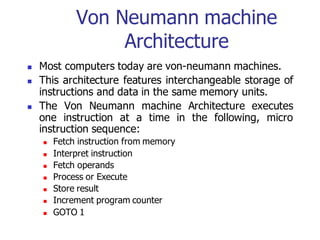
Von Neumann machine
Architecture
◼ Most computers today are von-neumann machines.
◼ This architecture features interchangeable storage of
instructions and data in the same memory units.
◼ The Von Neumann machine Architecture executes
one instruction at a time in the following, micro
instruction sequence:
◼ Fetch instruction from memory
◼ Interpret instruction
◼ Fetch operands
◼ Process or Execute
◼ Store result
◼ Increment program counter
◼ GOTO 1
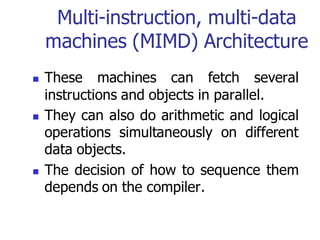
Multi-instruction, multi-data
machines (MIMD) Architecture
◼ These machines can fetch several
instructions and objects in parallel.
◼ They can also do arithmetic and logical
operations simultaneously on different
data objects.
◼ The decision of how to sequence them
depends on the compiler.
Data Flow Graphs
◼ The data flow graph is a graph
consisting of nodes and directed links.
◼ We will use an control graph to show
what happens to data objects of
interest at that moment.
◼ Our objective is to expose deviations
between the data flows we have and
the data flows we want.
Data Object State and Usage
◼ Data objects can be created, killed and used.
◼ They can be used in two distinct ways:
◼ In a calculation
◼ As a part of a control flow predicate
◼ The following symbols denote these possibilities.
◼ d- defined, created, initialized, etc.,
◼ k- killed, undefined, released.
◼ u- used for some thing.
◼ c- used in calculations
◼ p- used in a predicate
Defined
◼ an object is defined explicitly when it appears
in a data declaration.
◼ Or implicitly when it appears on the left hand
side of the assignment.
◼ It is also to be used to mean that a file has
been opened.
◼ A dynamically allocated object has been
allocated.
◼ Something is pushed on to the stack.
◼ A record written.
Killed or Undefined
◼ An object is killed on undefined when it is
released or otherwise made unavailable.
◼ When its contents are no longer known with
certitude.
◼ Release of dynamically allocated objects back to
the availability pool.
◼ Return of records
◼ The old top of the stack after it is popped.
◼ An assignment statement can kill and redefine
immediately.
Usage
◼ A variable is used for computation (c)
when it appears on the right hand side
of an assignment statement.
◼ A file record is read or written.
◼ It is used in a Predicate (p) when it
appears directly in a predicate.
Data Flow Anomalies
◼ An anomaly is denoted by a two-
character sequence of actions.
◼ For example, ku means that the object
is killed and then used, where as dd
means that the object is defined twice
without an intervening usage.
◼ What is an anomaly is depend on the
application.
Data Flow Anomalies-continued.,
◼ There are nine possible two-letter combinations for d, k and
u. some are bugs, some are suspicious, and some are okay.
◼ dd- probably harmless but suspicious. Why define the
object twice without an intervening usage.
◼ dk- probably a bug. Why define the object without using it.
◼ du- the normal case. The object is defined and then used.
◼ kd- normal situation. An object is killed and then redefined.
◼ kk- harmless but probably buggy. Did you want to be sure
it was really killed?
◼ ku- a bug. the object doesnot exist.
◼ ud- usually not a bug because the language permits
reassignment at almost any time.
◼ uk- normal situation.
◼ uu- normal situation.
Data Flow Anomalies-continued.,
◼ In addition to the two letter situations
there are six single letter situations.
◼ We will use a leading dash to mean that
nothing of interest (d,k,u) occurs prior
to the action noted along the entry-exit
path of interest.
◼ A trailing dash to mean that nothing
happens after the point of interest to
the exit.
◼ -k: possibly anomalous because from the entrance to this point on the
path, the variable had not been defined. We are killing a variable that
does not exist.
◼ -d: okay. This is just the first definition along this path.
◼ -u: possibly anomalous. Not anomalous if the variable is global and has
been previously defined.
◼ k-: not anomalous. The last thing done on this path was to kill the
variable.
◼ d-: possibly anomalous. The variable was defined and not used on this
path. But this could be a global definition.
◼ u-: not anomalous. The variable was used but not killed on this path.
Although this sequence is not anomalous, it signals a frequent kind of
bug. If d and k mean dynamic storage allocation and return
respectively, this could be an instance in which a dynamically allocated
object was not returned to the pool after use.
Data Flow Anomalies-continued.,
Data-Flow Anomaly State
Graph
◼ Data flow anomaly model prescribes that an
object can be in one of four distinct states:
◼ K- undefined, previously killed, doesnot exist
◼ D- defined but not yet used for anything
◼ U- has been used for computation or in predicate
◼ A- anomalous
◼ These capital letters (K,D,U,A) denote the
state of the variable and should not be
confused with the program action, denoted
by lower case letters.
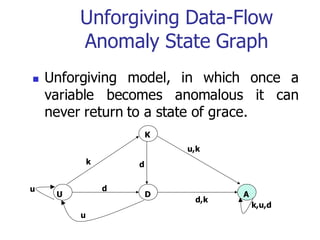
Unforgiving Data-Flow
Anomaly State Graph
◼ Unforgiving model, in which once a
variable becomes anomalous it can
never return to a state of grace.
K
U A
D
u,k
d
k,u,d
d,k
d
u
u
k
Static Vs Dynamic
Anomaly Detection
◼ Static analysis is analysis done on source
code without actually executing it.
◼ For example: source code syntax error detection is
the static analysis result.
◼ Dynamic analysis is done on the fly as the
program is being executed and is based on
intermediate values that result from the
program’s execution.
◼ For example: a division by zero warning is the
dynamic result.
Static Vs Dynamic
Anomaly Detection-continued.,
◼ If a problem, such as a data flow anomaly, can be
detected by static analysis methods, then it doesnot
belongs in testing- it belongs in the language
processor.
◼ There is actually a lot more static analysis for data
flow analysis for data flow anomalies going on in
current language processors.
◼ For example, language processors which force
variable declarations can detect (–u) and (ku)
anomalies.
◼ But still there are many things for which current
notions of static analysis are inadequate.
Why isn’t static analysis enough?
◼ there are many things for which current notions of
static analysis are inadequate they are:
◼ Dead Variables.
◼ Arrays.
◼ Records and pointers.
◼ Dynamic subroutine or function name in a call.
◼ False anomalies.
◼ Recoverable anomalies and alternate state graphs.
◼ Concurrency, interrupts, system issues.
◼ Although static analysis methods have limits, they are
worth using and a continuing trend in language
processor design has been better static analysis
methods for data flow anomaly detection.
The Data Flow Model
◼ The data flow model is based on the program’s
control flow graph.
◼ Here we annotate each link with symbols or
sequences of symbols that denote the sequence
of data operations on that link with respect to the
variable of interest. Such annotations are called
link weights.
◼ the control flow graph structure is same for every
variable: it is the weights that change.
Components of the Model
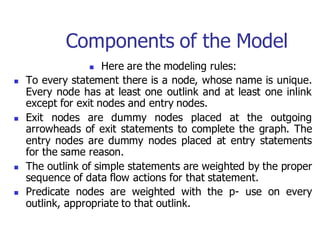
◼ Here are the modeling rules:
◼ To every statement there is a node, whose name is unique.
Every node has at least one outlink and at least one inlink
except for exit nodes and entry nodes.
◼ Exit nodes are dummy nodes placed at the outgoing
arrowheads of exit statements to complete the graph. The
entry nodes are dummy nodes placed at entry statements
for the same reason.
◼ The outlink of simple statements are weighted by the proper
sequence of data flow actions for that statement.
◼ Predicate nodes are weighted with the p- use on every
outlink, appropriate to that outlink.
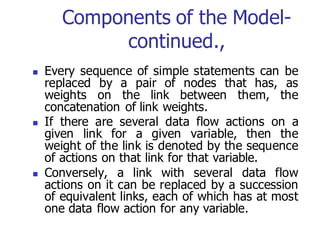
◼ Every sequence of simple statements can be
replaced by a pair of nodes that has, as
weights on the link between them, the
concatenation of link weights.
◼ If there are several data flow actions on a
given link for a given variable, then the
weight of the link is denoted by the sequence
of actions on that link for that variable.
◼ Conversely, a link with several data flow
actions on it can be replaced by a succession
of equivalent links, each of which has at most
one data flow action for any variable.
Components of the Model-
continued.,
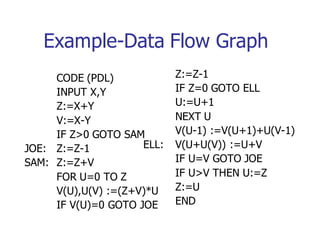
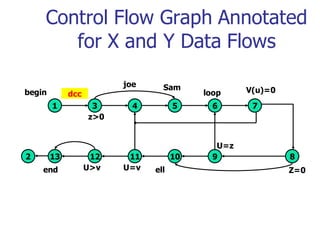
Example-Data Flow Graph
CODE (PDL)
INPUT X,Y
Z:=X+Y
V:=X-Y
IF Z>0 GOTO SAM
JOE: Z:=Z-1
SAM: Z:=Z+V
FOR U=0 TO Z
V(U),U(V) :=(Z+V)*U
IF V(U)=0 GOTO JOE
Z:=Z-1
IF Z=0 GOTO ELL
U:=U+1
NEXT U
V(U-1) :=V(U+1)+U(V-1)
ELL: V(U+U(V)) :=U+V
IF U=V GOTO JOE
IF U>V THEN U:=Z
Z:=U
END
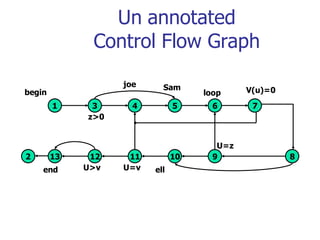
Un annotated
Control Flow Graph
1 3 4 5 6 7
13 12 11 10 9 8
2
begin
z>0
joe Sam
loop V(u)=0
U=z
ell
U=v
end U>v
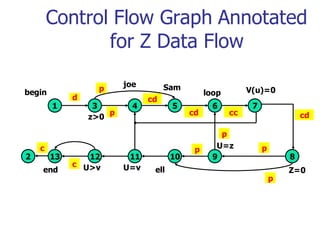
Control Flow Graph Annotated
for X and Y Data Flows
Z=0
1 3 4 5 6 7
13 12 11 10 9 8
2
begin
z>0
joe Sam
loop V(u)=0
U=z
ell
U=v
end U>v
dcc
Control Flow Graph Annotated
for Z Data Flow
Z=0
1 3 4 5 6 7
13 12 11 10 9 8
2
begin
z>0
joe Sam
loop V(u)=0
U=z
ell
U=v
end U>v
d
p
p
cd
cd cc cd
p
p
p
p
c
c
Data Flow Testing Strategies
◼ Data Flow Testing Strategies are structural
strategies.
◼ Data Flow Testing Strategies require data
flow link weights.
◼ Data Flow Testing Strategies are based on
selecting test path segments (sub paths) that
satisfy some characteristic of data flows for
all data objects.
◼ For example, all sub paths that contain a d.
Definition Clear Path Segment
◼ Definition Clear Path Segment with
respect to a variable X is a connected
sequence of links such that X is defined on
the first link and not redefined or killed on
any sub sequent link of that path
segment.
◼ The fact that there is a definition clear sub
path between two nodes does not imply
that all sub paths between those nodes
are definition clear.
Loop Free Path Segment
◼ A loop free path segment is a path
segment for which every node is visited
at most once.
A simple path segment
◼ A simple path segment is a path
segment in which at most one node is
visited twice.
du path
◼ A du path from node i to k is a path
segment such that if the last link has a
computational use of X, then the path is
simple and definition clear; if the
penultimate node is j-that is, the path is
(i.p,q,……r,s,t,j,k) and link (j,k)has a
predicate use- then the path from i to j
is both loop free and definition clear.
The data flow testing strategies
◼ Various types of data flow testing strategies
in decreasing order of their effectiveness are:
◼ All du paths Strategy
◼ All uses Strategy
◼ All p-uses/some c-uses Strategy
◼ All c-uses/some p-uses Strategy
◼ All definitions Strategy
◼ All predicates uses, all computational uses
Strategy
All du paths Strategy
◼ The all du path (ADUP) strategy is the
strongest data flow testing strategy.
◼ It requires that every du path from
every definition of every variable to
every use of that definition be exercised
under some test.
All Uses Strategy
◼ The all uses strategy is that at least one
definition clear path from every
definition of every variable to every use
of that definition be exercised under
some test.
All P-uses/some c-uses
Strategy
◼ All p-uses/some c-uses (APU+c)
strategy is defined as follows: for every
variable and every definition of that
variable, include at least one definition
free path from the definition to every
predicate use; if there are definitions of
the variables that are not covered by
the above prescription, then add
computational use test cases as
required to cover every definition.
All C-uses/some p-uses
Strategy
◼ The all c-uses/some p-uses strategy
(ACU+P) is to first ensure coverage by
computational use cases and if any
definition is not covered by the
previously selected paths, add such
predicate use cases as are needed to
assure that every definition is included
in some test.
All Definitions Strategy
◼ The all definitions strategy asks only
every definition of every variable be
covered by atleast one use of that
variable, be that use a computational
use or a predicate use.
All predicate-uses, All
Computational uses Strategies
◼ The all predicate uses strategy is derived
from APU+C strategy by dropping the
requirement that we include a c-use for the
variable if there are no p-uses for the
variable.
◼ The all computational uses strategy is derived
from ACU+P strategy by dropping the
requirement that we include a p-use for the
variable if there are no c-uses for the
variable.
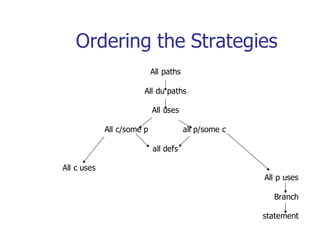
Ordering the Strategies
All paths
All du paths
All uses
All c/some p all p/some c
all defs
All c uses
All p uses
Branch
statement
Slicing and Dicing
◼ A program slice is a part of a program defined with
respect to a given variable X and a statement i: it is
the set of all statements that could affect the value of
X at statement i- where the influence of a faulty
statement could result from an improper
computational use or predicate use of some other
variable at prior statements. If X is incorrect at
statement i, it follows that the bug must be in the
program slice for X with respect to i;
◼ A program dice is a part of a slice in which all
statements which are known to be correct have been
removed.

Data Flow Testing in Software Testing - JNTUA

  • 1.
    Chapter - 5 DATAFLOW TESTING
  • 2.
    Data Flow TestingBasics ◼ Data flow testing is the name given to a family of test strategies based on selecting paths through the program’s control flow in order to explore sequences of events related to the status of data objects. ◼ For example, pick enough paths to assure that every data object has been initialized prior to use or that all defined objects have been used for something.
  • 3.
    Motivation ◼ “ itis our belief that, just as one would not feel confident about a program without executing every statement in it as part of some test, one should not feel confident about a program without having seen the effect of using the value produced by each and every computation.”
  • 4.
    Data flow machines ◼There are two types of data flow machines with different architectures. ◼ Von Neumann machines ◼ Multi-instruction, multi-data machines (MIMD)
  • 5.
    Von Neumann machine Architecture ◼Most computers today are von-neumann machines. ◼ This architecture features interchangeable storage of instructions and data in the same memory units. ◼ The Von Neumann machine Architecture executes one instruction at a time in the following, micro instruction sequence: ◼ Fetch instruction from memory ◼ Interpret instruction ◼ Fetch operands ◼ Process or Execute ◼ Store result ◼ Increment program counter ◼ GOTO 1
  • 6.
    Multi-instruction, multi-data machines (MIMD)Architecture ◼ These machines can fetch several instructions and objects in parallel. ◼ They can also do arithmetic and logical operations simultaneously on different data objects. ◼ The decision of how to sequence them depends on the compiler.
  • 7.
    Data Flow Graphs ◼The data flow graph is a graph consisting of nodes and directed links. ◼ We will use an control graph to show what happens to data objects of interest at that moment. ◼ Our objective is to expose deviations between the data flows we have and the data flows we want.
  • 8.
    Data Object Stateand Usage ◼ Data objects can be created, killed and used. ◼ They can be used in two distinct ways: ◼ In a calculation ◼ As a part of a control flow predicate ◼ The following symbols denote these possibilities. ◼ d- defined, created, initialized, etc., ◼ k- killed, undefined, released. ◼ u- used for some thing. ◼ c- used in calculations ◼ p- used in a predicate
  • 9.
    Defined ◼ an objectis defined explicitly when it appears in a data declaration. ◼ Or implicitly when it appears on the left hand side of the assignment. ◼ It is also to be used to mean that a file has been opened. ◼ A dynamically allocated object has been allocated. ◼ Something is pushed on to the stack. ◼ A record written.
  • 10.
    Killed or Undefined ◼An object is killed on undefined when it is released or otherwise made unavailable. ◼ When its contents are no longer known with certitude. ◼ Release of dynamically allocated objects back to the availability pool. ◼ Return of records ◼ The old top of the stack after it is popped. ◼ An assignment statement can kill and redefine immediately.
  • 11.
    Usage ◼ A variableis used for computation (c) when it appears on the right hand side of an assignment statement. ◼ A file record is read or written. ◼ It is used in a Predicate (p) when it appears directly in a predicate.
  • 12.
    Data Flow Anomalies ◼An anomaly is denoted by a two- character sequence of actions. ◼ For example, ku means that the object is killed and then used, where as dd means that the object is defined twice without an intervening usage. ◼ What is an anomaly is depend on the application.
  • 13.
    Data Flow Anomalies-continued., ◼There are nine possible two-letter combinations for d, k and u. some are bugs, some are suspicious, and some are okay. ◼ dd- probably harmless but suspicious. Why define the object twice without an intervening usage. ◼ dk- probably a bug. Why define the object without using it. ◼ du- the normal case. The object is defined and then used. ◼ kd- normal situation. An object is killed and then redefined. ◼ kk- harmless but probably buggy. Did you want to be sure it was really killed? ◼ ku- a bug. the object doesnot exist. ◼ ud- usually not a bug because the language permits reassignment at almost any time. ◼ uk- normal situation. ◼ uu- normal situation.
  • 14.
    Data Flow Anomalies-continued., ◼In addition to the two letter situations there are six single letter situations. ◼ We will use a leading dash to mean that nothing of interest (d,k,u) occurs prior to the action noted along the entry-exit path of interest. ◼ A trailing dash to mean that nothing happens after the point of interest to the exit.
  • 15.
    ◼ -k: possiblyanomalous because from the entrance to this point on the path, the variable had not been defined. We are killing a variable that does not exist. ◼ -d: okay. This is just the first definition along this path. ◼ -u: possibly anomalous. Not anomalous if the variable is global and has been previously defined. ◼ k-: not anomalous. The last thing done on this path was to kill the variable. ◼ d-: possibly anomalous. The variable was defined and not used on this path. But this could be a global definition. ◼ u-: not anomalous. The variable was used but not killed on this path. Although this sequence is not anomalous, it signals a frequent kind of bug. If d and k mean dynamic storage allocation and return respectively, this could be an instance in which a dynamically allocated object was not returned to the pool after use. Data Flow Anomalies-continued.,
  • 16.
    Data-Flow Anomaly State Graph ◼Data flow anomaly model prescribes that an object can be in one of four distinct states: ◼ K- undefined, previously killed, doesnot exist ◼ D- defined but not yet used for anything ◼ U- has been used for computation or in predicate ◼ A- anomalous ◼ These capital letters (K,D,U,A) denote the state of the variable and should not be confused with the program action, denoted by lower case letters.
  • 17.
    Unforgiving Data-Flow Anomaly StateGraph ◼ Unforgiving model, in which once a variable becomes anomalous it can never return to a state of grace. K U A D u,k d k,u,d d,k d u u k
  • 18.
    Static Vs Dynamic AnomalyDetection ◼ Static analysis is analysis done on source code without actually executing it. ◼ For example: source code syntax error detection is the static analysis result. ◼ Dynamic analysis is done on the fly as the program is being executed and is based on intermediate values that result from the program’s execution. ◼ For example: a division by zero warning is the dynamic result.
  • 19.
    Static Vs Dynamic AnomalyDetection-continued., ◼ If a problem, such as a data flow anomaly, can be detected by static analysis methods, then it doesnot belongs in testing- it belongs in the language processor. ◼ There is actually a lot more static analysis for data flow analysis for data flow anomalies going on in current language processors. ◼ For example, language processors which force variable declarations can detect (–u) and (ku) anomalies. ◼ But still there are many things for which current notions of static analysis are inadequate.
  • 20.
    Why isn’t staticanalysis enough? ◼ there are many things for which current notions of static analysis are inadequate they are: ◼ Dead Variables. ◼ Arrays. ◼ Records and pointers. ◼ Dynamic subroutine or function name in a call. ◼ False anomalies. ◼ Recoverable anomalies and alternate state graphs. ◼ Concurrency, interrupts, system issues. ◼ Although static analysis methods have limits, they are worth using and a continuing trend in language processor design has been better static analysis methods for data flow anomaly detection.
  • 21.
    The Data FlowModel ◼ The data flow model is based on the program’s control flow graph. ◼ Here we annotate each link with symbols or sequences of symbols that denote the sequence of data operations on that link with respect to the variable of interest. Such annotations are called link weights. ◼ the control flow graph structure is same for every variable: it is the weights that change.
  • 22.
    Components of theModel ◼ Here are the modeling rules: ◼ To every statement there is a node, whose name is unique. Every node has at least one outlink and at least one inlink except for exit nodes and entry nodes. ◼ Exit nodes are dummy nodes placed at the outgoing arrowheads of exit statements to complete the graph. The entry nodes are dummy nodes placed at entry statements for the same reason. ◼ The outlink of simple statements are weighted by the proper sequence of data flow actions for that statement. ◼ Predicate nodes are weighted with the p- use on every outlink, appropriate to that outlink.
  • 23.
    ◼ Every sequenceof simple statements can be replaced by a pair of nodes that has, as weights on the link between them, the concatenation of link weights. ◼ If there are several data flow actions on a given link for a given variable, then the weight of the link is denoted by the sequence of actions on that link for that variable. ◼ Conversely, a link with several data flow actions on it can be replaced by a succession of equivalent links, each of which has at most one data flow action for any variable. Components of the Model- continued.,
  • 24.
    Example-Data Flow Graph CODE(PDL) INPUT X,Y Z:=X+Y V:=X-Y IF Z>0 GOTO SAM JOE: Z:=Z-1 SAM: Z:=Z+V FOR U=0 TO Z V(U),U(V) :=(Z+V)*U IF V(U)=0 GOTO JOE Z:=Z-1 IF Z=0 GOTO ELL U:=U+1 NEXT U V(U-1) :=V(U+1)+U(V-1) ELL: V(U+U(V)) :=U+V IF U=V GOTO JOE IF U>V THEN U:=Z Z:=U END
  • 25.
    Un annotated Control FlowGraph 1 3 4 5 6 7 13 12 11 10 9 8 2 begin z>0 joe Sam loop V(u)=0 U=z ell U=v end U>v
  • 26.
    Control Flow GraphAnnotated for X and Y Data Flows Z=0 1 3 4 5 6 7 13 12 11 10 9 8 2 begin z>0 joe Sam loop V(u)=0 U=z ell U=v end U>v dcc
  • 27.
    Control Flow GraphAnnotated for Z Data Flow Z=0 1 3 4 5 6 7 13 12 11 10 9 8 2 begin z>0 joe Sam loop V(u)=0 U=z ell U=v end U>v d p p cd cd cc cd p p p p c c
  • 28.
    Data Flow TestingStrategies ◼ Data Flow Testing Strategies are structural strategies. ◼ Data Flow Testing Strategies require data flow link weights. ◼ Data Flow Testing Strategies are based on selecting test path segments (sub paths) that satisfy some characteristic of data flows for all data objects. ◼ For example, all sub paths that contain a d.
  • 29.
    Definition Clear PathSegment ◼ Definition Clear Path Segment with respect to a variable X is a connected sequence of links such that X is defined on the first link and not redefined or killed on any sub sequent link of that path segment. ◼ The fact that there is a definition clear sub path between two nodes does not imply that all sub paths between those nodes are definition clear.
  • 30.
    Loop Free PathSegment ◼ A loop free path segment is a path segment for which every node is visited at most once.
  • 31.
    A simple pathsegment ◼ A simple path segment is a path segment in which at most one node is visited twice.
  • 32.
    du path ◼ Adu path from node i to k is a path segment such that if the last link has a computational use of X, then the path is simple and definition clear; if the penultimate node is j-that is, the path is (i.p,q,……r,s,t,j,k) and link (j,k)has a predicate use- then the path from i to j is both loop free and definition clear.
  • 33.
    The data flowtesting strategies ◼ Various types of data flow testing strategies in decreasing order of their effectiveness are: ◼ All du paths Strategy ◼ All uses Strategy ◼ All p-uses/some c-uses Strategy ◼ All c-uses/some p-uses Strategy ◼ All definitions Strategy ◼ All predicates uses, all computational uses Strategy
  • 34.
    All du pathsStrategy ◼ The all du path (ADUP) strategy is the strongest data flow testing strategy. ◼ It requires that every du path from every definition of every variable to every use of that definition be exercised under some test.
  • 35.
    All Uses Strategy ◼The all uses strategy is that at least one definition clear path from every definition of every variable to every use of that definition be exercised under some test.
  • 36.
    All P-uses/some c-uses Strategy ◼All p-uses/some c-uses (APU+c) strategy is defined as follows: for every variable and every definition of that variable, include at least one definition free path from the definition to every predicate use; if there are definitions of the variables that are not covered by the above prescription, then add computational use test cases as required to cover every definition.
  • 37.
    All C-uses/some p-uses Strategy ◼The all c-uses/some p-uses strategy (ACU+P) is to first ensure coverage by computational use cases and if any definition is not covered by the previously selected paths, add such predicate use cases as are needed to assure that every definition is included in some test.
  • 38.
    All Definitions Strategy ◼The all definitions strategy asks only every definition of every variable be covered by atleast one use of that variable, be that use a computational use or a predicate use.
  • 39.
    All predicate-uses, All Computationaluses Strategies ◼ The all predicate uses strategy is derived from APU+C strategy by dropping the requirement that we include a c-use for the variable if there are no p-uses for the variable. ◼ The all computational uses strategy is derived from ACU+P strategy by dropping the requirement that we include a p-use for the variable if there are no c-uses for the variable.
  • 40.
    Ordering the Strategies Allpaths All du paths All uses All c/some p all p/some c all defs All c uses All p uses Branch statement
  • 41.
    Slicing and Dicing ◼A program slice is a part of a program defined with respect to a given variable X and a statement i: it is the set of all statements that could affect the value of X at statement i- where the influence of a faulty statement could result from an improper computational use or predicate use of some other variable at prior statements. If X is incorrect at statement i, it follows that the bug must be in the program slice for X with respect to i; ◼ A program dice is a part of a slice in which all statements which are known to be correct have been removed.