© Oxford University Press 2011. All rights reserved.
1
Chapter 5
Dynamic Testing: White Box Testing Techniques
Objectives
• White box testing needs the full understanding of the
logic/structure of the program.
• Test case designing using white box testing techniques
• Basis Path testing method
• Building a Path testing tool using graph matrices
• Loop testing
• Data Flow testing method
• Mutation testing method
© Oxford University Press 2011. All rights reserved.
2
Evolution of Software Testing
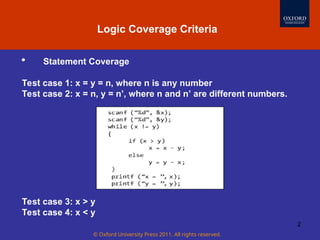
 Statement Coverage
Test case 1: x = y = n, where n is any number
Test case 2: x = n, y = n’, where n and n’ are different numbers.
Test case 3: x > y
Test case 4: x < y
Logic Coverage Criteria
© Oxford University Press 2011. All rights reserved.
3
Evolution of Software Testing
Decision or Branch Coverage
• Test case 1: x = y
• Test case 2: x != y
• Test case 3: x < y
• Test case 4: x > y
Condition Coverage
while ((I <= 5) && (J < COUNT))
• Test case 1: I <= 5, J < COUNT
• Test case 2: I > 5, J > COUNT
Logic Coverage Criteria
© Oxford University Press 2011. All rights reserved.
4
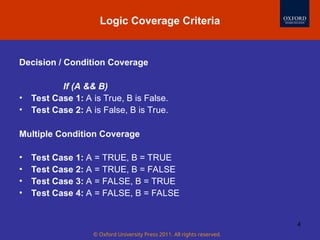
Logic Coverage Criteria
Decision / Condition Coverage
If (A && B)
• Test Case 1: A is True, B is False.
• Test Case 2: A is False, B is True.
Multiple Condition Coverage
• Test Case 1: A = TRUE, B = TRUE
• Test Case 2: A = TRUE, B = FALSE
• Test Case 3: A = FALSE, B = TRUE
• Test Case 4: A = FALSE, B = FALSE
© Oxford University Press 2011. All rights reserved.
5
• Path Testing is based on control structure of the program for
which flow graph is prepared.
• requires complete knowledge of the program’s structure.
• closer to the developer and used by him to test his module.
• The effectiveness of path testing is reduced with the increase in
size of software under test.
• Choose enough paths in a program such that maximum logic
coverage is achieved.
Basis Path Testing
© Oxford University Press 2011. All rights reserved.
6
• Node
• Edges or Links
• Decision Node
• Junction Node
• Regions
Control Flow Graph
© Oxford University Press 2011. All rights reserved.
7
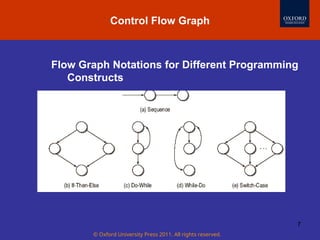
Flow Graph Notations for Different Programming
Constructs
Control Flow Graph
© Oxford University Press 2011. All rights reserved.
8
Software Testing Myths
• Path
• Segment
• Path Segment
• Length of a Path
• Independent Path
Path Testing Terminology
© Oxford University Press 2011. All rights reserved.
9
Path Testing Terminology
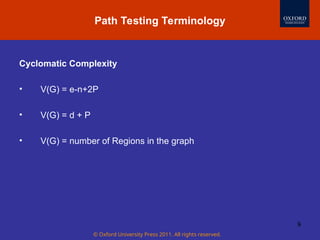
Cyclomatic Complexity
• V(G) = e-n+2P
• V(G) = d + P
• V(G) = number of Regions in the graph
© Oxford University Press 2011. All rights reserved.
10
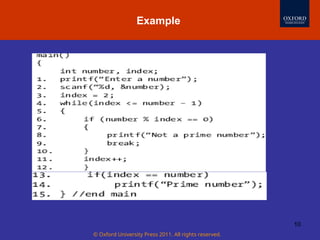
Example
© Oxford University Press 2011. All rights reserved.
11
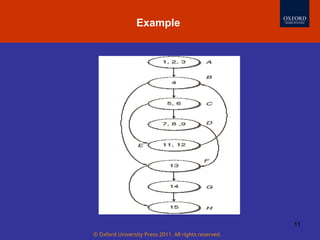
Example
© Oxford University Press 2011. All rights reserved.
12
Example
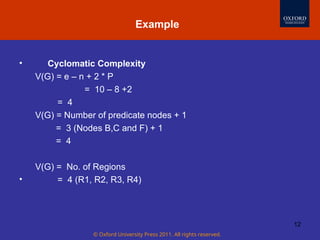
• Cyclomatic Complexity
V(G) = e – n + 2 * P
= 10 – 8 +2
= 4
V(G) = Number of predicate nodes + 1
= 3 (Nodes B,C and F) + 1
= 4
V(G) = No. of Regions
• = 4 (R1, R2, R3, R4)
© Oxford University Press 2011. All rights reserved.
13
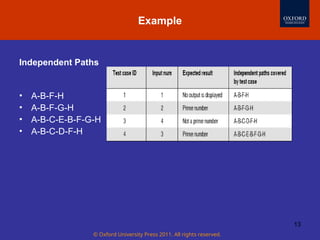
Independent Paths
• A-B-F-H
• A-B-F-G-H
• A-B-C-E-B-F-G-H
• A-B-C-D-F-H
Example
© Oxford University Press 2011. All rights reserved.
14
Graph Matrices
© Oxford University Press 2011. All rights reserved.
15
Connection Matrix
Graph Matrices
© Oxford University Press 2011. All rights reserved.
16
Graph Matrices
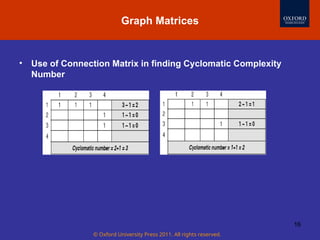
• Use of Connection Matrix in finding Cyclomatic Complexity
Number
© Oxford University Press 2011. All rights reserved.
17
Graph Matrices
• Use of Graph Matrix for Finding the Set of all Paths
Consider the following graph. Derive its graph matrix and find 2-link
and 3-link set of paths.
© Oxford University Press 2011. All rights reserved.
18
Loop Testing
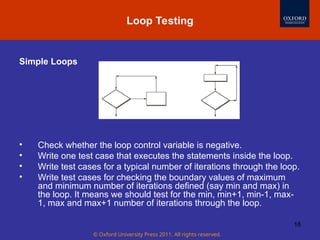
Simple Loops
• Check whether the loop control variable is negative.
• Write one test case that executes the statements inside the loop.
• Write test cases for a typical number of iterations through the loop.
• Write test cases for checking the boundary values of maximum
and minimum number of iterations defined (say min and max) in
the loop. It means we should test for the min, min+1, min-1, max-
1, max and max+1 number of iterations through the loop.
© Oxford University Press 2011. All rights reserved.
19
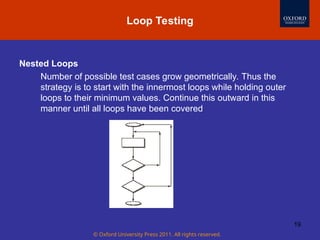
Nested Loops
Number of possible test cases grow geometrically. Thus the
strategy is to start with the innermost loops while holding outer
loops to their minimum values. Continue this outward in this
manner until all loops have been covered
Loop Testing
© Oxford University Press 2011. All rights reserved.
20
Loop Testing
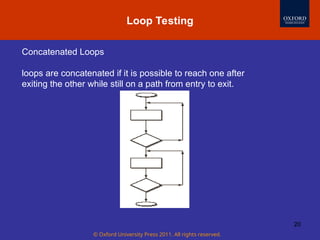
Concatenated Loops
loops are concatenated if it is possible to reach one after
exiting the other while still on a path from entry to exit.
© Oxford University Press 2011. All rights reserved.
21
Detect improper use of data values due to coding errors.
Closely examines the state of the data in the control flow graph
resulting in a richer test suite than the one obtained from control
flow graph based path testing strategies like branch coverage, all
statement coverage, etc
Data Flow Testing
© Oxford University Press 2011. All rights reserved.
22
• Defined (d):
• Killed / Undefined / Released (k):
• Usage (u):
computational use (c-use) or predicate use (p-use).
Data Flow Testing
© Oxford University Press 2011. All rights reserved.
23
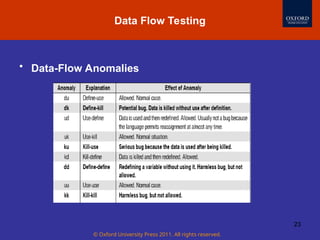
Data Flow Testing
• Data-Flow Anomalies
© Oxford University Press 2011. All rights reserved.
24
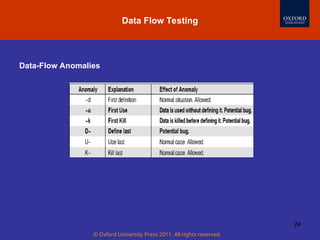
Data Flow Testing
Data-Flow Anomalies
© Oxford University Press 2011. All rights reserved.
25
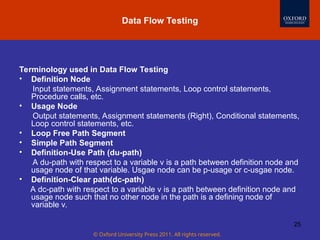
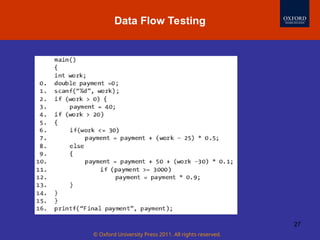
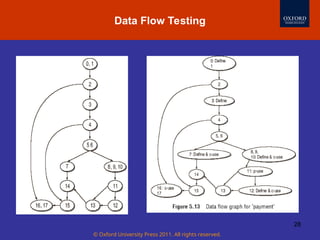
Terminology used in Data Flow Testing
• Definition Node
Input statements, Assignment statements, Loop control statements,
Procedure calls, etc.
• Usage Node
Output statements, Assignment statements (Right), Conditional statements,
Loop control statements, etc.
• Loop Free Path Segment
• Simple Path Segment
• Definition-Use Path (du-path)
A du-path with respect to a variable v is a path between definition node and
usage node of that variable. Usgae node can be p-usage or c-usgae node.
• Definition-Clear path(dc-path)
A dc-path with respect to a variable v is a path between definition node and
usage node such that no other node in the path is a defining node of
variable v.
Data Flow Testing
© Oxford University Press 2011. All rights reserved.
26
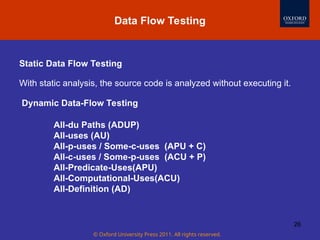
Static Data Flow Testing
With static analysis, the source code is analyzed without executing it.
Data Flow Testing
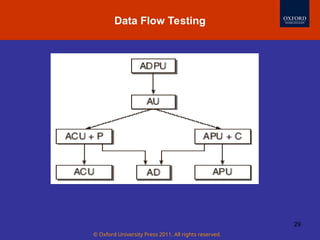
Dynamic Data-Flow Testing
All-du Paths (ADUP)
All-uses (AU)
All-p-uses / Some-c-uses (APU + C)
All-c-uses / Some-p-uses (ACU + P)
All-Predicate-Uses(APU)
All-Computational-Uses(ACU)
All-Definition (AD)
© Oxford University Press 2011. All rights reserved.
27
Data Flow Testing
© Oxford University Press 2011. All rights reserved.
28
Data Flow Testing
© Oxford University Press 2011. All rights reserved.
29
Data Flow Testing
© Oxford University Press 2011. All rights reserved.
30
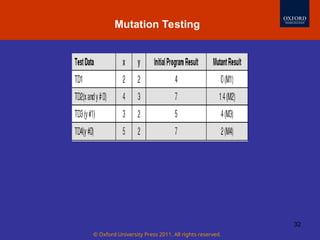
• Mutation testing is the process of mutating some segment of
code(putting some error in the code) and then testing this mutated
code with some test data. If the test data is able to detect the
mutations in the code,
• Mutation testing helps a user create test data by interacting with the
user to iteratively strengthen the quality of test data. During mutation
testing, faults are introduced into a program by creating many
versions of the program, each of which contains one fault. Test data
are used to execute these faulty programs with the goal of causing
each faulty program to fail.
• Faulty programs are called mutants of the original program and a
mutant is said to be killed when a test case causes it to fail. When
this happens, the mutant is considered dead
Mutation Testing
© Oxford University Press 2011. All rights reserved.
31
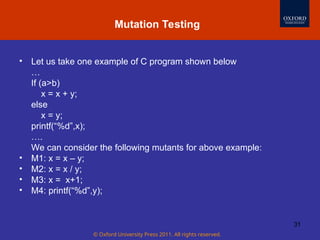
• Let us take one example of C program shown below
…
If (a>b)
x = x + y;
else
x = y;
printf(“%d”,x);
….
We can consider the following mutants for above example:
• M1: x = x – y;
• M2: x = x / y;
• M3: x = x+1;
• M4: printf(“%d”,y);
Mutation Testing
© Oxford University Press 2011. All rights reserved.
32
Mutation Testing

2.2_Dynamic Testing: White Box Testing Techniques.ppt

  • 1.
    © Oxford UniversityPress 2011. All rights reserved. 1 Chapter 5 Dynamic Testing: White Box Testing Techniques Objectives • White box testing needs the full understanding of the logic/structure of the program. • Test case designing using white box testing techniques • Basis Path testing method • Building a Path testing tool using graph matrices • Loop testing • Data Flow testing method • Mutation testing method
  • 2.
    © Oxford UniversityPress 2011. All rights reserved. 2 Evolution of Software Testing  Statement Coverage Test case 1: x = y = n, where n is any number Test case 2: x = n, y = n’, where n and n’ are different numbers. Test case 3: x > y Test case 4: x < y Logic Coverage Criteria
  • 3.
    © Oxford UniversityPress 2011. All rights reserved. 3 Evolution of Software Testing Decision or Branch Coverage • Test case 1: x = y • Test case 2: x != y • Test case 3: x < y • Test case 4: x > y Condition Coverage while ((I <= 5) && (J < COUNT)) • Test case 1: I <= 5, J < COUNT • Test case 2: I > 5, J > COUNT Logic Coverage Criteria
  • 4.
    © Oxford UniversityPress 2011. All rights reserved. 4 Logic Coverage Criteria Decision / Condition Coverage If (A && B) • Test Case 1: A is True, B is False. • Test Case 2: A is False, B is True. Multiple Condition Coverage • Test Case 1: A = TRUE, B = TRUE • Test Case 2: A = TRUE, B = FALSE • Test Case 3: A = FALSE, B = TRUE • Test Case 4: A = FALSE, B = FALSE
  • 5.
    © Oxford UniversityPress 2011. All rights reserved. 5 • Path Testing is based on control structure of the program for which flow graph is prepared. • requires complete knowledge of the program’s structure. • closer to the developer and used by him to test his module. • The effectiveness of path testing is reduced with the increase in size of software under test. • Choose enough paths in a program such that maximum logic coverage is achieved. Basis Path Testing
  • 6.
    © Oxford UniversityPress 2011. All rights reserved. 6 • Node • Edges or Links • Decision Node • Junction Node • Regions Control Flow Graph
  • 7.
    © Oxford UniversityPress 2011. All rights reserved. 7 Flow Graph Notations for Different Programming Constructs Control Flow Graph
  • 8.
    © Oxford UniversityPress 2011. All rights reserved. 8 Software Testing Myths • Path • Segment • Path Segment • Length of a Path • Independent Path Path Testing Terminology
  • 9.
    © Oxford UniversityPress 2011. All rights reserved. 9 Path Testing Terminology Cyclomatic Complexity • V(G) = e-n+2P • V(G) = d + P • V(G) = number of Regions in the graph
  • 10.
    © Oxford UniversityPress 2011. All rights reserved. 10 Example
  • 11.
    © Oxford UniversityPress 2011. All rights reserved. 11 Example
  • 12.
    © Oxford UniversityPress 2011. All rights reserved. 12 Example • Cyclomatic Complexity V(G) = e – n + 2 * P = 10 – 8 +2 = 4 V(G) = Number of predicate nodes + 1 = 3 (Nodes B,C and F) + 1 = 4 V(G) = No. of Regions • = 4 (R1, R2, R3, R4)
  • 13.
    © Oxford UniversityPress 2011. All rights reserved. 13 Independent Paths • A-B-F-H • A-B-F-G-H • A-B-C-E-B-F-G-H • A-B-C-D-F-H Example
  • 14.
    © Oxford UniversityPress 2011. All rights reserved. 14 Graph Matrices
  • 15.
    © Oxford UniversityPress 2011. All rights reserved. 15 Connection Matrix Graph Matrices
  • 16.
    © Oxford UniversityPress 2011. All rights reserved. 16 Graph Matrices • Use of Connection Matrix in finding Cyclomatic Complexity Number
  • 17.
    © Oxford UniversityPress 2011. All rights reserved. 17 Graph Matrices • Use of Graph Matrix for Finding the Set of all Paths Consider the following graph. Derive its graph matrix and find 2-link and 3-link set of paths.
  • 18.
    © Oxford UniversityPress 2011. All rights reserved. 18 Loop Testing Simple Loops • Check whether the loop control variable is negative. • Write one test case that executes the statements inside the loop. • Write test cases for a typical number of iterations through the loop. • Write test cases for checking the boundary values of maximum and minimum number of iterations defined (say min and max) in the loop. It means we should test for the min, min+1, min-1, max- 1, max and max+1 number of iterations through the loop.
  • 19.
    © Oxford UniversityPress 2011. All rights reserved. 19 Nested Loops Number of possible test cases grow geometrically. Thus the strategy is to start with the innermost loops while holding outer loops to their minimum values. Continue this outward in this manner until all loops have been covered Loop Testing
  • 20.
    © Oxford UniversityPress 2011. All rights reserved. 20 Loop Testing Concatenated Loops loops are concatenated if it is possible to reach one after exiting the other while still on a path from entry to exit.
  • 21.
    © Oxford UniversityPress 2011. All rights reserved. 21 Detect improper use of data values due to coding errors. Closely examines the state of the data in the control flow graph resulting in a richer test suite than the one obtained from control flow graph based path testing strategies like branch coverage, all statement coverage, etc Data Flow Testing
  • 22.
    © Oxford UniversityPress 2011. All rights reserved. 22 • Defined (d): • Killed / Undefined / Released (k): • Usage (u): computational use (c-use) or predicate use (p-use). Data Flow Testing
  • 23.
    © Oxford UniversityPress 2011. All rights reserved. 23 Data Flow Testing • Data-Flow Anomalies
  • 24.
    © Oxford UniversityPress 2011. All rights reserved. 24 Data Flow Testing Data-Flow Anomalies
  • 25.
    © Oxford UniversityPress 2011. All rights reserved. 25 Terminology used in Data Flow Testing • Definition Node Input statements, Assignment statements, Loop control statements, Procedure calls, etc. • Usage Node Output statements, Assignment statements (Right), Conditional statements, Loop control statements, etc. • Loop Free Path Segment • Simple Path Segment • Definition-Use Path (du-path) A du-path with respect to a variable v is a path between definition node and usage node of that variable. Usgae node can be p-usage or c-usgae node. • Definition-Clear path(dc-path) A dc-path with respect to a variable v is a path between definition node and usage node such that no other node in the path is a defining node of variable v. Data Flow Testing
  • 26.
    © Oxford UniversityPress 2011. All rights reserved. 26 Static Data Flow Testing With static analysis, the source code is analyzed without executing it. Data Flow Testing Dynamic Data-Flow Testing All-du Paths (ADUP) All-uses (AU) All-p-uses / Some-c-uses (APU + C) All-c-uses / Some-p-uses (ACU + P) All-Predicate-Uses(APU) All-Computational-Uses(ACU) All-Definition (AD)
  • 27.
    © Oxford UniversityPress 2011. All rights reserved. 27 Data Flow Testing
  • 28.
    © Oxford UniversityPress 2011. All rights reserved. 28 Data Flow Testing
  • 29.
    © Oxford UniversityPress 2011. All rights reserved. 29 Data Flow Testing
  • 30.
    © Oxford UniversityPress 2011. All rights reserved. 30 • Mutation testing is the process of mutating some segment of code(putting some error in the code) and then testing this mutated code with some test data. If the test data is able to detect the mutations in the code, • Mutation testing helps a user create test data by interacting with the user to iteratively strengthen the quality of test data. During mutation testing, faults are introduced into a program by creating many versions of the program, each of which contains one fault. Test data are used to execute these faulty programs with the goal of causing each faulty program to fail. • Faulty programs are called mutants of the original program and a mutant is said to be killed when a test case causes it to fail. When this happens, the mutant is considered dead Mutation Testing
  • 31.
    © Oxford UniversityPress 2011. All rights reserved. 31 • Let us take one example of C program shown below … If (a>b) x = x + y; else x = y; printf(“%d”,x); …. We can consider the following mutants for above example: • M1: x = x – y; • M2: x = x / y; • M3: x = x+1; • M4: printf(“%d”,y); Mutation Testing
  • 32.
    © Oxford UniversityPress 2011. All rights reserved. 32 Mutation Testing