Lecture Notes on 
Dataflow Analysis 
15-411: Compiler Design 
Frank Pfenning 
Lecture 5 
September 9, 2008 
1 Introduction 
In this lecture we first extend liveness analysis to handle memory refer-ences 
and then consider neededness analysis which is similar to liveness 
and used to discover dead code. Both liveness and neededness are back-wards 
dataflow analyses. We then describe reaching definitions, a forwards 
dataflow analysis which is an important component of optimizations such 
as constant propagation or copy propagation. 
2 Memory References 
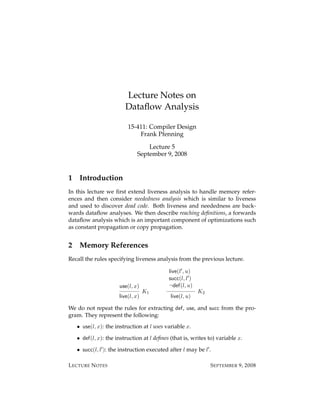
Recall the rules specifying liveness analysis from the previous lecture. 
use(l, x) 
live(l, x) 
K1 
live(l0, u) 
succ(l, l0) 
¬def(l, u) 
live(l, u) 
K2 
We do not repeat the rules for extracting def, use, and succ from the pro-gram. 
They represent the following: 
• use(l, x): the instruction at l uses variable x. 
• def(l, x): the instruction at l defines (that is, writes to) variable x. 
• succ(l, l0): the instruction executed after l may be l0. 
LECTURE NOTES SEPTEMBER 9, 2008
L5.2 Dataflow Analysis 
In order to model the store in our abstract assembly language, we add 
two new forms of instructions 
• Load: y   M[x]. 
• Store: M[x]   y. 
All that is needed to extend the liveness analysis is to specify the def, use, 
and succ properties of these two instructions. 
l : x   M[y] 
def(l, x) 
use(l, y) 
succ(l, l0) 
J6 
l : M[y]   x 
use(l, x) 
use(l, y) 
succ(l, l0) 
J7 
The rule J7 for storing a register contents to memory does not define any 
value, because liveness analysis does not track memory, only variables 
which then turn into registers. Tracking memory is indeed a difficult task 
and subject of a number of analyses of which alias analysis is the most 
prominent. We will consider this in a later language. 
The two rules for liveness itself do not need to change! This is an indi-cation 
that we refactored the original specification in a good way. 
3 Dead Code Elimination 
An important optimization in a compiler is dead code elimination which re-moves 
unneeded instructions from the program. Even if the original source 
code does not contain unnecessary code, after translation to a low-level lan-guage 
dead code often arises either just as an artefact of the translation itself 
or as the result of optimizations. We will see an example of these phenom-ena 
in Section 5; here we just use a small example. 
In this code, we compute the factorial of x. The variable x is live at the 
first line. This would typically be the case of an input variable to a program. 
Instructions Live variables 
1 : p   1 x 
2 : p   p  x p, x 
3 : z   p + 1 p, x 
4 : x   x − 1 p, x 
5 : if (x  0) goto 2 p, x 
6 : return p p 
LECTURE NOTES SEPTEMBER 9, 2008
Dataflow Analysis L5.3 
The only unusual part of the loop is the unnecessary computation of p + 1. 
We may suspect that line 3 is dead code, and we should be able to elim-inate 
it, say, by replacing it with some nop instruction which has no effect, 
or perhaps eliminate it entirely when we finally emit the code. The reason 
to suspect this is that z is not live at the point where we define it. While 
this may be sufficient reason to eliminate the assignment here, this is not 
true in general. For example, we may have an assignment such as z   p/x 
which is required to raise an exception if x = 0, or if the result is too large 
to fit into the allotted bits on the target architecture. Another example is a 
memory reference such as z   M[x] which is required to raise an excep-tion 
if the address x has actually not been allocated or is not readable by 
the executing process. We will come back to these exception in the next 
section. First, we discuss another phenomenon exhibited in the following 
small modification of the program above. 
Instructions Live variables 
1 : p   1 x, z 
2 : p   p  x p, x, z 
3 : z   z + 1 p, x, z 
4 : x   x − 1 p, x, z 
5 : if (x  0) goto 2 p, x, z 
6 : return p p 
Here we see that z is live in the loop (and before it) even though the value of 
z does not influence the final value returned. To see this yourself, note that 
in the first backwards pass we find z to be used at line 3. After computing 
p, x, and z to be live at line 2, we have reconsider line 5, since 2 is one of its 
successors, and add z as live to lines 5, 4, and 3. 
This example shows that liveness is not precise enough to eliminate 
even simple redundant instructions such as the one in line 3 above. 
4 Neededness 
In order to recognize that assignments as in the previous example program 
are indeed redundant, we need a different property we call neededness. We 
will structure the specification in the same way as we did for liveness: we 
analyze each instruction and extract the properties that are necessary for 
neededness to proceed without further reference to the program instruc-tions 
themselves. 
LECTURE NOTES SEPTEMBER 9, 2008
L5.4 Dataflow Analysis 
The crucial first idea is that the some variables are needed because an 
instruction they are involved in may have an effect. Let’s call such vari-able 
necessary. Formally, we write nec(l, x) to say that x is necessary at 
instruction l. We use the notation  for a binary operator which may raise 
an exception, such as division or the modulo operator. For our set of in-structions 
considered so far, the following are places where variables are 
necessary because of the possiblity of effects. 
l : x   y  z 
nec(l, y) 
nec(l, z) 
E1 
l : if (x ? c) goto l0 
nec(l, x) 
E2 
l : return x 
nec(l, x) 
E3 
l : y   M[x] 
nec(l, x) 
E4 
l : M[x]   y 
nec(l, x) 
nec(l, y) 
E5 
Here, x is flagged as necessary at a return statement because that is the final 
value returned, and a conditional branch because it is necessary to test the 
condition. The effect here is either the jump, or the lack of a jump. 
A side remark: on many architectures including the x86 and x86-64, 
apparently innocuous instructions such as x   x+y have an effect because 
they set the condition code registers. This makes optimizing unstructured 
machine code quite difficult. However, in compiler design we have a secret 
weapon: we only have to optimize the code that we generate! For example, 
if we make sure that when we compile conditionals, the condition codes 
are set immediately before the branching instruction examines them, then 
the implicit effects of other instructions that are part of code generation 
are benign and can be ignored. However, such “benign effects” may be 
lurking in unexpected places and may perhaps not be so benign after all, 
so it is important to reconsider them especially as optimizations become 
more aggressive. 
Now that we have extracted when variables are immediately necessary 
at any given line, we have to exploit this information to compute needed-ness. 
We write needed(l, x) if x is needed at l. The first rule captures the 
motivation for designing the rules for necessary variables. 
nec(l, x) 
needed(l, x) 
N1 
This seeds the neededness relation and we need to consider how to prop-agate 
it. Our second rule is an exact analogue of the way we propagate 
LECTURE NOTES SEPTEMBER 9, 2008
Dataflow Analysis L5.5 
liveness. 
needed(l0, u) 
succ(l, l0) 
¬def(l, u) 
needed(l, u) 
N2 
The crucial rule is the last one. In an assignment x   y  z the variables y 
and z are needed if x is needed in the remaining computation. If x cannot 
be shown to be needed, then y and z are not needed if  is an effect free 
operation. Abstracting away from the particular instruction, we get the 
following: 
use(l, y) 
def(l, x) 
succ(l, l0) 
needed(l0, x) 
needed(l, y) 
N3 
We see that neededness analysis is slightly more complex than liveness 
analysis: it requires three rules instead of two, and we need the new con-cept 
of a variable necessary for an instruction due to effects. We can restruc-ture 
the program slightly and unify the formulas nec(l, x) and needed(l, x). 
This is mostly a matter of taste and modularity. Personally, I prefer to sep-arate 
local properties of instructions from those that are propagated during 
the analysis, because local properties are more easily re-used. The speci-fication 
of neededness is actually an example of that: is employs use(l, x) 
in rule N3 which we first introduced for liveness analysis. If we had struc-tured 
liveness analysis so that the rules for instructions generate live(l, x) 
directly, it would not have worked as well here. 
We can now perform neededness analysis on our example program. We 
have indexed each variable with the numbers of all rules that can be used 
to infer that they are needed (N1, N2, or N3). 
Instructions Needed variables 
1 : p   1 x2 
2 : p   p  x p3, x2,3 
3 : z   z + 1 p2, x2 
4 : x   x − 1 p2, x3 
5 : if (x  0) goto 2 p2, x1,2 
6 : return p p1 
At the crucial line 3, z is defined but not needed on line 4, and consequently 
it is not needed at line 3 either. 
LECTURE NOTES SEPTEMBER 9, 2008
L5.6 Dataflow Analysis 
Since the right-hand side of z   z + 1 does not have an effect, and z 
is not needed at any successor line, this statement is dead code and can be 
optimized away. 
5 Reaching Definitions 
The natural direction for both liveness analysis and neededness analysis 
is to traverse the program backwards. In this section we present another 
important analysis whose natural traversal directions is forward. As moti-vating 
example for this kind of analysis we use an array access with bounds 
checks. 
We imagine in our source language (which remains nebulous for the 
time being) we have an assignment x = A[0] where A is an array. We 
also assume there are (assembly language) variables n with the number of 
elements in array A, s with the size of the array elements, and a with the 
base address of the array. We might then translate the assignment to the 
following code: 
1 : i   0 
2 : if (i  0) goto error 
3 : if (i  n) goto error 
4 : t   i  s 
5 : u   a + t 
6 : x   M[u] 
7 : return x 
The last line is just to create a live variable x. We notice that line 2 is redun-dant 
because the test will always be false. We do this in two steps. First we 
apply constant propagation to replace (i  0) by (0  0) and then apply con-stant 
folding to evaluate the comparison to 0 (representing falsehood). Line 
3 is necessary unless we know that n  0. Line 4 performs a redundant 
multiplication: because i is 0 we know t must also be 0. This is an example 
of an arithmetic optimization similar to constant folding. And now line 5 
is a redundant addition of 0 and can be turned into a move u   a, again a 
simplification of modular arithmetic. 
LECTURE NOTES SEPTEMBER 9, 2008
Dataflow Analysis L5.7 
At this point the program has become 
1 : i   0 
2 : nop 
3 : if (i  n) goto error 
4 : t   0 
5 : u   a 
6 : x   M[u] 
7 : return x 
Now we notice that line 4 is dead code because t is not needed. We can also 
apply copy propagation to replace M[u] by M[a], which now makes u not 
needed so we can apply dead code elimination to line 4. Finally, we can again 
apply constant propagation to replace the only remaining occurrence of i in 
line 3 by 0 followed by dead code elimination for line 1 to obtain 
1 : nop 
2 : nop 
3 : if (0  n) goto error 
4 : nop 
5 : nop 
6 : x   M[a] 
7 : return x 
which can be quite a bit more efficient than the first piece of code. Of course, 
when emitting machine code we can delete the nop operations to reduce 
code size. 
One important lesson from this example is that many different kinds of 
optimizations have to work in concert in order to produce efficient code in 
the end. What we are interested in for this lecture is what properties we 
need for the code to ensure that the optimization are indeed applicable. 
We return to the very first optimization. We replaced the test (i  0) 
with (0  0). This looks straightforward, but what happens if some other 
control flow path can reach the test? For example, we can insert an incre- 
LECTURE NOTES SEPTEMBER 9, 2008
L5.8 Dataflow Analysis 
ment and a conditional to call this optimization into question. 
1 : i   0 1 : i   0 
2 : if (i  0) goto error 2 : if (i  0) goto error 
3 : if (i  n) goto error 3 : if (i  n) goto error 
4 : t   i  s 4 : t   i  s 
5 : u   a + t 5 : u   a + t 
6 : x   M[u] 6 : x   M[u] 
7 : return x 7 : i   i + 1 
8 : if (i  n) goto 2 
9 : return x 
Even though lines 1–6 have not changed, suddenly we can no longer re-place 
(i  0) with (0  0) because the second time line 2 is reached, i is 
1. With arithmetic reasoning we may be able to recover the fact that line 
2 is redundant, but pure constant propogation and constant folding is no 
longer sufficient. 
What we need to know is that the definition of i in line 1 is the only 
definition of i that can reach line 2. This is true in the program on the left, 
but not on the right since the definition of i at line 7 can also reach line 2 if 
the condition at line 9 is true. 
We say a definition l : x   . . . reaches a line l0 if there is a path of control 
flow from l to l0 at which x is not redefined. In logical language: 
• reaches(l, x, l0) if the definition of x at l reaches l0. 
We only need two inference rules to defines this analysis. The first states 
that a variable definition reaches any immediate successor. The second ex-presses 
that we can propagate a reaching definition of x to all successors of 
a line l0 we have already reached, unless this line also defines x. 
def(l, x) 
succ(l, l0) 
reaches(l, x, l0) 
R1 
reaches(l, x, l0) 
succ(l0, l00) 
¬def(l0, x) 
reaches(l, x, l00) 
R2 
Analyzing the original program on the left, we see that the definition of 
i at line 1 reaches lines 2–7, and this is (obviously) the only definition of i 
reching lines 2 and 4. We can therefore apply the optimizations sketched 
above. 
In the program on the right hand side, the definition of i at line 7 also 
reaches lines 2–8 so neither optimization can be applied. 
LECTURE NOTES SEPTEMBER 9, 2008
Dataflow Analysis L5.9 
Inspection of rule R2 confirms the intuition that reaching definitions are 
propagated forward along the control flow edges. Consequently, a good im-plementation 
strategy starts at the beginning of a program and computes 
reaching definitions in the forward direction. Of course, saturation in the 
presence of backward branches means that we may have to reconsider ear-lier 
lines, just as in the backwards analysis. 
A word on complexity: we can bound the size of the saturated database 
for reaching definitions by L2, where L is the number of lines in the pro-gram. 
This is because each line defines at most one variable (or, in realistic 
machine code, a small constant number). Counting prefix firings (which 
we have not yet discussed) does not change this estimate, and we obtain a 
complexity of O(L2). This is not quite as efficient as liveness or neededness 
analysis (which are O(L·V )), so we may need to be somewhat circumspect 
in computing reaching definitions. 
6 Summary 
We have extended the ideas behind liveness analysis to neededness anal-ysis 
which enables more aggressive dead code elimination. Neededness 
is another example of a program analysis proceeding naturally backward 
through the program, iterating through loops. 
We have also seen reaching definitions, which is a forward dataflow 
analysis necessary for a number of important optimizations such as con-stant 
propagation or copy propagation. Reaching definitions can be spec-ified 
in two rules and do not require any new primitive concepts beyond 
variable definitions (def(x, l)) and the control flow graph (succ(l, l0)), both 
of which we already needed for liveness analysis. 
For an alternative approach to dataflow analysis via dataflow equations, 
see the textbook [App98], Chapters 10.1 and 17.1–3. Notes on implementa-tion 
of dataflow analyses are in Chapter 10.1–2 and 17.4. Generally speak-ing, 
a simple iterative implementation with a library data structure for sets 
which traverses the program in the natural direction should be efficient 
enough for our purposes. We would advise against using bitvectors for 
sets. Not only are the sets relatively sparse, but bitvectors are more time-consuming 
to implement. An interesting alternative to iterating over the 
program, maintaining sets, is to do the analysis one variable at a time (see 
the remark on page 216 of the textbook). The implementation via a saturat-ing 
engine for Datalog is also interesting, a bit more difficult to tie into the 
infrastructure of a complete compiler. The efficiency gain noted by Whaley 
LECTURE NOTES SEPTEMBER 9, 2008
L5.10 Dataflow Analysis 
et al. [WACL05] becomes only critical for interprocedural and whole pro-gram 
analyses rather than for the intraprocedural analyses we have pre-sented 
so far. 
References 
[App98] Andrew W. Appel. Modern Compiler Implementation in ML. 
Cambridge University Press, Cambridge, England, 1998. 
[WACL05] John Whaley, Dzintars Avots, Michael Carbin, and Monica S. 
Lam. Using Datalog and binary decision diagrams for program 
analysis. In K.Yi, editor, Proceedings of the 3rd Asian Symposium 
on Programming Languages and Systems (APLAS’05), pages 97– 
118. Springer LNCS 3780, November 2005. 
LECTURE NOTES SEPTEMBER 9, 2008

05 dataflow

  • 1.
    Lecture Notes on Dataflow Analysis 15-411: Compiler Design Frank Pfenning Lecture 5 September 9, 2008 1 Introduction In this lecture we first extend liveness analysis to handle memory refer-ences and then consider neededness analysis which is similar to liveness and used to discover dead code. Both liveness and neededness are back-wards dataflow analyses. We then describe reaching definitions, a forwards dataflow analysis which is an important component of optimizations such as constant propagation or copy propagation. 2 Memory References Recall the rules specifying liveness analysis from the previous lecture. use(l, x) live(l, x) K1 live(l0, u) succ(l, l0) ¬def(l, u) live(l, u) K2 We do not repeat the rules for extracting def, use, and succ from the pro-gram. They represent the following: • use(l, x): the instruction at l uses variable x. • def(l, x): the instruction at l defines (that is, writes to) variable x. • succ(l, l0): the instruction executed after l may be l0. LECTURE NOTES SEPTEMBER 9, 2008
  • 2.
    L5.2 Dataflow Analysis In order to model the store in our abstract assembly language, we add two new forms of instructions • Load: y M[x]. • Store: M[x] y. All that is needed to extend the liveness analysis is to specify the def, use, and succ properties of these two instructions. l : x M[y] def(l, x) use(l, y) succ(l, l0) J6 l : M[y] x use(l, x) use(l, y) succ(l, l0) J7 The rule J7 for storing a register contents to memory does not define any value, because liveness analysis does not track memory, only variables which then turn into registers. Tracking memory is indeed a difficult task and subject of a number of analyses of which alias analysis is the most prominent. We will consider this in a later language. The two rules for liveness itself do not need to change! This is an indi-cation that we refactored the original specification in a good way. 3 Dead Code Elimination An important optimization in a compiler is dead code elimination which re-moves unneeded instructions from the program. Even if the original source code does not contain unnecessary code, after translation to a low-level lan-guage dead code often arises either just as an artefact of the translation itself or as the result of optimizations. We will see an example of these phenom-ena in Section 5; here we just use a small example. In this code, we compute the factorial of x. The variable x is live at the first line. This would typically be the case of an input variable to a program. Instructions Live variables 1 : p 1 x 2 : p p x p, x 3 : z p + 1 p, x 4 : x x − 1 p, x 5 : if (x 0) goto 2 p, x 6 : return p p LECTURE NOTES SEPTEMBER 9, 2008
  • 3.
    Dataflow Analysis L5.3 The only unusual part of the loop is the unnecessary computation of p + 1. We may suspect that line 3 is dead code, and we should be able to elim-inate it, say, by replacing it with some nop instruction which has no effect, or perhaps eliminate it entirely when we finally emit the code. The reason to suspect this is that z is not live at the point where we define it. While this may be sufficient reason to eliminate the assignment here, this is not true in general. For example, we may have an assignment such as z p/x which is required to raise an exception if x = 0, or if the result is too large to fit into the allotted bits on the target architecture. Another example is a memory reference such as z M[x] which is required to raise an excep-tion if the address x has actually not been allocated or is not readable by the executing process. We will come back to these exception in the next section. First, we discuss another phenomenon exhibited in the following small modification of the program above. Instructions Live variables 1 : p 1 x, z 2 : p p x p, x, z 3 : z z + 1 p, x, z 4 : x x − 1 p, x, z 5 : if (x 0) goto 2 p, x, z 6 : return p p Here we see that z is live in the loop (and before it) even though the value of z does not influence the final value returned. To see this yourself, note that in the first backwards pass we find z to be used at line 3. After computing p, x, and z to be live at line 2, we have reconsider line 5, since 2 is one of its successors, and add z as live to lines 5, 4, and 3. This example shows that liveness is not precise enough to eliminate even simple redundant instructions such as the one in line 3 above. 4 Neededness In order to recognize that assignments as in the previous example program are indeed redundant, we need a different property we call neededness. We will structure the specification in the same way as we did for liveness: we analyze each instruction and extract the properties that are necessary for neededness to proceed without further reference to the program instruc-tions themselves. LECTURE NOTES SEPTEMBER 9, 2008
  • 4.
    L5.4 Dataflow Analysis The crucial first idea is that the some variables are needed because an instruction they are involved in may have an effect. Let’s call such vari-able necessary. Formally, we write nec(l, x) to say that x is necessary at instruction l. We use the notation for a binary operator which may raise an exception, such as division or the modulo operator. For our set of in-structions considered so far, the following are places where variables are necessary because of the possiblity of effects. l : x y z nec(l, y) nec(l, z) E1 l : if (x ? c) goto l0 nec(l, x) E2 l : return x nec(l, x) E3 l : y M[x] nec(l, x) E4 l : M[x] y nec(l, x) nec(l, y) E5 Here, x is flagged as necessary at a return statement because that is the final value returned, and a conditional branch because it is necessary to test the condition. The effect here is either the jump, or the lack of a jump. A side remark: on many architectures including the x86 and x86-64, apparently innocuous instructions such as x x+y have an effect because they set the condition code registers. This makes optimizing unstructured machine code quite difficult. However, in compiler design we have a secret weapon: we only have to optimize the code that we generate! For example, if we make sure that when we compile conditionals, the condition codes are set immediately before the branching instruction examines them, then the implicit effects of other instructions that are part of code generation are benign and can be ignored. However, such “benign effects” may be lurking in unexpected places and may perhaps not be so benign after all, so it is important to reconsider them especially as optimizations become more aggressive. Now that we have extracted when variables are immediately necessary at any given line, we have to exploit this information to compute needed-ness. We write needed(l, x) if x is needed at l. The first rule captures the motivation for designing the rules for necessary variables. nec(l, x) needed(l, x) N1 This seeds the neededness relation and we need to consider how to prop-agate it. Our second rule is an exact analogue of the way we propagate LECTURE NOTES SEPTEMBER 9, 2008
  • 5.
    Dataflow Analysis L5.5 liveness. needed(l0, u) succ(l, l0) ¬def(l, u) needed(l, u) N2 The crucial rule is the last one. In an assignment x y z the variables y and z are needed if x is needed in the remaining computation. If x cannot be shown to be needed, then y and z are not needed if is an effect free operation. Abstracting away from the particular instruction, we get the following: use(l, y) def(l, x) succ(l, l0) needed(l0, x) needed(l, y) N3 We see that neededness analysis is slightly more complex than liveness analysis: it requires three rules instead of two, and we need the new con-cept of a variable necessary for an instruction due to effects. We can restruc-ture the program slightly and unify the formulas nec(l, x) and needed(l, x). This is mostly a matter of taste and modularity. Personally, I prefer to sep-arate local properties of instructions from those that are propagated during the analysis, because local properties are more easily re-used. The speci-fication of neededness is actually an example of that: is employs use(l, x) in rule N3 which we first introduced for liveness analysis. If we had struc-tured liveness analysis so that the rules for instructions generate live(l, x) directly, it would not have worked as well here. We can now perform neededness analysis on our example program. We have indexed each variable with the numbers of all rules that can be used to infer that they are needed (N1, N2, or N3). Instructions Needed variables 1 : p 1 x2 2 : p p x p3, x2,3 3 : z z + 1 p2, x2 4 : x x − 1 p2, x3 5 : if (x 0) goto 2 p2, x1,2 6 : return p p1 At the crucial line 3, z is defined but not needed on line 4, and consequently it is not needed at line 3 either. LECTURE NOTES SEPTEMBER 9, 2008
  • 6.
    L5.6 Dataflow Analysis Since the right-hand side of z z + 1 does not have an effect, and z is not needed at any successor line, this statement is dead code and can be optimized away. 5 Reaching Definitions The natural direction for both liveness analysis and neededness analysis is to traverse the program backwards. In this section we present another important analysis whose natural traversal directions is forward. As moti-vating example for this kind of analysis we use an array access with bounds checks. We imagine in our source language (which remains nebulous for the time being) we have an assignment x = A[0] where A is an array. We also assume there are (assembly language) variables n with the number of elements in array A, s with the size of the array elements, and a with the base address of the array. We might then translate the assignment to the following code: 1 : i 0 2 : if (i 0) goto error 3 : if (i n) goto error 4 : t i s 5 : u a + t 6 : x M[u] 7 : return x The last line is just to create a live variable x. We notice that line 2 is redun-dant because the test will always be false. We do this in two steps. First we apply constant propagation to replace (i 0) by (0 0) and then apply con-stant folding to evaluate the comparison to 0 (representing falsehood). Line 3 is necessary unless we know that n 0. Line 4 performs a redundant multiplication: because i is 0 we know t must also be 0. This is an example of an arithmetic optimization similar to constant folding. And now line 5 is a redundant addition of 0 and can be turned into a move u a, again a simplification of modular arithmetic. LECTURE NOTES SEPTEMBER 9, 2008
  • 7.
    Dataflow Analysis L5.7 At this point the program has become 1 : i 0 2 : nop 3 : if (i n) goto error 4 : t 0 5 : u a 6 : x M[u] 7 : return x Now we notice that line 4 is dead code because t is not needed. We can also apply copy propagation to replace M[u] by M[a], which now makes u not needed so we can apply dead code elimination to line 4. Finally, we can again apply constant propagation to replace the only remaining occurrence of i in line 3 by 0 followed by dead code elimination for line 1 to obtain 1 : nop 2 : nop 3 : if (0 n) goto error 4 : nop 5 : nop 6 : x M[a] 7 : return x which can be quite a bit more efficient than the first piece of code. Of course, when emitting machine code we can delete the nop operations to reduce code size. One important lesson from this example is that many different kinds of optimizations have to work in concert in order to produce efficient code in the end. What we are interested in for this lecture is what properties we need for the code to ensure that the optimization are indeed applicable. We return to the very first optimization. We replaced the test (i 0) with (0 0). This looks straightforward, but what happens if some other control flow path can reach the test? For example, we can insert an incre- LECTURE NOTES SEPTEMBER 9, 2008
  • 8.
    L5.8 Dataflow Analysis ment and a conditional to call this optimization into question. 1 : i 0 1 : i 0 2 : if (i 0) goto error 2 : if (i 0) goto error 3 : if (i n) goto error 3 : if (i n) goto error 4 : t i s 4 : t i s 5 : u a + t 5 : u a + t 6 : x M[u] 6 : x M[u] 7 : return x 7 : i i + 1 8 : if (i n) goto 2 9 : return x Even though lines 1–6 have not changed, suddenly we can no longer re-place (i 0) with (0 0) because the second time line 2 is reached, i is 1. With arithmetic reasoning we may be able to recover the fact that line 2 is redundant, but pure constant propogation and constant folding is no longer sufficient. What we need to know is that the definition of i in line 1 is the only definition of i that can reach line 2. This is true in the program on the left, but not on the right since the definition of i at line 7 can also reach line 2 if the condition at line 9 is true. We say a definition l : x . . . reaches a line l0 if there is a path of control flow from l to l0 at which x is not redefined. In logical language: • reaches(l, x, l0) if the definition of x at l reaches l0. We only need two inference rules to defines this analysis. The first states that a variable definition reaches any immediate successor. The second ex-presses that we can propagate a reaching definition of x to all successors of a line l0 we have already reached, unless this line also defines x. def(l, x) succ(l, l0) reaches(l, x, l0) R1 reaches(l, x, l0) succ(l0, l00) ¬def(l0, x) reaches(l, x, l00) R2 Analyzing the original program on the left, we see that the definition of i at line 1 reaches lines 2–7, and this is (obviously) the only definition of i reching lines 2 and 4. We can therefore apply the optimizations sketched above. In the program on the right hand side, the definition of i at line 7 also reaches lines 2–8 so neither optimization can be applied. LECTURE NOTES SEPTEMBER 9, 2008
  • 9.
    Dataflow Analysis L5.9 Inspection of rule R2 confirms the intuition that reaching definitions are propagated forward along the control flow edges. Consequently, a good im-plementation strategy starts at the beginning of a program and computes reaching definitions in the forward direction. Of course, saturation in the presence of backward branches means that we may have to reconsider ear-lier lines, just as in the backwards analysis. A word on complexity: we can bound the size of the saturated database for reaching definitions by L2, where L is the number of lines in the pro-gram. This is because each line defines at most one variable (or, in realistic machine code, a small constant number). Counting prefix firings (which we have not yet discussed) does not change this estimate, and we obtain a complexity of O(L2). This is not quite as efficient as liveness or neededness analysis (which are O(L·V )), so we may need to be somewhat circumspect in computing reaching definitions. 6 Summary We have extended the ideas behind liveness analysis to neededness anal-ysis which enables more aggressive dead code elimination. Neededness is another example of a program analysis proceeding naturally backward through the program, iterating through loops. We have also seen reaching definitions, which is a forward dataflow analysis necessary for a number of important optimizations such as con-stant propagation or copy propagation. Reaching definitions can be spec-ified in two rules and do not require any new primitive concepts beyond variable definitions (def(x, l)) and the control flow graph (succ(l, l0)), both of which we already needed for liveness analysis. For an alternative approach to dataflow analysis via dataflow equations, see the textbook [App98], Chapters 10.1 and 17.1–3. Notes on implementa-tion of dataflow analyses are in Chapter 10.1–2 and 17.4. Generally speak-ing, a simple iterative implementation with a library data structure for sets which traverses the program in the natural direction should be efficient enough for our purposes. We would advise against using bitvectors for sets. Not only are the sets relatively sparse, but bitvectors are more time-consuming to implement. An interesting alternative to iterating over the program, maintaining sets, is to do the analysis one variable at a time (see the remark on page 216 of the textbook). The implementation via a saturat-ing engine for Datalog is also interesting, a bit more difficult to tie into the infrastructure of a complete compiler. The efficiency gain noted by Whaley LECTURE NOTES SEPTEMBER 9, 2008
  • 10.
    L5.10 Dataflow Analysis et al. [WACL05] becomes only critical for interprocedural and whole pro-gram analyses rather than for the intraprocedural analyses we have pre-sented so far. References [App98] Andrew W. Appel. Modern Compiler Implementation in ML. Cambridge University Press, Cambridge, England, 1998. [WACL05] John Whaley, Dzintars Avots, Michael Carbin, and Monica S. Lam. Using Datalog and binary decision diagrams for program analysis. In K.Yi, editor, Proceedings of the 3rd Asian Symposium on Programming Languages and Systems (APLAS’05), pages 97– 118. Springer LNCS 3780, November 2005. LECTURE NOTES SEPTEMBER 9, 2008