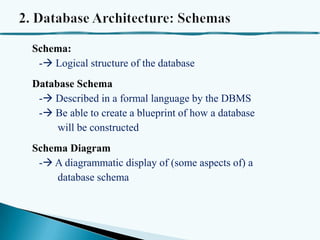
Schema:
- Logical structure of the database

Database Schema
- Described in a formal language by the DBMS
- Be able to create a blueprint of how a database
will be constructed
Schema Diagram
- A diagrammatic display of (some aspects of) a
database schema
Schema Diagram Example:
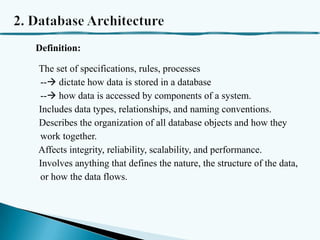
Definition:
The set of specifications, rules, processes
-- dictate how data is stored in a database
-- how data is accessed by components of a system.
Includes data types, relationships, and naming conventions.
Describes the organization of all database objects and how they
work together.
Affects integrity, reliability, scalability, and performance.
Involves anything that defines the nature, the structure of the data,
or how the data flows.
Database Independence :
Logical data independence
The capacity to change the conceptual schema without having to
change external schema or application programs.
Ex: employee (e#, name, address, salary)
Physical data independence
The capacity to change the internal schema without having to
change the conceptual (or external) schema.
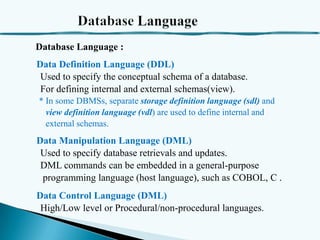
Database Language :
Data Definition Language (DDL)
Used to specify the conceptual schema of a database.
For defining internal and external schemas(view).
* In some DBMSs, separate storage definition language (sdl) and
view definition language (vdl) are used to define internal and
external schemas.

Data Manipulation Language (DML)
Used to specify database retrievals and updates.
DML commands can be embedded in a general-purpose
programming language (host language), such as COBOL, C .
Data Control Language (DML)
High/Low level or Procedural/non-procedural languages.
Definition :
The aggregate of means by which people interact with the database.
- Input : users to manipulate a system
- Output : to produce the effects of the users' manipulation.

Examples :
Stand-alone query language interfaces.
Programmer interfaces.
* Pre-compiler approach
* Procedure (subroutine) call approach
User-friendly interfaces.
* Menu-based, popular for browsing on the web
* Forms-based, designed for naïve users
* Graphics-based (point and click, drag and drop etc.)
* Natural language: requests in written English

3 db architecture

  • 1.
    Schema: - Logical structureof the database Database Schema - Described in a formal language by the DBMS - Be able to create a blueprint of how a database will be constructed Schema Diagram - A diagrammatic display of (some aspects of) a database schema
  • 2.
  • 3.
    Definition: The set ofspecifications, rules, processes -- dictate how data is stored in a database -- how data is accessed by components of a system. Includes data types, relationships, and naming conventions. Describes the organization of all database objects and how they work together. Affects integrity, reliability, scalability, and performance. Involves anything that defines the nature, the structure of the data, or how the data flows.
  • 4.
    Database Independence : Logicaldata independence The capacity to change the conceptual schema without having to change external schema or application programs. Ex: employee (e#, name, address, salary) Physical data independence The capacity to change the internal schema without having to change the conceptual (or external) schema.
  • 5.
    Database Language : DataDefinition Language (DDL) Used to specify the conceptual schema of a database. For defining internal and external schemas(view). * In some DBMSs, separate storage definition language (sdl) and view definition language (vdl) are used to define internal and external schemas. Data Manipulation Language (DML) Used to specify database retrievals and updates. DML commands can be embedded in a general-purpose programming language (host language), such as COBOL, C . Data Control Language (DML) High/Low level or Procedural/non-procedural languages.
  • 6.
    Definition : The aggregateof means by which people interact with the database. - Input : users to manipulate a system - Output : to produce the effects of the users' manipulation. Examples : Stand-alone query language interfaces. Programmer interfaces. * Pre-compiler approach * Procedure (subroutine) call approach User-friendly interfaces. * Menu-based, popular for browsing on the web * Forms-based, designed for naïve users * Graphics-based (point and click, drag and drop etc.) * Natural language: requests in written English