INTRODUCTION TO PMKY
-POOJA AND DEEPU-
Skill India
Skill India is launched by prime minister Narendra
Modi on 15th July 2015.
It includes various initiatives of government like
National skill development mission, National policy
for skill development & entrepreneurship 2015,
Pradan Mantri Kaushal Vikas Yojana(PMKVY) and
skill loans scheme .
Eligibility
Yojana aims to provide jobs to:
o first time job entrains
o class 10 or 12 drop outs
o applicant has to provide adhar card no. , mobile
number, pan card.
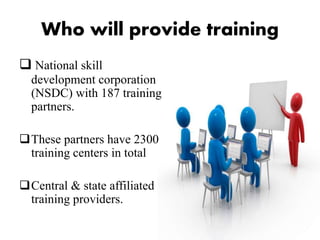
Who will provide training
 National skill
development corporation
(NSDC) with 187 training
partners.
These partners have 2300
training centers in total
Central & state affiliated
training providers.
curriculum
 Soft skills
Work ethics
Personality development
Behavioral development
Cleanliness & Others
status
o As per the data on NSDC website so far:
o number of people trained: 3657763
o placement or job offered : 1406800
INTRODUCTION
• PMKVY scheme has come by the central or union
of India.
• This scheme is realised by P.M Narendra Modi .
• This scheme is accessed by NSDC.
• Various type of courses are present for all
candidates and institution owners.
• This scheme provides the education for all youth,
medium category candidates.
• PMKVY is the flag scheme of Ministry of Skill
Development & Entrepreneurship (MSDE).
• The objective of this skill Certification
Scheme is to enable a large number of Indian
youth to take up industry- relevant skill
training that will help them in securing a
better livelihood.
• Under this scheme, Training and Assessment
fees are completely paid by the Government.
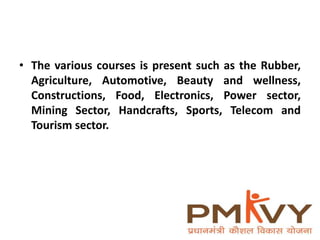
• The various courses is present such as the Rubber,
Agriculture, Automotive, Beauty and wellness,
Constructions, Food, Electronics, Power sector,
Mining Sector, Handcrafts, Sports, Telecom and
Tourism sector.
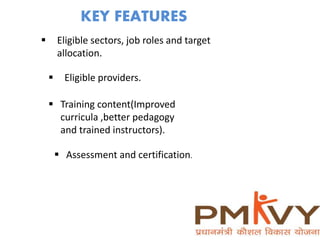
KEY FEATURES
 Eligible sectors, job roles and target
allocation.
 Eligible providers.
 Training content(Improved
curricula ,better pedagogy
and trained instructors).
 Assessment and certification.
 Eligible Beneficiaries.
 Monetary Awards.
 Mentoring support.
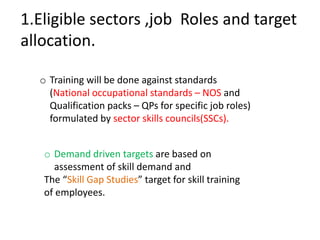
1.Eligible sectors ,job Roles and target
allocation.
o Training will be done against standards
(National occupational standards – NOS and
Qualification packs – QPs for specific job roles)
formulated by sector skills councils(SSCs).
o Demand driven targets are based on
assessment of skill demand and
The “Skill Gap Studies” target for skill training
of employees.
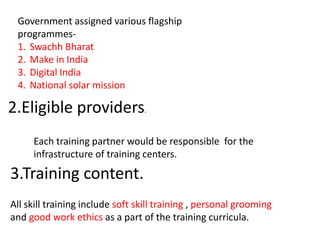
Government assigned various flagship
programmes-
1. Swachh Bharat
2. Make in India
3. Digital India
4. National solar mission
2.Eligible providers.
Each training partner would be responsible for the
infrastructure of training centers.
3.Training content.
All skill training include soft skill training , personal grooming
and good work ethics as a part of the training curricula.
4.Assessment and certification
Third party assessments for skill training will be done
based on national standards.
Under PMKVY, trainees with prior experience or skills and
competencies will be assessed and given monetary
rewards to them.
5.Eligible Beneficiaries
This scheme is any candidates of Indian nationality who:
a) Undergoes a skill development training in an eligible sector
by an eligible training provider.
b) And should be certified during the span of 1 year from the
date of the launch of the scheme.
6.Monetary Awards
For skill
Training
For
Recognitio
n
Of prior
learning(R
PL)
NSQF Levels Manufacturin
g
Plumbing &
construction
sectors
Other
sectors
Manufacturi
ng
Plumbing &
Construction
sectors
Other
sectors
Level 1&2 7,500 5,000
Level 3&4 10,000 7,500 2,500 2000
Level 4&6 12,500 10,000
7.Mentoring support
• A mentorship programme will be
created to support trainees.
• It leads to more employment
opportunities.
OBJECTIVE
-ANGELA MARIYA ROY-
OBJECTIVE
• The objective of this Scheme is to encourage
skill development for youth by providing
monetary rewards for successful completion of
approved training programs.
• Encourage standardization
• Enable and mobilize a large number of Indian
youth to take up skill training and become
employable and earn their livelihood
• Benefit 24 lakh youth at an approximate
total cost of Rs. 1,500 Crores
• Provide Monetary Awards for Skill Certification
• Reward candidates undergoing skill training
STRATEGY AND APPROACH
- ALEN PHILIP -
Strategy and approach
• The Scheme will provide monetary incentives
for successful completion of market-driven
skill training and certification to approximately
twenty four lakh youth in in a span of one year
from the date of implementation of the
scheme.
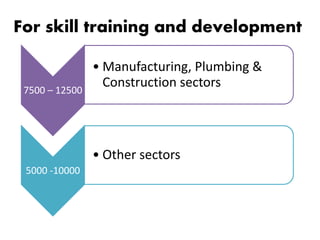
For skill training and development
7500 – 12500
• Manufacturing, Plumbing &
Construction sectors
5000 -10000
• Other sectors
For Recognition of Prior Learning [RPL]
2500
• Manufacturing, Plumbing &
Construction sectors
2000
• Other sectors
Strategy and approach
• This Scheme shall be implemented through
Public-Private and Public-Public partnerships.
Strategy and approach
 NSDC will be the implementing agency for this
Scheme.
NSDC
The National Skill Development Corporation
(NSDC) has been instituted to foster private sector
initiatives in skill development. It is a Private Public
Partnership(PPP) organization with representatives
of Government and Industry Associations on its
Board.
Strategy and approach
• Trainings and certification under Recognition of
Prior Learning will be specifically oriented for
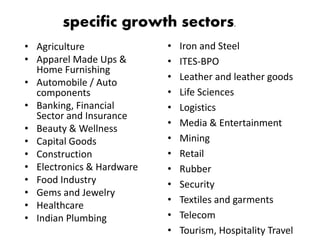
developing skills in specific growth sectors.
• Agriculture
• Apparel Made Ups &
Home Furnishing
• Automobile / Auto
components
• Banking, Financial
Sector and Insurance
• Beauty & Wellness
• Capital Goods
• Construction
• Electronics & Hardware
• Food Industry
• Gems and Jewelry
• Healthcare
• Indian Plumbing
• Iron and Steel
• ITES-BPO
• Leather and leather goods
• Life Sciences
• Logistics
• Media & Entertainment
• Mining
• Retail
• Rubber
• Security
• Textiles and garments
• Telecom
• Tourism, Hospitality Travel
specific growth sectors.
Strategy and approach
• Assessment and training bodies for all
purposes of the Scheme will be separate and
no overlap of roles will be allowed to maintain
transparency and objectivity..
Strategy and approach
• The monetary reward will be wholly funded by the
MSDE, Government of India and will be affected
through bank transfer to the beneficiaries’ accounts.
For facilitating the smooth disbursement as
prescribed under the scheme, the entire money
along with the additional implementation fund will
be transferred to National Skill Development Fund
for further utilization by NSDC.
Pradhan Mantri Kaushal Vikas Yojana
-SIJU V EAPEN-
• This is the flagship scheme for skill training of youth to be
implemented by the new Ministry of Skill Development and
Entrepreneurship through the National Skill Development
Corporation (NSDC).
• Skill training would be done based on the National Skill
Qualification Framework (NSQF) and industry led standards.
• The average monetary reward would be around Rs.8000 per
trainee.
NNS
National Skill Development Corporation.
Implementing Agency
N.S.D.C
• This Scheme shall be implemented through Public-Private and
Public-Public partnerships.
• NSDC will be the implementing agency for this Scheme and
NSDF shall monitor the implementation of the Scheme, using
mutually agreed criteria with NSDC.
• The Scheme will provide monetary incentives for successful
completion of, market-driven skill training to approximately
ten lakh youth in in a span of one year from the date of
implementation of the scheme.
N.S.D.C (National Skill
Development Corporation)
Steering Committee
- BIBIN JOSE -
• Steering Committee for PMKVY would be
responsible for providing direction for
implementation of the scheme.
• The Steering Committee will be empowered to
review the framework and make suitable
modification as and when required in the
scheme.
• The Committee will oversee dynamic
fixation of targets for skilling, amount of
monetary reward by job roles, activities
related to awareness building and trainee
mobilization, mentorship support.
• The Steering Committee may appoint sub-
committees at national or state level (s) to
assist in exercise of its functions
• It is recommended that sub-committees at
the district level are also formed especially
to focus on awareness and mobilization
activities, as well as for monitoring of the
scheme.

Pmky by prime minister

  • 1.
  • 2.
    Skill India Skill Indiais launched by prime minister Narendra Modi on 15th July 2015. It includes various initiatives of government like National skill development mission, National policy for skill development & entrepreneurship 2015, Pradan Mantri Kaushal Vikas Yojana(PMKVY) and skill loans scheme .
  • 3.
    Eligibility Yojana aims toprovide jobs to: o first time job entrains o class 10 or 12 drop outs o applicant has to provide adhar card no. , mobile number, pan card.
  • 4.
    Who will providetraining  National skill development corporation (NSDC) with 187 training partners. These partners have 2300 training centers in total Central & state affiliated training providers.
  • 5.
    curriculum  Soft skills Workethics Personality development Behavioral development Cleanliness & Others
  • 6.
    status o As perthe data on NSDC website so far: o number of people trained: 3657763 o placement or job offered : 1406800
  • 8.
    INTRODUCTION • PMKVY schemehas come by the central or union of India. • This scheme is realised by P.M Narendra Modi . • This scheme is accessed by NSDC.
  • 9.
    • Various typeof courses are present for all candidates and institution owners. • This scheme provides the education for all youth, medium category candidates. • PMKVY is the flag scheme of Ministry of Skill Development & Entrepreneurship (MSDE).
  • 10.
    • The objectiveof this skill Certification Scheme is to enable a large number of Indian youth to take up industry- relevant skill training that will help them in securing a better livelihood. • Under this scheme, Training and Assessment fees are completely paid by the Government.
  • 11.
    • The variouscourses is present such as the Rubber, Agriculture, Automotive, Beauty and wellness, Constructions, Food, Electronics, Power sector, Mining Sector, Handcrafts, Sports, Telecom and Tourism sector.
  • 12.
    KEY FEATURES  Eligiblesectors, job roles and target allocation.  Eligible providers.  Training content(Improved curricula ,better pedagogy and trained instructors).  Assessment and certification.
  • 13.
     Eligible Beneficiaries. Monetary Awards.  Mentoring support.
  • 14.
    1.Eligible sectors ,jobRoles and target allocation. o Training will be done against standards (National occupational standards – NOS and Qualification packs – QPs for specific job roles) formulated by sector skills councils(SSCs). o Demand driven targets are based on assessment of skill demand and The “Skill Gap Studies” target for skill training of employees.
  • 15.
    Government assigned variousflagship programmes- 1. Swachh Bharat 2. Make in India 3. Digital India 4. National solar mission 2.Eligible providers. Each training partner would be responsible for the infrastructure of training centers. 3.Training content. All skill training include soft skill training , personal grooming and good work ethics as a part of the training curricula.
  • 16.
    4.Assessment and certification Thirdparty assessments for skill training will be done based on national standards. Under PMKVY, trainees with prior experience or skills and competencies will be assessed and given monetary rewards to them. 5.Eligible Beneficiaries This scheme is any candidates of Indian nationality who: a) Undergoes a skill development training in an eligible sector by an eligible training provider. b) And should be certified during the span of 1 year from the date of the launch of the scheme.
  • 17.
    6.Monetary Awards For skill Training For Recognitio n Ofprior learning(R PL) NSQF Levels Manufacturin g Plumbing & construction sectors Other sectors Manufacturi ng Plumbing & Construction sectors Other sectors Level 1&2 7,500 5,000 Level 3&4 10,000 7,500 2,500 2000 Level 4&6 12,500 10,000
  • 18.
    7.Mentoring support • Amentorship programme will be created to support trainees. • It leads to more employment opportunities.
  • 19.
  • 20.
    OBJECTIVE • The objectiveof this Scheme is to encourage skill development for youth by providing monetary rewards for successful completion of approved training programs. • Encourage standardization • Enable and mobilize a large number of Indian youth to take up skill training and become employable and earn their livelihood
  • 21.
    • Benefit 24lakh youth at an approximate total cost of Rs. 1,500 Crores • Provide Monetary Awards for Skill Certification • Reward candidates undergoing skill training
  • 22.
  • 23.
    Strategy and approach •The Scheme will provide monetary incentives for successful completion of market-driven skill training and certification to approximately twenty four lakh youth in in a span of one year from the date of implementation of the scheme.
  • 24.
    For skill trainingand development 7500 – 12500 • Manufacturing, Plumbing & Construction sectors 5000 -10000 • Other sectors
  • 25.
    For Recognition ofPrior Learning [RPL] 2500 • Manufacturing, Plumbing & Construction sectors 2000 • Other sectors
  • 26.
    Strategy and approach •This Scheme shall be implemented through Public-Private and Public-Public partnerships.
  • 27.
    Strategy and approach NSDC will be the implementing agency for this Scheme.
  • 28.
    NSDC The National SkillDevelopment Corporation (NSDC) has been instituted to foster private sector initiatives in skill development. It is a Private Public Partnership(PPP) organization with representatives of Government and Industry Associations on its Board.
  • 29.
    Strategy and approach •Trainings and certification under Recognition of Prior Learning will be specifically oriented for developing skills in specific growth sectors.
  • 30.
    • Agriculture • ApparelMade Ups & Home Furnishing • Automobile / Auto components • Banking, Financial Sector and Insurance • Beauty & Wellness • Capital Goods • Construction • Electronics & Hardware • Food Industry • Gems and Jewelry • Healthcare • Indian Plumbing • Iron and Steel • ITES-BPO • Leather and leather goods • Life Sciences • Logistics • Media & Entertainment • Mining • Retail • Rubber • Security • Textiles and garments • Telecom • Tourism, Hospitality Travel specific growth sectors.
  • 31.
    Strategy and approach •Assessment and training bodies for all purposes of the Scheme will be separate and no overlap of roles will be allowed to maintain transparency and objectivity..
  • 32.
    Strategy and approach •The monetary reward will be wholly funded by the MSDE, Government of India and will be affected through bank transfer to the beneficiaries’ accounts. For facilitating the smooth disbursement as prescribed under the scheme, the entire money along with the additional implementation fund will be transferred to National Skill Development Fund for further utilization by NSDC.
  • 33.
    Pradhan Mantri KaushalVikas Yojana -SIJU V EAPEN-
  • 34.
    • This isthe flagship scheme for skill training of youth to be implemented by the new Ministry of Skill Development and Entrepreneurship through the National Skill Development Corporation (NSDC). • Skill training would be done based on the National Skill Qualification Framework (NSQF) and industry led standards. • The average monetary reward would be around Rs.8000 per trainee.
  • 35.
    NNS National Skill DevelopmentCorporation. Implementing Agency N.S.D.C
  • 36.
    • This Schemeshall be implemented through Public-Private and Public-Public partnerships. • NSDC will be the implementing agency for this Scheme and NSDF shall monitor the implementation of the Scheme, using mutually agreed criteria with NSDC. • The Scheme will provide monetary incentives for successful completion of, market-driven skill training to approximately ten lakh youth in in a span of one year from the date of implementation of the scheme. N.S.D.C (National Skill Development Corporation)
  • 37.
  • 38.
    • Steering Committeefor PMKVY would be responsible for providing direction for implementation of the scheme. • The Steering Committee will be empowered to review the framework and make suitable modification as and when required in the scheme.
  • 39.
    • The Committeewill oversee dynamic fixation of targets for skilling, amount of monetary reward by job roles, activities related to awareness building and trainee mobilization, mentorship support. • The Steering Committee may appoint sub- committees at national or state level (s) to assist in exercise of its functions
  • 40.
    • It isrecommended that sub-committees at the district level are also formed especially to focus on awareness and mobilization activities, as well as for monitoring of the scheme.