ETHICAL ISSUES
RELATED TO DATA
COLLECTION
GUNJAN
ME. CSE(2nd semester)
23-305
CONTENTS
 Data Ethics
 3 Important Ethics in Data Collection
 Ethical considerations in Data Collection
 Ethical Issues related to Data Collection
 7 Principles of Data Ethics
Data Ethics
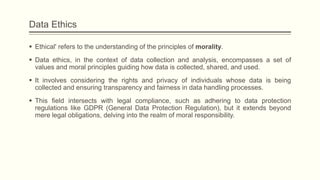
 Ethical' refers to the understanding of the principles of morality.
 Data ethics, in the context of data collection and analysis, encompasses a set of
values and moral principles guiding how data is collected, shared, and used.
 It involves considering the rights and privacy of individuals whose data is being
collected and ensuring transparency and fairness in data handling processes.
 This field intersects with legal compliance, such as adhering to data protection
regulations like GDPR (General Data Protection Regulation), but it extends beyond
mere legal obligations, delving into the realm of moral responsibility.
Types of Data Collection
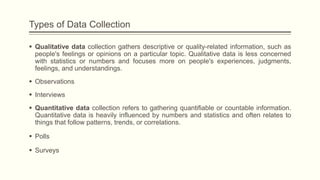
 Qualitative data collection gathers descriptive or quality-related information, such as
people's feelings or opinions on a particular topic. Qualitative data is less concerned
with statistics or numbers and focuses more on people's experiences, judgments,
feelings, and understandings.
 Observations
 Interviews
 Quantitative data collection refers to gathering quantifiable or countable information.
Quantitative data is heavily influenced by numbers and statistics and often relates to
things that follow patterns, trends, or correlations.
 Polls
 Surveys
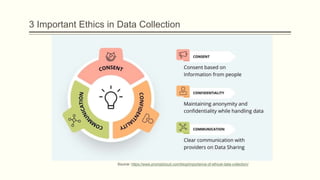
3 Important Ethics in Data Collection
Source- https://www.promptcloud.com/blog/importance-of-ethical-data-collection/
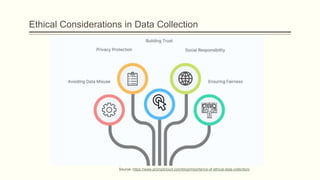
Ethical Considerations in Data Collection
Source- https://www.promptcloud.com/blog/importance-of-ethical-data-collection/
Ethical Considerations in Data Collection contd..
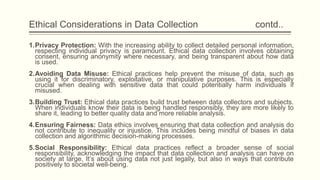
1.Privacy Protection: With the increasing ability to collect detailed personal information,
respecting individual privacy is paramount. Ethical data collection involves obtaining
consent, ensuring anonymity where necessary, and being transparent about how data
is used.
2.Avoiding Data Misuse: Ethical practices help prevent the misuse of data, such as
using it for discriminatory, exploitative, or manipulative purposes. This is especially
crucial when dealing with sensitive data that could potentially harm individuals if
misused.
3.Building Trust: Ethical data practices build trust between data collectors and subjects.
When individuals know their data is being handled responsibly, they are more likely to
share it, leading to better quality data and more reliable analysis.
4.Ensuring Fairness: Data ethics involves ensuring that data collection and analysis do
not contribute to inequality or injustice. This includes being mindful of biases in data
collection and algorithmic decision-making processes.
5.Social Responsibility: Ethical data practices reflect a broader sense of social
responsibility, acknowledging the impact that data collection and analysis can have on
society at large. It’s about using data not just legally, but also in ways that contribute
positively to societal well-being.
Ethical Issues related to Data Collection
Source- https://www.promptcloud.com/blog/importance-of-ethical-data-collection/
Ethical Issues related to Data Collection contd..
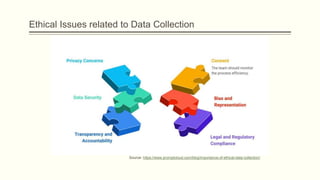
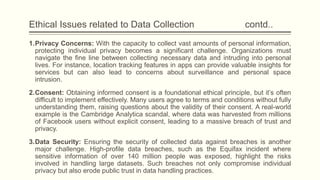
1.Privacy Concerns: With the capacity to collect vast amounts of personal information,
protecting individual privacy becomes a significant challenge. Organizations must
navigate the fine line between collecting necessary data and intruding into personal
lives. For instance, location tracking features in apps can provide valuable insights for
services but can also lead to concerns about surveillance and personal space
intrusion.
2.Consent: Obtaining informed consent is a foundational ethical principle, but it’s often
difficult to implement effectively. Many users agree to terms and conditions without fully
understanding them, raising questions about the validity of their consent. A real-world
example is the Cambridge Analytica scandal, where data was harvested from millions
of Facebook users without explicit consent, leading to a massive breach of trust and
privacy.
3.Data Security: Ensuring the security of collected data against breaches is another
major challenge. High-profile data breaches, such as the Equifax incident where
sensitive information of over 140 million people was exposed, highlight the risks
involved in handling large datasets. Such breaches not only compromise individual
privacy but also erode public trust in data handling practices.
Ethical Issues related to Data Collection contd..
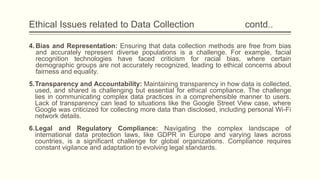
4. Bias and Representation: Ensuring that data collection methods are free from bias
and accurately represent diverse populations is a challenge. For example, facial
recognition technologies have faced criticism for racial bias, where certain
demographic groups are not accurately recognized, leading to ethical concerns about
fairness and equality.
5.Transparency and Accountability: Maintaining transparency in how data is collected,
used, and shared is challenging but essential for ethical compliance. The challenge
lies in communicating complex data practices in a comprehensible manner to users.
Lack of transparency can lead to situations like the Google Street View case, where
Google was criticized for collecting more data than disclosed, including personal Wi-Fi
network details.
6.Legal and Regulatory Compliance: Navigating the complex landscape of
international data protection laws, like GDPR in Europe and varying laws across
countries, is a significant challenge for global organizations. Compliance requires
constant vigilance and adaptation to evolving legal standards.
Ethical Issues related to Data Collection contd..
7. Respect for Intellectual Property: Data collection practices should respect intellectual
property rights, including copyright. Unauthorized collection or use of copyrighted
materials without proper licensing or permission can infringe upon creators' rights and
devalue their work.
8. Acknowledgment: When collecting data that includes copyrighted materials, proper
attribution and acknowledgment of the original creators or rights holders should be
provided. Failing to give credit to the appropriate sources can be considered unethical
and disrespectful.
7 Principles of Data Ethics
1.Transparency: This principle emphasizes the importance of being open and clear
about how and why data is collected, used, and shared. It involves communicating the
purposes of data processing in an understandable manner to the individuals
concerned.
2.Accountability: Organizations must be accountable for the data they collect and use.
This includes taking responsibility for managing data ethically and being answerable
for any misuse or harm that results from data practices.
3.Integrity: Data should be collected and processed honestly and ethically, avoiding
deceptive practices. This principle includes ensuring the authenticity and accuracy of
the data.
4.Protection of Privacy: The privacy of individuals whose data is collected should be
respected and protected. This involves implementing measures to protect personal
data from unauthorized access and ensuring that data collection is as unintrusive as
possible.
7 Principles of Data Ethics contd..
5. Respect for User Rights: This principle involves recognizing and upholding the rights
of data subjects, such as the right to access, correct, and delete their data, and the
right to consent to or opt out of data collection.
6.Fairness: Data practices should be fair and non-discriminatory. This includes ensuring
that data collection and processing do not perpetuate biases or inequalities and that
decisions based on data are just and equitable.
7.Beneficence: The principle of beneficence is about ensuring that data practices
contribute positively to society, doing good wherever possible and minimizing harm.
This involves considering the broader impacts of data use on communities and society.
THANK YOU 

ETHICAL ISSUES RELATED TO DATA COLLECTION.pptx

  • 1.
    ETHICAL ISSUES RELATED TODATA COLLECTION GUNJAN ME. CSE(2nd semester) 23-305
  • 2.
    CONTENTS  Data Ethics 3 Important Ethics in Data Collection  Ethical considerations in Data Collection  Ethical Issues related to Data Collection  7 Principles of Data Ethics
  • 3.
    Data Ethics  Ethical'refers to the understanding of the principles of morality.  Data ethics, in the context of data collection and analysis, encompasses a set of values and moral principles guiding how data is collected, shared, and used.  It involves considering the rights and privacy of individuals whose data is being collected and ensuring transparency and fairness in data handling processes.  This field intersects with legal compliance, such as adhering to data protection regulations like GDPR (General Data Protection Regulation), but it extends beyond mere legal obligations, delving into the realm of moral responsibility.
  • 4.
    Types of DataCollection  Qualitative data collection gathers descriptive or quality-related information, such as people's feelings or opinions on a particular topic. Qualitative data is less concerned with statistics or numbers and focuses more on people's experiences, judgments, feelings, and understandings.  Observations  Interviews  Quantitative data collection refers to gathering quantifiable or countable information. Quantitative data is heavily influenced by numbers and statistics and often relates to things that follow patterns, trends, or correlations.  Polls  Surveys
  • 5.
    3 Important Ethicsin Data Collection Source- https://www.promptcloud.com/blog/importance-of-ethical-data-collection/
  • 6.
    Ethical Considerations inData Collection Source- https://www.promptcloud.com/blog/importance-of-ethical-data-collection/
  • 7.
    Ethical Considerations inData Collection contd.. 1.Privacy Protection: With the increasing ability to collect detailed personal information, respecting individual privacy is paramount. Ethical data collection involves obtaining consent, ensuring anonymity where necessary, and being transparent about how data is used. 2.Avoiding Data Misuse: Ethical practices help prevent the misuse of data, such as using it for discriminatory, exploitative, or manipulative purposes. This is especially crucial when dealing with sensitive data that could potentially harm individuals if misused. 3.Building Trust: Ethical data practices build trust between data collectors and subjects. When individuals know their data is being handled responsibly, they are more likely to share it, leading to better quality data and more reliable analysis. 4.Ensuring Fairness: Data ethics involves ensuring that data collection and analysis do not contribute to inequality or injustice. This includes being mindful of biases in data collection and algorithmic decision-making processes. 5.Social Responsibility: Ethical data practices reflect a broader sense of social responsibility, acknowledging the impact that data collection and analysis can have on society at large. It’s about using data not just legally, but also in ways that contribute positively to societal well-being.
  • 8.
    Ethical Issues relatedto Data Collection Source- https://www.promptcloud.com/blog/importance-of-ethical-data-collection/
  • 9.
    Ethical Issues relatedto Data Collection contd.. 1.Privacy Concerns: With the capacity to collect vast amounts of personal information, protecting individual privacy becomes a significant challenge. Organizations must navigate the fine line between collecting necessary data and intruding into personal lives. For instance, location tracking features in apps can provide valuable insights for services but can also lead to concerns about surveillance and personal space intrusion. 2.Consent: Obtaining informed consent is a foundational ethical principle, but it’s often difficult to implement effectively. Many users agree to terms and conditions without fully understanding them, raising questions about the validity of their consent. A real-world example is the Cambridge Analytica scandal, where data was harvested from millions of Facebook users without explicit consent, leading to a massive breach of trust and privacy. 3.Data Security: Ensuring the security of collected data against breaches is another major challenge. High-profile data breaches, such as the Equifax incident where sensitive information of over 140 million people was exposed, highlight the risks involved in handling large datasets. Such breaches not only compromise individual privacy but also erode public trust in data handling practices.
  • 10.
    Ethical Issues relatedto Data Collection contd.. 4. Bias and Representation: Ensuring that data collection methods are free from bias and accurately represent diverse populations is a challenge. For example, facial recognition technologies have faced criticism for racial bias, where certain demographic groups are not accurately recognized, leading to ethical concerns about fairness and equality. 5.Transparency and Accountability: Maintaining transparency in how data is collected, used, and shared is challenging but essential for ethical compliance. The challenge lies in communicating complex data practices in a comprehensible manner to users. Lack of transparency can lead to situations like the Google Street View case, where Google was criticized for collecting more data than disclosed, including personal Wi-Fi network details. 6.Legal and Regulatory Compliance: Navigating the complex landscape of international data protection laws, like GDPR in Europe and varying laws across countries, is a significant challenge for global organizations. Compliance requires constant vigilance and adaptation to evolving legal standards.
  • 11.
    Ethical Issues relatedto Data Collection contd.. 7. Respect for Intellectual Property: Data collection practices should respect intellectual property rights, including copyright. Unauthorized collection or use of copyrighted materials without proper licensing or permission can infringe upon creators' rights and devalue their work. 8. Acknowledgment: When collecting data that includes copyrighted materials, proper attribution and acknowledgment of the original creators or rights holders should be provided. Failing to give credit to the appropriate sources can be considered unethical and disrespectful.
  • 12.
    7 Principles ofData Ethics 1.Transparency: This principle emphasizes the importance of being open and clear about how and why data is collected, used, and shared. It involves communicating the purposes of data processing in an understandable manner to the individuals concerned. 2.Accountability: Organizations must be accountable for the data they collect and use. This includes taking responsibility for managing data ethically and being answerable for any misuse or harm that results from data practices. 3.Integrity: Data should be collected and processed honestly and ethically, avoiding deceptive practices. This principle includes ensuring the authenticity and accuracy of the data. 4.Protection of Privacy: The privacy of individuals whose data is collected should be respected and protected. This involves implementing measures to protect personal data from unauthorized access and ensuring that data collection is as unintrusive as possible.
  • 13.
    7 Principles ofData Ethics contd.. 5. Respect for User Rights: This principle involves recognizing and upholding the rights of data subjects, such as the right to access, correct, and delete their data, and the right to consent to or opt out of data collection. 6.Fairness: Data practices should be fair and non-discriminatory. This includes ensuring that data collection and processing do not perpetuate biases or inequalities and that decisions based on data are just and equitable. 7.Beneficence: The principle of beneficence is about ensuring that data practices contribute positively to society, doing good wherever possible and minimizing harm. This involves considering the broader impacts of data use on communities and society.
  • 14.

Editor's Notes

  • #2 NOTE: To change the image on this slide, select the picture and delete it. Then click the Pictures icon in the placeholder to insert your own image.