Introduction to Wireless
Sensor Networks
Presented by
Sushanth Sivaram Vallath
The most profound technologies are those that
disappear. They weave themselves into the
fabric of everyday life until they are
indistinguishable from it.
- The late Mark Weiser, Father of Ubiquitous Computing and Chief
Technologist of Xerox PARC
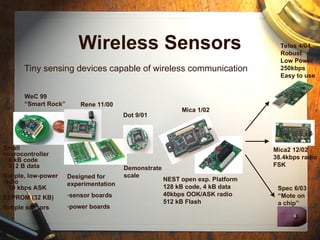
Wireless Sensors
Small
microcontroller
8 kB code
512 B data
Simple, low-power
radio
10 kbps ASK
EEPROM (32 KB)
Simple sensors
WeC 99
“Smart Rock”
Mica 1/02
NEST open exp. Platform
128 kB code, 4 kB data
40kbps OOK/ASK radio
512 kB Flash
Rene 11/00
Designed for
experimentation
-sensor boards
-power boards
Dot 9/01
Demonstrate
scale
Spec 6/03
“Mote on
a chip”
Telos 4/04
Robust
Low Power
250kbps
Easy to use
Mica2 12/02
38.4kbps radio
FSK
Tiny sensing devices capable of wireless communication
What are sensor
networks
spatially distributed sensors to monitor
conditions at different locations, such as
temperature, sound, vibration, pressure,
motion or pollutants.
Platforms
• Berkeley Motes
• Tiny OS
• nesC
• Ns-2
• TOSSIM
Applications of WSN
• Temperature
• Humidity
• Vehicular movement
• Pressure
• Noise levels
• Mechanical stress levels on attached objects
• Speed, direction
• Etc…
Factors Influencing Sensor
Network Design
• Fault tolerance
• Scalability
• Operating environment
• Sensor network topology
• Transmission media
• Power consumption
Sensors Representation
• Communication Graph
– Sensors are nodes
– Link between the sensors are the edges
Routing Protocols
• LEACH
• Directed Diffusion
• PEGASIS
• TEEN
• APTEEN
• Etc…
Sensor Issues
• Energy Constraint
• High Communication cost
• & Lot of other issues
Management Issues
• Conversion of data to Information
• Data access control
SQL
• Underlying routing protocol transparent
to user
• Some routing protocols are considered
to be aggregation protocols (implicit
aggregation)
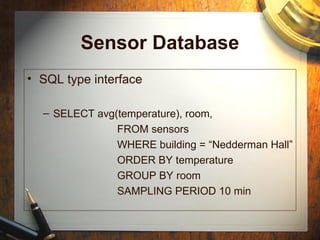
Sensor Database
• SQL type interface
– SELECT avg(temperature), room,
FROM sensors
WHERE building = “Nedderman Hall”
ORDER BY temperature
GROUP BY room
SAMPLING PERIOD 10 min
SQL type interfaces
• Cougar
• TinyDB
Approximations
Query Propagation
Data Centric Storage
Aging Data
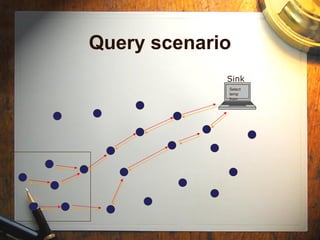
Query scenario
Sink
Select
temp
from
Efficiency achieved
through
In-network aggregation
Different types of queries
• Fully aggregated queries
• Un-aggregated queries
• Partially aggregated queries
Fully aggregated queries
Theorem: Finding maximum lifetime
routing tree for fully aggregated queries
with reception costs is NP-complete.
Similar to Minimum Degree Spanning
Tree(MDST) which is known to be NP-
complete
Un-aggregated queries
Theorem: Finding maximum lifetime
routing tree for unaggregated queries is
NP-complete.
Reduced from decision problem for SET-
COVER.
Partially aggregated
queries
Can be reduced to unaggregated queries
Approximation algorithms used to solve
the unaggregated routing tree problem
can be adapted.
Active areas in WSN
• Routing
• Topology control
• Data management, aggregation and query
• MAC protocols
• Target tracking, resource discovery
• Monitoring and maintenance
• Sensor validation
• Power issues
• Coverage and Connectivity
Companies in Research
• Crossbow
• Intel
• IBM
• Microsoft
• PARC
• Fujitsu
• Lot more…
References
[1] Cedric Florens and Robert McEliece, “Packet Distribution Algorithms for Sensor Networks”, IEEE INFOCOM 2003.
[2] Samuel Madden, Robert Szewczyk, Michael J. Franklin and David Culler, “Supporting Aggregate Queries Over Ad-Hoc Wireless
Sensor Networks”,
[3] Sartaj Sahni and Xiaochun Xu, Algorithms for Wireless Sensor Networks.
[4] Jamal N. Al-Karaki Ahmed E. Kamal, Routing Techniques in Wireless Sensor Networks: A Survey.
[5] Bhaskar Krishnamachari, D Estrin, Stephen Wicker, Modeling Data-Centric Routing in Wireless Sensor Networks.
[6] S.S Iyengar, Richard R. Brooks, “Distributed Sensor Networks”, Chapman & Hall/CRC.
[7] Wendi Rabiner Heinzelman, Anantha Chandrakasan, and Hari Balakrishnan, “Energy-efficient communication protocol for wireless
microsensors networks,” in 33rd Annual Hawaii International conference on System Sciences.
[8] David Braginsky and Deborah Estrin, “Rumor routing algorithm for sensor networks,” in First ACM International Workshop on
Wireless Sensor Networks and Application.
[9] Y.Xu, J. Heidemann, and D. Estrin, “Geography-informed energy conservation for ad hoc routing,” in Proceedings of the Seventh
Annual ACM/IEEE International Conference on Mobile Computing and Networking, 2001.
[10] B. Chen, K. Jamieson, H. Balakrishnan, and R. Morris, “SPAN: An energy-efficient coordination algorithm for topology maintenance
in ad-hoc wireless networks,” ACM Wireless Networks Journal, September 2002.
[11] Feng Zhao and Leonidas Guibas, “Wireless Sensor Networks, an Information Processing Approach”.
[12] Yong Yao, J. E. Gehrke. The Cougar Approach to In-Network Query Processing in Sensor Networks. Sigmod Record, Volume 31,
Number 3. September 2002.
[13] Yong Yao, J. E. Gehrke. Query Processing in Sensor Networks. In Proceedings of the First Biennial Conference on Innovative Data
Systems Research (CIDR 2003). Asilomar, California, January 2003.
[14] Xiuli Ma, Dongqing Yang, Shiwei Tang, Qiong Luo, Dehui Zhang, and Shuangfeng Li. Online Mining in Sensor Networks. NPC
2004: 544-550
[15] Chiranjeeb Buragohain, Divyakant Agrawal, and Subhash Suri, Power Aware Routing for Sensor Databases.
Thank You

Introduction to Wire less Sensor Networks.ppt

  • 1.
    Introduction to Wireless SensorNetworks Presented by Sushanth Sivaram Vallath
  • 2.
    The most profoundtechnologies are those that disappear. They weave themselves into the fabric of everyday life until they are indistinguishable from it. - The late Mark Weiser, Father of Ubiquitous Computing and Chief Technologist of Xerox PARC
  • 3.
    Wireless Sensors Small microcontroller 8 kBcode 512 B data Simple, low-power radio 10 kbps ASK EEPROM (32 KB) Simple sensors WeC 99 “Smart Rock” Mica 1/02 NEST open exp. Platform 128 kB code, 4 kB data 40kbps OOK/ASK radio 512 kB Flash Rene 11/00 Designed for experimentation -sensor boards -power boards Dot 9/01 Demonstrate scale Spec 6/03 “Mote on a chip” Telos 4/04 Robust Low Power 250kbps Easy to use Mica2 12/02 38.4kbps radio FSK Tiny sensing devices capable of wireless communication
  • 4.
    What are sensor networks spatiallydistributed sensors to monitor conditions at different locations, such as temperature, sound, vibration, pressure, motion or pollutants.
  • 5.
    Platforms • Berkeley Motes •Tiny OS • nesC • Ns-2 • TOSSIM
  • 6.
    Applications of WSN •Temperature • Humidity • Vehicular movement • Pressure • Noise levels • Mechanical stress levels on attached objects • Speed, direction • Etc…
  • 7.
    Factors Influencing Sensor NetworkDesign • Fault tolerance • Scalability • Operating environment • Sensor network topology • Transmission media • Power consumption
  • 8.
    Sensors Representation • CommunicationGraph – Sensors are nodes – Link between the sensors are the edges
  • 9.
    Routing Protocols • LEACH •Directed Diffusion • PEGASIS • TEEN • APTEEN • Etc…
  • 10.
    Sensor Issues • EnergyConstraint • High Communication cost • & Lot of other issues
  • 11.
    Management Issues • Conversionof data to Information • Data access control
  • 12.
    SQL • Underlying routingprotocol transparent to user • Some routing protocols are considered to be aggregation protocols (implicit aggregation)
  • 13.
    Sensor Database • SQLtype interface – SELECT avg(temperature), room, FROM sensors WHERE building = “Nedderman Hall” ORDER BY temperature GROUP BY room SAMPLING PERIOD 10 min
  • 14.
    SQL type interfaces •Cougar • TinyDB Approximations Query Propagation Data Centric Storage Aging Data
  • 15.
  • 16.
  • 17.
    Different types ofqueries • Fully aggregated queries • Un-aggregated queries • Partially aggregated queries
  • 18.
    Fully aggregated queries Theorem:Finding maximum lifetime routing tree for fully aggregated queries with reception costs is NP-complete. Similar to Minimum Degree Spanning Tree(MDST) which is known to be NP- complete
  • 19.
    Un-aggregated queries Theorem: Findingmaximum lifetime routing tree for unaggregated queries is NP-complete. Reduced from decision problem for SET- COVER.
  • 20.
    Partially aggregated queries Can bereduced to unaggregated queries Approximation algorithms used to solve the unaggregated routing tree problem can be adapted.
  • 21.
    Active areas inWSN • Routing • Topology control • Data management, aggregation and query • MAC protocols • Target tracking, resource discovery • Monitoring and maintenance • Sensor validation • Power issues • Coverage and Connectivity
  • 22.
    Companies in Research •Crossbow • Intel • IBM • Microsoft • PARC • Fujitsu • Lot more…
  • 23.
    References [1] Cedric Florensand Robert McEliece, “Packet Distribution Algorithms for Sensor Networks”, IEEE INFOCOM 2003. [2] Samuel Madden, Robert Szewczyk, Michael J. Franklin and David Culler, “Supporting Aggregate Queries Over Ad-Hoc Wireless Sensor Networks”, [3] Sartaj Sahni and Xiaochun Xu, Algorithms for Wireless Sensor Networks. [4] Jamal N. Al-Karaki Ahmed E. Kamal, Routing Techniques in Wireless Sensor Networks: A Survey. [5] Bhaskar Krishnamachari, D Estrin, Stephen Wicker, Modeling Data-Centric Routing in Wireless Sensor Networks. [6] S.S Iyengar, Richard R. Brooks, “Distributed Sensor Networks”, Chapman & Hall/CRC. [7] Wendi Rabiner Heinzelman, Anantha Chandrakasan, and Hari Balakrishnan, “Energy-efficient communication protocol for wireless microsensors networks,” in 33rd Annual Hawaii International conference on System Sciences. [8] David Braginsky and Deborah Estrin, “Rumor routing algorithm for sensor networks,” in First ACM International Workshop on Wireless Sensor Networks and Application. [9] Y.Xu, J. Heidemann, and D. Estrin, “Geography-informed energy conservation for ad hoc routing,” in Proceedings of the Seventh Annual ACM/IEEE International Conference on Mobile Computing and Networking, 2001. [10] B. Chen, K. Jamieson, H. Balakrishnan, and R. Morris, “SPAN: An energy-efficient coordination algorithm for topology maintenance in ad-hoc wireless networks,” ACM Wireless Networks Journal, September 2002. [11] Feng Zhao and Leonidas Guibas, “Wireless Sensor Networks, an Information Processing Approach”. [12] Yong Yao, J. E. Gehrke. The Cougar Approach to In-Network Query Processing in Sensor Networks. Sigmod Record, Volume 31, Number 3. September 2002. [13] Yong Yao, J. E. Gehrke. Query Processing in Sensor Networks. In Proceedings of the First Biennial Conference on Innovative Data Systems Research (CIDR 2003). Asilomar, California, January 2003. [14] Xiuli Ma, Dongqing Yang, Shiwei Tang, Qiong Luo, Dehui Zhang, and Shuangfeng Li. Online Mining in Sensor Networks. NPC 2004: 544-550 [15] Chiranjeeb Buragohain, Divyakant Agrawal, and Subhash Suri, Power Aware Routing for Sensor Databases.
  • 24.

Editor's Notes

  • #3 Before we jump in to the technical material, I would like to give you one more bit of context.