Aggregation In Wireless Sensor Network.Under the guidance of Dr. N. Marchang.ByH. SaratchandraMT/11/CSE/04
I. Introduction sensor networks composed of small and cost effective sensing devices equipped with wireless radio transceiver for environment monitoring.
Advantages does not require  infrastructure such aselectric mains for power supply   wired lines for Internet connections to   collect data.    human interaction while deploying.     These sensor nodes can monitor the environment.
Aggregation The intelligent way to combine and compress the data belonging to a single cluster is known as data aggregation in cluster based environment.Clusteringprocess of grouping the sensor nodes in a densely deployed large-scale sensor network
Goal of aggregationThe main goal of these algorithms is to gather and aggregate data in an energy efficient manner network lifetime is enhanced. WSN offer an increasingly attractive method of data gathering in distributed system architectures and dynamic access via wireless connectivity.
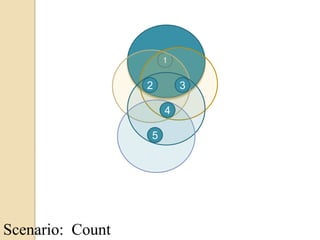
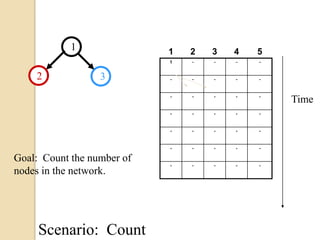
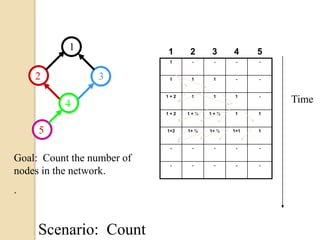
12345Scenario:  Count
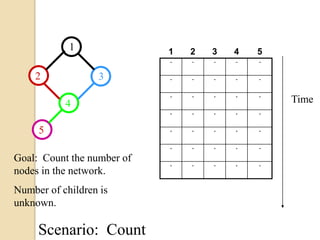
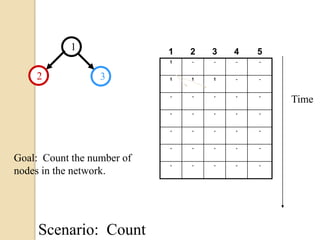
12345TimeGoal:  Count the number of nodes in the network.Number of children is unknown.Scenario:  Count
123TimeGoal:  Count the number of nodes in the network.Scenario:  Count
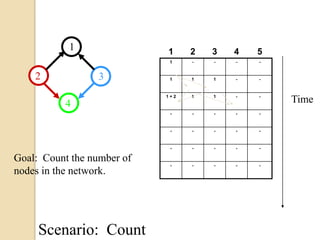
1234TimeGoal:  Count the number of nodes in the network.Scenario:  Count
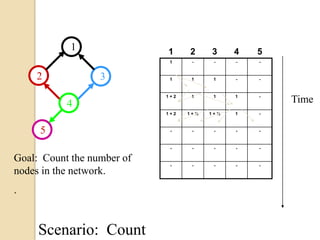
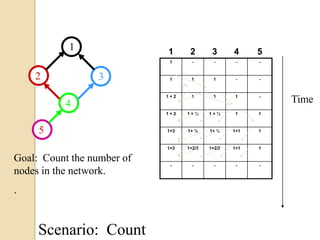
12345TimeGoal:  Count the number of nodes in the network..Scenario:  Count
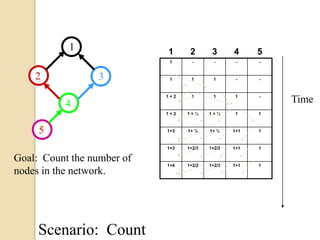
12345TimeGoal:  Count the number of nodes in the network.Scenario:  Count
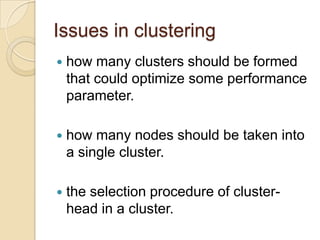
Issues in clusteringhow many clusters should be formed that could optimize some performance parameter.how many nodes should be taken into a single cluster.the selection procedure of cluster-head in a cluster.
II. Problem DefinitionAims of aggregation protocols. eliminating redundant data transmission.improve the lifetime of energy constrained wireless sensor network.
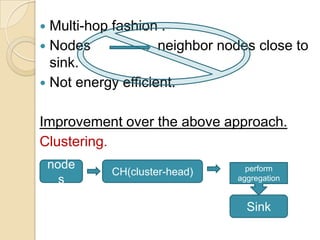
Multi-hop fashion .Nodes                 neighbor nodes close to sink.Not energy efficient.Improvement over the above approach.Clustering.nodesCH(cluster-head)perform aggregationSink
Cont. Performing aggregation function over CH still causes significant energy wastage.homogeneous sensor network CH will soon die out and again re-clustering has to be done which again cause energy consumption.
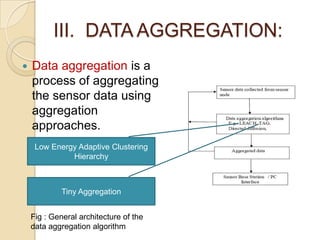
III.  DATA AGGREGATION:Data aggregation is a process of aggregating the sensor data using aggregation approaches.Low Energy Adaptive Clustering HierarchyTiny AggregationFig : General architecture of the data aggregation algorithm
There are many types of aggregation techniquesCentralized Approach
In-Network Aggregation
Tree-Based Approach
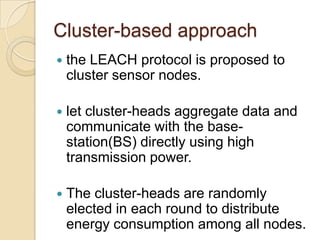
Cluster-Based ApproachCluster-based approachthe LEACH protocol is proposed to cluster sensor nodes.let cluster-heads aggregate data and communicate with the base-station(BS) directly using high transmission power.The cluster-heads are randomly elected in each round to distribute energy consumption among all nodes.
uses the base-station to broadcast CH assignment to further spreading out the CHs throughout the network.refines the cluster-head election algorithm that does not require the participation of the base-station and scatters CHs more evenly across the network.
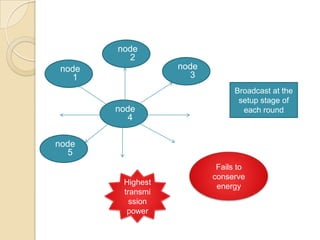
node2node3node1Broadcast at the setup stage of each roundnode4node5Fails to conserve energyHighest transmission power
LEACH based protocol assumes that BS can be reach by any Node in one hop.Limit the size of Network.DisadvantagesData cannot be aggregated properly.CH has to send many packets to the BS using high transmission power.
IV.  QUERY PROCESSING Query Models.Query Language in TinyDB. Queries and Aggregates .
1.Query Models.COUGAR approach proposes a query layer to support aggregate queries.the clients can issue queries without knowing how the results are generated, processed and returned by the sensor network to them.TAG also proposes a query model for supporting aggregate queries.
2. Query Language in TinyDBbased on SQL               TinySQLSupports:-selection projectiondetermining sampling rate group aggregationuser defined aggregationevent triggerlifetime query setting storing point and simple join
 3. Queries and Aggregates Simple queries.Complex queries.Event Driven queries.
1. Simple queries These are non aggregate queries.   E.g. "SELECT temperature FROM sensor WHERE node = z".     These are generally mapped into broadcast or point to point queries.
2. Complex queriesThey may contain sub queries.  E.g. "SELECT temperature FROM sensor WHERE room = (SELECT room WHERE floor = ’3’)"
3. Event Driven Queriescontinuous query that returns the values periodically at specified time intervals.Eg:   “SELECT AVG (temperature) FROM sensor where node = z“
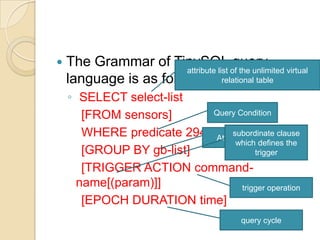
The Grammar of TinySQL query language is as follows:  SELECT select-list     [FROM sensors]     WHERE predicate 294    [GROUP BY gb-list]     [TRIGGER ACTION command-name[(param)]]     [EPOCH DURATION time] attribute list of the unlimited virtual relational tableQuery Conditionsubordinate clause which defines the triggerAttribute listtrigger operationquery cycle
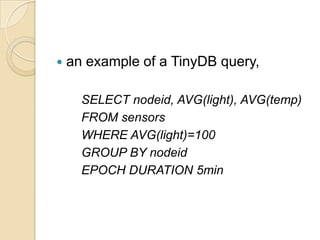
an example of a TinyDB query,SELECT nodeid, AVG(light), AVG(temp)     FROM sensors        WHERE AVG(light)=100     GROUP BY nodeid    EPOCH DURATION 5min
V.  SIMULATIONSimulation Tools:TOSSIM, NS-2, OPNET, OMNet++, J-Sim,GlomoSim, andQualnet
TOSSIMdiscrete event simulator for TinyOS sensor networks. Instead of compiling a TinyOS application for a mote, users can compile it into the TOSSIM framework, which runs on a PC. allows users to debug, test, and analyze algorithms in a controlled and repeatable environment.
VI.  CONCLUSIONThe two most important parts of data communication in sensor networks- query processing, data aggregation.communication in sensor networks is different from other wireless networks.It is an energy constrained network. The process of data aggregation becomes an important issue and optimization is needed. Efficient data aggregations not only provide energy conservation but also remove redundancy data and hence provide useful data only.
Thank you

Presentation on sensor network

  • 1.
    Aggregation In WirelessSensor Network.Under the guidance of Dr. N. Marchang.ByH. SaratchandraMT/11/CSE/04
  • 2.
    I. Introduction sensornetworks composed of small and cost effective sensing devices equipped with wireless radio transceiver for environment monitoring.
  • 3.
    Advantages does notrequire infrastructure such aselectric mains for power supply wired lines for Internet connections to collect data. human interaction while deploying. These sensor nodes can monitor the environment.
  • 4.
    Aggregation The intelligentway to combine and compress the data belonging to a single cluster is known as data aggregation in cluster based environment.Clusteringprocess of grouping the sensor nodes in a densely deployed large-scale sensor network
  • 5.
    Goal of aggregationThemain goal of these algorithms is to gather and aggregate data in an energy efficient manner network lifetime is enhanced. WSN offer an increasingly attractive method of data gathering in distributed system architectures and dynamic access via wireless connectivity.
  • 6.
  • 7.
    12345TimeGoal: Countthe number of nodes in the network.Number of children is unknown.Scenario: Count
  • 8.
    123TimeGoal: Countthe number of nodes in the network.Scenario: Count
  • 9.
    123TimeGoal: Countthe number of nodes in the network.Scenario: Count
  • 10.
    1234TimeGoal: Countthe number of nodes in the network.Scenario: Count
  • 11.
    12345TimeGoal: Countthe number of nodes in the network..Scenario: Count
  • 12.
    12345TimeGoal: Countthe number of nodes in the network..Scenario: Count
  • 13.
    12345TimeGoal: Countthe number of nodes in the network..Scenario: Count
  • 14.
    12345TimeGoal: Countthe number of nodes in the network.Scenario: Count
  • 15.
    Issues in clusteringhowmany clusters should be formed that could optimize some performance parameter.how many nodes should be taken into a single cluster.the selection procedure of cluster-head in a cluster.
  • 16.
    II. Problem DefinitionAimsof aggregation protocols. eliminating redundant data transmission.improve the lifetime of energy constrained wireless sensor network.
  • 17.
    Multi-hop fashion .Nodes neighbor nodes close to sink.Not energy efficient.Improvement over the above approach.Clustering.nodesCH(cluster-head)perform aggregationSink
  • 18.
    Cont. Performing aggregationfunction over CH still causes significant energy wastage.homogeneous sensor network CH will soon die out and again re-clustering has to be done which again cause energy consumption.
  • 19.
    III. DATAAGGREGATION:Data aggregation is a process of aggregating the sensor data using aggregation approaches.Low Energy Adaptive Clustering HierarchyTiny AggregationFig : General architecture of the data aggregation algorithm
  • 20.
    There are manytypes of aggregation techniquesCentralized Approach
  • 21.
  • 22.
  • 23.
    Cluster-Based ApproachCluster-based approachtheLEACH protocol is proposed to cluster sensor nodes.let cluster-heads aggregate data and communicate with the base-station(BS) directly using high transmission power.The cluster-heads are randomly elected in each round to distribute energy consumption among all nodes.
  • 24.
    uses the base-stationto broadcast CH assignment to further spreading out the CHs throughout the network.refines the cluster-head election algorithm that does not require the participation of the base-station and scatters CHs more evenly across the network.
  • 25.
    node2node3node1Broadcast at thesetup stage of each roundnode4node5Fails to conserve energyHighest transmission power
  • 26.
    LEACH based protocolassumes that BS can be reach by any Node in one hop.Limit the size of Network.DisadvantagesData cannot be aggregated properly.CH has to send many packets to the BS using high transmission power.
  • 27.
    IV. QUERYPROCESSING Query Models.Query Language in TinyDB. Queries and Aggregates .
  • 28.
    1.Query Models.COUGAR approachproposes a query layer to support aggregate queries.the clients can issue queries without knowing how the results are generated, processed and returned by the sensor network to them.TAG also proposes a query model for supporting aggregate queries.
  • 29.
    2. Query Languagein TinyDBbased on SQL TinySQLSupports:-selection projectiondetermining sampling rate group aggregationuser defined aggregationevent triggerlifetime query setting storing point and simple join
  • 30.
    3. Queriesand Aggregates Simple queries.Complex queries.Event Driven queries.
  • 31.
    1. Simple queriesThese are non aggregate queries. E.g. "SELECT temperature FROM sensor WHERE node = z". These are generally mapped into broadcast or point to point queries.
  • 32.
    2. Complex queriesTheymay contain sub queries. E.g. "SELECT temperature FROM sensor WHERE room = (SELECT room WHERE floor = ’3’)"
  • 33.
    3. Event DrivenQueriescontinuous query that returns the values periodically at specified time intervals.Eg: “SELECT AVG (temperature) FROM sensor where node = z“
  • 34.
    The Grammar ofTinySQL query language is as follows: SELECT select-list [FROM sensors] WHERE predicate 294 [GROUP BY gb-list] [TRIGGER ACTION command-name[(param)]] [EPOCH DURATION time] attribute list of the unlimited virtual relational tableQuery Conditionsubordinate clause which defines the triggerAttribute listtrigger operationquery cycle
  • 35.
    an example ofa TinyDB query,SELECT nodeid, AVG(light), AVG(temp) FROM sensors WHERE AVG(light)=100 GROUP BY nodeid EPOCH DURATION 5min
  • 36.
    V. SIMULATIONSimulationTools:TOSSIM, NS-2, OPNET, OMNet++, J-Sim,GlomoSim, andQualnet
  • 37.
    TOSSIMdiscrete event simulatorfor TinyOS sensor networks. Instead of compiling a TinyOS application for a mote, users can compile it into the TOSSIM framework, which runs on a PC. allows users to debug, test, and analyze algorithms in a controlled and repeatable environment.
  • 38.
    VI. CONCLUSIONThetwo most important parts of data communication in sensor networks- query processing, data aggregation.communication in sensor networks is different from other wireless networks.It is an energy constrained network. The process of data aggregation becomes an important issue and optimization is needed. Efficient data aggregations not only provide energy conservation but also remove redundancy data and hence provide useful data only.
  • 39.